On 4 September 2026 a driver on the A3 near Limburg an der Lahn, heading towards Frankfurt, rang us with two damaged tyres on one rigid truck: a screw in the tread of one and a bulge in the sidewall of another. Our dispatch team sent a mobile crew, who fitted two new 245/70 R19.5 tyres at the roadside. From the first call to the moment the wheels turned again, 125 minutes passed, 60 of them spent working on site. The net bill came to 1,185 EUR, and no secondary damage had occurred.
This write-up walks through the whole job: what the driver saw, how we organised the truck tyre service, what the crew found when they got there, and what every line of the invoice paid for. If you run a fleet or drive for a living, you will find the numbers useful, because they show how long a proper truck tyre replacement on the autobahn really takes and what it costs when nobody cuts corners.
What happened on the A3 near Limburg
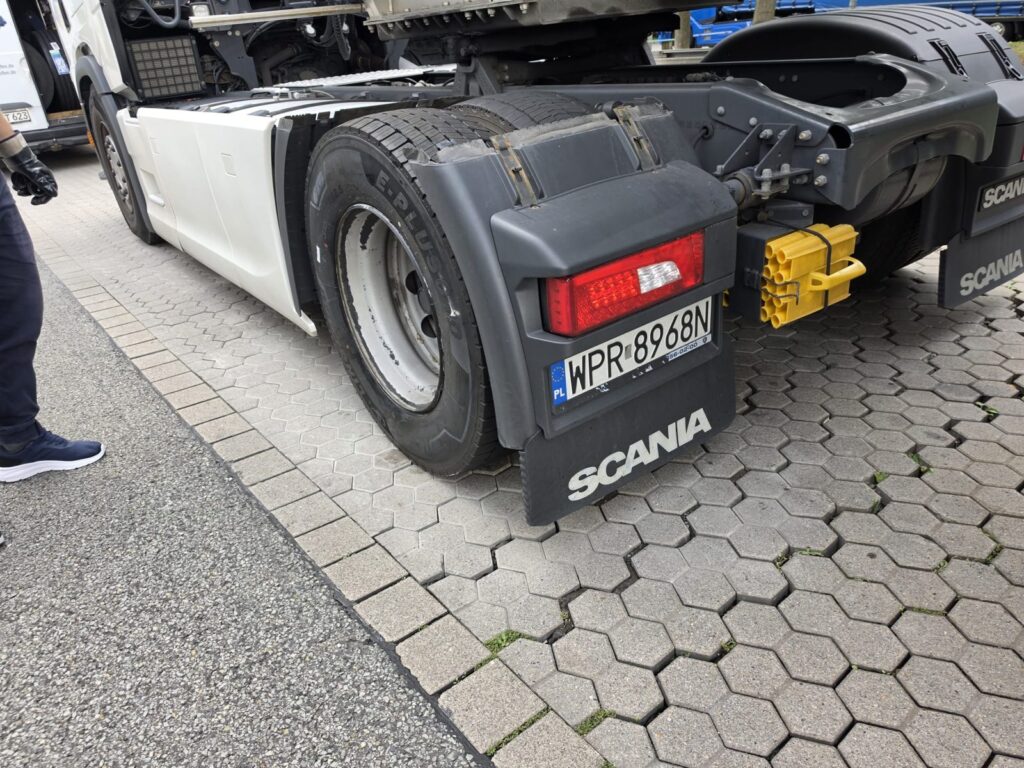
The truck was a rigid box lorry with a tarpaulin body, running on 245/70 R19.5 tyres, the standard size for a lot of medium-duty distribution vehicles in Germany. The driver was on his way to Frankfurt when he felt the steering turn vague and heard a soft hiss. He pulled onto the hard shoulder, switched on the hazard lights and walked around the vehicle. It was a dry, bright afternoon, which made everything easier for him and for us later.
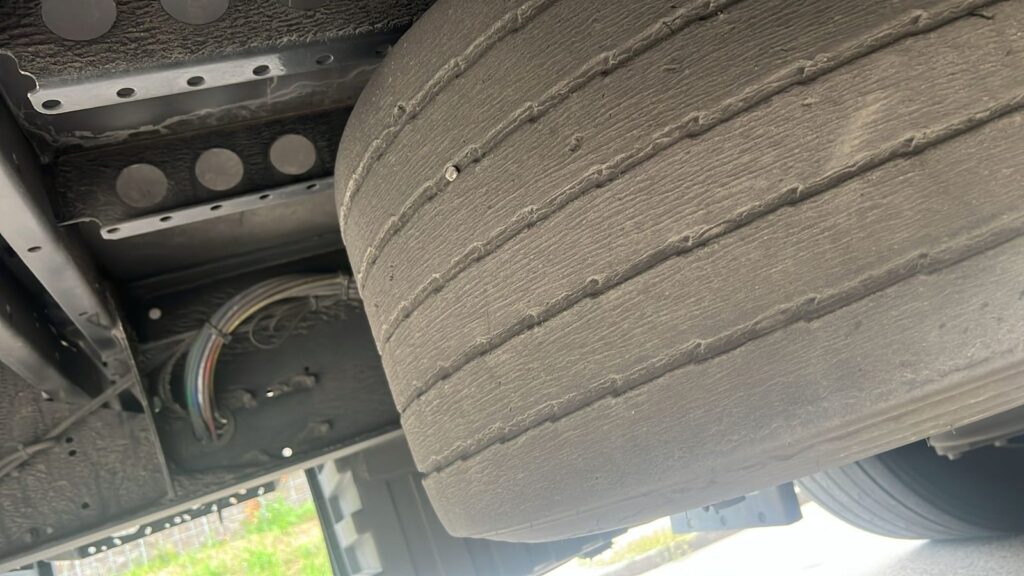
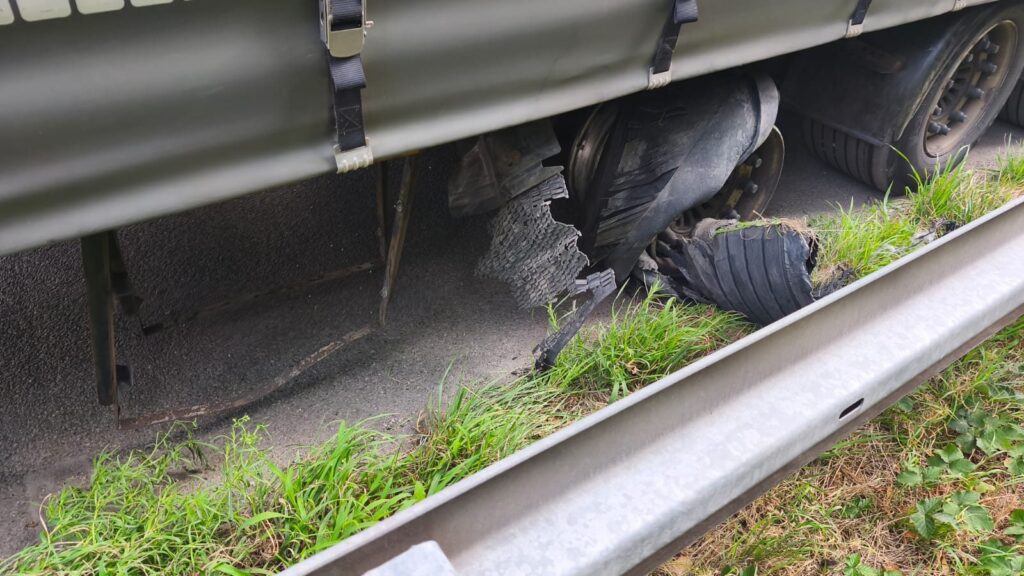
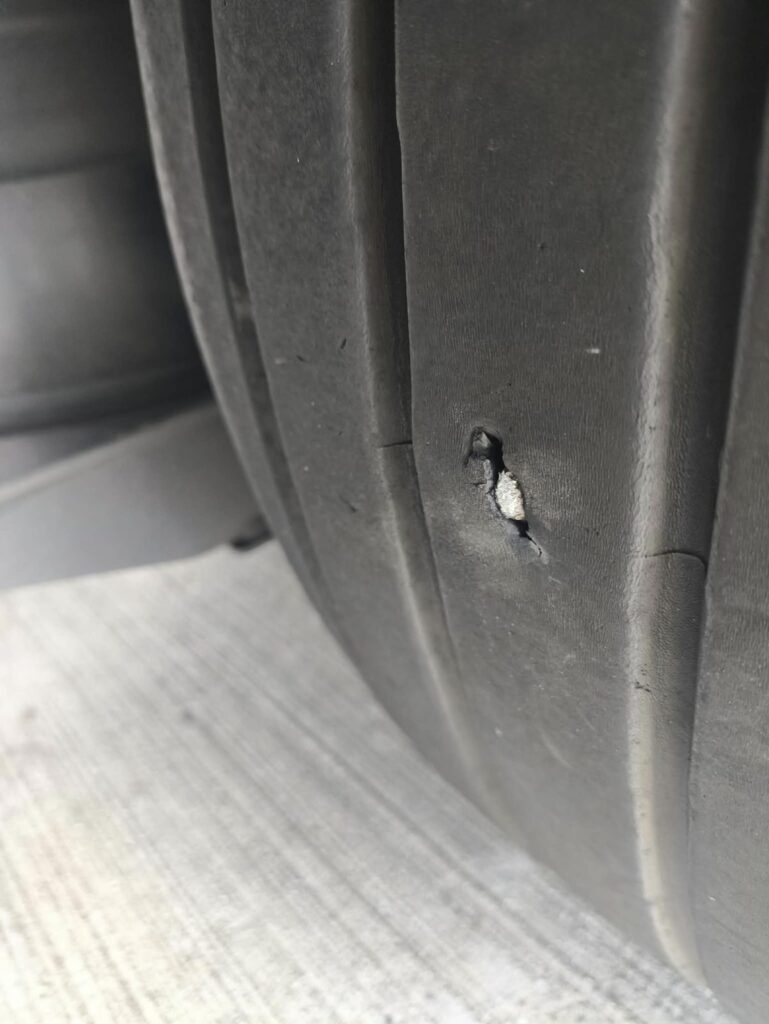
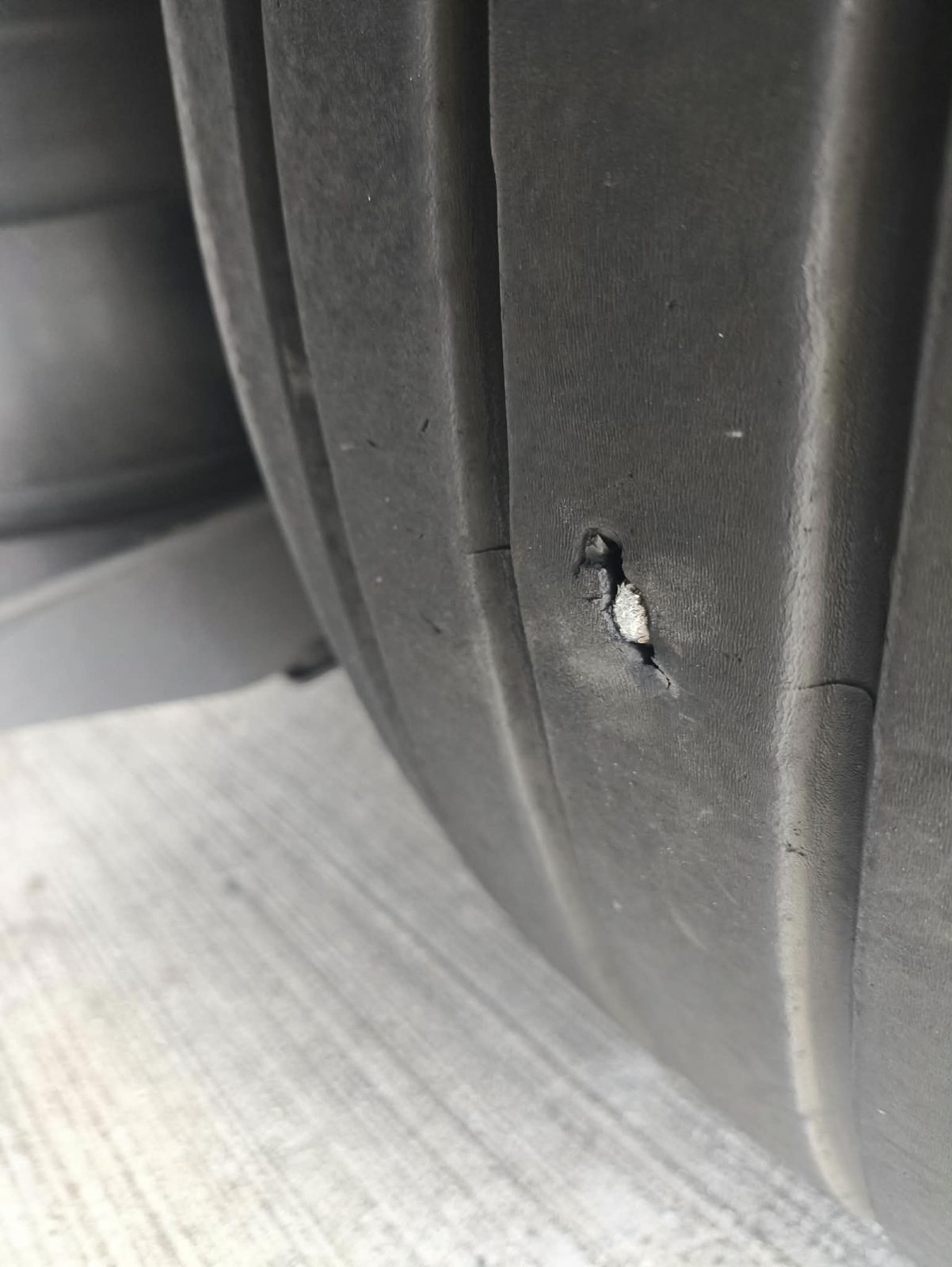
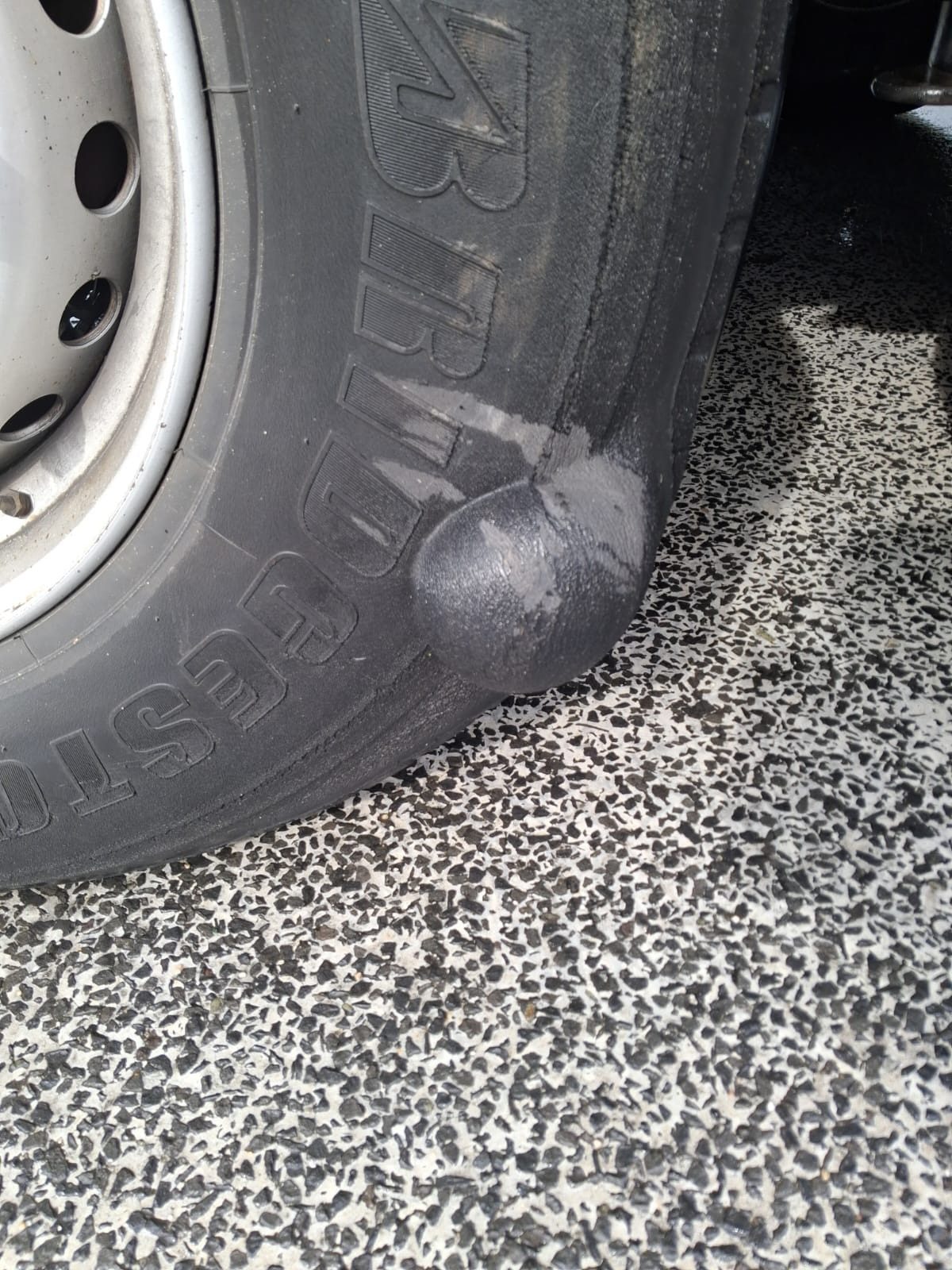
On the drive axle he found the first problem. A screw had gone straight through the tread and stayed there, a small metal head sitting in the groove with a crack in the rubber around it. The tyre was losing air slowly but steadily. On the second tyre, a Bridgestone on the other axle, he saw something that worried him more: a clear bulge in the sidewall, about the size of a fist.
He did the right thing. He did not try to limp to the next car park, and he did not keep rolling because “it was only a few kilometres”. He called our number at 14:30.
The two defects in plain language
A puncture in the tread is the damage most drivers know. A nail, a screw or a stone works its way through the rubber and the steel belts, and the air escapes. Depending on where the object sits, such a tyre can sometimes be repaired.
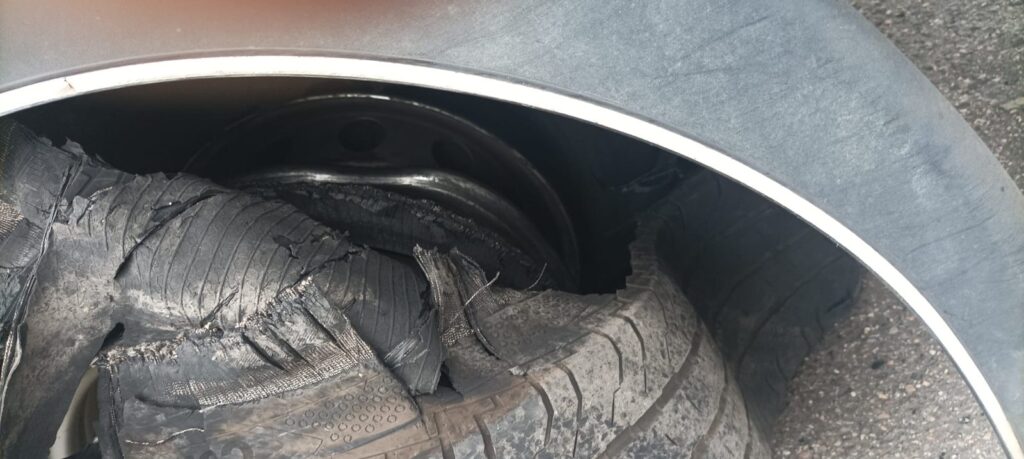
A bulge in the sidewall is a different matter. It means that the cords inside the casing (the Karkasse) have broken, and only a thin layer of rubber is holding the pressure. Nobody can repair that. The tyre can let go without any warning, and at 8.5 bar a failure of this kind is violent.
First call: what we asked the driver
The first minutes of any truck tyre roadside assistance call decide how fast the job goes. Our dispatcher asked five things:
- Where exactly are you, and in which direction are you heading?
- Are you on the hard shoulder or in a car park, and is the vehicle clear of the lane?
- What is the tyre size printed on the sidewall, and which axle is affected?
- Is the tyre flat, or is it losing air slowly?
- Is there visible damage anywhere else on the tyre or the rim?
The answers took less than two minutes. The driver gave the position on the A3 near Limburg, confirmed the size as 245/70 R19.5 and mentioned the bulge on the second tyre. That last detail changed the plan. A one-tyre job became a two-tyre job, and the crew needed to bring two matching tyres instead of one.
How we organised the help
Dispatch took 15 minutes, from 14:30 to 14:45. That is longer than a simple callout but it covered more than finding a van. Here is what happened in that time:
- The dispatcher confirmed the size and the load rating the vehicle needs, so the replacement tyres would carry the same load as the originals.
- He contacted the nearest service partner of our network with a crew on the road in the Limburg and Lahn valley area, and checked that they carried two tyres of the right size.
- He agreed the estimate with the driver by phone, line by line, before anybody drove off.
- He told the driver how to secure the spot while he waited: warning triangle at the correct distance, high-visibility vest on, and nobody standing between the truck and the traffic.
We do not rely on a single workshop. Our partner network covers the whole of Germany, and each crew works on a vehicle that is a small tyre workshop in itself, with a compressor, a mobile tyre changer, a balancer and a calibrated torque wrench. You can see what our mobile truck service covers on the service page.
Why the estimate comes before the trip
A driver on the hard shoulder is under pressure. His schedule is slipping, the customer is calling, and he wants to hear one thing: how long. If the price turns up only at the end, that adds a second shock to a bad afternoon. So we state the prices before the crew leaves. In this case the driver heard the total of 1,185 EUR net, plus VAT, and said yes.
Arrival and safety at the roadside
The crew arrived at 15:35, which is 65 minutes after the call. Of those, 15 went on dispatch and 50 on driving. For a Friday afternoon on the A3, a route with plenty of traffic around Limburg, that is a normal time. In heavy rain or during rush hour it would be longer, and we always say so honestly on the phone.
The first thing the technician did was not to touch a tyre. He checked the place. The truck stood on the hard shoulder, so he set up the warning triangle, put the amber beacon on the service van, parked the van behind the truck as a shield and made sure the wheel to be changed was on the side away from the traffic. Working next to a lane where lorries pass at 80 km/h is the most dangerous part of this profession, and the preparation takes five minutes at most. Our article on why the hard shoulder is the most dangerous place to work explains the reasoning in detail.
Inspection: what the technician found
The inspection ran from 15:41 and took only a few minutes, but it was thorough. He looked at both damaged tyres, at the wheel nuts, at the rim flanges and at the valves.
Tyre one, the screw in the tread. The screw sat in the main groove close to the shoulder of the tyre. When the technician removed it, the hole was clearly through the belt package. A repair is only an option in the central tread area and only if the steel cords are intact. Here, with the crack in the surrounding rubber and the position near the shoulder, a repair would not have been safe or legal.
Tyre two, the sidewall bulge. Here the decision was even simpler. A bulge means that the cords are broken. This Bridgestone could not stay on the vehicle for another kilometre.
The rims. Both steel rims were intact. No cracks, no bent flanges, no corrosion around the bead seat. The wheel nuts were tight and the studs undamaged. Good news, because a damaged rim adds cost and time.
So the decision was to replace both tyres, with no half measures. This happens often: a visible puncture draws attention, and a second defect hides on the other side of the axle.
Why a bulged sidewall cannot wait
A bulge in the sidewall is an emergency, and the reasons are mechanical. A truck tyre of this size runs at roughly 8.5 to 9.5 bar. The sidewall carries the load by means of cords, and when those cords break, the rubber alone must hold that pressure. It cannot, at least not for long. Heat, a kerb, a pothole or simply a long stretch of motorway can turn the bulge into a burst.
A burst at motorway speed does three things:
- It throws the truck off its line, especially on the steering axle.
- It sends heavy rubber fragments into the traffic behind.
- It can damage the wheel arch, the brake lines and the air hoses.
The cost of this chain is much higher than the cost of two tyres. According to Goodyear, regular checks of pressure and condition are the simplest way to prevent exactly this scenario, and our experience on the road agrees with that.
Our colleagues dealt with the same problem on another job: a livestock lorry tyre blowout on the A29, where a tyre had already let go.
Step by step: how the truck tyre change went
The crew worked in five clear steps. Nothing dramatic happened, and that is the point.
Step 1: Inspection and decision (15:41)
Visual and manual check of both tyres, rims and nuts. Pressure reading of the other tyres on the axle. The decision to replace both damaged tyres was taken within minutes and confirmed with the driver.
Step 2: Securing the vehicle
The truck was parked on level ground, with the parking brake on and wheel chocks under the wheels that stayed on the ground. The axle was lifted with a hydraulic jack rated for the load, then supported with an axle stand. A jack alone is never enough, because a jack can fail or slip.
Step 3: Removing the wheels
The technician loosened the ten wheel nuts with an impact wrench, removed the wheel and checked the studs and the hub. He then broke the bead and took the old tyre off the rim with the mobile tyre changer. The rim was cleaned of rust and old rubber residue, and a new valve was fitted. The same was done for the second wheel.
Step 4: Mounting the new tyres
Two new tyres in size 245/70 R19.5 were mounted on the rims. The crew lubricated the beads, seated them and inflated the tyres carefully inside a safety cage, which is standard practice. Then both wheels were balanced on the mobile balancer. An unbalanced wheel on a truck causes vibration, uneven wear and stress on the wheel bearings, so we do not skip it.
Step 5: Final check (16:30)
The wheels went back on the hubs. The nuts were first tightened by hand and then in a star pattern with a calibrated torque wrench, in two or three passes. The pressure was set to 8.5 bar, as required for the load. The crew then checked the valve caps, the lights and the tyres once more. If you want to see the required values for various vehicles, our wheel nut torque table lists them.
At 16:35 the truck pulled back onto the A3.
Full timeline of the job
Here is the minute-by-minute record of the callout. The times come from the dispatch log and the crew’s report.
| Time | Phase | Action |
|---|---|---|
| 14:30 | Call | The driver reports a screw puncture and a sidewall bulge on a second tyre, truck stopped on the hard shoulder, A3 near Limburg |
| 14:45 | Dispatch | Size confirmed, partner crew selected, estimate agreed (15 min) |
| 15:35 | Arrival | Mobile crew on site, 65 min after the call, location secured, warning triangle in place |
| 15:41 | Inspection | Screw puncture in the tread, bulge in the sidewall of the other tyre, decision to replace both |
| 16:12 | Removal and fitting | Wheels removed, two new 245/70 R19.5 tyres mounted, balanced |
| 16:30 | Final check | Pressure 8.5 bar, wheel nuts tightened in a star pattern with a torque wrench |
| 16:35 | Done | Truck back on the road, 125 minutes in total, 60 minutes of work on site |
The 60 minutes on site are the part customers often underestimate. Two tyres, two wheels, two balancing runs and a careful final check do not fit into a quarter of an hour. They fit into an hour when the crew is experienced and the equipment is good.
What the job cost: the full estimate
The price is where trust is won or lost, so here is every line. All amounts are net, zzgl. MwSt. (plus 19 % VAT).
| Item | Price (EUR) |
|---|---|
| Callout / Anfahrt | 240 |
| Tyre 245/70 R19.5, 2 pcs at 370 | 740 |
| Labour, 1.5 h at 110 | 165 |
| Disposal of 2 old tyres at 20 | 40 |
| TOTAL | 1,185 |
With VAT of 225.15 EUR the gross amount is 1,410.15 EUR.
What drives the price of a truck tyre callout
Several factors decide the final figure, and it helps to know them before you call:
- Distance and time of day. The callout fee depends on how far the crew drives. At night and on weekends we add 25 to 50 %, because crews work unsocial hours.
- Tyre size and brand. Prices for a 245/70 R19.5 run from about 320 to 420 EUR, depending on make and tread pattern. A 315/80 R22.5 costs more, and a van tyre such as a 235/65 R16C costs less.
- Number of tyres. The callout fee is paid once, so replacing two tyres on a single visit is cheaper than calling twice.
- Condition of the rim. A bent or cracked rim means more labour and sometimes a new rim.
- Special tools. A seized wheel nut or a stuck bead takes extra time.
Our article on the cost of a truck tyre change goes into the price structure in more detail.
The comparison that matters: standstill
A standing truck costs roughly 800 to 1,200 EUR per day in lost earnings, wages, fixed costs and missed delivery slots. Looked at this way, 1,185 EUR for a replacement that took two hours is cheap. The alternative would have been a tow to a workshop, a wait for tyres to be delivered and probably a night in a lay-by. A tow alone would have cost 850 EUR or more, depending on the distance, and the tyres would still have been needed. If a tow becomes necessary, our towing service can handle it.
Why you should leave truck tyre repairs to professionals
Some drivers try to change a wheel themselves. With a car that is manageable. With a truck it is a different story, and the risks pile up quickly:
- A truck wheel with a tyre weighs well over 60 kg, and a wrong lifting position can injure your back or crush a hand.
- A standard vehicle jack is not designed for a loaded truck, and it can slip.
- Inflating a truck tyre without a safety cage is dangerous, because the stored energy at 8.5 bar is high.
- Without a calibrated torque wrench, wheel nuts end up too loose or too tight. Loose nuts let wheels come off. Overtightened ones stretch the studs.
- Working on the hard shoulder puts you inches from passing traffic.
- A badly seated bead or a missed hidden defect leads to a second breakdown a few hours later.
On top of that, in Germany the condition of tyres is regulated. Section 36 of the StVZO sets minimum requirements for tyres on motor vehicles, including tread depth and general condition. A tyre with a bulged sidewall does not meet them.
Typical situations where we are called out
The case on the A3 is typical, but not the only kind of job we handle. In a normal month our crews attend:
- Punctures from screws, nails, stones and metal splinters on motorways and in industrial areas.
- Tyre bursts on the steering and drive axles of tractor units.
- Trailer tyre damage, including twin tyres where one of the pair has failed.
- Sidewall damage from kerbs, potholes and loading ramps.
- Valve failures and slow leaks that keep coming back.
- Seasonal wheel changes for distribution vehicles and fleets.
- Wheel nut problems and damaged studs after poorly done work elsewhere.
We also see mixed jobs. A tyre problem sometimes comes with a second issue, such as a damaged air hose or a loose wheel bearing. In those cases the crew can often fix the problem on the spot, and our guide to truck repair on the road shows what is possible without a workshop.
Prevention: how to avoid a roadside tyre emergency
Most roadside tyre jobs are avoidable. Based on what we see, these habits pay off:
- Check the pressure every week, cold, with a reliable gauge. A tyre running 1 bar below the correct figure overheats and wears faster.
- Walk around the vehicle before each trip. Look for bulges, cuts, embedded objects and uneven wear. A bulge like the one on the A3 is easy to spot if you look.
- Watch the tread depth. The legal minimum in Germany is 1.6 mm, and many fleets replace steering axle tyres at 3 mm or more.
- Match the tyres on twin axles. Different diameters on a pair put extra load on one tyre.
- Check the nuts after a wheel change. Re-torque after the first 50 to 100 km.
- Do not ignore slow leaks. A tyre that loses 0.3 bar a week has a reason.
- Mind the rims. Rust and dents on the bead seat lead to leaks and damage new tyres.
Fleet managers can go further. A short, documented tyre inspection every month, with pressure, depth and condition logged for each wheel position, is cheap and catches problems early. We describe a practical routine in our report on a fleet tyre inspection near Dortmund.
A closer look at truck tyres, brands and maintenance
Anyone who drives or manages trucks in Germany ends up choosing between the major manufacturers: Michelin, Continental, Goodyear and Bridgestone. All four produce good tyres, and each has a few specialities.
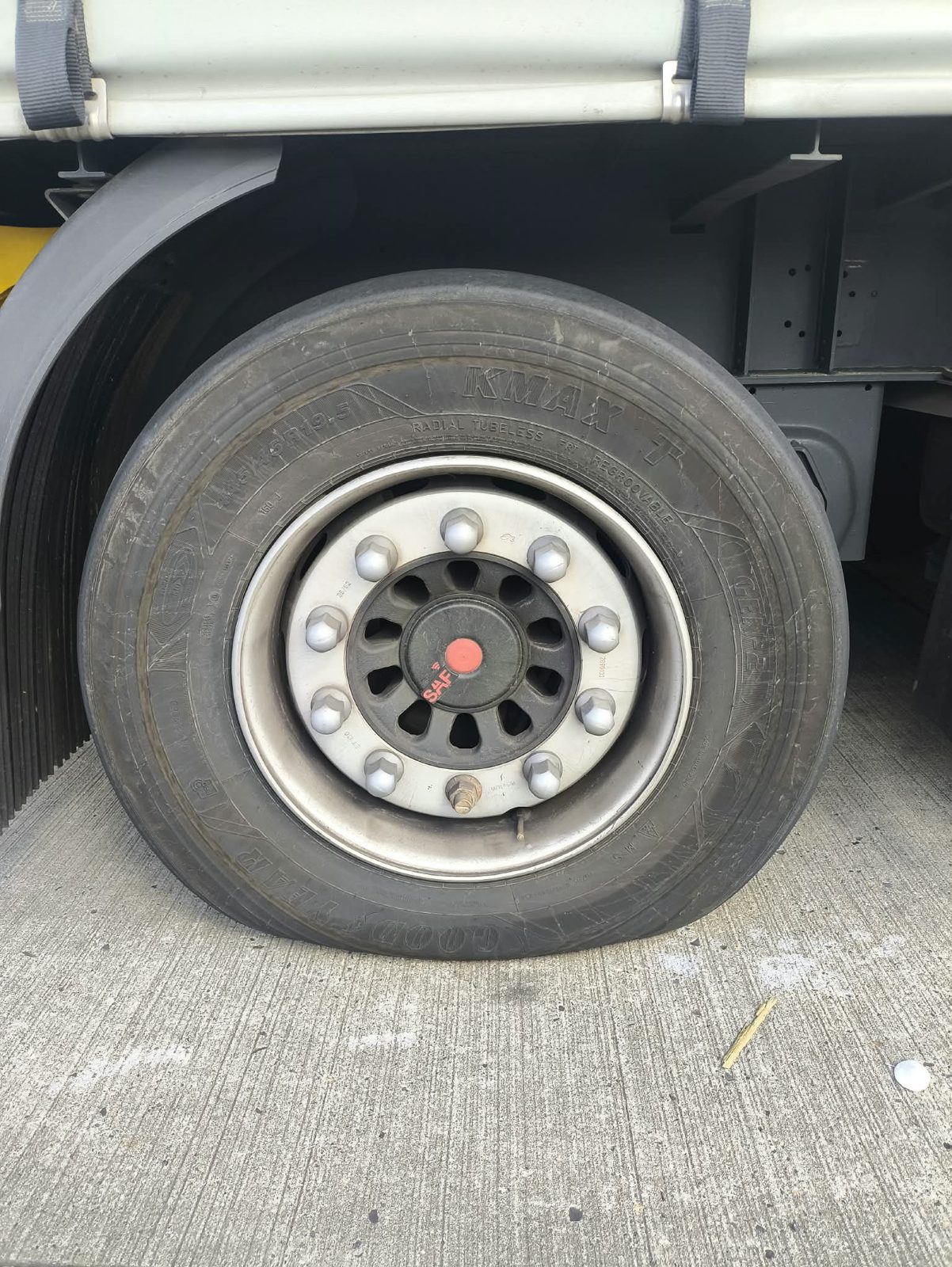
Regroovable tyre — a tyre with enough rubber under the tread pattern for a specialist to cut new grooves once the original ones wear down. The Goodyear KMAX T on the drive axle in this case is built this way, which can lower the cost per kilometre for a fleet.
Casing — the internal structure of cords and belts that carries the load. A good casing can be retreaded, which is why many fleets treat quality tyres as an asset rather than a consumable. When the casing is damaged, as with a sidewall bulge, retreading is impossible.
Load index — the number on the sidewall that tells you the maximum weight a tyre can carry. For a 245/70 R19.5 the typical value is 136/134, so always match it when you replace a tyre.
The size designation itself follows an international standard. The European Tyre and Rim Technical Organisation (ETRTO) publishes the dimensions for tyres and rims, so a 245/70 R19.5 from one brand fits the same rim as one from another. For the drive axle of a distribution vehicle, buy tyres with the right load index and use a pattern designed for regional work. On the steering axle, choose a tyre built for precise handling and even wear.
When you fit a new tyre, ask for the DOT code, which shows the production week. A tyre that has sat in a warehouse for four years is still legal, but it may have aged. Also keep the tyres on one axle at similar wear levels. Mixing a new and a half-worn tyre gives uneven braking.
If you are choosing between a replacement and a repair, remember one rule: punctures in the central tread, with no damage to the steel cords, can be repaired by a specialist. Shoulder and sidewall damage cannot. Our case of a screw in the shoulder of a lorry tyre on the A71 shows why a replacement can be the economical decision as well as the safe one.
Frequently asked questions
How long does a truck tyre change on the autobahn take?
From the call to the finished job, expect 1.5 to 3 hours. Dispatch takes 10 to 20 minutes, the crew needs 35 to 70 minutes to arrive, and the work itself takes 45 to 90 minutes. In this case it was 125 minutes in total, with 60 minutes of work on site.
What does mobile truck tyre service cost?
A typical job costs between 750 and 1,400 EUR net on the motorway, depending on the tyre size, the number of tyres and the time of day. In this case, two 245/70 R19.5 tyres cost 1,185 EUR net, including callout, labour and disposal.
Can a tyre with a bulge in the sidewall be repaired?
No. A bulge means the internal cords are broken. The tyre must be replaced at once, and the vehicle should not be driven further than is needed to reach a safe stopping place.
Can a punctured truck tyre be repaired at the roadside?
Sometimes. If the object is in the central tread and the steel belt is intact, a repair may be possible. If the damage is near the shoulder, in the sidewall or has cracked the surrounding rubber, a replacement is the only safe option.
What should I do while I wait for the crew?
Switch on the hazard lights, put on a high-visibility vest, set up the warning triangle, and stand behind the crash barrier if there is one. Do not stay in the cab on the traffic side, and never try to work on the wheel yourself.
Do you work at night and on weekends?
Yes. We are available around the clock, every day of the year, throughout Germany. Night and weekend jobs carry a surcharge of 25 to 50 % on the callout fee, and arrival times can be longer in bad weather.
Why drivers and fleets choose lkwhelp24
We handle truck tyre emergencies every day, and a few things set our work apart:
- Round-the-clock availability. One phone number, any hour, anywhere in Germany.
- A tested partner network. The crews know the work, carry the right equipment and arrive with tyres on board.
- Transparent prices. You hear the estimate before the crew sets off, and the invoice matches it.
- A multilingual dispatch team. Drivers from many countries use our service, and the dispatchers speak with them in their own language, so nothing gets lost in translation.
- Honest advice. If a repair is enough, we say so. If a tyre must go, we explain why.
For more on what the service involves, see our overview of truck tyre service and the guide to emergency tire service for trucks.
Summary: the key figures
| Parameter | Value |
|---|---|
| Vehicle | Rigid truck with tarpaulin body |
| Tyres | 2 x 245/70 R19.5 (Goodyear KMAX T and Bridgestone) |
| Location | A3 near Limburg an der Lahn, towards Frankfurt |
| Damage | Screw puncture in the tread, bulge in the sidewall of the other tyre |
| Response time | 65 minutes from the call to arrival |
| Time on site | 60 minutes |
| Total time | 125 minutes |
| Pressure after fitting | 8.5 bar |
| Net cost | 1,185 EUR (zzgl. MwSt.) |
| Secondary damage | None |
Need help with a truck tyre? Call us now
If you have a flat, a bulge or a burst tyre on a truck, trailer or van, don’t wait and don’t drive on. Call +49 160 5753826 and our dispatch team will organise a mobile crew within minutes. You will find us at www.lkwhelp24.com, and you can also reach us through our contact page.
Round-the-clock service throughout Germany.
Keywords: truck tyre service | truck tyre replacement | truck tyre change | truck tyre roadside assistance | truck tyre repair | truck tyre callout | mobile tyre service | trailer tyre service | truck tyre breakdown Germany | 245/70 R19.5 | A3 Limburg
Related articles
- Truck Tyre Service Repairs a Tipper Truck’s Screw Puncture Near Regensburg in 100 Minutes
- Tire Blowout on the Autobahn: The Immediate Action Checklist for Truck Drivers
- LNG Volvo Tyre Change at a Recklinghausen Yard in 2h 5min
- Emergency Wheel Change on a Truck: What to Do After a Tyre Blowout on the Motorway