Skip to content
Quick summary: On the evening of 21 July 2026, at around 20:04, a tyre blew out on a blue Scania tractor unit on the A19 near Malchin, Mecklenburg, heading towards Rostock. The driver initially could not pin down his exact position. Using a distance-marker post and a location pin sent by messenger, the site was confirmed in 18 minutes; our technician arrived after a 53-minute drive, and fitting a replacement 385/55 R22.5 tyre took 65 minutes. Total time from call to departure: 2 hours 16 minutes, total cost net 960 euros.
A tyre blowout on a quiet stretch of motorway in the evening is one of the more awkward situations a driver and dispatcher face together. Not because of the mechanical work itself — swapping a wheel on an artic is routine for an experienced roadside crew. The real problem starts earlier: when a driver cannot say exactly where he is, the whole chain loses time before it even begins.
That is precisely what happened this evening. This stretch of the A19 between Malchin and the coast carries light traffic outside peak holiday periods, with wider gaps between junctions and service areas than on busier motorways. Fewer fixed landmarks, combined with fading light, made it genuinely difficult for a driver unfamiliar with the route to describe his own position. This article explains how our dispatch team resolves cases like this, which tools actually work, and why pinpointing the location — not the tyre change itself — is what decides arrival time.

The Callout: A Tyre Blowout on an Empty Stretch with No Clear Location
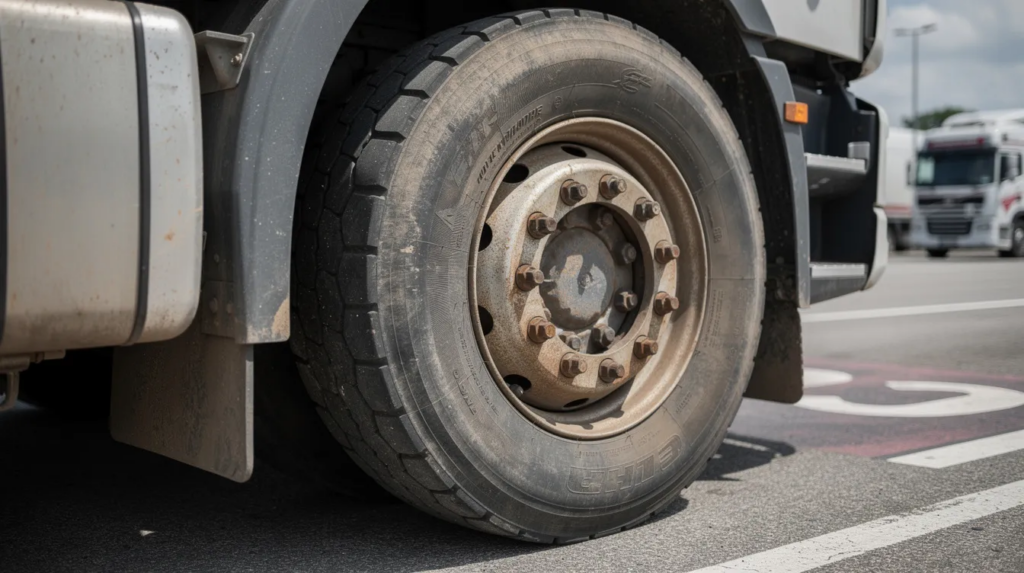
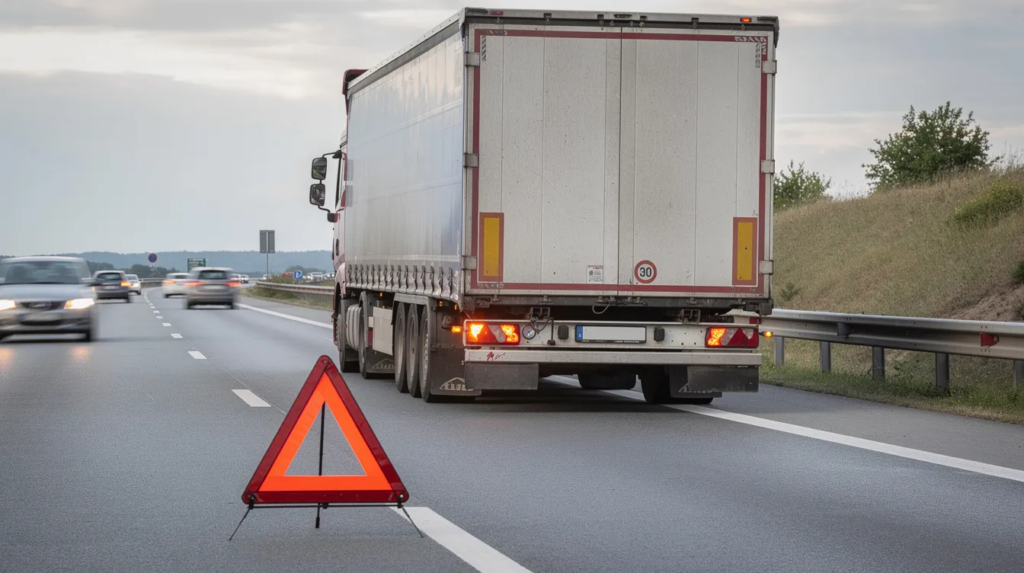
At 20:04 our dispatch received the call: a steer-axle tyre had blown on a Scania artic, heading towards Rostock, somewhere on the A19 near Malchin. The carcass was shredded, with rubber debris scattered across the verge. The driver’s instinct had been correct — he had pulled in behind the crash barrier, onto the grass, rather than stopping on the running lane.
The real difficulty was that the driver didn’t know the route and couldn’t give a distance-marker reading. All he could say was that he was “somewhere past Malchin” — not much use to a service crew when junctions on this stretch can be ten or more kilometres apart.
The tyre specification was clear: 385/55 R22.5, a size commonly fitted to the steer and drive axles of heavy tractor units. The damaged tyre was unroadworthy, the vehicle was safely positioned but unlit and exposed on a stretch with no lighting, as dusk closed in.
Why Distance-Marker Posts Are the Most Useful Way to Pinpoint a Location on the Motorway
The small blue signs along the hard shoulder show the road number and the exact kilometre point — they are the single most reliable way to state your position on a German motorway. Every 500 metres on German autobahns, one of these posts stands, usually on the right-hand verge or bolted to the crash barrier. The top figure gives the road number, the bottom figure the distance from the start of the route.
For a driver dealing with a blown tyre, glancing at this sign is the single most useful thing to do after getting the vehicle safely off the running lane. A call that opens with “A19, kilometre 47” saves ten minutes of back-and-forth questions. That’s why our dispatchers ask about it first, on every callout: “Can you see a blue sign with numbers on it? What does it say?”
In this case it took the driver a few minutes to find the nearest post — dusk made it harder to read. He was talked through it step by step over the phone, walking slowly along the barrier until the lettering came into view. Kilometre 47 on the A19 was the fixed point that changed everything.
Why Direction of Travel Matters as Much as the Kilometre Point
A kilometre point without a direction describes two different places, separated by a crash barrier — the wrong side can cost the crew 20 to 40 minutes on a detour. Motorways are structurally one-way with a central reservation. “A19 at kilometre 47” could mean the carriageway heading towards Rostock, or the opposite carriageway heading towards Berlin — two locations often reachable only via the next junction or a motorway bridge.
A service vehicle sent to the wrong side has to drive on to the next exit, turn round, and come back. On a quiet stretch like this section of the A19, junctions can be twelve to fifteen kilometres apart — the time lost is real and entirely avoidable.
That’s why “which way are you heading, what’s the next town?” matters just as much as the kilometre figure. In this case the answer was unambiguous: heading towards Rostock, coming from the direction of Berlin. Those two pieces of information together — kilometre 47 plus direction Rostock — were enough to fix the position to within a few hundred metres.
Emergency Call Posts: the Second Reliable Fixed Point Besides the Distance Marker
Arrows on the crash barrier point towards the nearest emergency call post, and each post carries its own number that pinpoints an exact position. Every two kilometres on German motorways stands an orange emergency call post, backed up by small reflective arrow markers on the barrier pointing towards the nearest one in each direction. These arrows are often easier to spot than a distance-marker post after dark, because they’re reflective.
Each post is numbered, and that number maps to an exact location known to the control centre. Reading out a post number gives dispatch the same quality of information as a GPS coordinate — without needing a phone signal. In this case it would have been the fallback if the distance marker hadn’t turned up; since the driver found the marker first, the extra walk to the post wasn’t needed.
For drivers who feel unsure: the emergency post works even without your own phone network, and connects straight through to the motorway authority or police, who can pass your exact position on to a breakdown or tyre service.
Sharing Your Phone’s Location: the Fastest and Most Reliable Method
A location pin shared through a messaging app is more reliable than any verbal description and takes under a minute to send. Nearly every smartphone can drop a pin in WhatsApp, Telegram, or via an SMS link. For dispatch, that’s the most precise information available — no risk of mixing up a kilometre figure, no language barrier.
On this callout, alongside the distance-marker reading, we asked the driver to send a WhatsApp location pin. It confirmed “kilometre 47, heading Rostock” exactly, and gave us the vehicle’s precise orientation on the map. That double confirmation — sign plus pin — is the reason location was locked down in just 18 minutes despite the awkward starting point.
A tip for drivers: leave location services switched on permanently, rather than trying to enable them in the middle of a breakdown. With location already on, sending a pin is a single tap — those are minutes you don’t get back if you’re fumbling through permission dialogues instead.
What Else Helps Dispatch Fix Your Position
Beyond a distance marker, direction of travel, and a GPS pin, a few other details speed things up:
- The last junction or service area you passed — even a rough estimate narrows the search area considerably.
- The next major town in your direction of travel — more useful than a town you can simply see (more on that below).
- Road signage — brown tourist signs, roadworks kilometre markers, exit numbers.
- Landmarks — bridges, wind turbines, radio masts that show up clearly on a map.
- Traffic density and road surface — helps dispatch give a realistic estimate of arrival time.
None of these alone is enough on its own, but together they build a clear picture within a few minutes.
Two Mistakes That Needlessly Slow Down Locating a Vehicle
A town visible on the horizon is rarely your actual position — it can be 10 to 15 kilometres away. Under stress, drivers often name the town they can see on a sign or in the distance. On a motorway with the long sightlines typical of Mecklenburg, that regularly leads to estimates that are off by ten kilometres or more.
Equally unhelpful is a phrase like “somewhere past Malchin” — it describes a stretch of road potentially twenty kilometres long. Both of these patterns caused the initial delay in this case, until the distance marker and the GPS pin resolved the uncertainty.
Why Quiet Stretches Make Location Harder to Pin Down
The A19 near Malchin is lightly trafficked outside peak periods, with junctions spaced further apart than on busy motorways such as the A2 or A7. In practice, that means:
- Fewer exits to use as reference points — the gap between two junctions can run to ten or fifteen kilometres.
- Fewer other vehicles that might stop and help — on busier roads, other drivers often report a breakdown too; here the driver was on his own.
- Service points further apart — service areas and fuel stations are sparser, which structurally lengthens the crew’s drive time.
- Signs harder to read at dusk — without a nearby service area’s lighting, distance-marker posts are harder to spot in fading light.
For those reasons, the 53-minute drive time in this case was realistic, not unusually long — on a busier motorway with a denser network of partner workshops, a similar callout can often be completed in 35 to 45 minutes.
How Our Dispatch Organised the Response
Once the location was confirmed, the internal process followed a clear sequence:
- Confirm location — cross-check the distance marker against the GPS pin, verify direction of travel.
- Confirm tyre specification — 385/55 R22.5, steer axle, Scania artic with semi-trailer.
- Alert the nearest regional partner workshop, checking stock for the matching tyre size.
- Talk the driver through securing the scene by phone — hazard lights, warning triangle at a safe distance, hi-vis vest, staying behind the barrier.
- Track location continuously during the drive, ready to adjust course if needed.
That structure is why, despite the initially unclear location, only 18 minutes passed before dispatch had a confirmed position.
On Site: Why a Steer-Axle Blowout Is Never a Minor Fault
A truck tyre normally runs at 8.5 to 9.5 bar — significantly higher than a car tyre. When the carcass fails, that pressure releases instantly, which can momentarily affect steering and, in the worst case, damage the rim. On a steer axle, the load bears directly on the vehicle’s tracking, so a damaged tyre in this position rules out continuing the journey, even over a short distance.
On this job the rim came through undamaged, which kept the repair to a straightforward tyre swap. That’s not a given: a blown carcass can strike and damage the rim’s edge as it collapses, adding cost and time.
The Tyre Change, Step by Step
- Visual inspection — check the condition of the tyre, rim, and hub, ruling out any knock-on damage to the brakes or suspension.
- Secure the work area — warning triangle placed at a safe distance, hazard lights on, the service vehicle positioned as an added shield.
- Removal — loosen the wheel nuts, take the damaged tyre off the rim.
- Fit the replacement 385/55 R22.5 tyre — mount, balance, inflate to the specified pressure.
- Final check — tighten the wheel nuts to the correct torque in a star pattern for an even seat, final visual check, and a short test roll on the verge.
That sequence is standard practice for any professional wheel change and took 65 minutes on this job, including reaching the exact spot on the grass verge and securing the work area as darkness set in.
Full Timeline of the Callout
| Time | Phase | Action |
|---|---|---|
| 20:04 | Emergency call | Call received, tyre blowout reported, location initially unclear |
| 20:04–20:22 | Locating | Distance marker, direction of travel, and GPS pin confirmed |
| 20:22–21:15 | Drive out | Technician en route to A19, kilometre 47, direction Rostock |
| 21:15–22:20 | Repair | Tyre change 385/55 R22.5, securing the site, final checks |
| 22:20 | Completed | Vehicle roadworthy again |
Total time from call to departure: 2 hours 16 minutes.
Cost Breakdown
| Item | Price (EUR, net) |
|---|---|
| Call-out fee | 260 |
| Labour (65 min, at 120 €/h pro-rated) | 130 |
| Tyre 385/55 R22.5 | 480 |
| Old tyre disposal | 20 |
| Evening surcharge | 70 |
| TOTAL | 960 |
All prices are net, plus VAT. The call-out fee sits towards the upper end of the usual range because the stretch of road was lightly trafficked and reached in the evening — both factors that add to the crew’s time and cost. For comparison, an artic left stranded typically costs its operator between 800 and 1,200 euros a day in downtime, depending on the load and contract — so a professional tyre change pays for itself the same evening.
Why an Autobahn Tyre Change Needs a Professional
Changing a truck tyre is not something a driver should attempt alone at the roadside:
- No specialist tools — a torque wrench set to the correct wheel-nut tightness is rarely part of standard onboard kit.
- The wheel’s weight — a complete truck wheel fitted with a 385/55 R22.5 tyre often weighs over 80 kilograms.
- Traffic risk — working at the roadside without a professional safety setup is genuinely dangerous, particularly at dusk.
- Knock-on damage — a badly fitted or under-inflated tyre can fail again on the next leg of the journey.
- No spare on board — the correct tyre size is rarely carried in the vehicle.
Typical Situations We Respond to Across Germany
Alongside motorway blowouts, our regular work includes tyre failures at junctions and service areas, breakdowns on car transporters and semi-trailers, tyre changes on construction vehicles and mobile cranes, and callouts to car transporters with more than one affected wheel at once. It’s common, on top of that, for foreign drivers to struggle to judge the situation on site, or to describe their position in German at all.
The Language Barrier: Explaining Your Location Without Speaking German
Many drivers in international haulage speak little or no German. For locating a vehicle, though, only a few universal elements are needed: the numbers on the blue distance-marker sign (digits read the same in any language), a photo of that sign sent by messenger, and a GPS pin. A multilingual dispatch team further reduces the risk of a misunderstood direction or road number — our calls run in German, English, Polish, and Russian depending on the driver, which makes a real difference for international hauliers.
What the Driver Should Do While Waiting
- Switch hazard lights on immediately, even once the vehicle has already stopped.
- Put on a hi-vis vest before stepping out of the cab.
- Place the warning triangle a safe distance back — typically 150 to 400 metres on a motorway, depending on visibility.
- Stay behind the crash barrier, never on or beside the running lane.
- Keep the phone reachable, ready to answer dispatch’s follow-up questions immediately.
Prevention for Drivers and Fleets
Regularly checking tyre pressure and tread depth significantly cuts the risk of a sudden blowout. Under § 36 StVZO, minimum tread requirements apply to commercial vehicle tyres — requirements many fleets fall below well before any damage becomes visible. It also pays to walk drivers through their phone’s location-sharing settings before they set off, and to set a standard reporting sequence for breakdowns, so no time is lost hunting for a location when it actually matters.
Extended SEO Block: Tyre Quality and Fleet Maintenance
For heavy artics, brands such as Michelin, Continental, Goodyear, and Bridgestone are among the most commonly fitted on German motorways. The right size depends on axle load and vehicle type: 315/80 R22.5 and 385/65 R22.5 are common on semi-trailers, while 385/55 R22.5 — as in this callout — is frequently used on the steer and drive axles of heavy tractor units. Regular checks of tyre pressure, tread depth, and overall condition noticeably cut the risk of a roadside blowout and reduce a fleet’s downtime costs over time.
Why Choose LKWHelp24
We’re reachable around the clock, anywhere in Germany, working with a vetted network of partner workshops and quoting prices up front before work begins. Our dispatch team is multilingual and specifically trained to reach a solid location fix quickly, even when the initial description is vague — as in this callout on the A19 near Malchin.
Frequently Asked Questions
What does a truck tyre change on the motorway cost?
A wheel change for an artic typically runs between 750 and 1,400 euros net, depending on tyre size, time of day, and distance. On this callout, with a 385/55 R22.5 tyre, the total came to 960 euros net.
How do I work out my location on a motorway I don’t know?
The most reliable method is the blue distance-marker sign on the verge, combined with your direction of travel and a GPS pin shared through a messaging app. That combination is enough for dispatch to fix a position to within a few hundred metres.
Why does direction of travel matter so much?
Because a kilometre point without a direction can describe two separate locations on opposite carriageways. Sending the crew to the wrong side means a detour via the next junction — often 20 to 40 minutes lost.
How long does the drive take on quiet stretches of road?
On motorways with wider gaps between junctions, like this stretch of the A19, a drive time of 45 to 70 minutes is realistic — longer than on busier roads with a denser network of workshops.
What if I don’t speak German?
A photo of the distance-marker sign and a GPS pin work regardless of language. Our dispatch team is also multilingual, to avoid any misunderstanding when describing a location.
Who pays for the tyre change — the driver or the haulier?
That’s settled between driver and haulier; we invoice the agreed contact and confirm the price before work starts.
Summary
- Specification: tyre 385/55 R22.5, steer axle, Scania artic with semi-trailer
- Location: A19 near Malchin, Mecklenburg, kilometre 47, direction Rostock
- Response time: 18 minutes to a confirmed location
- Drive time: 53 minutes
- Total time: 2 hours 16 minutes from call to departure
- Cost: 960 euros net
- Secondary damage: none, rim undamaged
Get Help Now
A tyre blowout on an empty stretch, an unclear location, dusk closing in — this is exactly the kind of case our dispatch is built to handle. Call us on +49 160 5753826, available around the clock, anywhere in Germany. More on our services at www.lkwhelp24.com.
Keywords: mobile truck tyre service | truck tyre blowout motorway | steer-axle tyre failure | pinpointing your location on the motorway | motorway distance marker | motorway emergency call post | artic tyre change | 385/55 R22.5 | 24/7 truck breakdown service Germany
Related Articles
- Truck Tyre Service Near Me: How LKWHelp24 Fixed a Scania Steer-Axle Blowout in Under Two Hours on the A6 near Mannheim
- Truck Tyre Service Near Me: How LKWHelp24 Replaced a Blown Steer-Axle Tyre in Under Two Hours on the A2 near Bielefeld
- Truck Tyre Service Near Me: How LKWHelp24 Replaced a Shredded Drive-Axle Tyre in Under Two Hours on the A9 near Dessau
- Trailer Tyre Blowout on the A10 near Michendorf: Curtainsider Semi-Trailer Back on the Road in 1 Hour 45 Minutes
- Truck Tyre Emergency Service – 24h Roadside Assistance Across Germany for Foreign Drivers
Tyre service: lkwhelp24.com/en/tire-service/ · Mobile service: lkwhelp24.com/en/mobile-truck-service/ · Towing service: lkwhelp24.com/en/towing-service/ · Truck workshop: lkwhelp24.com/en/truck-service/ · Contacts: lkwhelp24.com/en/contacts/
Available around the clock, anywhere in Germany: +49 160 5753826 · www.lkwhelp24.com