Skip to content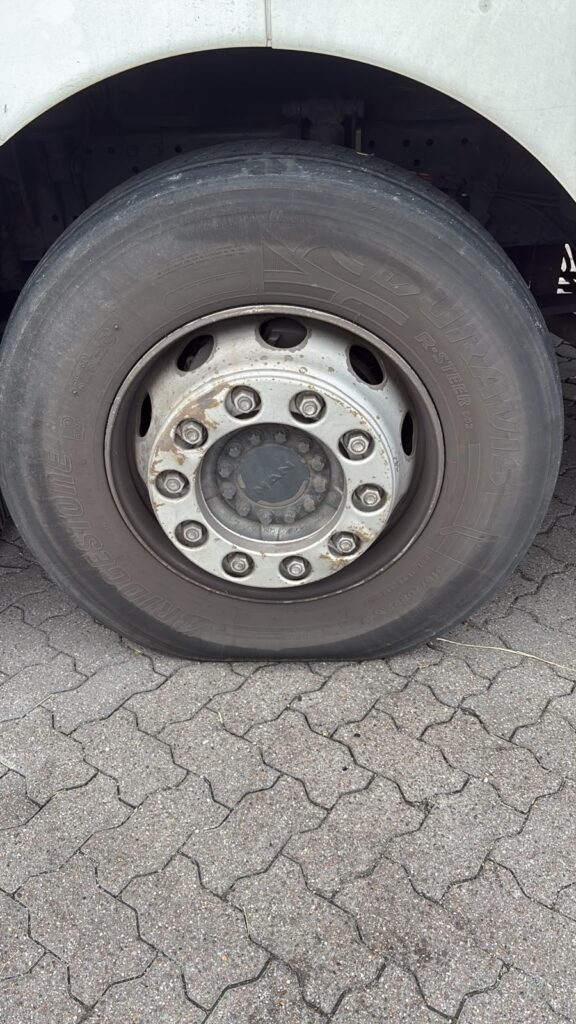
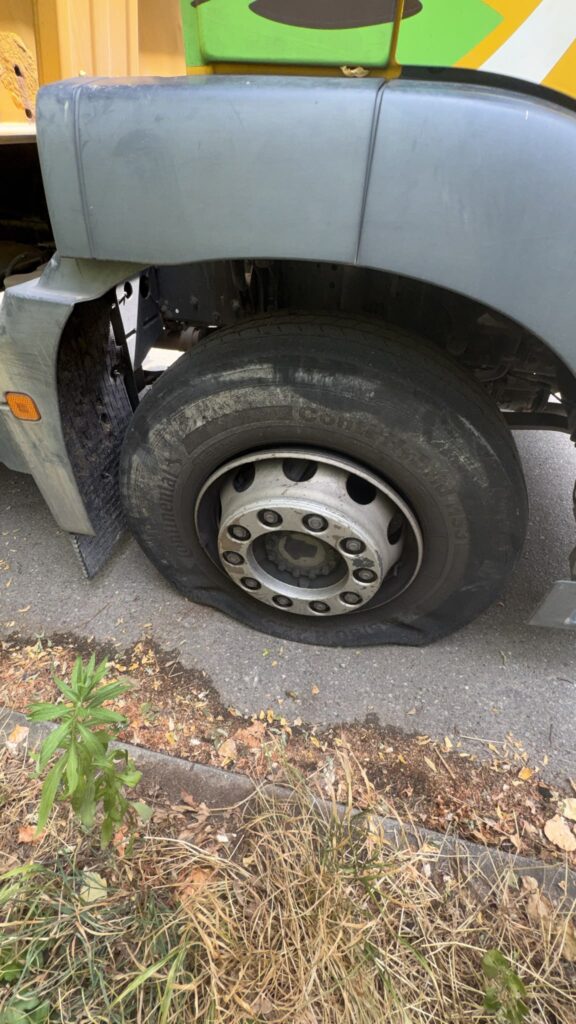
A drive-axle blowout is a different animal from a steer-axle one. The truck doesn’t pull to one side so much as it loses grip under load, and on a hot afternoon on the A9 that’s exactly what happened to a MAN tractor unit heading towards Munich. One moment the driver had traction, the next the trailer was pushing the tractor and the rear end was hunting for grip on bare rim.
Nobody was hurt. The driver got the rig onto the hard shoulder, triangle out, hazards on, and called our dispatch at 13:50. What followed was a fairly standard callout by our numbers, but the mechanics of why a drive-axle tyre fails differently, and what has to be checked afterwards, are worth walking through in detail. Steer-axle blowouts and dual-wheel setups get their own treatment elsewhere on this site; this one is about the axle that actually pushes the lorry down the road.
The emergency situation on the A9
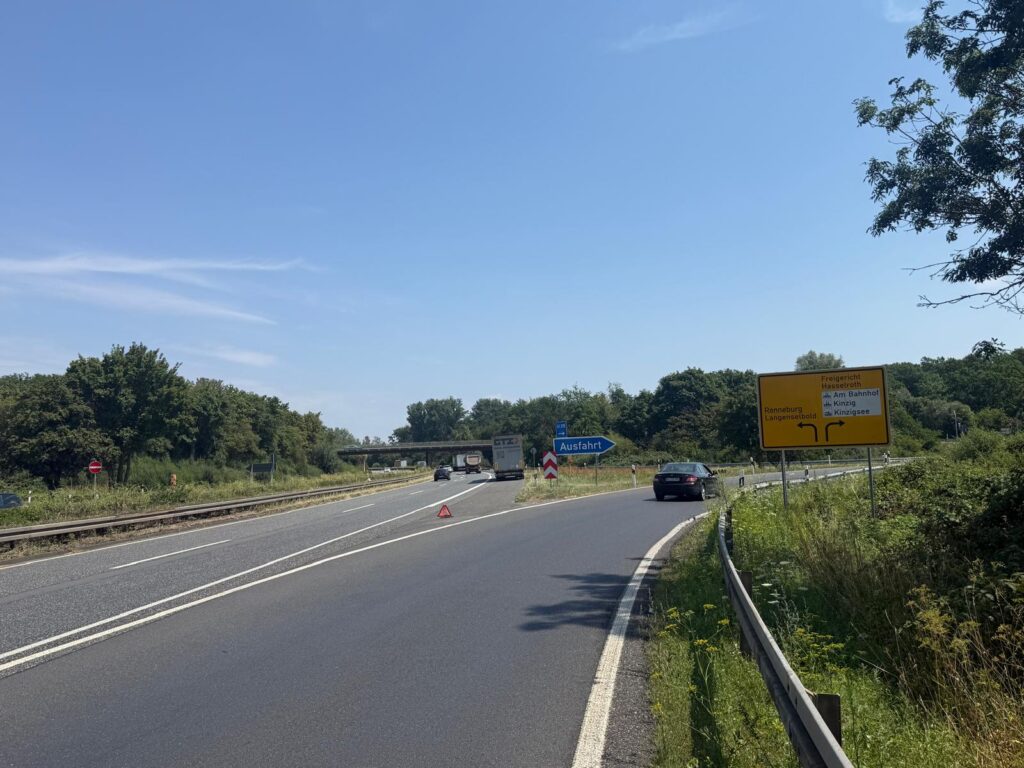
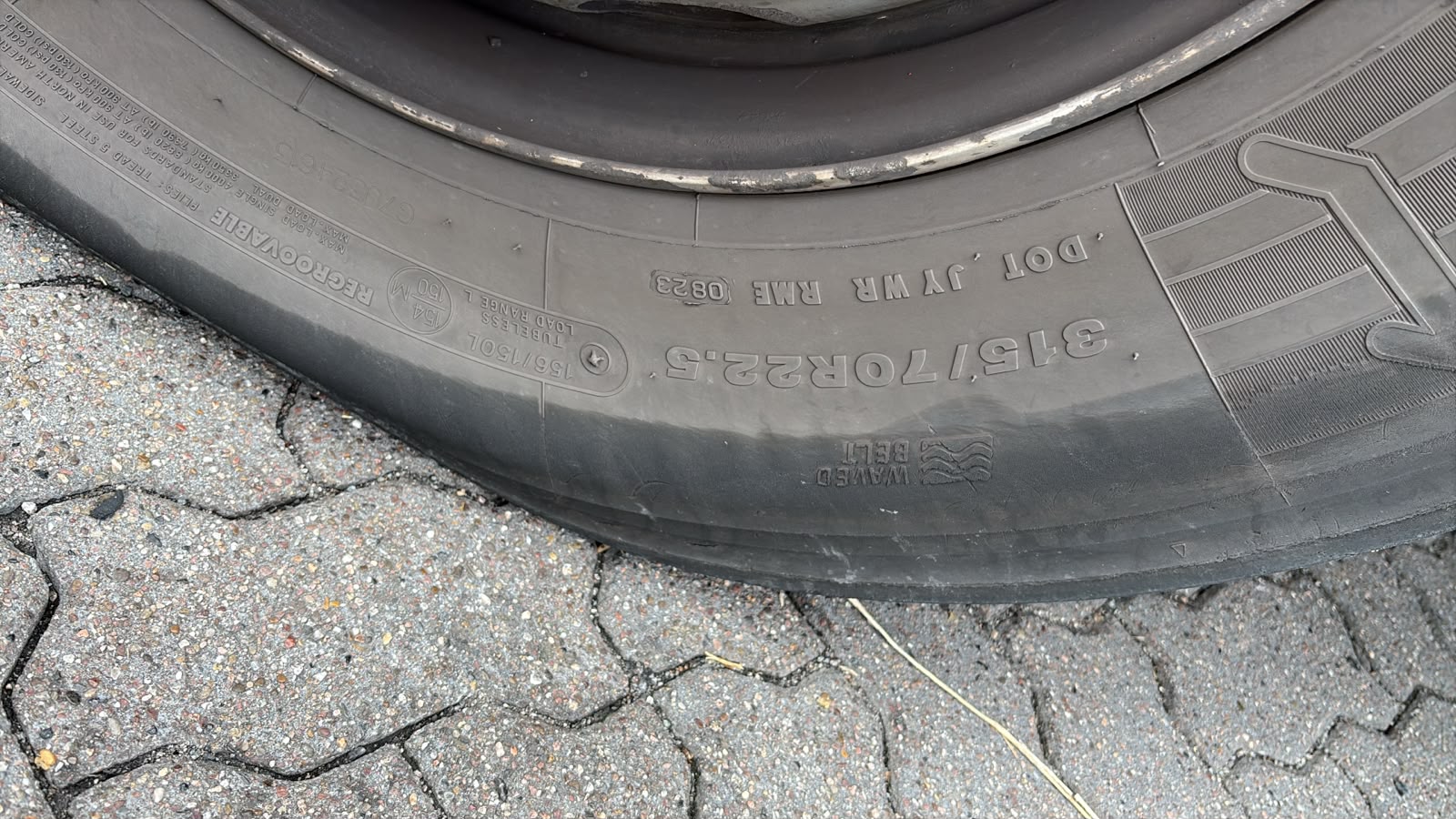
The location: A9 near Ingolstadt, direction Munich, daytime, dry weather. The vehicle: a MAN tractor unit pulling a loaded semi-trailer. The failure: a tyre blowout on the drive axle, tyre size 315/80 R22.5.
Drive-axle tyres on a rigid or tractor unit sit under the engine’s torque and most of the vehicle’s mass when loaded. When one lets go at speed, the axle doesn’t just lose a tyre, it briefly loses the ability to put power down evenly. On this stretch of the A9 the road was flat and dry, which worked in the driver’s favour. On an incline or in wet conditions the same failure can cause the drive wheels to spin uselessly on one side while the other tries to grip, which is how a rig ends up jack-knifing or stranded on a slope with the trailer’s weight holding it in place.
The driver did the right thing immediately: hazard lights, warning triangle placed well back, moved as far onto the hard shoulder as the geometry allowed, and called for mobile truck tyre service rather than attempting to limp to the next exit. Limping on a shredded drive-axle tyre risks damage to the wheel arch, the air lines, and sometimes the brake components mounted close to the rim.
How we organised help
Our dispatch runs 24/7 and the process for a motorway callout is built to compress the time between the phone ringing and a technician on site. For this job:
- 13:50 – call logged, GPS location confirmed via the driver’s description of the last exit sign
- Dispatcher checked live traffic on the A9 corridor and confirmed the correct tyre size and axle position with the driver
- Nearest available technician from our regional partner network was assigned, carrying 315/80 R22.5 stock
- Driver was told to stay in the cab or behind the barrier, not next to the vehicle
- Technician confirmed departure and estimated arrival time by phone
Carrying the right tyre matters more than people assume. A drive-axle tyre isn’t interchangeable with a steer-axle one even at the same nominal size, and turning up with the wrong compound means a second trip. Our network stocks drive-axle patterns separately for this reason.
The situation on site
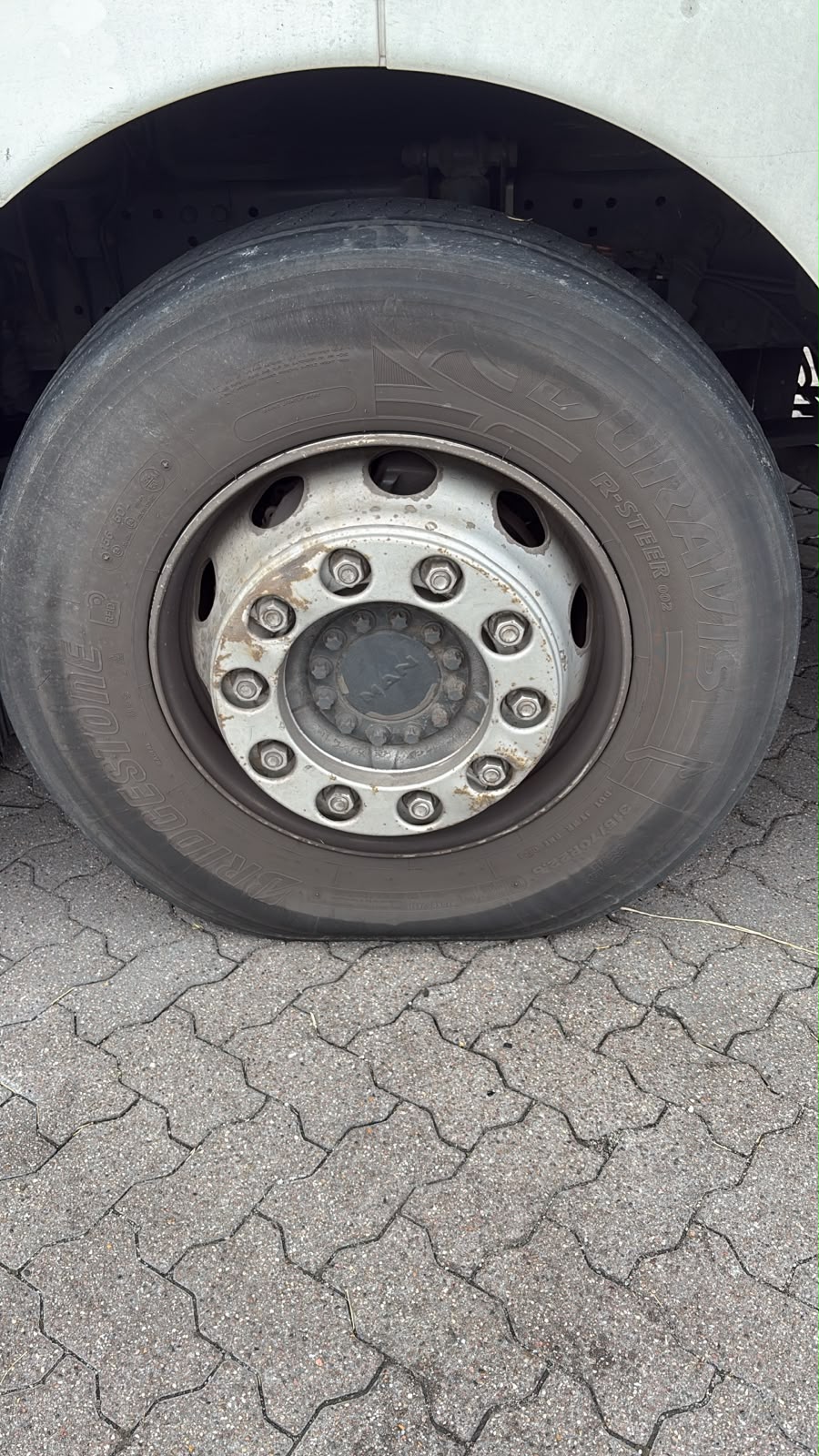
By 14:50 the technician was on site. The tyre was in pieces, the rim showed light scoring but no cracks, and the second tyre on the same side (this was a single, not a dual, drive-axle position) was intact.
A few things get checked before anything gets touched:
- Tyre pressure on drive-axle HGV tyres normally sits between 8 and 9 bar depending on load and manufacturer spec, so the technician confirms the working pressure for this axle before fitting the replacement.
- Rim condition. A blowout at speed can bend a steel rim or crack an alloy one. If the rim’s out of round, no amount of tyre fitting fixes the wobble.
- Brake and air-line proximity. Debris from a shredded tyre can nick air lines or damage the brake chamber housing sitting close to the wheel.
- Wheel bolt and hub condition. Loose or damaged studs need addressing before a new tyre goes anywhere near torque spec.
None of this took long, about fifteen minutes, but skipping it is how a routine tyre change turns into a second breakdown twenty kilometres down the road.
Step-by-step repair
Step 1 – Secure the site. Warning triangle further back than the driver’s own, cones out, technician in hi-vis working from the traffic side with care, hazard beacon on the service vehicle.
Step 2 – Remove the damaged tyre. Wheel nuts loosened in the correct star pattern before jacking, vehicle lifted with axle stands rated for the load, wheel removed.
Step 3 – Inspect and fit. Rim cleaned and checked, new 315/80 R22.5 fitted, valve replaced as standard practice rather than reused.
Step 4 – Torque in a star pattern. This is the step most drivers underestimate. Wheel nuts on a drive axle carry serious load and need tightening in sequence, not just spun down with a rattle gun. Uneven torque is one of the most common causes of wheel loss further down the line, and it’s avoidable with five minutes of care.
Step 5 – Final check. Pressure confirmed, nuts re-checked after initial settling, area cleared of debris, driver briefed on re-torque recommendation after roughly 50-100 km, which is standard advice after any roadside wheel change.
Full timeline
| Time | Phase | Action |
|---|---|---|
| 13:50 | Emergency call | Call received, location and axle position confirmed |
| 13:50–14:05 | Dispatch | Technician assigned, tyre stock confirmed (15 min) |
| 14:05–14:50 | Drive to site | Technician travels to the A9 near Ingolstadt (45 min) |
| 14:50–15:05 | Diagnosis | Site secured, rim and axle inspected (15 min) |
| 15:05–16:05 | Tyre change | Removal, fitting, torque-tightening in star pattern (60 min) |
| 16:05 | Complete | Final check done, vehicle back on the road |
Total time from call to completion: 2 hours 15 minutes.
Cost breakdown
| Item | Price (EUR, net) |
|---|---|
| Call-out | €240 |
| Labour (1.25 hrs at €120/hr) | €150 |
| Tyre 315/80 R22.5 (drive axle) | €560 |
| Old tyre disposal | €20 |
| TOTAL | €970 net (plus VAT) |
All figures are net, VAT added separately, as is standard for commercial callouts in Germany. The tyre itself is the largest line item, and price varies by brand: a premium drive-axle pattern from Michelin or Continental sits at the upper end of the range, while a budget or mid-tier brand can come in lower. We don’t fit unknown-origin tyres on a drive axle regardless of price, because a mismatch in compound or wear pattern against the paired tyre creates its own problems, which we’ll get to.
Compare that €970 against the cost of downtime. A loaded semi-trailer sitting idle on the hard shoulder costs the operator somewhere between €800 and €1,200 per day in lost transport time, contractual penalties, and driver hours that still have to be paid. A two-hour fix against a full day’s lost revenue is not a close call.
Why you need a professional for this
Changing a car tyre at the roadside is inconvenient. Changing a drive-axle HGV tyre at the roadside without the right equipment is dangerous, and here’s why:
- The wheel and tyre assembly on a 315/80 R22.5 weighs well over 80 kg. Lifting or manoeuvring it without proper equipment risks crush injuries.
- Jacking a loaded tractor unit on the hard shoulder without rated axle stands and traffic protection is how secondary accidents happen. Vehicles passing at 100+ km/h a metre or two away don’t leave room for error.
- Torque specification matters. Under-tightened wheel nuts can work loose within kilometres; over-tightened ones can shear studs or warp the hub. A rattle gun without a calibrated torque wrench doesn’t give you either outcome reliably.
- Getting the tyre size or the axle-specific pattern wrong is common when drivers try to source a replacement themselves from an unfamiliar supplier.
This is why the truck tyre service we run keeps trained technicians, calibrated torque equipment, and stock specific to steer, drive, and trailer positions, on call around the clock.
Typical callouts we handle across Germany
Drive-axle blowouts are one recurring pattern among several. In the last year alone we’ve handled steer-axle failures on the A9 near Nuremberg, a drive-axle tyre on a four-axle tipper on the A48 near Koblenz, and another drive-axle blowout on the A1 near Bremen. Each one has its own quirks depending on axle position, load, and weather, which is part of why generic advice online rarely matches what actually happens on the tarmac.
Prevention: what drivers and fleets can do
A blowout is rarely a surprise if the tyre’s been checked properly beforehand. A few habits cut the risk substantially:
- Check pressure cold, before the day’s first run, not after an hour on the motorway when heat has already expanded the air inside.
- Watch tread depth on drive-axle tyres specifically. They wear faster than steer-axle tyres because they transmit engine torque as well as carrying load, and the legal minimum in Germany is 1.6 mm, though most fleets replace well before that.
- Inspect for uneven wear across the axle. If one tyre on a drive axle is visibly more worn than its pair, that’s a sign of a pressure imbalance, a misaligned axle, or a suspension fault, not something to ignore until it fails.
- Keep records of tyre age and mileage. Rubber degrades even on tyres with plenty of tread left, particularly ones that sit in a yard between long hauls.
- Rotate or swap tyres according to manufacturer guidance rather than running drive-axle tyres to the cord because they’re “still holding air.”
Drive-axle tyres: the extended technical picture
Drive-axle tyres are engineered differently from steer-axle tyres, and the difference isn’t cosmetic.
Tread pattern. Steer-axle tyres are built for straight-line stability and steering precision, with ribbed patterns that resist irregular wear under steering forces. Drive-axle tyres carry deep lateral lugs instead, cut aggressively to bite into the road surface and transfer engine torque without slipping. That aggressive lug pattern is also why drive-axle tyres are noisier and wear down faster.
Compound. The rubber compound on a drive tyre is formulated for grip and torque transfer rather than pure mileage, which is a trade-off fleets accept because a tyre that can’t put power down safely isn’t worth the extra 20,000 km of tread life.
Winter marking requirements. Under German traffic law, HGVs must run tyres marked M+S (or the newer 3PMSF alpine symbol) on the drive axle whenever winter conditions apply, meaning snow, ice, slush, or black ice on the road, not a fixed calendar date. This is set out in §2 StVO and enforced with real consequences: fines, points in Flensburg, and potential insurance complications if an accident happens on a drive axle running summer-only rubber in winter conditions. It’s worth noting the legal requirement targets the drive axle specifically, because that’s the axle where traction loss under load causes the most dangerous outcomes, jack-knifing, stranding on inclines, or skidding under a loaded trailer.
Pairing. Tyres fitted to the same axle must match in type, wear level, and ideally manufacturer. Mismatched tyres, even both technically “drive-axle” tyres, can have different rolling circumferences once wear diverges. That mismatch forces the differential to compensate constantly, which stresses the gearbox and diff internals over time and, in the worst cases, leads to an expensive drivetrain repair that dwarfs the cost of a tyre.
Wear rate. Drive-axle tyres typically wear 15-25% faster than steer-axle tyres on the same vehicle, purely because of the torque they transmit. Fleets that rotate steer and drive tyres or plan replacement intervals around this difference get more even wear across the whole vehicle and fewer surprise blowouts.
Post-replacement checks. After any drive-axle tyre swap, a proper technician checks torque against manufacturer spec, inspects the second tyre on the axle for matching wear and pressure, confirms wheel fastenings and hub condition, and looks the rim over for scoring or hairline damage that a rushed job might miss. Skipping any of these steps is how a five-minute shortcut becomes next week’s breakdown.
Brands like Michelin, Continental, Goodyear, and Bridgestone all produce drive-axle-specific patterns, and stocking the right one for the right axle position is exactly what keeps a callout like this one under two and a half hours rather than stretching into an overnight wait for the correct part.
Why fleets and drivers choose us
We run dispatch around the clock, every day of the year, with multilingual staff who can talk a driver from Lithuania, Poland, or Serbia through what’s happening without a translation delay costing precious minutes. Our regional service partner network means a technician carrying the right stock is rarely far from any major German motorway corridor. When a breakdown turns out to need more than a tyre, the same dispatch can pull in our truck towing service for anything beyond a roadside fix.
Pricing is quoted net before work starts, no surprise line items added afterwards, and every callout report includes exactly what was checked, not just what was replaced.
Frequently asked questions
What does a drive-axle tyre replacement cost on the motorway?
For a common size like 315/80 R22.5, expect somewhere around €900-1,000 net including call-out, labour, the tyre itself, and disposal of the old one. Night, weekend, or difficult-access jobs can run higher because of surcharges on the call-out fee.
How long does a drive-axle tyre change take at the roadside?
From the moment the call comes in to the vehicle driving away, budget roughly two to two and a half hours in daylight with normal traffic. That covers dispatch, travel time, diagnosis, the physical tyre change, and a final torque check. Night jobs or bad weather add time.
Who pays for a roadside tyre replacement, the driver or the operator?
That depends entirely on the contract between driver and haulier, but our invoice goes to whoever books the callout, and we can invoice a fleet office directly rather than requiring the driver to pay on the spot, which is common practice for international hauliers.
Can I just fit a spare steer-axle tyre on the drive axle temporarily?
No. The tread pattern, compound, and rolling circumference differ enough that fitting a steer-axle tyre to a drive position, even briefly, risks uneven torque transfer and accelerated wear on the paired tyre, on top of it simply not being road-legal in most cases.
Why did the rim need inspecting if only the tyre failed?
A blowout at motorway speed frequently damages the rim, whether that’s light scoring from the tyre disintegrating against it or, in worse cases, a bent or cracked rim that needs replacing before a new tyre can even be fitted safely.
Is it legal to keep driving on a damaged drive-axle tyre to reach the next exit?
Not recommended and often not legal. A shredded tyre can damage air lines, brake components, and the wheel arch, turning a tyre job into a much bigger repair, and driving on a legally non-compliant tyre risks a fine even for a short distance.
Summary
MAN tractor unit, A9 near Ingolstadt direction Munich, drive-axle blowout, tyre size 315/80 R22.5, daytime, dry conditions. Emergency call at 13:50, technician on site by 14:50, vehicle back on the road by 16:05. Total time: 2 hours 15 minutes. Total cost: €970 net plus VAT. No secondary damage to the rim or drivetrain, second tyre on the axle confirmed sound, torque checked in star pattern before departure.
Need a technician on the road right now?
Call +49 160 5753826 or visit www.lkwhelp24.com. We run 24/7 across the whole of Germany, with technicians positioned to reach most motorway corridors within the hour.
Keywords: truck tyre service | drive-axle tyre blowout | mobile truck tyre service Germany | HGV tyre replacement A9 | 315/80 R22.5 | winter tyre law Germany StVO | truck breakdown assistance | 24/7 tyre service Germany
Related articles
- Truck Tyre Service Near Me: How LKWHelp24 Fixed a Steer Axle Blowout on the A9 near Ingolstadt
- Truck Tyre Service Near Me: How LKWHelp24 Replaced a Shredded Drive-Axle Tyre on the A9 near Dessau
- Winter Tyres for HGVs in Germany – Legal Requirements, Safety & Service
- Load Index for Truck and Commercial Vehicle Tyres