Skip to content
A steer-axle tyre blowout is one of the few roadside failures where the next three seconds decide whether a driver walks away with a fright or with something worse. On 21 July 2026, a Scania tractor unit lost its front-left tyre on the A72 near Chemnitz, heading towards Leipzig. Within an hour and a half of the emergency call, the truck was rolling again with a new 385/55 R22.5 tyre correctly torqued, aligned and checked.
This is not a routine trailer flat. When a tyre goes on the drive axle or a trailer axle, the vehicle usually stays broadly controllable. When it happens on the axle that steers, the driver loses directional authority at the exact moment they need it most. That distinction is the whole reason this case is worth documenting in detail, both for what happened on site and for what any driver or fleet manager should know before it happens to them.
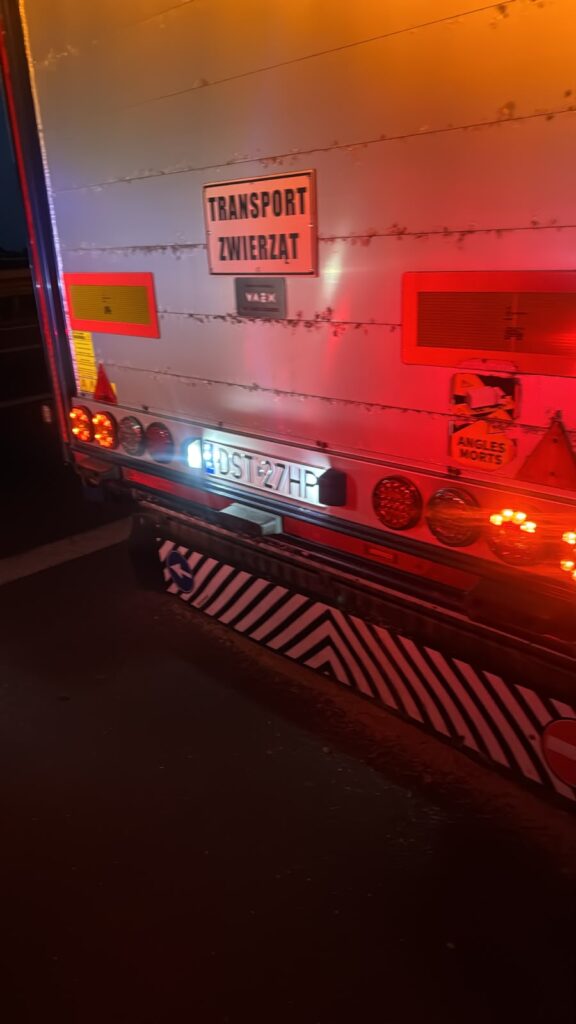
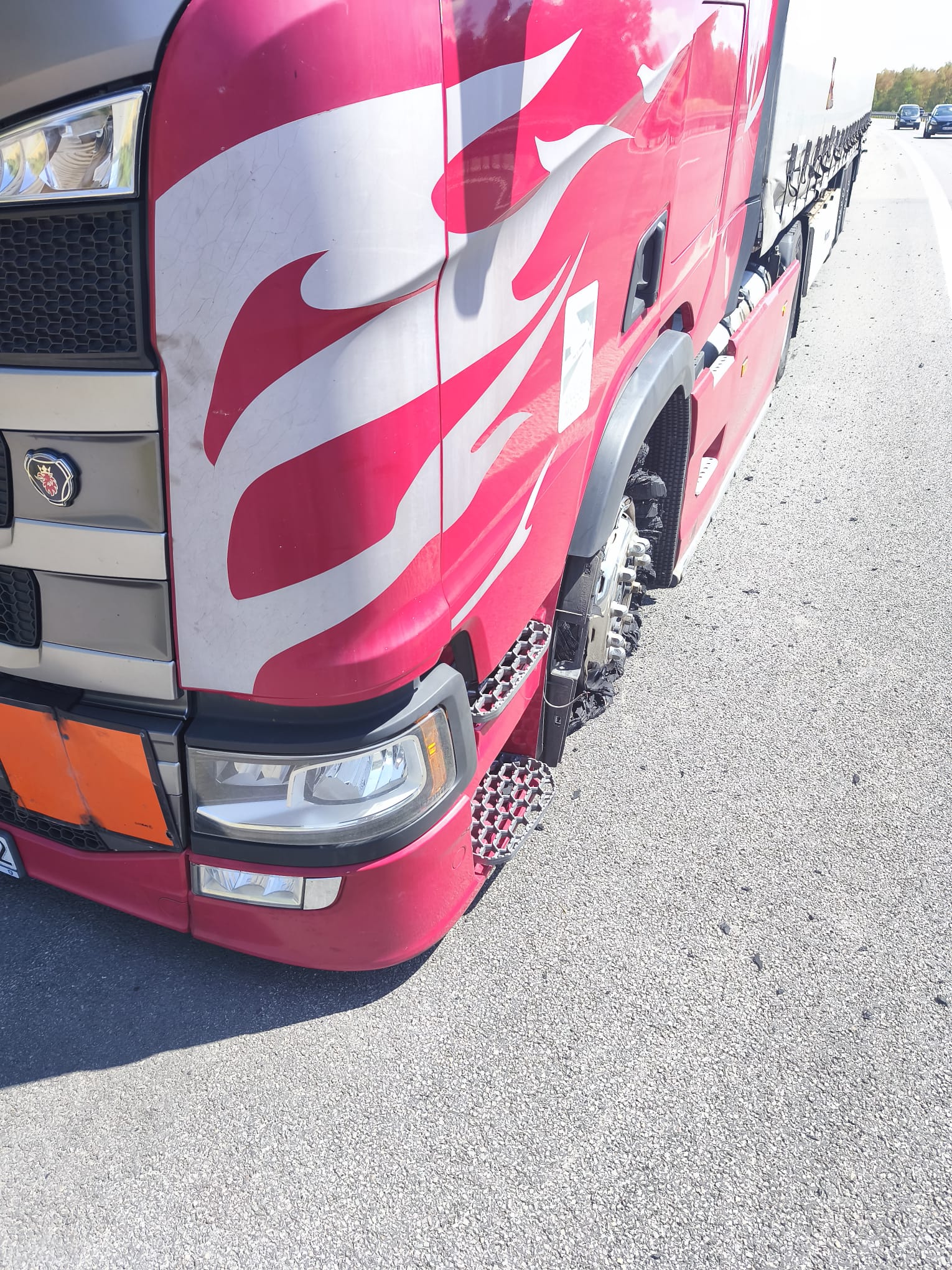
The truck carried an “Angles Morts” blind-spot sticker, the marking required in France for vehicles over 3.5 tonnes, a small clue that this was an international run rather than a local delivery. No detail about the haulier, the driver or the vehicle’s registration is included here, in line with our confidentiality policy for every published case study.
The emergency: a shredded carcass on the hard shoulder
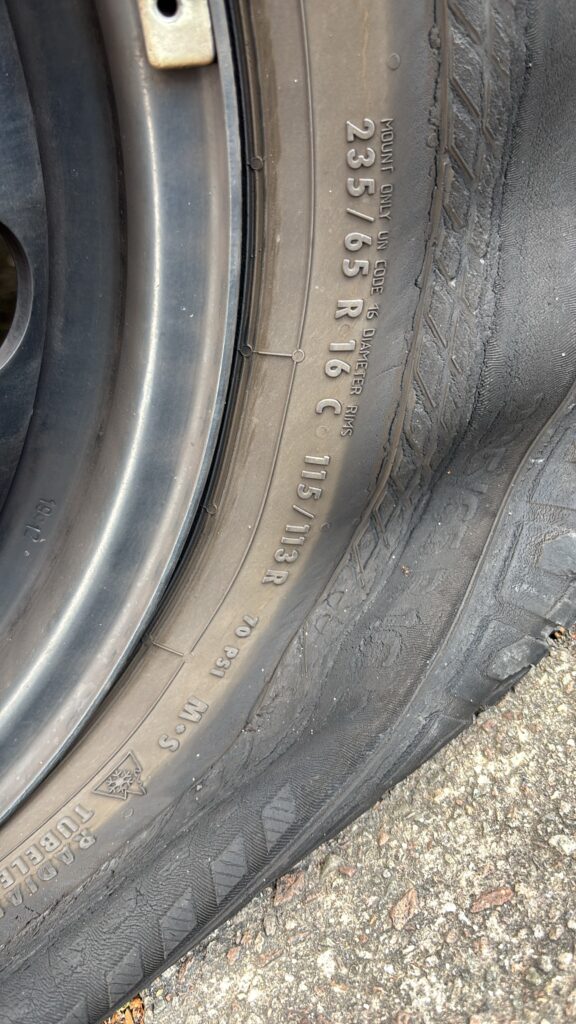
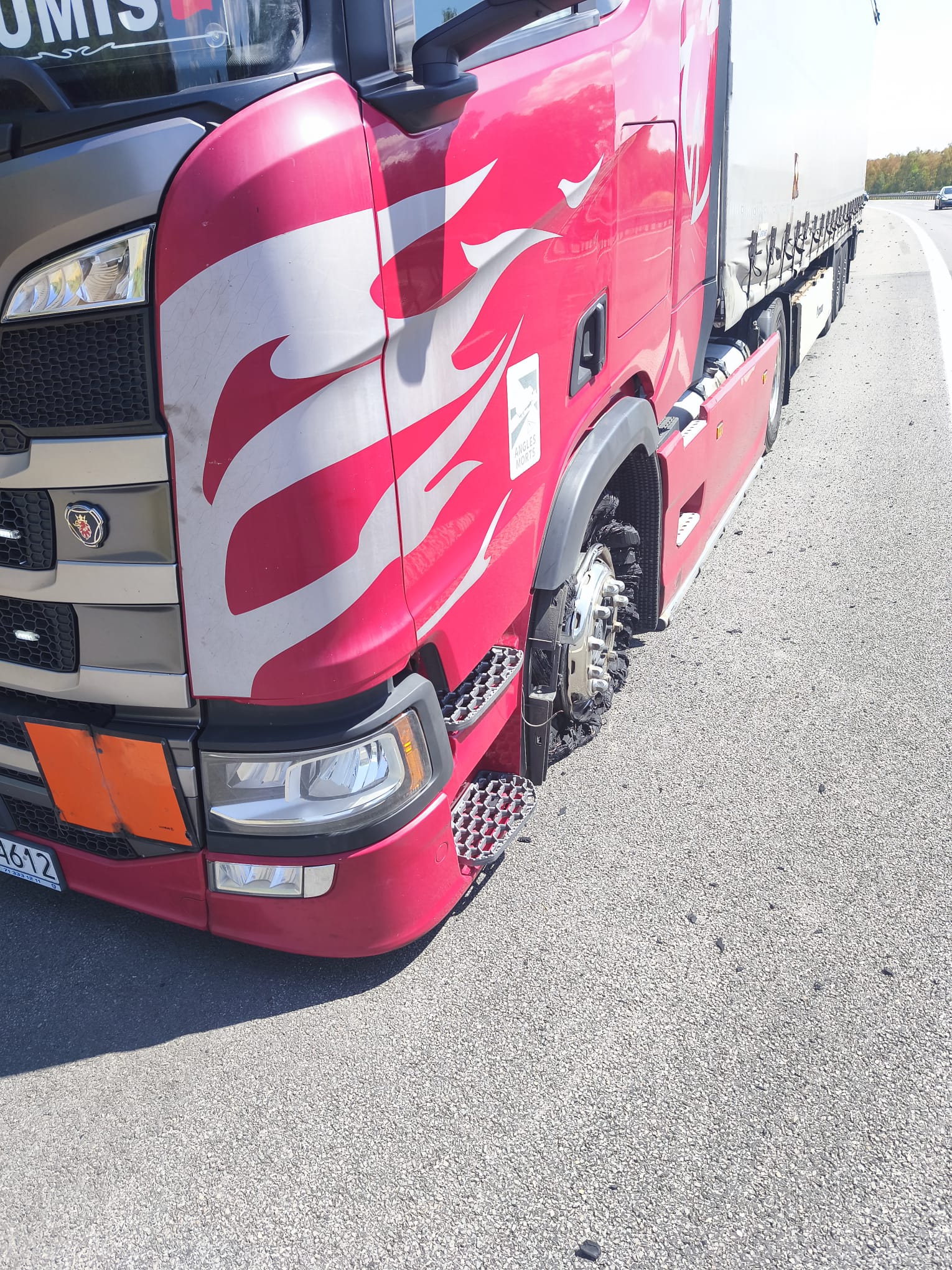
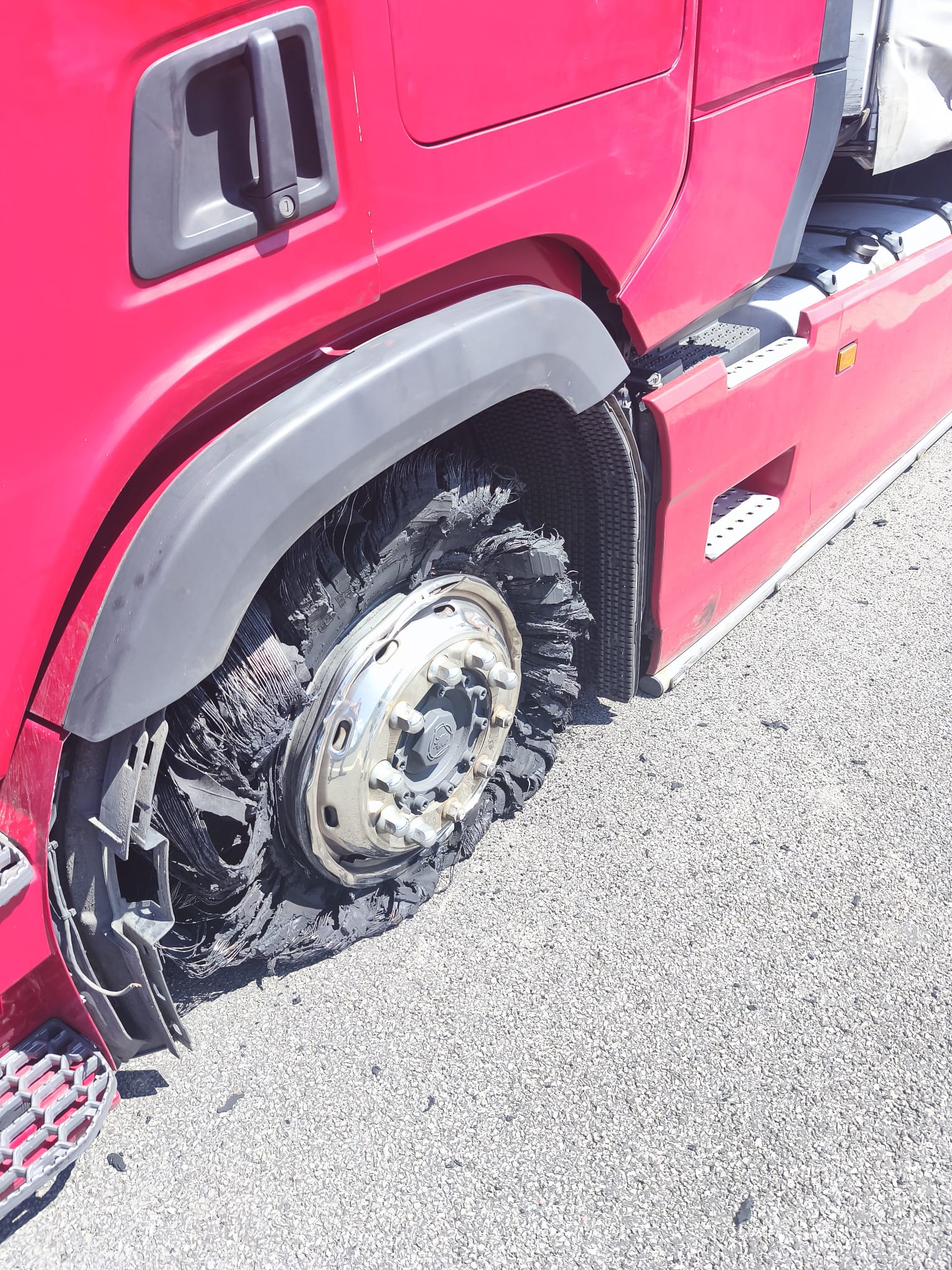
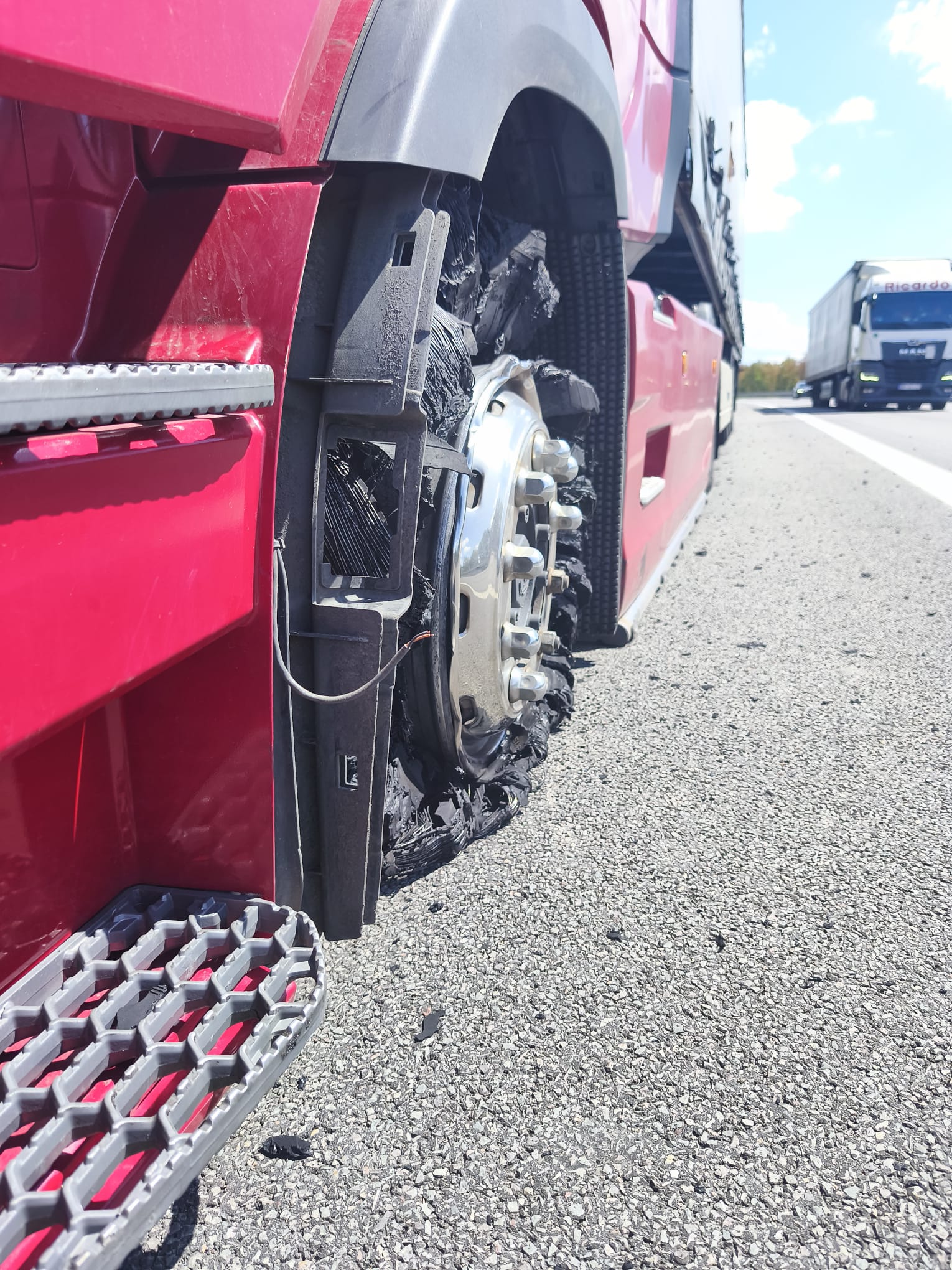
The call came in at 13:22. The driver had felt the tractor unit pull hard to one side, heard the bang a fraction of a second later, and managed to bring the combination to a stop on the hard shoulder of the A72 near Chemnitz. By the time our partner crew reached the site, the front steering axle tyre, a 385/55 R22.5, was beyond any roadside repair: the carcass had shredded into ribbons, the belt package was hanging loose, and the rim itself was exposed to the tarmac.
This size is standard fitment on many European tractor units, including current Scania models, and it carries the full weight of the front axle plus the leverage of the entire steering system. A blowout at this position is not cosmetic. It is a structural failure at the one point of the vehicle responsible for keeping it pointed in the right direction.
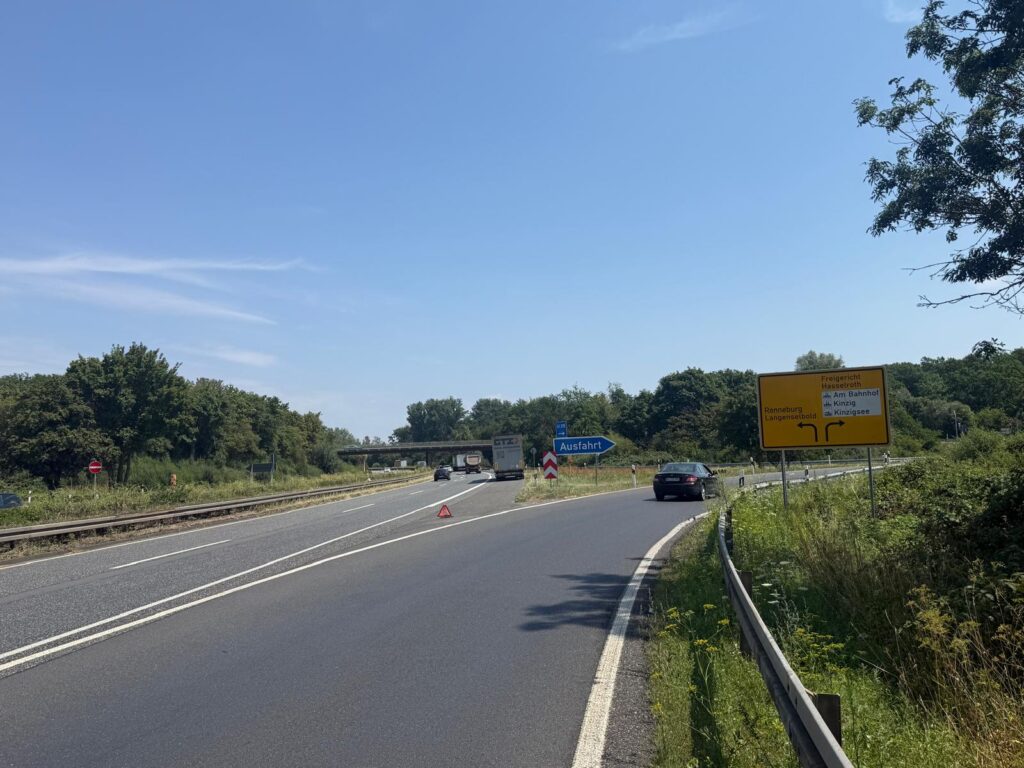
Weather was dry and visibility good, which meant no additional hazard from rain or spray, but the A72 at this point carries steady long-haul traffic in both directions, and the hard shoulder offered limited working width. While the team secured the scene, a MAN lorry passed on the carriageway at speed, close enough that the draught was noticeable, a small reminder of why every roadside job starts with hi-vis vests and a warning triangle before a single tool comes out.
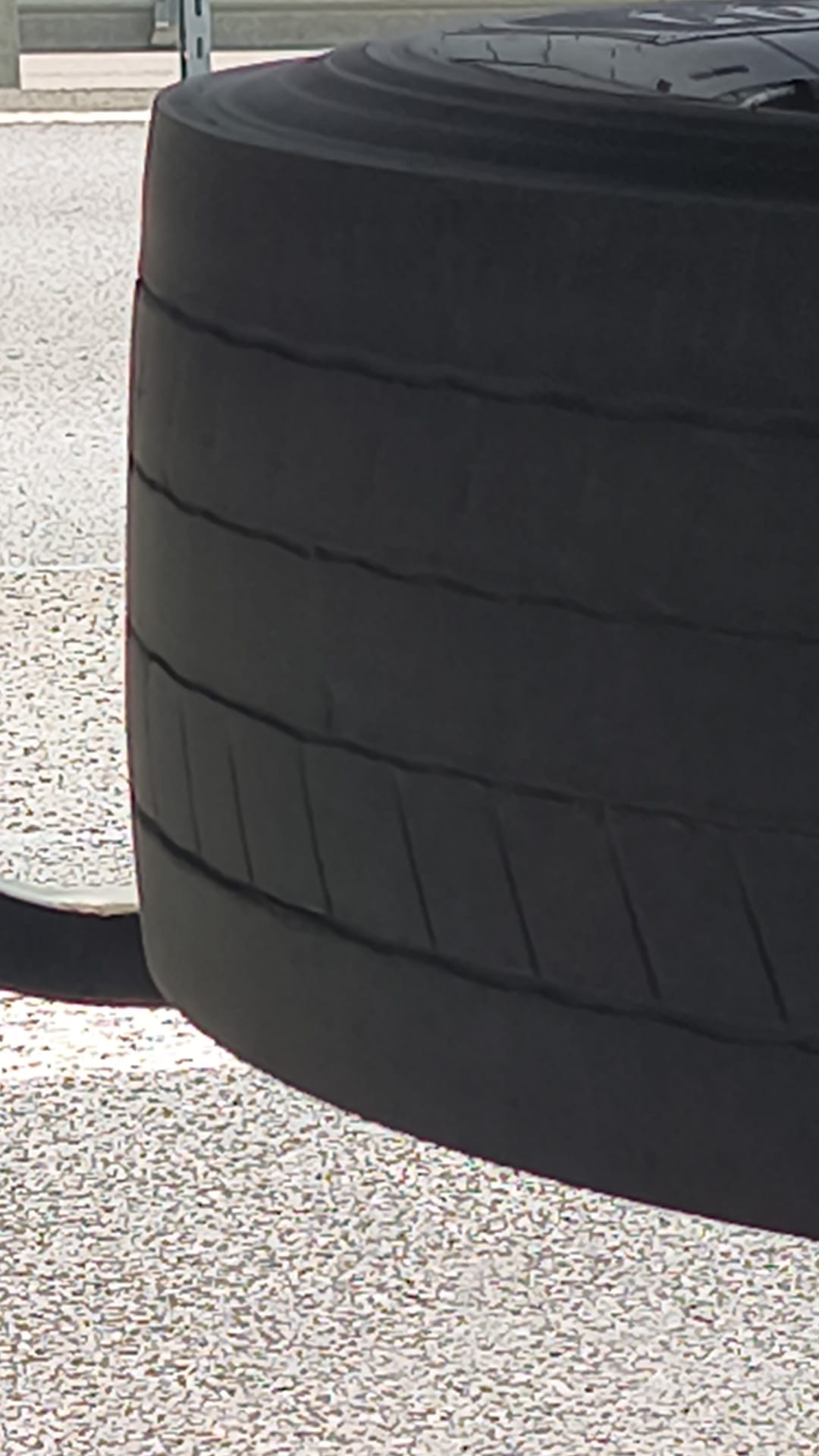
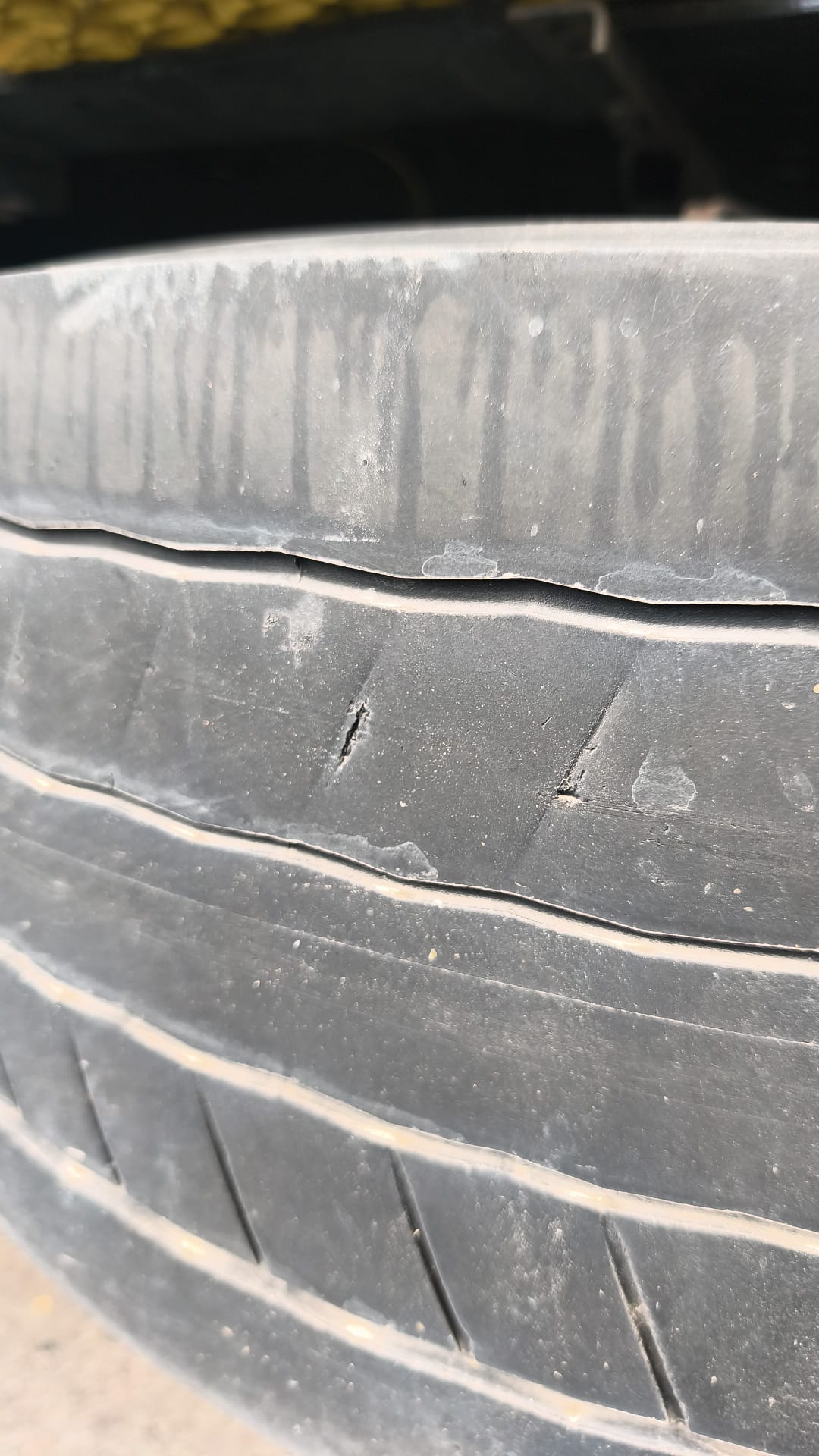
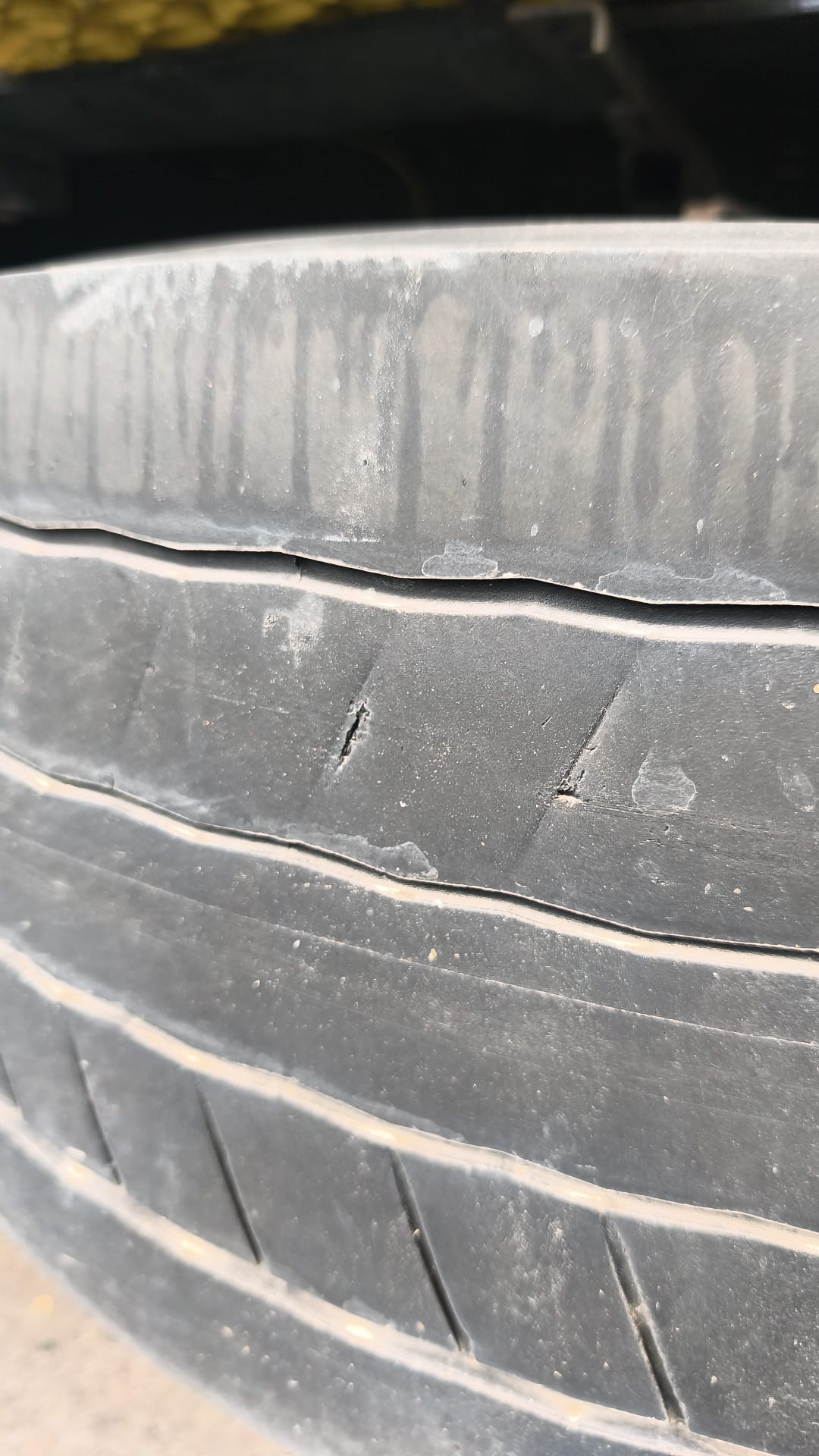
A second issue turned up during the routine walk-around: another tyre on the vehicle showed cracks and cuts across the tread, not an immediate blowout risk but worth flagging to the driver for attention at the next scheduled stop. Catching this kind of secondary wear during an emergency callout is routine practice for us and often saves a second breakdown further down the route.
What a steer-axle blowout does to the vehicle
To understand why this callout mattered, it helps to understand the physics for a moment. A tyre on the steering axle does two jobs at once: it carries roughly a third of the tractor unit’s weight, and it transmits every steering input from the driver’s hands to the road surface. When it fails suddenly at motorway speed, both jobs collapse together.
The vehicle does not drift gently. It pulls hard and immediately toward the side that failed, because the remaining tyre on that axle is now fighting an uneven, partially collapsed contact patch. The steering wheel can be wrenched out of a driver’s hands within a fraction of a second. At 80 km/h or more, that is enough to cross a lane marking before the driver has consciously registered what happened. On a motorway with oncoming traffic separated only by a central reservation, or on a two-lane rural road with no separation at all, the consequence of losing the lane is not hypothetical.
What a driver should do in the first three seconds
The instinctive reactions are almost always the wrong ones. What actually keeps the vehicle under control:
- Grip the wheel firmly with both hands and resist the pull rather than fighting it with large, sudden corrections.
- Do not brake hard. Heavy braking shifts weight forward onto the already-failed tyre and worsens the pull.
- Do not countersteer aggressively. Oversteering the correction is one of the most common causes of jack-knifing after a steer-axle failure.
- Let the vehicle coast down using engine braking and light, progressive pressure on the brake pedal, not a stab.
- Only then ease towards the hard shoulder, signalling early so following traffic has time to react.
Driver training on this exact sequence is inexpensive and takes ten minutes to cover. Fleets that include it in onboarding report noticeably calmer radio calls when a blowout does happen, which in turn means a faster, less chaotic recovery on site.
How the help was organised
Our dispatch model for motorway callouts relies on a network of partner crews positioned across Germany rather than a single central depot, which is what let us reach the A72 in well under half an hour of the initial call.
- Emergency call logged at 13:22. The driver described a steer-axle blowout and gave the motorway, direction and approximate position.
- Dispatch matched to stock, 13:22–13:40. Control room located the incident and identified a partner crew already carrying a 385/55 R22.5 steer-axle tyre in their vehicle, avoiding a return trip to a depot.
- Response drive, 13:40–14:05. The crew drove directly to the hard shoulder location on the A72.
- On-site work, 14:05–14:52. Securing the scene, inspection, removal, fitting and final checks, detailed step by step below.
- Job complete at 14:52. The tractor unit was roadworthy and the driver continued the journey towards Leipzig.
Carrying the correct steer-axle size in the response vehicle, rather than sourcing it after arrival, is what compresses a job like this from a half-day recovery into a 90-minute stop. It is also why dispatch spends real time matching tyre stock to the specific vehicle description before a crew even leaves.
Why this couldn’t wait: pressure, load and rim exposure
A shredded steer-axle tyre is not something to patch and monitor. Truck tyres in this class run at 8.5 to 9.5 bar, considerably higher than a car tyre, and that pressure exists specifically to support the axle load without excessive sidewall flex. Once the carcass is torn, there is no pressure to hold, and the remaining structure cannot bear the weight it was designed for.
More immediately, the exposed rim was already in contact with the road surface. Driving even a short distance on a bare rim damages the wheel itself, can crack a hub, and turns what should be a single tyre replacement into a wheel and possibly hub repair. It also throws sparks and debris that are a hazard to other traffic. There was no scenario here other than a full stop and a proper replacement.
Step-by-step repair on the hard shoulder
Step 1: Inspection. The crew confirmed the failure was isolated to the front-left steer-axle tyre, checked the rim for visible cracks or deformation, and carried out the wider walk-around that flagged the cracked tread on the second tyre.
Step 2: Securing the scene. Warning triangle placed at a safe distance behind the vehicle, hazard lights on, hi-vis vests worn throughout, and the crew positioned to keep the working area shielded from live-lane traffic as far as the hard shoulder allowed.
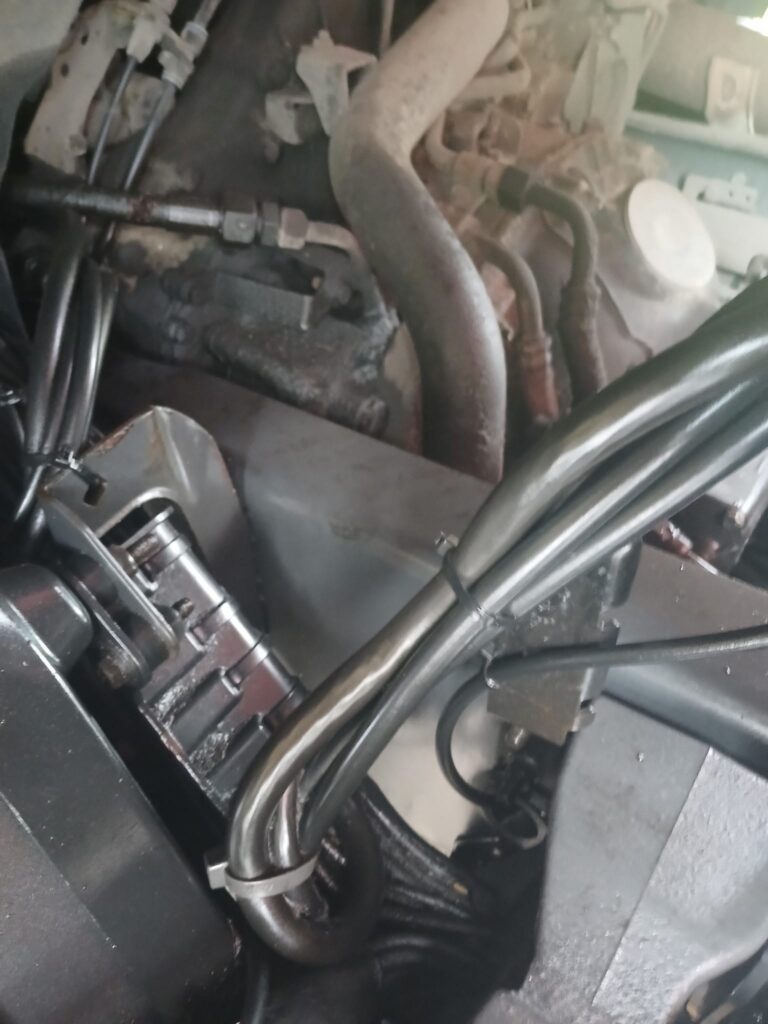
Step 3: Removal. Wheel bolts loosened in sequence, the wheel lifted clear, and the hub and brake components inspected for any debris or damage thrown off during the blowout itself, a step that matters more on a steer axle than almost anywhere else on the vehicle.
Step 4: Fitting. The new 385/55 R22.5 branded tyre mounted, balanced, and torqued onto the hub using a cross-pattern sequence, tightening opposite bolts in turn rather than working around the circle, which seats the wheel evenly and avoids warping the disc.
Step 5: Final check. Torque figures re-verified, tyre pressure set to spec, and a basic alignment check carried out before the vehicle was cleared to move. Wheel bolts on a steer axle are marked for re-torque after roughly 50 km, and the driver was briefed on that requirement before departure.
Full timeline
| Time | Phase | Action |
|---|---|---|
| 13:22 | Emergency call | Driver reports a steer-axle tyre blowout on the A72 hard shoulder near Chemnitz |
| 13:22–13:40 | Dispatch | Control room locates the site, alerts the partner crew carrying a 385/55 R22.5 steer-axle tyre in stock |
| 13:40–14:05 | Response drive | Service team reaches the incident site on the A72 |
| 14:05–14:52 | On-site work | Securing the scene, inspection, removal, fitting, checks |
| 14:52 | Job complete | Tractor unit roadworthy again, resumes journey |
Total time from call to departure: 1 hour 30 minutes.
Costs
| Item | Price (EUR) |
|---|---|
| Callout to the A72 | 260 |
| New steer-axle tyre 385/55 R22.5 (branded) | 480 |
| Fitting, balancing, alignment check | 220 |
| Disposal of old tyre | 20 |
| TOTAL | 980 |
All figures are net, plus statutory VAT. The three factors that move the price on any given job are location and time of day, tyre size and brand, and whether secondary damage to the rim or hub is found during inspection. In this case the rim had surface contact but no structural crack, which kept the job to a straight tyre replacement rather than a wheel exchange.
Set against the alternative, the number looks different. A stranded articulated lorry costs a haulier roughly €800 to €1,200 per day in lost use, driver hours and delayed cargo, before any penalty clauses on the load itself are even considered. A €980 callout that returns the vehicle to service in 90 minutes is, in almost every case, the cheaper outcome by a wide margin.
Why you need a professional, not a roadside fix
A steer-axle failure is one of the few truck repairs where attempting a shortcut is genuinely dangerous, not just inadvisable.
- No spare fits reliably without balancing equipment. An unbalanced steer-axle wheel vibrates the whole cab at speed and accelerates wear on track rods and shock absorbers.
- Torque sequence matters more here than anywhere else on the vehicle. Uneven torque on a steer-axle hub can warp the brake disc or leave bolts working loose within a few hundred kilometres.
- Alignment drifts the moment a steer tyre is replaced without a check. Skipping this step causes uneven wear on the new tyre almost immediately.
- Retreads are not permitted on the steer axle for both legal and practical reasons covered below, so fitting one, even temporarily, creates a compliance problem alongside the safety one.
- A hub or rim crack missed during a rushed change can fail later at speed, turning a manageable roadside job into a genuine emergency.
Why only new tyres go on the steer axle
German regulation under § 36 StVZO sets tread depth and construction requirements for tyres, and steer-axle positions in particular are treated more strictly across the industry than drive or trailer axles. Retreaded tyres are broadly prohibited on the steer axle of heavy goods vehicles because the steering axle demands consistent, predictable carcass strength under lateral load, something a retread’s bonded tread layer cannot guarantee to the same standard as a tyre built as a single unit. This is not a formality. It is the same load-bearing, direction-critical logic that makes a steer-axle blowout more dangerous than any other tyre failure in the first place.
Fleet managers specifying tyres should treat the steer axle as a separate purchasing decision from the rest of the vehicle, always new, always matched in size and load index, and always checked against § 36 StVZO requirements before a vehicle leaves the yard. The official text of § 36 StVZO sets out the tread depth and construction rules in full.
Typical callouts we handle across Germany
Steer-axle blowouts on the A72 are one entry in a much wider pattern of work we see nationwide, month in and month out.
- Steer and drive axle blowouts on articulated lorries and semi-trailer combinations, in sizes ranging from 245/70 R19.5 on lighter rigids up to 315/80 R22.5 and 385/65 R22.5 on heavy tractor units.
- Wheel hub and track rod damage following a high-speed tyre failure, where the blowout itself was only the first symptom.
- Recovery and towing for vehicles that cannot be made roadworthy on site, including combinations with cargo constraints on driving hours.
- Mobile workshop visits for fleets that prefer scheduled tread depth and pressure checks over reactive emergency calls.
- Tyre pressure and tread inspections during unrelated callouts, the same kind of secondary check that flagged the cracked tread on this Scania.
Prevention: what drivers and fleets can do
Most steer-axle blowouts give some warning before they happen. Building a five-minute pre-trip habit around tyre condition catches the majority of them before they turn into a motorway emergency.
For drivers:
– Check tyre pressure cold, before the vehicle has been driven, since running pressure reads high and can mask a slow leak.
– Look for cracks, cuts or bulges in the sidewall and tread, not just obvious wear, at every stop.
– Note any pull or vibration in the steering as soon as it starts rather than waiting to see if it worsens.
For fleets:
– Set a fixed replacement interval for steer-axle tyres rather than running them to the legal tread minimum.
– Standardise on branded tyres such as Michelin, Continental, Goodyear or Bridgestone for steer positions, where carcass consistency and load index accuracy matter most.
– Log torque and alignment checks after every steer-axle replacement, including the 50 km re-torque, as a fixed maintenance step rather than an optional extra.
– Brief every driver on the correct blowout response before it happens, not after.
Independent bodies including DEKRA and TÜV publish regular data on commercial vehicle tyre condition during roadside inspections, and steer-axle tread depth is consistently one of the most cited defects. It is a preventable one.
FAQ
How much does a motorway truck tyre change cost?
A typical steer-axle callout, including the emergency response, a new tyre, fitting and disposal, runs in the region of €980 net, though the exact figure depends on tyre size, location and any secondary damage found.
How long does a steer-axle tyre change take on the motorway?
From emergency call to a roadworthy vehicle is usually 60 to 120 minutes, depending on traffic access and whether the correct tyre size is already carried by the responding crew, as it was in this case at 90 minutes.
Who pays for the callout?
In most cases the haulier or vehicle operator settles the callout directly, though many international drivers coordinate payment through their dispatcher or fleet office while the work is carried out.
Can retreaded tyres be fitted to a steer axle?
No. German regulation and industry practice restrict retreads to drive and trailer axles; steer-axle positions require new tyres due to the higher structural and steering demands, as set out under § 36 StVZO.
What should a driver do in the first seconds after a steer-axle blowout?
Grip the wheel firmly, avoid hard braking or aggressive countersteering, let the vehicle coast down, and only then steer gently towards the hard shoulder.
Does a blowout always damage the rim?
Not always, but a shredded carcass frequently exposes the rim to the road surface within seconds, which is why continuing to drive on a blown steer-axle tyre, even briefly, risks turning a tyre job into a wheel or hub repair.
Why choose us
We run 24/7 across Germany, with a partner network positioned to reach most motorway incidents within 30 to 45 minutes of the initial call. Every price is quoted upfront before work begins, with no surprises on the invoice. Dispatch operates in German, English and Polish, which matters on routes like this one, where an international driver needs to describe a problem quickly and clearly under pressure. Crews carry common steer-axle sizes as standard stock precisely so that a job like this A72 callout does not need a second trip.
Summary
- Tyre: 385/55 R22.5, steer axle, complete blowout with exposed rim
- Location: A72 hard shoulder near Chemnitz, direction Leipzig
- Response time: dispatch to arrival in under 45 minutes
- Total time: 1 hour 30 minutes, call to departure
- Cost: €980 net (plus VAT)
- Secondary finding: cracks and cuts in the tread of a second tyre, flagged for the driver
Call us now
A steer-axle blowout does not wait for a convenient moment, and neither should the response. If a tyre has failed on the front axle, get the vehicle stopped safely, call +49 160 5753826, and a crew carrying the right stock will be dispatched immediately. We operate 24/7 across Germany. Full service details are at www.lkwhelp24.com.
Keywords: steer axle tyre service | truck tyre service | tyre blowout motorway | Scania steer axle | 385/55 R22.5 | roadside truck breakdown | HGV tyre change A72 | emergency tyre service Germany | articulated lorry breakdown assistance
Related articles
- Truck tyre service on the A9 near Nuremberg: Volvo FH460 steer axle
- Truck tyre blowout on the A2 near Bielefeld: Scania steer axle
- Truck tyre blowout on the A14 near Leipzig: steer axle
- Truck tyre service on the A6 near Mannheim: Scania 385/55 R22.5
- Steer axle blowout roadside service: what every driver should know
- Load index guide for truck and commercial vehicle tyres
For emergency towing, our towing service covers combinations that cannot be made roadworthy on site, while our tyre service page details coverage for all axle positions and sizes. Fleet managers planning ahead can also review our mobile truck service for scheduled inspections, our workshop service for hub and alignment work, or reach dispatch directly through our contact page.