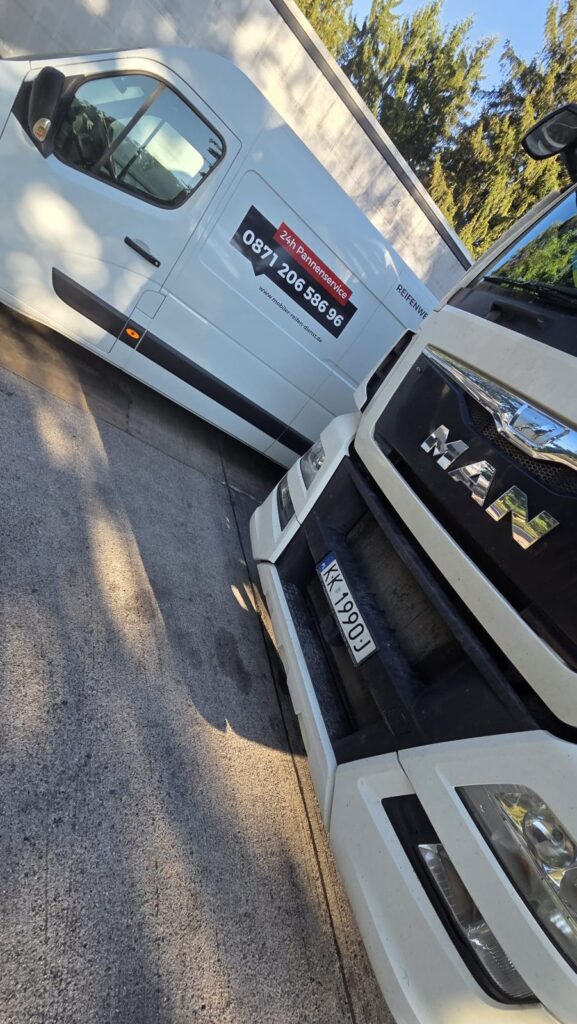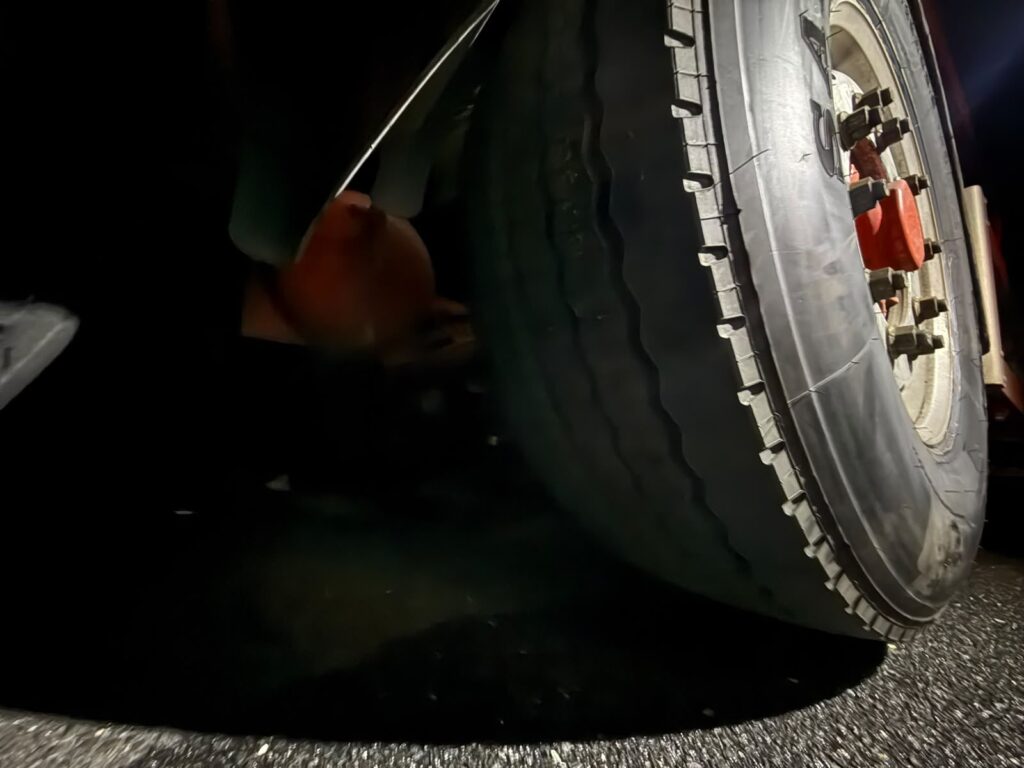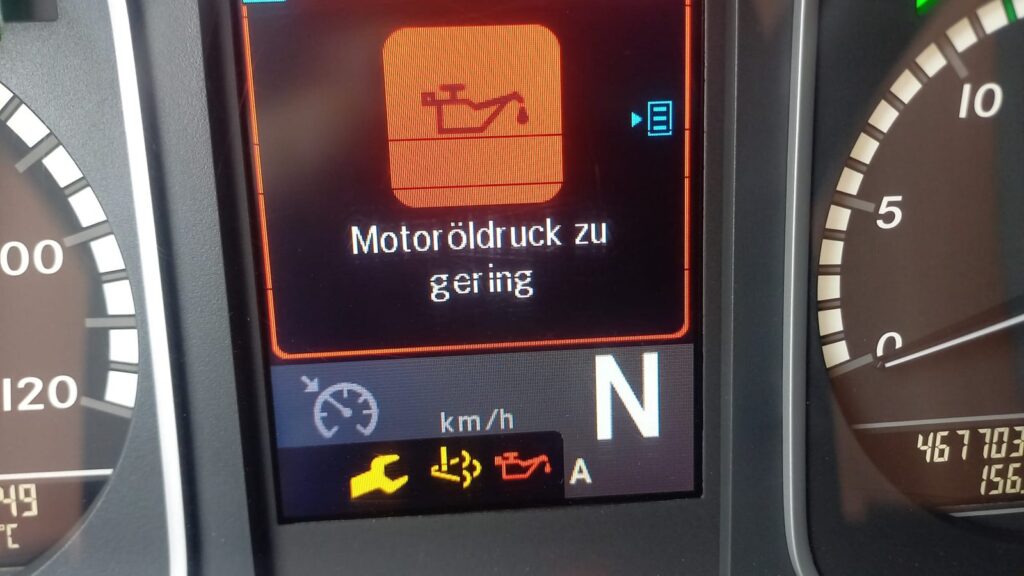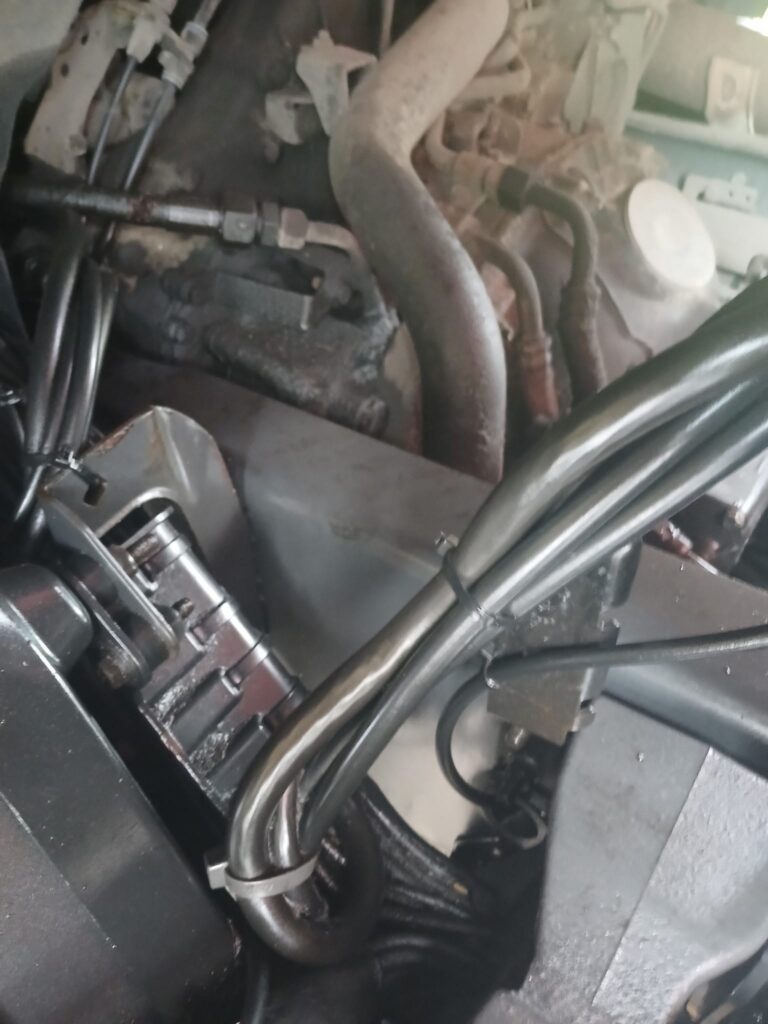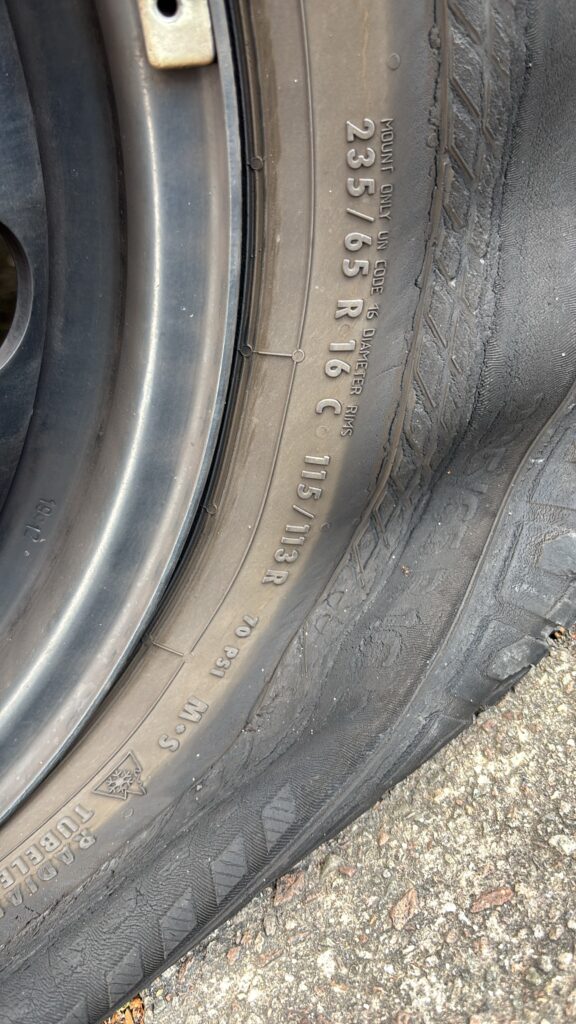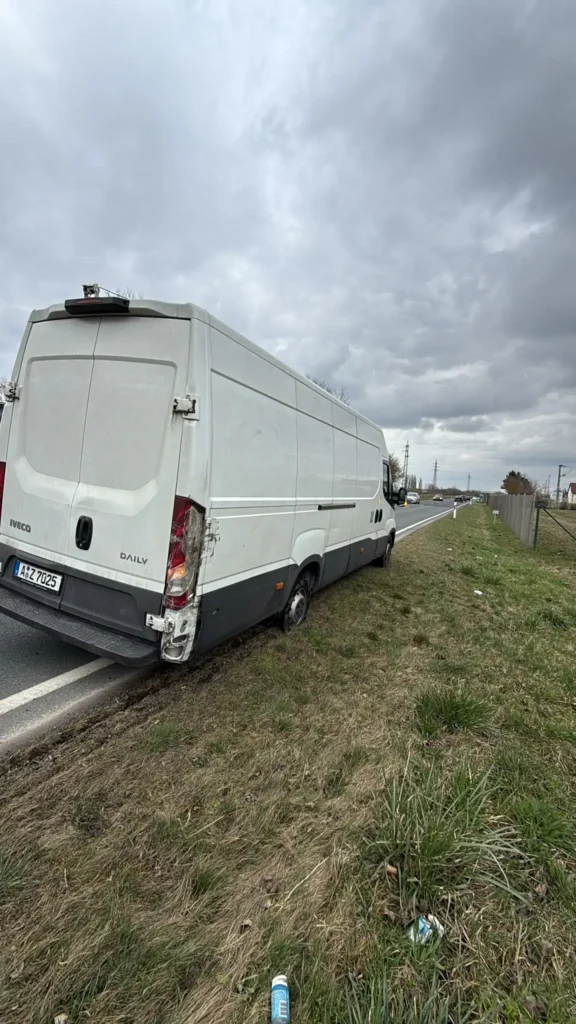
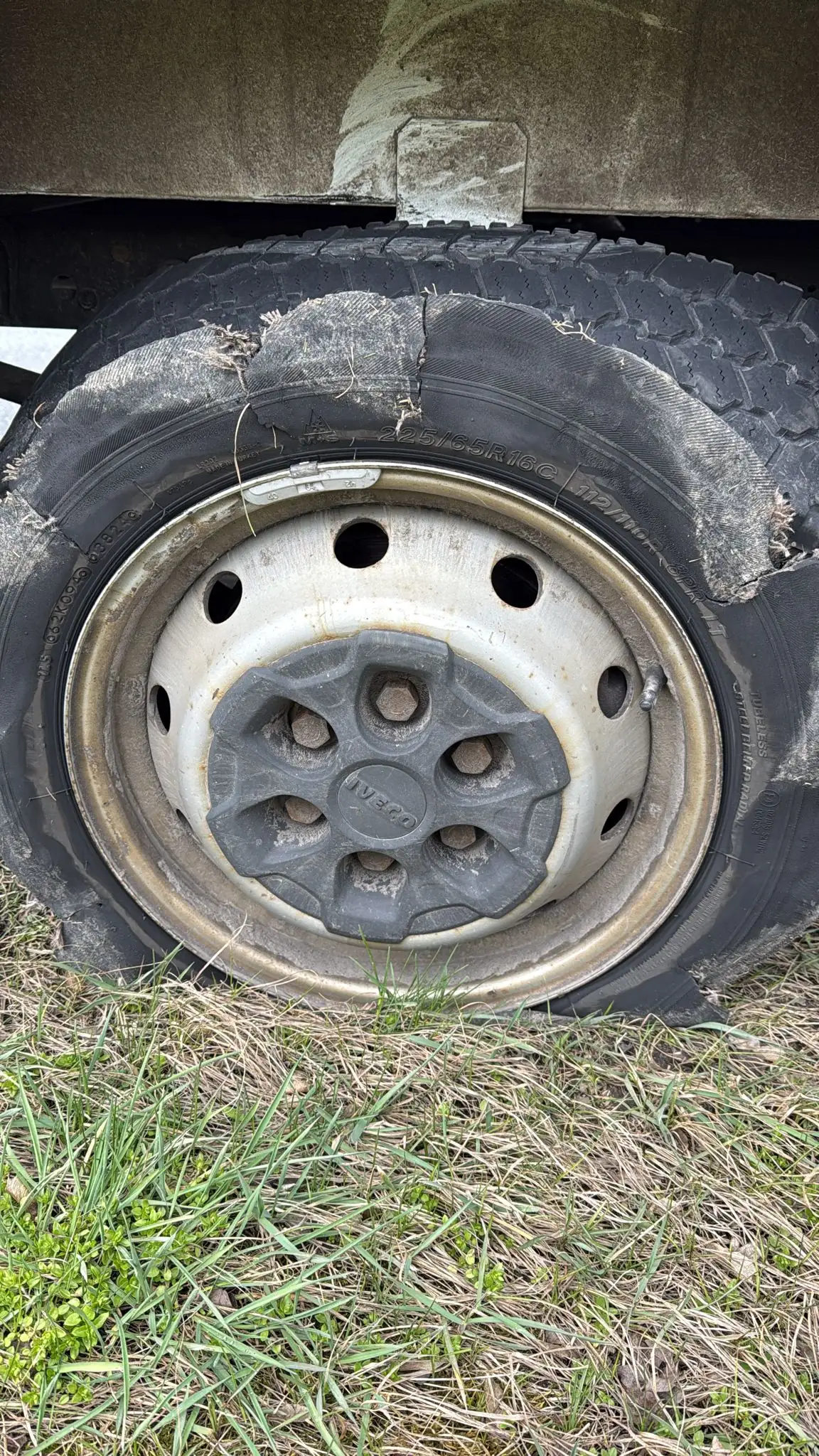
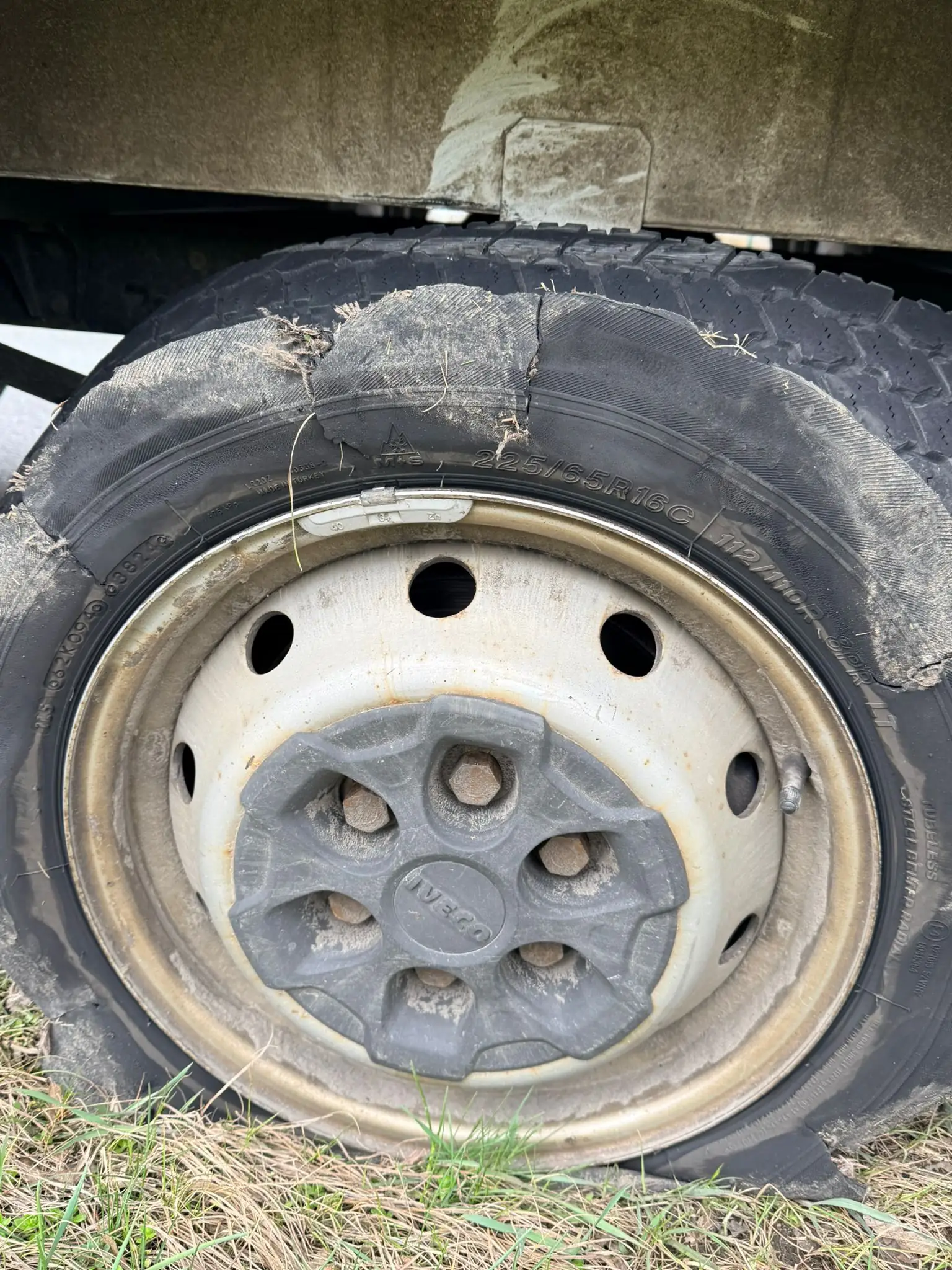
A rear tyre on an Iveco Eurocargo, a truck of 7.5 tonnes and above, failed on the B2 near Augsburg, tearing open and shedding tread while the truck was moving. The driver lost control of the rear end and slid onto the verge, with one wheel dropping into the roadside ditch. LKWHelp24 dispatched a mobile heavy-vehicle partner from the Augsburg/Swabia area, who secured the scene, pulled the truck clear of the ditch, fitted a new 315/80 R22.5 tyre via our tyre service and released the vehicle back onto the road. Total time from call to release: roughly 1 hour 45 minutes, with about 50 minutes spent on site.
Why a truck tyre blowout is more dangerous than it looks
Drivers often assume that a tyre failure on a heavy truck is a bigger version of the same problem on a car: pull over, swap the wheel, drive on. In practice, a rear tyre blowout on a loaded Iveco Eurocargo behaves very differently. The rear axle of a 7.5-tonne-plus truck carries a substantial share of the payload, and when a tyre such as a 315/80 R22.5 lets go at speed, the sudden change in rolling resistance on one side of the axle can pull the vehicle sideways before the driver has time to react. That is exactly what happened on the B2: the rear end stepped out, and the truck ended up on the verge with a wheel in the ditch.
Tread separation is particularly unforgiving because it rarely gives much warning, as with the trailer tyre blowout we handled on the A10 near Michendorf. Unlike a slow puncture, a delaminating tread can shed large sections in a fraction of a second, changing the handling balance instantly. On a two-lane rural road like the B2, with oncoming traffic and no hard shoulder to speak of, that instant is often all it takes to put a vehicle into the verge rather than safely onto the roadside.
This is also why breakdown assistance for heavy trucks needs to move on two fronts at once: making the scene safe for other road users, and getting the vehicle out of a position where it is blocking a lane or sitting at an unstable angle. Both mattered here, and both were dealt with in the same visit.
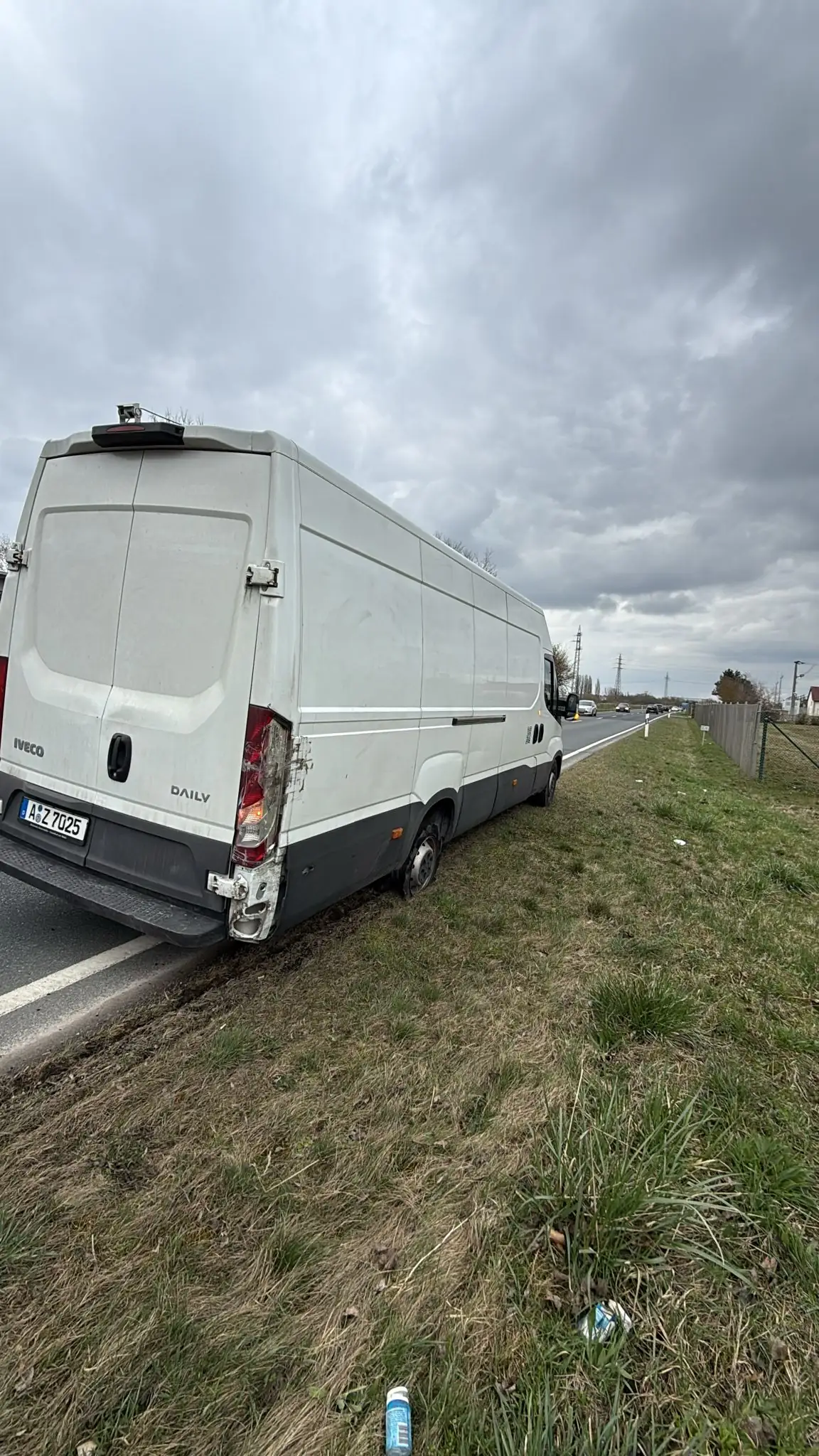
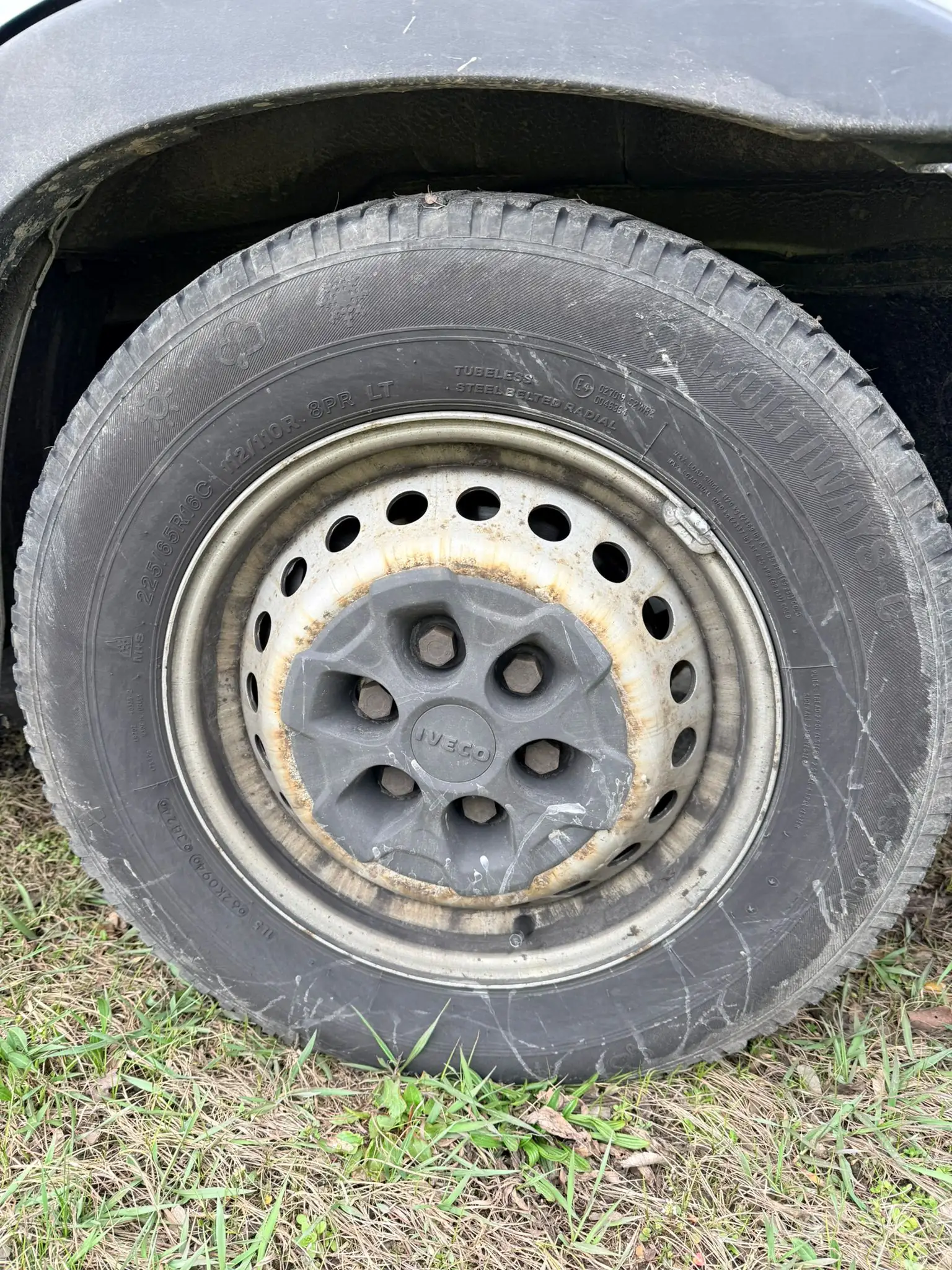
Iveco Eurocargo with a tyre failure (315/80 R22.5) in the roadside ditch: recovery and on-site tyre replacement by LKWHelp24 on the B2 near Augsburg.
The emergency
The call came in at 13:40. The driver reported a loud bang from the rear of the truck, followed immediately by a loss of steering control and the vehicle sliding off the carriageway onto the grass verge along the B2. One rear wheel had gone into the roadside ditch, the tyre was visibly torn open with tread hanging loose, and the truck was resting at an angle, not upright on level ground. The driver was unhurt, but the vehicle could not be driven and was partially off the road in a position that needed attention before any repair work could begin.
This is a fairly typical pattern for breakdown assistance calls involving a tyre blowout on trucks of 7.5 tonnes and above: the tyre failure itself is only step one of the problem. Step two, and often the more time-consuming one, is dealing with wherever the vehicle has ended up as a result.
How help was organised
LKWHelp24 runs a round-the-clock dispatch model built around a network of mobile partners covering different regions of Germany, so a call anywhere on the road network reaches a technician who can get there quickly rather than one based hours away. For a location on the B2 near Augsburg, that meant activating a mobile heavy-vehicle service based in the Augsburg/Swabia area.
The dispatch sequence:
● 13:40, call received, situation logged (location, vehicle type, nature of damage, position of the truck) ● 13:55, mobile partner in Augsburg/Swabia dispatched with an estimated time of arrival ● En route, driver kept informed of progress and expected arrival window ● 14:35, technician on site at the B2
Because the partner network is organised by region rather than dispatched from a single central depot, the gap between the call and a technician being on the road stayed short: 15 minutes from call to dispatch. Response times like this are why a 24/7 breakdown service is only as useful as the coverage behind it, not just the phone line answering.
The situation on site
On arrival at 14:35, the technician found the Iveco Eurocargo resting on the verge with the nearside rear wheel down in the ditch. The rear tyre, a 315/80 R22.5, had suffered a tread separation: a section of the tread had torn away from the carcass and partially delaminated, leaving the tyre unusable and the wheel unsupported on that corner.
The weather was overcast and the truck sat on a B-road with moving traffic, so the first job before touching the vehicle was making the scene safe. That meant a warning triangle and hazard lighting positioned to give approaching traffic clear warning, and the truck’s own position checked to confirm it was stable enough to work around without shifting further into the ditch. There was no roll-over and no damage to the rim or chassis, so the job stayed within the scope of a straightforward recovery and tyre job rather than turning into a structural inspection.
With the scene secured, the technician moved on to freeing the truck from the verge.
Step by step: from ditch to roadworthy
Step 1: secure the scene. Warning triangle and hazard lighting set up to protect the technician and the stranded vehicle from passing traffic on the B2, and the truck’s position assessed before any recovery work started.
Step 2: recover the truck from the verge. Using recovery equipment suited to stabilising and pulling a heavy vehicle out of a roadside ditch, the technician lifted and pulled the Eurocargo back onto solid, level ground. This step needs care. Pulling at the wrong angle or too quickly can shift a vehicle further into soft ground rather than out of it, so the recovery was done as a controlled, gradual pull rather than a single yank.
Step 3: remove the damaged wheel and inspect the rim. With the truck back on firm ground, the wheel carrying the torn 315/80 R22.5 tyre was removed. The rim was checked for dents, cracking and bead-seat damage, since a wheel driven on a collapsing tyre and then dragged through a ditch is a reasonable candidate for hidden damage. In this case the rim came through undamaged.
Step 4: fit the new tyre. A replacement 315/80 R22.5 tyre was mounted on the wheel, balanced and fitted to the axle.
Step 5: torque, pressure and final check, then release. Wheel nuts were torqued to specification, tyre pressure set to the correct value for the axle and load, and a visual and functional check carried out, covering wheel alignment by eye, brakes and general roadworthiness, before the truck was cleared to continue its journey.
Full timeline
| Time | Phase | Action |
|---|---|---|
| 13:40 | Call received | Driver reports rear tyre failure, truck off the road onto the verge, B2 near Augsburg |
| 13:55 | Partner dispatched | Mobile heavy-vehicle service in Augsburg/Swabia assigned, ETA given |
| 14:35 | On site | Technician arrives at the B2, assesses the truck and the damaged tyre |
| 14:50 | Secured & recovered | Scene made safe, truck lifted and pulled out of the verge/ditch |
| 15:15 | Tyre replaced | Damaged wheel removed, rim checked, new 315/80 R22.5 tyre fitted |
| 15:25 | Checked | Torque, pressure and function check completed |
| 15:25 | Released | Truck cleared to continue its journey |
Total elapsed time from call to release: roughly 1 hour 45 minutes. Time spent actually working on site: around 50 minutes.
Cost breakdown
| Item | Price (EUR) |
|---|---|
| Call-out / 24/7 daytime service | 290 |
| Recovery from verge/ditch | 160 |
| Tyre fitting on site | 110 |
| New 315/80 R22.5 tyre | 320 |
| Old-tyre disposal + valve | 25 |
| TOTAL | 905 |
A few things drive the price in a case like this. The daytime call-out starts from 290 €; a call-out at night or on a Sunday/public holiday starts from 549 €. The recovery element costs more than a routine roadside tyre change on flat ground, because pulling a heavy truck out of a ditch safely takes recovery equipment rated for vehicles of 7.5 tonnes and above, plus a slower, more deliberate process. Tyre fitting on site, including torque control, and the new tyre itself (truck tyres from R17.5 start from 315 € with us) make up the largest share of the material cost. Disposal of the old tyre plus a new valve rounds off the bill. The exact fixed price is always confirmed by phone before the technician sets off.
It’s worth comparing this against the alternative of towing the truck to a workshop instead of doing the repair on site. Towing a stranded truck from a rural road, having a workshop diagnose and fit a tyre, and then arranging a way to collect the vehicle afterwards typically costs more in total and takes considerably longer, often the best part of a day rather than under two hours. For a commercial vehicle that needs to get back on the road and back to work, a mobile tyre service that can recover, repair and release in one visit is usually the cheaper option as well as the faster one.
Why a professional service is essential
A tyre blowout that puts a heavy truck into a ditch is not a job for a passing motorist with a spare wheel, and it shouldn’t be treated as one. There are two separate risks that a professional recovery and tyre service is set up to manage.
The first is traffic safety. A truck sitting on the verge of a B-road, especially in overcast conditions with reduced visibility, is a hazard to other drivers until it is properly marked and, ideally, moved clear. Professional technicians carry the warning equipment and know the positioning that makes a roadside job safe rather than a second accident waiting to happen.
The second is the recovery itself. Pulling a heavy vehicle out of a ditch incorrectly can cause more damage than the original tyre failure: bent suspension components, a damaged rim, or the vehicle sliding further into soft ground. Recovery from a ditch needs the right equipment and a controlled technique, which is what our mobile truck service partners are equipped and trained to provide.
There’s also the question of the tyre itself. Truck tyres such as 315/80 R22.5 or 295/80 R22.5 fitments are load-rated very differently from passenger-car or van tyres, and fitting the wrong specification, or fitting a tyre that isn’t properly seated and torqued, is not a risk worth taking on a vehicle that will go straight back to carrying a full load.
Typical breakdown situations we handle
LKWHelp24’s mobile partner network deals with a wide range of truck breakdown situations for vehicles of 7.5 tonnes and above across Germany, including:
- Tyre blowouts and tread separation on trucks, including recovery from ditches or the verge, on 315/80 R22.5 and 295/80 R22.5 tyres
- Jump-starts for flat batteries on trucks stranded at the roadside
- Steering and suspension faults that leave a vehicle unsafe to drive
- Drive-axle tyre failures on heavier trucks, which carry different recovery and replacement considerations
- General roadside tyre replacement for punctures, sidewall damage and wear-related failures
Related cases from our archive illustrate the range: a truck recovery on the A4 near Bautzen that required a flatbed transport rather than an on-site fix, a jump start on the A9 near Hermsdorf for an Iveco Eurocargo with a dead battery, a steering repair on the A8 near Augsburg involving a damaged track rod, and a drive-axle tyre blowout on the A9 near Dessau.
Prevention tips for truck tyres
Tread separations like the one on this Eurocargo are usually the result of factors that build up over time rather than a sudden, unpredictable failure. A few habits cut the risk substantially.
Check tyre age, not just tread depth. A tyre can have plenty of tread left and still be structurally unsound if it’s old, since rubber compounds harden and the internal structure degrades with age, particularly on vehicles that sit idle between jobs. The manufacture date is moulded into the sidewall (DOT code) and is worth checking on any truck tyre over five years old.
Inspect tread condition regularly, looking for uneven wear, bulges or any sign of the tread starting to lift at the edges. Those are early signs of the kind of delamination that led to this blowout.
Keep tyre pressure correct for the load. Underinflation is one of the most common causes of heat build-up inside a tyre, and heat build-up is a direct contributor to tread separation, especially on rear axles carrying a heavier share of a loaded truck’s weight.
Match the tyre to the vehicle’s duty cycle. A truck doing long motorway stints under full load puts more sustained heat into its tyres than one doing short urban drops, and tyre choice and pressure should reflect that.
These checks matter more on trucks of 7.5 tonnes and above than on lighter vehicles, simply because the rear axle typically carries a higher, more variable load, and a failure at speed has more energy behind it.
Extended service note
LKWHelp24’s mobile tyre service covers the full range of truck fitments, including 315/80 R22.5 and 295/80 R22.5, for vehicles of 7.5 tonnes and above. For operators running multiple vehicles, our fleet service model means a single call covers breakdown assistance, recovery from a verge or ditch, and on-site tyre replacement anywhere in Germany, without needing a different provider for each region. Original-equipment tyre and parts information for Iveco models is available through IVECO Germany, and current traffic information for the B2 and the Augsburg area is published by Die Autobahn GmbH des Bundes. For drivers who want to understand repair options before a tyre is written off, see truck tyre repair, and for smaller tyre faults that don’t involve a recovery, our emergency truck tyre service is available around the clock. LKWHelp24 is reachable around the clock, every day of the week, anywhere in Germany, by phone or WhatsApp, in German, English, Polish and Russian.
Why LKWHelp24
LKWHelp24 runs a nationwide network of mobile partners rather than a single depot, and that is what let a technician based in Augsburg/Swabia reach the B2 within about 55 minutes of the call being logged. The same visit covered the recovery from the ditch and the tyre replacement, avoiding the delay and extra cost of a separate tow. A transparent fixed price confirmed by phone before dispatch, recovery equipment on the vehicle, and the ability to fit heavy-truck-spec tyres on site: that combination is the standard we aim to deliver on every breakdown assistance call, whatever the region and whatever the time of day.
Summary
- Location: B2 near Augsburg, Bavaria
- Vehicle: Iveco Eurocargo, truck 7.5 t and above
- Problem: tyre blowout with tread separation, vehicle on the verge/in the ditch
- Response time to arrival: 55 minutes
- Time on site: approx. 50 minutes
- Total duration: approx. 1 hour 45 minutes
- Total cost: 905 EUR
- Secondary damage: none
Request emergency help now
A tyre blowout or a recovery from the verge can happen at any time, on the motorway, the B-road or in city traffic. LKWHelp24 is available around the clock across Germany and brings recovery equipment and mobile tyre service directly to the scene.
Request emergency help now: +49 160 5753826 | lkwhelp24.com Available around the clock across Germany.
You might also be interested in
Further reading: https://lkwhelp24.com/en/truck-service/.