Skip to content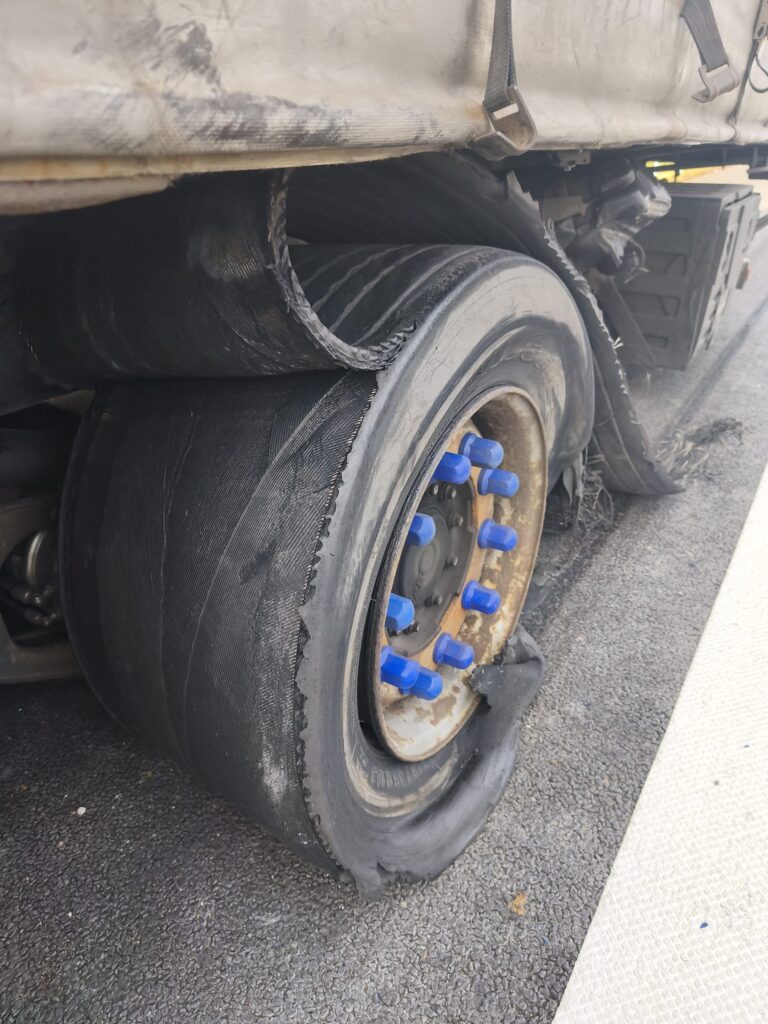
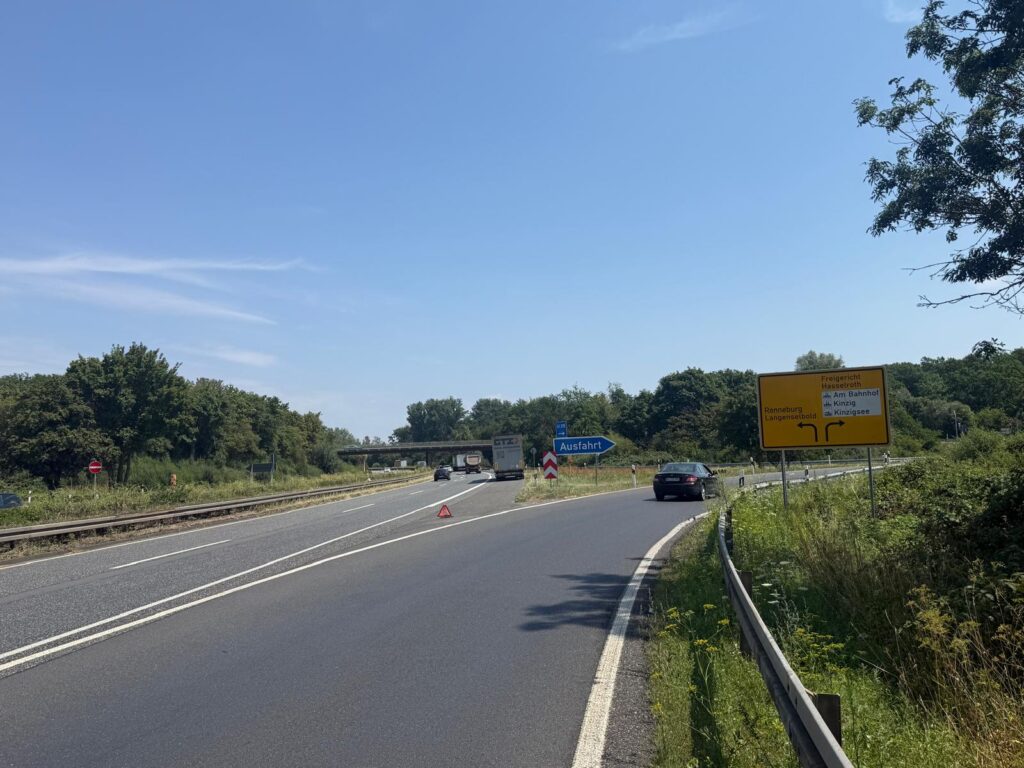
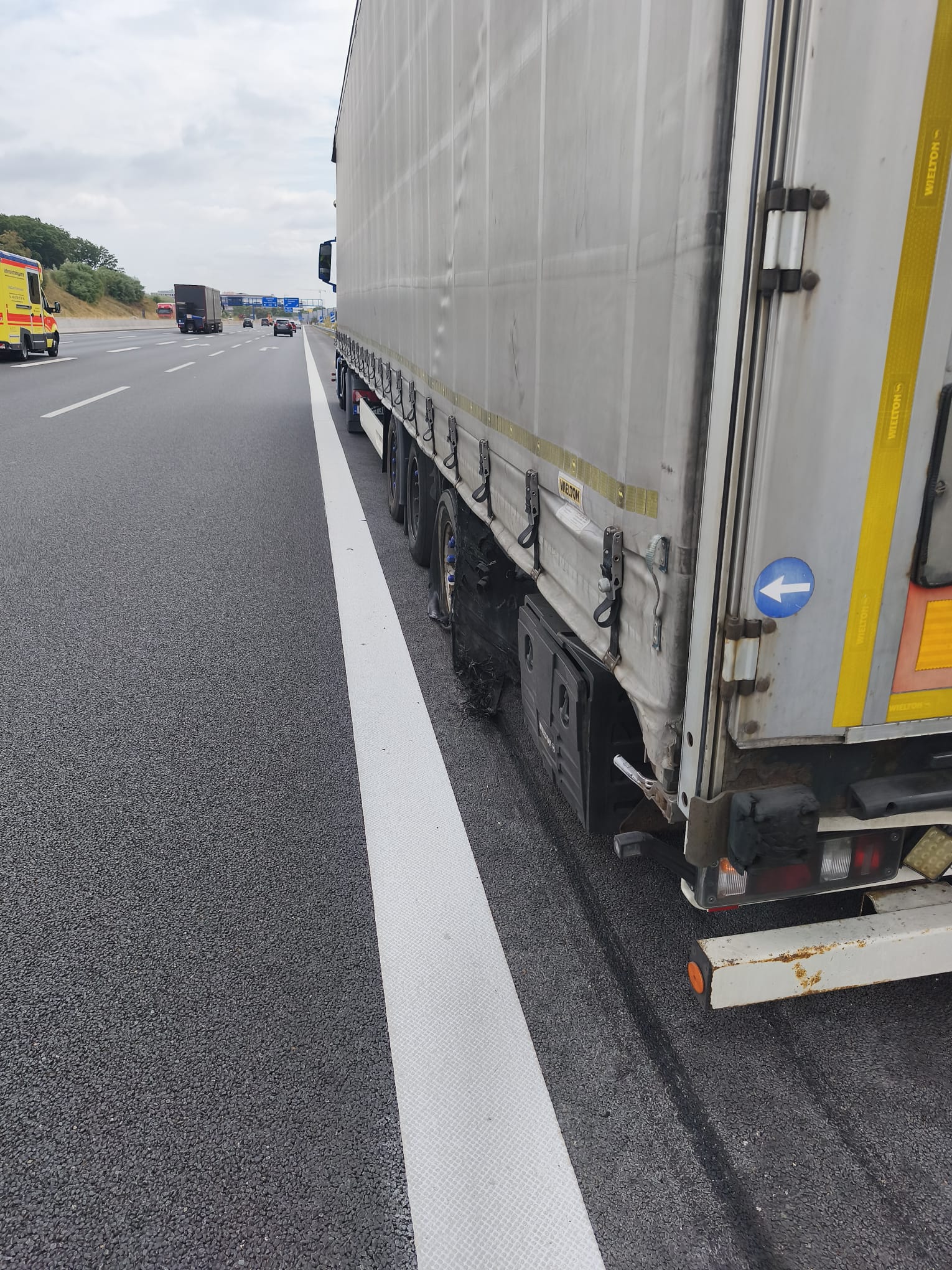
A blown trailer tyre is already a solid problem on its own. When it happens right where emergency crews are working a road accident and traffic has ground to a halt, a technical breakdown turns into a logistics puzzle with several layers at once. That is exactly what happened on 6 August on the A5 near Gießen, heading towards Kassel: an articulated lorry with a curtain-sided trailer lost a tyre on the twin-wheel set on the nearside lane, while an ambulance was working an accident a few hundred metres ahead.
What followed was not a standard job. The technician had to do more than loosen the wheel nuts and fit a fresh 385/65 R22.5 — first he had to physically get to the scene, through a traffic jam threaded by an emergency corridor that every vehicle, including his own, has a legal duty to respect. This article walks through how such a mobile truck tyre service call plays out in practice, what it costs, and why being straight about arrival times matters more in this kind of situation than any marketing promise.
The starting point: a blowout in the middle of an emergency-corridor jam
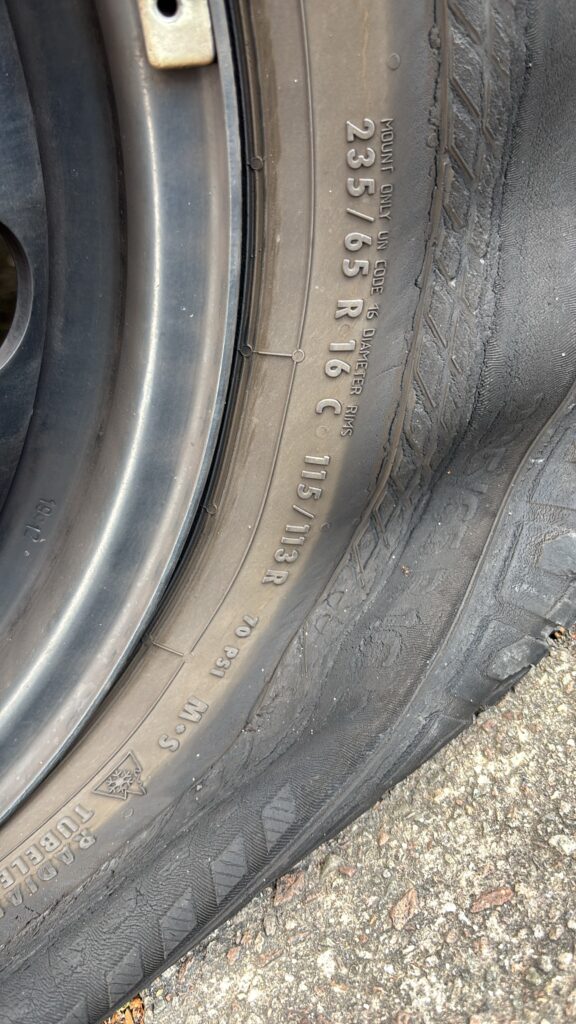
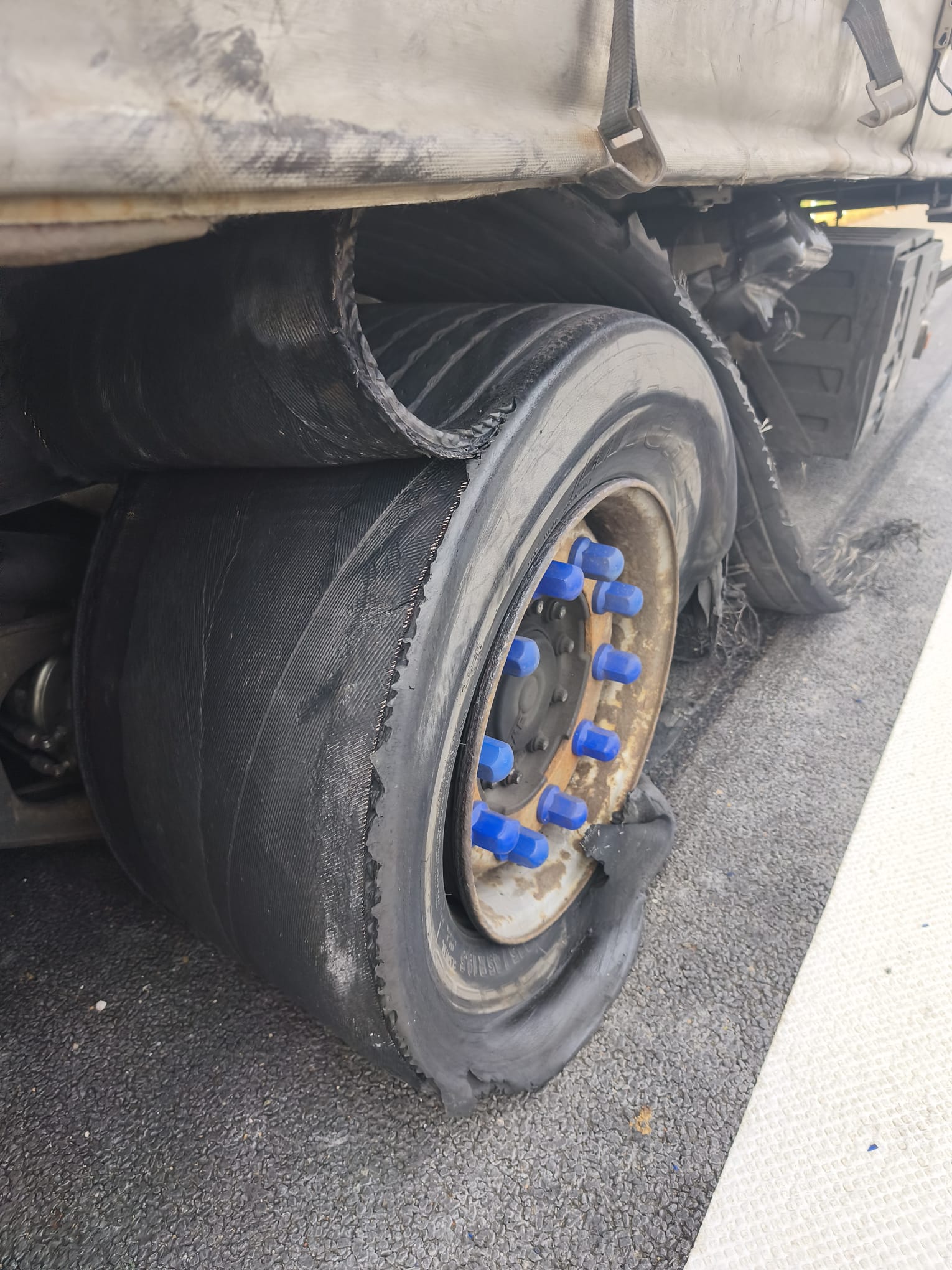
The driver called dispatch mid-morning. His articulated lorry with a curtain-sided trailer was stuck on the A5 between Gießen and Kassel in traffic that had backed up after a road accident. Ambulances, and apparently other emergency vehicles, were already on scene, with lanes partially blocked. In that situation, a tyre on the trailer’s twin-wheel set let go — the tread had come away from the carcass completely and lay in strips across the tarmac.
The specification was clear straight away: 385/65 R22.5, a common trailer size built for high load capacity. The neighbouring tyre on the same twin set was still holding air, but had visibly taken damage from debris thrown off during the blowout — heat and flying rubber from a burst tyre can quietly damage the tyre next to it without it being obvious at first glance. Checking that was one of the first things done on arrival.
What set this job apart from an ordinary roadside tyre change was context. The lorry wasn’t sitting freely accessible on the hard shoulder; it was boxed in by a jam structured around an active emergency corridor. Every approach and every positioning of the service van had to work within that constraint.
The Rettungsgasse: a legal duty, not a courtesy
Anyone caught in stationary or crawling traffic on a German motorway, or a multi-lane road outside built-up areas, must form an emergency corridor immediately — not only once blue lights become visible. § 11 StVO sets this out explicitly. The rule itself is simple, though it’s misapplied surprisingly often: with two lanes, traffic in the left-hand lane pulls left and everyone else pulls right; with three or more lanes, the corridor forms between the outermost left lane and all the others.
This isn’t a matter of politeness — it’s a statutory duty, and ignoring it carries real penalties. Failing to form or blocking an emergency corridor can bring fines of between €200 and €320 under the current catalogue, plus penalty points on the driver’s licence and, in serious cases, a driving ban of up to a month. ADAC regularly points out how often this corridor is either missing entirely or gets clogged by rubberneckers and impatient drivers, leaving ambulances, fire crews, and yes, roadside assistance vans stuck in the same queue.
For this job, that meant the technician could not treat the corridor as a convenient extra lane to save time. He had to work with the traffic situation, coordinate with the emergency crews on scene, and wait for their go-ahead before entering the immediate accident area.
Why a breakdown inside a jam is a special case
On a clear hard shoulder, the maths is straightforward: drive there, secure the scene, do the work. Once the stranded vehicle sits inside a jam next to an active rescue operation, the whole logic of the callout changes.
First, the service van simply has no clear route — it’s stuck in the same traffic or has to take a longer way round. Second, at the accident scene one priority overrides everything else: emergency services and police come first, and any civilian activity nearby has to fit around that. Third, this stretches the time before the actual repair starts — not because the technical work is harder, but because access is restricted.
Being honest about that is part of the job. Promising arrival within 40 minutes in this kind of situation is a promise nobody can keep, and it only adds stress for a driver already stuck in an accident-adjacent jam. The realistic figure is different: it can take an hour and a half to two hours before the service van even reaches the affected axle, depending on how long the traffic stays blocked and how the emergency crews manage access.
Priority for emergency services — no way around it
One principle governed the entire callout: the technician does not start work until police or ambulance crews have cleared the situation. In practice that meant:
- The service van does not occupy any part of the emergency corridor, not even briefly to park.
- Entry into the immediate accident area is agreed with the crews on scene, usually through hand signals or a short exchange with police.
- Only after clearance is the van positioned so it doesn’t itself become an obstacle.
- Hazard lights, a warning triangle, and a hi-vis vest are not paperwork here — they’re the difference between safe and unsafe, right beside an active rescue operation and crawling traffic.
That sequence might look like lost time from a pure efficiency standpoint. In practice, it’s the only way to avoid creating a second hazard next to the first one.
How dispatch plans the approach
The moment the call came in, dispatch started working the problem — not just distance, but traffic conditions. When a jam with an active emergency corridor is reported, several options get weighed at once:
- Approach via an earlier exit and a run through parallel roads, to sidestep the worst of the jam.
- Approach along the hard shoulder once traffic and emergency crews allow it — never on the technician’s own initiative, always after coordination.
- Wait until the acute phase of the accident response is over and traffic starts moving again, if no safe alternative route exists.
In this case dispatch chose a combination: motorway approach as far as possible, the last stretch along the hard shoulder once police on scene gave clearance. The regional workshop partner was briefed in parallel, so a second vehicle or spare material could be sent if, for example, the rim turned out to be damaged too.
Driver behaviour in a jam during a breakdown
What a driver does in the first minutes after a blowout matters enormously for his own safety, and the margin for error is smaller in a jam than on open road:
- Switch on hazard lights immediately, even if the lorry is already stationary in traffic.
- Stay off the carriageway, and especially off the emergency corridor — an emergency vehicle can pass through there at speed at any moment.
- Get behind the crash barrier or onto a safe area next to the carriageway, if that’s possible without crossing an active lane.
- Put on a hi-vis vest before leaving the cab.
- Stay in contact with dispatch and describe the position as precisely as possible — kilometre marker, direction of travel, visible landmarks.
The driver in this case did everything right: he stayed behind the barrier, kept a line of sight to the accident scene, and kept dispatch updated as traffic conditions changed. That running commentary helped plan a realistic approach.
The tyre change: step by step
Once clearance from emergency crews came through and the technician had safely reached the scene, the actual technical work began — fundamentally the same as any other trailer tyre change, just carried out with heightened awareness of the surroundings.
Step 1 — Visual inspection: The damage was documented first, and the neighbouring tyre on the twin-wheel set checked. A blown tyre can damage the second wheel through debris and heat build-up without it being obvious from the outside.
Step 2 — Securing the work area: Warning triangle, extra hazard lighting, and positioning the service van as a buffer against traffic approaching from behind — coordinated with the safety measures already in place from police and ambulance crews.
Step 3 — Removal: Loosening the wheel nuts, separating the failed tyre from the rim, checking the rim for damage. On a twin-wheel setup, the spacer rings and the hub also need checking for integrity.
Step 4 — Fitting the new tyre: The new 385/65 R22.5 is mounted, inflated to the correct 8.5 to 9.5 bar, and balanced. At this size, axle load is far higher than on a car wheel, which makes precise pressure control essential.
Step 5 — Final check: Wheel nuts tightened in a star pattern to the specified torque, typically between 600 and 650 Nm depending on the axle and manufacturer. A final visual check of the complete wheel, followed by a short test drive back into traffic once it starts moving again.
The full timeline
| Time | Phase | Action |
|---|---|---|
| 09:14 | Call | Driver reports a trailer blowout right next to an active accident scene with an ambulance on site |
| 09:14–09:28 | Dispatch | Location confirmed, traffic conditions checked, tyre spec 385/65 R22.5 confirmed, regional partner activated |
| 09:28–10:35 | Approach | Delayed by the jam and active emergency corridor; hard-shoulder access only after clearance from crews on scene |
| 10:35–10:58 | On-site coordination | Liaison with police/ambulance crews, securing the work area, warning triangle and hi-vis vest |
| 10:58–12:10 | Tyre change | Removal, fitting the new tyre, balancing, torque check in a star pattern |
| 12:10–12:22 | Wrap-up | Final check, paperwork, cleared to rejoin traffic |
Total time from call to departure: 3 hours 8 minutes.
That’s considerably longer than a roadside tyre change in normal conditions, which typically wraps up in 60 to 120 minutes. Nearly all of the difference sits in the approach and coordination phase, not the actual fitting work, which came in at 72 minutes — well within the usual range.
Cost breakdown
| Item | Price (EUR) |
|---|---|
| Call-out charge (difficult conditions due to emergency corridor and jam) | 320 |
| Labour (72 min tyre change) | 150 |
| Trailer tyre 385/65 R22.5 | 480 |
| Old tyre disposal | 20 |
| Difficulty surcharge / waiting time (clearance from emergency crews) | 80 |
| Total (net, plus VAT) | 1,050 |
The difficulty surcharge isn’t an arbitrary add-on. It reflects that the technician was tied up on site during the wait, unable to work, and that reaching the scene took considerably more effort than it would on open road. For comparison, a day off the road for a loaded articulated lorry typically costs between €800 and €1,200, depending on cargo and any contractual penalties. Even with the surcharge, a fast mobile tyre change is clearly the cheaper option against an overnight stand-down or a recovery into a workshop.
Why this isn’t a job for DIY
A trailer tyre change is fundamentally different from swapping a car wheel, and a jam next to an active accident scene adds risk on top of that:
- A 385/65 R22.5 weighs over 70 kg — without proper lifting gear, injury risk is real.
- The required 8.5 to 9.5 bar makes any fitting mistake potentially dangerous; in the worst case a tyre can jump off the rim while being inflated.
- Standing on the carriageway or the verge next to an active emergency corridor is genuinely dangerous — emergency vehicles move through there considerably faster than the rest of the queued traffic.
- Without coordinating with the emergency crews on scene, you risk becoming an obstacle to the rescue operation yourself, with legal and moral consequences.
- Poor fitting can lead to a repeat failure further down the road, with much higher risk at full motorway speed.
For all these reasons, a blowout beside an accident scene inside a jam is not something a driver should tackle alone, even a mechanically capable one.
Typical callouts of this kind across Germany
Tyre failures in a jam or an accident zone are far from a one-off. Recurring scenarios include:
- Blowouts on the tractor unit or trailer inside tailback traffic ahead of roadworks.
- Failures next to an accident scene, where the emergency corridor and traffic management complicate the approach.
- Tyre damage during a full closure, where access is only possible via the opposite carriageway or a distant exit.
- Weather-related delays, such as heavy rain or fog, that make traffic conditions worse still and stretch out arrival times.
In every one of these cases the same principle applies: safety and the priority of emergency crews come before speed. Being upfront about that doesn’t cost trust — it builds it.
Prevention for drivers and fleets
Some tyre failures can be avoided through consistent checking, even though a blowout inside a jam is usually not the driver’s fault:
- Check tyre pressure regularly, at least once a week and before any longer trip — especially on trailers, which change hands more often than the tractor unit itself.
- Keep an eye on tread depth; the legal minimum of 1.6 mm is a floor, not a target.
- On twin-wheel setups, check both tyres on an axle regularly for material fatigue, cracks, and bulges, not just the one that looks most worn.
- After any blowout, always have the neighbouring tyre checked too, even if it’s still holding air.
- Fleets should keep a fixed mobile tyre service partner on file, so no time is lost searching for one when it matters.
Tyres and fleet service: the bigger picture
A trailer blowout usually involves branded tyres from established manufacturers such as Michelin, Continental, Goodyear, or Bridgestone — tyre quality is rarely the sole cause; more often it’s material fatigue from age, localised overload, or unnoticed prior damage from debris on the road. DEKRA regularly notes that tyre failures on commercial vehicles remain among the most common technical breakdown causes on German motorways.
For fleets, a fixed maintenance routine pays off: regular visual checks, documented tread depth measurements, and a service contract that guarantees 24/7 availability. A single stranded articulated lorry can, depending on cargo and delivery deadline, cause economic losses that dwarf the cost of a preventive maintenance contract many times over.
Why LKWHelp24
A job like this shows what actually makes a reliable partner: not the fastest marketing promise, but a realistic read of the situation and a network that still works under difficult conditions.
- 24/7 availability across Germany, including outside peak hours.
- A vetted partner network of regional workshops and mobile technicians that can be dispatched at short notice.
- Transparent pricing with clear line items, no hidden surcharges added afterwards.
- Multilingual dispatch that can gather the relevant information quickly even from international drivers.
Frequently asked questions
How much does a truck tyre change on the motorway cost?
For a trailer tyre like the 385/65 R22.5, the total including call-out, labour, and disposal usually runs between €750 and €1,400. Under difficult conditions such as an active emergency corridor, a difficulty surcharge applies, as in this case, which came to €1,050 net.
How long does a tyre change take during a breakdown inside a jam?
The fitting time itself barely differs from a normal case, at around 60 to 90 minutes. Nearly all of the extra time comes from the approach and the necessary coordination with emergency crews on scene — in this case, a total of 3 hours 8 minutes.
Who pays for mobile tyre service when a third party is at fault?
Where the tyre damage was caused by road debris or a third party, costs can potentially be recovered through the responsible party’s liability insurance or the fleet’s own cover. The initial invoice is typically settled by the fleet or driver first.
Do I have to form an emergency corridor in a jam even without visible blue lights?
Yes. The duty to form an emergency corridor begins the moment traffic on a motorway, or a multi-lane road outside built-up areas, comes to a stop or slows to a crawl — regardless of whether an emergency vehicle is visible yet.
What happens if the second tyre on the twin-wheel set is also damaged?
It gets checked on site and replaced too if needed. That’s why checking the neighbouring tyre is standard practice after every blowout, even when it looks unaffected at first glance.
Can police or fire crews refuse access to a breakdown?
Yes, while the acute emergency response is still under way, emergency crews take priority. The technician waits in a safe position until clearance is given.
Summary
- Specification: trailer tyre 385/65 R22.5, twin-wheel set
- Location: A5 near Gießen, direction Kassel
- Special circumstance: breakdown right beside an accident scene with an active ambulance response and emergency corridor
- Response time to arrival: roughly 2 hours 21 minutes (delayed by the jam and coordination with emergency crews)
- Total time: 3 hours 8 minutes from call to departure
- Cost: €1,050 net, plus VAT
- Secondary damage: none, as the second tyre on the twin set was checked in time
Get help now
A tyre failure inside a jam next to an accident is an exceptional situation that calls for calm and experience. Call us on +49 160 5753826, visit www.lkwhelp24.com, or check our contact details — we’re reachable around the clock across Germany, and we’ll tell you honestly what to realistically expect. For a full breakdown rather than a tyre issue alone, our dispatch also coordinates mobile truck service across the country.
Keywords: mobile truck tyre service | trailer blowout | emergency corridor Germany | truck breakdown assistance motorway | 385/65 R22.5 | truck tyre change cost | tyre service A5 Gießen
Related reading
- Truck Tire Service Near Me: How We Got a DAF Artic Back on the Road in 2 Hours After a Tyre Blowout on the Autobahn Near Hof
- Truck Tire Service Near Me: Tyre Blowout and Rim Damage on the Motorway Near Trier: Full Fix in Under 2 Hours
- Truck Tire Service Near Me: Handling Trailer Tyre Blowout Near Berlin — LKWHelp24 on the Job
- Winter Tyres for HGVs in Germany – Legal Requirements, Safety & Service by LKWHelp24