Skip to content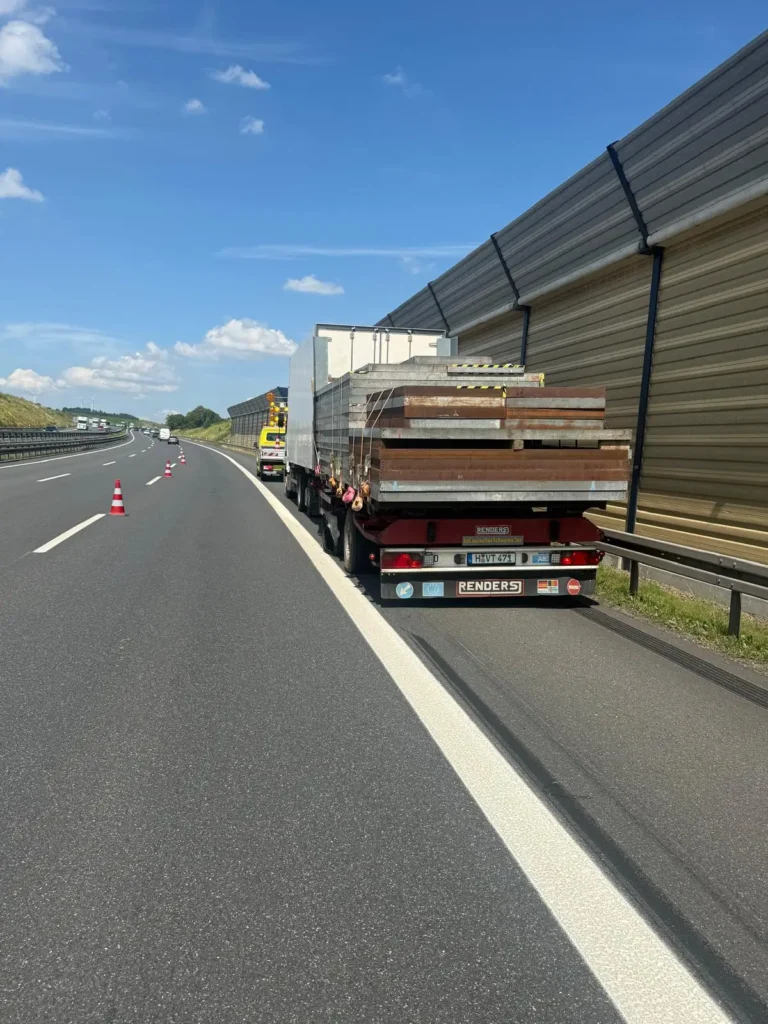
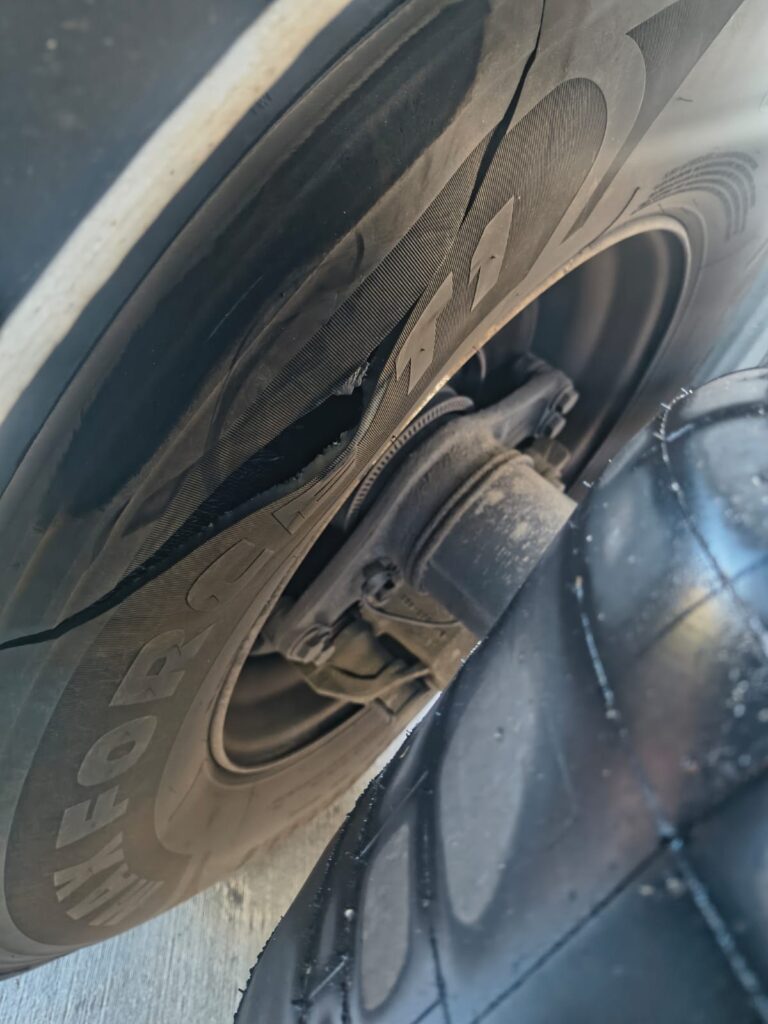
When a lowbed trailer carrying steel beams loses a tyre on the hard shoulder of the A7, the job stops being a routine wheel change the moment you look at the load. A standard breakdown crew can swap a tyre in twenty minutes. A heavy-haulage crew has to secure the site, stabilise a trailer that’s carrying several tonnes of structural steel, lift an axle that was never designed to be jacked up casually, and do all of that on a motorway shoulder with traffic thundering past at 120 km/h. Get any part of that sequence wrong and you’re not looking at a delayed delivery. You’re looking at a jackknifed trailer, a spilled load of steel, or a secondary collision.
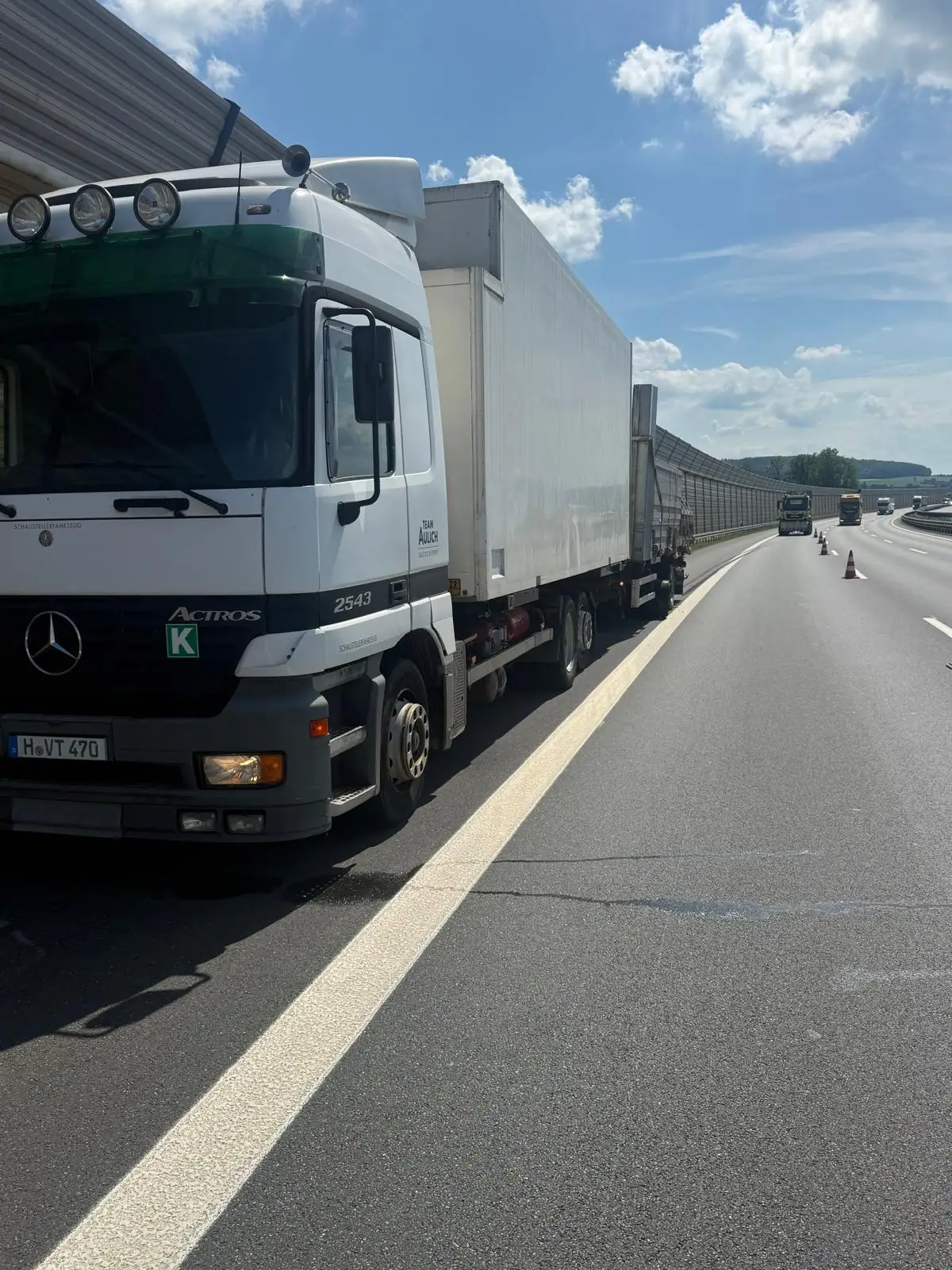
This is the exact scenario a haulage contractor from Hannover found himself in on a weekday afternoon on the A7 near Göttingen, heading towards Kassel. His articulated combination, a tractor unit pulling a Renders low-loader semi-trailer loaded with long steel beams, suffered a tyre failure on one of the trailer axles. What followed was a two-hour operation that shows exactly why heavy-load roadside assistance is a different discipline from ordinary truck tyre service, and why calling a dispatcher who actually understands heavy haulage matters more than calling the first number you find.
This case study walks through what happened, minute by minute, euro by euro, and explains why a professional, load-rated response was the only safe option.
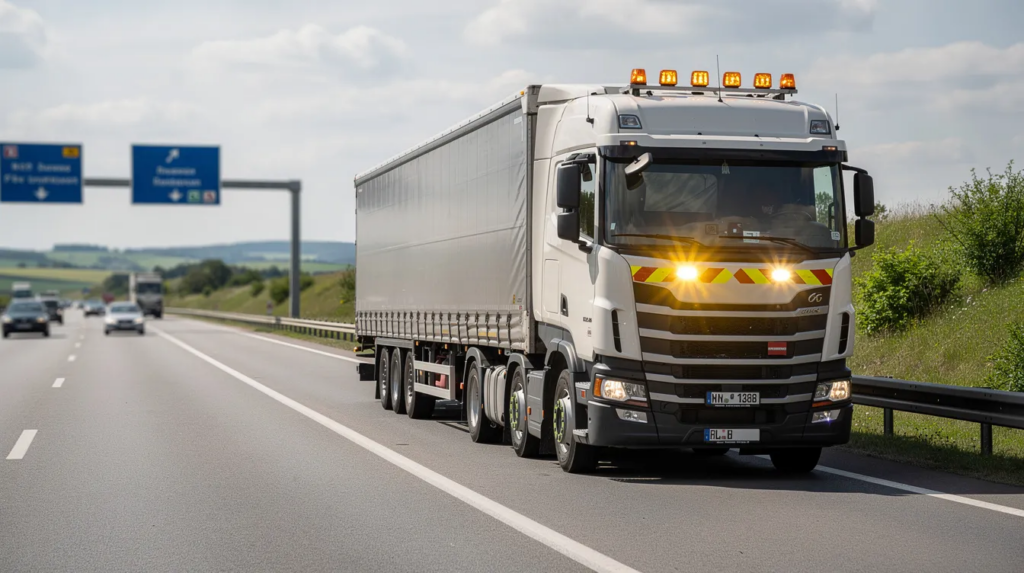
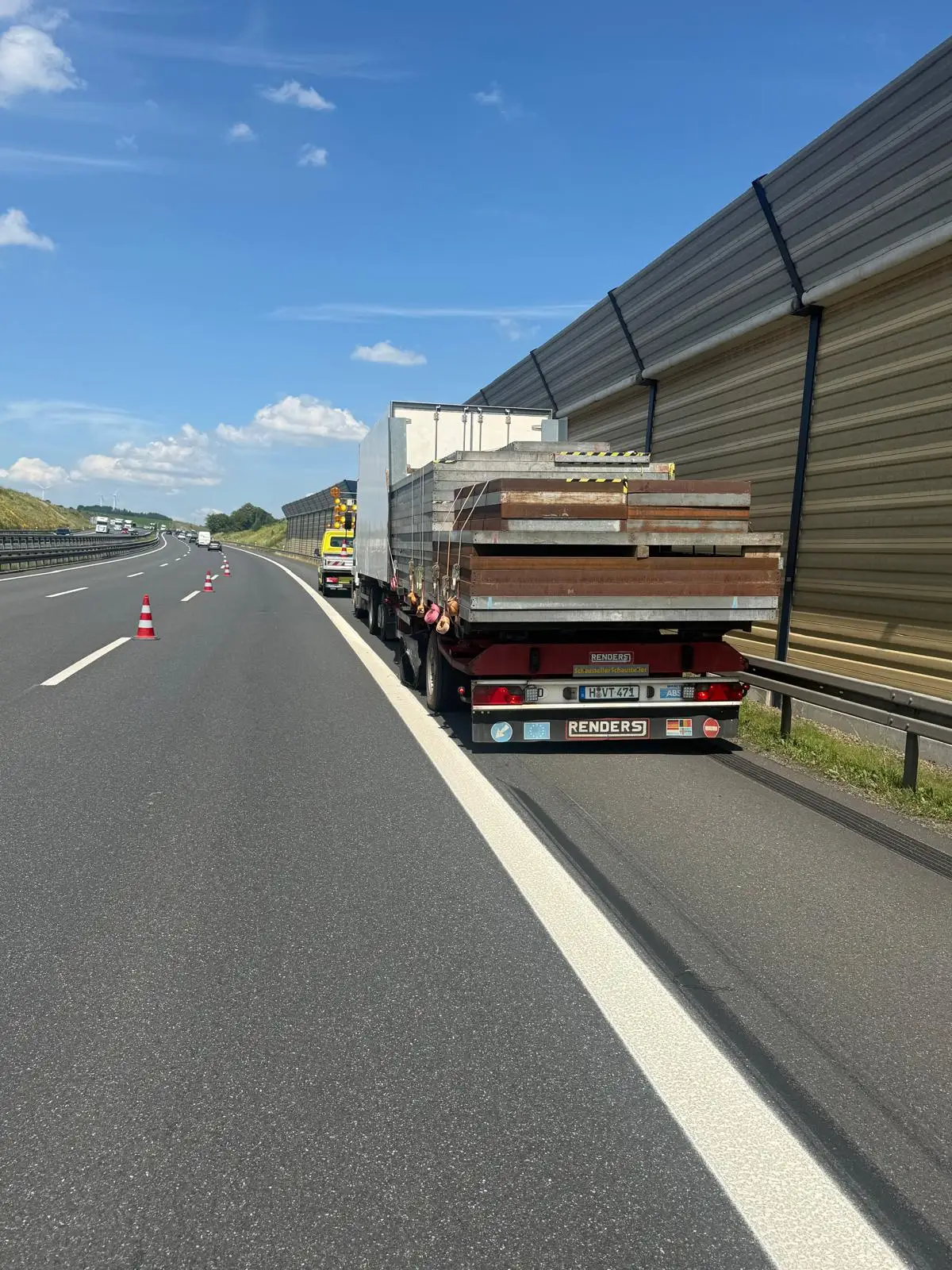
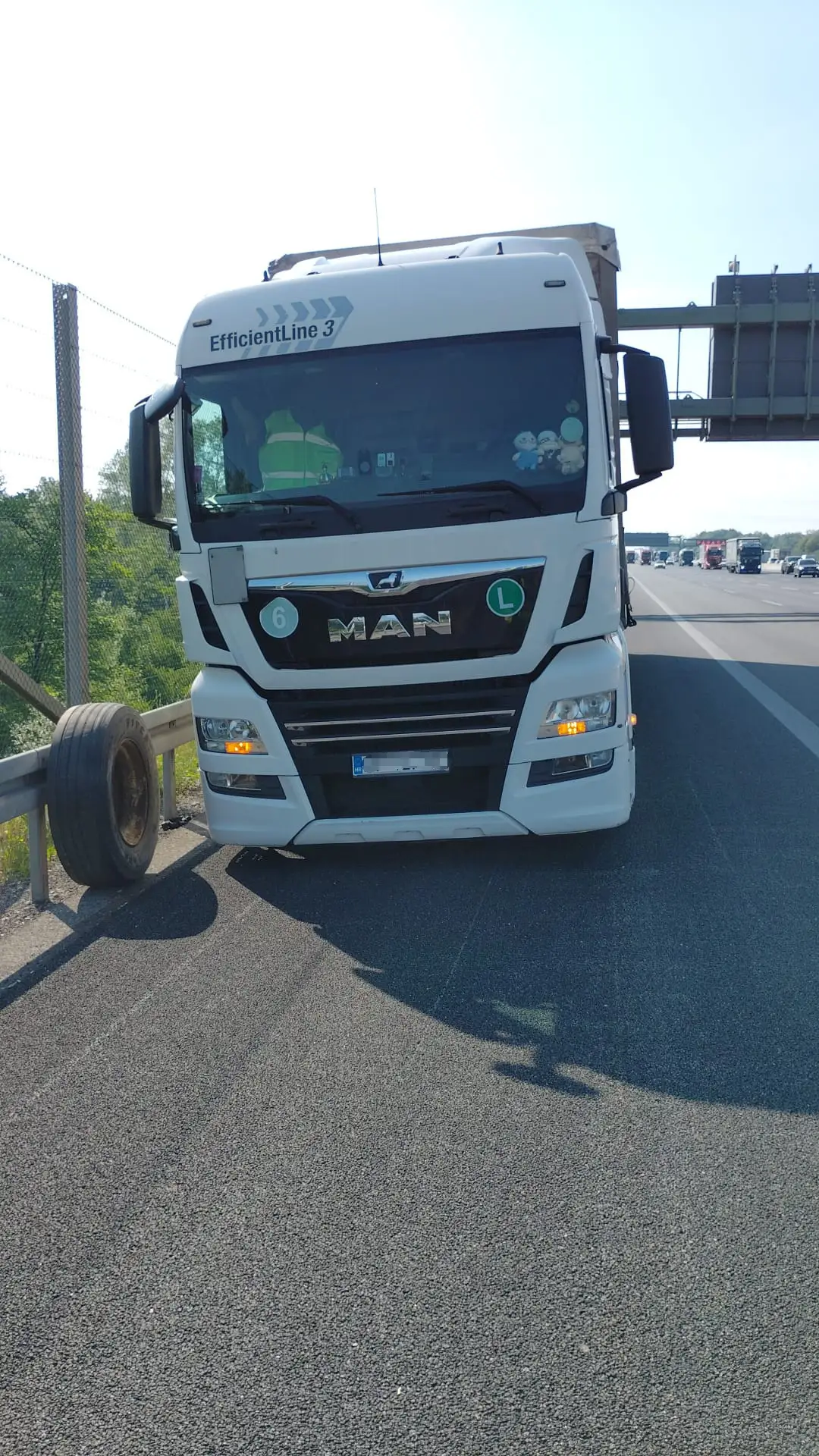
LKW Reifenservice bei Reifenpanne auf der A7 bei Göttingen. Schwertransport mit Stahlträgern.
The Emergency: A Loaded Low-Loader Stranded on the A7
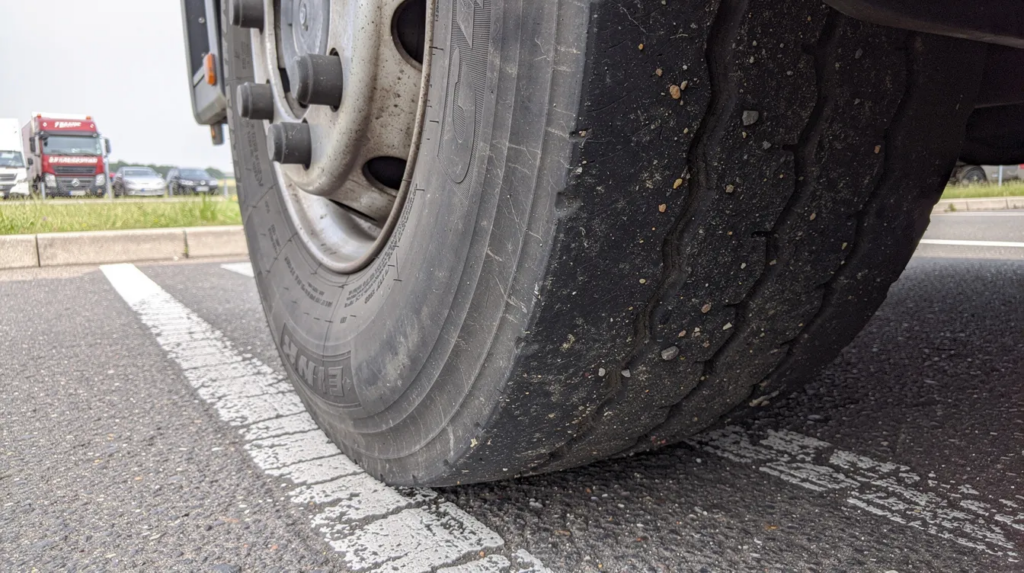
The vehicle involved was a full heavy-haulage combination: a tractor unit coupled to a Renders low-loader trailer, registered in Hannover (plate prefix H), carrying steel beams: long, rigid, heavy structural steel, the kind of load that cannot simply be shifted, redistributed, or offloaded at the roadside. The tyre affected was on one of the trailer axles, size 245/70 R19.5, a specification designed to carry serious axle loads on multi-axle low-loader trailers.
The failure happened on the A7, hard shoulder near Göttingen, in the direction of Kassel, one of the busiest north-south corridors in Germany, carrying a constant stream of heavy goods traffic. A tyre failure under a loaded axle here is not a “pull over and wait” situation. The trailer was sitting with a compromised axle, a live load of steel bearing down on it, and a stream of HGVs and cars passing within a couple of metres.
The driver did the right thing immediately: he got the hazard triangle out, moved as far onto the shoulder as the geometry allowed, and called LKWHelp24’s 24/7 emergency line rather than attempting anything himself. With a tyre down under a beam-laden trailer, there was no scenario in which a lone driver could safely jack the axle, let alone swap the wheel, without proper heavy-load equipment and a second person managing traffic safety.
How Help Was Organised
LKWHelp24 operates through a nationwide network of vetted breakdown and recovery partners, which means the dispatch process is built around matching the right specialist to the right job, not just sending “whoever is closest.”
- The call came in at 12:50, and the dispatcher immediately flagged the job as a heavy-haulage callout rather than a standard tyre change, based on the vehicle type and cargo described by the driver.
- Because the load was steel beams on a low-loader, the case was routed to a tyre and recovery partner in the Göttingen area with specific heavy-load experience rather than the nearest general breakdown van.
- The partner was briefed on load type, tyre specification (245/70 R19.5), and exact hard-shoulder location before departure, and confirmed an estimated time of arrival within minutes.
- The partner arrived fully equipped for the job: warning cones, a chase/escort vehicle for additional traffic protection, heavy-duty jacking equipment rated for trailer axle loads, and a replacement tyre already loaded rather than sourced on the way.
- On-site, the crew’s first task was not the wheel. It was securing the scene and confirming the load was stable before anyone worked near the axle.
This is the difference a proper dispatch network makes: instead of a generic mobile fitter turning up under-equipped and having to call for backup, the correct specialist was on the way within fourteen minutes of the phone ringing.
The Situation On-Site
By the time the partner arrived at 13:45, the combination had been sitting on the hard shoulder for nearly an hour with a live load overhanging a compromised axle. Several factors made this a genuinely hazardous job rather than a routine roadside repair:
- Axle load under a rigid steel cargo. Steel beams don’t flex or settle the way palletised or bulk freight can. The full static load was transferring straight through the axle and onto the damaged wheel position, meaning any careless movement while jacking could shift the load’s centre of gravity.
- Hard-shoulder exposure. Working on the A7 shoulder near Göttingen means working a few metres from live motorway traffic. HGVs generate significant slipstream turbulence at speed, which is enough to unsettle unsecured cones, tools, or a technician working close to the carriageway edge.
- Correct tyre pressure and torque for a heavy trailer axle. Trailer tyres in this class typically run in the region of 8.5-9.5 bar depending on axle rating and manufacturer spec, dramatically higher than a car or van tyre, and not something to estimate by eye. Getting inflation wrong on a load-bearing axle risks another failure within kilometres.
- Wheel-nut torque specification. Heavy trailer wheels are secured with multiple nuts tightened to a precise torque value, applied in a star pattern to seat the wheel evenly. Under-torqued nuts can work loose under vibration; over-torqued nuts can damage the stud threads or distort the brake drum.
None of this is something a driver, however experienced, can safely manage alone at the roadside with a hand jack and a wheel brace. It requires trained technicians, the right lifting equipment, and a second person dedicated to traffic protection.
Step-by-Step: What the Crew Did
Step 1: Scene assessment and securing. On arrival at 13:45, the crew immediately positioned the escort vehicle and set out warning cones extending well back from the trailer to give approaching traffic maximum warning distance. Before touching the vehicle, the technicians visually checked the load securing straps and confirmed the steel beams hadn’t shifted.
Step 2: Load and site stabilisation. By 13:55, the site and the load were confirmed secure. This step matters as much as the tyre change itself: a lowbed carrying steel under a tilted or unstable axle is a genuine tip risk, so the crew would not proceed until they were satisfied the trailer was sitting level and stable enough to lift.
Step 3: Relieving the axle and removing the damaged wheel. Using heavy-duty jacking equipment rated for the trailer’s axle weight, the crew carefully lifted and relieved the affected axle, then removed the damaged 245/70 R19.5 tyre. This was completed by 14:20. The crew inspected the rim for damage or deformation before proceeding, a cracked or bent rim under this kind of load is a hidden hazard that a rushed job would miss.
Step 4: Fitting the replacement tyre. A new Continental 245/70 R19.5 tyre, matched to the trailer’s original specification, was fitted by 14:40. Wheel nuts were tightened in the correct star pattern to the manufacturer’s specified torque, appropriate for a load-bearing trailer axle carrying steel cargo.
Step 5: Final check under load. Rather than simply lowering the axle and waving the driver off, the crew ran a final inspection under load at 14:52, checking tyre seating, pressure, and that the axle was tracking correctly before releasing the vehicle. The combination was declared roadworthy and cleared to continue at 14:55.
Full Timeline
| Time | Phase | Action |
|---|---|---|
| 12:50 | Call received | Driver reports tyre failure, low-loader with steel beam load, A7 near Göttingen |
| 13:04 | Partner dispatched | Heavy-haulage tyre/recovery partner assigned, ETA confirmed |
| 13:45 | Arrival on-site | Crew arrives, begins scene assessment |
| 13:55 | Site secured | Warning cones, escort vehicle positioned, load checked |
| 14:20 | Axle relieved | Axle lifted, damaged tyre removed, rim inspected |
| 14:40 | New tyre fitted | Continental 245/70 R19.5 mounted, torqued to spec |
| 14:52 | Final check | Inspection under load, pressure and seating confirmed |
| 14:55 | Vehicle cleared | Combination roadworthy, journey resumes |
Total time: 2 hours 5 minutes from first call to departure, of which roughly 1 hour 10 minutes was spent on-site.
Cost of the Callout
| Item | Price (EUR) |
|---|---|
| Callout / 24-7 motorway emergency service | 210 |
| Tyre 245/70 R19.5 (Continental) | 220 |
| Fitting under load (complex conditions) & site securing | 280 |
| Old tyre disposal | 15 |
| TOTAL | 725 EUR |
A few points worth being clear about. This callout cost more than a standard truck tyre replacement, and the reason is straightforward: heavy-haulage conditions and roadside securing are labour- and equipment-intensive. Jacking and stabilising a trailer axle under a rigid steel load takes rated lifting gear that a general breakdown van doesn’t carry. Positioning an escort vehicle and extended cone runs on a motorway hard shoulder is additional manpower and additional risk exposure for the technicians, and that’s reflected in the fitting price. None of it is padding. Every line item corresponds to a specific, necessary step in getting a loaded heavy-haulage trailer back on the road safely.
Compare that to the alternative: calling in a flatbed to transport the entire combination to a workshop. For a low-loader carrying long steel beams, that isn’t even a realistic option in most cases. The load would need to be re-secured or partially offloaded, specialist heavy-recovery transport would be required, and the vehicle could be off the road for the best part of a day rather than two hours. At 725 EUR and just over two hours total, a mobile heavy-load tyre service is, in almost every case, both the cheaper and the faster route back to operation.
Why a Professional Service Is Essential
It’s tempting, especially for an experienced driver, to think a wheel change is a wheel change. Under a loaded heavy-haulage trailer, it emphatically isn’t, and the risks of attempting it without the right equipment and training are serious:
- Load shift during jacking. Lifting an axle under a rigid steel load without confirming stability first can shift the cargo’s centre of gravity, risking a partial load slip or a trailer tip.
- Incorrect torque leading to wheel loss. Under- or over-torquing wheel nuts on a heavy trailer axle is one of the leading causes of wheels detaching in transit, a catastrophic failure at motorway speed.
- Undetected rim damage. A rim that’s cracked or deformed from the original tyre failure but goes unchecked can fail again within kilometres, potentially at speed.
- Traffic exposure without proper protection. Changing a wheel on a motorway hard shoulder without an escort vehicle and adequate cone runs puts the driver directly in the path of passing HGV traffic and slipstream turbulence.
- Incorrect tyre pressure for the axle rating. Guessing pressure on a trailer tyre rated for 8.5-9.5 bar, rather than checking the axle’s actual specification, risks premature failure or uneven wear across the axle set.
A professional heavy-haulage tyre and recovery partner carries the rated jacks, the torque wrenches calibrated for trailer wheel specifications, the escort vehicle, and, critically, the experience to recognise when something about the load or the axle isn’t right before it becomes a bigger problem.
Typical Breakdown Situations We Handle
LKWHelp24’s partner network covers the full range of heavy vehicle breakdowns across Germany, including:
- Tyre blowouts and punctures on tractor units, semi-trailers, and low-loaders
- Heavy-haulage and abnormal-load breakdowns requiring specialist equipment
- Trailer axle and suspension issues under load
- Battery failure and starting problems for trucks and buses
- Engine faults requiring diagnosis and mobile repair or towing arrangements
- Fuel and AdBlue-related breakdowns
- Recovery and towing (Abschleppdienst) for vehicles that cannot be repaired roadside
- Coach and bus breakdown assistance, including passenger safety coordination
- Roadside assistance (Pannenhilfe) for vans and light commercial vehicles
Whatever the vehicle and whatever the cargo, the dispatch principle stays the same: match the right specialist and the right equipment to the job, first time.
Prevention Tips for Drivers and Fleets
A tyre failure under load can rarely be predicted with certainty, but fleets that stay on top of a few habits significantly reduce their risk of a roadside incident:
- Check trailer axle tyre pressures before every long haul, not just tractor tyres. Trailer tyres, especially on multi-axle low-loaders, are easy to overlook and run at higher pressures that degrade faster if neglected.
- Inspect tyres for sidewall damage, cuts, and uneven wear at every stop where practical, particularly before carrying heavy or high-value loads like structural steel.
- Match tyre load index to actual axle load, not just the trailer’s rated maximum, a beam load concentrated over fewer contact points can stress tyres differently than a distributed load.
- Keep torque records for wheel changes and re-check torque after the first 50-100 km following any wheel service, since new fittings can settle.
- Carry a hazard kit rated for motorway hard-shoulder work, reflective vest, sufficient warning triangles, and cones, even though the driver should never attempt a heavy-axle change alone.
- Save an emergency assistance number for heavy haulage specifically, not just a general breakdown line, so dispatch routing to a load-rated partner happens immediately rather than after a failed first attempt.
Fleet Maintenance and Tyre Brand Considerations for Heavy Haulage
For fleets running low-loaders and heavy-haulage trailers regularly, tyre choice and maintenance scheduling deserve more attention than they typically get. Brands like Continental, Michelin, and Goodyear all produce trailer-specific tyre lines built for the higher pressures and sustained heavy loading that low-loader axles experience, these aren’t interchangeable with standard commercial tyres, and fitting the wrong specification under a heavy structural load is a false economy.
Continental’s commercial trailer range, for instance, is engineered specifically around load-carrying capacity and heat dissipation under sustained high pressure, which matters enormously on long-distance heavy-haulage runs where a tyre might spend hours under near-maximum rated load. Michelin’s equivalent range focuses heavily on casing durability, which affects how well a tyre tolerates the kind of kerb contact and shoulder-surface irregularities that come with working close to motorway edges. Goodyear’s heavy-trailer lines tend to be selected by fleets prioritising mileage life across mixed load conditions.
Whichever brand a fleet standardises on, the more important factor for heavy-haulage operations is a documented tyre inspection and replacement schedule tied to load history, not just calendar intervals. A trailer that regularly carries concentrated heavy loads like steel beams should be inspected more frequently than one running lighter, evenly distributed freight. The wear and stress patterns are genuinely different.
LKWHelp24: Your Truck Emergency Partner
LKWHelp24 exists for exactly this kind of situation, the moment a loaded, high-value combination is stranded on a German motorway and the driver needs a specialist, not just the nearest available van.
- 24/7 availability across all of Germany, every motorway, every region
- A vetted partner network with genuine heavy-haulage and abnormal-load experience, not just generic breakdown cover
- Transparent, itemised pricing agreed before work begins, with no surprise call-out surcharges
- Multilingual dispatch, so drivers from anywhere in Europe can explain the situation clearly and get an accurate response
- Dispatch that matches the job to the right specialist, as this case shows, rather than sending whoever happens to be nearest
Summary
- Vehicle: Tractor unit with Renders low-loader semi-trailer, loaded with steel beams
- Tyre size: 245/70 R19.5 (trailer axle)
- Location: A7 hard shoulder near Göttingen, direction Kassel
- Response time: Partner dispatched within 14 minutes of the call, on-site by 13:45
- Total time: 2 hours 5 minutes, call to departure
- On-site time: Approximately 1 hour 10 minutes
- Total cost: 725 EUR
- Secondary damage: None. Load and axle checked and confirmed secure throughout
Request Emergency Assistance Now
If your truck, trailer, or heavy-haulage combination breaks down anywhere in Germany, don’t take chances with a loaded axle at the roadside. Call the specialists.
Call +49 160 5753826 or visit lkwhelp24.com
Available 24/7 across all of Germany
You Might Also Be Interested In
- Heavy Recovery on the A8 near Stuttgart: Scania Car Transporter Breakdown
- Low-Loader Transport: Volvo Tanker Truck Breakdown En Route to Austria
- Mobile Truck Tyre Service: Semi-Trailer Blowout and Wheel Change in Germany
- ADAC LKW Pannenhilfe: What Truck Drivers Need to Know
- Continental Truck Tyres: Specifications for Heavy Haulage