Skip to content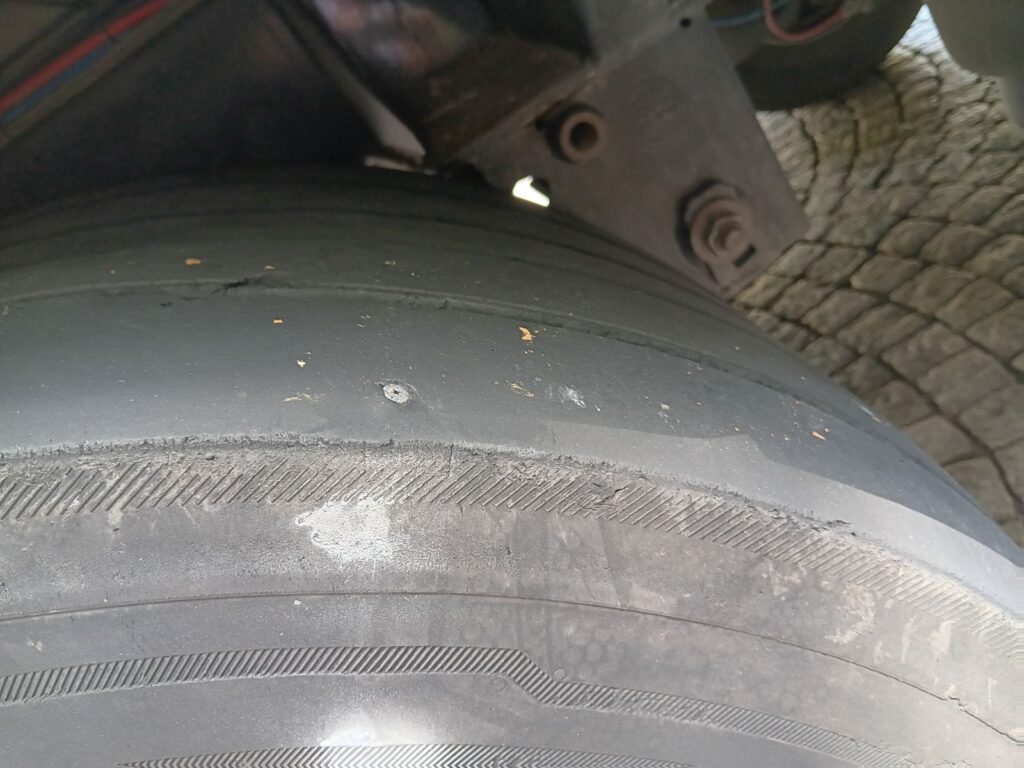
TL;DR: On 15 August 2026, a professional driver found a nail lodged in the tread of a 295/80 R22.5 tyre during his morning pre-trip inspection on a cobbled yard near Hamm, North Rhine-Westphalia. The tyre was still holding pressure. Callout, mushroom-plug tyre repair and balancing together cost €420 net and took 2 hours 25 minutes from report to release — against a possible motorway breakdown costing €750–1,400 plus lost operating time.
A nail in a tyre is nothing unusual on a haulage yard. What makes this case worth writing about isn’t the repair itself, but the moment it was caught: before departure, in daylight, on solid ground, with a technician who could work without time pressure. That’s the entire difference between a €420 morning invoice and a tyre blowout on the autobahn three hours later.
This isn’t a report about a dramatic rescue. It’s a case for why the daily walk-around before the first trip isn’t a box-ticking exercise, but the cheapest insurance a fleet has — and exactly what a driver needs to check during that walk-around.
The Find: A Nail in the Tread During the Pre-Trip Check
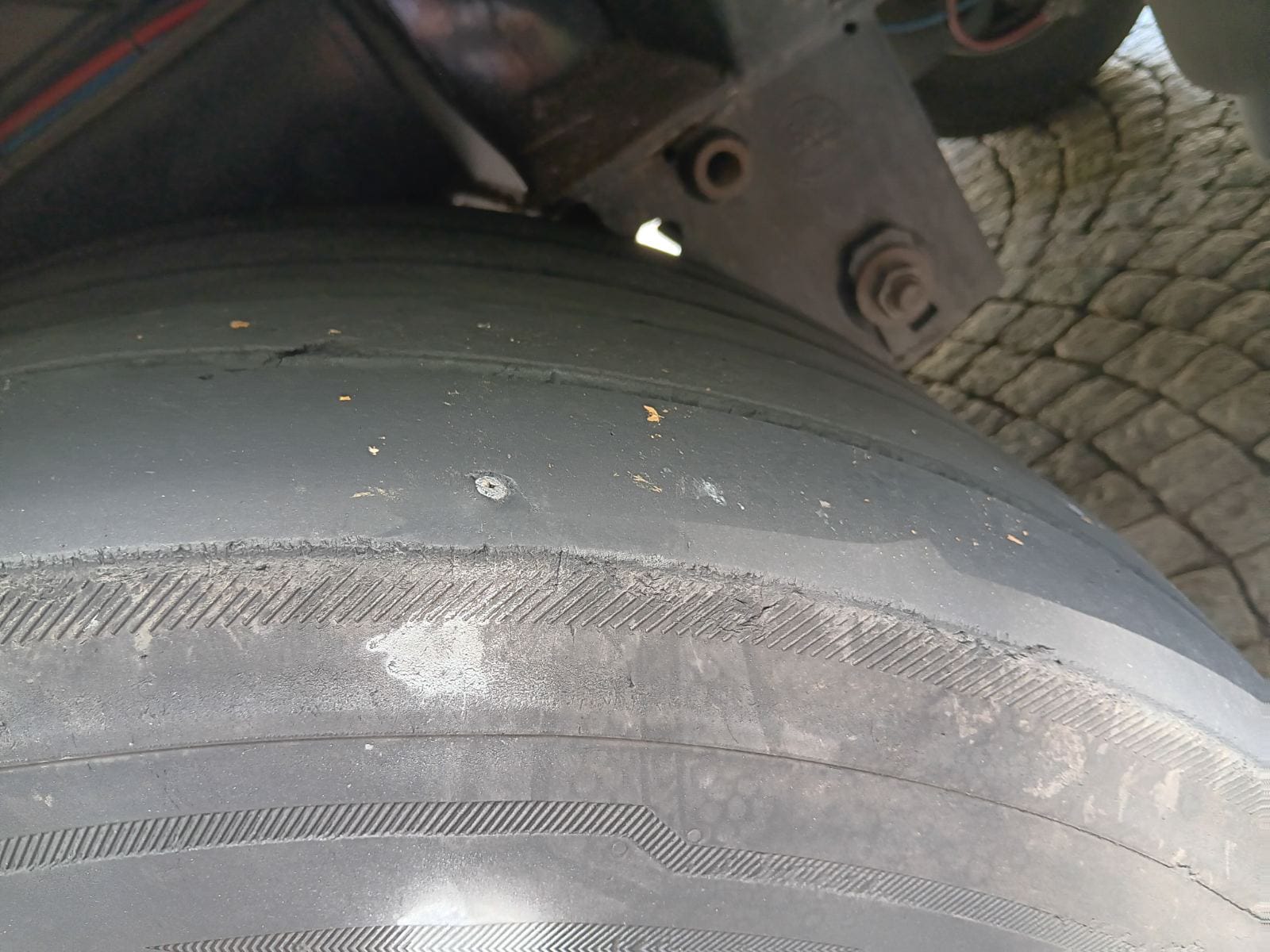
A nail lodged in a tyre’s tread that hasn’t yet caused air loss is the best possible outcome a walk-around inspection can produce. That’s exactly what happened on the morning of 15 August at a cobbled depot near Hamm, North Rhine-Westphalia.
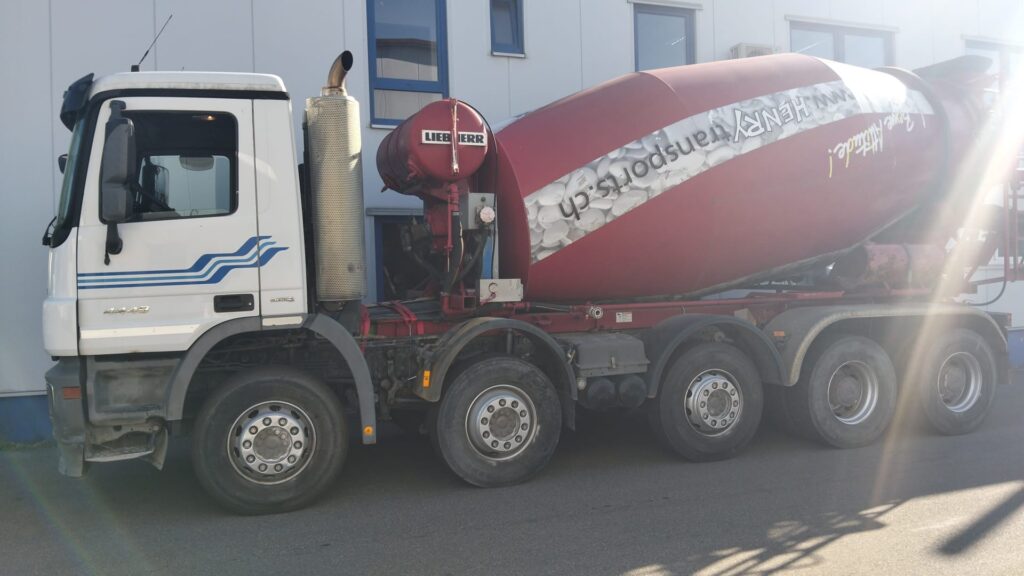
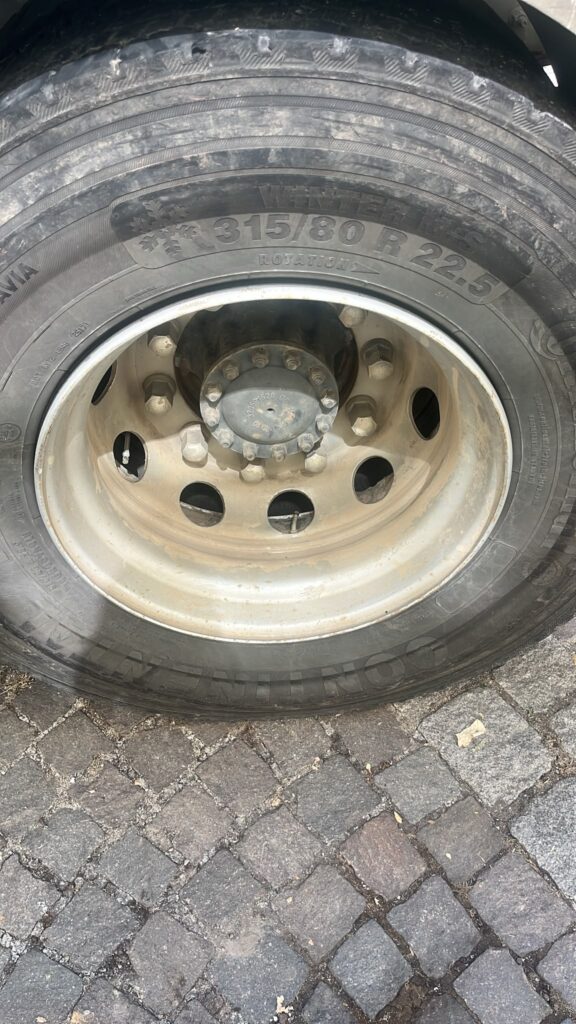
The driver of a fleet lorry was carrying out the mandatory walk-around before starting his first run. On one tyre — size 295/80 R22.5, a standard fitment for tractor units and heavy trailers — he noticed a foreign object embedded in the tread. On closer inspection: a nail, driven deep into the tread block but not yet through the carcass. At that point the tyre was still holding normal pressure.
That’s the key difference from many other tyre failures we cover: no pressure drop, no dashboard warning, no flat. Just a driver’s careful look at a rotating component running at 8.5 to 9.5 bar of internal pressure under the full axle load of a laden articulated lorry. Left unnoticed, the nail would have worked its way further into the carcass through the flexing motion of a rolling tyre — turning what should have been a 45-minute repair into a full tyre replacement on the hard shoulder.
The location matters here too. No motorway hard shoulder, no hazard lights, no queuing traffic behind — just a quiet depot with uneven cobblestones where a technician could work safely with a jack and hand tools. That’s the difference between a controlled workshop-style callout and an emergency recovery in live traffic.
Why the Pre-Trip Inspection Is a Legal Obligation, Not a Formality
The pre-trip walk-around is a legal duty of the driver, not a recommendation — grounded in the roadworthiness principle of § 23 StVO and detailed further in § 36 StVZO, which governs tyre tread depth among other things. Anyone putting a vehicle into service in Germany must confirm its roadworthy condition beforehand.
For professional drivers, the operator’s duty of care adds another layer. A haulier that sends vehicles onto the road without a documented check shares liability if something goes wrong. During a roadside stop by the Bundesamt für Güterverkehr (BAG) or the police, “when was this vehicle last checked?” is one of the first questions asked. Without evidence, that conversation gets uncomfortable — regardless of whether an actual defect exists.
What a driver is legally expected to check before setting off:
- Tyres and pressure — tread depth, visible damage, foreign objects, pressure loss.
- Wheel nuts and markings — loosened nuts, shifted torque-check marks on rim and stud.
- Lighting and reflectors — all lamps functioning, reflectors clean and undamaged.
- Mirrors — adjustment, cleanliness, cracks.
- Leaks under the vehicle — oil, coolant, or brake fluid stains on the ground.
- Coupling and safety cables — correct locking, intact safety chains.
- Load and straps — load securing, tension straps, tarpaulin.
- Number plates and placards — legible, undamaged, correctly mounted.
- Fluid levels — engine oil, coolant, AdBlue, screen wash.
A driver who follows a fixed order can work through all nine points in roughly ten minutes — the exact sequence is worth setting out in detail.
The Full Ten-Minute Walk-Around Route
A systematic walk-around, performed in the same order every time, takes an experienced driver eight to twelve minutes. That repeatability is the entire point — a driver who walks the same loop around his vehicle every day spots anything unusual instantly, because he knows what “normal” looks like.
The clockwise route, starting at the driver’s-side front corner, works well in practice:
- Front: headlamps, indicators, windscreen for cracks, radiator grille for damage, front plate.
- Along the driver’s side: steer axle tyres (tread, pressure, foreign objects), wheel nuts and torque marks, steps, mirrors, fuel filler for leaks.
- Fifth wheel or towbar: locking mechanism, safety pin, condition of cables and lines running to the trailer.
- Trailer or semi-trailer side: all axle tyres, brake discs for visible scoring, underrun protection, rear lighting, reflectors.
- Rear: tail lamps, number plate light, load doors and locks, visible check of load security.
- Passenger side back to front: mirror image of the driver’s side, plus a look underneath for fresh fluid marks.
- Cab: fluid levels, warning triangle and hi-vis vest present, digital tachograph functioning.
At every tyre, the same three-step glance applies: tread first for foreign objects and cuts, then the sidewall for bulges or cracks, then a visual pressure check. It was in this exact last step that the nail near Hamm was found — not flagged by a warning system, but caught by a driver who knew precisely where to look.
Why Inspections Happen Before Departure, Not After
The pre-trip check belongs at the start of the working day, not the end, because cold tyres give an honest pressure reading. A tyre that’s been driven on warms up, and the air inside expands with heat — pushing the pressure reading higher than the true cold value. A driver who checks in the evening after several hours on the road sees a flattering figure that doesn’t reflect the situation the next morning.
The second reason is simpler: fresh fluid stains. A vehicle parked overnight lets any leak collect as a visible mark on dry tarmac or cobbles. After a run, the ground is often clean again — washed by road spray, rain, or simply the passage of time — and the warning sign disappears before anyone can document it.
There’s a third, practical point too. A morning find can be fixed on the spot, calmly, with the dispatcher under no time pressure. A find made mid-route almost always means standing on the hard shoulder, often on unpaved ground with passing traffic just metres away.
What Drivers Find Most Often During Inspections
The most common finds during pre-trip inspections are foreign objects in tyre tread, slightly low tyre pressure, blown bulbs, loosened wheel nuts, and fluid stains under the vehicle. Each of these looks minor in isolation — which is exactly why they get missed on a quick glance when there’s no fixed routine to follow.
A nail or screw in the tread, as in this case, is one of the most classic finds of all. Haulage yards, construction sites and industrial estates tend to have more loose metal debris lying around than people expect, which is one more reason a daily check on your own depot ground matters just as much as one on the open road.
A loosened wheel nut is easy to catch once you know the trick: a small paint line drawn across rim and stud shows instantly if a nut has shifted even slightly, well before the wheel is actually loose. That simple marking method has prevented more than a few wheel-loss incidents on the motorway.
A Nail in the Tread: Why You Should Never Pull It Out Yourself
A nail or foreign object lodged in a tyre’s tread must never be pulled out by hand while the tyre is still holding pressure. In that state, the object works like a makeshift plug. Remove it, and the air escapes immediately and uncontrollably — turning a repairable puncture into a complete tyre failure before help even arrives.
The correct approach is straightforward: leave the object in place, document what happened, and act according to the situation. If the vehicle is already parked at a depot — as in this case near Hamm — a mobile workshop can drive straight to the site. If the vehicle is still moving and losing pressure noticeably, the driver should aim for the nearest safe, level surface and call a tyre service from there, rather than push on to the next scheduled stop.
Whether a mushroom-plug repair is possible or the tyre needs full replacement depends on where the puncture sits. A hole in the central tread area, without structural damage to the carcass, can generally be repaired properly according to tyre manufacturers’ guidelines. A puncture in the shoulder or sidewall almost always rules out repair — replacement is the only option.
Small Gear That Makes a Real Difference: A Torch and a Routine
A pre-trip inspection carried out in the dark without a torch is essentially useless, because yard lighting rarely reaches every angle underneath the vehicle or between twin wheels. A simple torch in the glovebox belongs in every driver’s basic kit — especially through the winter months, when a large share of inspections happen before sunrise.
Winter adds one more step: clearing snow and ice from headlamps and reflectors. A snow-covered reflector on the back of a trailer is effectively invisible at dusk — a real hazard to following traffic, and one that takes two minutes to fix.
Documentation: Why a Note in the Logbook Matters
Every pre-trip inspection should be logged — in the logbook, the digital tachograph system, or a fleet app — with a timestamp and outcome. Without that record, the inspection effectively didn’t happen as far as any later inquiry is concerned, however carefully it was actually carried out.
For the operator, documentation serves two practical purposes. First, during a roadside stop by police or BAG inspectors: a note with time and signature shows the driver met his obligation. Second, in an insurance claim: if damage is later traced to a technical fault that should have been caught during a proper inspection, missing documentation can complicate the claim. A clean record protects both driver and operator equally.
In this case, the find was logged straight away, the workshop was informed, and the tyre’s condition was recorded right up to the repair — a paper trail that holds up to scrutiny if it’s ever needed.
Building a Culture of Inspection Across the Fleet
A working inspection culture doesn’t come from rules alone — it comes from a short, practical checklist and visible recognition when something is caught. A laminated nine-point card in the cab, following exactly the sequence described above, lowers the barrier considerably. Nobody has to remember everything; they just tick the list.
Just as important: discuss finds, don’t punish them. A driver who reports a nail in a tyre should get credit for it, not the feeling that he’s caused a delay. Fleets that run a short team review of what’s been caught each week — what was found, and what it would have cost if it hadn’t been — build exactly the kind of awareness that turns a nail in the tread into routine business rather than an overlooked risk.
The Numbers: 10 Minutes of Inspection Against a €750–1,400 Breakdown
The economics of the pre-trip inspection come down to one comparison: €420 for a planned repair on the yard versus €750 to €1,400 for a comparable tyre failure on the motorway, plus €800 to €1,200 in lost operating time per day.
Here’s how the invoice broke down near Hamm:
| Item | Price (EUR, net) |
|---|---|
| Technician callout to the depot | 220 |
| Tyre repair (mushroom plug, removal and refit) | 120 |
| Materials (vulcanising compound, mushroom plug) | 45 |
| Balancing the repaired wheel | 35 |
| Total | 420 |
For comparison: replacing a tyre after an actual blowout on the motorway — with the callout to the hard shoulder, securing the scene, a new tyre, and fitting it under time pressure — typically runs between €750 and €1,400 net, depending on size and time of day. On top of that comes the vehicle’s downtime: €800 to €1,200 per day in lost transport capacity if a run is cancelled or delayed as a result.
The difference is clear-cut: catching the problem early saved at least €330 in pure repair costs — before even counting the avoided downtime, the risk of rim damage in a blowout under full load, and the danger a motorway tyre failure always poses to other road users.
The Full Timeline on the Morning of 15 August
From the moment the nail was found to the vehicle’s release, 2 hours and 25 minutes passed — including a technician response time of 55 minutes.
| Time | Phase | Action |
|---|---|---|
| 06:20 | Discovery | Driver finds a nail in the tread during the pre-trip inspection |
| 06:25 | Report | Call to dispatch, describing the find and tyre size |
| 06:40 | Dispatch | Technician assigned with the correct repair kit for a 295/80 R22.5 |
| 07:35 | Arrival | Technician reaches the depot near Hamm |
| 07:50 | Removal | Wheel removed, puncture inspected from inside the tyre |
| 08:20 | Repair | Mushroom plug fitted from inside, vulcanised |
| 08:40 | Refit | Wheel refitted, balancing completed |
| 08:45 | Release | Vehicle cleared for the day’s run |
Total: 2 hours 25 minutes from report to departure, of which 55 minutes was the technician’s travel time and roughly 50 minutes was hands-on work on the wheel.
Why a Professional Repair Matters
Tyre repair isn’t a place for improvisation, however small the damage looks. Several risks argue against any DIY fix or repair by unqualified staff:
- Uncontrolled pressure loss: removing the foreign object incorrectly can release the air suddenly.
- Hidden carcass damage: damage to internal steel belt layers, invisible from outside, is only caught by a proper internal inspection of the removed tyre.
- Non-approved repair locations: not every puncture location qualifies for repair under manufacturer guidelines — an improper repair can void insurance cover if the tyre fails later.
- Imbalance after repair: without balancing, any imbalance transfers to the steering and suspension, adding extra wear to tyres, bearings and dampers.
- Incorrect torque on refit: wheel nuts must be tightened to a specified torque in a star pattern — too loose risks the wheel coming off, too tight can damage the studs.
Typical Callouts We Handle Across Germany
The case near Hamm is one of many similar scenarios our mobile tyre service fleet deals with every day:
- Motorway tyre blowouts mid-journey, requiring the hard shoulder to be secured.
- Foreign objects in the tread, spotted during checks at rest areas or on depot ground.
- Slow pressure loss from a faulty valve, with no visible external damage.
- Rim damage after hitting kerbs or potholes.
- Wheels coming loose due to under-torqued studs, particularly soon after a recent wheel change.
Fleets that prefer scheduled maintenance to emergency callouts should look at our mobile truck service, which carries out inspections and minor repairs directly on the depot yard.
Tyres, Tread Depth and Fleet Care: The Bigger Picture
The 295/80 R22.5 size is among the most widely fitted tyre dimensions for tractor units across Europe, produced in various tread patterns for steer, drive and trailer axles by manufacturers including Continental, Michelin and Goodyear. The legal minimum tread depth for lorry tyres under § 36 StVZO is 1.6 mm, though in practice manufacturers and workshops recommend replacement at 3 to 4 mm remaining tread, to keep enough margin for wet roads and winter conditions.
A tyre’s load index shows the maximum weight it can carry at the correct pressure — a figure that must always match the actual axle load whenever a wheel is changed, and one every workshop checks before fitting a replacement.
One more thing that’s often underrated during daily checks: wheel nuts can settle slightly during the first hours of operation after a workshop visit. How dangerous that can get is shown in our report on a lorry that lost two wheels near Hannover after studs sheared off — a case that makes torque-check marking on the hub anything but optional.
Why LKWHelp24 Is the Right Partner for Fleets
Our network of technicians covers the whole of Germany and is reachable around the clock — whether a breakdown happens mid-motorway or, as in this case, an alert driver catches damage on his own depot yard. Dispatch is staffed multilingually, which makes a real difference for international fleets running drivers of different native languages.
Transparency starts with a phone estimate and ends with an itemised invoice with no hidden lines. For hauliers planning regular callouts, we offer dedicated contacts and the option to fold inspection routines and minor maintenance directly into a service plan — through our mobile truck workshop service or as a complement to standard towing service for the rarer cases where an on-site repair is no longer possible.
Frequently Asked Questions About Pre-Trip Inspections and Tyre Finds
Is the pre-trip inspection legally required for lorry drivers in Germany?
Yes. Drivers must confirm a vehicle’s roadworthy condition before setting off. This obligation follows from § 23 StVO combined with the technical requirements of the StVZO, including tyre tread depth under § 36 StVZO.
How long does a thorough pre-trip inspection take?
A systematic walk-around in a fixed order takes an experienced driver eight to twelve minutes. Skipping a set sequence tends to miss more details without actually saving much time.
Can I pull a nail out of a tyre myself?
No. As long as the tyre is still holding pressure, the foreign object acts like a plug. Removing it lets the air out immediately. Leave it in place and call a tyre service.
What does a tyre repair for a nail in the tread cost?
In this case, the total for callout, mushroom-plug repair and balancing came to €420 net. The exact figure depends on travel distance, time of day and tyre size.
What happens if the damage isn’t repairable?
If the puncture sits in the shoulder or sidewall, repair is usually not permitted. A full tyre replacement follows instead, exactly as carried out during our mobile tyre service callouts across Germany every day.
Does the pre-trip inspection need to be documented?
Documentation is strongly recommended, even where the exact format isn’t legally prescribed in detail. A timestamped note in the logbook, an app, or the tachograph system protects both driver and operator during checks and in the event of a claim.
Summary of the Key Figures
- Tyre size: 295/80 R22.5
- Location: Depot near Hamm, North Rhine-Westphalia (cobbled yard, no motorway callout)
- Find: Nail in the tread, tyre still holding pressure
- Response time: 55 minutes technician travel time
- Total time: 2 hours 25 minutes from report to release
- Repair: Mushroom plug fitted from inside plus balancing
- Total cost: €420 net (callout €220, repair €120, materials €45, balancing €35)
- Damage avoided: motorway breakdown costing €750–1,400 plus €800–1,200 daily downtime
Secure Your Fleet’s Inspection Routine Today
Whether a driver spots a foreign object during the morning check or a breakdown happens mid-route, our team is available around the clock. Call us on +49 160 5753826 or visit www.lkwhelp24.com — 24/7, across all of Germany.
Keywords: truck pre-trip inspection | mobile truck tyre service | nail in tyre | mushroom plug tyre repair | truck tyre pressure | 295/80 R22.5 | fleet safety | 24/7 truck breakdown service Germany
Related Articles
- Truck Tire Service Near Me: How LKWHelp24 Got a Semi-Truck Moving in 90 Minutes on the A43 Near Dortmund
- Winter Tyres for HGVs in Germany – Legal Requirements, Safety & Service
- Truck Loses 2 Wheels Near Hannover – Sheared Bolts
- Truck Tire Service Near Me
- Mobile Truck Tire Service in Germany 24/7 – We Arrived and Helped