Skip to content
A Polish-registered tractor unit pulled into a service yard just off the A4 motorway near Görlitz, Saxony, on 5 August with a problem that most drivers dread: strong vibration building up at motorway speed. This is what a genuine truck propshaft repair looks like from the first phone call to the moment the vehicle was cleared to drive again. Within two hours and thirty-five minutes, a mobile technician had diagnosed worn universal joints and a failing centre bearing, replaced both, and sent the tractor unit back onto the road.
HGV driveshaft vibration is one of those faults drivers try to talk themselves out of. It rarely announces itself with a warning light, and on a long haul route through Saxony towards the Polish border, stopping for anything that isn’t obviously an emergency feels like a luxury. In this case, the driver did the right thing: he pulled off the carriageway, contacted LKWHelp24 on +49 160 5753826, and waited at a nearby service yard rather than pushing on. That single decision likely spared the haulier a far more expensive breakdown, and possibly a dangerous one.
This article walks through what happened on site, why a vibrating propshaft is one of the few driveline faults that can turn into a genuine road hazard within seconds, and what the repair actually involved — underneath the chassis, on the hard standing of a service yard, with the clock running.
Emergency on the A4 near Görlitz
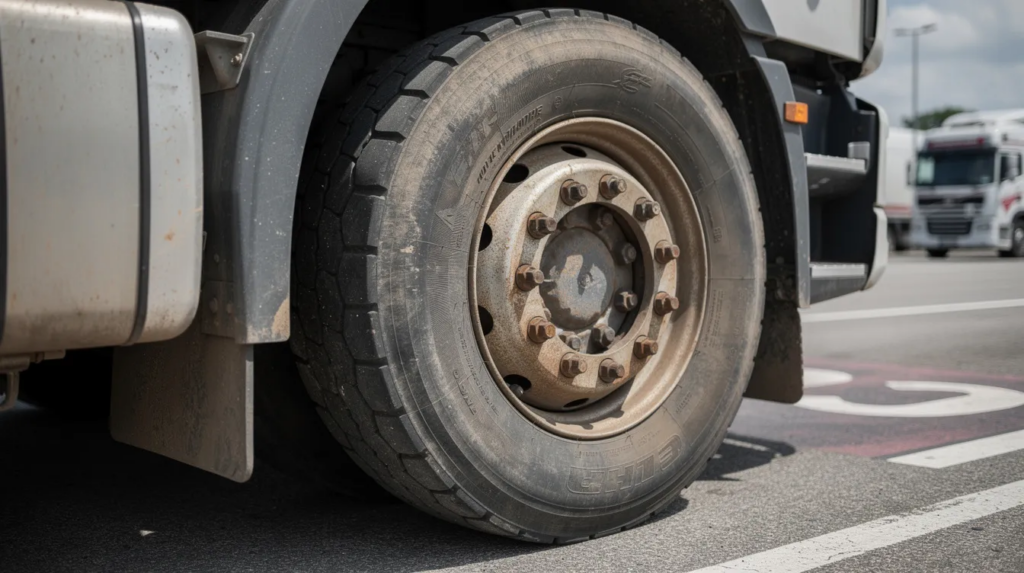
The tractor unit was travelling west on the A4 towards Dresden when the driver first noticed a vibration through the cab floor and steering column. It wasn’t subtle. By the time he reached a service yard just off the motorway near Görlitz, the shaking had become pronounced enough that continuing felt unwise. Saxony’s stretch of the A4 near the Polish border carries heavy volumes of long-distance freight traffic, much of it moving between Poland, the Czech Republic and western Germany, so a stranded semi-trailer in this corridor is not a small inconvenience — it is lost time on a route with tight delivery windows.
The vehicle itself was a standard semi-trailer combination: a tractor unit with a loaded trailer behind it, drive axle doing the work of putting torque to the road. Nothing about the load or the route was unusual. What was unusual, from the driver’s account, was how quickly the vibration escalated once it started — from a barely-there hum to something he could feel through the pedals within a matter of minutes.
How help was organised
LKWHelp24 runs a 24/7 breakdown assistance and mobile truck service network across Germany, built around a bench of partner workshops and independent technicians positioned near the country’s main freight corridors, including the A4 near the Saxon-Polish border. When the call came in, dispatch didn’t have to search far.
- 09:40 — driver calls in, describes strong vibration at speed and confirms his location at the service yard
- 09:50 — dispatch identifies the nearest available partner workshop and assigns a technician
- Technician confirms tools and parts likely needed based on the driver’s description (vibration band, noise, clunk on pull-away)
- Technician departs for the service yard
- Driver instructed to keep the vehicle stationary and avoid attempting to drive further
This kind of triage matters. A dispatcher who asks the right questions — at what speed does it vibrate, does it worsen under load, is there a knock when you pull away — can often narrow the fault down to the driveline before a technician even leaves the workshop, which shortens the whole job.
Why vibration on site couldn’t be ignored
Once the technician arrived and got underneath the vehicle, the cause was visible fairly quickly: heavy wear in the universal joints (also called crosses or spider joints) on the propshaft connecting the gearbox to the drive axle. This is a mechanically simple assembly, but it carries the entire torque output of the engine, and when it starts to fail, the failure mode is unforgiving.
A propshaft transmits rotational force from the gearbox to the differential through a series of joints that allow for the shaft’s flex as the axle moves on its suspension. The universal joints are the pivot points; the centre bearing (sometimes called the carrier or support bearing) holds a two-piece shaft steady at its midpoint; the slip joint, or spline coupling, lets the shaft change length slightly as the chassis flexes. Any one of these components wearing out throws the whole shaft off balance, and an out-of-balance shaft spinning at motorway speed generates forces that get worse, not better, the longer it runs.
Here is what makes this fault genuinely dangerous rather than just uncomfortable. A worn universal joint doesn’t degrade gracefully — it can seize or separate suddenly, and when that happens at speed, the shaft can detach from its mounts and strike whatever is underneath it: the underbody itself, fuel lines, the fuel tank, or the road surface, where it can dig in and pitch the vehicle. Of the driveline faults a technician sees on a mobile call-out, a failed propshaft sits close to the top of the list for turning into a crash within seconds rather than developing into a breakdown over hours. There is no long warning period once a joint fully lets go.
It’s also worth being honest about why “it’s just vibration” undersells the problem. Left running, an unbalanced or worn shaft doesn’t just eventually break — it drags a whole chain of secondary damage behind it. Vibration transmitted back through the shaft loosens gearbox and differential mounts, works seals loose until they weep oil, and accelerates wear in bearings that would otherwise last years. A driver who keeps driving on a vibrating propshaft for another few thousand kilometres can turn a €1,190 repair into a gearbox or differential rebuild.
According to data cited by organisations such as ADAC, driveline and running gear faults are a recurring cause of motorway breakdowns among commercial vehicles, alongside tyres and brakes — which is part of why routine underbody inspection during scheduled servicing matters as much as it does.
Step-by-step repair on the hard standing
Step 1 — Underbody inspection. With the tractor unit safely parked at the service yard, the technician got underneath and worked along the full length of the propshaft by hand, checking for play at each universal joint, inspecting the rubber boots and seals for cracking or missing grease, and looking for the tell-tale rust-coloured dust that collects around a joint when a bearing is dying internally. The centre bearing was checked next, feeling for play or roughness when rotated by hand.
Step 2 — Securing the site. Before any work began under the chassis, the vehicle was chocked and the work area marked out on the hard standing, standard practice whenever a technician needs to spend extended time beneath a loaded semi-trailer.
Step 3 — Removing the old joints and centre bearing. With the propshaft’s orientation marked to preserve its original balance position, the worn universal joints were pressed out and the centre bearing assembly unbolted from its mounting bracket. The old parts were set aside for disposal.
Step 4 — Fitting new parts, respecting alignment marks. New universal joints were pressed into the shaft yokes, and a replacement centre bearing was fitted to the mounting bracket. The alignment marks made in Step 3 were used to ensure the shaft went back together in the same phase relationship it left in — propshafts are not meant to be reassembled “any old way.” Getting the phasing wrong, even by one spline, reintroduces vibration that no amount of otherwise-correct work will fix.
Step 5 — Final check and torque. All fasteners were torqued to the manufacturer’s specification — the drive flange bolts on this job were torqued to 95 Nm, in line with the shaft manufacturer’s guidance for this joint size — and the technician rotated the shaft by hand to confirm smooth movement with no residual play before road-testing it briefly around the yard. Only after that function test was the tractor unit cleared to rejoin the road.
Timeline of the call-out
| Time | Phase | Action |
|---|---|---|
| 09:40 | Call | Driver reports strong vibration while driving on the motorway, at a service yard on the A4 near Görlitz |
| 09:50 | Dispatch | Partner workshop on site informed, technician assigned |
| 10:35 | Arrival | Technician reaches the service yard (45 min. travel time) |
| 10:55 | Diagnosis | Underbody check, universal joints and centre bearing inspected (20 min.) |
| 12:05 | Repair | Replacement of universal joints and centre bearing (70 min.) |
| 12:15 | Completion | Function test, cleared to drive |
Total time from call to clearance: 2 hours 35 minutes (155 minutes).
What it cost
| Item | Price (EUR, net, excl. VAT) |
|---|---|
| Call-out/travel | €220 |
| On-site diagnosis | €90 |
| Labour (2 technicians, approx. 3.5 hrs total at €120/hr) | €420 |
| Universal joints (2 units incl. material) | €260 |
| Centre bearing (support bearing) | €180 |
| Disposal of old parts | €20 |
| TOTAL | €1,190 net |
One factor worth flagging honestly, separate from this total: dynamic balancing of the propshaft after a repair is sometimes needed, particularly if the shaft has been run out of balance for a while before the fault was caught. That work is done in a workshop with balancing equipment, not on site, and it was not required — or included — in this particular quote. Where it is needed, budget an indicative €150-250 on top.
Set against that €1,190 figure, the cost of doing nothing looks worse fairly quickly. A stranded lorry costs a haulier roughly €800-1,200 per day in lost operating time — driver hours, missed delivery slots, knock-on scheduling costs across a fleet. A same-day mobile repair that gets the vehicle moving again inside three hours is, in almost every case, the cheaper outcome even before counting the risk of a joint failing catastrophically further down the road.
Why this is not a DIY job
A propshaft carries the full torque of a loaded lorry’s engine at motorway speed, and getting any part of the repair wrong has consequences that go well beyond a comeback job. The risks of attempting this without the right training and equipment include:
- Misaligned phasing — reassembling the shaft without respecting the original alignment marks reintroduces vibration, sometimes worse than the original fault
- Under- or over-torqued fasteners — flange bolts that are too loose can work free at speed; over-tightened bolts can shear or distort the yoke
- Missed secondary damage — a worn propshaft often means the gearbox or differential mounts have also loosened; skipping that check leaves a second fault waiting to surface
- No balancing check — a shaft that “feels fine” spun by hand can still be out of dynamic balance at 1,500 rpm on the motorway
- Working under a loaded vehicle without proper support — a serious safety risk in itself, regardless of the mechanical work involved
This is a job for a technician with the right tools, torque specifications, and experience reading the early signs of driveline wear — not a roadside improvisation.
Typical call-outs LKWHelp24 handles across Germany
Driveline and transmission faults like this one are a regular part of the work. Recent examples from the mobile truck service network include a gearbox failure recovery near Frankfurt (Oder), an engine failure on the A14 near Leipzig, and a case in Hannover where a lorry lost two wheels after sheared bolts were caught before they caused a bigger incident. Alongside driveline work, the truck service team regularly deals with tyre failures — covered in more detail in the guide to truck tyre service across Germany — as well as general breakdown assistance in Bavaria and recovery jobs such as a DAF recovery on the A40 near Essen. When a vehicle genuinely cannot be repaired on site, the towing service arm handles recovery to the nearest suitable workshop.
Prevention: catching driveline wear before it becomes a call-out
Most propshaft failures give some warning before they become a roadside emergency, and drivers and fleet managers who know what to listen and feel for can usually get ahead of it.
- Pay attention to vibration that appears in a specific speed band, typically around 60-80 km/h (roughly 37-50 mph) — this is a classic early sign of driveline imbalance
- Listen for a hum or howl from under the floor that changes pitch with road speed rather than engine revs
- Note any clunk on pull-away or when shifting between acceleration and deceleration — that’s often play in a universal joint or slip joint
- Watch for vibration that intensifies noticeably under load, which points towards the driveline rather than tyres or wheel balance
- Include underbody inspection as a standing item at every scheduled service, not just when a fault is reported
- Check grease nipples where fitted — some propshafts require lubrication on a fixed interval, and a missed greasing interval at a service is one of the most common causes of premature universal joint wear
- Know your shaft type: sealed-for-life propshafts have no grease points and cannot be topped up — they can only be replaced once worn, so their inspection schedule matters even more
The honest answer to “can I keep driving on it” depends entirely on what the check reveals. A light vibration that hasn’t yet developed into a clunk or detectable play might allow a careful, low-speed drive to the nearest workshop — but a clear knock, or any play felt by hand in a joint, means the vehicle should not be driven under its own power. At that point, recovery is the only safe option.
Fleet maintenance and the driveline
Vibration faults like this one sit at the intersection of two things fleet managers often treat separately: routine servicing and roadside risk. A propshaft that’s greased on schedule, inspected at every service, and replaced proactively when wear is found rarely fails on the motorway. One that’s left to run past its wear limits eventually does, and it tends to do so without much notice.
Component manufacturers such as ZF and BPW, both major suppliers of driveline and running gear components to the European commercial vehicle industry, publish maintenance intervals and wear-limit guidance for exactly this reason — a propshaft, axle, or suspension component that’s serviced within spec has a predictable life, while one that isn’t becomes a source of unplanned downtime. For fleets running mixed cargo across long routes, that predictability is worth more than the cost of the parts themselves. Bodies such as DEKRA regularly flag driveline and running gear wear among the defects found at roadside and periodic technical inspections, which underlines why this isn’t a fringe issue affecting a handful of older vehicles — it’s a routine wear item on any lorry that racks up serious annual mileage.
Fleet managers who build underbody and driveline checks into every scheduled service, rather than reacting only when a driver reports a fault, consistently see fewer roadside call-outs of this kind. It costs a few extra minutes on the ramp. It saves a stranded lorry, a missed delivery window, and — in the worst case — a joint failure at speed.
Why choose LKWHelp24
A propshaft fault at motorway speed is not something to wait out. LKWHelp24 operates a 24/7 breakdown assistance network across Germany, built on verified partner workshops positioned near the country’s main freight corridors, including the Saxon stretch of the A4 near the Polish border. Dispatch is multilingual, which matters on a route used heavily by Polish, Czech and other international hauliers, and every job is quoted transparently before work begins — as reflected in the itemised cost table above. There’s no guesswork about what a technician will find or what it will cost once they’re under the vehicle; the diagnosis comes first, the quote follows, and the work only proceeds with that clarity in place.
Frequently asked questions
How do I know if it’s my propshaft and not my tyres causing the vibration?
Tyre-related vibration usually stays constant with road speed regardless of load and often correlates with visible tread wear. Propshaft vibration typically appears in a specific speed band (around 60-80 km/h), intensifies under load, and is often accompanied by a hum, howl, or clunk on pull-away that tyre imbalance doesn’t produce.
Can I keep driving with a vibrating propshaft?
It depends on severity. Light vibration without a clunk or detectable joint play might allow a careful, low-speed drive to the nearest workshop. A clear knock or play felt by hand in a universal joint means the vehicle should not be driven — call for recovery instead.
What actually wears out on a propshaft?
The universal joints (crosses), the centre bearing, the slip joint or spline coupling, and the shaft’s overall dynamic balance. Any one of these degrading throws off the whole assembly, which is why a full underbody check assesses all of them rather than just one component.
Why is a failed propshaft more dangerous than most other faults?
Because failure can be sudden rather than gradual. A joint that lets go at speed can allow the shaft to detach and strike the underbody, fuel lines, or the road surface, with the potential to pitch the vehicle — one of the few faults that can turn into a crash within seconds.
How much does a propshaft repair like this typically cost?
In this case, the total was €1,190 net, covering call-out, diagnosis, labour, universal joints, centre bearing, and disposal. Dynamic balancing, when needed, is a separate workshop job costing an indicative €150-250 on top.
How often should a propshaft be inspected or greased?
Underbody and driveline inspection should be part of every scheduled service. Shafts with grease nipples need lubrication on a fixed interval specified by the manufacturer; sealed-for-life shafts have no grease points and can only be replaced once worn, so their inspection matters just as much.
Summary
A Polish-registered tractor unit reported strong vibration on the A4 near Görlitz on 5 August. A LKWHelp24 technician reached the service yard in 45 minutes, diagnosed worn universal joints and a failing centre bearing in 20 minutes, and completed the replacement in 70 minutes. Total time from call to clearance: 2 hours 35 minutes. Total cost: €1,190 net, against a stranded-vehicle downtime cost of roughly €800-1,200 per day. The vehicle was cleared to drive the same morning.
Get help now
If your lorry is vibrating at speed anywhere in Germany, don’t wait for it to get worse. Call LKWHelp24 on +49 160 5753826 or visit www.lkwhelp24.com. Available 24/7 across Germany.
Keywords: truck propshaft repair | HGV driveshaft vibration | universal joint replacement | centre bearing failure | mobile truck service Germany | breakdown assistance A4 Görlitz | driveline repair lorry | propshaft balancing | tractor unit vibration | 24/7 truck recovery Germany