Skip to content
TL;DR: On 18 July, an articulated lorry’s inner trailer tyre blew out unnoticed on the A6 near Schwäbisch Hall, heading towards Nuremberg. The driver only found out at a stop. Our truck tyre service arrived within 1h05, replaced both tyres of the dual pair (385/65 R22.5), and had the vehicle roadworthy again in 2 hours 30 minutes total. Cost: €1,500 net.
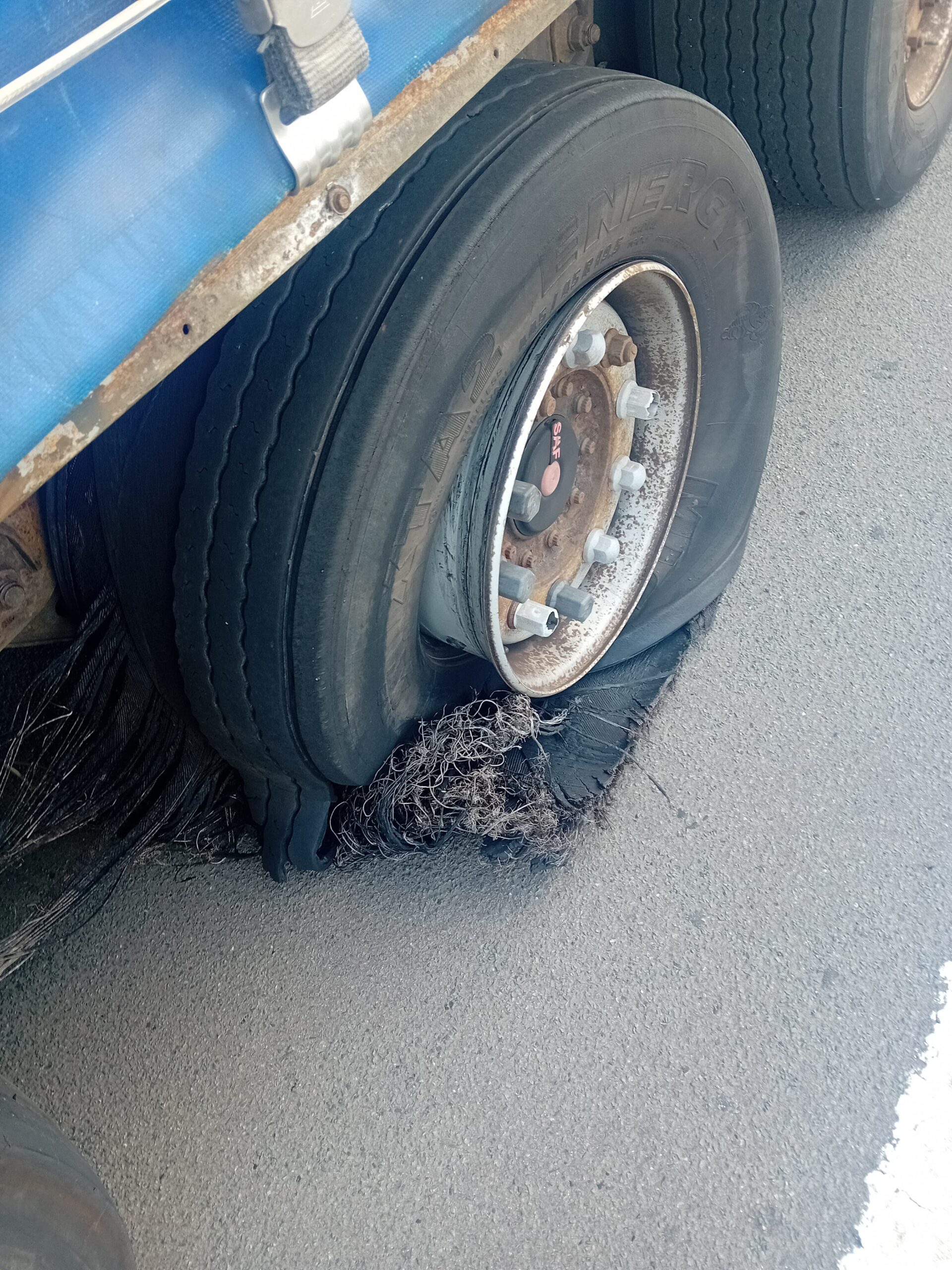
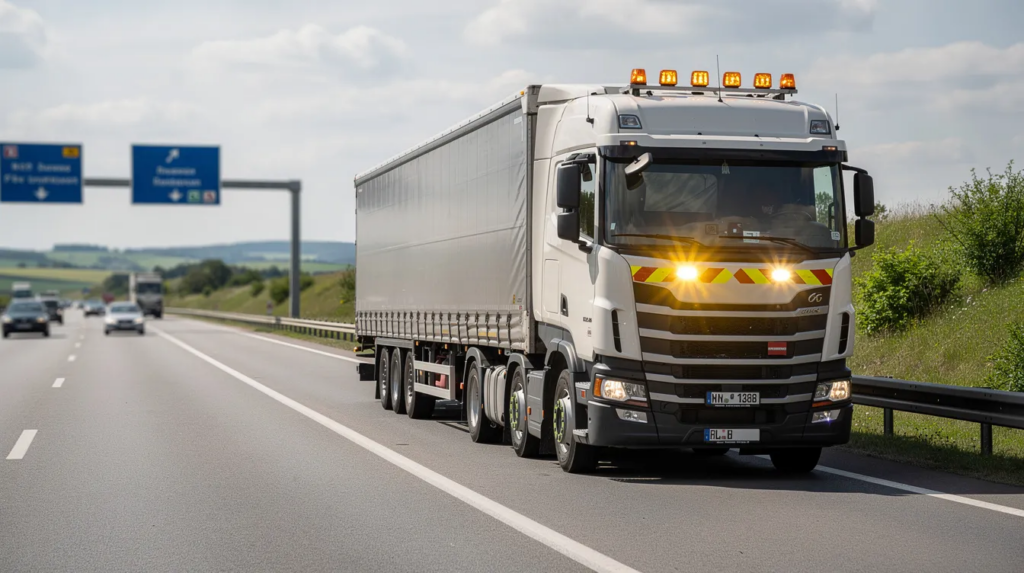
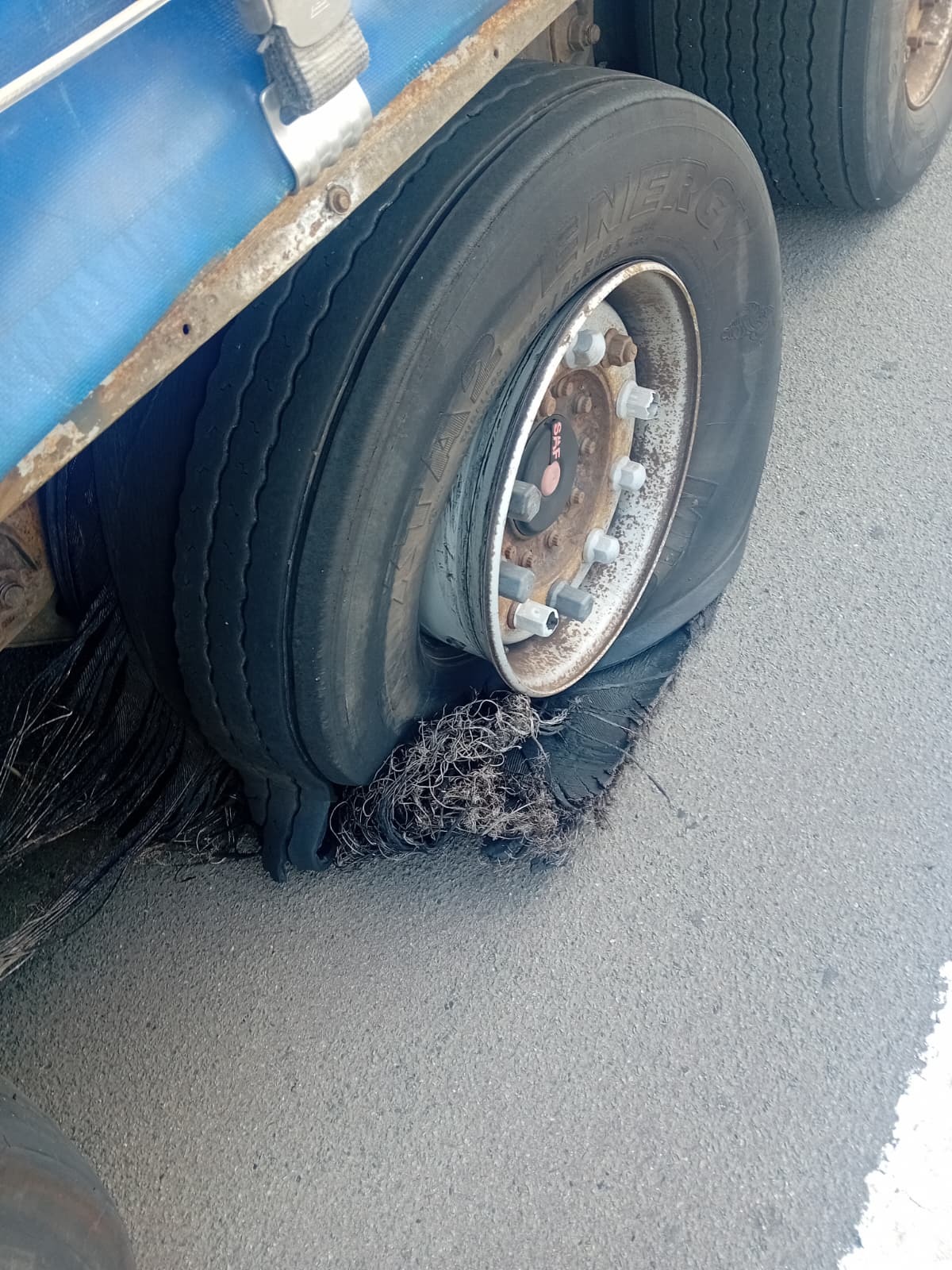
The driver had no idea anything was wrong. That’s the unsettling part of this case. Somewhere on the A6 between Schwäbisch Hall and the Nuremberg direction, the inner tyre of a dual-wheel pair on the trailer axle shredded — carcass torn open, belt and cord exposed to the road. No bang he noticed in the cab, no pull on the wheel, no sag in the trailer. The lorry just kept rolling, apparently fine, while one of its ten tyres was effectively gone.
This is what makes dual-wheel failures different from a steer-axle blowout. On a single tyre, a puncture announces itself immediately — the vehicle pulls, drops, or vibrates hard enough that any driver notices within seconds. On a twin-tyre setup, the outer tyre can carry the whole corner alone for kilometres, sometimes longer, before anyone realises. Our mobile truck tyre service reached the scene, confirmed the damage, and got both tyres of the pair replaced roadside — full details, timeline, and costs below.
The Emergency: A Blowout Nobody Heard
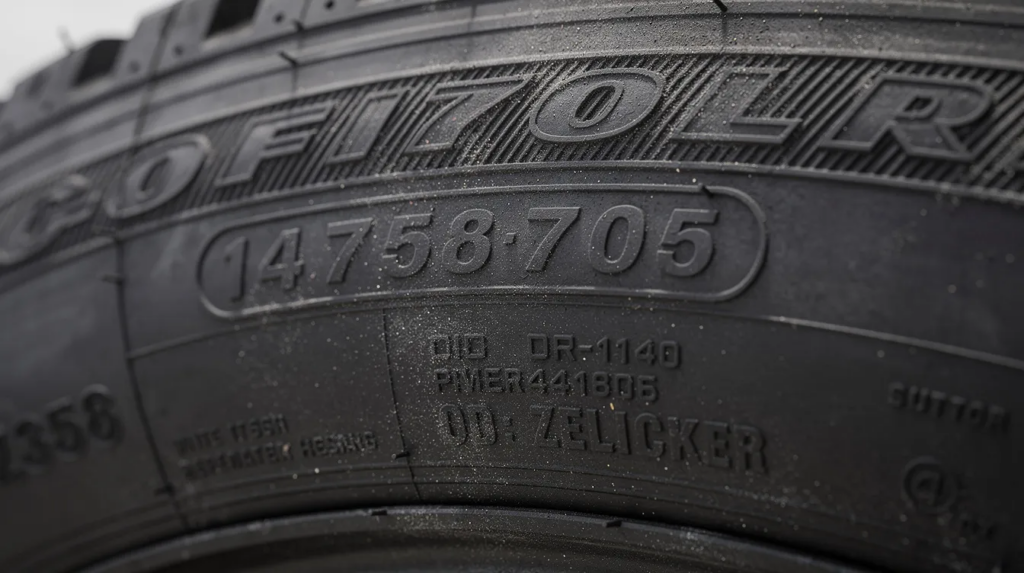
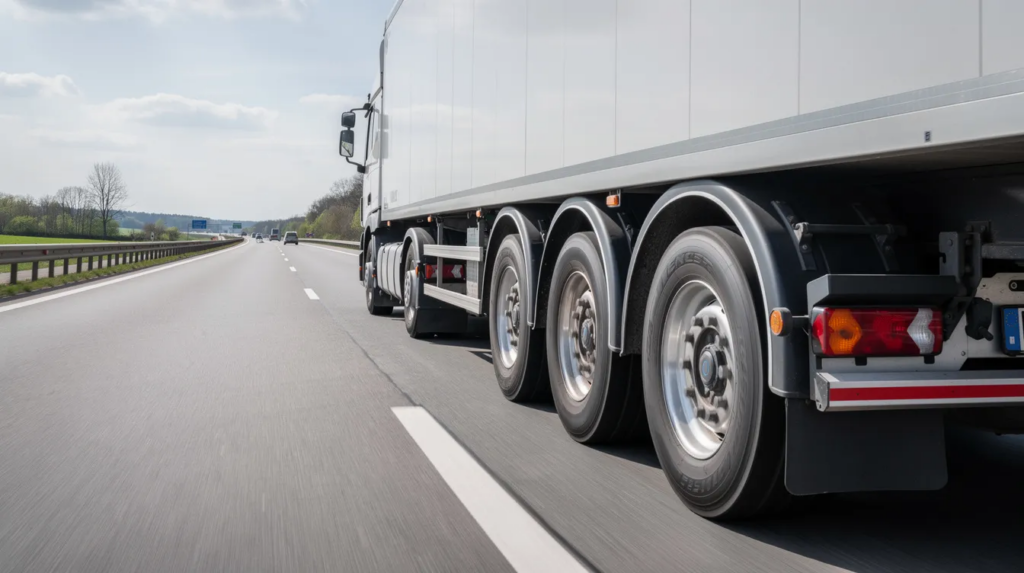
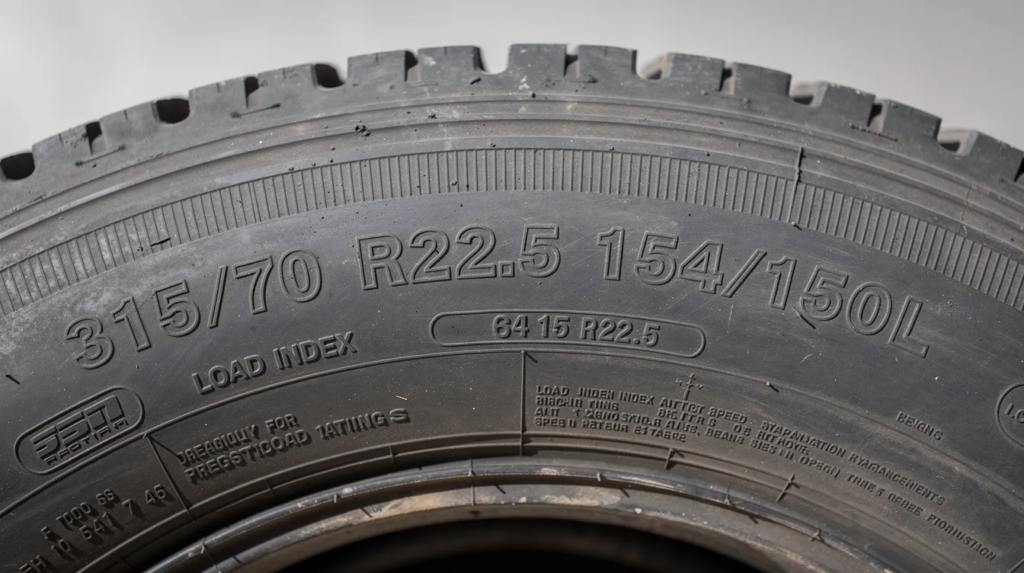
The vehicle was an articulated lorry with a curtainsider semi-trailer, running on dual wheels at the trailer axle — the standard setup for most heavy-goods trailers in Germany. Tyre size: 385/65 R22.5, the common size for trailer and drive axles on this class of vehicle. The location was the A6 near Schwäbisch Hall in the direction of Nuremberg, mid-afternoon on 18 July, dry weather, moderate traffic.
The failure itself was a classic carcass rupture on the inner tyre of the pair — the tread and sidewall had torn away in strips, exposing the steel belt underneath. On a single wheel that kind of damage would have been unmissable within seconds. Here it wasn’t, because the outer tyre simply picked up the load and kept the trailer riding level. The driver told our dispatcher he’d noticed nothing unusual until he pulled in and did a quick check, more out of habit than suspicion.
How Help Was Organised
Our dispatch process for this kind of call runs the same way across Germany, whether it’s a dual-wheel blowout, a steer-axle failure, or a full recovery job:
- Driver calls the 24/7 line and reports location, vehicle type and, where possible, tyre size
- Dispatcher logs the details and checks tyre availability with the nearest regional partner workshop
- Regional partner workshop confirmed and mobilised with the correct 385/65 R22.5 stock on board
- Service vehicle dispatched directly to the reported motorway section
- Driver advised on hazard warning lights, warning triangle placement and hi-vis vest use while waiting
Because 385/65 R22.5 is a widely stocked size, the partner workshop had matching tyres in the van before setting off — no return trip to a depot, no delay hunting for stock.
On-Site Situation
By the time the service team reached the lorry, it was parked safely on the hard shoulder with hazard lights on and a warning triangle placed further back. A quick visual pass showed nothing obviously wrong from a distance — which, again, is the point of this failure type. It took a closer inspection to confirm what dispatch had already suspected from the driver’s description.
Tapping both tyres of the pair with a rubber mallet and checking pressure through the extended valve told the real story fast. HGV tyres normally run somewhere between 8.5 and 9.5 bar depending on load and manufacturer spec; the inner tyre read essentially zero, while the outer sat noticeably higher than usual, compensating for the axle load it had been carrying alone. Rim damage was checked next — a shredded tyre running flat for any distance can score or crack the wheel hub and rim flange, and at motorway speed that risk climbs fast.
Why a Blown Inner Tyre Can Go Completely Unnoticed
A blown inner tyre in a dual-wheel pair often produces zero symptoms the driver can feel, because the outer tyre absorbs the load on its own. There’s no sag on that corner, no steering pull, and the sound of the tyre failing is usually lost in road and wind noise inside the cab — especially at motorway speed with the radio on or road surface noise from the autobahn’s concrete sections.
Compare that to a steer-axle blowout, which announces itself instantly through the wheel. A dual-wheel inner blowout is arguably the most deceptive tyre failure a driver on the road can face, precisely because the vehicle keeps behaving normally. Drivers can and do complete entire legs of a journey without knowing one tyre is destroyed underneath them.
How Drivers Usually Discover It
Most drivers find out by chance — at a rest stop, during a routine walk-round, or because something finally draws their attention. A knocking or slapping sound as the shredded rubber flails against the underside of the trailer is a common tell, as is the smell of hot or burnt rubber drifting into the cab on a warm day. In the worst cases, the fault only becomes obvious once the second tyre in the pair also fails, having carried double load for too long.
In this case it was a routine stop that revealed it. The driver said he’d simply walked round out of habit and spotted the shredded rubber straight away once he looked at the wheel from the right angle.
Why the Inner Tyre Is Hard to Inspect
The inner tyre of a dual pair sits hidden directly behind the outer one, which means it’s essentially invisible during a standard visual walk-round check. You’d need to crouch and peer through the gap between the two tyres to see anything, and even then, tread condition on the far side is guesswork.
The correct inspection method isn’t visual at all — it’s tapping both tyres with a mallet or bar (a dull thud signals low pressure, a sharp ring signals a properly inflated tyre) combined with a pressure check via an extended valve routed out to where it can be reached. According to the ADAC, tyre pressure checks are among the most commonly skipped maintenance steps on commercial vehicles, and dual-wheel setups make that skip far easier to justify without meaning to.
What Happens to the Outer Tyre
The outer tyre in the pair takes on double the load once its partner fails, and it often keeps running that way for hours or days before it too gives out — usually at speed, often many kilometres from where the original fault began. One unnoticed problem becomes two, and what could have been a scheduled tyre change turns into a full roadside emergency, sometimes with the second failure happening in worse conditions than the first.
This is exactly the mechanism that turned an unnoticed fault into a €1,500 job rather than a simple tyre swap. Fleet managers who’ve dealt with dual-wheel setups long enough tend to treat any confirmed inner-tyre failure as an automatic inspection trigger for the outer tyre too, rather than waiting to see how it holds up.
Extended Valves: A Common Point of Failure
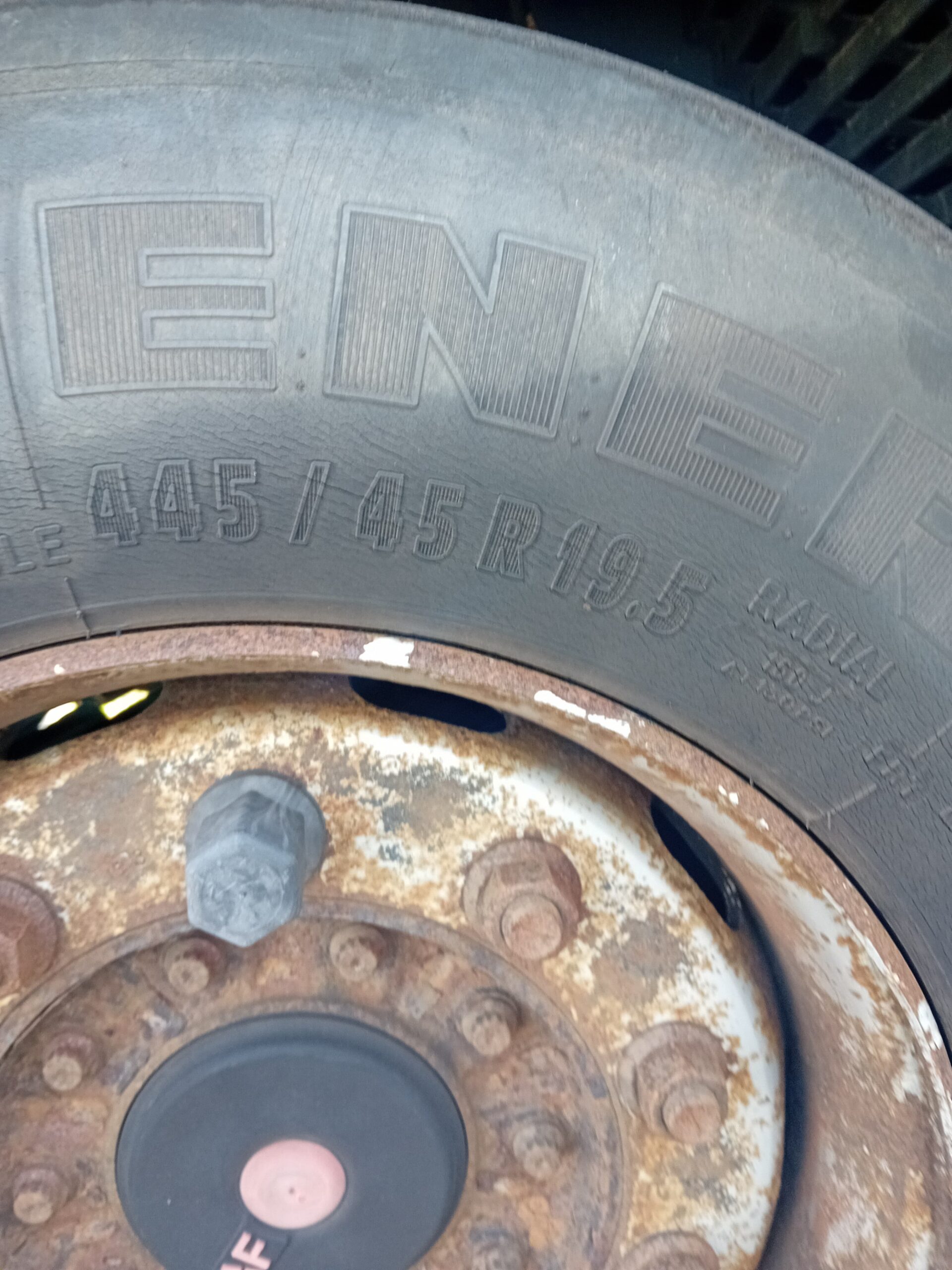
On dual-wheel axles, the inner tyre’s valve is routed out past the outer wheel using an extension hose or metal extender, since the valve stem itself would otherwise be completely inaccessible. These extensions are a known weak point — they crack with age, work loose at the connection, or develop slow leaks at the seal, and a slow leak on the inner tyre specifically is a textbook precursor to exactly the kind of failure seen in this case.
Whether the extension on this trailer contributed to the blowout couldn’t be confirmed after the fact, since the tyre itself had already shredded. But it’s a common enough failure mode that any fleet running dual wheels should have valve extensions checked as a routine item, not an afterthought.
Why TPMS Pays for Itself on Dual Wheels
Tyre pressure monitoring systems earn their cost fastest on exactly this kind of axle, because the inner tyre’s condition simply cannot be judged by eye. A sensor reading pressure and temperature in real time would have flagged the drop long before the carcass gave way completely, giving the driver time to pull in safely rather than finding out after the fact.
For single-tyre axles, a driver’s own senses do a reasonable job of catching trouble early. For dual wheels, that early-warning channel is effectively cut off, which is precisely the gap TPMS is designed to close. Fleets that have adopted it report catching slow leaks days before they’d otherwise notice anything.
The Pairing Rule: Why Both Tyres Get Replaced
When one tyre of a dual pair fails and the other has been running the axle load alone — even briefly — workshops generally replace both rather than just the damaged one. An overloaded tyre can pick up hidden stress even without visible damage: heat build-up, uneven wear starting on the shoulder, or internal structural strain that won’t show up until it fails later, often without warning.
Fitting a brand-new tyre next to a stressed but visually intact one also creates a mismatch in diameter and wear pattern between the pair, which itself accelerates wear on both. Replacing the set is standard practice for exactly that reason, and it’s the main driver of cost in this case compared with a routine single-tyre callout.
Step-by-Step: How the Repair Was Carried Out
- Assessment — the technician tapped both tyres of the dual pair, checked pressure through the extended valve, and inspected the rim and wheel hub for damage from the shredded carcass.
- Securing the site — hazard lights confirmed on, warning triangle repositioned further back given the traffic speed on this stretch of the A6, hi-vis vests worn throughout.
- Removal — wheel bolts loosened in sequence, both wheels of the pair removed from the axle for a full inspection of the hub and brake components behind them.
- Fitting — two new 385/65 R22.5 tyres mounted and balanced, wheels refitted to the hub.
- Final check — wheel bolts torqued to spec in a star pattern to seat the wheel evenly, both tyres re-checked for correct pressure before the driver was cleared to continue.
Timeline
| Time | Phase | Action |
|---|---|---|
| 13:10 | Emergency call | Driver discovers the damage at a stop and calls dispatch |
| 13:10–13:25 | Dispatch (15 min) | Location, tyre size and vehicle type logged, regional partner workshop alerted |
| 13:25–14:15 | Response drive (50 min) | Service team drives to the A6 near Schwäbisch Hall |
| 14:15–14:25 | Assessment (10 min) | Tapping and pressure check on both tyres of the dual pair |
| 14:25–15:40 | Tyre replacement (75 min) | Both tyres of the pair replaced, torque checked in a star pattern |
| 15:40 | Done | Vehicle roadworthy again |
Total time from call to departure: 2 hours 30 minutes. Response time (call to arrival): 1 hour 5 minutes.
Cost Breakdown
| Item | Price (EUR) |
|---|---|
| Callout fee | 240 |
| Labour (2.5 hrs at €120/hr) | 300 |
| Tyres 385/65 R22.5 (2 units at €460) | 920 |
| Old tyre disposal (2 units at €20) | 40 |
| Total | €1,500 net (plus VAT) |
The total here runs higher than a typical single-tyre callout simply because both tyres of the dual pair had to go — the fault that went unnoticed doubled the job. For context, a stranded articulated lorry typically costs a haulier somewhere in the region of €800–1,200 per day in downtime, cargo delay penalties and driving-hours lost, so a same-afternoon fix at €1,500 compares favourably against a vehicle sitting idle waiting for parts or a workshop slot.
Price factors on any given callout include tyre size and brand availability, time of day, distance from the nearest partner workshop, and whether disposal of the old tyres is required on site.
Why You Need a Professional for This
Attempting a dual-wheel tyre change roadside without the right training carries real risk:
- Misjudging which tyre in the pair actually failed, given the inner tyre is hidden from view
- Incorrect wheel bolt torque leading to a loose wheel further down the road — a well-documented cause of wheel-off incidents
- No proper equipment to lift and support a heavy trailer axle safely on the hard shoulder
- Missing hidden rim or wheel hub damage that would fail a roadworthiness check later
- Standing in a live traffic lane without the right hi-vis and warning setup, which is both a legal requirement and a basic safety measure
Roadside tyre work on an HGV involves loads and torque specs well beyond what a car breakdown kit is built for, and getting it wrong risks a repeat failure within kilometres.
Typical Call-Outs Across Germany
Dual-wheel and single-tyre blowouts happen everywhere heavy traffic meets long hauls — the A6 corridor through Baden-Württemberg and Bavaria, the A45 through Siegen and the Sauerland, the A7 running north-south, and the ring roads around Berlin, Cologne and Hamburg all see a steady stream of these calls. Our network of regional partner workshops means a response vehicle is rarely more than an hour away, whatever the motorway.
Prevention for Drivers and Fleets
A few habits catch most dual-wheel problems before they turn into roadside emergencies:
- Tap-test both tyres of every dual pair on each walk-round, not just a visual glance
- Check cold tyre pressure weekly using the extended valve, and log it
- Inspect valve extensions for cracks, leaks or loose fittings during routine servicing
- Watch tread depth closely on both tyres — under StVZO §36, commercial vehicle tyres must meet minimum legal tread depth, and uneven wear between a pair often signals a pressure problem building
- Fit TPMS where the fleet budget allows, specifically because dual wheels are the axle configuration where driver senses are least reliable
Tyres, Fleets and Maintenance: The Bigger Picture
Tyre quality and maintenance discipline go hand in hand for any haulier running long distances on German motorways. Major manufacturers such as Michelin, Continental and Goodyear and Bridgestone all produce trailer-specific tyre lines built around load rating and heat resistance for exactly this kind of dual-wheel duty cycle. Choosing the right tyre for axle load and typical route profile matters as much as the brand — an under-specified tyre on a heavily loaded trailer axle wears faster and runs hotter, both of which shorten the gap between routine service and an unplanned callout.
For fleet managers, tyre condition monitoring is increasingly bundled into wider DEKRA and TÜV inspection routines, alongside brake and suspension checks. A dual-wheel axle that gets a proper tap-test and pressure check at every service interval is far less likely to produce the kind of silent failure described in this case. The mechanics of dual and twin-tyre assemblies on heavy vehicles are well documented for drivers wanting to understand the load-sharing principle behind why one tyre can fail without the vehicle showing it.
Why Choose Our Truck Tyre Service
Our truck tyre service runs 24 hours a day, seven days a week, anywhere in Germany, backed by a vetted network of regional partner workshops rather than a single depot with limited reach. Dispatch is handled in multiple languages, which matters given how much of the haulage traffic on German motorways is international. Pricing is quoted upfront before work begins, with no surprise add-ons once the technician is on site — the breakdown above reflects exactly what the driver was told before the callout fee was accepted.
Frequently Asked Questions
How can a tyre blow out without the driver noticing?
On a dual-wheel pair, the surviving outer tyre carries the load alone, so there’s no sag, no pull and often no audible bang over road noise. The vehicle can keep driving normally for a considerable distance before anyone realises.
Why replace both tyres instead of just the damaged one?
The surviving tyre has been carrying double the axle load, which can cause hidden heat and structural stress even without visible damage. Fitting one new tyre next to a stressed one also creates an uneven wear pattern, so pairing is standard practice.
What’s the normal tyre pressure for an HGV trailer axle?
Typically between 8.5 and 9.5 bar depending on load and manufacturer specification. Pressure should always be checked cold and via the correct valve, including the extended valve on dual-wheel setups.
Is TPMS worth fitting for a fleet running dual wheels?
Yes — it’s specifically valuable here because the inner tyre’s condition can’t be judged visually or by feel. Sensors flag pressure loss early, before a slow leak turns into a full blowout.
How fast can help reach me on a German motorway?
In this case, response time from call to arrival was 1 hour 5 minutes on the A6 near Schwäbisch Hall. Actual times vary by location and proximity to the nearest regional partner workshop, but our network is built to keep that window short nationwide.
What should I do if I suspect a dual-wheel tyre has failed?
Pull onto the hard shoulder as soon as safely possible, set hazard lights and a warning triangle, put on a hi-vis vest, and call for professional assistance rather than attempting an inspection in live traffic.
Summary
An articulated lorry lost its inner trailer tyre on the A6 near Schwäbisch Hall on 18 July, with the driver unaware until a routine stop. Our team responded in 1h05, replaced both 385/65 R22.5 tyres of the dual pair, torqued the wheels in a star pattern, and had the vehicle back on the road in 2h30 total, for €1,500 net. The case is a reminder that dual-wheel blowouts are the most deceptive tyre failure on the motorway, and that regular tap-tests and pressure checks are the only reliable way to catch them early.
Need Roadside Tyre Help in Germany?
Call +49 160 5753826 any time — we’re on call 24/7, anywhere in Germany. More details at www.lkwhelp24.com.
Keywords: truck tyre service | dual wheels | articulated lorry | tyre pressure | TPMS | breakdown assistance | A6 Schwäbisch Hall | 385/65 R22.5 | emergency tyre service | mobile tyre fitting