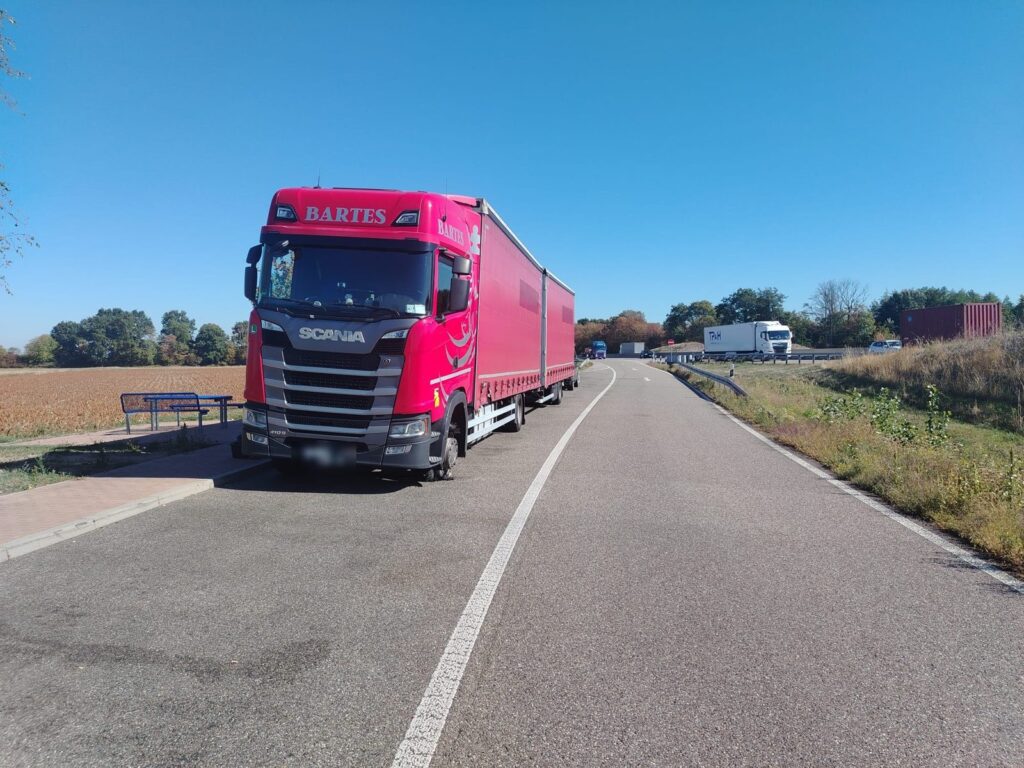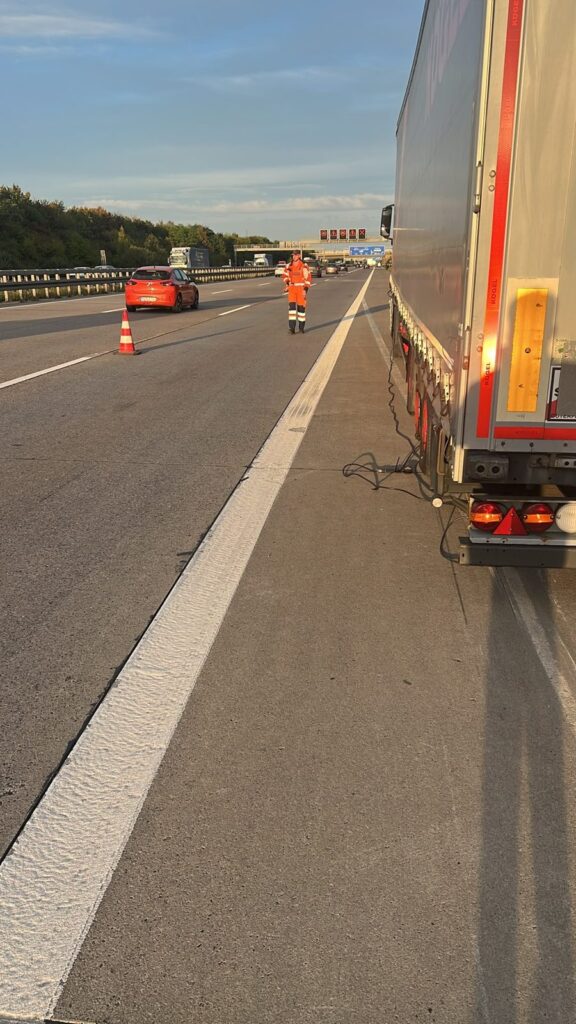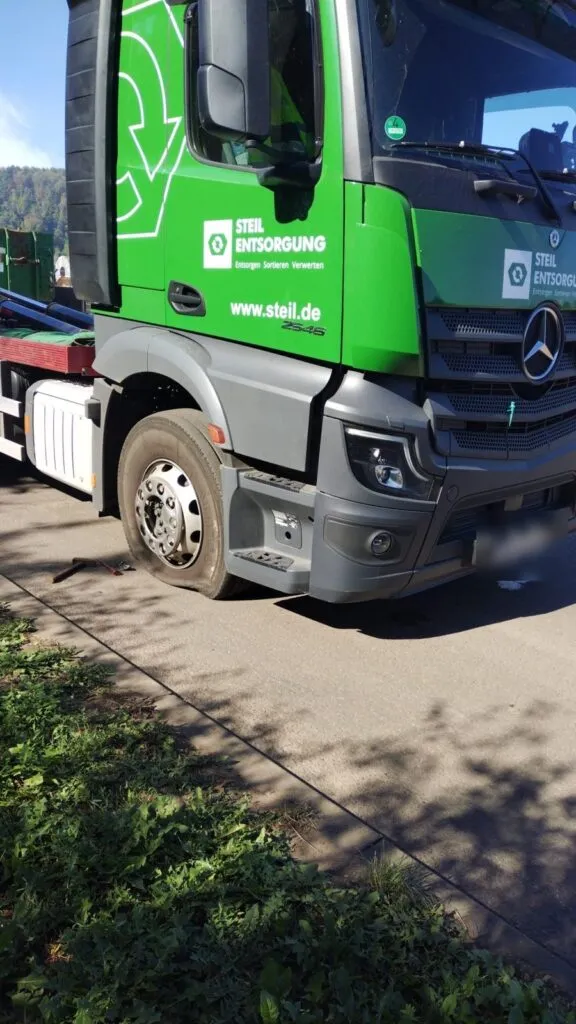
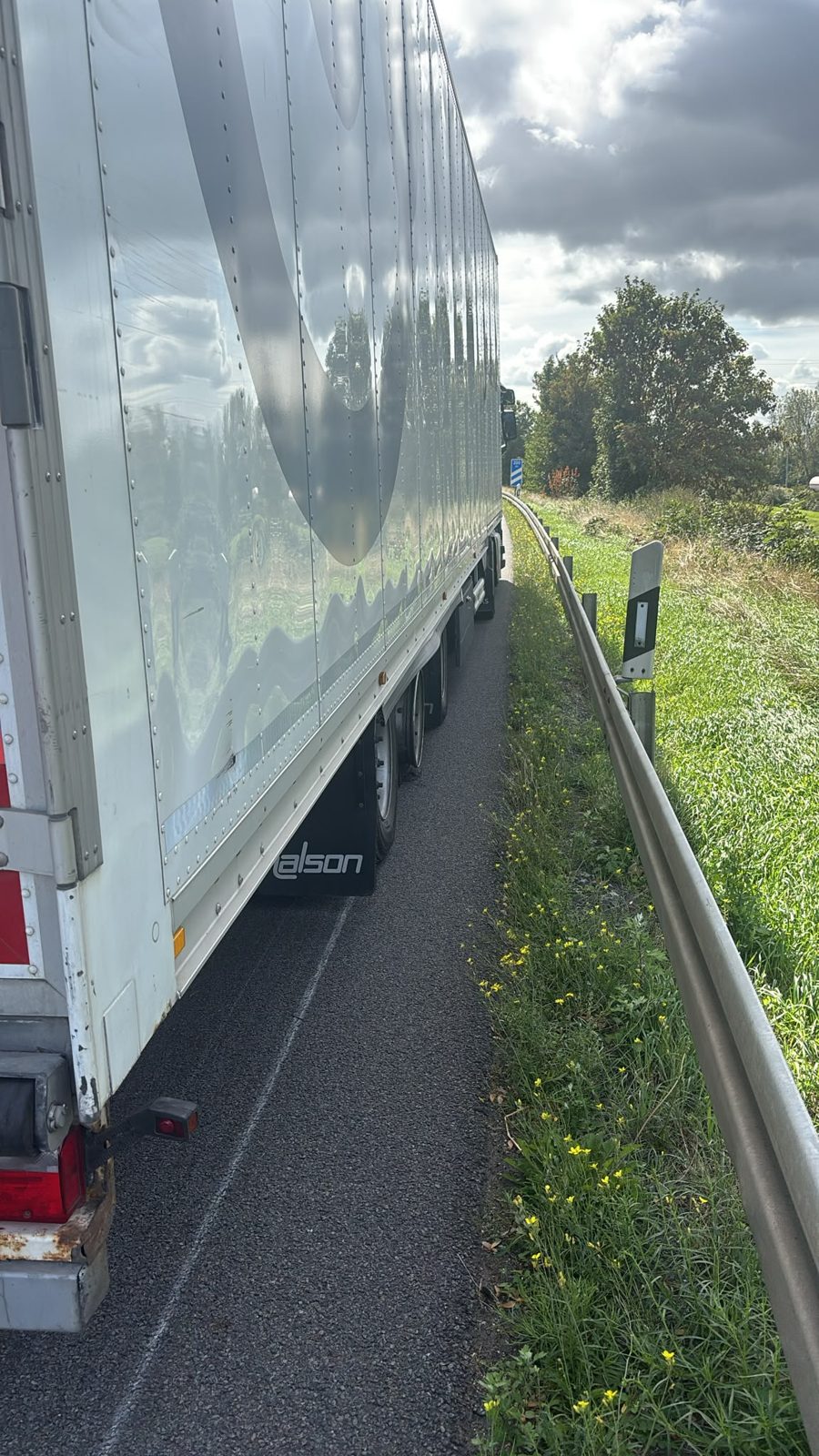
On 24 September 2026 a trailer tyre on the A1 near Lübeck came apart completely, and the artic was back on the road 130 minutes after the driver’s call. The blowout happened on the hard shoulder of the Hamburg-bound carriageway, a strip so narrow that the trailer’s side nearly touched the crash barrier. Our truck tyre service sent a mobile crew from the partner network, who fitted a new 245/70 R19.5 on site for €805 net. No tow, no second night in a lay-by, no damage to the axle.
Most drivers know the sound of a tyre letting go: a flat bang, a shudder through the cab, then the long scraping rumble of a rim that has lost its rubber. What they remember afterwards is rarely the noise. It is the next ten minutes, standing behind a barrier on a busy motorway, waiting for someone to tell them what happens next. This case walks through those minutes, hour by hour, with the real prices and the real timings, so you can see what a properly run roadside tyre job looks like and what it costs.
The emergency: a trailer tyre destroyed on a narrow hard shoulder
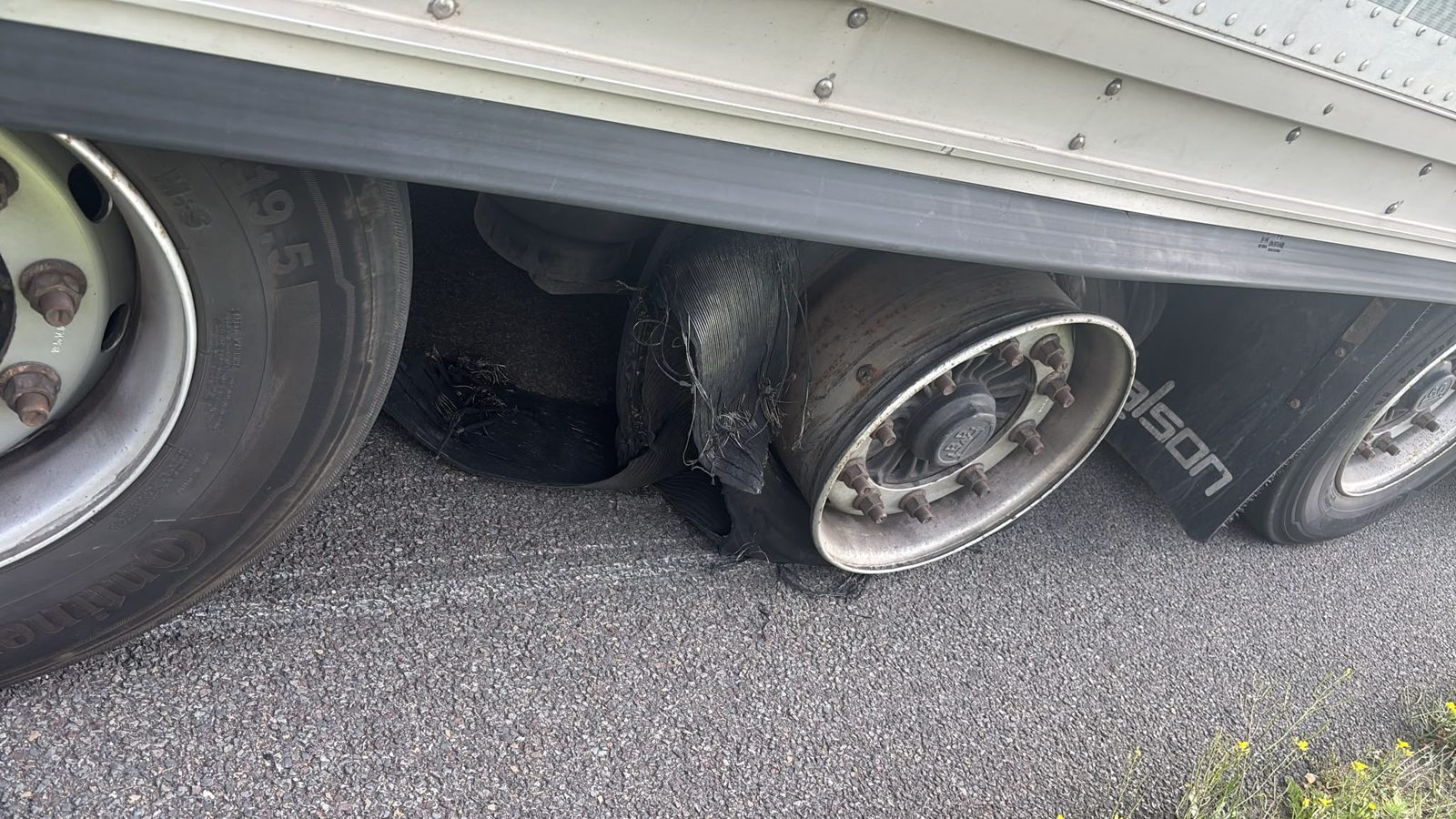
A refrigerated-style box trailer with a white aluminium body had been running north-east on the A1 towards Lübeck when one of its tyres failed without warning. The unit was one of those long-distance rigs you see crossing Germany day and night: tractor unit in front, air-suspended trailer behind, a driver already well into his shift. He felt the vibration, put the hazards on and rolled onto the hard shoulder before the tyre had finished disintegrating.
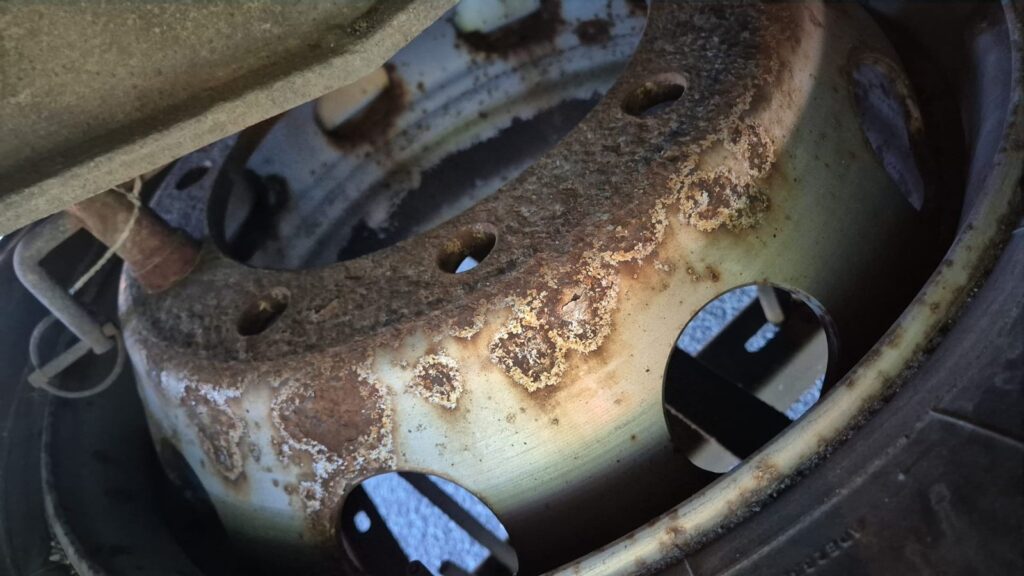
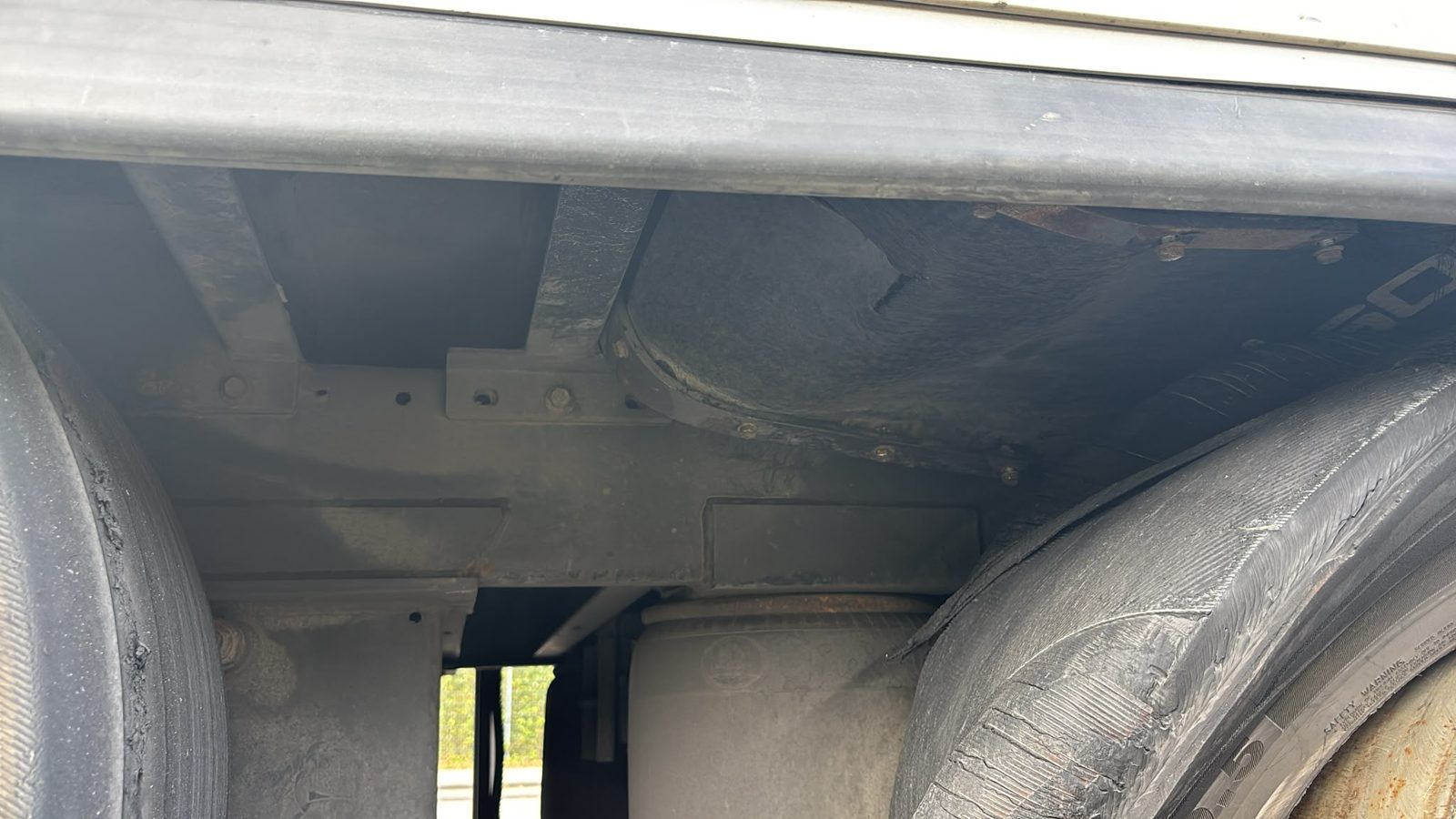
What he left behind was a tyre in ribbons. The tread had torn off, the carcass hung in strips from the rim, and the steel cord was spread across the wheel like wire from a snapped cable. The aluminium rim and the hub looked intact, and the wheel nuts were all in place. The neighbouring wheel carried a Continental tyre in 245/70 R19.5 that had survived, though its sidewall showed long scuff marks from the last few hundred metres.
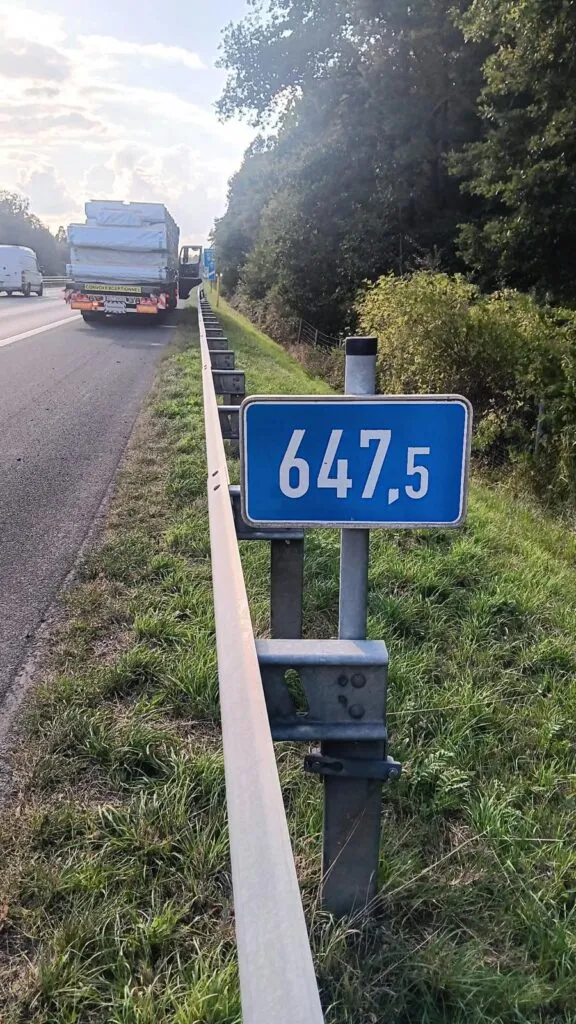
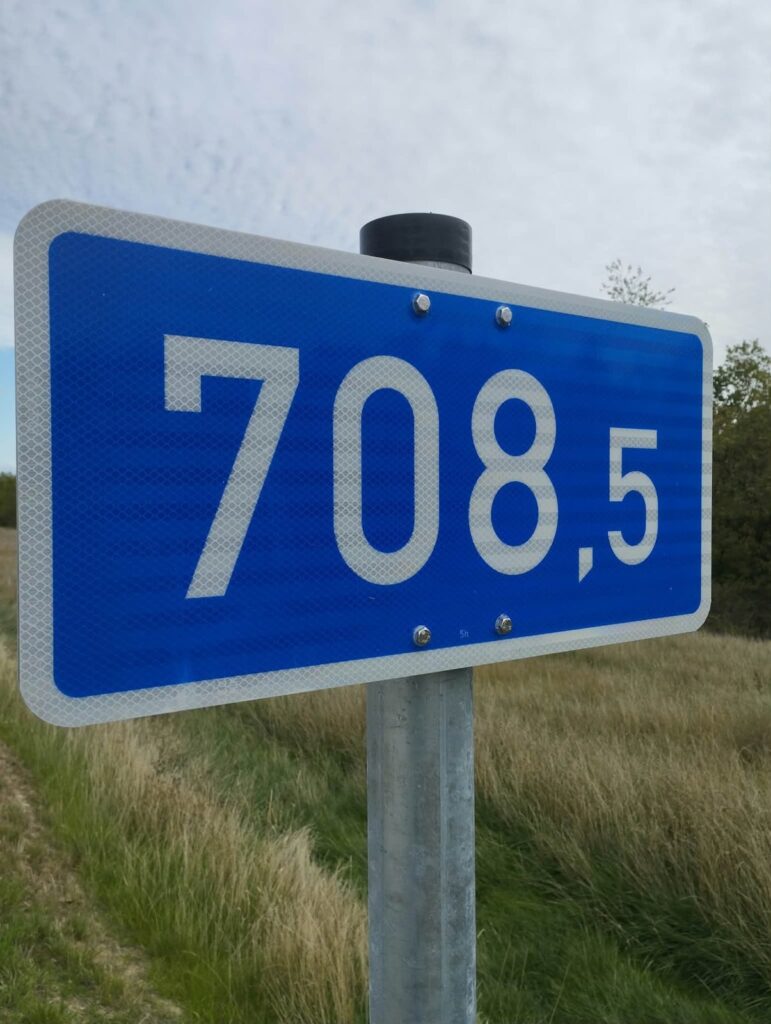
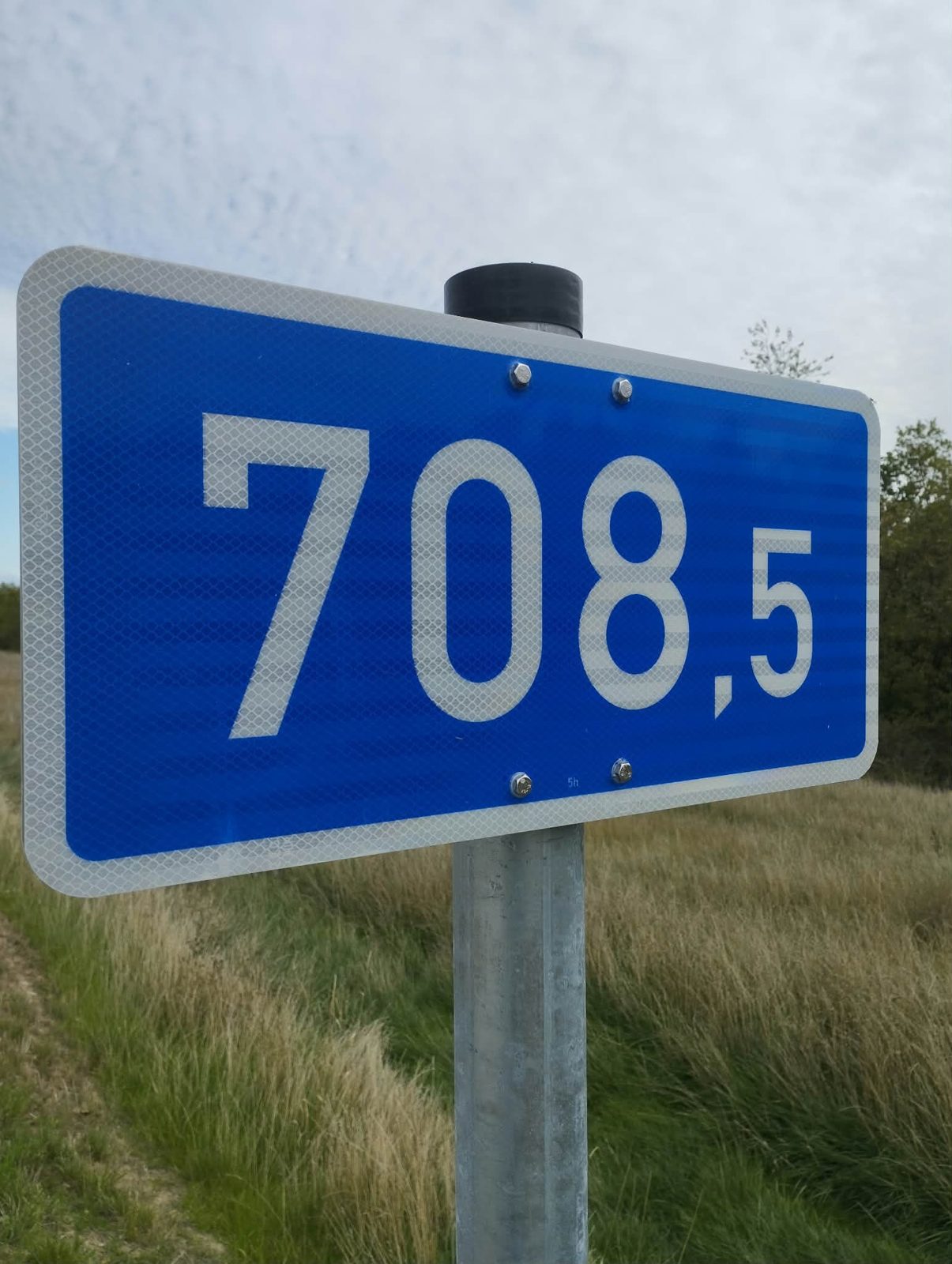
The location made everything harder. The shoulder was barely wider than the trailer. Traffic passed within a metre or two of the driver’s elbow, and the sun came and went between clouds, which is the worst kind of light for oncoming drivers judging distance. The kilometre marker beside the barrier gave our dispatcher a position to within a few metres, which later saved precious minutes.
Tyre blowout (also called a burst or Reifenplatzer): the sudden loss of tyre structure and air pressure while the vehicle is moving, usually caused by heat, damage to the carcass or running underinflated.
Nobody was hurt, there was no load fire and no brake damage. Those three facts are not luck, they are the result of how the driver reacted in the first minute, and we come back to that further down.
How the help was organised, minute by minute
Help was organised in three steps: a structured phone call, a dispatch decision in 15 minutes and a mobile crew driving to the exact spot. The call came in at 14:10. The driver spoke to our dispatcher in a mix of languages, and that is normal on our line, because our multilingual dispatch desk deals with drivers from half of Europe every day.
The dispatcher worked through a fixed list of questions, always in the same order:
- Is everyone out of the cab and standing behind the barrier?
- Are the hazards on and the warning triangle placed at the correct distance?
- Which axle, which side, and which tyre size is printed on the sidewall?
- What does the kilometre marker next to the vehicle say?
- Is the other tyre on that axle still holding air?
That last question matters more than people think. If the neighbouring tyre on a dual or axle pair has been overloaded for even a short distance, it can be a second job waiting to happen.
By 14:25 the dispatcher had found the closest mobile crew in our partner network, confirmed that a 245/70 R19.5 was on the van and agreed the price with the driver before anyone set off. That 15-minute window is not wasted time. A crew that arrives with the wrong size has just driven an hour to stand next to the trailer and make a phone call.
If you want to see what the service covers on a normal day, our page on truck tyre service lists the sizes we carry and the typical response areas.
Why you cannot ignore a destroyed trailer tyre
A trailer with a destroyed tyre cannot simply limp to the next services. The remaining tyres on that axle then carry the share of the load that the failed tyre used to take, and truck tyres are built to run at high pressure, typically 8.5 to 9.5 bar. A 245/70 R19.5 on a trailer axle is designed for a defined load index, and once one tyre is gone the neighbouring one is working beyond it.
There are four things that go wrong when a driver tries to carry on:
- The rim gets cut. Steel cord and the bare edge of the rim chew through the aluminium surface, and a rim with a deep score is scrap.
- The axle takes shock. A wheel running on bare metal transmits hard vibration into the hub and bearing, which can damage the seal or cause the bearing to run hot.
- The air spring suffers. On air-suspended trailers the bellows sit close to the wheel, and flying cord can cut them.
- Debris hits other traffic. Strips of casing are a hazard to the car behind, and the longer the trailer drives, the more of it is left on the carriageway.
Stopping immediately is, in most cases, the cheapest decision available. The tyre is gone either way, and the only question is how much else goes with it. Under § 36 StVZO tyres must be fit for the load and speed of the vehicle, so a trailer with a shredded tyre is not roadworthy and the driver has no business continuing on it.
Driving to the A1: the 60-minute wait
The crew left at 14:25 and reached the trailer at 15:25. Sixty minutes sounds long when you are standing at the side of a motorway, and drivers often ask why it is not 20. The answer is geography. Roadside tyre crews are not parked at every junction. The nearest one with the right tyre in stock and a free slot was an hour away in daytime traffic, and the hour was spent on the A1 itself, partly in slow-moving columns near the Hamburg ring.
It is worth being honest about this: the hour is the part of the job we influence least. What we control is the quality of the information passed to the crew and the speed of the dispatch decision. When both are right, the first minute after arrival is spent working, not guessing.
In our experience the waiting time on German motorways ranges from 35 to 70 minutes in daytime, and longer at night, in heavy rain or on weekends when fewer crews are on call. If a dispatcher promises you 20 minutes in the middle of nowhere, ask what they are basing it on.
Step by step: how the new tyre was fitted
The repair itself ran in five steps and took 55 minutes from arrival to handover, including the inspection. Here is how it went.
Step 1: securing the site
The crew pulled up behind the trailer at 15:25, switched on the amber beacons and placed additional markers to protect the working area. On a narrow hard shoulder this is not optional. The technician works with his back to live traffic, and the only protection he has is the vehicle and the cones.
Step 2: inspection before touching the wheel
Between 15:25 and 15:39 the crew took photographs of the damage for the file, then checked the frame, the air spring bellows, the rim and the hub. They looked at the neighbouring tyre, which showed long scuffs on the sidewall but no cord exposure. A good inspection can save a customer a second breakdown a week later, so this step is never skipped. The result: no secondary damage to the axle, the suspension or the rim.
Step 3: lifting the axle and removing the remains
From 15:39 the technician placed a hydraulic jack under the axle, lifted the wheel clear of the ground and removed the nuts one by one. The remains of the tyre were cut away from the rim, and the bead seat was cleaned. At this point the rim was checked a second time on the bench side: no cracks, no deep scoring, no bent flange.
Step 4: mounting the new 245/70 R19.5
The new tyre went onto the rim, was seated and inflated in stages with a safety cage-style procedure appropriate for roadside work, and the pressure was set to the figure printed on the trailer’s data plate. The wheel was refitted to the hub.
Step 5: torque and final check
Wheel nuts were tightened in a star pattern with a torque wrench, then checked again after the trailer was lowered. This is the part people cut corners on, and it is also the part that kills. A wheel that comes loose at 85 km/h is a wheel that ends up in the central reservation. At 16:10 the work was done, and from 16:10 to 16:20 the crew re-checked pressure, re-torqued the nuts, handed over the paperwork and took the old tyre away for disposal.
At 16:20 the trailer pulled out. If you would like to know more about the types of jobs that mobile crews can handle on site, our overview of mobile truck service explains the range.
The full timeline: 130 minutes from call to departure
The total time from the first call to the trailer driving off was 130 minutes. The table below shows each phase exactly as it happened.
| Time | Phase | Action |
|---|---|---|
| 14:10 | Call | Driver reports a tyre blowout on the A1 near Lübeck, trailer on a narrow hard shoulder. Dispatcher confirms size, axle and position from the kilometre marker, asks the driver to switch on the hazards, place the warning triangle and stand behind the barrier |
| 14:25 | Dispatch | Closest mobile crew from the partner network selected, 245/70 R19.5 confirmed in stock, price agreed with the driver (15 min) |
| 14:25 to 15:25 | Journey | Crew on the way, motorway, daytime traffic (60 min) |
| 15:25 | Arrival | Site secured with beacons, situation assessed |
| 15:39 | Inspection | Damage photographed, frame, air spring, rim, hub and neighbouring tyre checked (14 min) |
| 15:39 to 16:10 | Repair | Axle jacked up, tyre remains removed, rim inspected, new 245/70 R19.5 mounted and inflated, wheel nuts torqued (31 min) |
| 16:10 to 16:20 | Final check | Pressure checked, nuts re-torqued, paperwork handed over, old tyre removed (10 min) |
| 16:20 | Done | Trailer continues its journey |
Total: 130 minutes, or 2 hours 10 minutes. Of those, 60 minutes were pure driving time for the crew and 55 minutes were on-site work. The remaining 15 minutes were the dispatch decision. That ratio, roughly half the time spent getting the crew to the vehicle, is typical for motorway jobs in Schleswig-Holstein and Lower Saxony.
What the job cost: an itemised bill
The job cost €805 net (excluding VAT), and every line is shown below. We give the price before the crew leaves, not after.
| Item | Price (EUR) |
|---|---|
| Call-out (Anfahrt) A1 near Lübeck | 260 |
| Labour, about 1.25 hours (inspection, removal, mounting, torque check) | 145 |
| Tyre 245/70 R19.5 (trailer) | 380 |
| Disposal of the old tyre | 20 |
| Total | 805 |
All amounts are net, plus VAT where applicable. The call-out charge reflects the distance the crew drove, in this case about an hour each way. The labour figure of €145 covers roughly 75 minutes of actual work, at a rate that sits within the normal range of €90 to €140 per hour for emergency roadside labour. The tyre price is for a new trailer-axle tyre in the standard size, not a retread. Disposal is charged because old tyres are regulated waste in Germany, and the crew takes the casing away so the customer does not have to.
What moves the price up or down
A few things change the bill on a job like this:
- Time of day. Night and weekend call-outs carry a surcharge of 25 to 50 percent on the call-out fee.
- Distance. A crew from 20 kilometres away charges less than one from 80.
- Tyre size and brand. A 315/80 R22.5 drive tyre costs more than a 245/70 R19.5 trailer tyre, and a premium brand more than an economy one.
- Additional damage. A cracked rim or a cut air spring adds parts and labour. This case had neither.
- Tow instead of repair. If the wheel cannot be repaired on site, recovery from the hard shoulder costs between €850 and €1,600, depending on distance.
What a standing trailer costs
The comparison that matters is the cost of doing nothing. A refrigerated or box trailer standing at the roadside, with a driver whose driving hours are running down, loses roughly €800 to €1,200 per day in lost revenue. A job that is finished in 130 minutes is cheaper than any alternative that involves waiting for morning, towing to a workshop or finding a tyre fitter with an open bay.
That is the economics behind roadside tyre work. The crew costs more per hour than a workshop. The driver, the load and the schedule cost far more per hour than the crew.
Why you need a professional for this kind of repair
Changing a truck tyre by the road is a job for trained people with the right kit, and the reasons are practical, not bureaucratic. A truck wheel with its tyre can weigh well over 100 kg. A 245/70 R19.5 inflated to working pressure stores a great deal of energy, and a bead that lets go during inflation is dangerous at any distance.
Here is what goes wrong when a driver attempts it alone:
- Wrong jack position, with the axle slipping off the jack or the air suspension collapsing mid-lift.
- Inflating without a restraint, which is how people get hurt.
- Under-torqued nuts, which loosen within the first 50 kilometres.
- Over-torqued nuts, which stretch studs and crack alloy rims.
- Damage to the hard shoulder position itself: a driver working on the traffic side of the trailer has no protection from passing vehicles.
- Warranty and insurance questions if a tyre was fitted without the right tools or documentation.
The DEKRA technical inspection organisation publishes regular reports on tyre-related accident causes, and the pattern is consistent: tyres that were poorly fitted or run underinflated are over-represented in commercial vehicle breakdowns.
There is another reason, and it concerns the neighbouring tyre. A professional looks at it. A driver in a hurry does not.
Situations where we are called out across Germany
We deal with far more than blowouts. A typical week of motorway callouts includes the following:
- Puncture from a screw, nail or stone in the tread.
- Sidewall damage after hitting a kerb or a pothole.
- Retread separation on the drive axle in summer heat.
- Dual-wheel pairs where one tyre has lost pressure unnoticed, so the other has been overloaded.
- Valve failures and slow leaks that show up only on the TPMS warning.
- Wheel-nut loosening after a recent tyre change elsewhere.
- Seasonal changes for fleets that cannot afford a day in a workshop.
Some of those jobs are quick. A puncture repair on a tubeless tyre may take 40 minutes on site. Some are not: a retread that has torn off may take the mudguard and brake lines with it. Our page on towing and recovery explains what happens when the vehicle cannot be repaired where it stands.
For a closer look at a different type of blowout, see the case of a livestock lorry tyre blowout on the A29, where the added complication was the animals on board.
What drivers and fleet managers can do to prevent this
Most blowouts are not sudden. They are the end of a process that started weeks earlier with low pressure, a damaged sidewall or a misjudged load. A short routine at every stop catches many of them.
Daily checks for the driver:
- Walk round the vehicle and look at every tyre, including the inner dual.
- Tap the tyres or use a pressure gauge, and compare with the figure on the data plate.
- Check sidewalls for cuts, bulges or exposed cord.
- Look at wheel nuts for rust trails, which mean movement.
- Listen for hissing at valves after parking.
Monthly or per-trip checks for fleets:
- Tread depth against the legal minimum of 1.6 mm, and against your own replacement threshold, which should be higher.
- Matching dual tyres by diameter, because a mismatch overloads the larger one.
- Retread quality and age, particularly in summer.
- Axle alignment and brake drag, which show up as one-sided wear.
A tyre running at 20 percent below the recommended pressure can lose a good part of its life, and runs hotter along the way. Heat is what kills carcasses. Our guide to truck tyre pressure sets out correct values and measuring technique in detail.
Truck tyres in the fleet: sizes, brands and what to look for
The tyre in this case, a 245/70 R19.5, is a common trailer and light-distribution size, and the Continental tyre on the neighbouring wheel is a good example of the premium brands you see on German motorways. Continental is one of several manufacturers, alongside Michelin, Goodyear, Bridgestone and Pirelli, that supply the bulk of the long-haul market, and all of them publish load and pressure tables for their ranges.
The numbers on the sidewall mean the following. In 245/70 R19.5, 245 is the section width in millimetres, 70 is the aspect ratio (sidewall height as a percentage of width), R stands for radial construction and 19.5 is the rim diameter in inches. The size standards behind these figures are maintained by the ETRTO, the European body for tyre and rim technical dimensions. A separate load index and a speed symbol follow the size and tell you how much weight the tyre may carry and how fast.
Other common truck sizes you will meet on the road:
| Size | Typical use | Notes |
|---|---|---|
| 315/80 R22.5 | Drive and steer axles of tractor units | Most common long-haul size |
| 385/65 R22.5 | Trailer axles, mega trailers | Wide single, used in place of duals |
| 245/70 R19.5 | Trailer axles, distribution trucks | The size in this case |
| 235/65 R16C | Vans and light commercial vehicles | Reinforced carcass |
For a fleet, the cheapest tyre per kilometre is rarely the cheapest tyre on the invoice. A premium casing that can be retreaded once or twice often returns a lower cost per kilometre, but only if the casing is kept in good condition. That means regular pressure checks, prompt replacement of damaged tyres and avoiding the damage that comes from running a flat.
Mixing brands on the same axle is another common mistake. Two different tyres may differ slightly in outer diameter, even when both carry the same size marking. On a dual pair, that difference puts a few millimetres of extra load on the larger tyre. Over thousands of kilometres this shortens its life, and it can make the difference between a tyre that lasts and one that blows out in September.
Questions drivers ask after a blowout
How long does a truck tyre change on the motorway take?
A mobile truck tyre change takes between 45 and 90 minutes on site, plus the time for the crew to reach you. In this case the on-site work lasted 55 minutes, and the total from call to departure was 130 minutes. Night, rain and busy corridors add to that figure.
What does an emergency truck tyre replacement cost?
A typical roadside tyre job on a motorway costs between €750 and €1,400 net for a lorry or artic, and €350 to €600 for a van. This trailer case cost €805 net, including call-out, labour, tyre and disposal.
Should I keep driving to the next lay-by after a blowout?
No. Driving on a destroyed tyre damages the rim, the hub and the air spring, and sheds debris onto the carriageway. Stop as soon as it is safe to do so, switch on the hazards, place the warning triangle and get everyone behind the barrier before you phone.
Can a blown truck tyre be repaired?
A blown tyre cannot be repaired. Repair is only possible for small punctures in the tread area, and the casing must be undamaged. Once the carcass has torn or the steel belt is exposed, the tyre must be replaced.
Who pays for a roadside tyre change?
The vehicle owner pays, unless a service contract, a fleet card or an insurance policy covers it. Some breakdown policies include tyres, others exclude them. Check your terms and keep the itemised invoice for your accounts or claim.
How do I tell the dispatcher where I am?
Give the motorway number, the direction of travel and the number on the nearest blue kilometre marker. In this case the marker told us the position within a few metres, which saved at least ten minutes of searching. If you cannot read the marker, the autobahn.de portal and your navigation app can still give a good approximation.
Why fleets and drivers choose us
Drivers call us because the phone is answered at any hour, in their language, by someone who knows what a 245/70 R19.5 is. We work with a network of vetted mobile crews across Germany, and each job is priced before the crew moves. There are no surprise lines on the invoice.
What you can expect from us:
- A live person on the line 24/7, including nights, weekends and public holidays.
- A dispatcher who speaks German, English, Polish or Russian.
- A fixed price agreed before dispatch, with a breakdown by item.
- A crew that carries the common sizes, so the first visit is usually the only visit.
- Documents and an invoice you can hand to your accountant without a rewrite.
If you manage a fleet and want to avoid the 2 a.m. scramble, call us before the next breakdown and talk through your routes, your tyre sizes and the regions where your trucks spend most time. It takes ten minutes, and the next call is faster for it. You can also reach us through our contact page.
Summary: the key facts of this job
- Vehicle: artic with a box trailer, air-suspended axle
- Failed part: trailer tyre, size 245/70 R19.5, complete blowout
- Location: A1 near Lübeck, Hamburg-bound hard shoulder
- Date: 24 September 2026
- Dispatch time: 15 minutes from call to crew assigned
- Crew journey: 60 minutes
- On-site work: 55 minutes, including 14 minutes of inspection
- Total time: 130 minutes (2 hours 10 minutes), 14:10 to 16:20
- Cost: €805 net (call-out €260, labour €145, tyre €380, disposal €20)
- Secondary damage: none to rim, hub, axle or air spring
Call us if a tyre lets go
If a tyre fails on the motorway, stop safely, get behind the barrier and call. We pick up at any hour.
Phone: +49 160 5753826
Web: www.lkwhelp24.com
Round the clock across Germany
Keywords: truck tyre service | mobile reifenservice | truck tyre replacement | truck tyre change | truck tyre callout | truck tyre roadside assistance | truck tyre repair | trailer tyre service | truck tyre burst | truck tyre breakdown Germany | A1 Lübeck | 245/70 R19.5
Related reading
- Livestock Lorry Tyre Blowout: A29 Fixed in 2h 13min
- Truck Tyre Service on the A7 Near Soltau: Trailer Back on the Road in 2h 30min
- Tire Blowout on the Autobahn: The Immediate Action Checklist for Truck Drivers
- Truck Tyre Repair 2026: When It Works and When Only Replacement Will Do
- Mobile Truck Tyre Service on the A19 near Malchin: Scania Artic Back on the Road in 2 Hours 16 Minutes After a Blowout