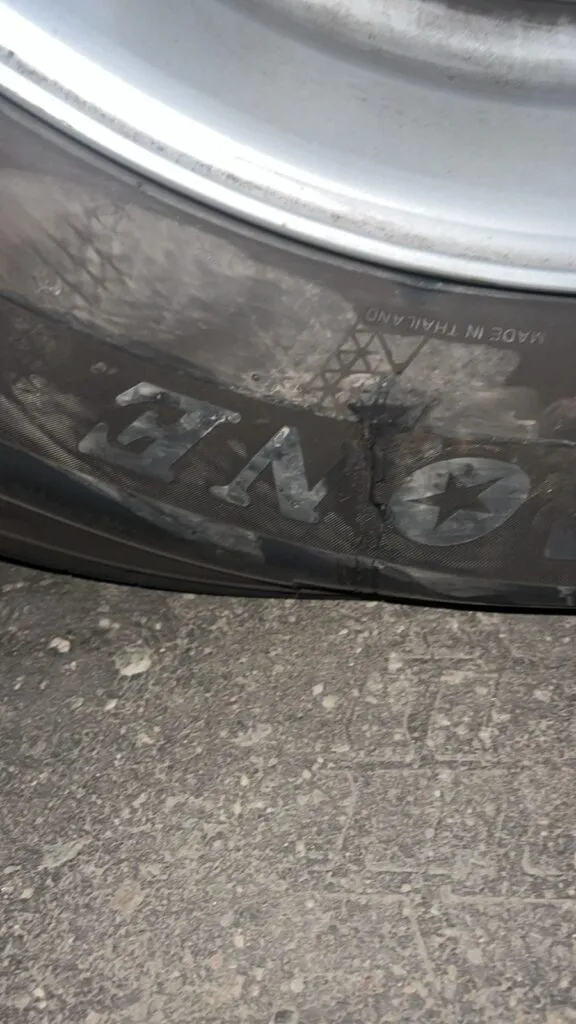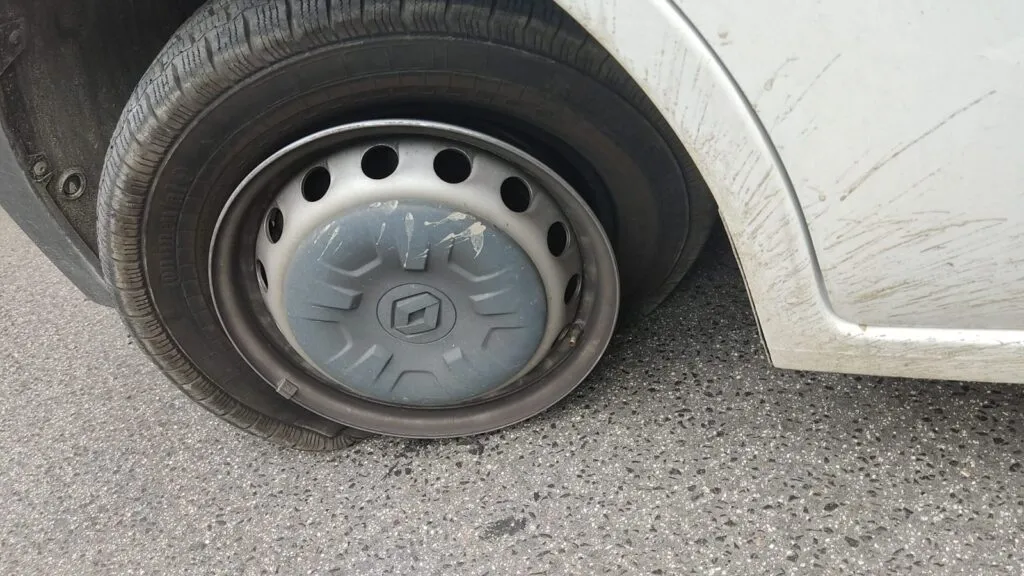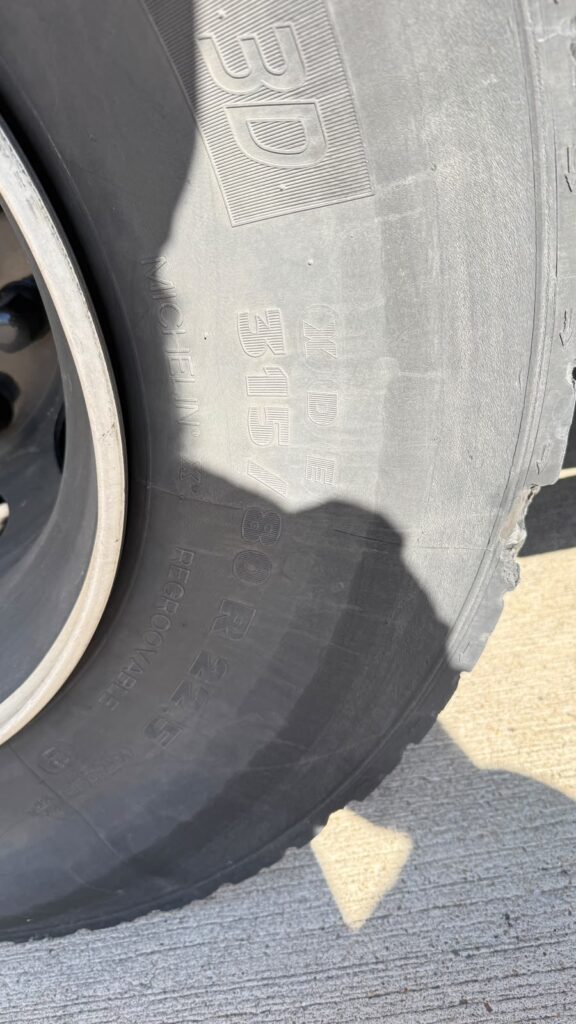
TL;DR: A drive-axle tyre on a container trailer at a terminal in Neuss, North Rhine-Westphalia, showed deep cracks in the tread base and shoulder, making it unsafe for further travel. LKWHelp24 dispatched a mobile service unit within 15 minutes of the call. The technician arrived after a 50-minute journey, performed a full inspection, replaced the damaged Michelin 315/80 R22.5 tyre with a new one, and completed the job in just 130 minutes. Total cost: €985 (net). The truck was back on the road with no delay to its scheduled cargo load. No delays, no penalties, just professional roadside assistance, 24/7, across Germany.
Why a Damaged Drive-Axle Tyre Is a Critical Safety Hazard
A tyre failure on the drive axle of a heavy goods vehicle isn’t just an inconvenience, it’s a potential catastrophe. The drive axle carries the full torque from the engine, transfers power to the road, and supports a significant portion of the vehicle’s weight, especially when hauling a 40-foot container. When the tyre’s structural integrity is compromised, as in this case with deep cracks in the tread base and shoulder, the risk of sudden blowout increases exponentially.
These cracks aren’t superficial. They originate in the rubber compound beneath the tread and propagate through the carcass, weakening the entire structure. Even if the tyre holds pressure temporarily, the stress from high-speed driving or heavy loads can trigger a sudden, explosive failure. This can lead to loss of control, especially during cornering or braking, potentially causing a rollover, multi-vehicle collision, or total cargo loss.
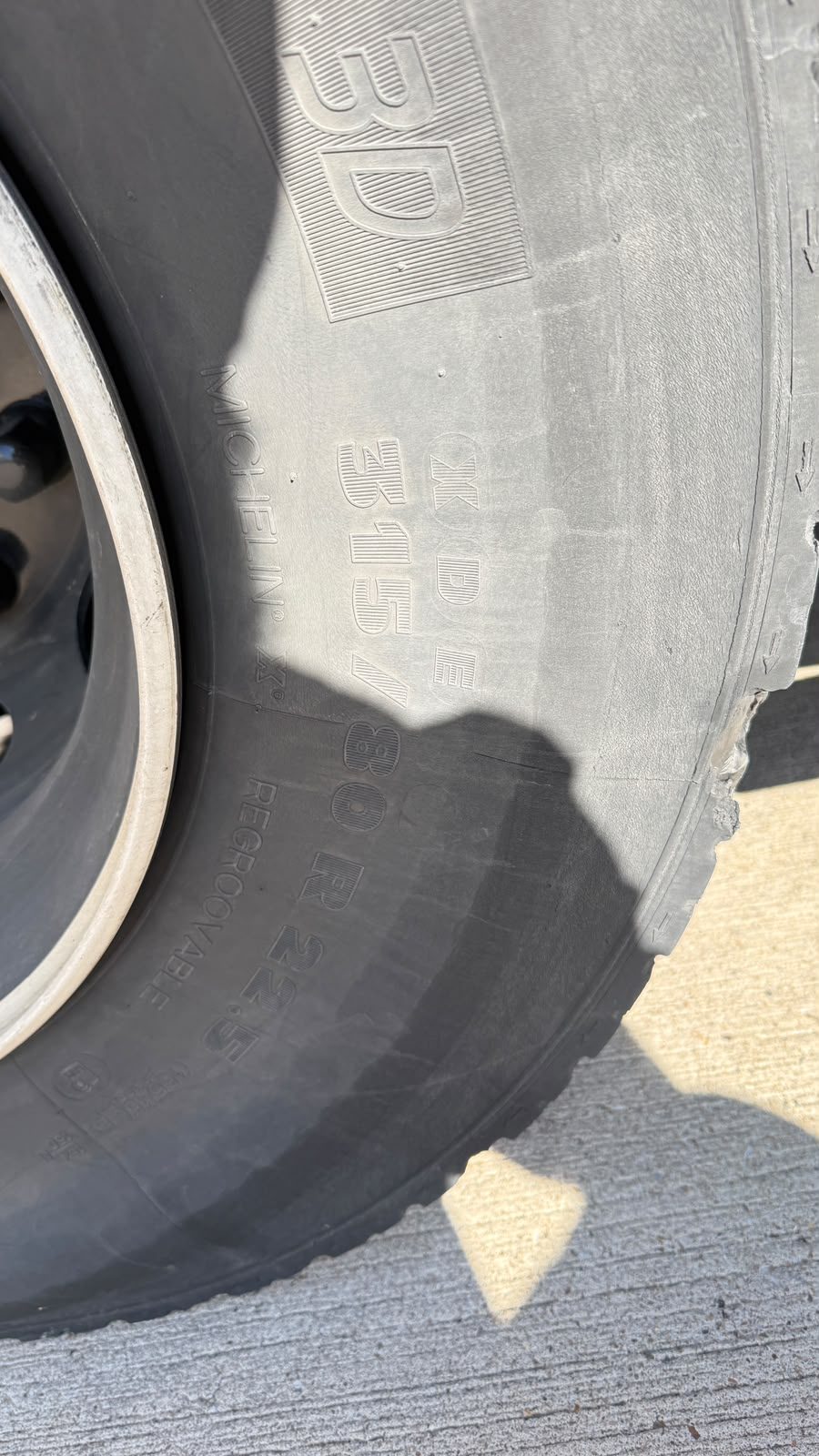
Moreover, the shoulder area, where the tread meets the sidewall, is particularly vulnerable. It experiences high flexing under load and lateral forces. A crack here can rapidly grow into a separation, causing the tread to detach entirely. In this instance, the Michelin X-series tyre, though designed for durability and long life, had reached a critical point in its service cycle. The presence of regroovable markings indicated it had been retreaded, which is acceptable if done properly, but the visible damage suggested either improper retreading or excessive wear beyond safe limits.
Driving on such a tyre is not only dangerous but also violates German road safety regulations. According to § 36 StVZO, tyres must be free from cracks, bulges, or cuts that compromise their structural integrity. Continuing to operate a vehicle with a damaged drive-axle tyre could result in fines, insurance denial, and legal liability in the event of an accident.
The On-Site Challenge: A High-Stakes Tyre Replacement on a Terminal Yard
The incident occurred at a container terminal in Neuss, located near the A57 in North Rhine-Westphalia. The site is a high-traffic logistics hub, with frequent loading and unloading operations, making safety and reliability paramount. The vehicle involved was a Sattelzug (semi-trailer truck) with a 40-foot container mounted on a chassis, standing on a concrete yard awaiting departure.
What made this situation particularly sensitive was timing. The driver had reported the issue during pre-departure checks, before the vehicle was due to leave for its next shipment. This proactive alert prevented a far more serious incident on the motorway. Had the truck left the terminal with the damaged tyre, a blowout during acceleration or at highway speed could have led to a chain reaction, endangering not just the driver and cargo, but also other workers on site.
The site itself posed logistical challenges. The container was heavy, and the chassis was secured to the ground with chocks. The vehicle was not on a standard roadside layby but in a tightly controlled industrial zone. This meant that access for a mobile service team had to be coordinated with terminal staff, and the service vehicle had to be positioned carefully to avoid obstructing other operations.
The technician’s task was not just to replace the tyre, it was to do so safely, efficiently, and without compromising the integrity of the container or chassis. The work had to be completed in a way that allowed the vehicle to be repositioned immediately after, minimizing downtime.
How We Organised the Emergency Response in 15 Minutes
When the call came in at 00:00, our central dispatch team immediately activated the emergency protocol for a mobile truck tyre service. The first step was to verify the tyre size and type. The driver confirmed it was a 315/80 R22.5 Michelin X-series regroovable tyre on the drive axle. This information was instantly cross-checked against our national partner network.
Within 15 minutes, we had confirmed the availability of a qualified technician and a fully equipped mobile service van from our partner organisation in the Rhineland region. The technician was already en route from a nearby maintenance base, and our system automatically calculated the fastest route to the terminal in Neuss, factoring in real-time traffic and road conditions.
Our dispatch system uses geolocation and historical response data to select the closest available team with the correct equipment. In this case, the nearest unit was 42 km away. The 50-minute travel time was acceptable given the nature of the site, a terminal yard, not a motorway shoulder, and the fact that the vehicle was already stationary.
During the journey, the technician reviewed the job details, prepared the tool kit, and confirmed the correct replacement tyre was in stock. He also briefed the driver on safety procedures, including the need to keep the engine off and the parking brake engaged during the service.
This level of coordination is only possible through a robust, decentralised network of vetted partners. Every technician is trained, insured, and monitored via our digital platform. The entire process, from call to dispatch, took just 15 minutes, setting the stage for a rapid and professional on-site response.
On-Site Inspection: What the Technician Found
Upon arrival at 01:05, the technician conducted a thorough inspection of the damaged tyre and surrounding components. The first priority was safety: he placed warning triangles at a safe distance, activated the hazard lights, and ensured the vehicle was properly secured.
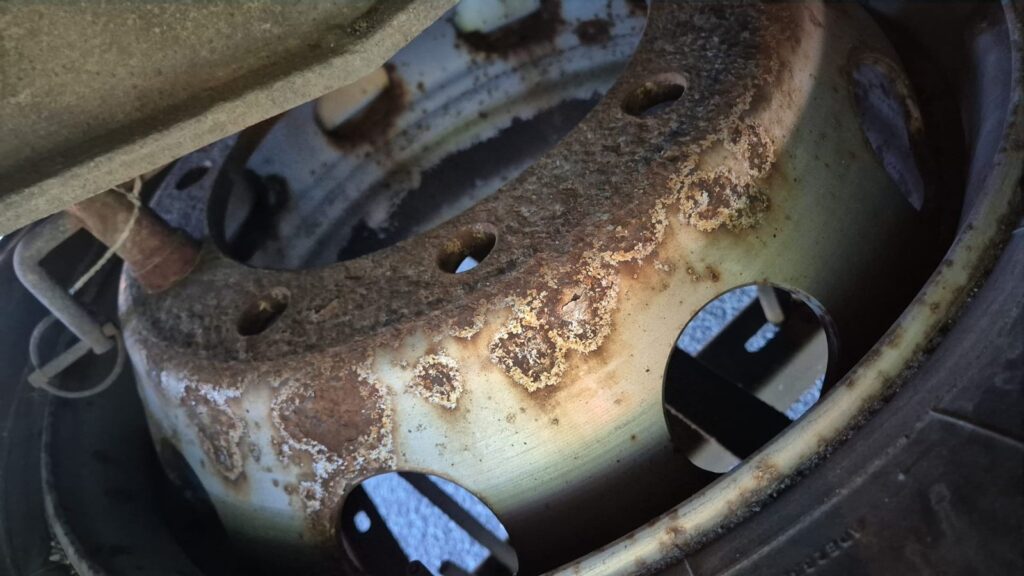
The visual assessment revealed deep, jagged cracks in the tread base, extending from the central groove toward the shoulder. The shoulder area showed a visible tear, with rubber partially peeled back, exposing the underlying fabric layers. This was not a simple puncture or cut; it was structural failure in progress.
The tyre pressure was measured at 9.2 bar, within the acceptable range for this load, but insufficient to compensate for the structural weakness. The technician noted that pressure alone does not guarantee safety, especially when internal damage is present.
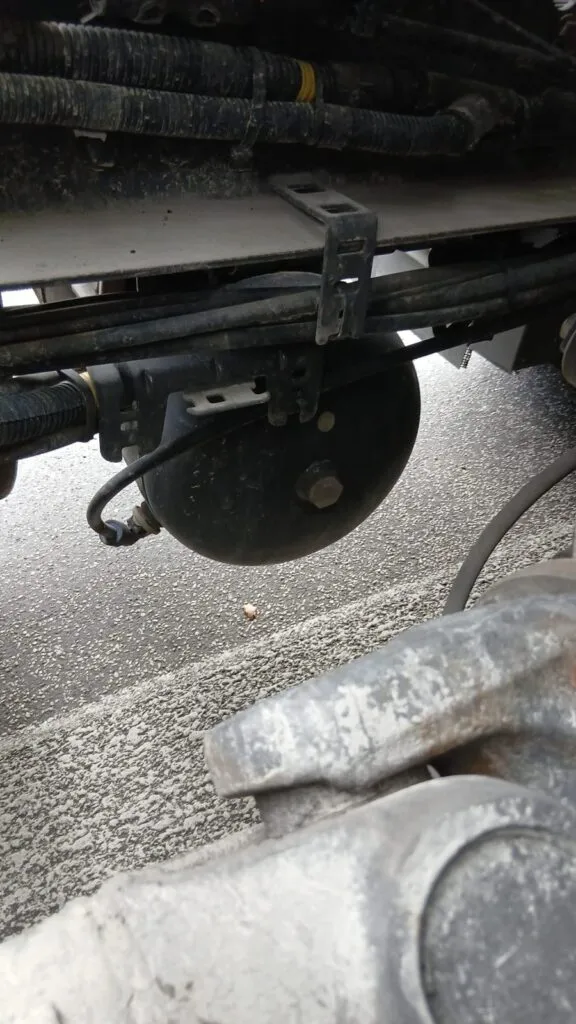
He then inspected the wheel hub and rim. The 10-hole steel rim showed no visible deformation, and the wheel nuts were properly torqued. However, during the inspection of the wheel arch, he noticed a secondary issue: a rubber air hose near the engine intake had developed a porous, frayed end, with the weave of the fabric layer visibly worn through. This was not a critical fault at that moment, but it posed a future risk of air leakage or failure under high pressure.
He documented the finding with a photo and verbally advised the driver to have the hose checked by a specialist during the next scheduled maintenance. No immediate repair was required, but the warning was logged in the service report for future reference.
The technician also verified the correct tyre type for the vehicle. The Michelin X-series 315/80 R22.5 is a common choice for long-haul container transport due to its load capacity and durability. The regroovable designation confirmed it had been retreaded, which is standard practice in fleet operations to extend tyre life and reduce costs.
Why You Should Never Ignore a Tyre with Cracks in the Shoulder or Tread Base
A cracked shoulder or tread base is not a cosmetic flaw, it’s a warning sign of imminent failure. The shoulder of a tyre is designed to absorb lateral forces during cornering, braking, and acceleration. When cracks appear here, the structural integrity of the tyre is compromised. The rubber can separate from the underlying steel belts or carcass, leading to a sudden loss of support.
Similarly, cracks in the tread base, the area directly beneath the tread pattern, indicate that the internal construction is deteriorating. This is especially dangerous on the drive axle, where torque and load are highest. Even if the tyre appears to hold pressure, the risk of a sudden blowout remains extremely high.
According to ADAC, tyre failures account for approximately 12% of all heavy vehicle accidents in Germany. Of these, over 60% occur on the drive axle. The consequences are severe: loss of control, jackknifing, fire (especially in tankers or vehicles carrying flammable goods), and multi-vehicle pile-ups.
In this case, the damage was visible to the naked eye. The driver’s decision to report it before departure was the right one. Had the vehicle continued, the tyre could have failed at speeds above 80 km/h, potentially leading to a loss of control and a serious incident.
The fact that the tyre was regrooved adds another layer of complexity. Retreading is a precise process that requires expert inspection and proper bonding. If the original casing is already damaged or worn beyond limits, retreading can accelerate failure. This tyre had likely been retreaded multiple times, and the cracks were a result of cumulative stress.
Step-by-Step Tyre Replacement Process: From Demount to Final Check
Step 1: Safety and Stabilisation
The technician placed wheel chocks on the non-drive wheels, activated the parking brake, and secured the container chassis with additional supports. He then used a hydraulic jack to lift the drive axle slightly, enough to relieve pressure on the tyre but not enough to risk instability.
Step 2: Removal of the Damaged Tyre
Using a torque wrench, he loosened the wheel nuts in a star pattern to prevent rim deformation. He then removed the wheel and placed it safely on the ground. The old tyre was carefully inspected and documented for the service report.
Step 3: Mounting the New Tyre
The new Michelin 315/80 R22.5 tyre was mounted onto the 10-hole steel rim using a mobile tyre mounting machine. The technician applied a thin layer of rubber lubricant to the bead to ensure a smooth fit. The rim was balanced before mounting to prevent vibrations.
Step 4: Reinstallation and Torquing
The newly mounted tyre was reinstalled onto the axle. The wheel nuts were tightened in a star pattern, a critical step to ensure even load distribution. The technician used a calibrated torque wrench to apply 170 Nm of force, the manufacturer’s recommended value for this axle.
Step 5: Final Pressure and Test Drive
The tyre was inflated to the correct pressure: 9.5 bar, as specified by the vehicle manufacturer. The technician performed a final visual check, ensuring the bead was seated properly and no debris was trapped. He then conducted a short test drive on the terminal yard, just 20 meters, to confirm stability and steering response.
All steps were completed by 02:00, with the vehicle ready for immediate departure.
Full Timeline of the Service (130 Minutes Total)
| Time | Phase | Action |
|---|---|---|
| 00:00 | Call Received | Driver reports deep cracks in drive-axle tyre during pre-departure check |
| 00:15 | Dispatch Confirmed | Tyre size 315/80 R22.5 confirmed; technician and vehicle dispatched |
| 01:05 | Arrival on Site | Mobile service unit reaches terminal yard (50 min travel) |
| 01:15 | Inspection | Visual check, pressure test, discovery of porous air hose |
| 01:25 | Safety & Lift | Wheel chocks, jack lift, stabilisation of chassis |
| 01:40 | Demount & Mount | Old tyre removed; new Michelin tyre mounted on rim |
| 02:00 | Reinstall & Test | Wheel reinstalled, torqued to 170 Nm, pressure set to 9.5 bar |
| 02:10 | Final Check | Test drive on yard, handover to driver |
Total time from call to completion: 130 minutes (2 hours 10 minutes).
Cost Breakdown: Transparent Pricing, No Hidden Fees
| Position | Price (EUR) |
|---|---|
| Mobile Truck Tyre Service – Anfahrt | 240,00 |
| Labour – 1.5 hours at 110 EUR/hour | 165,00 |
| New Michelin 315/80 R22.5 Tyre (regroovable) | 560,00 |
| Disposal of Old Tyre | 20,00 |
| TOTAL | 985,00 |
All prices are net (excluding VAT).
This cost includes everything: travel, labour, parts, disposal, and full technical service. There are no surprise charges. The price is fixed and communicated upfront.
For comparison, if the vehicle had remained stranded, the daily cost of downtime, including lost revenue, demurrage fees, and potential penalties, would have been €1,100–€1,500 per day. In this case, the repair cost €985 and took under 2.5 hours. The return on investment was immediate.
Why You Should Always Use a Professional Mobile Tyre Service
Attempting a tyre change on your own, especially on a drive axle with a heavy container, is extremely risky. Here’s why:
- Improper torque: Wheel nuts must be tightened in a star pattern to 170 Nm. Using a standard wrench risks under-torquing or over-torquing, leading to wheel detachment.
- Incorrect tyre mounting: Without a proper mounting machine, you risk damaging the rim or creating an uneven bead seat, causing air leaks or vibrations.
- Lack of tools: A hydraulic jack, torque wrench, and spare tyre are not standard in every truck’s toolkit.
- Safety hazards: Working near a heavy container chassis increases the risk of injury if the vehicle shifts.
- Legal exposure: Driving a vehicle with a damaged tyre, even temporarily, may violate road safety laws and void insurance.
Only trained professionals with certified equipment should handle such repairs. Our technicians are not just mechanics, they are certified in mobile service, safety protocols, and emergency response.
Typical Scenarios We Handle Across Germany
We respond to a wide range of tyre-related emergencies on motorways, terminals, depots, and industrial sites. Common situations include:
- Drive-axle tyre blowouts on container trucks
- Steering-axle tyre failures causing loss of control
- Retreaded tyre failures due to poor quality or overuse
- Flat tyres on trailers with dual wheels
- Cracked shoulders or tread bases detected during pre-trip inspections
- Air hose leaks or ruptures near the engine
- Tyre damage from road debris or potholes
We serve all types of vehicles: Sattelzüge, Anhänger, Gliederzüge, and transporters. Whether it’s a 40-foot container, a refrigerated trailer, or a heavy hauler, we’re equipped to help.
Proactive Maintenance Tips for Drivers and Fleets
To avoid emergency repairs, follow these best practices:
- Inspect tyres daily: Check for cracks, bulges, cuts, and uneven wear.
- Monitor tyre pressure: Use a digital gauge at least once per week. Ideal pressure: 9.0–9.5 bar for drive axles.
- Check load index and speed rating: Ensure tyres match the vehicle’s specifications.
- Replace tyres at 4 mm tread depth: According to § 36 StVZO, minimum tread depth is 1.6 mm, but 4 mm is safer for long-haul.
- Avoid overloading: Exceeding weight limits accelerates tyre wear and failure.
- Schedule regular retreading checks: Retreaded tyres must be inspected every 5,000 km.
- Train drivers in emergency response: Know how to secure the vehicle and call for help.
Fleet managers should implement a digital tyre management system to track wear, pressure, and maintenance schedules.
Advanced SEO Block: Tyres, Brands, and Standards
When choosing tyres for commercial vehicles, consider the following brands and standards:
- Michelin: Known for durability, low rolling resistance, and long life. The X-series is popular for long-haul transport.
- Continental: Offers high-performance tyres with excellent traction and braking.
- Goodyear: Reliable for heavy-duty applications, especially in demanding conditions.
- Bridgestone: High load capacity and resistance to wear.
- ETRTO: European Tyre and Rim Technical Organisation, sets standard tyre dimensions and load ratings.
- § 36 StVZO: German law requiring tyres to be free from structural damage and meet minimum tread depth.
Always match the tyre size (e.g., 315/80 R22.5) and load index (e.g., 122/121) to your vehicle’s specifications. Using the wrong tyre can lead to failure, fines, or accidents.
Why Choose LKWHelp24?
We are the trusted partner for 24/7 mobile truck tyre service across Germany. Here’s why:
- 24/7 Availability: No matter the time or weather, we’re on call.
- Nationwide Network: Over 300 vetted partners across Germany.
- Transparent Pricing: No hidden fees, all costs quoted upfront.
- Multilingual Support: Dispatchers speak English, German, Polish, and Russian.
- Fast Response: Average arrival time: under 1 hour.
- Certified Technicians: Trained, insured, and equipped with the latest tools.
- Digital Reporting: Full service report with photos and recommendations.
We don’t just fix tyres, we protect your business, your cargo, and your drivers.
Summary: Key Facts from the Incident
- Vehicle Type: Sattelzug (Container Trailer)
- Location: Container Terminal, Neuss, North Rhine-Westphalia (near A57)
- Issue: Deep cracks in tread base and shoulder of drive-axle tyre (Michelin 315/80 R22.5)
- Time to Arrival: 50 minutes
- Total Service Time: 130 minutes (2h 10min)
- Tyre Replaced: New Michelin 315/80 R22.5 (regroovable)
- Total Cost: €985 (net)
- Secondary Finding: Porous air hose near engine (advised for future check)
- No Downtime: Vehicle back on the road immediately
Get Help, Fast and Reliable
If your truck breaks down, don’t wait. Call us now: +49 160 5753826
We’re here 24/7, across Germany.
Visit: www.lkwhelp24.com
Mobile Truck Tyre Service | Truck Tyre Service | Towing Service | Truck Service | Contact Us
Keywords
truck tyre service | mobile reifenservice | truck tyre replacement | truck tyre change | truck tyre callout | truck tyre roadside assistance | truck tyre repair | mobile reifenwechsel | truck tyre germany | mobile truck tyre service | trailer tyre service | truck tyre burst | truck tyre emergency | truck tyre breakdown service | truck tyre breakdown germany | truck tyre blowout | trailer tyre replacement | trailer tyre puncture | trailer flat tyre | tyres repair near me | tyre change near me | truck wheel repair | truck wheel change | truck tyres near me | truck tyre shop near me | truck tyre service near me | truck tyre service germany | truck tyre repair near me | truck tyre puncture repair | truck tyre near me | truck tyre mobile service | truck tyre help | truck tyre fitting | truck tyre fitters near me | truck tyre emergency | truck tyre breakdown | truck tyre breakdown | truck tyre blowout | trailer tyre replacement | trailer tyre puncture | trailer flat tyre | reifenwechsel near me | pneuhage truck fleet support | pneuhage truck and bus services | pneuhage roadside assistance
Related Articles
- Tyre Fire on the A5 Near Müllheim: MAN TGX Recovery in 2h 20min
- Speed Rating Q on Truck Tyres: Meaning, Safety & Breakdown Help
- Truck Steering-Axle Tyre Blowout – Mobile Roadside Tyre Service 24/7 in Germany
- Truck Tyre Service Kehl (77694): Tyre Change with New Goodyear Tyre and Rim Straightening on a Krone Trailer
- Mobile Truck Tyre Service on the A31 near Haltern am See: Walking Floor Trailer Back on the Road in 2 Hours 30 Minutes After a Blowout