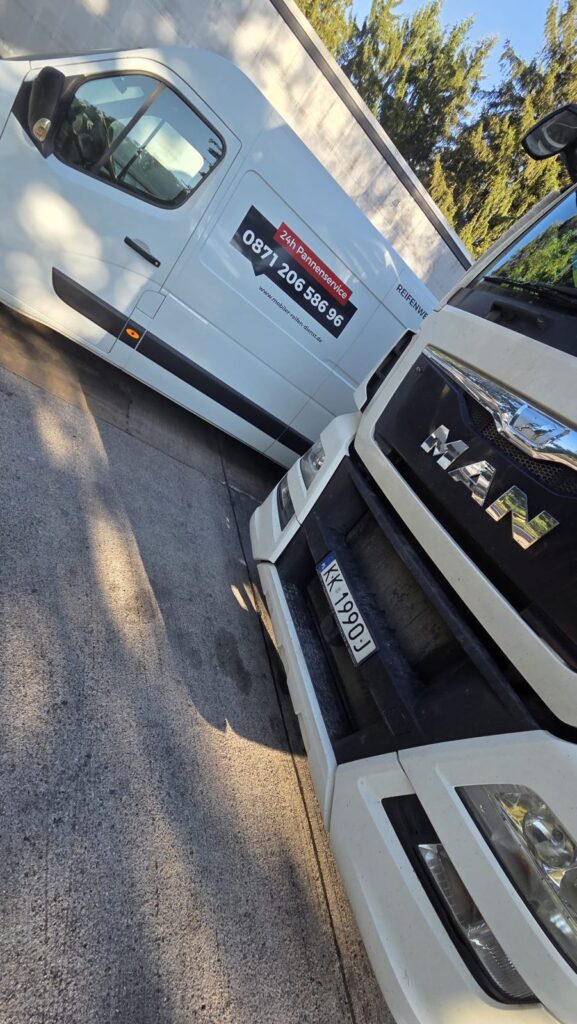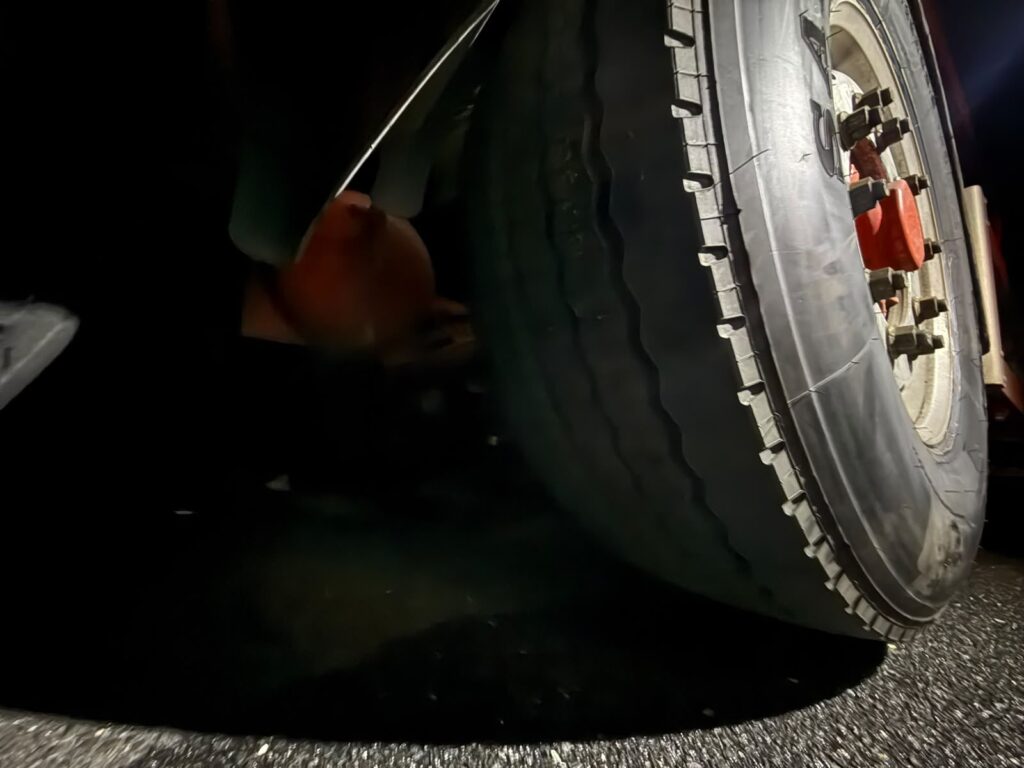
On the morning of 20 August 2026 the rear tyre of an orange municipal refuse truck came apart on the A4 near Jena, heading towards Dresden. The driver stopped safely on the hard shoulder and called us at 08:55. Our partner crew arrived 53 minutes later, and the lorry rolled off at 10:45, 1 hour 50 minutes after the call, for a net total of 985 EUR. No rim, no wheel arch, no brake hose had to be replaced.
This is a full account of that truck tyre service callout: what the driver saw, how the dispatch worked, what the crew did step by step, what it cost and why. If you drive a lorry, run a fleet or sit in a transport office and wonder what a real emergency tyre job looks like, the numbers below are from the job itself, not from a brochure.
Why a shredded truck tyre is more than a puncture
A burst tyre on a heavy vehicle is a safety event first and a repair job second. A truck tyre on a rear axle carries several tonnes and runs at roughly 8.5 to 9.5 bar. When the casing lets go, that stored energy is released in a fraction of a second. The tread can be thrown across lanes, the wheel arch and the plastic mudguard take the beating, and a loose steel cord can cut through brake hoses or cabling behind the wheel.
For the operator, the second problem is time. A standing lorry costs between 800 and 1,200 EUR per day in lost work. A refuse truck on a fixed collection round is a special case: bins stay unemptied, the schedule slips, and the next day is already full. That is why fast truck tyre roadside assistance pays for itself even when the invoice looks large.
Quick facts about the callout
- Location: A4 near Jena, Thuringia, direction Dresden, right-hand hard shoulder (concrete carriageway)
- Vehicle: orange two-axle municipal refuse truck, around 18 tonnes
- Damage: rear-axle tyre of size 315/80 R22.5 completely destroyed, tread torn off and lying on the concrete
- Time of call: 08:55, dry weather, partly cloudy, steady traffic in the left lane
- Response time: 53 minutes to arrival, 57 minutes of work on site
- Total time: 110 minutes, from call to departure
- Cost: 985 EUR net, plus VAT
The emergency: what happened on the A4
The driver was on his way back from a morning round when he felt a sudden thump from the rear, followed by a flapping noise and a pull towards the right. He did what every professional is trained to do: he held the wheel, let the lorry slow down without hard braking, switched on the hazard lights and rolled onto the hard shoulder. Only when the truck had stopped did he get out, put on his high-visibility vest, and place the warning triangle at the distance required on a motorway.
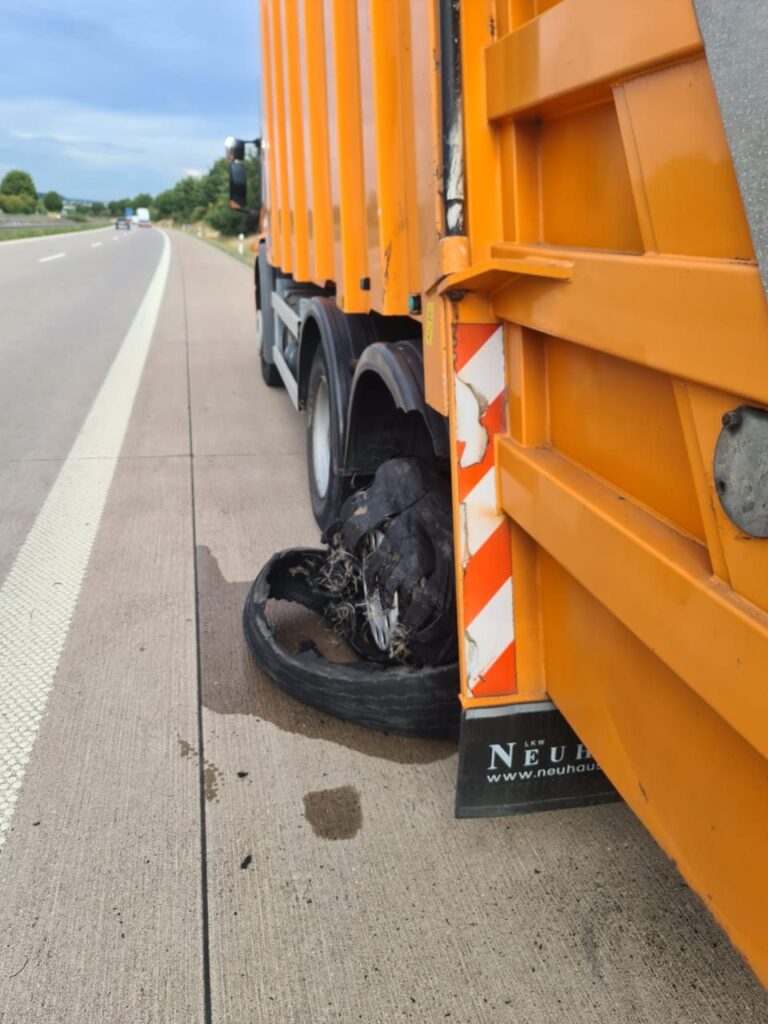
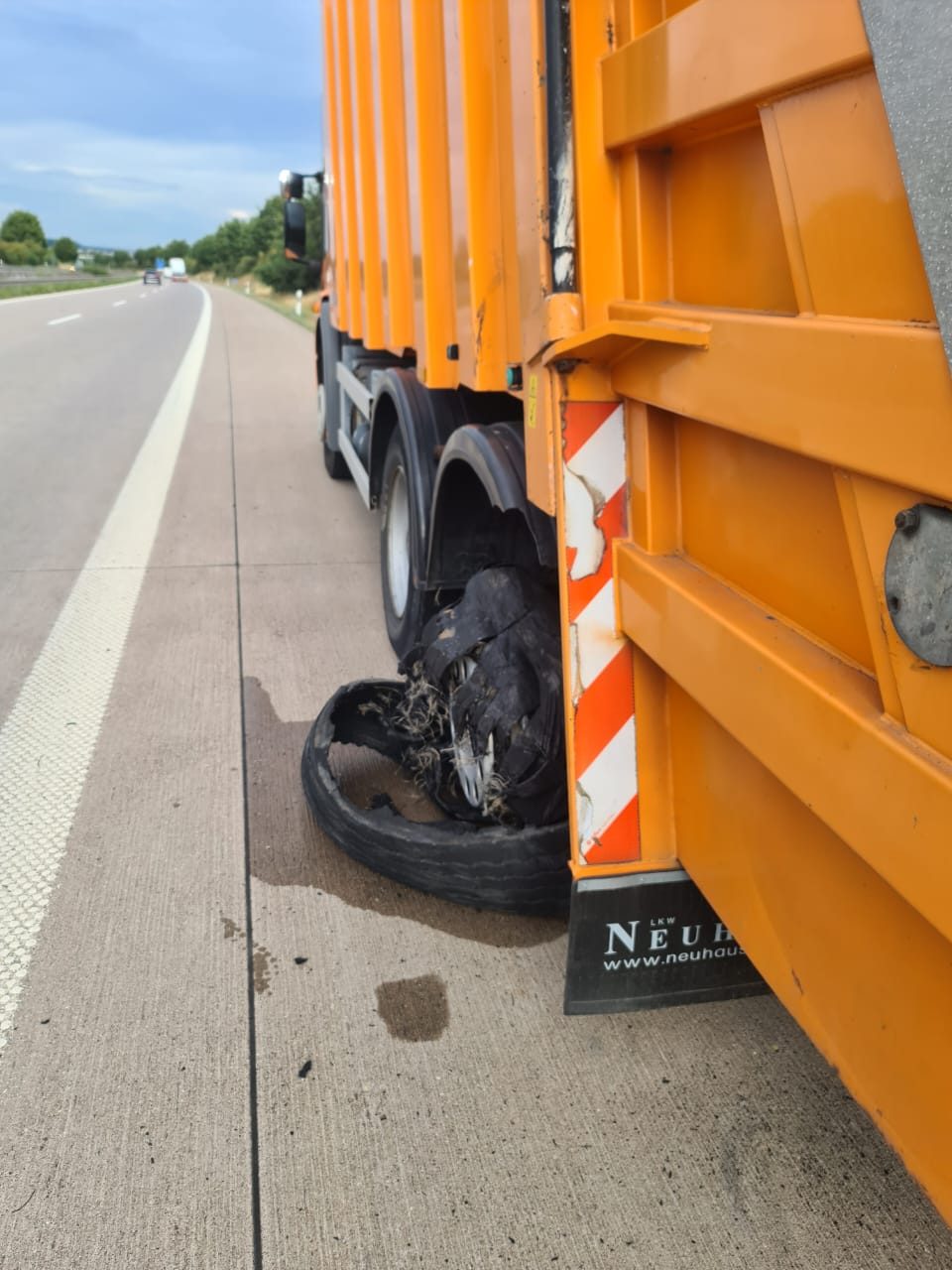
What he found was a tyre in pieces. The tread lay on the concrete in a long arc, the carcass was in rags with cord showing, and bits of rubber and roadside debris had been wrapped around the wheel. The rim was partly visible. The plastic wheel-arch lining on that side was ripped. Dark stains on the concrete looked like rubber residue, with no sign of fuel.
He rang us at 08:55. His first sentence was short and useful: rear tyre gone, truck secured, nobody hurt, nothing leaking. That kind of opening saves minutes, because our dispatcher can go straight to the questions that decide which crew and which material to send.
What the dispatcher asked
The questions are always the same, and each one has a reason:
- Exact position: motorway, direction, nearest junction or parking area. The A4 near Jena has long stretches without a hard shoulder lay-by, so the side of the road matters.
- Is the vehicle fully on the hard shoulder, and are the hazard lights and triangle in place?
- Which axle, which wheel, single or twin fitment?
- Tyre size, if the driver can read it from the other tyres on the same axle.
- Can the driver see the rim? Is it bent, cracked or sitting on the rubber?
- Any visible damage to hoses, cables, brake chamber or mudguard?
The size was confirmed as 315/80 R22.5, which is the standard fitment for a rear axle on a vehicle of this class. The rim looked intact, though that is something nobody trusts until the wheel is off.
How we organised the help
The call came in at 08:55. By 09:07 the job was confirmed with a crew. Those twelve minutes are the dispatch phase, and they are not wasted time. In that window the dispatcher checks which mobile unit of our partner network is closest to the A4 near Jena, whether that unit carries a 315/80 R22.5 tyre on the van or needs to collect one, and whether the crew has a heavy-duty jack and the right socket for the wheel nuts of that axle.
The steps in sequence:
- Take the call, confirm the location and the safety status of the driver.
- Collect tyre size, axle position and rim condition.
- Pick the nearest suitable service crew from our partner network in the region.
- Confirm the price frame with the customer before the crew leaves, so there are no surprises on the invoice.
- Send the driver a message with the estimated arrival time and the crew’s contact details.
- Stay on the line with the crew until the work is signed off.
We do not send a generic “breakdown van”. A mobile truck tyre service needs a vehicle with a compressor that delivers enough volume for a 22.5-inch tyre, a hydraulic jack rated for the axle load, an impact wrench that reaches the correct torque, and tyres in the common sizes. If you want to see what such a crew carries, our page on mobile truck service across Germany describes the equipment and the regions we cover.
Waiting on the hard shoulder
The crew drove 41 minutes along the A4. In the meantime the driver stayed behind the crash barrier in his vest, away from the traffic, with the triangle placed and the hazard lights on. This is the part of any motorway breakdown that people underestimate: the hard shoulder is not a safe place. Passing lorries, wind blast and tired drivers make it one of the most dangerous workplaces in the country. Our checklist on what to do after a tyre blowout on the autobahn walks through the drill that this driver followed correctly.
The rules for stopping and securing a vehicle on German roads are set out in the Straßenverkehrs-Ordnung (in German, § 15 covers the emergency stop and warning devices). For the practical side, including current road information, the official Autobahn portal is a good bookmark for any driver in Germany.
On site: why a destroyed tyre cannot be ignored
It is tempting to think a lorry with one twin tyre gone could limp to a nearby yard. On this axle it could not, for several reasons.
On a rear axle with twin wheels, the remaining tyre on the same hub carries the full share of that side of the axle. The tyre next to a destroyed one is overloaded, overheats, and is likely to fail within a few kilometres. If the vehicle runs on the rim, the bead seat and the flange deform, the steel can crack, and a repair becomes a rim replacement. If the loose casing winds around the axle, it can pull on the brake hoses and the ABS sensor cable.
There is also the legal side. Under § 36 of the Straßenverkehrs-Zulassungs-Ordnung, tyres must be suitable for the vehicle and in a safe condition. The text of § 36 StVZO is short and worth reading if you manage a fleet. A vehicle with a missing or damaged tyre is not roadworthy, and driving it risks a fine and an immediate stop.
What we checked before touching the wheel
The crew arrived at 09:48 and began with a ten-minute assessment, because the damage you see is rarely all the damage there is. They:
- placed cones and a warning sign to extend the safe working zone behind the truck;
- looked at the wheel arch, the mudguard and the inner side of the chassis;
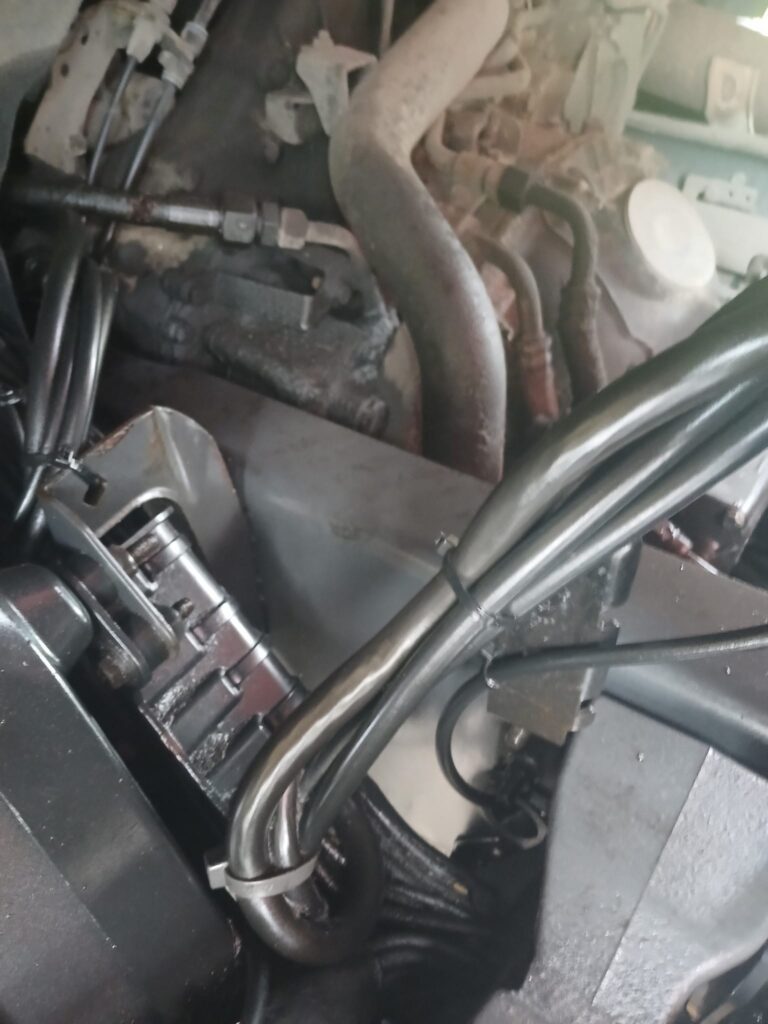
- inspected the brake hoses and the cable runs behind the wheel for cuts;
- checked the second wheel on the same hub for heat damage and cord exposure;
- looked at the rim for cracks, deformation and flange wear.
This was the moment the job could have become more expensive. A bent rim on a municipal refuse truck would add the price of a new wheel and a longer stop. Here the rim held up, the hoses were intact, and only the arch lining was damaged. That is why the invoice stayed at 985 EUR.
Step by step: how the truck tyre was replaced
Below is the sequence the crew followed. It is the standard order for a rear-axle truck tyre replacement on the hard shoulder, and every step has a reason.
Step 1: Inspection and assessment
The crew confirmed the axle load, noted the tyre size and DOT date on the neighbouring tyres, and photographed the damage for the record. They also checked tyre pressure on the surviving tyres, because one blowout often points to an under-inflated twin partner or an overloaded axle.
Step 2: Securing the work area
The vehicle was already parked on firm concrete, so no extra support surface was needed. The crew applied the parking brake, chocked the front wheels, and set up their cones. The jack went under the axle at the designated lifting point, not under the chassis, and the truck was raised only as far as needed to clear the wheel.
Step 3: Removing the wheel
The wheel nuts were loosened while the wheel was still on the ground, then taken off after the axle was lifted. The remains of the tyre were cut away and removed from the rim. This took about 22 minutes in total, from jacking to a clean rim, because the shredded casing had to be cleared in pieces.
With the wheel off, the crew checked:
- the hub face and the studs for stretching or thread damage;
- the rim for cracks, particularly around the valve hole and the bead seat;
- the brake drum or disc and the dust shield for contact damage;
- the valve and the pressure sensor, where fitted.
Everything passed. That is not guaranteed after a violent blowout, and it is the check we would never skip.
Step 4: Fitting the new tyre
A new 315/80 R22.5 tyre went onto the rim. The bead was lubricated, the tyre was seated with a controlled inflation, and the pressure was brought to 8.5 bar, the value required for that axle load. The wheel was lifted back on the hub and aligned on the studs. The tyre-fitting part of the job, from mounting to a wheel ready for the hub, took around 20 minutes.
For anyone wondering whether a recovered casing could have been reused: no. A casing that has burst under load has lost its structure, and even a cord that looks intact can be torn internally. Fitting a retread on a steering axle is also not advisable; on a rear axle, a quality retread from a reputable maker is legal and common. In this case the customer chose a new tyre, and that was a sensible decision for a vehicle that works every day.
Step 5: Final tightening and check
The wheel nuts were tightened in a criss-cross pattern in stages, to the torque specified by the vehicle and wheel manufacturer. For this class of wheel with M22 nuts, the specification typically lies around 600 to 650 Nm, but the actual value must always come from the manufacturer’s data. Pressure was checked again, the work was documented, and the truck was released at 10:45. The full explanation of the procedure is in our truck wheel nut torque table and mounting procedure.
One detail that is often skipped: after the first 50 to 100 kilometres, the nuts should be re-checked. We told the driver, and we put the reminder on the job sheet.
Full timeline of the job
The times below are from the real job log.
| Time | Phase | Action |
|---|---|---|
| 08:55 | Call | Driver reports a burst tyre on the rear axle; truck on the hard shoulder with hazard lights and warning triangle in place |
| 08:55–09:07 | Dispatch | Location, tyre size and rim condition clarified; nearest mobile crew of our partner network selected and confirmed |
| 09:07–09:48 | Drive to site | Crew travels along the A4 (41 minutes); driver waits behind the crash barrier in a high-visibility vest |
| 09:48–09:58 | Inspection and securing | Damage assessment, work zone secured, wheel arch, brake hoses and rim checked |
| 09:58–10:20 | Wheel removal | Axle jacked up, wheel removed, tyre remains cleared, rim, hub and studs inspected |
| 10:20–10:40 | Fitting | New tyre mounted on the rim, inflated to 8.5 bar, wheel fitted to the axle |
| 10:40–10:45 | Final check | Nuts tightened in a criss-cross pattern to specification, pressure checked again, job sheet completed, vehicle released |
| 10:45 | Done | Truck continues its work |
Total: 110 minutes (1 hour 50 minutes) from call to departure. Response time to arrival: 53 minutes. Work on site: 57 minutes.
If you see a faster number elsewhere, check what it measures. Some providers quote time from arrival to completion, which leaves out the drive. What matters to a driver standing on a hard shoulder is the time from the phone call to the moment the truck can move.
What the job cost
All amounts are net, plus VAT (zzgl. MwSt.).
| Item | Price (EUR) |
|---|---|
| Callout / Anfahrt (A4, daytime) | 240 |
| Labour, 1.5 hours at 110 EUR | 165 |
| New truck tyre 315/80 R22.5 | 560 |
| Disposal of the destroyed tyre | 20 |
| Total | 985 |
What drives the price of a roadside tyre job
- Distance and location. The callout fee covers the crew’s drive and the time they are not working elsewhere. A hard shoulder far from the nearest crew costs more than a yard in a city.
- Time of day. Nights, weekends and public holidays carry a surcharge, typically 25 to 50 percent. This job was on a weekday morning, so none applied.
- Tyre size and brand. A 315/80 R22.5 sits in the middle of the range. Premium makes from Michelin, Continental, Goodyear or Bridgestone cost more than budget tyres, but last longer and hold their value as retread casings. You can compare ranges on the maker sites, for example Michelin’s truck tyre pages.
- Secondary damage. A bent rim, a cut brake hose or a broken sensor adds parts and hours. Here there was none.
- Disposal. A used truck tyre cannot go in the bin. Disposal is a small fixed item.
For a wider look at what drivers and fleets typically pay, see our overview of truck tyre change cost.
The comparison that matters
If the truck had gone to a tow-and-repair route, the tow alone would have cost 850 to 1,600 EUR, plus the repair, plus a day or two of standing at 800 to 1,200 EUR per day. The mobile job cost 985 EUR and ended the same morning. Even for a vehicle with a high daily value, the maths is not close. Where towing really is the right answer, for example with a damaged axle or a leaking brake system, our towing and recovery service takes over.
Why a professional should do this job
It is easy to say “I’ll just swap the wheel myself” until you stand next to a 315/80 R22.5 wheel. A fitted wheel of this size weighs well over 100 kilograms, and handling it on a hard shoulder with traffic at 90 km/h a few metres away is a real hazard.
The main risks of a do-it-yourself change:
- a standard vehicle jack is not rated for a loaded commercial axle and can slip or collapse;
- wrong torque or the wrong tightening order leads to loose or overstressed nuts, and wheel loss is a documented cause of serious accidents;
- a tyre mounted on a damaged rim can fail again within kilometres;
- a worn or cracked bead seat goes unnoticed without proper inspection;
- no one documents the work, which matters for insurance and for the liability of the operator;
- a driver working on the hard shoulder without proper protection is exposed to live traffic.
A professional crew has the right equipment, checks the parts that matter, and leaves a record. The extra cost is smaller than one mistake.
Typical situations we attend across Germany
The A4 near Jena is one of many places where we send crews. In a normal month the callouts look like this:
- Tyre blowouts on tractor units and trailers on the main corridors: A2, A3, A5, A7, A9, A61 and A8.
- Slow punctures and screw damage, often found at a rest area after a long drive.
- Damaged rims after kerb contact or after running a flat tyre for too long.
- Stuck or seized wheel nuts after a tyre was last fitted without the right torque.
- Seasonal wheel changes for fleets, on the customer’s own yard.
- Tyre checks before long-haul trips, including pressure, tread depth and sidewalls.
- Trailer tyre service for refrigerated and curtainside trailers.
- Van and light commercial tyres in sizes such as 235/65 R16C.
Each of these has a different price and time profile. A simple puncture on a trailer might take 60 minutes in total. A destroyed tyre with rim damage may take a few hours. Our page on truck tyre service in Germany lists the most common jobs.
For another example from Thuringia, our report on a screw in the shoulder of a lorry tyre on the A71 near Erfurt shows when a repair is the wrong decision.
Prevention: how to avoid the next truck tyre breakdown
A tyre that blows without warning usually did give warning, just not loudly enough. These habits cut the risk:
- Check pressure every week, cold. Under-inflation is the most common reason for a casing to overheat and fail. A drop of 1 bar on a twin tyre pair can be enough to overload the neighbour.
- Look at the tyre, not just the tread depth. Bulges, cuts, exposed cord and uneven wear show problems early. The legal minimum tread depth for trucks is 1.6 mm, but most fleets set 3 to 4 mm as their own limit.
- Match twin tyres. Two tyres on the same hub should have similar tread depth and the same size. A big difference in diameter forces one tyre to carry more load.
- Do not overload axles. Know the axle load limit, and check it, especially on vehicles with variable loads such as refuse trucks, tippers and distribution lorries.
- Re-torque after any wheel change. Do it after 50 to 100 kilometres.
- Use the right tyre for the axle and the job. Steering, drive and trailer axles need different types. A tyre built for long-haul motorway use does not like frequent kerb contact.
- Inspect after every impact. A pothole, a kerb or a kerb strike can damage a casing in a way you cannot see.
- Keep records. A simple log of pressures, rotations and replacements helps you spot problem vehicles.
For fleet managers, the strongest tool is a scheduled inspection. We offer tyre checks on your yard, so the vehicle does not lose a working day. More on that on our tyre service page.
Tyres and fleet maintenance: a closer look
A truck tyre is a structure of steel cord, rubber compounds and a bead wire, built to carry a heavy load at motorway speed for hundreds of thousands of kilometres. The main tyre makers, Michelin, Continental, Goodyear and Bridgestone, sell different casing constructions for steering, drive and trailer positions, and each also supplies retread programmes. For the technical data on a given tyre, the manufacturer’s site is the right reference, for example Continental’s commercial vehicle tyre range.
The size code 315/80 R22.5 reads as follows: 315 mm section width, aspect ratio 80 percent (the sidewall height is 80 percent of the width), radial construction, 22.5-inch rim diameter. The load index and speed symbol on the sidewall tell you how much each tyre can carry and at what top speed. A 156/150 marking, for example, means 156 for single and 150 for twin fitment. If you do not know how to read the code, see our guide to 385/65 R22.5 and what the numbers mean.
Other common sizes are 385/65 R22.5 for trailers, 245/70 R19.5 for medium-weight distribution vehicles, and 235/65 R16C for vans.
Retreads and casing management
Retreading a good casing can cut cost per kilometre noticeably, and in Europe it is a normal practice for drive and trailer axles. The condition of the casing is what counts. A casing that has run under-inflated, been overloaded or been repaired badly is not a candidate. That is why fleets that log pressures and rotations get more out of their tyres.
Tread depth, pressure and sensors
A tyre pressure monitoring system is worth the money on a fleet. Many modern trucks have one built in. For older vehicles, retrofit systems can warn the driver when a tyre loses pressure. Even then, a weekly manual check is cheap insurance.
Seasonal considerations
In Germany, winter conditions require appropriate tyres on the drive axle. The all-season symbol and the three-peak mountain snowflake have specific meaning for trucks. Our guide to winter truck tyres and the rules covers it.
Frequently asked questions
How much does a truck tyre change on the autobahn cost?
A truck tyre change on the autobahn usually costs between 750 and 1,400 EUR net for a heavy vehicle, and 350 to 600 EUR net for a van. In this case the invoice was 985 EUR net: 240 EUR callout, 165 EUR labour, 560 EUR for the tyre and 20 EUR for disposal. Nights and weekends add 25 to 50 percent.
How long does a truck tyre callout take?
From the phone call to departure, expect between one and a half and three hours. In this case, dispatch took 12 minutes, the crew arrived after 53 minutes in total, and the work on site took 57 minutes. At night or in bad weather, it takes longer.
Can I drive on with a destroyed tyre on a twin axle?
No. The remaining tyre carries the entire side load, overheats and can fail within a few kilometres. The rim can also be ruined, and the vehicle is not roadworthy under § 36 StVZO. Stop on the hard shoulder, secure the vehicle and call for help.
What should I do first when a truck tyre bursts on the motorway?
Hold the steering wheel firmly, do not brake hard, and let the vehicle slow down. Switch on the hazard lights, stop on the hard shoulder, put on a high-visibility vest, place the warning triangle, and wait behind the crash barrier. Then call for help and give your exact position.
Do you repair or replace a damaged truck tyre?
A tyre with a puncture in the tread area can sometimes be repaired, if the damage is small and the casing is sound. A tyre with torn sidewalls, exposed cord or a full burst, like this one, must be replaced. Our crew inspects first and recommends the option that is safe and cost-effective.
Do you work 24 hours a day?
Yes. Our dispatch is staffed around the clock, every day, for the whole of Germany. Calls are answered in several languages. Night and weekend jobs carry a surcharge, which we confirm before the crew leaves.
Why drivers and fleets choose us
- 24/7 availability. A tyre does not fail on office hours, and neither do we.
- A tested partner network. The crews that attend are screened, equipped and insured, and they work to the same checklist everywhere in Germany.
- Price confirmed before the crew leaves. You know the frame in advance. Extra items, such as a damaged rim, are discussed on site.
- A multilingual dispatch. Many drivers on German roads do not speak German as a first language. We handle the call in the language they are comfortable with.
- Documentation. Every job ends with a job sheet that you can pass on to your fleet manager or insurer.
If you need to reach us for a quote or to plan a regular service, our contact page lists all ways to get in touch.
Summary
| Item | Value |
|---|---|
| Vehicle | Two-axle municipal refuse truck, about 18 t |
| Location | A4 near Jena, direction Dresden, hard shoulder |
| Tyre | 315/80 R22.5, rear axle, completely destroyed |
| Response time | 53 minutes from call to arrival |
| Work on site | 57 minutes |
| Total time | 1 hour 50 minutes (110 minutes) |
| Cost | 985 EUR net, plus VAT |
| Secondary damage | None to the rim, hoses or hub; only the arch lining was damaged |
A burst truck tyre does not have to cost a whole day. With a clear report from the driver, a fast dispatch and a well-equipped crew, the job was done before noon.
Stuck on the road with a damaged truck tyre?
Call us now, at any time of day or night: +49 160 5753826
Website: www.lkwhelp24.com
Round the clock, anywhere in Germany.
Keywords: truck tyre service | truck tyre replacement | truck tyre change | truck tyre callout | truck tyre roadside assistance | truck tyre repair | mobile truck tyre service | truck tyre blowout | truck tyre breakdown | truck tyre emergency | truck tyre fitting | truck tyre germany | trailer tyre service | tyre change near me | mobile reifenservice