Skip to content
The speed rating Q stands for a maximum permitted speed of 160 km/h (99 mph). For trucks over 7.5 t, semi-trailers, trailers and buses, this rating is a safety-relevant value required by law. This article explains what speed rating Q means, where to find it, which rules apply, and what to do in case of a tyre blowout on the motorway.
Key points at a glance
- Speed rating Q indicates a maximum speed of up to 160 km/h (99 mph). This value is marked on the tyre sidewall and in the vehicle registration document.
- Tyres with a lower speed rating than stated in the vehicle registration document are not permitted. A higher rating (e.g. R, S, T) is allowed, as long as size and load index match.
- For certain winter tyres in Germany, a slightly lower speed rating may be used if a sticker showing the permitted maximum speed is displayed in the cab.
- Lkwhelp24 only assists trucks, semi-trailers, trailers and buses over 7.5 t. No help for cars, vans under 7.5 t or motorhomes. For these vehicles, contact ADAC or a local car breakdown service.
- In case of a truck tyre blowout on the motorway: contact Lkwhelp24 by phone or WhatsApp (+49 160 575 3826). Arrival time is usually 30 to 60 minutes, depending on location.

Introduction: what does speed rating Q mean?
The speed rating indicates a tyre’s permitted maximum speed. The letter Q in the tyre designation means: this tyre is approved for a maximum continuous speed of 160 km/h (99 mph), at correct tyre pressure and permitted load.
In a speed rating table, Q corresponds to 160 km/h. For comparison: speed rating H allows up to 210 km/h, T stands for 190 km/h, V for 240 km/h. The speed categories overall range from A to Y, with Y covering up to 300 km/h.
The difference between a tyre’s speed rating and the vehicle’s top speed matters: the tyre’s rating must be at least as high as the vehicle’s design-related maximum speed. For trucks and buses, the vehicle often weighs 20 to 40 tonnes. High mass at high speed creates enormous forces on the tyre. That’s why keeping the correct rating is even more critical for heavy commercial vehicles than for a car.
In a breakdown, Lkwhelp24 checks the correct tyre size and the right speed rating (at least Q or higher, depending on the vehicle documents).
Where is the speed rating found on the tyre and in the registration document?
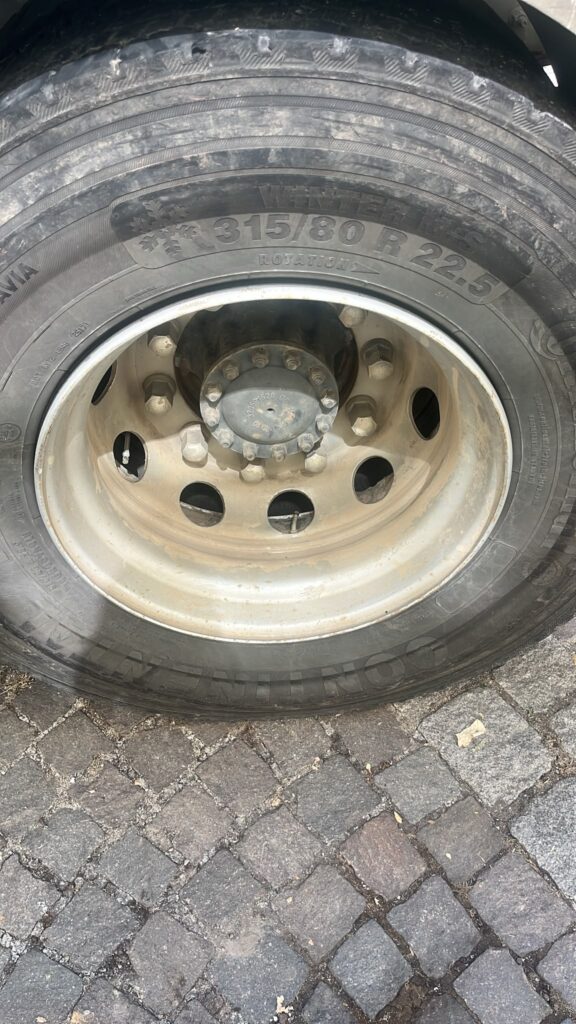
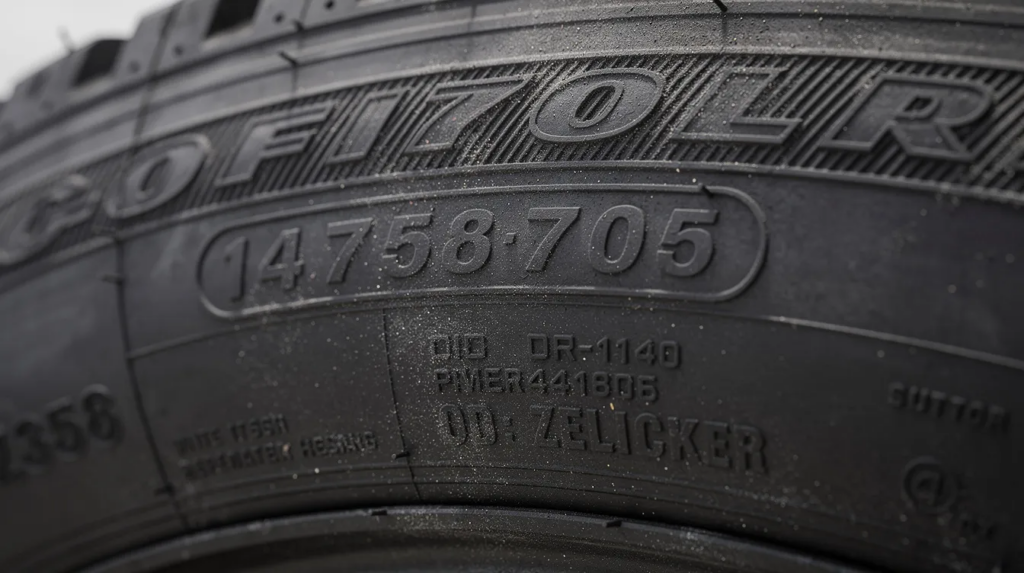
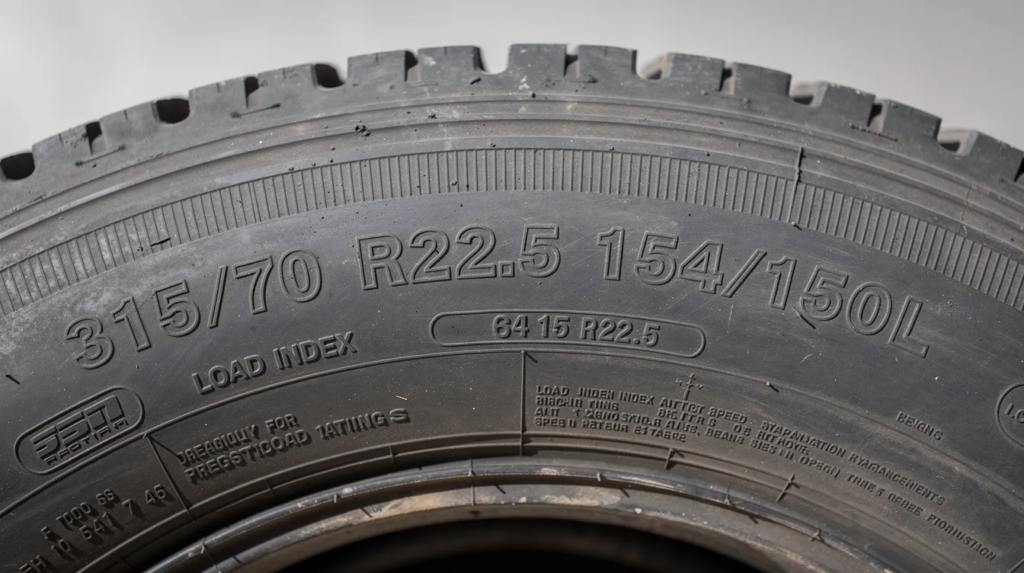
The speed rating is marked on the tyre sidewall. The last letter in the tyre designation shows the speed rating. Example: in 315/70 R22.5 154/150Q, the letter Q at the end is the speed rating.
How to read a truck tyre sidewall:
- 315 = tyre width in millimetres
- 70 = aspect ratio (height to width) in percent
- R = radial construction
- 22.5 = rim diameter in inches
- 154/150 = load index (single fitment / dual fitment)
- Q = speed rating (160 km/h)
In the vehicle registration document, the speed rating is listed under lines 15.1 (front axle) and 15.2 (rear axle). The registration certificate Part I shows the full tyre designation with size, load index and speed rating. On older documents, these values are listed under items 20 to 23.
Practical tip for drivers: If you’re unsure, take a photo of the tyre sidewall and of the registration document. Send the photos via WhatsApp to Lkwhelp24. The team reads the tyre’s speed rating and load index and selects the correct replacement tyre.
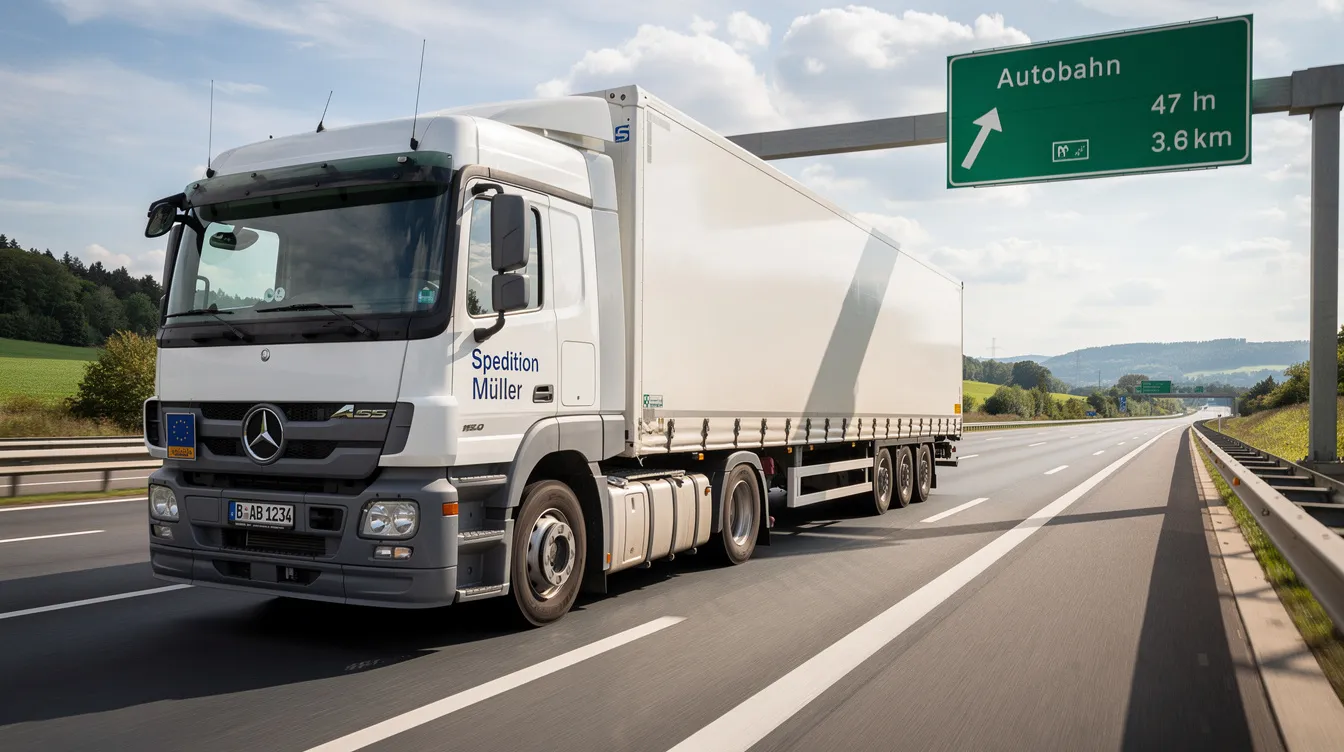
Speed rating Q at a glance: 160 km/h for commercial vehicles
A Q-rated tyre is designed for a maximum continuous speed of 160 km/h. This assumes correct tyre pressure and permitted load. Vehicles fitted with Q-rated tyres must never be driven continuously faster than 160 km/h.
For a typical truck, that’s more than enough. In Europe, trucks on the motorway usually travel at 80 to 100 km/h. The technical top speed of many commercial vehicles is between 90 and 120 km/h. A Q rating therefore offers a clear safety margin for overtaking, downhill stretches and temperature peaks.
For orientation, without a full table:
- Q = 160 km/h
- R = 170 km/h
- S = 180 km/h
- Speed rating T = 190 km/h
- Speed rating H = 210 km/h
- V rated tyre = 240 km/h
- W rated tyre = 270 km/h
- Speed rating Y = 300 km/h
Speed rating Q is found on many C-class tyres (commercial vehicle tyres, class C3), winter tyres and all-season tyres. Car tyres usually carry higher ratings such as H, V or W, because cars travel faster. The choice of speed rating should match the typical driving profile, whether city traffic, motorway or construction site use.
Tyres with a higher speed rating than Q: worthwhile or not?
Tyres with a higher speed rating than stated in the registration document are generally permitted. If the documents state Q, you may also fit tyres rated R, S, T or H, as long as tyre size and load index match the axle.
Advantages of tyres with a higher speed rating: they are built for higher temperatures and stronger centrifugal forces. That provides reserves on long downhill stretches, at high sustained speed and in high outside temperatures. Driving safety increases because the tyre stays more stable under extreme conditions.
Possible drawbacks: a higher speed rating often means a harder rubber compound. That can lead to faster tread wear on rough roads. The price also tends to be higher. For a truck covering many kilometres per year, that price difference adds up.
Tyres with a lower speed rating than stated in the registration document must not be used. A tyre with a lower speed rating must not be fitted, even if the truck actually only travels at 90 km/h. The only exception concerns certain winter tyres with special marking.
Example: The registration document states Q. You fit a tyre rated S (180 km/h). That’s permitted. Conversely: the document states R (170 km/h), you fit Q (160 km/h). That’s not allowed and can lead to the vehicle being taken off the road at a roadside check.
Speed rating Q for trucks, semi-trailers and buses: practical examples
A long-haul semi-trailer combination with a gross weight of 40 tonnes travels on the German motorway at 80 to 89 km/h. Its design top speed is often 90 to 100 km/h. A Q-rated tyre can be suitable as long as the vehicle’s top speed doesn’t exceed 160 km/h. In practice, no 40-tonne truck exceeds that value.
An 18-tonne solo truck has a design top speed of roughly 110 to 130 km/h. Here too, a Q rating covers the requirements. Many manufacturers deliver such vehicles from the factory with R- or T-rated tyres, even though the actual driving speed is well below that.
Coaches are a different case. A long-distance coach can reach a design speed of 120 to 130 km/h. Some models reach 140 km/h according to the manufacturer. Here, Q is sufficient in most cases.
When retrofitting during a breakdown: the rating required in the vehicle documents must not be undercut. If the documents state R, at least R must be fitted. Check the registration certificate Part I before a tyre change.
Check question for drivers: If the documents state Q, you may not go down to N or P, even if the truck only travels at 90 km/h.
Difference between speed rating and load index on a truck tyre
The load index appears before the speed rating in the tyre designation. Both indices are shown in the tyre designation and must be considered together. More on this in the article on the load index in the vehicle registration document.
In the designation 315/70 R22.5 154/150Q, this means:
- 154/150 = load capacity index (154 for single fitment, 150 for dual fitment).
- Q = speed rating, maximum speed 160 km/h
A tyre’s load index must match the vehicle’s permitted axle load. A tyre with index 154 carries 3,750 kg in single fitment. At index 150 in dual fitment, each tyre carries 3,350 kg.
High speeds can reduce a tyre’s load capacity. This means: a tyre that can carry 3,750 kg at 160 km/h may carry less at 200 km/h. Load capacity is important and must be considered alongside the speed rating.
For comparison: 315/70 R22.5 154/150L has speed rating L (120 km/h), 315/70 R22.5 154/150Q has Q (160 km/h). Same size, same load index, but different permitted tyre speed. The same principle of load index and speed rating also applies to the 91H tyre marking.
In a breakdown, Lkwhelp24 arranges tyres with the correct load capacity and speed category. The preferred brand usually can’t be accommodated in an emergency. The tyre fitted is the one available immediately, in the correct size, with the correct rating and load index.
Legal basis: which speed rating must a truck tyre have?
The vehicle registration document states the vehicle’s permitted maximum speed, and the tyre’s rated speed must not fall below it. This is regulated by § 36 StVZO in Germany. The tyre’s speed rating must cover at least the vehicle’s design top speed.
In practice, many trucks in Germany travel at 80 to 90 km/h on the motorway. Nevertheless, the speed rating must cover the higher technical design top speed, not the actual travel speed. A truck with a design top speed of 100 km/h needs at least a tyre rated for 100 km/h or more. Q at 160 km/h meets that.
A higher speed rating than required is always permitted under current rules. A lower one is only permitted under clearly regulated exceptions: certain winter tyres with the Alpine symbol may have a lower rating. Condition: a sticker showing the permitted maximum speed must be placed within the driver’s field of view. The speed shown there must not be exceeded.
Warning: An incorrect speed rating can have the following consequences at a roadside check in Germany:
- The vehicle’s operating licence becomes void when non-compliant tyres are used
- Vehicles with an incorrect speed rating can be taken off the road immediately
- Insurance can refuse to pay out if the speed rating is incorrect, e.g. after an accident
Speed rating Q on winter and all-season tyres for commercial vehicles
Speed rating Q is especially common on winter or all-season tyres. Many winter and all-weather truck tyres have a somewhat lower speed rating than comparable summer tyres. This is due to the softer rubber compound, which grips better in cold conditions but heats up faster at high speed.
Lower driving speeds generally apply in winter anyway. Braking distances are longer on wet or snowy roads. Adapting driving style to winter conditions is mandatory.
In Germany, winter or all-season tyres with a lower speed rating may be used if a sticker showing the permitted maximum speed is displayed. The speed on the sticker must then not be exceeded.
For international trips, national rules on winter tyres and speed ratings apply. Check the relevant country regulations before departure.
Recommendation: If you’re unsure, choose a tyre with a higher speed rating than Q. That provides additional safety margin during continuous operation and in unforeseen situations.
What happens if the speed rating is exceeded or undercut?
If a truck tyre with too low a speed rating is subjected to high speed, it heats up significantly. The rubber compound and the carcass (the internal structure of the tyre) are not designed for that load. The tread can separate from the carcass. This is called delamination. In the worst case, the tyre bursts.
A truck weighs 20 to 40 tonnes. A tyre blowout at 80 to 90 km/h is extremely dangerous at this mass. The risk of an accident increases. Other vehicles on the motorway are also at risk. Debris and tyre fragments can be left on the road.
Tyres with a low speed rating increase accident risk. The speed rating directly affects the vehicle’s safety and reliability at high speeds.
Legal consequences of a violation:
- The vehicle is taken off the road at the next check
- The operating licence becomes void
- In case of a claim, the insurer can refuse payment
A load index that’s too low is also critical. If the tyre can’t carry the axle load, it behaves similarly to a tyre with too low a speed rating: overheating, material failure, blowout.
Recommendation: Never knowingly drive on a tyre whose speed rating or load index is below the values stated in the vehicle registration document. If unsure, contact a specialist workshop or Lkwhelp24.
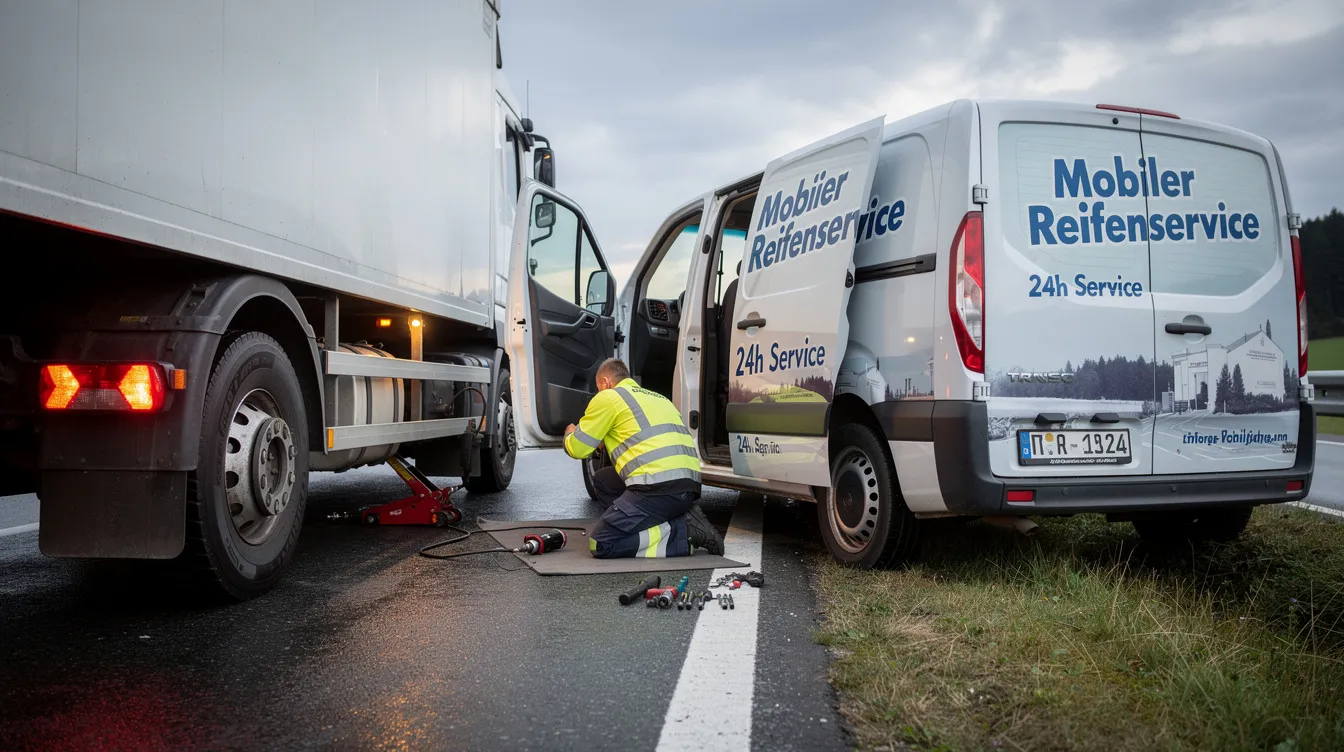
Typical breakdown scenarios with the wrong or overloaded tyre rating
Scenario 1: Long downhill descent with a heavy trailer. A 40-tonne truck descends a mountain pass. The driver brakes frequently. The brakes heat up, but so do the tyres. If the tyre is only rated N (140 km/h) while Q is required, the thermal reserve is missing. The tyre can fail under this sustained load.
Scenario 2: Underinflation in summer heat. At high outside temperature and full load, the tyre’s internal temperature rises noticeably. If tyre pressure is below the target value, the tyre flexes more. The rubber compound softens. A tyre with the wrong rating can’t withstand this combined load.
Scenario 3: Old tyre, over 8 years old. The rubber compound hardens over time and becomes brittle. Cracks form on the sidewall and tread. Even if speed rating Q is correct, the tyre loses performance with age. Combined with high load and high speed, the risk of sudden failure increases.
Consequences for haulage companies and drivers: delivery delays of several hours, standing time on the motorway, high towing and recovery costs and, in the worst case, reputational damage with the customer. Choosing the correct load index and speed rating Q or higher, combined with regular checks of tyre pressure and tyre age, measurably reduces the likelihood of a breakdown.
What to do in case of a truck tyre blowout on the motorway?
Proceed step by step. Every minute counts.
- Switch on hazard lights. Immediately, while the vehicle is still moving.
- Stop the vehicle as far right as possible. On the hard shoulder, a breakdown bay or a rest area. Don’t stop on the carriageway.
- Put on a hi-vis vest. Before leaving the cab. This is mandatory in Germany.
- Set up a warning triangle. For trucks on the motorway, at least 150 metres behind the vehicle. Further at hard-to-see locations.
- Go behind the crash barrier. Driver and passenger take shelter behind the crash barrier. Do not stand next to the truck on the hard shoulder.
- Determine your location. Motorway number (e.g. A3), direction of travel, nearest exit or rest area, kilometre marker on the roadside, GPS coordinates from your smartphone.
- Call breakdown assistance. Reach Lkwhelp24 by phone or WhatsApp: +49 160 575 3826.
Never change a truck wheel yourself on the hard shoulder. The danger from passing traffic is too great. Also, a truck wheel with tyre weighs 60 to 80 kg. Tightening the wheel nuts requires special tools with the correct torque.
For foreign drivers: Motorway number, kilometre marker and direction of travel can simply be sent as a photo via WhatsApp. Lkwhelp24 speaks German, English, Polish and Russian.
What information does breakdown assistance need by phone or WhatsApp?
- Exact location: GPS coordinates, motorway and direction, exit or rest area, kilometre marker
- Registration plates: Tractor unit and trailer stated separately
- Vehicle type: Solo truck, semi-trailer combination, drawbar combination, bus
- Gross weight: How heavy is the loaded vehicle?
- Tyre size and rating: e.g. 315/70 R22.5 154/150Q. State the axle (steer axle, drive axle, trailer axle)
- Photos: Close-up of the damage and a photo of the whole axle
Photos help estimate consequential damage and bring the right tools. If a driver struggles with German terms, clear photos and a voice message in Polish, Russian or English are enough.
Types of breakdown assistance available for trucks
Motoring clubs for trucks: Some clubs offer special memberships for commercial vehicles. This requires a membership taken out in advance. The scope of cover varies by tariff.
Manufacturer services: Major truck brands offer their own breakdown services specialised for their vehicles. These are often tied to the respective manufacturer’s dealer network.
Independent mobile truck breakdown services: Independent operators who carry out tyre changes, repairs or jump-starts directly on site. No membership required, billed per callout.
Specialised dispatch services: Companies like Lkwhelp24, which coordinate a network of vetted service partners. They don’t operate their own recovery trucks but organise the nearest available towing service or mobile tyre service. The advantage: one point of contact, multiple languages, a fixed price.
The difference between these models lies mainly in availability, language and billing. For foreign drivers without a German club membership, a dispatch service is often the fastest option.
What determines the cost of a truck tyre breakdown?
Costs are made up of several factors:
| Cost factor | Influence |
|---|---|
| Time of day | Cheaper during the day, more expensive at night and on weekends |
| Distance | The further the nearest dealer or service provider, the higher the travel cost |
| Tyre type and size | 22.5-inch tyres, reinforced trailer tyres or winter tyres cost differently |
| Speed rating | Tyres with a higher rating (e.g. T instead of Q) can be more expensive |
| Waiting time and access | Traffic jams, a difficult location or recovery add extra cost |
Specific rates at Lkwhelp24:
- Mobile truck tyre service during the day: from 290 € net
- Nights and weekends: from 549 € net
- Plus tyre price in each case
The fixed price is confirmed by phone before dispatch. No hidden costs. Payment by card or cash.
How Lkwhelp24 helps with speed rating Q issues
Lkwhelp24 dispatches and coordinates breakdown assistance for trucks over 7.5 t throughout Germany, 24 hours a day, 7 days a week. The process is simple: call or send a WhatsApp message. Share your location via GPS. Send photos of the damaged tyre and the registration document.
Usually within 30 to 60 minutes, a partner workshop can be on site with the correct truck tyre, depending on location. In a breakdown, the tyre fitted always has the correct load index and speed rating available immediately. The preferred brand is usually not available in an emergency; brand requests can be attempted for an extra charge and waiting time when placing the order.
Lkwhelp24 assists semi-trailer combinations, solo trucks, trailers and buses. No help for cars, car tyres, vans under 7.5 t or motorhomes. For these vehicles, we recommend ADAC or a local car breakdown service.
Contact:
- Phone/WhatsApp: +49 160 575 3826
- Languages: German, English, Polish, Russian
Tips for fleet operators: tyre selection and checking the speed rating
- Define standards: Set a minimum speed rating for each axle group (steer axle, drive axle, trailer axle). For example: at least R for all axles, even if the documents only require Q.
- Regular checks: Drivers or the workshop check the tyre codes on the sidewall at every pre-trip check. This includes: tyre size, load index, speed rating and manufacture date (DOT code).
- Specify workshop orders precisely: In framework agreements with tyre dealers, clearly define the minimum speed rating and load index accepted. This prevents incorrect fitments.
- Consistent rating across the fleet: If all vehicles use the same rating (e.g. R everywhere instead of Q), stock management becomes simpler. Breakdown handling gets faster, because the next available tyre is more likely to match.
- Watch tyre age: Tyres older than 8 to 10 years lose performance, regardless of tread depth. The DOT date on the sidewall shows the week and year of manufacture. Regular replacement reduces safety risks.
FAQ on speed rating Q for truck tyres
Can I fit tyres rated R or S instead of Q on my truck?
Yes. A higher speed rating than stated in the documents is generally permitted. Condition: load index, tyre size and construction type must match the vehicle. If unsure, ask at a registration office, a specialist workshop or the Federal Motor Transport Authority.
Isn’t speed rating Q too high for a truck that only travels at 90 km/h?
No. The rating is based on the vehicle’s design top speed, not the actual travel speed of 80 to 90 km/h. Q provides reserves for overtaking, downhill stretches and emergency manoeuvres. It also handles temperature peaks in high outside temperatures better.
Can Lkwhelp24 fit a different rating than stated in the registration document in an emergency?
Lkwhelp24 always tries to supply the registered combination of size, load index and speed rating. If it’s technically permitted and legally justifiable, a higher rating can be used. Going below the registered rating is not arranged.
As a foreign driver, how do I quickly identify the rating I need?
Take photos of the tyre sidewall and the registration document. Send both via WhatsApp to Lkwhelp24 (+49 160 575 3826). The team reads the speed rating and load index and selects the correct replacement tyre. Communication is possible in German, English, Polish and Russian.
Does Lkwhelp24 also change car tyres with speed rating Q?
No. Lkwhelp24 only assists trucks, semi-trailer combinations, trailers and buses over 7.5 t. For cars, vans under 7.5 t and motorhomes, ADAC or local car breakdown services are responsible. We don’t offer service for Sprinter, Ducato, Transit, Iveco Daily or similar vehicles.