Skip to content
TL;DR: On 29 July 2026 an articulated lorry pulled into a rest area on the A71 near Erfurt, Thuringia, with a screw lodged in the shoulder of a 315/70 R22.5 tyre. The shoulder sits outside the repairable zone, so the tyre had to be replaced, not patched. From the 11:20 call to the vehicle rolling again took 2 hours 5 minutes and cost €910 net. Had the same screw landed two to three centimetres closer to the tread centre, a mushroom-plug repair at roughly €120-150 would have done the job.
This is not another “can a punctured tyre be repaired” piece — we’ve covered that ground in earlier case studies. This one is about the line itself: the exact boundary between the tread’s repairable zone and the shoulder where repair is prohibited, why that boundary exists physically rather than by convention, and why a couple of centimetres of tyre geometry turned a minor repair bill into a five-figure-adjacent one for the operator’s day.
The Emergency Situation: A Screw Where a Patch Won’t Help
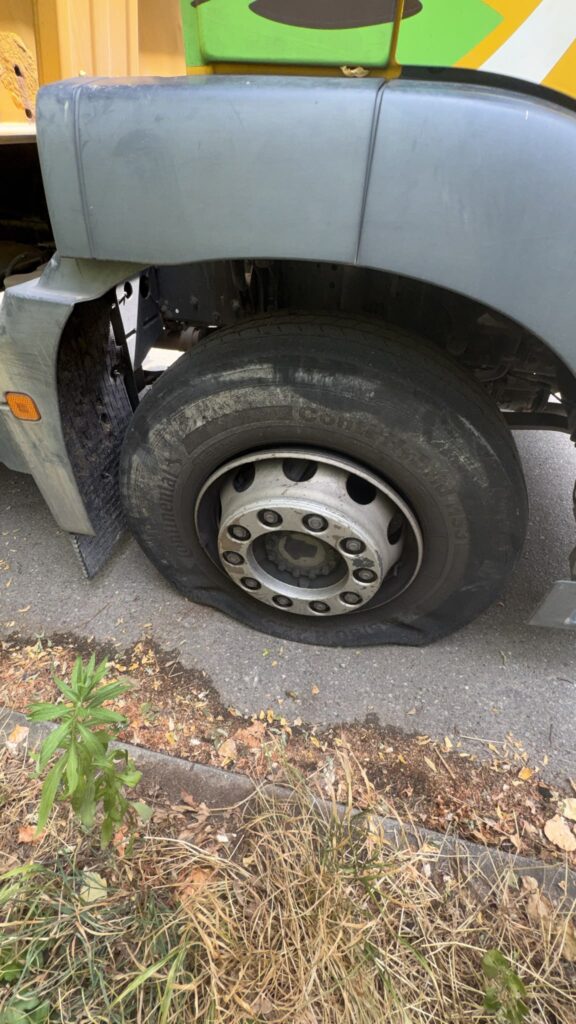
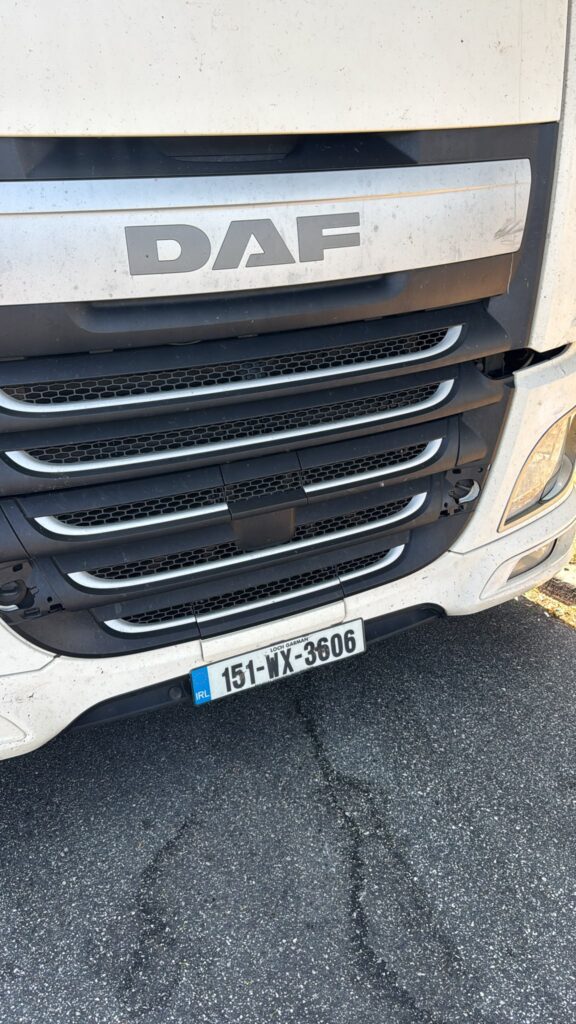
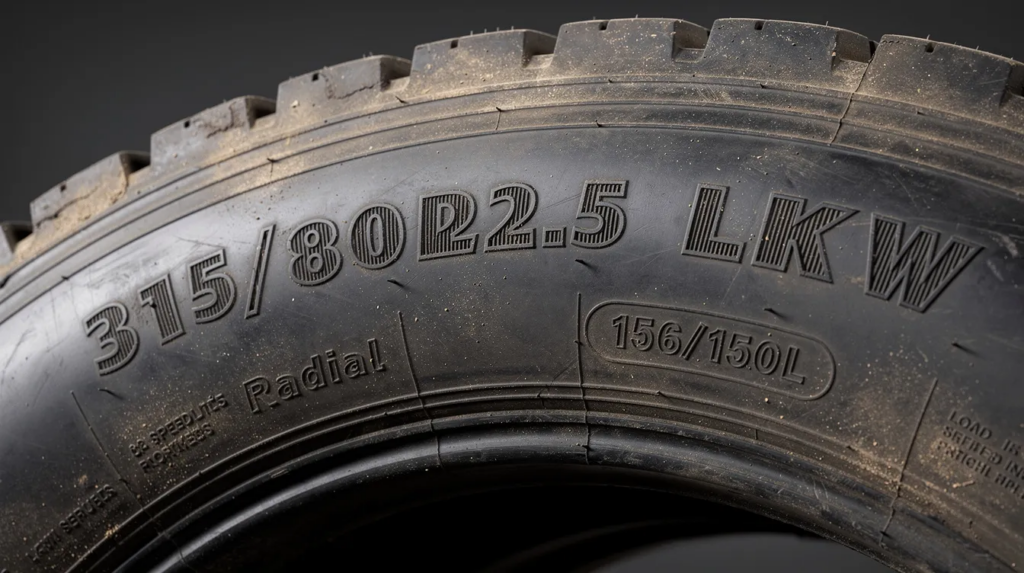
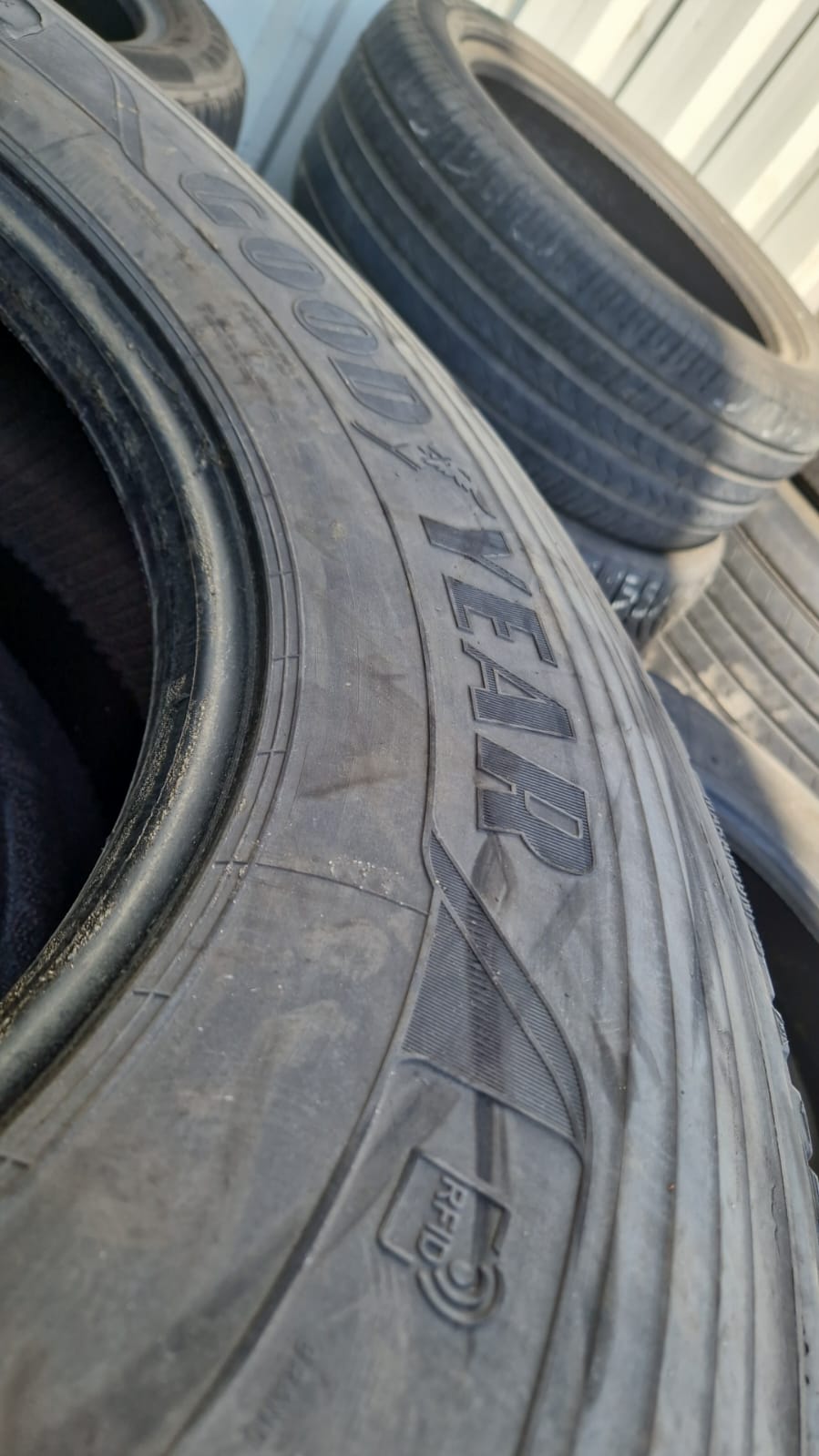
A metal object lodged in the tyre shoulder is not a routine puncture — it sits in a zone where German technical standards and every reputable tyre manufacturer rule out repair, full stop. On 29 July, a driver on the A71 near Erfurt felt the tell-tale pull to one side, stopped at the next rest area, and found a screw driven into the tread shoulder of one of his trailer’s 315/70 R22.5 tyres.
The tyre still held air. That’s the trap: a slow leak or a firmly wedged object can look survivable, and drivers sometimes ask whether they can limp to the next town. With a shoulder-zone penetration, the honest answer is no — not because of the hole itself, but because of where it sits.
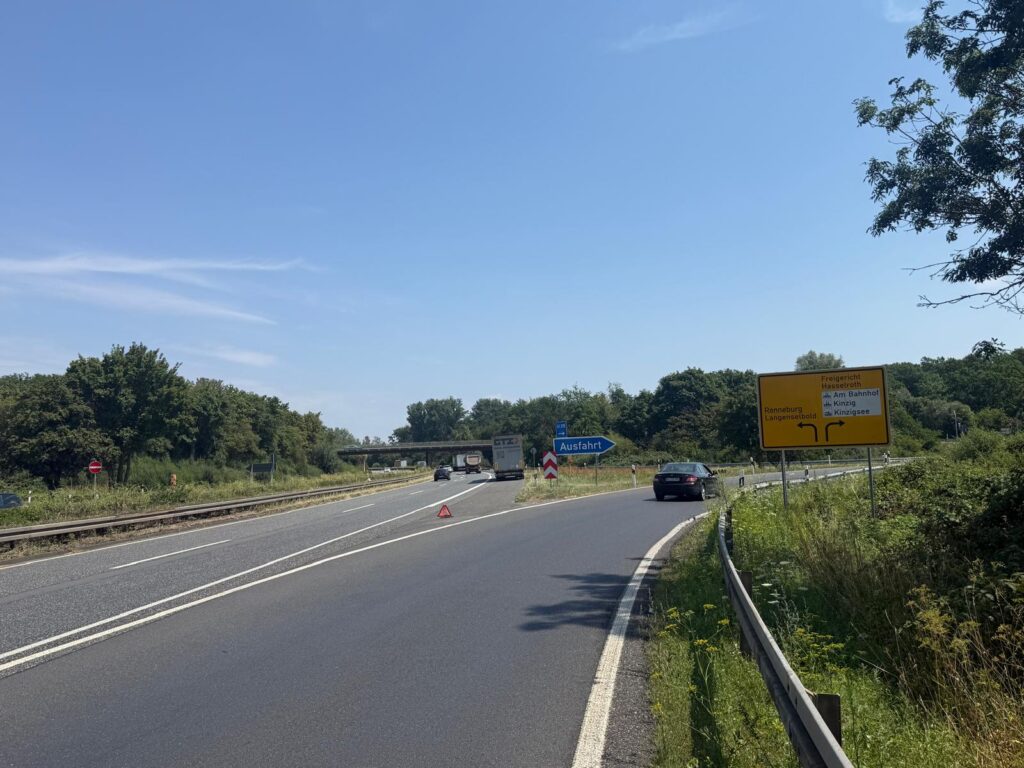
The lorry was an articulated combination, tractor unit plus semi-trailer, fully loaded and parked safely off the carriageway on the rest area apron. No injuries, no blocked lane. The only open question was how fast a replacement tyre and a fitter could reach a rest stop in rural Thuringia on a weekday.
Where the Repairable Zone Actually Ends
A lorry tyre’s repair zone is the central belt of the tread, bounded by the tread grooves closest to the shoulder — not “the middle” judged by eye, but a specific area defined by the tyre’s internal construction. Outside that belt, repair is off the table regardless of how small the puncture looks from the outside.
Fitters determine the boundary practically, not by guessing. On a 315/70 R22.5 casing, the repairable area typically extends to within roughly 2-3 cm of where the tread shoulder begins its curve toward the sidewall — the point where the steel belt package narrows and the construction starts transitioning into flexible sidewall. Tyre manufacturers publish repair-zone diagrams for exactly this reason: a technician measures from the tread’s centreline and cross-checks against the belt edge, visible once the tyre is demounted and inspected from the inside.
From the road, a screw two centimetres inside the belt and a screw two centimetres outside it look identical. That’s precisely why the assessment happens on a lift, with the wheel off and the inner liner inspected — not at the roadside with a torch.
Why a Shoulder-Zone Patch Doesn’t Hold
A repair in the shoulder area fails because that part of the tyre flexes hardest and builds up the most heat while rolling — a patch bonded there is fighting forces no adhesive is rated for. The tread centre stays comparatively rigid under load. The shoulder, by contrast, is where the sidewall’s flex transitions into the belt’s rigidity, so it bends and unbends thousands of times per hour of driving, generating localised heat that a repair patch simply isn’t designed to survive.
Under that cyclical flex, an externally applied patch starts to delaminate at the edges within weeks, sometimes days at motorway speeds and full load. The rubber-to-rubber bond peels, moisture works into the gap, and the steel belt underneath keeps corroding from the inside. The tyre doesn’t fail instantly — it fails progressively, and often at the worst possible moment: full load, motorway speed, hot afternoon.
This is also why a plug alone, without a proper internal patch bonded to the casing, is never acceptable on a lorry tyre anywhere on the tread — the shoulder just makes an already inadequate fix actively dangerous.
The Two Centimetres That Cost €780
Had the screw in this case sat two to three centimetres closer to the tread’s centreline, inside the repairable belt, a mushroom-plug repair would have cost roughly €120-150 and taken well under an hour. Because it sat in the shoulder, the only compliant fix was a full tyre replacement at €910 net, including call-out, labour, the new tyre, and disposal of the old one.
That gap — €780 or more, on this single event — is the real subject of this article. It isn’t a story about a random unlucky puncture. It’s a story about tyre geometry deciding, almost to the centimetre, whether a driver loses forty-five minutes and €150 or two hours and nearly a thousand euros.
There’s no way to see this coming from inside the cab. A screw picked up off a rest area apron or a construction-adjacent stretch of carriageway lands wherever it lands. What operators can control is how the tyre is inspected and treated once it happens — and that’s where the next section matters.
Who Decides: Workshop or Customer?
The workshop decides whether a tyre is repairable, not the customer, and a reputable operator will refuse to repair a tyre outside the permitted zone even if the customer offers to pay extra and sign a waiver. This isn’t stubbornness — it’s liability and safety, in that order.
A lorry tyre carries several tonnes of axle load at motorway speed. If a shoulder repair fails on the road, the resulting blowout can damage the wheel arch, the brake lines, or a following vehicle, and the fitter who signed off on a non-compliant repair carries direct responsibility for that outcome. German technical rules for commercial vehicle equipment don’t leave room for a documented exception based on a customer’s request.
A driver frustrated by a €910 bill sometimes asks, reasonably, whether a temporary fix would get them to the next depot. The honest answer from a professional service is that “temporary” on a shoulder puncture usually means “temporary until it fails,” and the consequences of that failure land on whoever authorised the repair. We say no to shoulder repairs for the same reason a good workshop always will.
What Disreputable Operators Do — And How to Spot One
A dangerous workaround some low-cost operators use is gluing an external patch or plug into the shoulder zone “for show,” without opening the tyre to bond a proper internal repair to the casing — and it’s detectable if you know what to check. The tyre looks fixed. It holds air for the test drive. It is not actually repaired.
Warning signs worth checking after any roadside tyre repair:
- No demounting. A genuine shoulder-zone assessment requires the wheel off and the inner liner inspected. If a technician “fixes” a puncture without removing the tyre from the rim, that repair cannot be trusted.
- External-only plug. A rubber string pushed into the hole from outside, with no internal patch, is a temporary seal at best — acceptable nowhere on the shoulder, and only ever a stopgap even in the repair zone.
- No documentation. A proper repair on a commercial tyre gets logged: location, size, method. No paperwork is a red flag.
- Refusal to show the old tyre. Ask to see the removed tyre and the damage location. A workshop with nothing to hide will show you.
If in doubt, a second opinion from an independent tyre specialist before the vehicle covers serious distance is worth the delay.
Truck Tyre Repair Standards in Germany
German commercial vehicle rules limit how, where, and how often a lorry tyre may be repaired, and steer-axle tyres may not be repaired at all — only replaced. The technical framework sits under § 36 StVZO, the vehicle type-approval regulation covering tyres and wheels, which in turn references the tyre and repair-material industry standards applied by workshops across the country.
In practice, the rules that matter on the road:
- Repair zone only. Repairs are permitted solely within the central tread area defined by the tyre manufacturer — never the shoulder, never the sidewall.
- No steer-axle repairs. A tyre on a driven-steering axle gets replaced, never repaired, regardless of damage location, because steering precision cannot tolerate a compromised carcass.
- Repair count and spacing. Manufacturers cap the number of repairs per tyre and require minimum spacing between them — typically several centimetres — so repaired areas don’t overlap and weaken the same section of belt twice.
- Size limits. Damage above a certain diameter, generally around 6mm for nail-type punctures depending on the manufacturer’s chart, falls outside repairable limits even inside the correct zone.
These aren’t bureaucratic hurdles. They’re the accumulated experience of the tyre industry translated into enforceable limits, and organisations like TÜV and the ADAC publish consumer-facing guidance that lines up with the same boundaries.
How Help Was Organised
Dispatch alerted our regional partner workshop within ten minutes of the driver’s call, and the response vehicle was en route with the correct 315/70 R22.5 tyre already loaded. Speed on a rest-area call depends on having the right size in stock nearby — guessing wrong means a second trip.
The sequence dispatch followed:
- Confirm tyre size, damage description, and exact rest area location from the driver.
- Check regional partner stock for a matching 315/70 R22.5 tyre.
- Assign the nearest available mobile fitting unit.
- Relay estimated arrival time to the driver so they could plan around the stop.
- Keep the line open for updates if road conditions changed the drive time.
This structure is what compresses a rest-area breakdown into hours rather than the better part of a working day. A driver with no local contacts, on the phone in a language that isn’t their own, needs a dispatcher who can move fast without extra back-and-forth — which is why our team runs multilingual around the clock.
The Situation on Site
A lorry tyre running underinflated or on a compromised casing is a stability and blowout risk long before it fully deflates, which is why professional assessment at the roadside always precedes any decision to drive on. Standard operating pressure for tyres in this size range runs 8.5-9.5 bar; a tyre losing air unevenly shifts load onto neighbouring tyres on the same axle, accelerating wear and raising blowout risk across the whole set.
On arrival, the technician confirmed what the driver had already suspected: the screw sat in the shoulder, clearly outside the belt edge, visible even before the wheel came off. No ambiguity, no judgement call — the geometry made the decision for them.
The rest area itself was quiet on a weekday afternoon, dry conditions, good visibility. Not every call plays out this smoothly — heavy rain or a poorly lit rest stop after dark adds real time to every step of the process, from spotting the damage accurately to torquing bolts safely.
Step-by-Step: From Assessment to Release
Step 1 — Site safety. Warning triangle placed, technician in a high-visibility vest, vehicle confirmed stable on the rest area surface before any tools came out.
Step 2 — Damage inspection. Wheel checked in place first to confirm the object’s position relative to the tread pattern, then flagged for removal once shoulder-zone damage was confirmed.
Step 3 — Wheel removal. Bolts loosened in the correct star pattern, wheel lifted clear, tyre demounted from the rim for full internal inspection — confirming no additional damage to the casing or rim itself.
Step 4 — New tyre fitted and balanced. Replacement 315/70 R22.5 mounted, seated, and balanced on the mobile unit’s equipment before remounting.
Step 5 — Final check. Wheel bolts retorqued in a cross pattern to 650 Nm, tyre pressure set and verified at 9.0 bar, visual check of the neighbouring tyre on the same axle for any related wear.
Torque and pressure are the two figures we never skip documenting. An under-torqued wheel bolt loosens under vibration; an over-torqued one can crack a stud. Both are avoidable with a calibrated torque wrench and a technician who checks twice.
Full Timeline
| Time | Phase | Action |
|---|---|---|
| 11:20 | Call received | Driver reports a metal object in the tyre, articulated lorry at the A71 rest area near Erfurt |
| 11:20–11:30 | Dispatch | Regional partner workshop alerted (10 min) |
| 11:30–12:20 | Response drive | 50 minutes to reach the site |
| 12:20–12:30 | Assessment and site safety | Warning triangle, hi-vis vest, damage zone inspection (10 min) |
| 12:30–13:10 | Wheel removal and tyre replacement | Wheel removed, new tyre fitted and balanced (40 min) |
| 13:10–13:25 | Final check | Cross-pattern torque to 650 Nm, pressure checked at 9.0 bar (15 min) |
Total: 2 hours 5 minutes (125 minutes) from call to vehicle release.
Cost Breakdown and the Repair That Wasn’t
The total bill for a shoulder-zone tyre replacement in this case came to €910 net, against a hypothetical €120-150 had the same damage sat inside the repairable belt. That single comparison is the clearest illustration of why puncture location matters more than puncture size.
| Item | Cost (EUR, net) |
|---|---|
| Call-out | €240 |
| Labour | €130 |
| Tyre 315/70 R22.5 | €520 |
| Old tyre disposal | €20 |
| TOTAL | €910 (plus VAT) |
For context, if the screw had landed two to three centimetres closer to the tread centre, a mushroom-plug repair at roughly €120-150 would have been the compliant fix instead. Set against average lorry downtime costs of €800-1,200 per day, the 2-hour-5-minute turnaround still kept this closer to a rounding error on the day’s schedule than a lost day — but the €780 gap between “repairable” and “not repairable” is money no dispatcher can plan around in advance.
Why a Professional Is Needed
Roadside tyre work on a lorry carries risks a passenger-car driver rarely has to think about, from the sheer mass being lifted to the torque specification on the bolts holding the wheel to the axle. Attempting it without the right equipment and training exposes the driver to real danger and the fleet to worse downstream costs.
Key risks of DIY or under-equipped repair attempts:
- Incorrect torque. Wheel bolts on a lorry axle require a calibrated torque wrench set to the manufacturer’s Nm specification — hand-tightening or guessing risks a wheel working loose at speed.
- Misjudged repair zone. Without demounting the tyre and inspecting the belt edge, it’s easy to misjudge whether damage falls inside the repairable area.
- Jack and stand safety. A loaded semi-trailer axle needs rated lifting equipment on stable ground — an improvised jack on a soft rest-area verge is a genuine hazard.
- Balance and fitment. An unbalanced replacement tyre accelerates wear on the whole axle and can mask a deeper alignment issue.
None of this is a reason to over-dramatise a routine call-out. It’s a reason to have a trained technician handle it rather than a well-meaning driver with a floor jack from the cab locker.
Typical Situations We’re Called Out to Across Germany
Shoulder-zone punctures are one recurring pattern among several tyre-related call-outs our regional partner network handles daily on motorways nationwide, from full blowouts to slow leaks caught before they become emergencies. Common scenarios include a nail or screw picked up near roadworks, a sidewall cut from kerb contact while manoeuvring in a depot yard, sudden pressure loss from a valve failure, and gradual wear-related failures on tyres that missed a scheduled inspection interval.
Location matters as much as damage type. A rest area, like this one on the A71, is the safest possible place for this kind of repair — stable ground, room to work, no live traffic lane involved. A breakdown on the hard shoulder of a busy stretch changes the calculation entirely, adding traffic management to every step and typically extending the timeline.
Prevention: Extending Tyre and Fleet Life
Regular pressure and tread checks before departure catch slow leaks and embedded objects before they force a roadside stop, and remain the single most effective prevention step available to any driver or fleet manager. A five-minute walk-around with a pressure gauge, done at the start of a shift, finds the majority of developing issues before they become breakdowns.
When damage does occur close to the repairable-zone boundary but the exact position is uncertain, repositioning the wheel to a less-loaded axle — where the load and legal rules allow it — can extend a tyre’s useful life rather than forcing an immediate replacement. This isn’t always possible; steer-axle and drive-axle positions carry stricter rules, but trailer axles sometimes offer flexibility a fleet manager can use.
Practical steps for fleet operators:
- Log tyre age and repair history per vehicle, not just per axle position.
- Retire any tyre approaching or exceeding its repair-count limit rather than pushing for one more patch.
- Train drivers to recognise a puncture in the tread centre versus the shoulder before calling it in — it changes what kind of help to expect.
- Keep a current inventory of tyre sizes across the fleet so partner workshops can match stock faster in an emergency.
What Happens to the Damaged Tyre
A replaced lorry tyre gets disposed of through a licensed recycling channel, not kept as a spare — a tyre condemned for shoulder damage has a compromised carcass and no safe second life on any axle. Disposal costs, typically €15-25 per tyre, cover the collection and material recovery process required under German waste regulations for used commercial tyres.
Some drivers ask about keeping the old tyre as an emergency backup for a future puncture elsewhere on the vehicle. It’s understandable instinct, but a tyre condemned for shoulder-zone damage carries that same structural weakness wherever it’s mounted next — there’s no axle position where it becomes safe again. Proper disposal, documented and included in the invoice, is the only responsible outcome.
Extended Notes on Tyres and Fleet Maintenance
Tyre quality and repair discipline are two separate variables in total cost of ownership, and both matter more on commercial fleets than on private vehicles given the mileage and load involved. Premium manufacturers including Michelin, Continental, Goodyear, and Bridgestone publish detailed repair-zone diagrams for their commercial ranges precisely because the boundary this article covers varies slightly by tyre model and construction.
A 315/70 R22.5 casing from one manufacturer won’t have an identical repairable belt width to a 315/80 R22.5 from another — tread pattern, belt package, and shoulder design all shift the boundary by a centimetre or two. This is one more reason a roadside “eyeball” assessment isn’t reliable and demounting the tyre for proper inspection remains standard practice across our partner network.
Fleet managers running mixed tyre brands across a yard benefit from keeping each manufacturer’s repair-limit documentation on file rather than assuming one universal rule applies. It rarely does, and the variance is exactly where roadside disputes over “repairable or not” tend to start.
Why Choose Us
Round-the-clock coverage, a vetted regional partner network, and transparent net pricing quoted before work begins are the three things drivers consistently mention after a call-out. Every job comes with a documented breakdown of what was found, what was done, and why — the same standard applied to this A71 case.
Our dispatch team operates in multiple languages, which matters on German motorways where a large share of the commercial traffic is international. A driver stranded at a rest area shouldn’t have to fight a language barrier on top of a mechanical problem.
Frequently Asked Questions
Where exactly does the repairable zone end on a lorry tyre?
The repairable zone covers the central tread area only, bounded roughly 2-3 cm inside the point where the shoulder begins curving toward the sidewall on a typical 315/70 R22.5 casing. The precise boundary varies by tyre model, which is why a technician confirms it by demounting the tyre and checking the belt edge, not by eye at the roadside.
Can a workshop repair a tyre in the shoulder zone if the customer insists?
No. A reputable workshop refuses shoulder-zone repairs regardless of customer request, because the repair won’t hold under the flex and heat that zone experiences while rolling, and the fitter carries liability if it fails. This is a safety limit, not a pricing decision either party can negotiate around.
Why did this repair cost €910 instead of around €130?
The screw sat in the shoulder, outside the repairable belt, which under German technical standards means replacement rather than repair regardless of the puncture’s small size. A comparable puncture two to three centimetres closer to the tread centre would have cost roughly €120-150 for a mushroom-plug repair instead.
How long does a lorry tyre replacement take at the roadside?
In this case, total time from the 11:20 call to the vehicle’s release at 13:25 was 2 hours 5 minutes, covering dispatch, a 50-minute response drive, assessment, wheel removal, fitting, balancing, and a final torque and pressure check. Night call-outs or bad weather typically add time to the response-drive and assessment stages.
Can steer-axle tyres ever be repaired?
No. Steer-axle tyres on a lorry are never repaired under German commercial vehicle rules, regardless of where the damage sits — any puncture or cut on a steer-axle tyre means replacement. This reflects the higher precision and load demands placed on steering tyres compared with drive or trailer axles.
What happens to a tyre that’s condemned for shoulder damage?
It goes to licensed disposal and recycling, never back into service as a spare, because a tyre condemned for shoulder-zone damage carries the same structural weakness on any other axle position. Disposal typically costs €15-25 per tyre and is documented as a separate line item on the invoice.
Summary
- Location: Rest area on the A71 near Erfurt, Thuringia
- Vehicle: Articulated lorry, tractor unit with semi-trailer
- Tyre: 315/70 R22.5, metal object in the shoulder — outside the repairable zone
- Response time: 50 minutes’ drive after a 10-minute dispatch
- Total time: 2 hours 5 minutes, call to release
- Cost: €910 net (replacement) versus an estimated €120-150 had the damage sat inside the repair zone
- Torque/pressure: 650 Nm cross-pattern, 9.0 bar
Get Help Now
A metal object in your lorry’s tyre shoulder needs an honest assessment, not a roadside guess. Call +49 160 5753826 or visit www.lkwhelp24.com — we’re available 24/7 across Germany, with a regional partner network that reaches motorway rest areas fast and gives you a clear, documented answer on repair versus replacement before any work starts.
Keywords: truck tyre shoulder damage | lorry tyre repair zone | tyre repair vs replacement | 315/70 R22.5 | A71 Erfurt tyre service | mobile truck tyre service Germany | § 36 StVZO tyre repair | HGV tyre call-out cost
Related Articles
- Truck Tyre Service Near Me: How We Got a DAF Artic Back on the Road in 2 Hours After a Tyre Blowout on the Autobahn Near Hof
- Truck Tyre Service for Blowout and Rim Damage on the Motorway near Trier: Complete Solution in Under 2 Hours
- Winter Tyres for HGVs in Germany – Legal Requirements, Safety & Service by LKWHelp24
- Rest Areas and Rest Stops on the Motorway in Germany
- Truck Loses 2 Wheels Near Hannover – Sheared Bolts | 24/7 Mobile Roadside
Explore our services: truck tyre service, mobile truck service, truck workshop service, towing service, or contact us directly.