Skip to content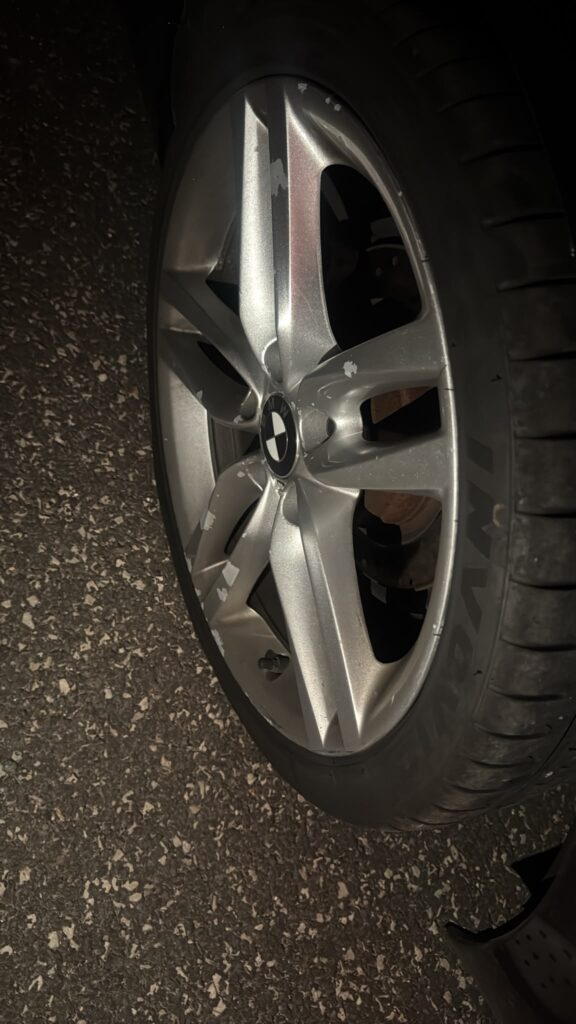
TL;DR: During the night of 6 August, a wheel rim was damaged while loading a car transporter at a rest area on the A31 near Dorsten. LKWHelp24’s regional partner team documented the damage, checked and re-secured tie-downs on all five vehicles, and cleared the transporter to continue within 2 hours 20 minutes, for a total of €850 net.
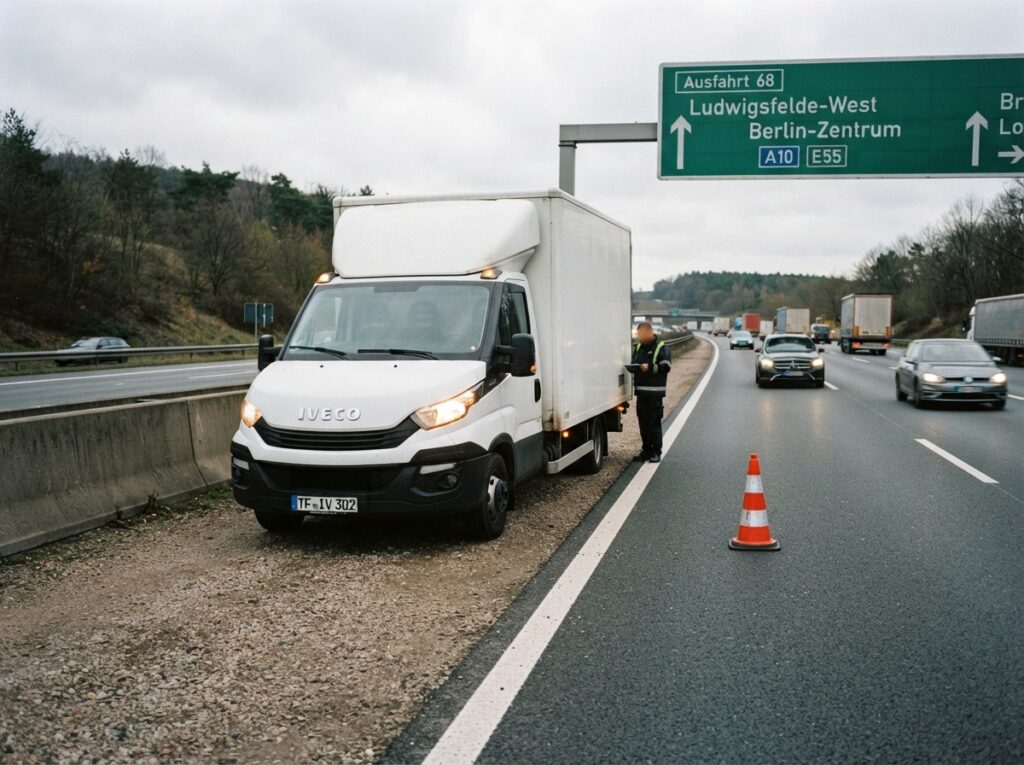
The emergency situation
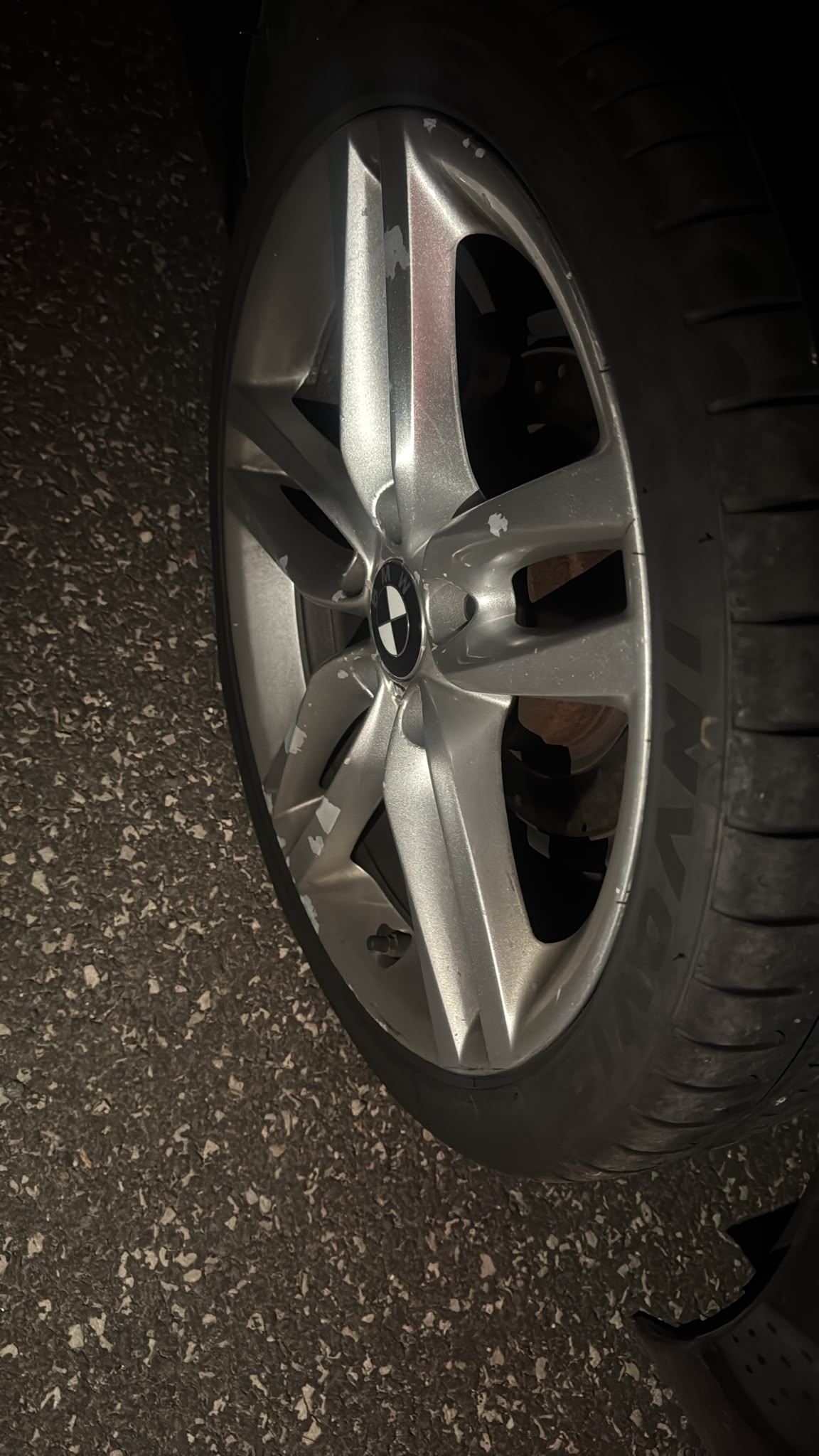
It was just after one in the morning on 6 August when things went wrong at a rest area on the A31 near Dorsten, in North Rhine-Westphalia. A car transporter carrying five vehicles across two decks was midway through loading when a wheel rim on one of the cars on the upper deck made contact with the loading ramp, or possibly a tie-down strap that had been pulled too tight. Either way, the damage was there the moment anyone looked closely: a scuff and a dent on an alloy rim belonging to a car that, minutes earlier, had been in showroom condition.
For anyone who has never worked around vehicle transport, it is hard to overstate how much this kind of incident matters. A car transporter is not carrying gravel or pallets of bottled water. It is carrying assets worth, in most cases, considerably more than the tractor unit pulling them. A single scratch on a brand-new car can trigger a dealer claim, a repainting job, and weeks of correspondence between insurers who will each try to establish exactly whose fault it was and exactly when it happened. That is why, at 01:15, the driver was on the phone to the LKWHelp24 dispatch centre rather than trying to sort the problem out alone in the dark.
How the help was organised
Our dispatch centre took the call at 01:15 and had a regional partner team confirmed and briefed within ten minutes. The team was already stationed within reach of the A31 corridor, which is one of the busier heavy-goods routes running north from the Ruhr area towards the Dutch border, and they were on the road by 01:25. Fifty minutes later, at 02:15, they arrived at the rest area near Dorsten.
The first thing the team did was not touch a single strap. They took photographs. Before any vehicle was unloaded or any tie-down adjusted, the damaged rim was documented from multiple angles, with the surrounding straps, the ramp, and the position of the car all captured on camera. This sequencing matters enormously in cargo damage cases, and we will come back to why. Only once that record existed did the inspection and re-securing work begin.
Why this can’t be ignored
A loose strap on a car transporter is not a minor housekeeping issue. It is the difference between a vehicle arriving at the dealership exactly as it left the factory, and a vehicle arriving with cosmetic or structural damage that no amount of paperwork will undo cheaply.
Tie-down straps on a car transporter need to run around the wheel and tyre, never around suspension components or body panels. Wheel-strap securing spreads load evenly and lets the vehicle’s own suspension absorb vibration, whereas a strap looped round a control arm or a subframe point transmits every jolt from the road straight into parts never designed to take that kind of lateral load. Get the tension wrong in either direction and you have a problem: too loose, and the vehicle can shift, sway into its neighbour, or let the strap slide until it contacts the rim edge and starts chafing paint or lacquer off the metal; too tight, and the strap itself can deform an alloy rim or place unnecessary stress on the suspension components it’s looped near.
Rim protection is the other detail that gets skipped when a crew is in a hurry, and a night loading job at a rest area, working against the clock before a terminal or a client’s schedule closes in, is exactly the kind of situation where corners get cut. Rubber or felt sleeves at the contact point between strap and rim prevent the kind of chafing that, over several hundred kilometres of vibration, can leave a visible ring worn into the paint or clear coat of an alloy wheel. It costs almost nothing to fit them. It costs a great deal to explain their absence to an insurer.
And once one strap has been found compromised, on any deck, the sensible response is not to fix that one and move on. If the tension on one securing point was wrong, or if the loading process rushed one attachment, there’s a real chance the same rushing affected others. That’s why the team checked and re-tensioned every strap on all five vehicles that night, not only the one nearest the damaged rim.
Step-by-step process
Step 1 — Call and dispatch. The driver reported the damage to LKWHelp24’s dispatch centre at 01:15. Within ten minutes a regional partner team had been located and briefed on the situation: location, vehicle type, and the nature of the damage.
Step 2 — Response drive. The team travelled to the rest area on the A31, arriving at 02:15, fifty minutes after the call was logged.
Step 3 — Photo documentation before touching anything. Between 02:15 and 02:35 the team photographed the damaged rim, its position on the upper deck, and the surrounding strap and ramp arrangement, before any vehicle was moved or any strap adjusted.
Step 4 — Inspection and re-securing. From 02:35 to 03:15, all five vehicles across both decks were checked. Straps were re-tensioned where needed and rim protection was reapplied or replaced where it had worn or slipped.
Step 5 — Documentation and handover. Between 03:15 and 03:35 the findings were entered into the CMR consignment note and a handover report was completed for the transporter’s operator, giving both driver and shipper a written record of what was found and what was done.
By 03:35 the car transporter was cleared to continue its journey, two hours and twenty minutes after the initial call.
Timeline
| Time | Phase | Action |
|---|---|---|
| 01:12 | Damage discovered | Rim damage noticed during loading at the A31 rest area near Dorsten |
| 01:15 | Call received | Call to the LKWHelp24 dispatch centre |
| 01:15–01:25 (10 min) | Dispatch | Regional partner team located, job confirmed |
| 01:25–02:15 (50 min) | Response drive | Team travels to the site on the A31 |
| 02:15–02:35 (20 min) | Initial assessment | Photo documentation of the damage before unloading |
| 02:35–03:15 (40 min) | Inspection & re-securing | Checking and re-tensioning tie-downs on all 5 vehicles |
| 03:15–03:35 (20 min) | Documentation | Entry in the CMR consignment note and handover report |
| 03:35 | Job complete | Car transporter cleared to continue its journey |
Total time from call to completion: 2 hours 20 minutes.
Cost breakdown
| Item | Price (EUR) |
|---|---|
| Night callout, A31 near Dorsten | €220 |
| On-site labour (1 h 20 min) | €150 |
| Damage documentation & photo report | €80 |
| Inspection & re-securing of all vehicles (5 cars) | €140 |
| Correction/replacement of damaged tie-down straps incl. rim protectors | €90 |
| Subtotal | €680 |
| Night surcharge (25%) | €170 |
| Total | €850 |
A few things drive the final figure. The night-time hour is one: work carried out between roughly 22:00 and 06:00 attracts a 25% surcharge across the industry, reflecting the cost of keeping crews and vehicles available around the clock rather than only during the day. Location plays a part too, since a rest area beside a busy motorway like the A31 near Dorsten is more straightforward to reach than a rural back road, which keeps the drive-time component down. And the scale of the job matters: checking one vehicle’s straps takes minutes, but checking five, across two decks, with proper documentation for each, is a different order of work.
Set against that €850, a car transporter standing idle typically costs its operator somewhere between €800 and €1,200 per day once demurrage, late-delivery penalties, and contractual knock-on costs are counted. On that basis, the callout more or less paid for itself against a single day of downtime, and the transporter never lost that day at all, since the whole job was wrapped up before dawn.
It is worth being clear about one thing: this figure does not include repairing the damaged rim itself. That work belongs to a bodyshop or a wheel specialist, and typically costs somewhere in the region of €250 to €600 depending on whether the rim can be straightened and refinished or needs replacing outright. LKWHelp24’s role that night was load securing, inspection, and documentation, not cosmetic repair, and we think it is more useful to be upfront about that distinction than to blur it.
Why you need a professional
A driver on their own, at one in the morning, with a damaged rim and four other vehicles still to check, is not in a good position to make sound decisions about strap tension or documentation standards. Fatigue after a long shift, poor lighting on a rest-area ramp, and the pressure of a schedule all push towards rushing exactly the steps that need care. A trained team, arriving with the right equipment and a clear process, removes that pressure and replaces guesswork with a repeatable checklist.
There is also a liability dimension that a driver working alone simply cannot manage well. Under CMR, the international convention governing road haulage across borders, the carrier is liable for goods from the moment they are accepted for transport until they are delivered. That liability clock does not pause because it is the middle of the night. Photographing the condition of every vehicle before departure, and again if anything changes en route, is the carrier’s best protection against a claim that damage occurred somewhere other than where it actually did.
Typical jobs we respond to
Car transporter callouts follow some recurring patterns, and this Dorsten job touches several of them.
Loading-ramp incidents are common, particularly at night or in poor weather, when the angle of the ramp and the low light make it easy to misjudge clearance and catch a wheel or bumper against the ramp edge. Strap-related damage is another frequent cause: either straps fitted around the wrong points on the vehicle, straps over-tightened in an attempt to be thorough, or straps that were correctly tensioned at loading but worked loose over a few hundred kilometres of motorway vibration and then began rubbing against a rim or arch liner. Vehicles shifting and contacting one another mid-journey, usually because of inadequate initial tensioning rather than any fault in the straps themselves, is a third common cause, and it tends to produce the worst damage because two vehicles are involved rather than one.
Stone chips thrown up by the tractor unit onto the vehicles on the lower deck are a separate category, more about paint protection than securing, but often flagged during the same kind of roadside inspection. We also get called to straightforward tyre issues on the transporter’s own axles, which is a different job but sits in the same operational world: keeping heavy vehicles moving safely through the night. For readers dealing with tyre problems on a transporter rather than cargo damage, our tyre service page covers what to expect from a roadside callout, and our write-up of a similar car transporter tyre job near Freiburg on the A5 shows how those calls typically unfold.
Recovery situations, where a transporter itself has broken down or been involved in an incident rather than its cargo, are a related but distinct service. Our case report from a car transporter towing job on the A59 near Cologne covers that scenario in detail, and our general towing service page explains coverage and response times across Germany.
Prevention for fleets and drivers
Most of the damage we see on car transporters is preventable with a handful of habits that take a few extra minutes at the point of loading.
The single most useful habit is a re-tension check at the first stop after loading, ideally within the first thirty to sixty minutes of driving. Straps settle and vehicle suspension compresses slightly once a load starts moving, and a strap that felt correctly tensioned in a stationary rest area can be noticeably looser twenty kilometres down the autobahn. Building that first-stop check into a standard operating procedure catches most of the shifting-and-rubbing damage before it becomes visible.
Carrying a stock of protective sleeves for the strap-to-rim contact point is cheap insurance. A set of decent rim protectors costs a fraction of what a single repainted alloy wheel costs, and fitting them takes seconds per wheel once it’s routine. Fleets running regular car-transport routes should treat these as consumables, replacing worn sleeves the same way they’d replace a worn strap.
A standard photo protocol, applied to every vehicle at loading and again at any intermediate stop where cargo is checked, removes most of the ambiguity that turns a minor scuff into a drawn-out insurance dispute. Photographing wheels, bumpers, and panel edges from consistent angles, with a timestamp, gives both the carrier and the shipper a clear record that either supports or rules out a claim quickly. Loading in daylight where the schedule allows is worth pushing for too, since visibility on a ramp at 01:00 is simply worse than at 15:00, however experienced the crew.
Finally, training loading crews specifically on wheel-strap technique, rather than assuming general lashing experience transfers directly, pays for itself. The mechanics of securing a wheel round its tyre, at the right tension, with protection in place, are specific enough that they deserve their own briefing rather than being folded into general load-securing training.
Extended notes on load securing and car transport
Load securing for car transporters sits in an odd middle ground within German and EU transport regulation. The general principles of secure loading under road traffic law, including the requirement that cargo must not endanger other road users, are set out clearly enough, but the practical detail of how to secure a vehicle by its wheels rather than by lashing points designed for pallets or crates is something crews mostly learn on the job or through manufacturer and industry training rather than a single definitive rulebook. Organisations such as DEKRA and TÜV publish guidance and run inspections that touch on load securing standards, and their material is a reasonable starting point for fleets building or updating internal procedures.
Strap and lashing equipment itself is generally rated and marked for safe working load, and using equipment matched to vehicle weight rather than whatever is on the truck that night is a basic but frequently skipped step. Wheel straps designed specifically for vehicle transport, as opposed to general cargo ratchet straps, are built with a wider, softer contact surface precisely because they’re expected to sit directly against a tyre and rim rather than a crate corner. Mixing equipment types, using a general-purpose ratchet strap because the correct wheel strap wasn’t to hand, is a common shortcut that increases the risk of exactly the kind of rim chafing seen in the Dorsten case.
Tyre brands matter here too, if indirectly. A transporter’s own tyres, whether Michelin, Continental, Bridgestone or another major brand, need to be in good condition and correctly inflated to cope with the combined weight of the tractor, trailer, and up to five or six vehicles. Underinflated or worn tyres on the transporter itself change the vehicle’s dynamics under load, which in turn can make the cargo shift more than expected even when the straps were correctly tensioned at loading. Fleet managers who treat transporter tyre condition and cargo securing as two separate maintenance items are missing how closely the two interact. Our case report on a Goodyear-shod Krone trailer callout near Kehl touches on how tyre condition and trailer handling connect in practice.
Roadworthiness inspections carried out by the Bundesamt für Güterverkehr and related bodies also cover load securing as a checkpoint, and a transporter stopped for a routine check with a poorly secured load faces delays, fines, and reputational cost with the client well beyond the immediate roadside inconvenience. For fleets running regular long-distance vehicle transport routes, whether that’s factory-to-dealer runs or auction-to-buyer logistics, building load-securing checks into the same rhythm as pre-trip vehicle inspections is one of the more effective ways to keep both the transporter and its cargo out of trouble. Background on vehicle transport as an industry, including the scale and typical routing of car-carrier logistics in Europe, is covered reasonably well on Wikipedia for readers wanting general context.
Why choose us
LKWHelp24 runs a 24/7 dispatch network covering the whole of Germany, built specifically around the reality that heavy-vehicle and cargo problems don’t wait for office hours. For car transporter incidents specifically, that means a team that understands wheel-strap securing, knows to document before touching anything, and treats every vehicle on the load as worth checking, not just the one that’s visibly damaged. Our mobile truck service network means a regional partner team is rarely more than an hour from most major routes, including corridors like the A31, and our contacts page has direct lines for dispatch at any hour.
FAQ
What should a driver do first when cargo damage is found on a car transporter?
Photograph the damage from multiple angles before moving or unloading anything, then call dispatch. Documentation before disturbance is the single most important step, since it protects both the carrier and the shipper if a claim follows later.
Who is liable for damage discovered during loading under CMR?
The carrier is liable for cargo from the moment of acceptance under CMR, so damage found during loading, before the consignment note is finalised, needs to be recorded clearly to establish exactly when and how it occurred.
Does LKWHelp24 repair damaged wheel rims on site?
No. We handle load securing, inspection, and documentation; actual rim repair or replacement is carried out by a bodyshop or wheel specialist afterwards, typically costing €250–600 depending on the extent of the damage.
Why check all vehicles after finding damage on just one?
If one tie-down was found incorrectly tensioned or rubbing against a rim, there’s a reasonable chance the same loading process affected others. Checking every vehicle, not just the damaged one, is standard practice and took forty minutes across five cars in this case.
How much does a night callout for a car transporter typically cost?
In this case, total costs came to €850 net including the night surcharge, covering the callout, on-site labour, documentation, and re-securing of all five vehicles. Costs vary with location, time, and scope of work.
Is night loading riskier than daytime loading?
Yes. Poor visibility on ramps, driver fatigue after a long shift, and time pressure before a terminal closes all increase the likelihood of contact damage or rushed strap tensioning during night loading.
Summary
A rim damaged during night loading on the A31 near Dorsten turned into a two-hour-twenty-minute job: photograph first, check every vehicle’s straps, document properly, and get the transporter moving again. The total cost of €850 net is a fraction of what a full day’s downtime would have cost, and the honest handling of the job, fixing what we could fix and being clear about what needs a bodyshop, is exactly the standard we hold every callout to.
Get help now
Call +49 160 5753826 any hour of the day or night, or visit www.lkwhelp24.com. LKWHelp24 covers breakdowns, tyre problems, towing, and load-securing emergencies across Germany, 24/7.
Keywords: car transporter load securing, rim damage roadside assistance, CMR cargo liability, A31 breakdown service Dorsten, tie-down strap inspection, night callout truck service Germany