Skip to content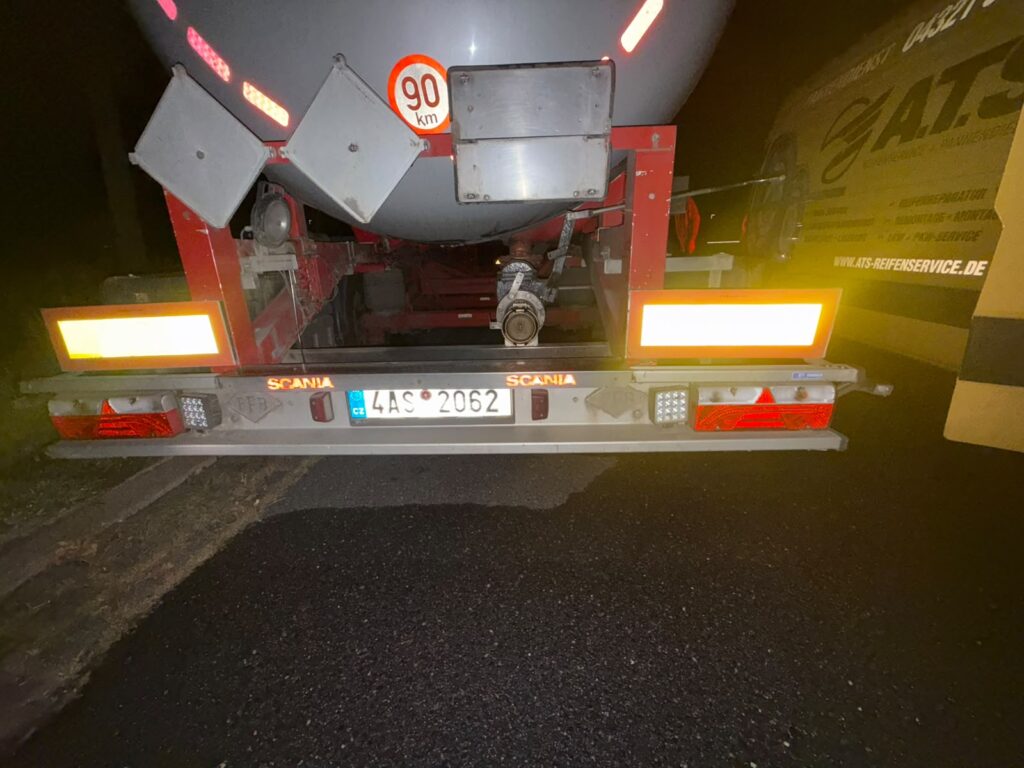
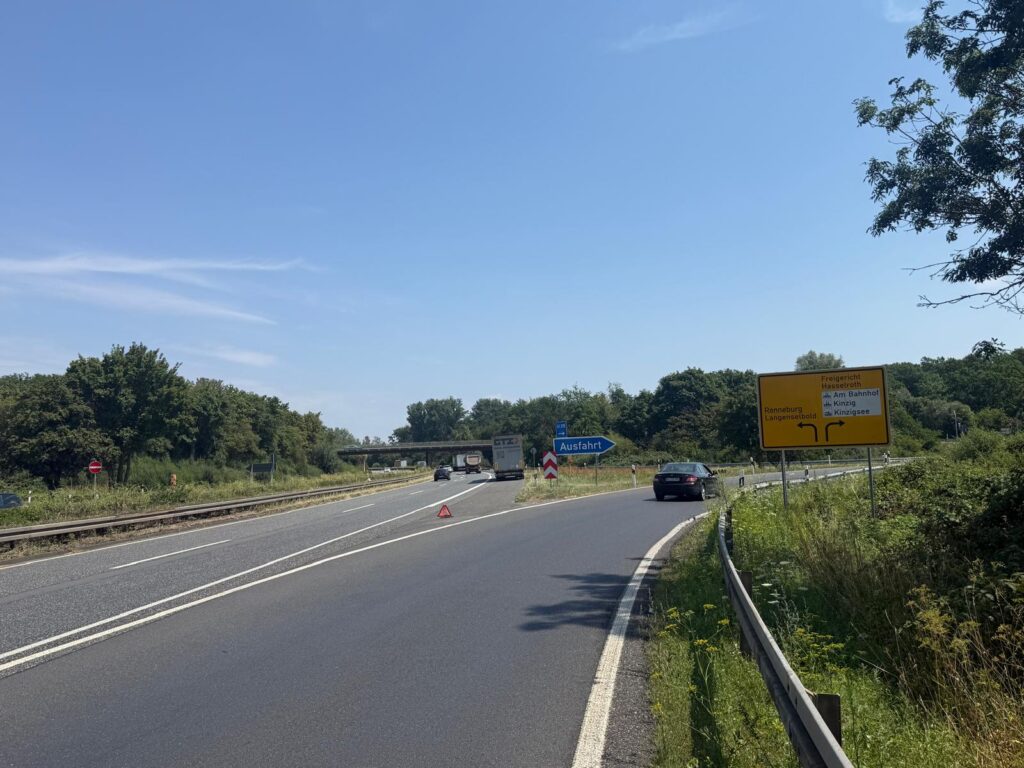
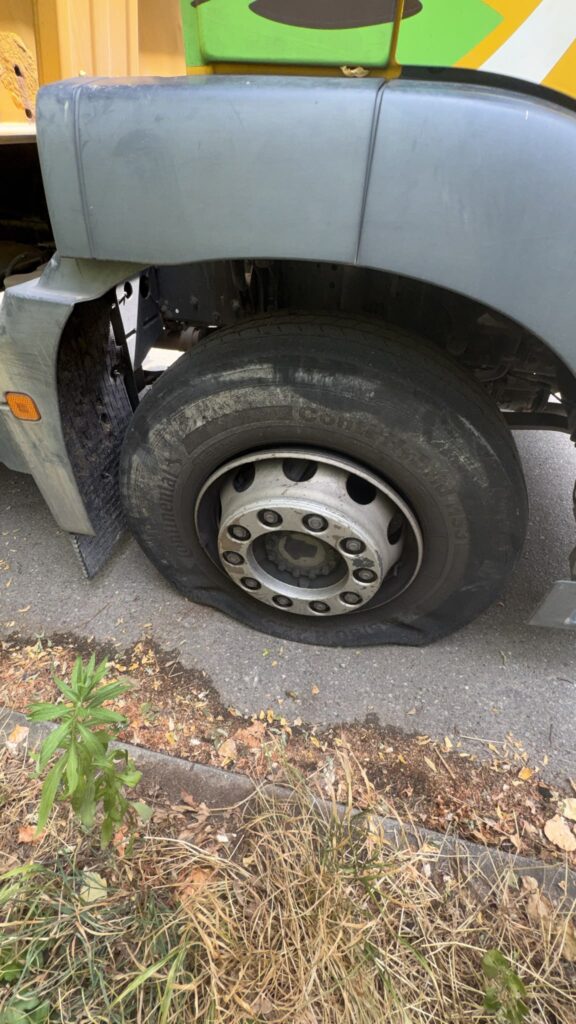
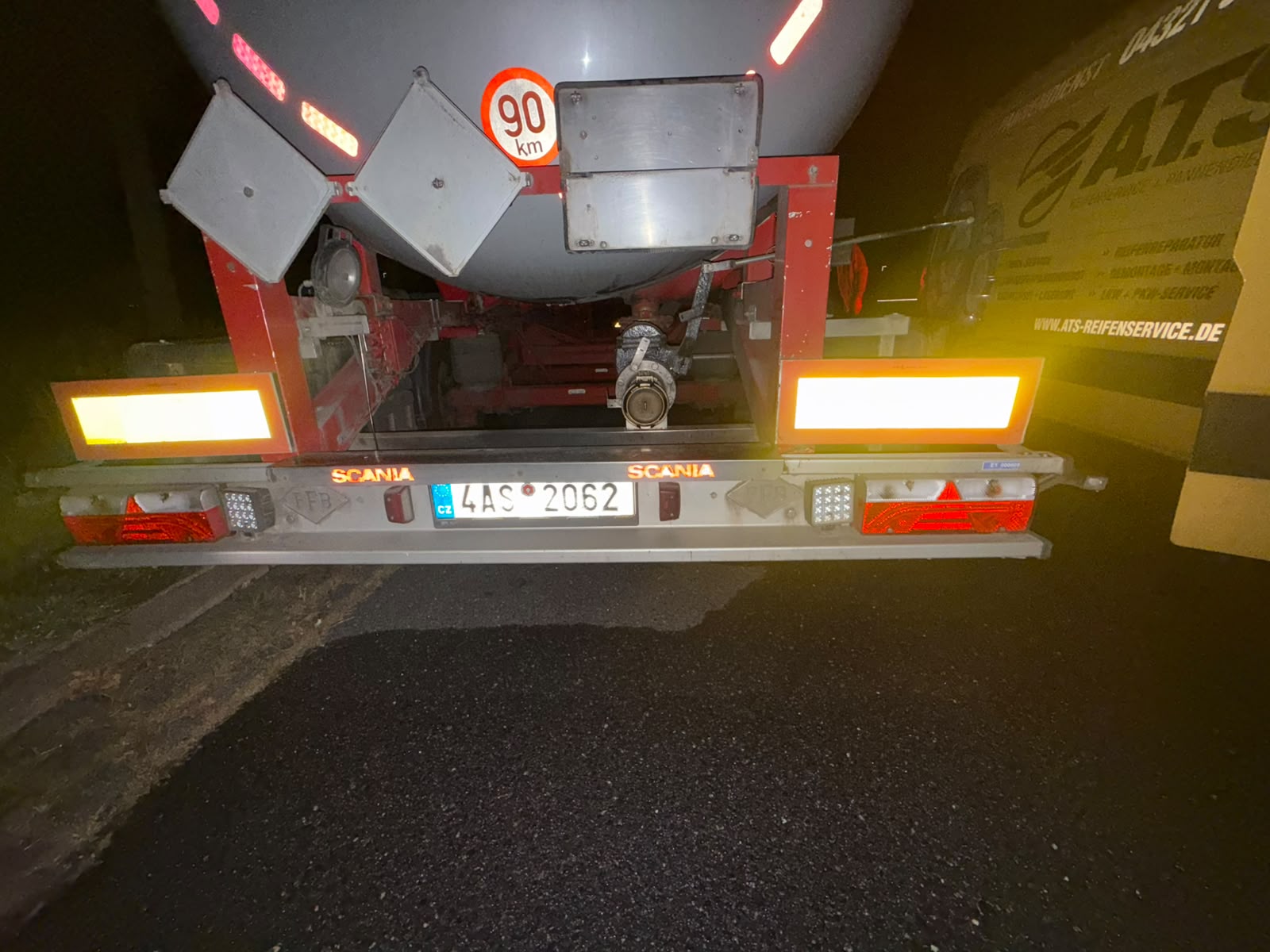
A blown tyre just before two in the morning is a different job from the same failure at three in the afternoon. On the motorway it is dark, most tyre shops are shut, and the driver is standing alone on the hard shoulder while traffic streams past at 120 km/h. That is exactly what happened during the night of 14 August on the A61 near Koblenz, heading towards Cologne: a semi-truck lost a tyre on the drive axle in the middle of the night, far from the nearest open tyre depot.
Night-time truck tyre service is not simply daytime work stretched a few hours later. It is its own discipline, with different risks, different logistics, different pricing and different demands on kit and experience. A driver stranded on the motorway after dark needs a partner who understands exactly that, not just someone with a toolbox in the boot.
This report walks through how such a night callout actually unfolds, from the first phone call to the finished wheel change, with every time and every cost laid out plainly.
The emergency: A61 near Koblenz, deep night
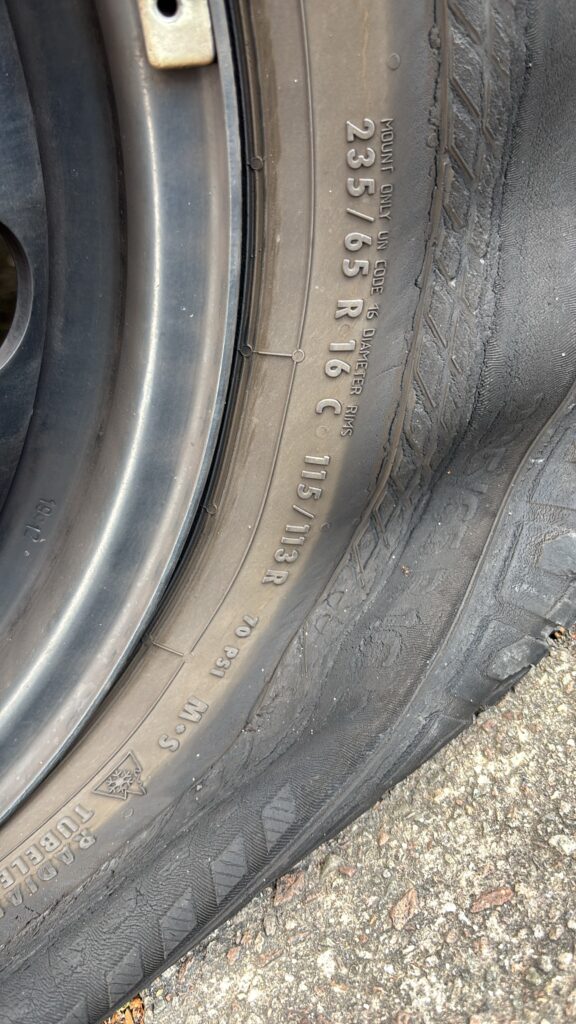
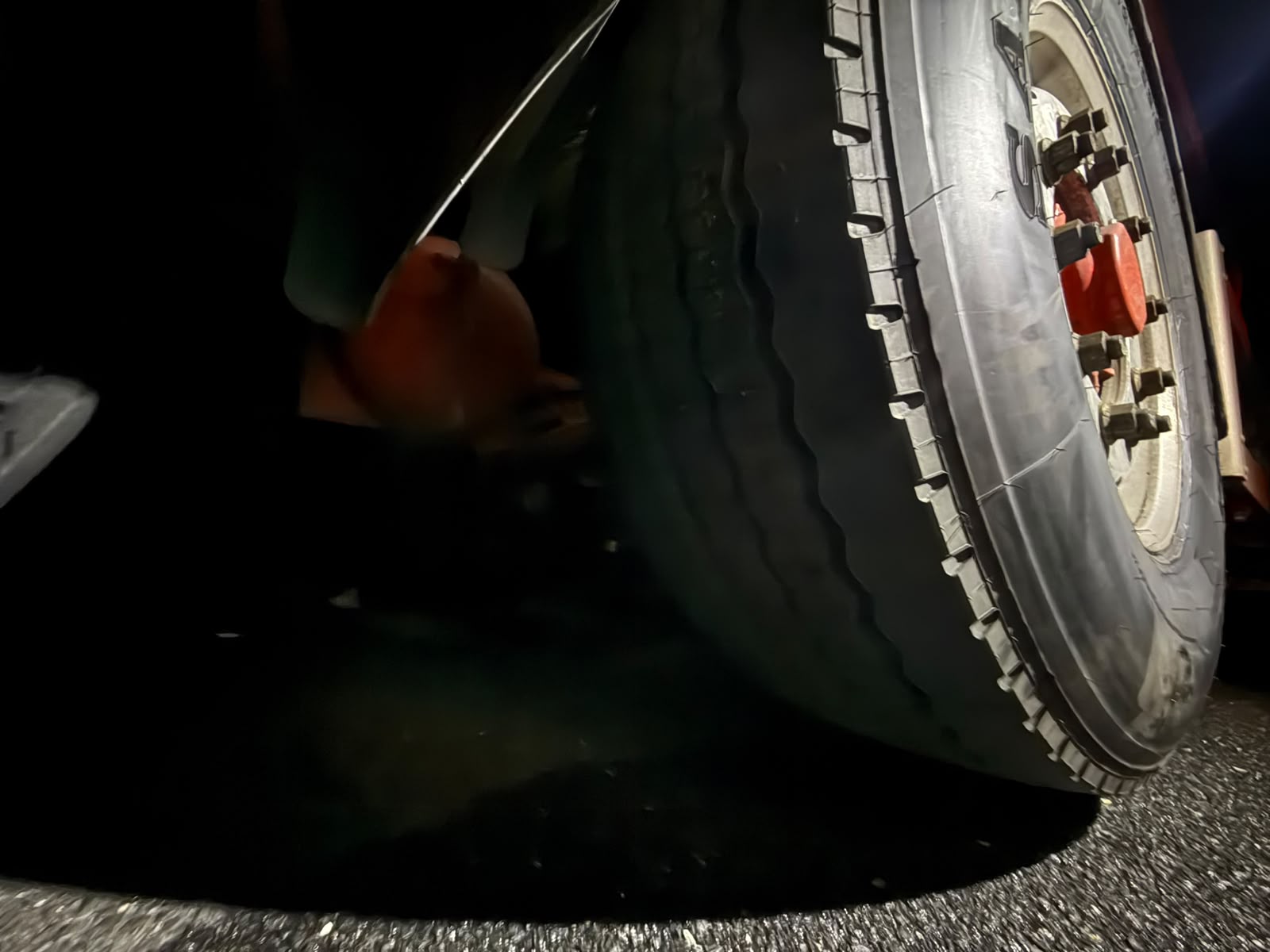
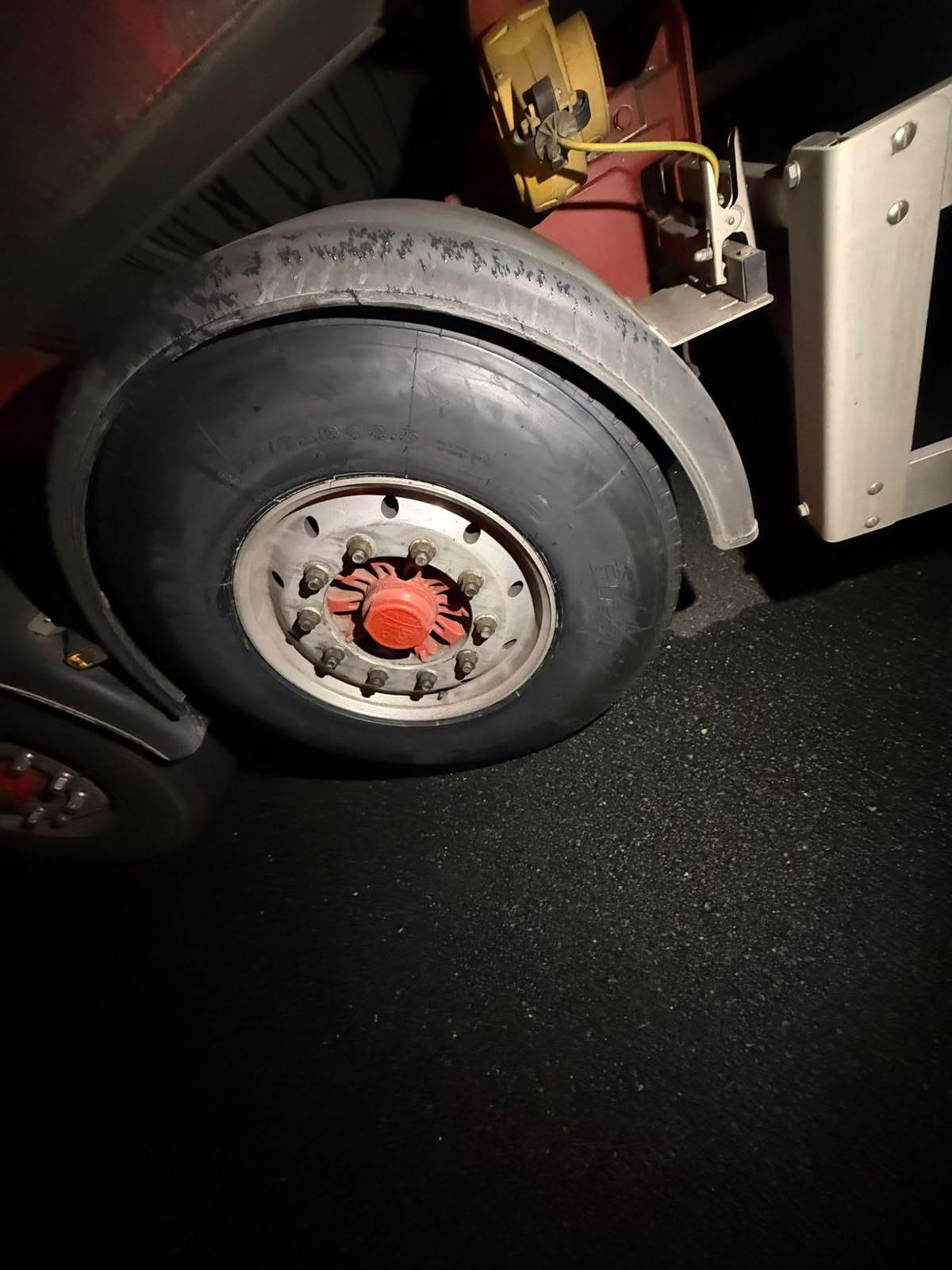
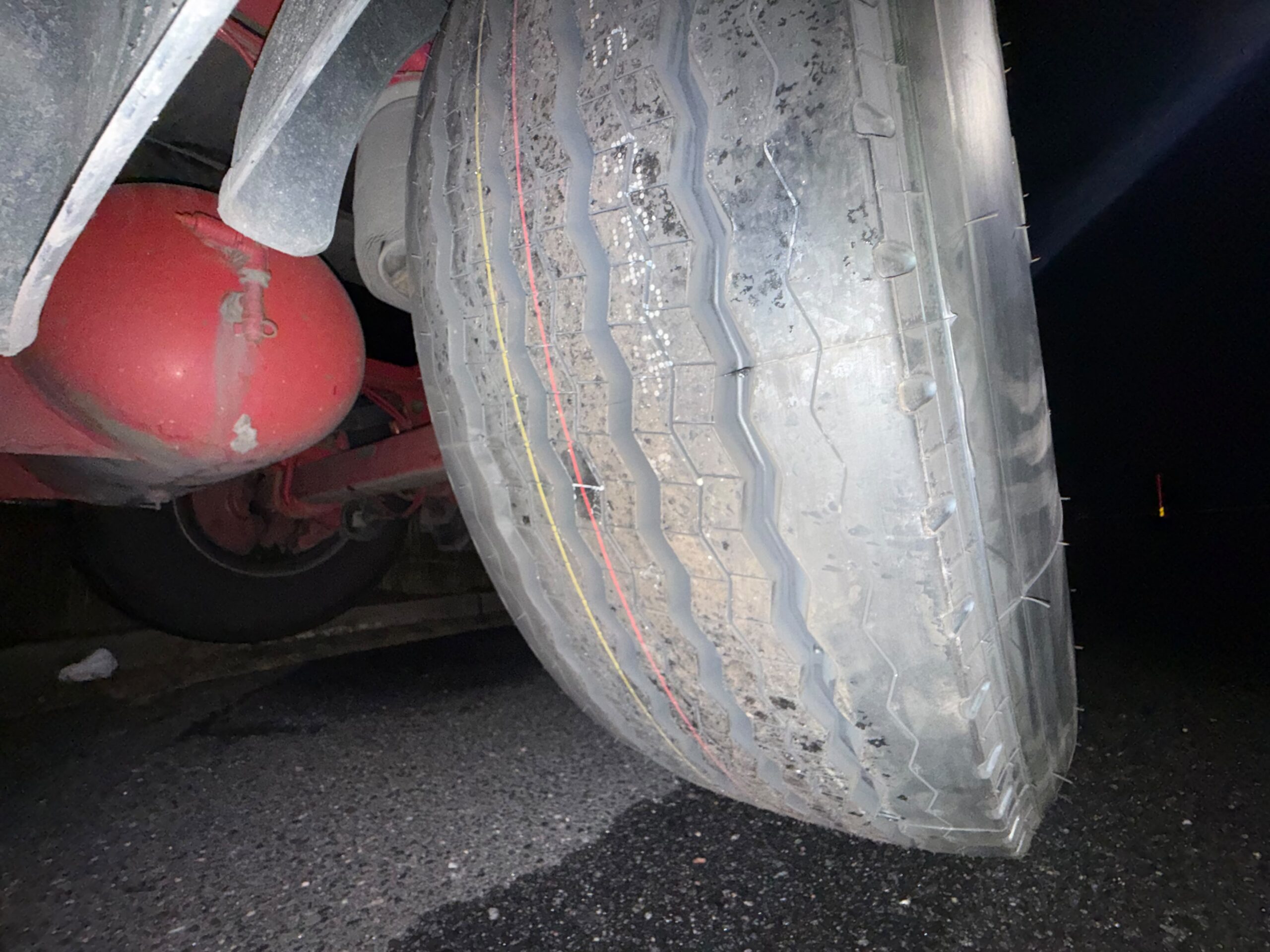
The lorry was heading towards Cologne when, at around 01:35, a loud bang came from the rear axle. A tyre in size 295/80 R22.5 on the drive axle had blown, the carcass partly shredded, rubber scattered across the lane. The driver managed to steer the vehicle onto the hard shoulder just before a gradient, at a spot with no street lighting at all.
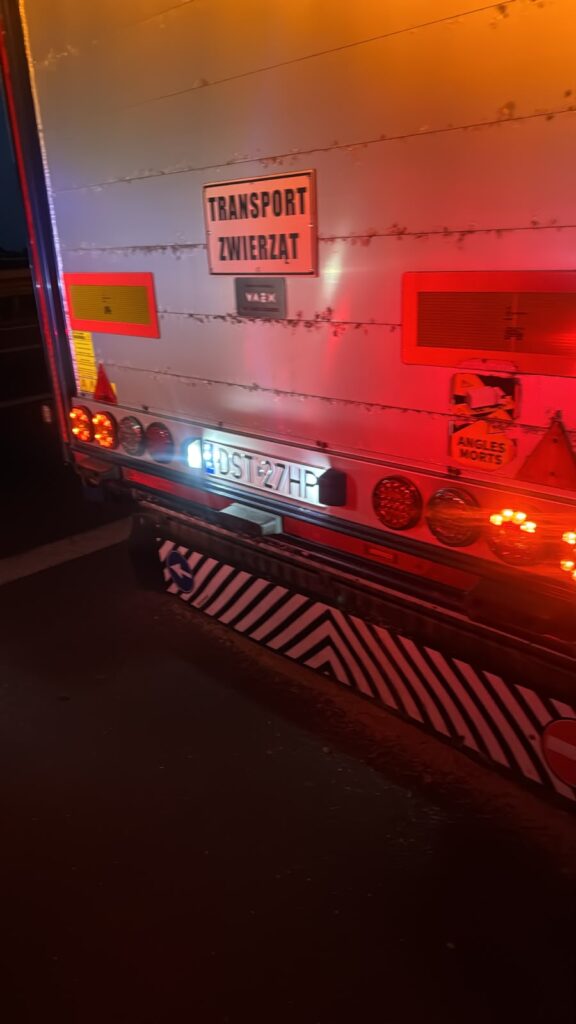
At that hour the A61 near Koblenz is far from empty. Freight traffic runs around the clock, and a stationary semi-truck with limited visibility is a genuine hazard, both for a driver who has to step out of the cab and for the vehicles closing in behind. Without a warning triangle placed far enough back and a hi-vis vest on, every minute on the hard shoulder gets more dangerous.
295/80 R22.5 is one of the standard sizes for drive axles on tractor units, built to run at roughly 8.5 to 9.5 bar and carry heavy axle loads. When a tyre like that fails under a loaded trailer, the neighbouring tyre on the same twin-mounted axle instantly takes more strain, and a damaged rim edge or a knocked wheel hub is not unusual. Looking at the tyre from a distance is not enough here; it takes a proper on-site inspection.
How the help was organised
Our dispatch desk runs 24 hours a day, seven days a week, and it is precisely at night that this matters most. A driver from abroad calling a German motorway hotline at 01:38 in the morning often does not have the patience, or the language, to sit through a queue or a callback system. With us, someone picks up immediately who speaks German, English, Polish and Russian.
The dispatch sequence:
- Take the call, pin down the exact location on the A61 and the direction of travel, using motorway signage or GPS.
- Confirm tyre size and axle position: 295/80 R22.5, drive axle, so the right replacement wheel can be identified in stock or in a partner vehicle straight away.
- Give the driver safety instructions: put on the hi-vis vest, place the warning triangle well back, and only leave the cab on the side away from live traffic.
- Activate a suitable partner workshop in the Koblenz area that is actually operating at night — this is the real bottleneck for night calls, since not every tyre service sends a van out after 10pm.
- Send the technician with the right equipment and tyre, and give the driver a realistic estimated arrival time.
That fourth step is exactly what separates a night tyre service from a daytime one. During the day, most towns have several open workshops to choose from. At night, only a handful of operators will actually drive out at all, which is why a driver needs a network that is known and reachable, not a search engine result at two in the morning.
On site: why night work on the motorway is not routine
A wheel change on a tractor unit is demanding enough in daylight. After dark, several extra factors come into play that cannot be ignored.
First, visibility. Without enough lighting, a driver doing 120 km/h will only see a technician working at the rear of a vehicle at the very last moment. Our partner crew always sets up extra warning lights and reflective kit before any tool comes out, and that takes time — time that a daytime job doesn’t need, but a night job cannot skip.
Second, fatigue. A driver woken at 01:35, or already deep into a long overnight run, reacts more slowly, is more stressed, and is more likely to make a mistake if he tries to sort the wheel himself. That is exactly why we advise against attempting a self-repair at night, even with a spare wheel on board.
Third, driving and rest time rules. For the driver, a night-time tyre blowout is not just a mechanical problem, it is a tachograph problem. If the vehicle sits until a workshop opens in the morning because no night service could be reached, the mandatory rest period gets pushed back or interrupted, and the whole day’s schedule falls apart. A haulier who skips a fast night callout risks not only downtime, but a breach of the driving-time rules once the driver is under pressure to catch up afterwards.
Fourth, the tyre pressure itself. At 8.5 to 9.5 bar running pressure, a blowout is not a small event; the force released can damage bodywork and injure people standing even at what looks like a safe distance. A technician who knows how to approach a damaged drive-axle wheel checks the rim and the wheel studs before touching the removal at all.
The wheel change, step by step
Step 1 — Initial inspection. The technician assesses the damage: state of the carcass, whether the rim is bent, whether the wheel studs or hub have been affected. In this case the rim was undamaged, so a straightforward tyre swap was possible.
Step 2 — Securing the scene. Warning triangle, hi-vis vest, extra warning lights. On the dark hard shoulder of the A61 this step is not optional, it is the foundation for everything that follows.
Step 3 — Removal. Vehicle chocked, wheel jacked, studs loosened, damaged tyre taken off the rim or the whole wheel swapped, depending on condition.
Step 4 — Fitting the replacement. New tyre, specification 295/80 R22.5, mounted, balanced, and fitted onto the drive axle.
Step 5 — Final check. Wheel studs tightened in a star pattern to the correct torque, air pressure checked and set, quick visual check of the neighbouring tyre on the same axle.
Only after this final step does the technician clear the truck to move on.
The full timeline
| Time | Phase | Action |
|---|---|---|
| 01:35 | Incident | Drive-axle tyre blows, driver steers onto the hard shoulder |
| 01:38 | Call | Driver reaches the 24/7 dispatch desk |
| 01:38–01:53 | Dispatch | Location confirmed, tyre size checked, partner workshop near Koblenz activated |
| 01:53 | Departure | Technician sets off with a replacement 295/80 R22.5 tyre |
| 02:35 | Arrival | Technician reaches the A61 near Koblenz |
| 02:35–02:45 | Securing | Warning triangle, hi-vis vest, extra warning lights set up |
| 02:45–03:05 | Removal/fitting | Damaged wheel removed, new tyre fitted |
| 03:05–03:25 | Finishing | Torque checked in a star pattern, air pressure verified |
| 03:28 | Done | Semi-truck back on the road towards Cologne |
Total time from call to departure: 1 hour 50 minutes. In daylight the same job would often be 15 to 20 minutes faster; the extra time at night comes mainly from finding an available partner, since fewer workshops operate after dark, and from the additional work of securing the site.
What the callout cost
| Item | Price (EUR, net) |
|---|---|
| Callout (night service) | 280 |
| Labour (approx. 50 min) | 140 |
| Tyre 295/80 R22.5 (drive axle) | 560 |
| Disposal of old tyre | 20 |
| Night surcharge (22:00–06:00) | 90 |
| Total | 1,090 |
All prices are net, plus VAT. The night surcharge is listed as its own line because it is a real cost: higher standby staffing, extra safety equipment, and often a longer drive because fewer technicians are on shift at once.
For comparison, a semi-truck sitting on the hard shoulder until a workshop opens in the morning racks up roughly 800 to 1,200 euros a day in downtime, plus the driver’s lost night’s rest and a schedule thrown off by the driving-time rules. Against that, a night callout costing roughly 1,090 euros that puts the truck back on the road within two hours is the clearly cheaper option.
Why this needs a professional, not the driver
A wheel change on a tractor unit is fundamentally different from swapping a car tyre. The risks of a DIY attempt:
- Running pressure of up to 9.5 bar can cause serious injury if handled incorrectly.
- Without a torque wrench, wheel studs end up either too loose or over-tightened — both eventually cause damage, and in the worst case a wheel can come off while driving.
- Working on a hard shoulder without proper scene protection carries a real risk of being struck by passing traffic.
- A damaged rim edge is easy for an untrained eye to miss and often causes another pressure loss soon after.
- Missing equipment, such as a jack rated for a tractor unit and the right tyre tools, usually rules out a DIY fix anyway.
Typical night callouts across Germany
A 24/7 tyre service sees similar scenarios recur at night: a drive-axle blowout on a semi-truck, slow pressure loss on a trailer on a quiet country road, a van with a burst tyre just short of a services, or an articulated lorry whose driver only spots the damaged sidewall during a stop at a motorway rest area. The A61, the A48 and other Rhineland-Palatinate motorways see this often because of the heavy night-time transit traffic heading towards the Benelux countries and France.
Beyond straightforward blowouts, night crews regularly deal with wheel studs weakened by an earlier repair, a tyre slashed by debris on a roadworks lane, or a slow puncture caused by a foreign object that only causes total failure kilometres further on. On narrower motorway sections with a tight hard shoulder, of which the A61 has several stretches, securing the scene takes noticeably longer, because the technician has very little room to stay clear of moving traffic.
Equipment and preparation for a night callout
A partner workshop that reliably turns out at night needs more than what sits in a daytime van: battery-powered LED floodlights, reflective cones on top of the statutory warning triangle, a hydraulic jack rated for a tractor unit, and a calibrated torque wrench that reaches well into three-digit newton-metre readings. Just as important is a second technician, or at least a second vehicle with a beacon parked behind the scene as extra protection — something that can often be skipped in daylight but never at night on a motorway like the A61.
Prevention for drivers and fleets
Reducing night-time breakdowns starts with regular checks of tread depth (the legal minimum for HGV tyres is 1.6 mm, though a much higher margin is sensible in practice), checking tyre pressure before any long overnight run, and not ignoring visible damage to the carcass even if the tyre still holds air. Fleets benefit from fixed maintenance intervals and a saved emergency number that a driver does not have to search for at two in the morning.
Tyres, brands and fleet service
Drive-axle tyres for tractor units in Germany are dominated by brands such as Continental, Michelin, Goodyear and Bridgestone. Size 295/80 R22.5 is available from all of them in several tread patterns, from pure motorway profiles to tougher mixed-service compounds. For fleets, a maintenance contract combining tread-depth checks, pressure monitoring and rotation cuts the odds of a night-time blowout significantly, though it never replaces a 24/7 emergency service for the exceptional case.
FAQ
How much does a night-time truck tyre change cost on the motorway?
For a drive-axle tyre in size 295/80 R22.5, the total including night surcharge, callout and labour typically runs between 900 and 1,200 euros net. The exact figure depends on the tyre model, the distance to the nearest partner workshop, and the time of day.
How long does a night-time wheel change take?
From the call to driving off usually takes 1.5 to 3 hours. In this case it was 1 hour 50 minutes, slightly faster than average because a partner workshop near Koblenz was available immediately.
Who pays for the tyre change?
Usually the vehicle owner or the haulage company, often through fleet insurance or an assistance package. We issue an itemised invoice so it can be passed on without any hassle.
Why is a night surcharge justified?
At night far fewer tyre services are operating, drive times to the scene are often longer, and securing the site takes more time and equipment because of the dark. The surcharge covers that real additional cost.
Can a driver fit the replacement wheel themselves?
Technically possible, but not advisable given the high tyre pressure, the torque wrench required, and the lack of scene protection on a motorway. The risk of a follow-on failure or injury usually outweighs the time saved.
What happens to my driving hours if I break down at night?
An unplanned stop can count against driving time but does not automatically satisfy the mandatory rest period. A fast night callout helps keep the original schedule as intact as possible.
Is a mobile tyre service at night as thorough as during the day?
Yes, the technical steps are identical: inspection, securing the scene, removal, fitting, torque check. The difference lies in the extra time needed for lighting and scene protection, and in the smaller number of partner workshops available, not in the quality of the work itself.
One thing that often gets overlooked with night callouts is communication during the wait. Between the call and the technician’s arrival, 57 minutes passed on this job — time during which a driver sits alone in a darkened cab wondering whether anyone is actually coming. Our dispatch team checks in briefly during that window, confirms status and gives a realistic arrival estimate rather than leaving the driver guessing. For a driver from abroad who does not know the area and is stranded on an unfamiliar motorway at night, that small habit makes a real difference.
Summary
- Tyre specification: 295/80 R22.5, drive axle
- Location: A61 near Koblenz, direction Cologne
- Response time (call to arrival): 57 minutes
- Total duration (call to departure): 1 hour 50 minutes
- Cost: 1,090 euros net
- Secondary damage: none, rim undamaged, no further downtime
Get help now
A blown tyre in the middle of the night is no reason to wait for morning. Our dispatch desk is reachable around the clock, speaks several languages, and knows partner workshops across Germany that go out at night too.
Call: +49 160 5753826 · www.lkwhelp24.com · Available 24/7, anywhere in Germany.
Keywords: truck tyre service near me | night truck tyre change | tyre blowout motorway A61 Koblenz | semi-truck tyre service 295/80 R22.5 | 24/7 truck breakdown assistance | drive-axle tyre blowout | night truck tyre service Germany
Truck Service in Your Region
Our workshop and roadside service network also covers Andernach, Anklam and Ansbach.
Related articles
- Truck Tyre Service Near Me: How LKWHelp24 Fixed a 4-Axle Tipper’s Drive-Axle Tyre in 1 Hour 47 Minutes on the A48 near Koblenz
- Truck Tyre Service Near Me: How LKWHelp24 Replaced a Blown Drive-Axle Tyre in 1 Hour 40 Minutes on the A1 near Bremen
- Truck Tyre Service Near Me: How LKWHelp24 Replaced a Shredded Drive-Axle Tyre in Under Two Hours on the A9 near Dessau
- Truck Tyre Emergency Service – 24h Roadside Assistance Across Germany for Foreign Drivers
- Mobile Truck Tire Service in Germany 24/7 – We Arrived and Helped