Skip to content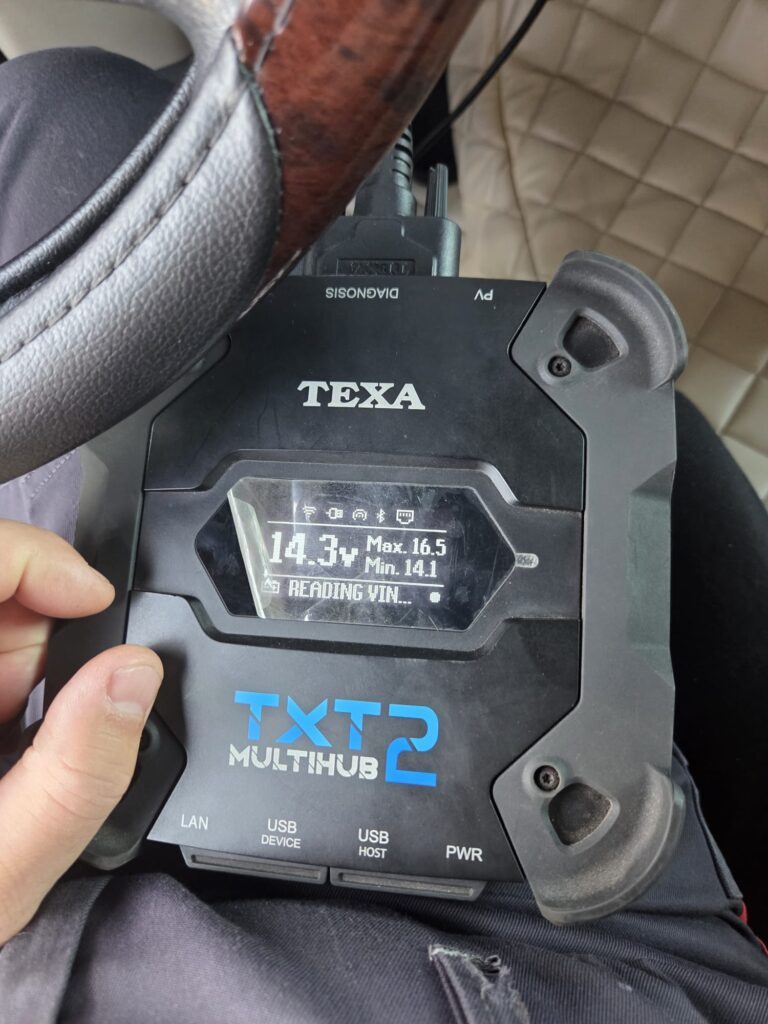
TL;DR: On 7 August, a loaded Scania articulated lorry came to a stop on the B65 near Bückeburg (Lower Saxony) on a long uphill stretch — the clutch had overheated, and the diagnostic tool confirmed an active “clutch overheat” fault code. From the first call to hand-over at the workshop, the job took 3 hours 20 minutes, at a total cost of €1,410 net. Continuing the journey was never an option: the clutch plate had already lost its friction properties for good.
An overheated clutch pack is not a minor fault you can nurse along by driving gently. Once the driver smells burning in the cab and the revs climb without the lorry gaining speed, the friction lining is already damaged. Every extra second of slip pushes the temperature higher and risks dragging the flywheel and pressure plate into the damage as well.
This report covers a real call-out on a Lower Saxon B-road — not a motorway — on a long gradient of exactly the kind that catches out lorry drivers in the hill country between the Weser and the Wiehen Hills. It explains why clutches overheat there in particular, how a driver spots the warning signs, what to do in the first few minutes, and why, in almost every case, the decision comes down to the workshop with a lift rather than a spanner on the verge.
What happened on the B65 near Bückeburg?
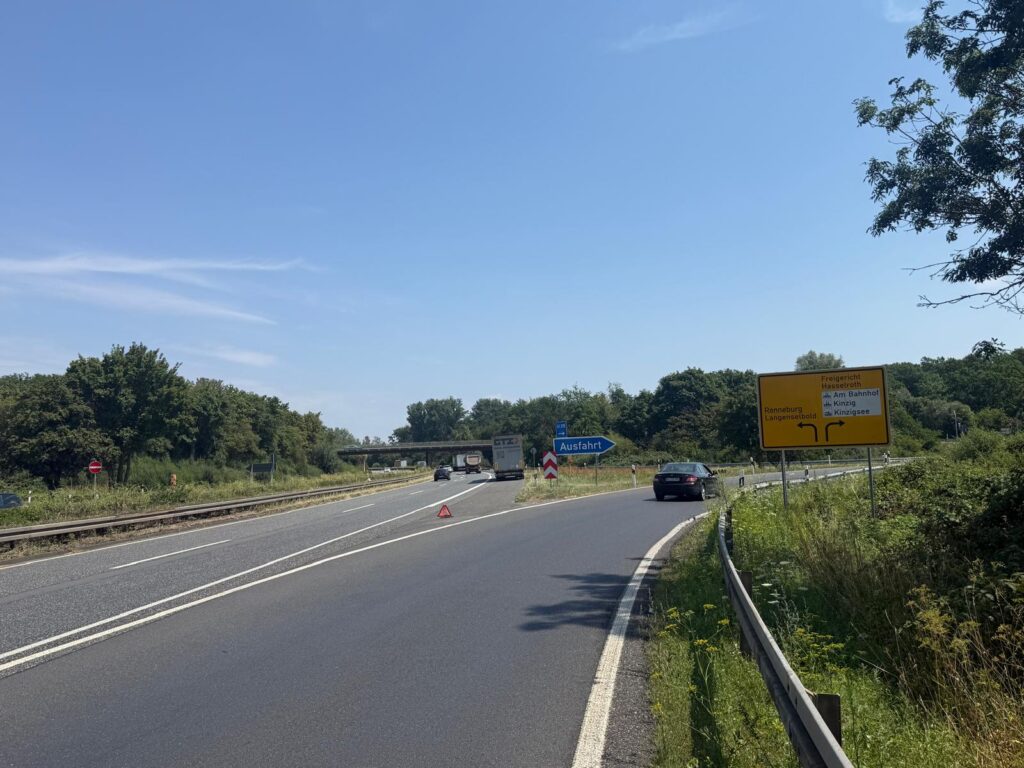
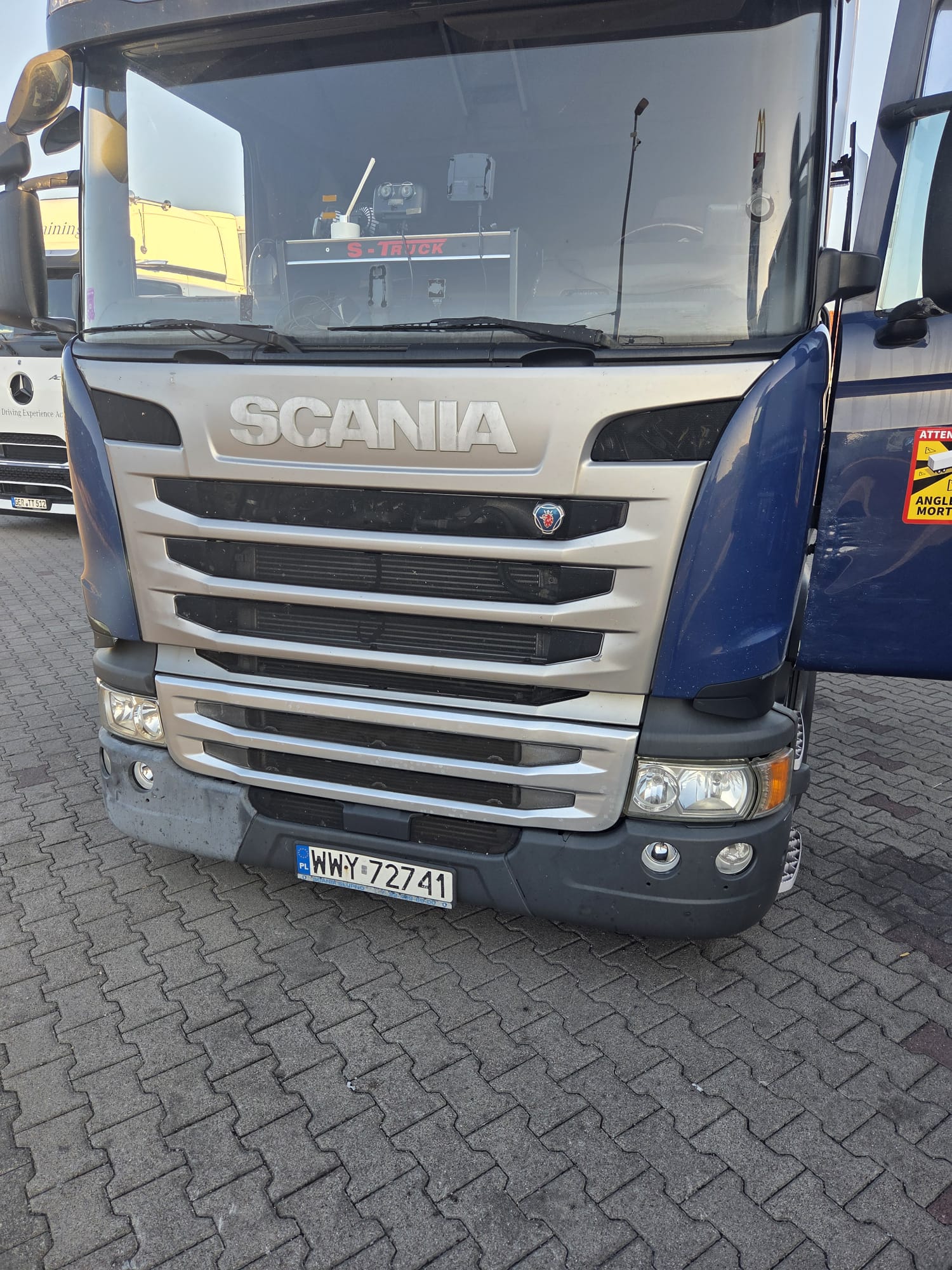
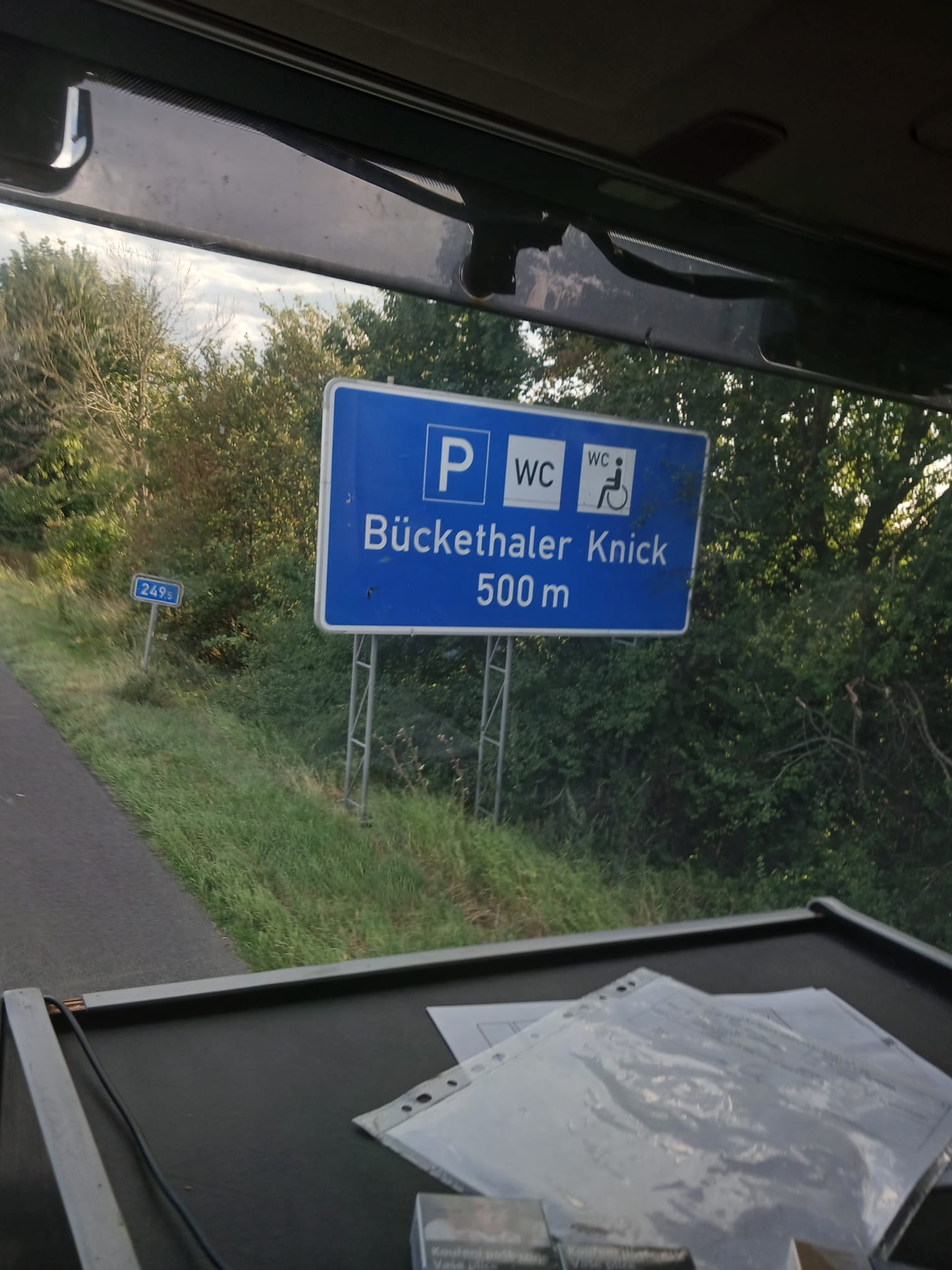
A loaded Scania tractor unit with a laden trailer stopped during the day on 7 August on the B65 at the Bückethaler Knick lay-by near Bückeburg, Lower Saxony, on a long uphill section. The B65 is not a motorway but a winding B-road with noticeable gradients through the foothills of the Wiehen Hills — precisely the kind of terrain that puts the most strain on a clutch.
The driver first noticed a sharp, acrid smell from the bellhousing area, then felt the unit losing pulling power even as the engine revs climbed. Shortly afterwards the lorry could no longer manage the gradient under its own power. He secured the vehicle as best he could on the narrow B-road and called the 24/7 breakdown number.
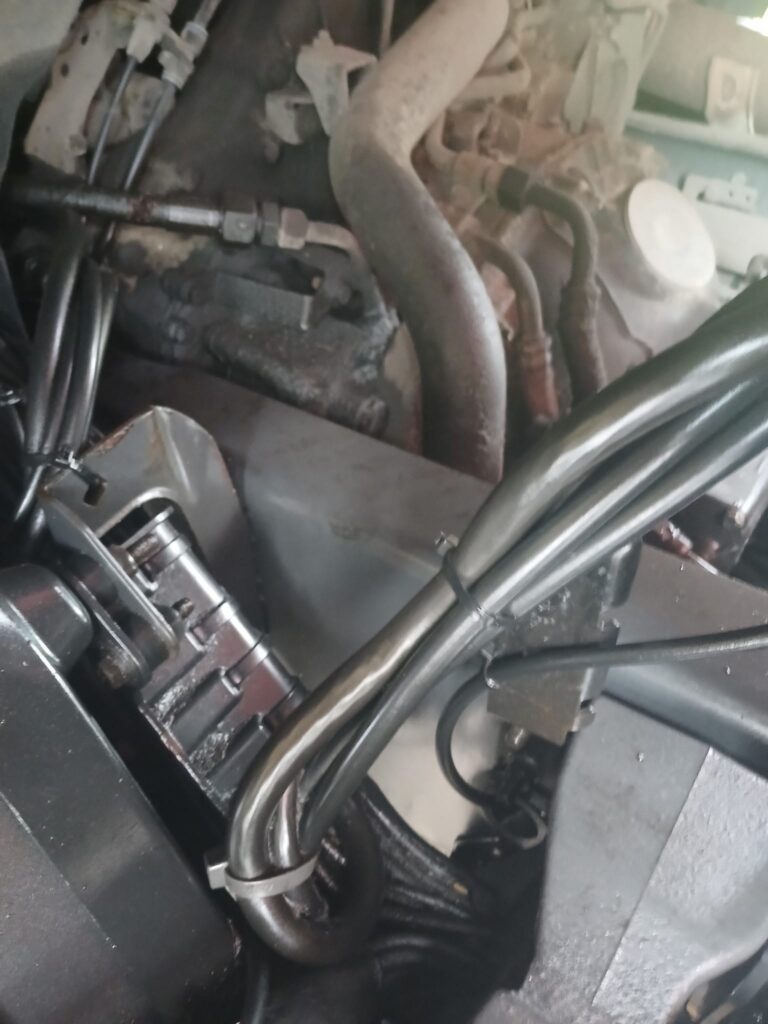
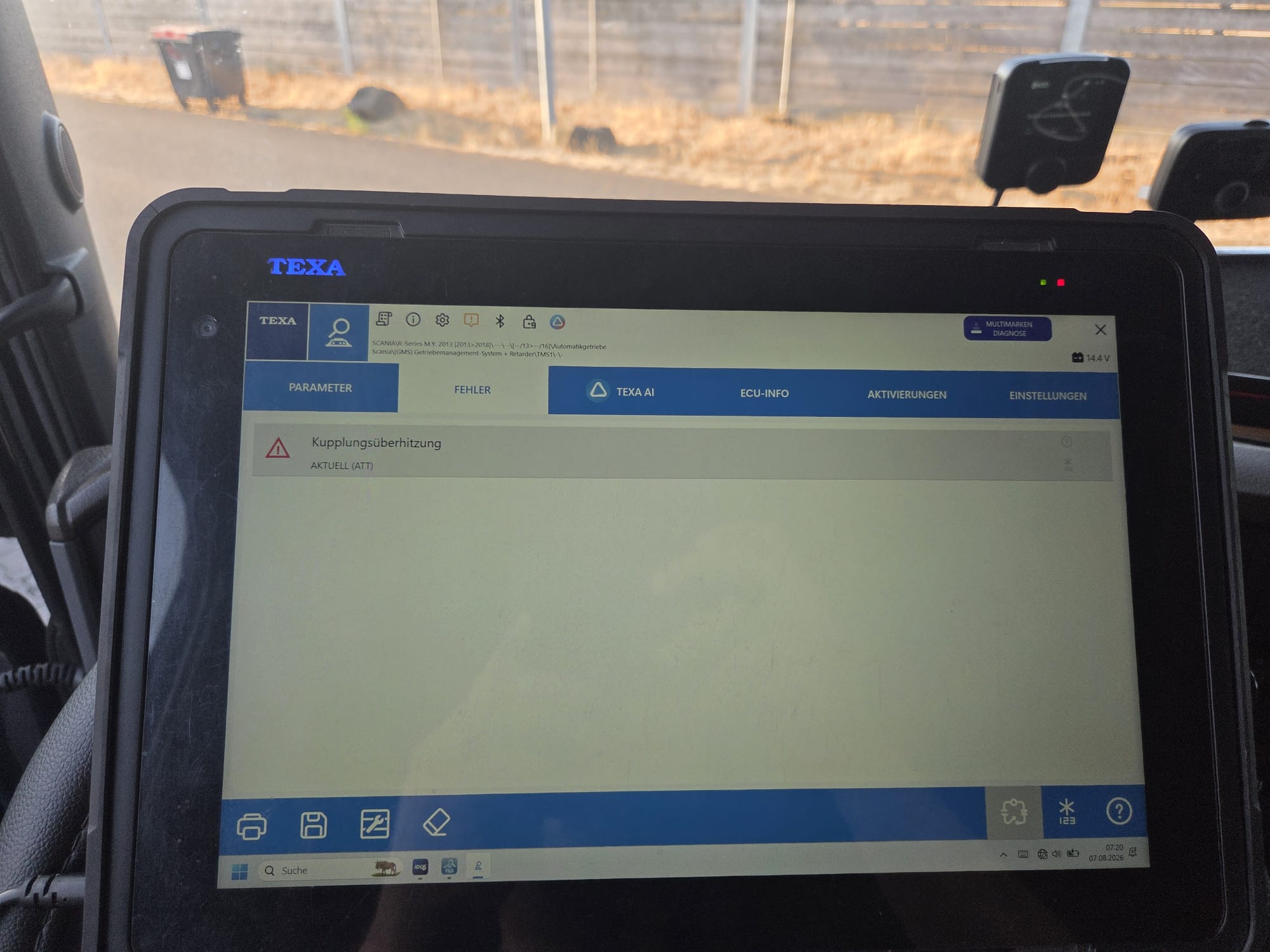
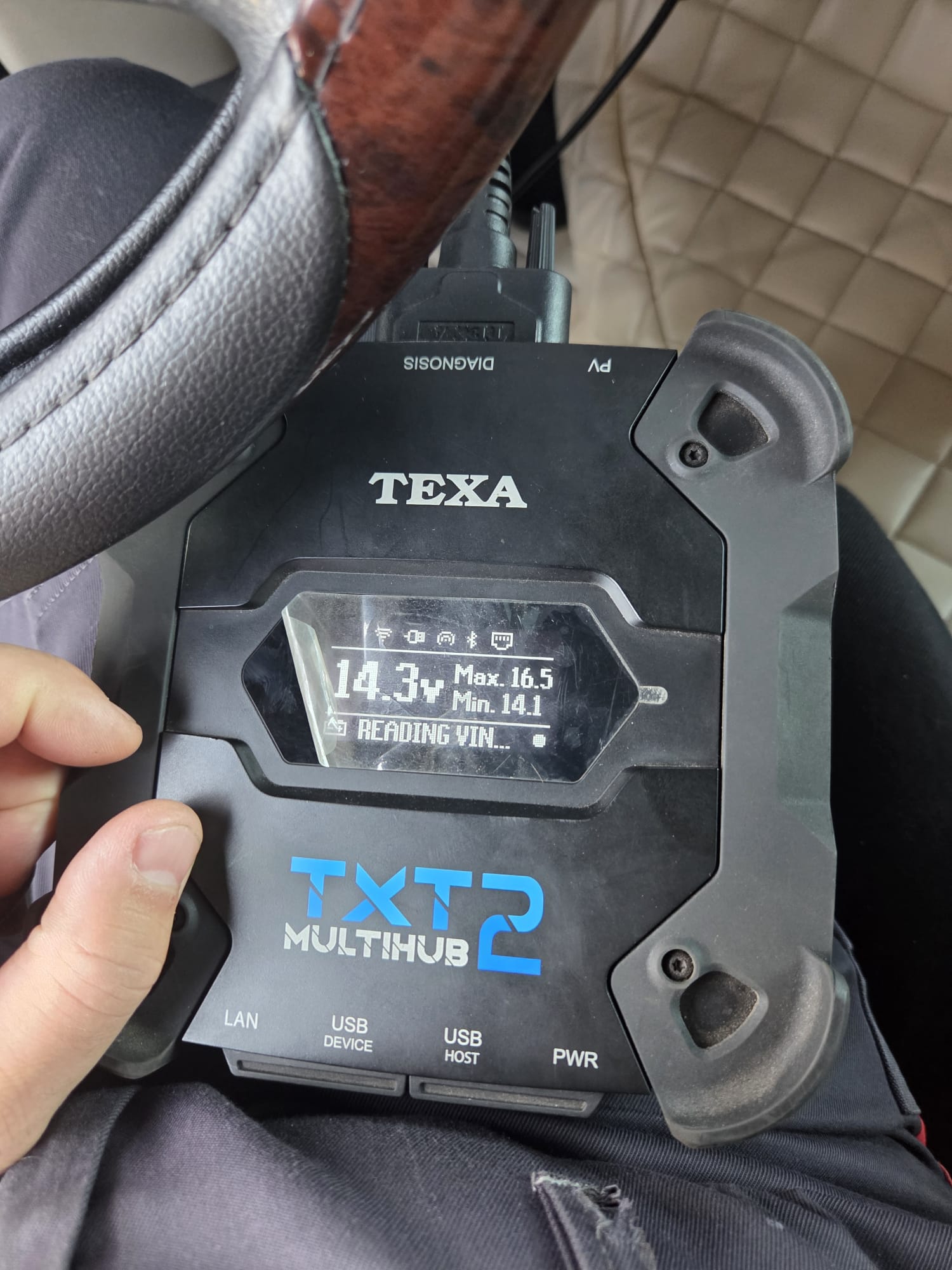
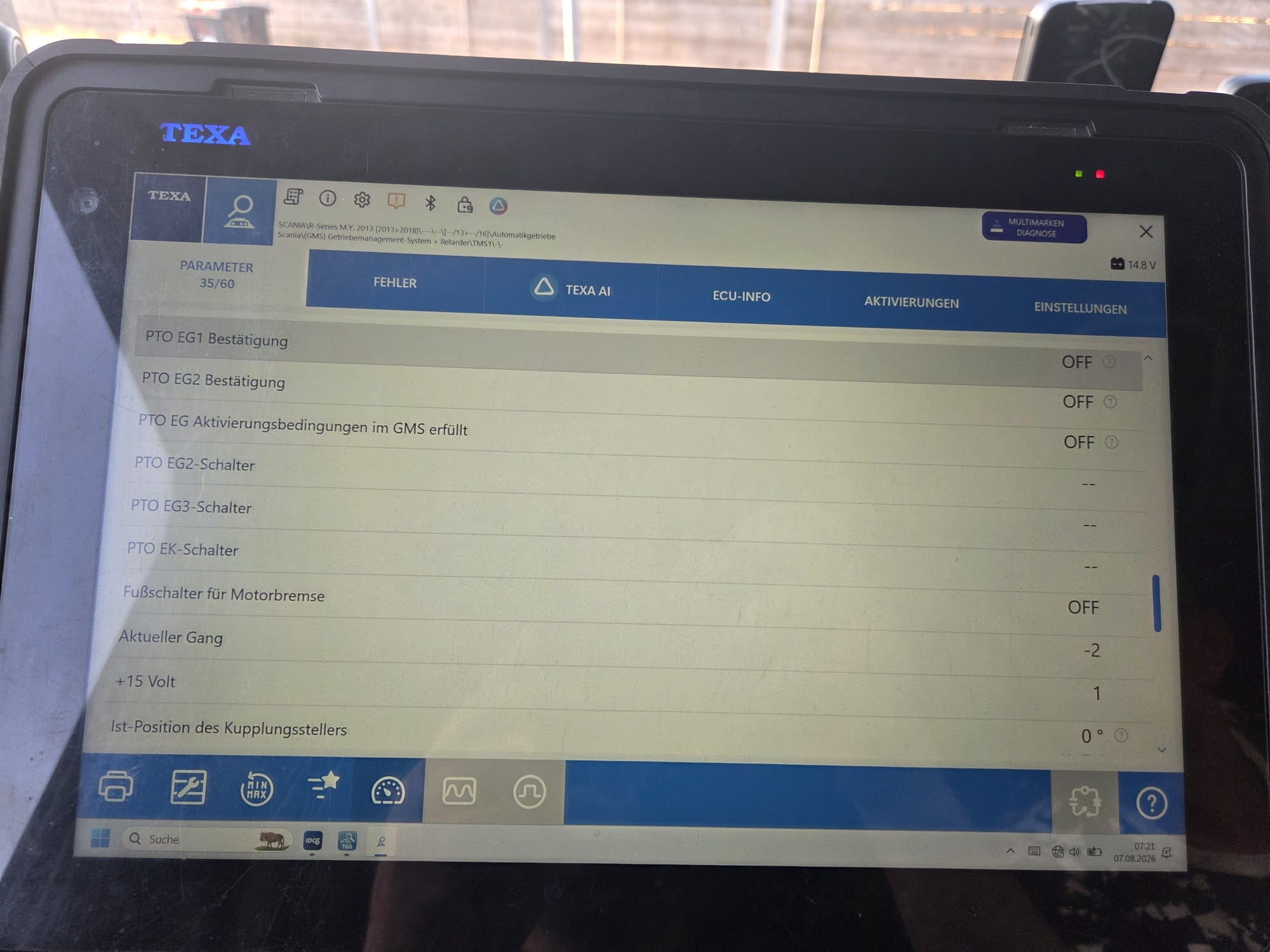
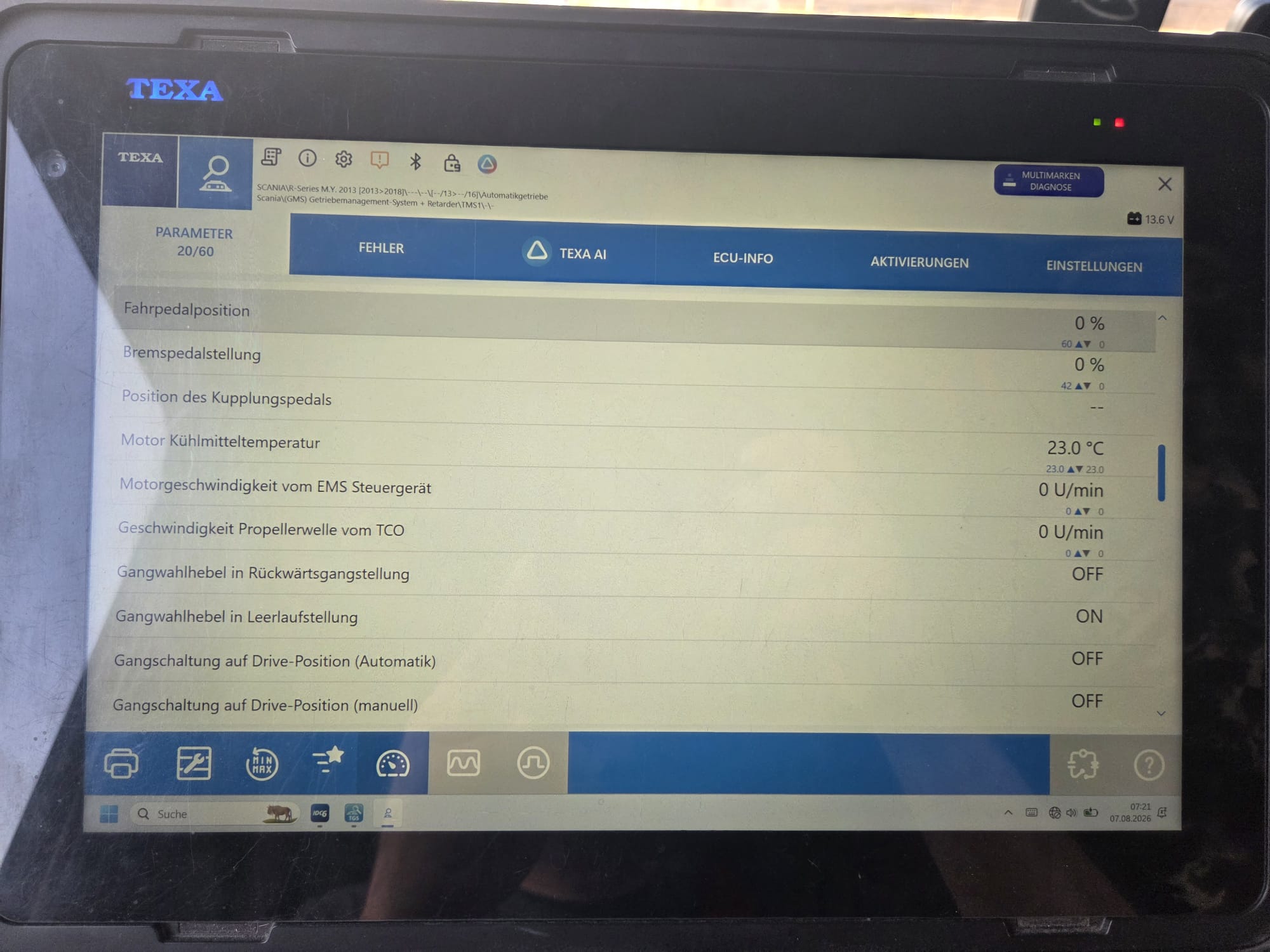
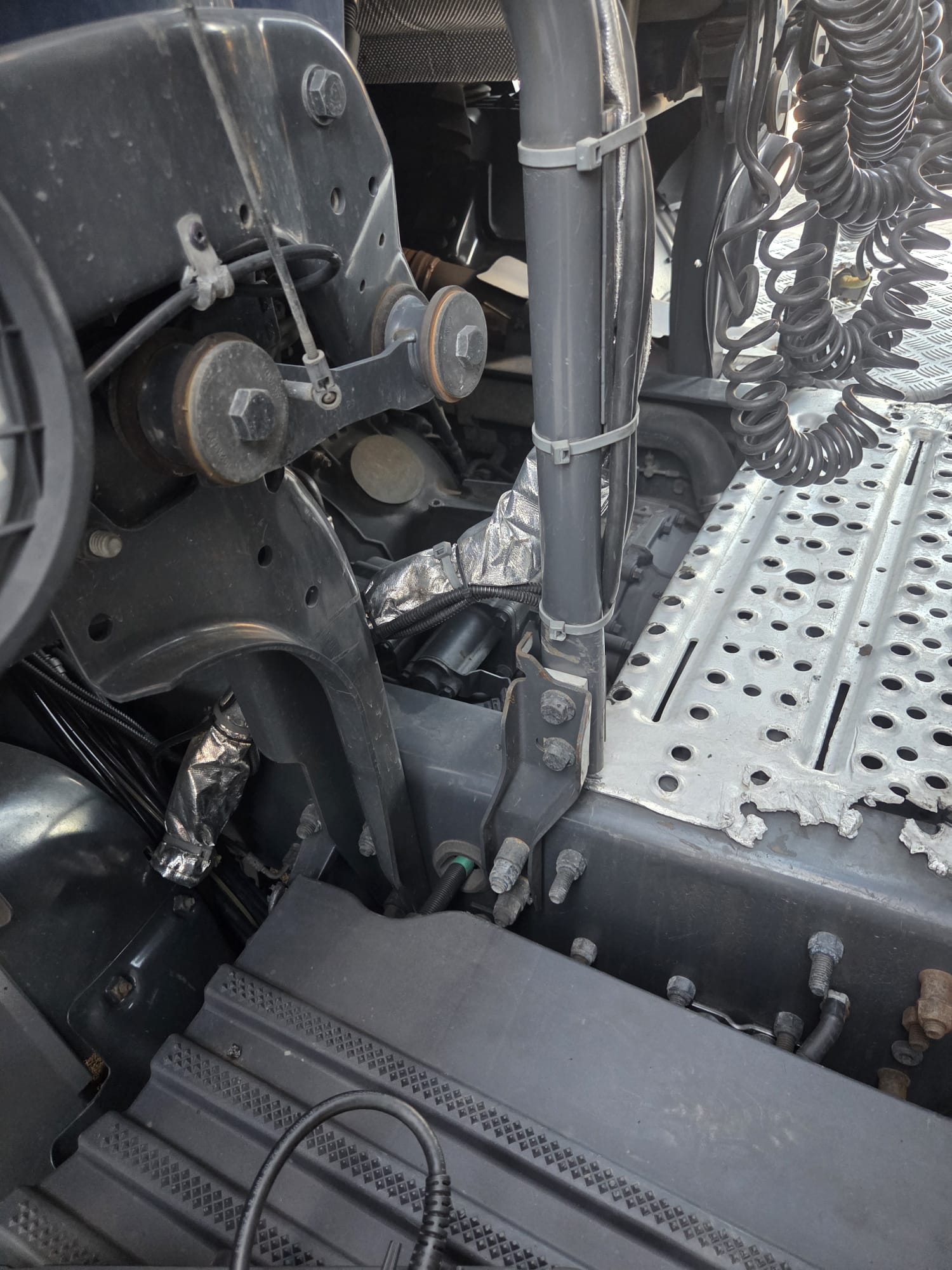
When the technician arrived, a TEXA diagnostic tool confirmed an active “clutch overheat” fault code — a current, live fault rather than a historic log entry. The gearbox parameters (Scania GMS/retarder) were also read out to rule out any knock-on damage to the transmission. The registration document confirmed the tractor’s registration; for data-protection reasons, no plate details or vehicle papers are reproduced here.
Why does a clutch overheat specifically on a hill?
A clutch overheats on gradients because the driver has to tolerate slip for an extended period while pulling away and holding the loaded combination on the incline — and that slip is exactly what generates the friction heat that destroys the lining. At a gross weight of 40 tonnes on a long ramp, a single wrong gear choice is enough to ruin the lining in minutes.
Three driving errors account for almost every real-world case. First: pulling away on a hill with too much load and not enough torque, so the clutch drags for minutes instead of engaging cleanly. Second: “feathering” the clutch to hold the lorry during stop-start traffic on a slope, rather than using the brake for that job. Third — and the most likely cause here — driving “on the clutch” in too high a gear, where the engine can’t deliver enough torque and the clutch slips continuously under partial load instead of transmitting full power in a lower gear without slip.
The physics is simple: every second of slip converts kinetic energy into heat that has to be dissipated through the clutch disc. On flat ground, the brief pull-away phase gives that heat time to dissipate. On a long climb like the B65 near Bückeburg, there is no recovery window — the temperature keeps building until the friction lining glazes over and loses its grip.
How does a driver spot an overheating clutch in time?
The most reliable warning sign is a sharp, burning smell in the cab combined with rising engine revs that aren’t matched by any increase in road speed. That pattern — press the accelerator, revs climb, speed stays flat or drops — is the classic signature of a slipping clutch disc.
Other signs include a clutch pedal that starts to feel increasingly “dead” or spongy, drive taking up later and more softly than usual, and on modern lorries, a warning light or plain-text alert on the dashboard. On automated manual gearboxes such as Scania Opticruise, ZF TraXon-based systems, or comparable PowerShift solutions from other manufacturers, the control unit often logs the condition as its own fault code — exactly as confirmed here with the TEXA scanner.
A driver shouldn’t wait to see if things “sort themselves out”. In practice, the condition worsens within minutes, because the heat inside the clutch housing has nowhere to go while the lorry remains under load.
What should you do if the clutch overheats on a hill?
The correct immediate response is not to push on through, but to pull up in a safe spot in a controlled manner and take the load off the clutch. Every additional second of slip makes the damage to the lining worse — once a lining has glazed over, it cannot be “bedded in” again by continuing to drive; it simply gets more damaged.
Immediate steps, in order:
- Switch on hazard lights and, if possible, roll a short distance further to a wider stretch of road or a lay-by/rest area.
- Secure the vehicle: place a warning triangle at a safe distance and put on a hi-vis vest — especially important on a narrow B-road without a hard shoulder like the B65.
- Stop operating the clutch and let the engine idle so the system can cool down.
- Call the emergency number and give as precise a location as possible (road, direction of travel, nearest kilometre marker or lay-by name).
- Never try to “have another go” at the gradient with high revs — that turns a clutch fault into a clutch-plus-flywheel-plus-pressure-plate fault.
On the B65, that meant the driver coasted to the Bückethaler Knick rest area, chocked the unit against rolling back downhill, and waited for the on-site diagnosis.
Why is driving on with a hot clutch never an option?
Because an overheated friction lining loses its grip properties permanently, and continuing to drive reliably extends the damage to far more expensive components. A glazed clutch lining doesn’t bite cleanly again, no matter how carefully the driver treats it afterwards.
The cost logic is straightforward: replacing a clutch disc alone is the cheapest fix. If the driver carries on and lets the clutch slip again, the heat transfers to the pressure plate and, in the worst case, the flywheel — both of which cost considerably more than a disc replacement and extend the workshop downtime further. In practice, the gap between “disc only” and “disc plus pressure plate plus flywheel” can run into several thousand euros — many times the cost of the recovery itself.
That’s why the decision here was clear-cut: confirm the diagnosis, secure the vehicle, recover it to the workshop. No attempt to somehow squeeze out the last few kilometres.
What does the fault code mean on an automated gearbox?
Automated manual gearboxes such as Scania Opticruise operate the clutch electronically, but they don’t protect the lining from physical overload. The electronics usually pick the right gear automatically, but they can’t compensate for too steep a climb combined with too much load — if the available torque isn’t enough, the clutch still has to slip, exactly as with a manually operated clutch.
The real advantage of these systems lies in the diagnosis: they log the overheating as an active fault code that a diagnostic tool — the TEXA scanner used here — can read out immediately. That takes the guesswork out of the workshop diagnosis and objectively confirms what the driver had already suspected from the smell and the loss of pulling power. In this case, the gearbox parameters (GMS/retarder) were also checked to make sure the overheating hadn’t already spread into the transmission itself.
Why is this almost always a recovery job, not a roadside repair?
Replacing a clutch means separating the engine from the gearbox — work that needs a lift or a pit and specialist tools, and simply can’t be done at the roadside. Unlike a tyre change or a jump start, a clutch cannot be swapped out on a mobile basis.
For that reason, it was clear from the outset for the Scania artic on the B65: the diagnosis happens on site, but the actual repair only takes place in a properly equipped truck workshop. The technician on scene confirms the fault, secures the vehicle, and arranges onward transport to a partner workshop in the region — exactly the division of labour that shapes our towing service call-outs in cases like this.
How did the recovery unfold, step by step?
The recovery followed five clearly separated phases: diagnosis, securing the scene, load preparation, loading, and transport. Each phase had its own priority — safety first, then clarity on the fault, only then the actual transport.
- Diagnosis (30 min): TEXA scan confirms the “clutch overheat” fault code (active, current), gearbox parameters read out as a check, visual inspection for consequential damage.
- Securing the gradient (20 min): Warning triangle placed well ahead of the crest, since the incline on the B65 limits following traffic’s sightline; hi-vis vests for everyone on scene.
- Load preparation (part of the 40 min): Checking whether the tractor unit can still be moved (clutch stationary, no driving), handbrake and wheel chocks against rolling back on the hill.
- Loading (remainder of the 40 min): Loading the tractor and trailer onto the recovery vehicle — a more demanding job on a hill than on flat ground, since the combination also has to be secured against sliding.
- Transport to the partner workshop (45 min): Hand-over of the complete artic to the workshop for the actual clutch repair.
Full timeline: from the call to the workshop
| Time | Phase | Action |
|---|---|---|
| 09:10 | Call | Driver reports clutch smell and loss of power on the B65 gradient |
| 09:10–09:25 | Dispatch (15 min) | Technician and recovery vehicle briefed and dispatched |
| 09:25–10:15 | Travel to site (50 min) | Drive to the Bückethaler Knick rest area on the B65 near Bückeburg |
| 10:15–10:45 | Diagnosis (30 min) | TEXA scan, fault code confirmed, gearbox parameters checked |
| 10:45–11:05 | Securing the scene (20 min) | Warning triangle, hi-vis vests, securing against rolling back on the hill |
| 11:05–11:45 | Loading (40 min) | Tractor and trailer loaded onto the recovery vehicle |
| 11:45–12:30 | Transport (45 min) | Drive to the partner workshop |
Total time from the call to hand-over at the workshop: 3 hours 20 minutes.
What does a call-out for clutch overheating cost?
The total cost for diagnosis, securing the scene, and recovery to the workshop came to €1,410 net (plus VAT). The actual clutch repair is not included, since that only happens at the workshop with a lift.
| Item | Price (EUR, net) |
|---|---|
| Call-out | €220 |
| Diagnosis (TEXA scan, fault code read-out) | €140 |
| On-site labour (securing the scene, load preparation) | €100 |
| Towing/recovery to the partner workshop | €950 |
| Total | €1,410 |
For comparison: a full clutch kit replacement (disc, pressure plate, possibly release bearing) at a workshop, depending on the vehicle and extent of the damage, often runs into the mid-to-high four-figure range — considerably more if the flywheel is also affected. That’s exactly why stopping immediately at the first signs pays off: it keeps the damage on the cheaper end of that range.
A loaded artic standing idle also costs the haulier further downtime — typically €800 to €1,200 a day through lost freight, contract penalties, or rescheduling. A quick, clean recovery cuts that secondary loss significantly, even if the workshop repair itself takes several days.
Frequently asked questions about clutch overheating on lorries
How much does recovery cost for a lorry with an overheated clutch?
In this case, diagnosis, securing the scene, and towing to the workshop came to €1,410 net. The subsequent clutch replacement at the workshop is billed separately and depends on the actual extent of the damage.
How long does recovery take after a clutch overheats?
From the first call to hand-over at the workshop, 3 hours 20 minutes elapsed, including travel to site, diagnosis, securing the scene, loading, and transport.
Can you keep driving with an overheated clutch?
No. The friction lining permanently loses its grip properties once overheated. Driving on risks additional damage to the pressure plate and flywheel, which multiplies the repair cost.
How do you recognise an overheated clutch?
By a sharp, burning smell, rising engine revs without a corresponding increase in speed, and a clutch pedal that feels “dead”. On automated gearboxes, a fault code often also appears on the dashboard.
Why do clutches overheat more often on gradients than on the motorway?
Because pulling away and holding position on a hill requires slip over an extended period, which generates friction heat. On flat ground, the brief pull-away phase gives that heat time to dissipate — on a long climb, that recovery window doesn’t exist.
Who pays for recovery costs after clutch damage?
That depends on the haulage contract and the vehicle owner’s insurance. In practice, the haulier or their fleet insurance usually covers the cost, depending on the contract with the driver or subcontractor.
Why is trying to push through on your own risky?
A driver who tries to force the gradient with high revs turns a repairable clutch fault into a far more expensive gearbox fault. The three biggest risks in summary:
- Consequential damage to the pressure plate and flywheel: additional heat transfers to neighbouring components, multiplying the repair cost.
- Breaking down in an awkward spot: forcing the last few metres risks a complete standstill in the carriageway instead of a controlled stop at a lay-by.
- Danger to following traffic: on a winding B-road like the B65, sightlines on gradients are limited — a stranded artic in the wrong place is a serious accident risk.
Other typical call-outs around drivetrain and transmission
Beyond clutch overheating on gradients, other drivetrain problems are part of our everyday call-outs: gearbox failures under full load, such as a total breakdown near the Polish border, or recoveries after driving into mud, like the 25-tonne Scania near Regensburg. Cases like these show that drivetrain problems are, as a rule, workshop jobs, not roadside repairs.
Prevention: how can you avoid clutch overheating?
The most effective prevention is choosing the right gear before the climb, combined with consistent use of the engine or exhaust brake rather than the clutch to hold the lorry on a slope. A gear selected early enough delivers enough torque to pull away without meaningful slip.
Concrete recommendations for drivers and fleets:
- Change down early on known climbs, rather than revving up “on the clutch”.
- Handle downhill stretches with the engine brake or retarder as standard, not the service brake — this also indirectly protects the clutch on the next climb, because the system isn’t already pre-heated.
- Never use the clutch as a “hill hold” during stop-start traffic on a slope.
- Schedule driver training on gradient driving: the cost of a single training session is well below the cost of a single clutch replacement.
- React immediately to fault messages on the display, rather than pushing on “just to the next services”.
A well-trained driver base is the cheapest protection against exactly the kind of failure that brought the lorry to a stop on the B65 near Bückeburg.
Why choose LKWHelp24 for a call-out like this?
We operate around the clock across Germany, including away from the motorways on B-roads like the B65. Our nationwide partner network of technicians and recovery vehicles keeps response times under an hour even on less frequented routes. Multilingual dispatch reaches drivers from across Europe in their own language, prices are calculated transparently in advance, and on-site diagnosis with professional equipment like the TEXA scanner prevents unnecessary wrong calls at the roadside.
Summary
- Vehicle: Scania articulated lorry with a laden trailer
- Location: B65 near Bückeburg, Bückethaler Knick rest area, Lower Saxony
- Problem: Clutch overheating on a long gradient, fault code confirmed by TEXA scan
- Response time: 50 minutes until the technician arrived
- Total time: 3 hours 20 minutes from the call to hand-over at the workshop
- Cost: €1,410 net for diagnosis, securing the scene, and recovery
- Consequential damage: avoided by stopping immediately and recovering rather than driving on
Get help now
Clutch smell, loss of power on a hill, or a fault code on the display — don’t hesitate, call us: +49 160 5753826, around the clock, across Germany. Find out more about our services at www.lkwhelp24.com or contact our mobile service directly for call-outs away from the motorway.
Keywords: clutch overheating lorry | truck towing service B65 | Scania clutch fault code | lorry breakdown assistance Lower Saxony | clutch overheats on hill | truck workshop clutch replacement | 24/7 mobile truck breakdown assistance
Related articles
- Truck Breakdown Assistance in Germany – 24/7 Emergency Service
- Truck Towing Service in Germany – 24/7 Heavy-Duty Assistance
- Truck Recovery from Mud – Mercedes-Benz Actros
Sources and further reading: ADAC on commercial vehicle breakdown statistics, Section 15 StVO on towing procedures under German road traffic law, ZF as a manufacturer of clutch and transmission systems for commercial vehicles, Scania on Opticruise and drivetrain technology.