Skip to content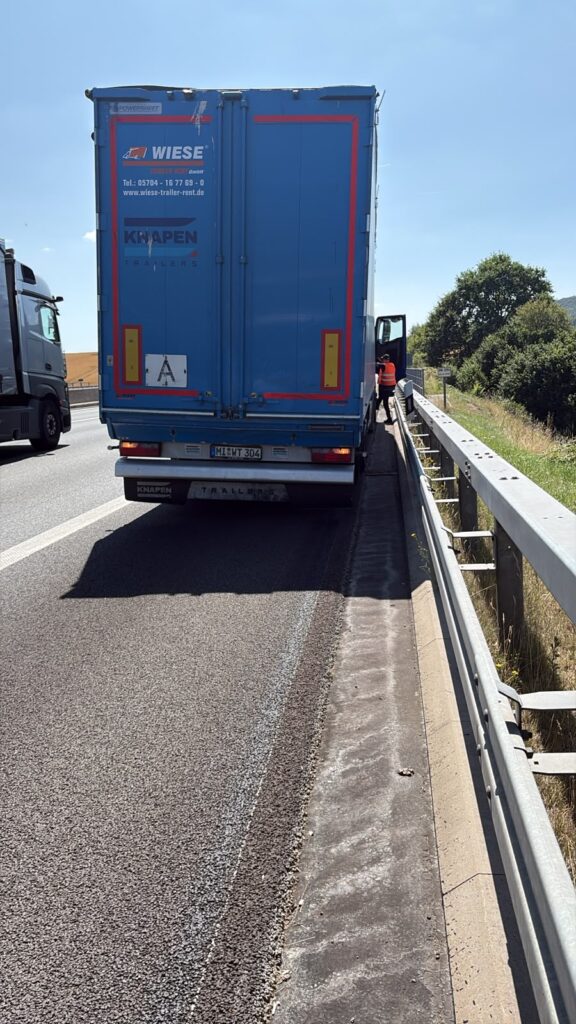
A tyre blowout on a loaded walking floor trailer’s axle is not an everyday breakdown. Unlike a standard curtainsider, a walking floor trailer carries extra weight from the outset: a hydraulic unit, a steel sliding floor, a reinforced chassis. Add unevenly settled bulk cargo and the remaining tyres on that axle can be carrying a load that turns a worn tread into a full-blown blowout within seconds.
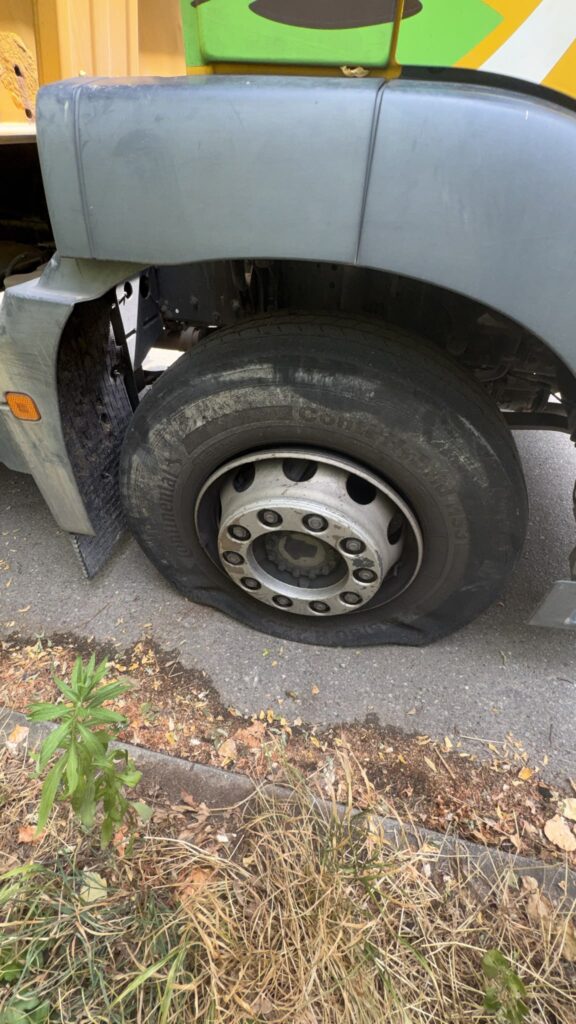
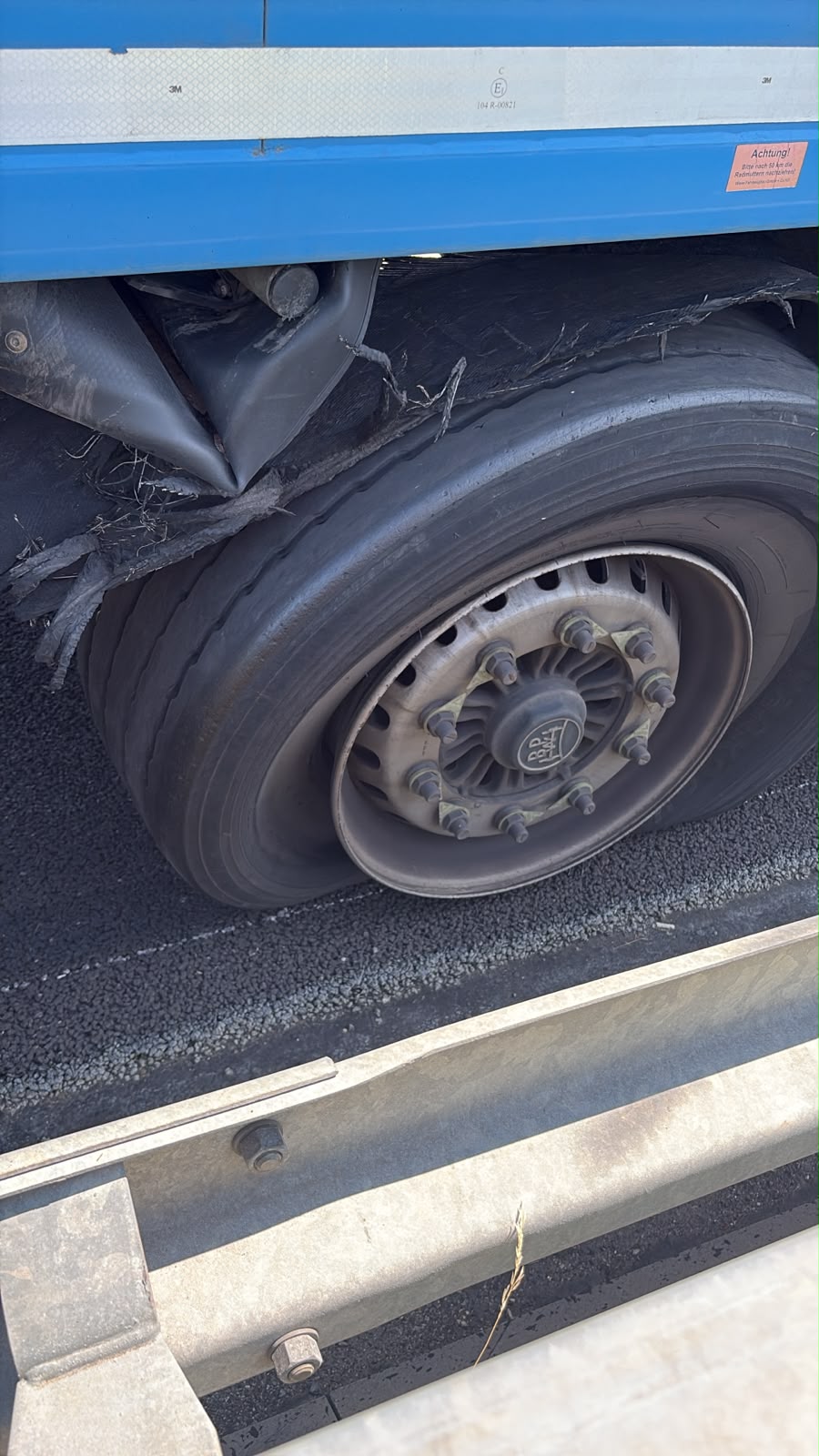
That is exactly what happened on 24 July on the A31 near Haltern am See, heading towards Bocholt. A tyre on the trailer axle disintegrated completely, and the driver managed to bring the rig safely onto the hard shoulder. In moments like these, what matters is not just speed but having the right equipment for an axle that carries considerably more than a standard tautliner.
This report explains how our partner workshop organised the callout, why walking floor trailers form their own risk category on the road, and what a full tyre change under full load actually cost.
The emergency on the A31
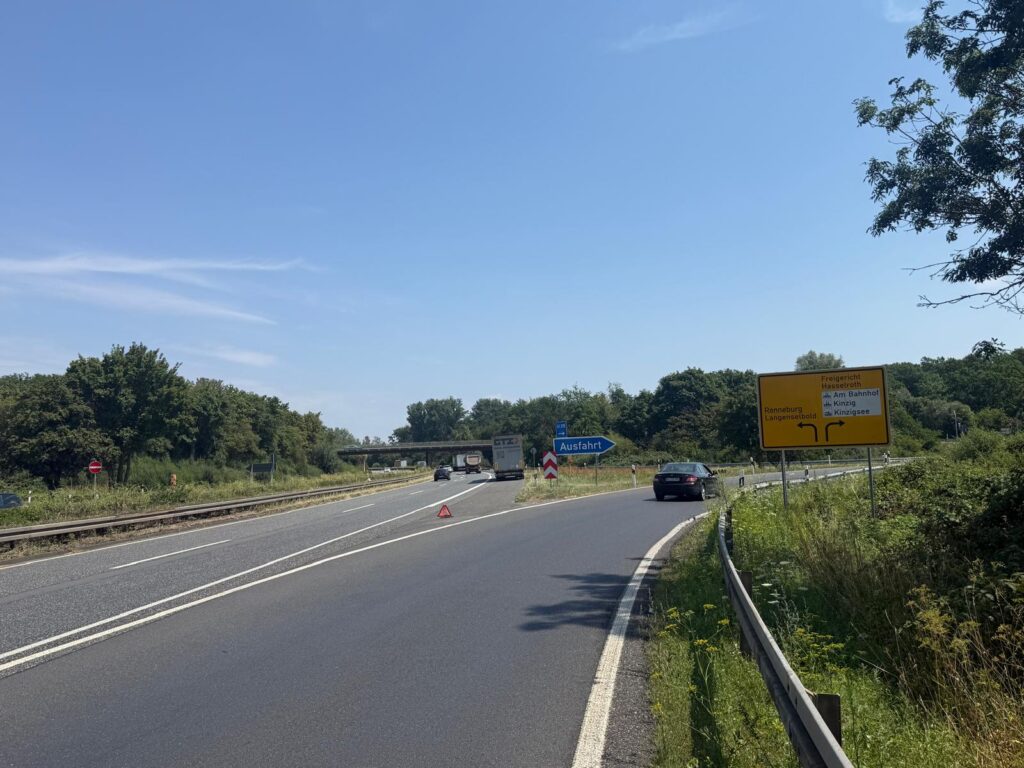
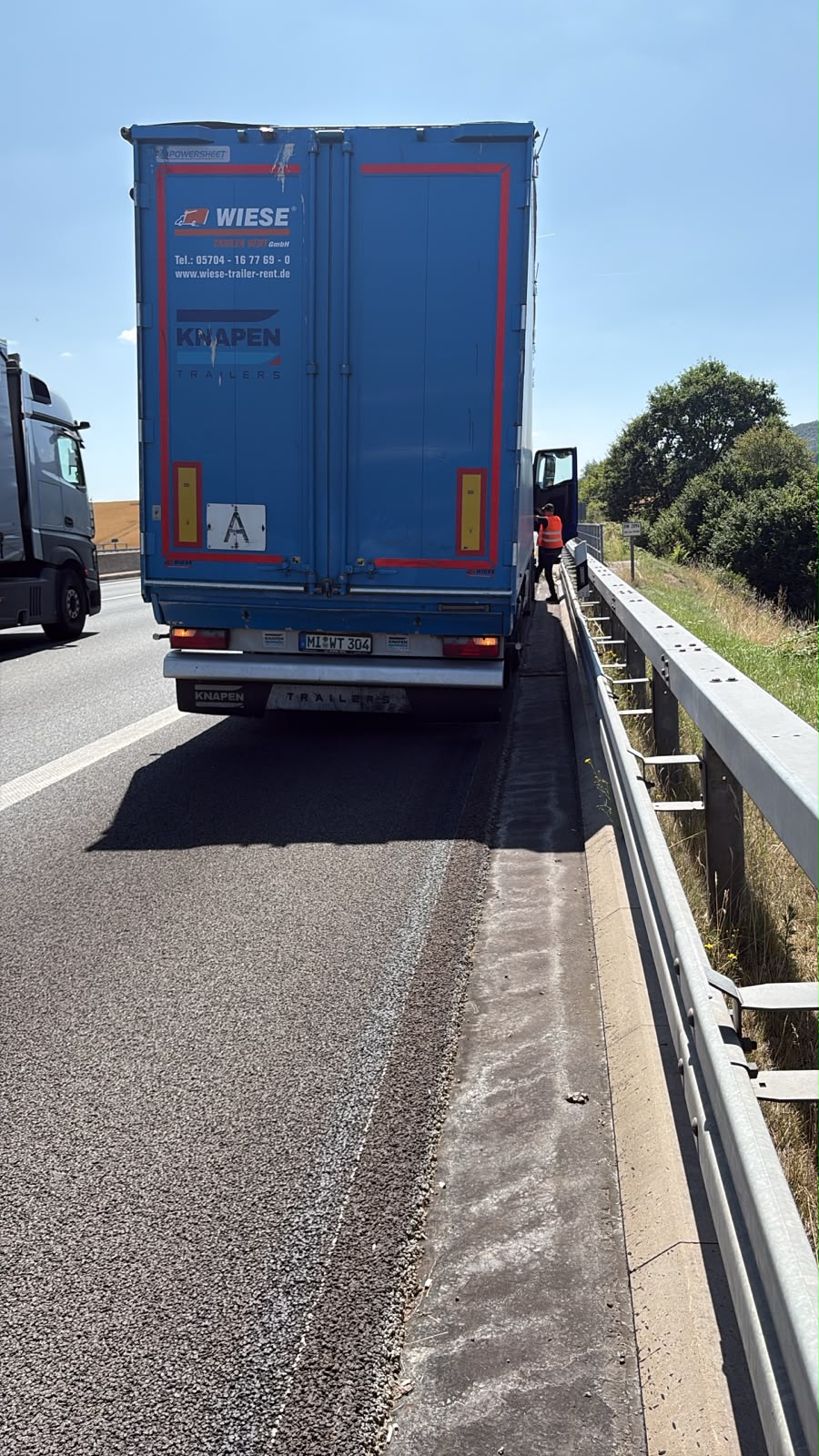
The incident took place in the early afternoon on the A31 near Haltern am See, heading towards Bocholt — a busy heavy-goods corridor connecting the Ruhr area with the Netherlands. The vehicle involved was a walking floor trailer, the type commonly used to haul wood chips, biomass, municipal waste, or other bulk material.
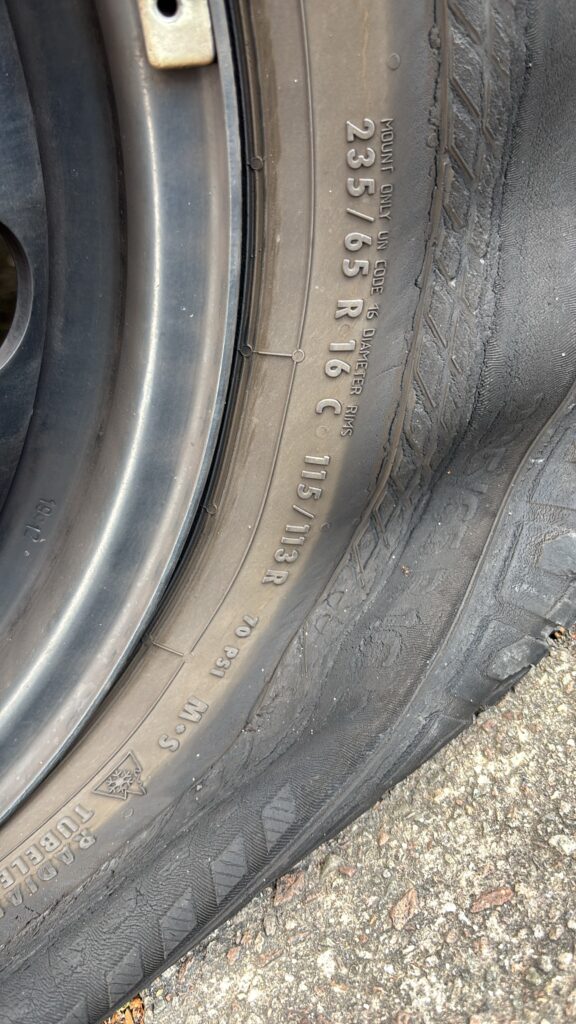
The tyre size on the trailer axle: 385/65 R22.5 — the standard dimension for heavy-duty trailer axles, built for high axle loads and sustained duty. The tyre had shredded completely on failure, with the carcass hanging in strips from the rim. The driver stood in a high-visibility vest behind the crash barrier while the rig sat safely on the hard shoulder.
A blowout on a walking floor trailer is trickier to handle than one on an ordinary semi-trailer, and the reason lies in how the vehicle itself is built.
What makes a walking floor trailer different
A walking floor trailer — also known in the trade as a Schubbodenauflieger — unloads its cargo not by tipping, but through hydraulically driven slats set into the floor. These slats move out of sync with one another, nudging the load towards the rear in small steps. That principle allows unloading of material that resists tipping: wood chips, bark, compost, municipal waste, sometimes grain or recycled material.
For the operator, that is genuinely convenient. For the axle’s tyres, it means a kind of sustained stress a plain curtainsider never sees.
Three factors stack on top of each other:
- Higher unladen weight. The hydraulic pump, drive motor, reinforced steel floor, and the slats themselves add substantially more kerb weight than a simple tarpaulin over a frame. With the same maximum gross weight, less allowance remains for payload — and once that margin is used, the tyres are already carrying more before a single load goes on.
- Uneven weight distribution during unloading. While the floor is running, the centre of gravity of the remaining cargo keeps shifting rearward. Over repeated unloading cycles, this produces recurring load spikes on individual axles that stress the sidewall more than a settled, uniform load would.
- Poor access roads. Biomass yards, recycling centres, compost sites, landfills — these facilities rarely have paved approach roads. Gravel, scrap metal, sharp debris, and deep ruts are routine. That is where the cuts and pinch damage originate that show up weeks later as a blowout on the motorway.
Overload: the real risk with bulk cargo
With bulk material like wood chips or compost, density is often hard to judge by eye. A driver fills the trailer by volume — the loading space looks correctly filled — and still ends up over the permitted axle weight. Wet material weighs considerably more than dry, and that swing is nearly impossible to spot at the loading point without a scale.
For the tyre, overload is not an abstract problem. An excessive load-to-pressure ratio increases flexing in the carcass, the carcass heats up, the rubber loses strength, and under sustained motorway load — constant speed, high summer temperatures — that is exactly what can cause sudden failure. Roadside checks by the Federal Office for Goods Transport (BAG) specifically target this combination of axle load and tyre condition, since overloading is one of the most common causes of tyre failure in heavy goods transport.
How the callout was organised
The call reached our 24/7 dispatch centre as soon as the driver had safely reached the hard shoulder. The process followed our standard procedure for tyre failures on heavy-duty axles:
- Location check — exact section of the A31, direction of travel, visible landmarks for the approach.
- Vehicle and load check — axle position of the failed tyre, tyre size, confirmation that the walking floor trailer was fully loaded, not running empty.
- Dispatching the right technician — a partner experienced with heavy-duty axles and carrying a hydraulic jack rated for high loads.
- Safety briefing for the driver — hazard lights, warning triangle at a safe distance, high-visibility vest, staying behind the crash barrier.
- Departure with a 385/65 R22.5 tyre already in stock — the correct size did not need to be sourced separately, which saved the most time across the whole callout. This is the same principle behind every job handled through our mobile truck tyre service: fast location check, the right technician, no wasted time waiting on parts.
Dispatch took 15 minutes in total before the technician was on the way.
The situation on the ground: why waiting is not an option
A flat tyre on a motorway hard shoulder is more than an inconvenience. Heavy-goods tyres normally run at 8.5 to 9.5 bar — when that pressure drops to zero suddenly, axle load distribution changes immediately. The neighbouring tyre on a dual-wheel setup briefly takes on the entire axle load, which on a loaded walking floor trailer can quickly overload the second tyre as well.
There is a further risk: if a vehicle continues moving even briefly on a blown tyre, the rim itself can be damaged. A bent or cracked rim edge makes fitting a new tyre on site impossible and turns a tyre failure into a far costlier repair involving rim replacement.
That is why the first instruction to the driver was unambiguous: do not move the vehicle again, not even a few metres for a better position.
Why the trailer was not unloaded
One obvious idea: if the trailer is too heavy, why not unload part of the cargo to make the tyre change easier? In practice, that is not an option on a hard shoulder.
First, there is no safe surface there for bulk material — dumping wood chips or biomass on a hard shoulder would be an environmental hazard and would further block an already narrow safety zone. Second, a walking floor trailer only unloads through the hydraulic slats at the rear; a controlled partial discharge in the middle of a motorway is simply not practical. Third, a partial unload shifts the centre of gravity unpredictably, which would make the vehicle less stable during subsequent manoeuvring than a constant, known load.
Our partner recovery crew therefore works as standard with the full vehicle weight:
- Hydraulic jacks rated for increased load, built to handle the extra weight of the hydraulic unit and steel floor.
- Lift points on the reinforced chassis, not on the axle itself — on walking floor trailers these points often sit differently than on standard trailers, which is why experience with this vehicle class matters.
- Double securing, with an axle stand placed under the chassis in addition to the jack before anyone reaches under the vehicle.
The tyre change, step by step
Step 1 — Securing the site. Warning beacon, an extra warning triangle, reflective barriers along the approach. Technical work only begins once this is in place.
Step 2 — Visual inspection. Checking the rim for distortion or cracks, and the wheel bolts and hub for damage caused by the blown tyre.
Step 3 — Lifting under full load. The hydraulic jack is set at the reinforced chassis point, the wheel is freed, and an axle stand adds a second layer of security.
Step 4 — Removal and fitting. The shredded 385/65 R22.5 tyre is removed, the replacement fitted, balanced, and mounted on the rim.
Step 5 — Final check with a torque wrench. Wheel bolts are tightened in a star pattern to the specified torque — a step that must never be skipped on a heavy-duty axle, since unevenly tightened bolts can work loose within a few hundred kilometres.
After fitting, a short test roll along the hard shoulder and a final visual check preceded releasing the trailer back onto the road.
The full timeline
| Time | Phase | Action |
|---|---|---|
| 13:20 | Emergency call | Driver reports tyre blowout on the A31 near Haltern am See |
| 13:20–13:35 | Dispatch | Location, vehicle, and load check, technician assigned (15 min) |
| 13:35–14:30 | Travel | Technician en route to the site (55 min) |
| 14:30–14:35 | Securing the site | Warning beacon, visual check of rim and hub |
| 14:35–15:40 | Tyre change | Lifting under full load, removal, fitting, balancing (65 min) |
| 15:40–15:50 | Final check | Torque check in star pattern, test roll |
Total time from call to departure: 2 hours 30 minutes.
What the callout cost
| Item | Price (EUR, net) |
|---|---|
| Call-out fee | 260 |
| Labour (2 hrs at €120) | 240 |
| Truck tyre 385/65 R22.5 | 480 |
| Old tyre disposal | 20 |
| Total | 1,000 |
All amounts are net, plus statutory VAT. The price for a callout to a loaded walking floor trailer sits toward the upper end of the usual range, because working under full load takes longer and requires heavier lifting gear than a change on an empty or partially loaded standard trailer.
For comparison: a day of downtime for a loaded semi costs operators roughly €800 to €1,200 through lost freight, demurrage, and possible penalties for late delivery. A tyre change for around €1,000 in two and a half hours is clearly the better economic outcome compared with any longer standstill.
Why this vehicle class needs a professional
Attempting a tyre change on a loaded walking floor trailer without the right equipment carries real risks:
- Wrong lift points on the chassis can cause the jack to slip under heavy load.
- Insufficient jack capacity — standard jacks designed for cars or light vans are simply not rated for this axle load.
- Uneven wheel bolt torque without a torque wrench causes vibration that only becomes apparent after a few hundred kilometres as loosened bolts, often too late.
- No secondary support, when no axle stand is used and a technician works underneath a lifted vehicle.
- Working in live traffic without adequate protection — a serious risk to everyone involved on a motorway hard shoulder.
Typical callouts we handle
Beyond the case described here, our partner workshops across Germany routinely handle:
- Tyre blowouts on steering and drive axles of tractor units
- Double tyre failures on car transporters with high point loads
- Tyre failures on bulk-material and recycling vehicles with unusual weight distribution
- Rim damage from continuing to drive on an already flat tyre
- Tyre changes on tankers and tippers where the load cannot be removed
Each of these situations calls for a different set of lift points, jack capacity, and experience — a one-size-fits-all approach rarely works for heavy-duty vehicles.
Prevention for drivers and fleets
Operators running walking floor trailers on bulk-material routes can cut the risk of a blowout considerably:
- Check tyre pressure under full load, not when empty — the correct pressure depends directly on the actual axle weight.
- Visually inspect tyres after every unload at a biomass or recycling site, since that is where the cuts and pinch damage originate that only fail weeks later.
- Fit reinforced tyres with the right load index, matched to the vehicle class’s higher unladen weight, rather than the cheapest option available.
- Control loading by weight, not just volume, especially with wet material.
- Measure tread depth regularly — the legal minimum for commercial vehicle tyres is set out in German road traffic licensing regulations.
Tyres and fleet maintenance: what actually matters
The load index of a truck tyre indicates the maximum weight the tyre can carry at a defined speed. On walking floor trailers, it is generally worth choosing a higher load index than on a comparable standard trailer, since the extra unladen weight from the hydraulics and steel floor sits on the axle permanently, not only when fully loaded.
Manufacturers such as Continental, Michelin, Goodyear, and Bridgestone offer dedicated trailer tyre ranges with reinforced carcasses built specifically for this kind of sustained load. Fleet operators benefit from a fixed inspection routine: pressure and tread depth every two weeks, plus a visual check after any run over unpaved access roads. Operators regularly serving sites with gravel or scrap surfaces should shorten those intervals further.
Rim condition matters just as much. On walking floor trailers carrying heavy axle loads, a slightly distorted rim accelerates air loss without the driver necessarily noticing straight away. A tyre running weeks with slightly low pressure heats up more than intended, the carcass fatigues, and eventually the result is a sudden blowout, often at motorway speed on a hot day. A simple pressure check during every fuel stop takes a few minutes and prevents exactly this scenario. For fleets running several walking floor trailers, keeping a per-axle tyre record — fitting date, tread depth at the last inspection, any damage noted — makes it possible to retire a tyre that has repeatedly hit sharp scrap early, rather than reacting only after the blowout.
Why drivers and fleets choose us
- Available 24/7, every day of the year, including nights and public holidays
- Nationwide partner network with technicians experienced on heavy-duty axles
- Transparent fixed pricing before work begins, no hidden surcharges
- Multilingual dispatch for international drivers and haulage companies
Beyond the tyre change itself, we also arrange truck towing services when a vehicle is no longer roadworthy after damage, and our mobile truck service for broader technical issues right at the roadside.
Frequently asked questions
What does a truck tyre change on the motorway cost?
A tyre change on a semi-trailer or tractor unit on the motorway typically costs between €750 and €1,400 net, depending on tyre size, axle load, and time of day. On loaded walking floor trailers, the price tends toward the upper end of that range, since working under full load takes longer and needs heavier equipment.
How long does a tyre change on a loaded trailer take?
From the call to departure, it usually takes between 1.5 and 3 hours. In the case described here, it was 2 hours 30 minutes, with 65 minutes of actual hands-on work at the roadside.
Who pays for a tyre change during a breakdown?
Typically, the fleet operator or haulage company covers the cost, unless a separate breakdown or insurance cover applies. Many fleets simply bill the callout directly to their cost centre.
Does the trailer need to be unloaded for the tyre change?
No, not normally. Our technicians work with lifting equipment rated for the full axle load, so unloading on a hard shoulder — which is rarely even safely possible — is not necessary.
What happens if the rim was damaged in the blowout?
Then rim straightening or replacement is needed in addition to the tyre change, which adds time and cost. That is why it matters to stop immediately after a blowout rather than continuing on the damaged tyre.
Is night-time callout more expensive?
Yes, nights and weekends typically carry a surcharge of 25 to 50% on the call-out fee, since dispatch and travel happen under more demanding conditions.
Summary
- Tyre size: 385/65 R22.5, trailer axle of a loaded walking floor trailer
- Location: A31 near Haltern am See, heading towards Bocholt
- Response time: 15 minutes dispatch, 55 minutes travel
- Total duration: 2 hours 30 minutes from call to departure
- Cost: €1,000 net, including call-out, labour, tyre, and disposal
- Secondary damage: none — rim and hub remained undamaged thanks to stopping immediately
Get help now
A blowout on a loaded walking floor trailer is not a job for improvisation. Call us wherever you are in Germany: +49 160 5753826. More about our service at www.lkwhelp24.com — available around the clock, nationwide.
Keywords: mobile truck tyre service | tyre blowout motorway | walking floor trailer | Schubbodenauflieger | 385/65 R22.5 | truck breakdown A31 | trailer tyre replacement | truck roadside assistance Germany
Related articles
- Truck Tire Service Near Me: Handling Trailer Tyre Blowout Near Berlin — LKWHelp24 on the Job
- Trailer Tyre Blowout on the A10 near Michendorf: Curtainsider Semi-Trailer Back on the Road in 1 Hour 45 Minutes
- Winter Tyres for HGVs in Germany – Legal Requirements, Safety & Service by LKWHelp24
- Truck Breakdown Assistance in Germany – 24/7 Emergency Service from LKW Help 24
- Contacts – LKWHelp24