Skip to content
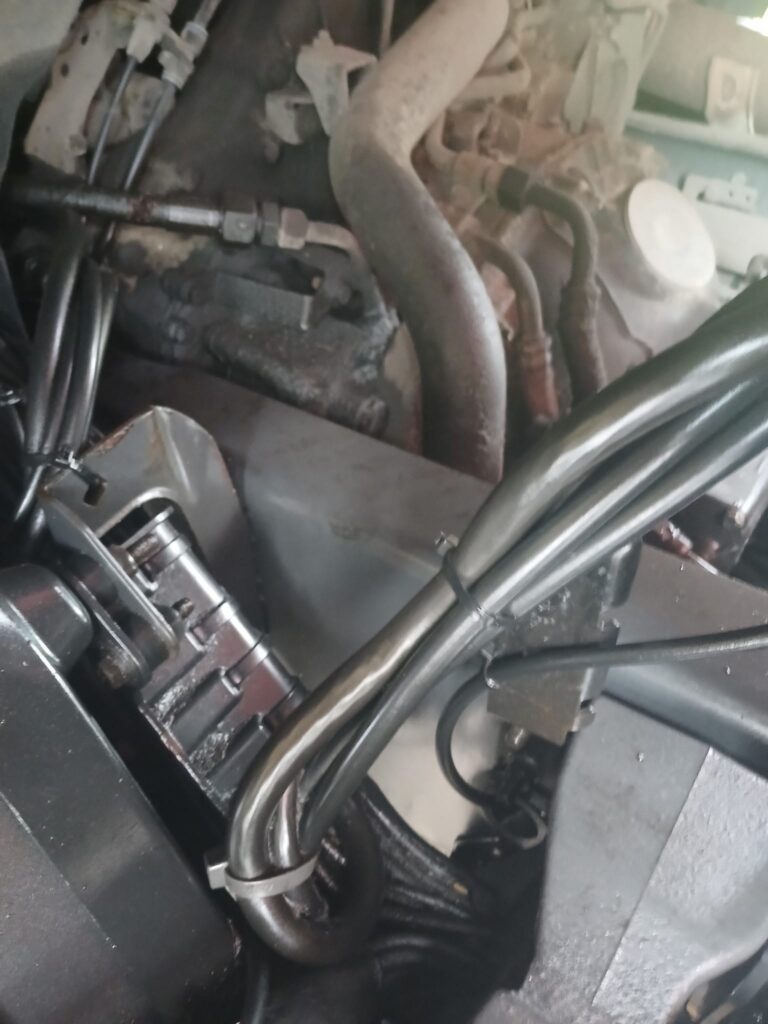
Most drivers picture a tyre blowout as a loud bang, a wobble, and a slow walk to the hard shoulder. In reality, on a loaded articulated tractor unit doing motorway speed, the shredding tread becomes a whip. It doesn’t just destroy the tyre — it can tear through the mudguard, slash the compressed-air lines that feed the brakes and suspension, rip out ABS/EBS sensor wiring, and in the worst cases graze the fuel tank or its mounting brackets. Our truck tyre service exists precisely because the tyre itself is rarely the whole story.
This case documents exactly that scenario: a Volvo FH tractor unit that suffered a steer-axle blowout on the A38 near Halle, and the two hours and forty minutes it took our regional service partner to inspect, repair, and clear the collateral damage before the vehicle was released back onto the road. No dramatics, no invented details — just the timeline, the costs, and the reasoning behind each step.
The wider point is one hauliers and fleet managers often underestimate: a blown steer tyre is rarely a single-component failure. Treating it as one — swapping the wheel and sending the driver on his way — is how a €540 tyre problem quietly turns into a brake-system failure two hundred kilometres down the road.
The emergency: A38 rest area near Halle
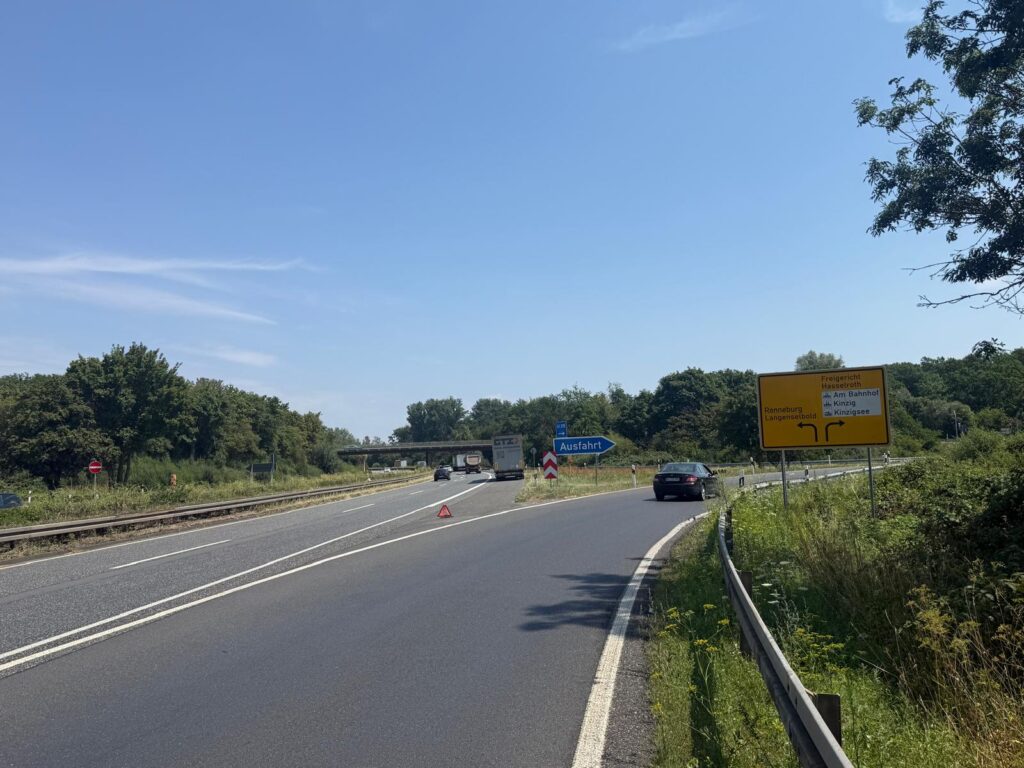
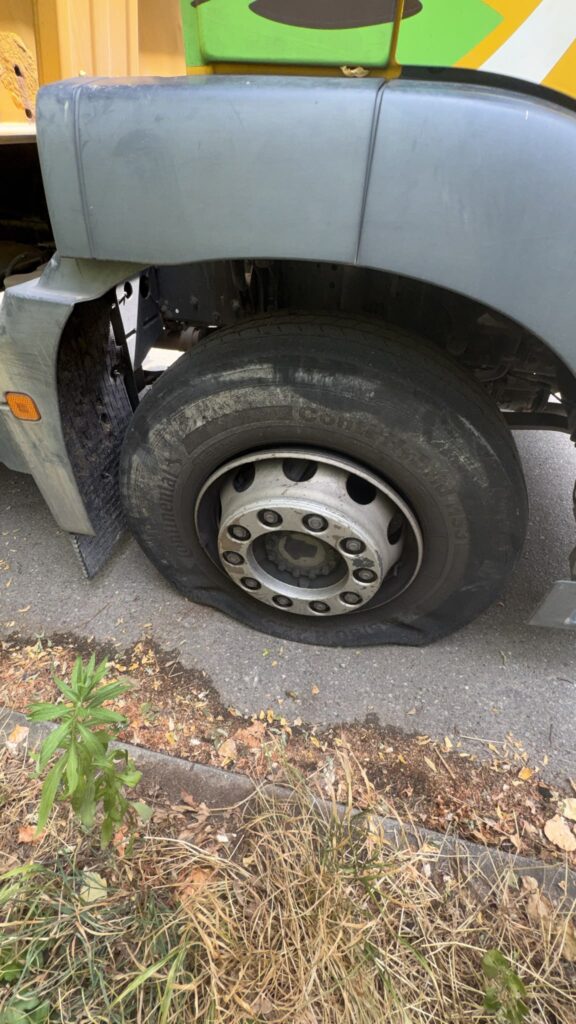
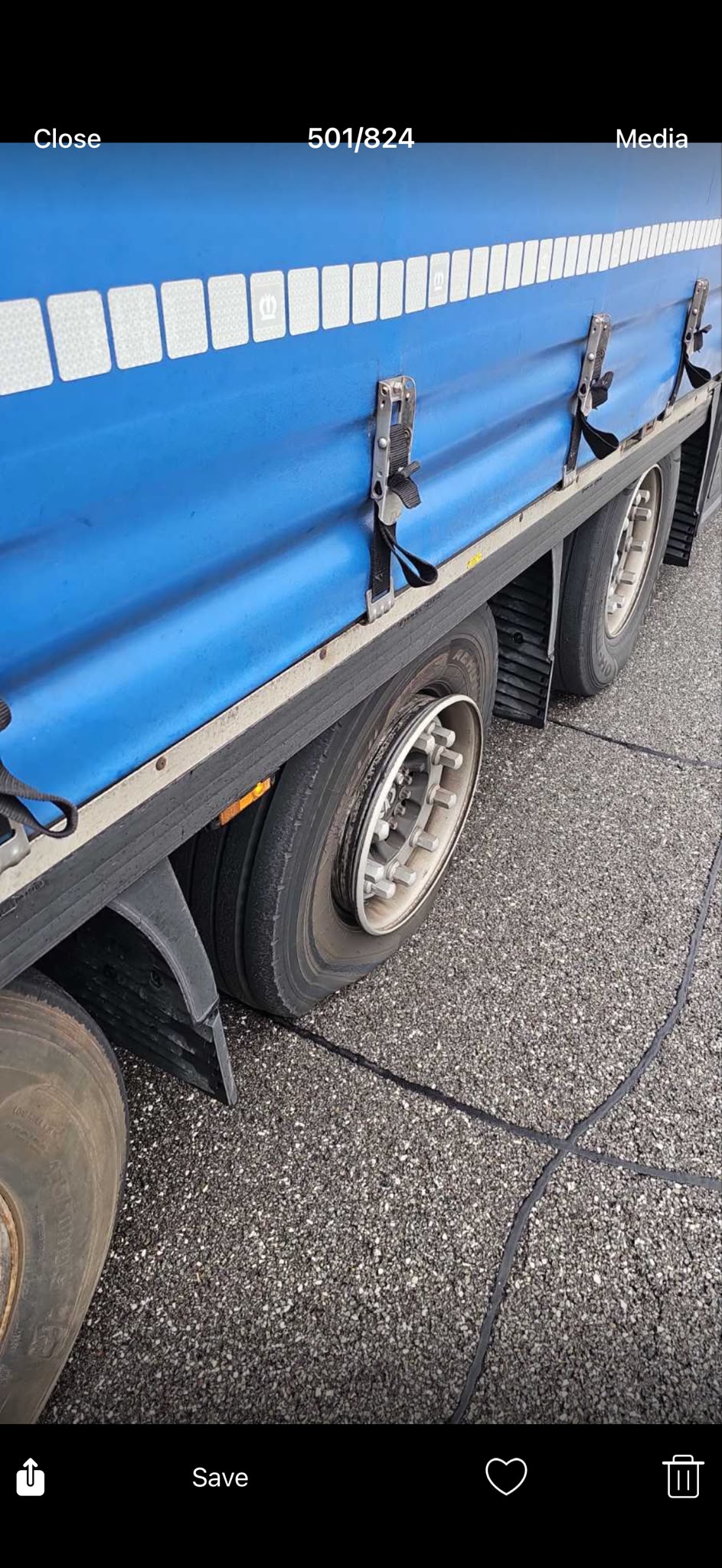
The call came in early afternoon on 22 July. A Volvo FH articulated tractor unit had pulled into a rest area on the A38, direction Göttingen, after the driver felt a hard pull to one side and heard what he described as a “flat crack, then flapping.” He’d done the right thing immediately — eased off the throttle, avoided braking hard, and steered the unit onto the rest area apron rather than the narrow hard shoulder.
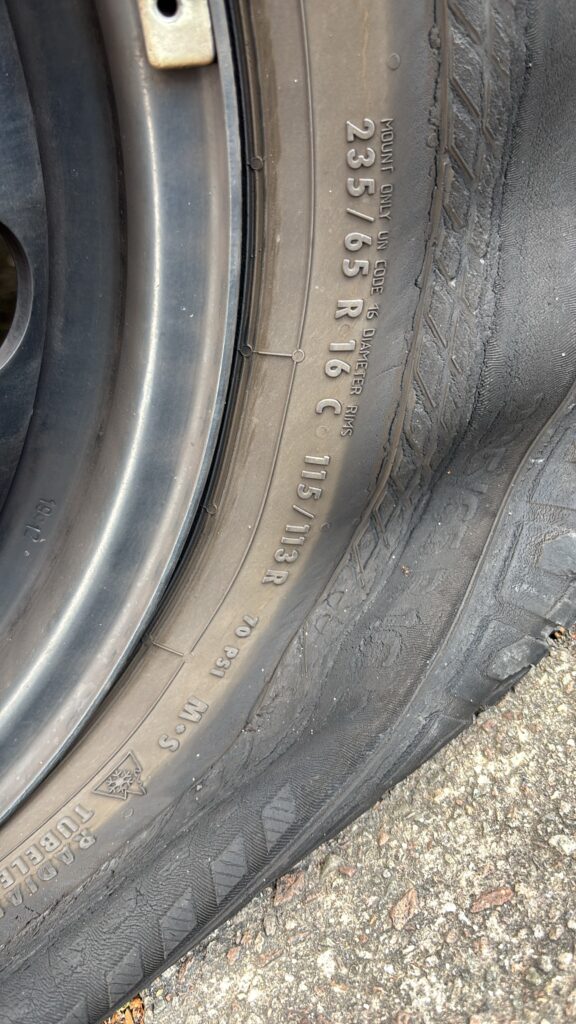
The affected tyre was a 315/70 R22.5 on the steer axle — the standard fitment for a European tractor unit of this class, run at somewhere between 8.5 and 9.5 bar depending on load and manufacturer spec. At that pressure and at roughly 85 km/h, when the carcass lets go, the tread doesn’t just fall off. It separates in large, heavy chunks that get thrown outward and backward against everything mounted along the chassis rail behind the wheel arch. That is the mechanism behind almost every collateral-damage case we handle, and it’s why our dispatch protocol for steer-axle blowouts always includes an instruction to check more than the wheel.
How help was organised
The driver rang our 24/7 mobile truck service line. Dispatch is built to move fast on exactly this kind of call, because a stationary tractor unit on a motorway rest area is not a place anyone wants to linger, least of all with a loaded semi-trailer behind it.
- 13:42 — Emergency call logged: steer-axle blowout, A38 rest area near Halle, direction Göttingen.
- 13:57 — After a 15-minute triage call to confirm tyre size, axle position, and whether the vehicle could be safely approached, a technician from our regional service partner network was dispatched with an ETA of 50 minutes.
- 14:47 — Technician arrives on site.
Triage matters more than it sounds. Getting tyre size, axle, and visible damage confirmed before a technician leaves the workshop means the right tyre and the right tools are already on the van — a detail that shaves real minutes off jobs where every minute on a live rest area apron carries risk.
On-site situation: why collateral damage can’t be ignored
By the time the technician arrived, the driver had already put out a warning triangle and was standing well clear in his hi-vis vest — exactly what we ask every driver to do while waiting. The rest area was busy with lorry traffic passing close to the parked unit, so the first job was simply securing the scene properly before touching a spanner.
Then came the part that separates a proper roadside repair from a rushed one. A steer axle on a fully loaded Volvo FH carries a substantial share of the vehicle’s front-end weight, and when a tyre disintegrates at speed, the wheel arch and everything behind it takes the impact. The technician’s inspection covered:
- The tyre carcass and rim — visually and by touch, checking for heat distortion.
- The mudguard and splash guard — for tears, missing sections, or bent mounting brackets.
- The air lines running along the chassis rail near the wheel — for cuts, abrasion, or full severance.
- The ABS/EBS sensor wiring at the hub — for exposed conductors or connector damage.
- The fuel tank and its mounting straps — for dents or fuel weeping.
This is also the step drivers most often skip when they try to save time by fitting a spare themselves. A damaged air line hose doesn’t always show up straight away. Small leaks or partially cut hoses sometimes hold pressure well enough that the compressor masks the problem for the first few dozen kilometres, and the fault only throws a warning — or a full brake-pressure drop — once the driver is back on the autobahn with a load behind him. That is not a risk worth taking to save forty minutes at a rest area.
Step-by-step repair
Step 1 — Inspect surrounding damage. Before anything is removed, the technician walks the full area around the wheel arch: mudguard, air lines, wiring loom, fuel tank. This is the step that determines whether the job is “change a tyre” or “change a tyre plus repair three other things.”
Step 2 — Secure the site. Warning triangle placed, hi-vis vest on, wheel chocks in position, and the vehicle confirmed stable on the rest area surface before jacking begins.
Step 3 — Remove the wheel. Wheel nuts loosened in sequence, wheel lifted clear. With the wheel off, the hub and rim get a proper look — overheating from even a short distance driven on a destroyed tyre can warp a rim or damage a hub bearing, and a warped rim will not seat a new tyre correctly no matter how carefully it’s balanced.
Step 4 — Fit the new wheel. A fresh 315/70 R22.5 tyre is mounted, balanced, and torqued onto the hub.
Step 5 — Final check. Wheel nuts re-torqued in a star pattern to the correct specification, air-line repair pressure-tested, and a short test drive to confirm handling and braking before the unit is cleared to continue.
The air line repair itself is checked with a straightforward pressure-drop test — the system is charged, isolated, and monitored for a drop over a set period — followed by a soap-water check along the repaired section and fittings to spot any residual bubbling that indicates a slow leak. It’s not glamorous work, but it’s the difference between a lorry that leaves with a genuinely sealed brake circuit and one that leaves with a leak nobody caught.
Full timeline
| Time | Phase | Action |
|---|---|---|
| 13:42 | Emergency call received | Driver reports steer-axle tyre blowout, A38 rest area near Halle, direction Göttingen |
| 13:57 | Technician dispatched (15-min triage) | Regional partner workshop confirms, ETA 50 minutes |
| 14:47 | Arrival on site (50-min drive) | Site secured with warning triangle and hi-vis vest |
| 15:02 | Initial inspection complete | Tyre, mudguard, air lines, wiring, fuel tank checked |
| 15:07 | Wheel removed | Rim and hub checked for warping/overheating |
| 15:35 | New 315/70 R22.5 tyre fitted and balanced | — |
| 15:55 | Air line repaired | Leak-tested with soap solution |
| 16:10 | Mudguard/splash guard replaced | ABS/EBS sensor wiring secured |
| 16:22 | Final check | Wheel nuts torqued in a star pattern, brake pressure tested, test drive — done |
Total time: 2 hours 40 minutes (160 minutes) from call to job completion.
Cost breakdown
| Item | Price (EUR) |
|---|---|
| Callout fee | 260 |
| Labour (2.5 hrs at €120) | 300 |
| Tyre 315/70 R22.5 | 540 |
| Old tyre disposal | 20 |
| Air line repair | 180 |
| Mudguard/splash guard replacement | 150 |
| Electrical check ABS/EBS sensor wiring | 140 |
| TOTAL | €1,590 net, excl. VAT |
The tyre itself, at €540, is actually the smaller half of the invoice once collateral damage enters the picture. Air line repair, the splash guard, and the wiring check together add nearly €500 on top of labour and the callout fee. This is the pattern we see repeatedly with steer-axle blowouts at speed: the visible damage is one line item, the hidden damage is several more.
Set against downtime, the arithmetic still favours a fast, thorough repair. A stranded tractor unit costs roughly €800–1,200 per day in lost revenue, driver time, and missed delivery windows. At €1,590 for a job completed in under three hours, this repair had effectively paid for itself before the end of the working day.
Why you need a professional
A driver reaching for a spare and a wheel brace after a blowout is understandable — nobody wants to sit at a rest area for an hour. But DIY repair after a steer-axle blowout on a heavy tractor unit carries risks most drivers aren’t equipped to assess:
- No way to properly inspect or pressure-test the compressed-air brake lines, meaning a cut or abraded hose can go unnoticed until it fails on the move.
- No diagnostic access to confirm ABS/EBS sensor wiring is intact rather than just “not currently throwing a code.”
- No means to check rim and hub for heat-related warping, which affects both tyre seating and long-term bearing wear.
- Working jacked up on a live rest area or hard shoulder without proper signage, chocks, and hi-vis discipline.
- Incorrect wheel-nut torque or sequence, which on a steer axle is a genuine steering-safety issue, not just a maintenance detail.
None of this is about discouraging a competent driver from checking his vehicle. It’s about recognising that a blowout with collateral damage needs the same diagnostic rigour as a workshop job, just delivered at the roadside.
Typical jobs we respond to across Germany
Steer-axle blowouts with collateral damage are one recurring category among many. Across the country, our dispatch line fields calls for truck tyre service on drive-axle and trailer tyres, brake and air-system faults, alternator and starter failures, coolant leaks on long autobahn stretches, and full towing and recovery service when a vehicle genuinely can’t be repaired on site. We’ve handled comparable steer-axle incidents elsewhere in Germany too — a DAF articulated unit blowout near Hof, a case with rim damage near Trier, and a semi-trailer blowout in Berlin. Each one follows the same logic: check what the blowout hit, not just what it broke.
Prevention: tips for drivers and fleets
A blowout at motorway speed is rarely a complete surprise if the tyre was checked beforehand. A few habits reduce both the frequency of failures and the scale of collateral damage when one does happen:
- Check tyre pressure cold, before departure, not after several hours of running — heat inflates the reading and hides genuine underinflation.
- Watch tread depth closely on steer axles; legal minimum in Germany is 1.6 mm, but most fleets replace well above that for steer positions specifically.
- Inspect the carcass sidewall for bulges, cuts, or embedded debris during every pre-trip walk-around — a slow puncture developing into a carcass weakness is often visible days before it fails outright.
- Keep an eye on uneven wear patterns, which usually point to alignment or suspension issues rather than the tyre itself.
- Report any pulling, vibration, or unusual noise immediately rather than waiting for the next scheduled stop.
Tyres, fleets, and maintenance: the bigger picture
Steer-axle tyres on a tractor unit like a Volvo FH do a different job from drive-axle or trailer tyres — they carry steering forces as well as load, which is why manufacturers such as Michelin, Continental, Goodyear, and Bridgestone all produce dedicated steer-axle patterns with reinforced shoulders and stiffer sidewalls. Mixing tyre brands or patterns across axle positions isn’t itself illegal, but fleets that standardise tend to see fewer unexplained wear patterns and easier diagnosis when something does go wrong.
Carcass integrity matters more on a steer axle than almost anywhere else on the vehicle. A tyre that’s been run underinflated for even a short period builds internal heat that weakens the casing long before any visible bulge appears, and it’s this weakened carcass — not simple wear — that tends to produce the sudden, violent failure seen in this case rather than a gradual deflation. Regular pressure checks, proper wheel alignment, and prompt attention to irregular wear are the cheapest insurance a haulage company has against a €1,590 roadside bill.
Fleet operators running mixed axle configurations should also factor tread depth differentials between axles into their maintenance schedule — a steer tyre worn unevenly against its drive-axle counterpart is often an early warning of a wheel alignment issue rather than a tyre defect, and catching it during a routine service is a great deal cheaper than catching it on a rest area apron near Halle.
Why customers choose us
Hauliers and independent drivers call our line because it works the same way every time, wherever in Germany the breakdown happens:
- 24/7 availability — a call at 13:42 on a weekday gets the same response as one at 3 a.m.
- Vetted regional partner network — technicians dispatched are workshops we know and trust, not a random subcontractor found on the fly.
- Transparent, itemised pricing — every job comes with a clear cost breakdown before work starts, not a surprise invoice afterwards.
- Multilingual dispatch — drivers from across the EU can explain the problem in a language they’re comfortable with, which speeds up accurate triage.
FAQ
How much does a truck tyre change on the motorway cost?
A straightforward steer-axle tyre change with no collateral damage typically runs from the callout fee, labour, and tyre cost alone — in this case that portion came to roughly €1,100. Once air lines, mudguards, or wiring are involved, the total rises accordingly, as seen here at €1,590 net.
How long does a blowout job with collateral damage take?
In this case, 2 hours 40 minutes from the initial call to the vehicle being cleared to drive, including a 50-minute drive to site and a full inspection of the surrounding components. Jobs without collateral damage are usually faster; jobs with more extensive wiring or air-system damage can take longer.
Who pays for the air line repair?
That depends on the haulage company’s insurance and fleet policy, but the repair itself is not optional — a damaged brake or suspension air line is a safety issue, not a cosmetic one, and it’s addressed in the same callout rather than deferred to a workshop visit days later.
Can I keep driving a short distance on a blown steer tyre to reach the next exit?
No. Even a short distance on a shredded steer-axle tyre risks rim damage, hub overheating, and further tearing to air lines and wiring that were only partially damaged in the initial blowout. If the vehicle can be safely stopped, it should be — don’t drive one metre further than absolutely necessary.
Does this kind of collateral damage happen on every blowout?
Not every blowout tears out air lines or wiring, but at motorway speed with an 8.5–9.5 bar steer tyre, the risk is high enough that a full inspection should be standard procedure every time, not just when damage looks obvious.
What tyre pressure should a steer axle run at?
It varies by manufacturer and load, but 8.5 to 9.5 bar is typical for a 315/70 R22.5 steer-axle fitment on a tractor unit like this Volvo FH. Always follow the specific vehicle manufacturer’s placard figures.
Summary
- Tyre spec: 315/70 R22.5, steer axle
- Location: A38 rest area near Halle, direction Göttingen
- Vehicle: Volvo FH articulated tractor unit
- Response time: 50 minutes from dispatch to arrival on site
- Total job time: 2 hours 40 minutes (160 minutes)
- Total cost: €1,590 net, excl. VAT
- Collateral damage addressed: air line, mudguard/splash guard, ABS/EBS sensor wiring, rim/hub inspection
Get help now
If a steer tyre blows out on an autobahn or rest area anywhere in Germany, call us before making any decision about driving further. We’re available 24/7 across the country.
Phone: +49 160 5753826
Website: www.lkwhelp24.com
Keywords
truck tyre service | steer axle blowout | HGV roadside assistance Germany | mobile truck tyre repair | articulated tractor unit breakdown | 315/70 R22.5 tyre | A38 breakdown service | truck breakdown recovery | air line repair lorry | ABS EBS sensor wiring damage | Volvo FH tyre service | fleet tyre maintenance | motorway truck tyre change | wheel hub inspection | rim damage truck tyre | 24/7 truck service Germany