Skip to content
 Finding a suitable truck parking spot is a daily source of stress for many long-haul drivers in Germany. Overcrowded rest areas, tight time windows and rising demands for safety and comfort shape the reality on German motorways. This article looks at the current situation, the digital solutions already in place, and where truck parking is heading in the years ahead.
Introduction: the current truck parking situation in Germany
Since around 2018 the parking-space situation on German motorways has steadily worsened. The Federal Ministry of Transport put the shortfall at roughly 19,630 regular truck parking spaces in 2023 – industry associations sometimes cite figures as high as 40,000 missing spaces. These numbers point to a structural problem that affects thousands of drivers every single day.
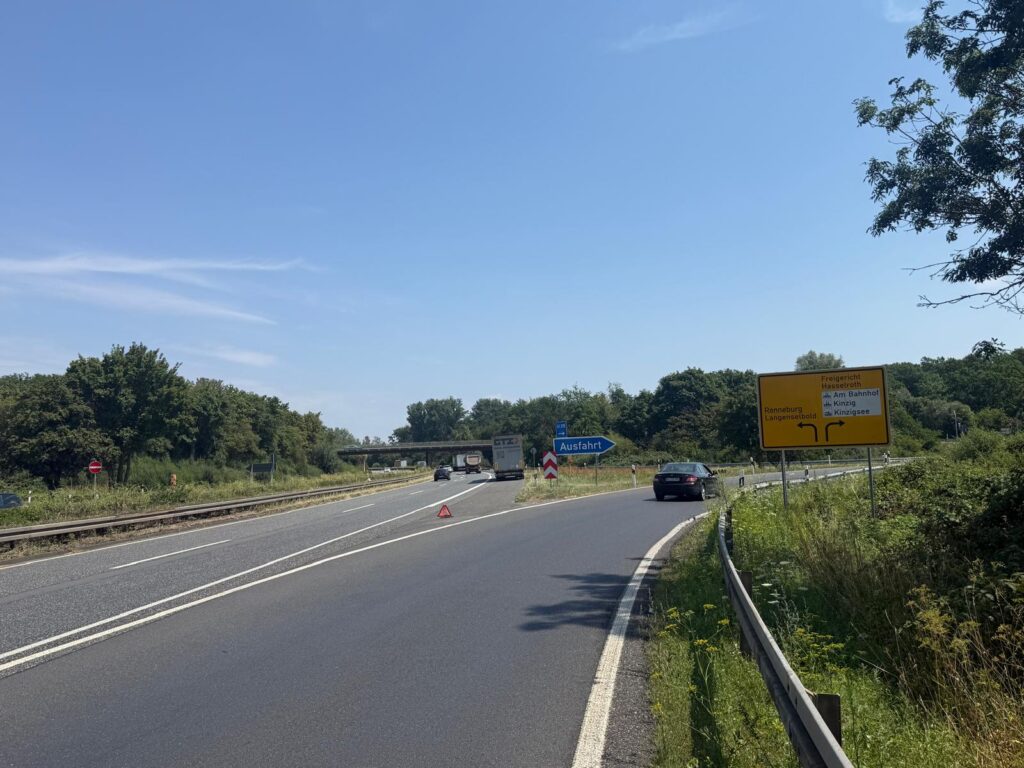
For the individual truck driver, this situation means one thing above all: stress. Anyone who, after eight or nine hours behind the wheel, cannot find a free parking spot is caught between legally mandated rest periods and the reality of overcrowded rest areas. The consequences range from fines and safety risks to rising costs for haulage companies and their customers. A typical scenario: a driver heading south on the A7 reaches the limit of his driving time around 9 p.m. The next three rest areas are completely full. He ends up parking on a slip road – illegal, dangerous, but with no alternative.

Types of truck parking: from motorway service stations to secure lots
The landscape of truck parking areas in Germany is diverse. Broadly speaking, four main types can be distinguished, each meeting different requirements and serving different groups of users.
Motorway rest areas are operated by the federal Autobahn GmbH and are located directly along motorways such as the A3, A7 or A2. They offer basic infrastructure with sanitary facilities and often fuel stations, but are frequently overcrowded and rarely have comprehensive security features.
Truck stops (Autohöfe) are typically located at motorway exits and run by private operators. They generally offer more comfort: showers, restaurants, laundry facilities and Wi-Fi are often standard. Large truck stops in Bavaria or North Rhine-Westphalia can have several hundred spaces and have become important hubs for freight transport.
Haulage company yards and depots are primarily reserved for a company’s own vehicles. These sites offer high security through fencing and access control, but are usually not accessible to outside drivers.
Guarded secure parking areas represent the premium category. They feature 24-hour video surveillance, controlled access, bright lighting and often on-site staff. These parking areas are especially relevant for transports carrying valuable cargo and typically charge parking fees.
Challenges: why truck parking has become a bottleneck
The already tight situation has grown worse since 2020. The e-commerce boom, growing freight volumes and the chronic driver shortage have all put massive pressure on existing infrastructure. This creates concrete problems for everyone involved – drivers, dispatchers and companies alike.
Searching for parking often costs drivers between 30 and 60 minutes a day. That time is lost for actually moving cargo and triggers a chain reaction of delays and planning uncertainty. Overnight parking on entry and exit ramps, in emergency bays or on unmarked areas is not uncommon – despite the fines and traffic-safety risks involved.
For companies, these challenges translate into unplanned downtime. Violations of Regulation (EC) No. 561/2006 on driving and rest times can result in significant penalties. On top of that come higher insurance risks when vehicles are regularly forced to park in unsafe locations.
A typical night on the A61 or A8 illustrates the problem: by around 8 p.m., the official spaces are already full. Trucks line up along hard shoulders and slip roads, manoeuvring in the dark increases the risk of accidents, and for drivers arriving later the search becomes increasingly hopeless.
Legal driving and rest times and their impact on the parking search
Every search for parking is directly linked to the legal rules on driving and rest times. These rules determine the latest point at which a driver must stop – and therefore how much time is left to find a suitable truck parking spot.
The specific requirements are clearly defined: a maximum of 9 hours of driving time per day is allowed, extendable to 10 hours twice a week. After at most 4.5 hours of driving, a break of at least 45 minutes is mandatory. The daily rest period is at least 11 hours, though under certain conditions a reduced rest period of 9 hours is permitted.
In practice, this means a driver must find a safe parking spot at the latest 30 to 60 minutes before reaching the permitted driving time limit. Anyone who fails to factor in this buffer risks either violating rest-time rules or having to stop in an unsuitable location.
A concrete example illustrates the point: on a route from Hamburg to Munich via the A7 and A9 – roughly 780 kilometres – an experienced driver plans for two longer stops. The choice of parking spot is not random but based on remaining driving time and the known occupancy of certain rest areas. A driver who sets off at 6 a.m. should be heading for a spot for the main rest period by around 3 p.m. – by which time many attractive locations are already well filled.
Digital solutions: finding, booking and utilising truck parking
Since around 2020, digitalisation in the field of truck parking has gained real momentum. Telematics systems, dedicated apps and the use of toll data now allow for a much more targeted search and planning process than just a few years ago.
Modern systems for capturing parking occupancy rely on various technologies. Camera sensors, inductive loops or radar detect occupancy of individual spaces and transmit the data to central platforms in near real time. Drivers can use apps or onboard computers to see how many spaces are still free at a given rest area and which services are available there – from showers and Wi-Fi to restaurants.
In Germany, the use of public data plays a growing role. Platforms such as the federal government’s Mobilithek provide occupancy data that navigation providers and app developers can integrate into their solutions. Services such as Happytrucker or Kravag Truck Parking aggregate this information and make it practically usable for drivers.
A typical scenario: a driver heading east on the A2 checks his app around 7 p.m. The next rest area shows red – completely full. The one after that, 25 kilometres further on, is still 60 percent occupied. With this information he can drive straight there instead of wasting valuable time on a fruitless search.

Reserving and booking truck parking spaces
The ability to reserve parking spaces is becoming increasingly important, especially for transports carrying valuable cargo. Instead of driving on and hoping for the best, drivers or dispatchers can secure parking spots along the route in advance – typically 6 to 24 hours before the planned arrival.
The technical process is similarly structured in most applications: first the desired location is selected, then the time window is set. The relevant vehicle data and licence plate are submitted, and once the booking is confirmed the driver receives a confirmation. In practice, digital tickets or QR codes automatically open the barriers or gates at the site as soon as the vehicle arrives.
For haulage companies this approach offers considerable advantages: route planning becomes more reliable, since the parking spot for the end of the day is already fixed. Dispatchers can plan routes so that rest periods are spent in secured locations – without the risk that the driver won’t find a spot.
Real-time occupancy data for truck rest areas
Occupancy data on federal motorways is now collected from various sources. Alongside direct sensors, data from Toll Collect also plays a role, since it makes truck movement patterns and standing times traceable. This information is typically updated on a minute-by-minute basis.
For the user, this is usually presented via simple colour codes: green signals free capacity, yellow high occupancy, and red an almost or fully occupied parking area. This visualisation allows for a quick decision without requiring the driver to interpret complex figures.
The benefits for drivers are obvious: heading straight for rest areas that aren’t yet full reduces search traffic and makes it easier to keep to rest periods on time. For companies, this data means better route planning, reliable compliance with legal requirements and, not least, lower fuel and time costs thanks to avoided detours.
Safety at truck parking areas: protecting drivers and cargo
Theft and cargo crime are a serious problem at unguarded parking areas. Incidents occur regularly, particularly along heavily used routes such as the A2 or A4. For drivers and companies, protecting the vehicle and its cargo is therefore a key criterion when choosing a parking spot.
Typical security features of guarded truck parking areas operate on several levels:
Security feature | Function |
|---|---|
Fencing | Physical barrier against unauthorised access |
Controlled access | Barriers, codes or licence-plate recognition |
Lighting | Deterrence and better visibility |
Video surveillance | Documentation and prevention |
On-site staff | Direct intervention in case of incidents |
Many secure parking areas in Europe are classified according to EU standards, such as the ESPORG levels. These define minimum requirements for different security tiers and give drivers and companies guidance when choosing suitable locations.
Practical tips for drivers complement the technical measures: the parking position should be chosen as close as possible to lighting and camera coverage, not in remote corners of the site. The vehicle should always be properly secured, and visible signs of valuable cargo – such as certain trailer markings – should be avoided where possible.

Improving drivers’ working conditions
Well-equipped truck parking areas contribute significantly to better working conditions. The days when drivers had to spend their entire rest period cramped inside the cab are, at least at modern sites, a thing of the past.
Concrete amenities that increase comfort include:
- Clean showers and sanitary facilities
- Stable Wi-Fi for communication and entertainment
- Hot meals at restaurants or bistros
- Common rooms for relaxing
- Washing machines and dryers for laundry on the road
EU rules stipulate that regular weekly rest periods should not be spent in the cab at ordinary parking areas. Modern sites with appropriate infrastructure – as found at various locations in Bavaria, Hesse or Lower Saxony – meet these requirements and offer drivers rest, security and predictability.
These improvements are not merely a matter of comfort. In a market with a chronic driver shortage, the quality of working conditions can be a decisive factor in the attractiveness of the profession. Companies that plan their routes so drivers can take breaks at well-equipped sites have an edge in recruiting and retaining staff.
Efficiency, environment and cost: why the right truck parking spot matters
Unnecessary search trips have a direct impact on cost, emissions and stress. What looks like a minor annoyance at first glance adds up to significant sums over a year and across a fleet.
A conservative calculation: if a driver spends 30 minutes a day searching for parking, that adds up to about 2.5 hours a week. Extrapolated over a year, that’s roughly 130 hours of search time per vehicle. At an hourly rate of €50 (including vehicle costs), that amounts to €6,500 a year – per truck.
The environmental angle compounds the problem: every extra kilometre driven means higher diesel consumption and thus more CO₂ emissions and air pollutants. At a time when sustainability is becoming ever more important in freight transport too, cutting search traffic is a concrete way to ease the burden.
Economically, the parking problem also affects delivery reliability. Delays at loading ramps can trigger contractual penalties, tight time windows are missed, and the entire supply chain stalls. For haulage companies this means not only direct costs but also reputational damage with customers.
Savings potential | Annual savings per vehicle |
|---|---|
20 min less search time/day | approx. €200-300 in fuel |
30 min less search time/day | approx. €300-450 in fuel |
Avoided fines | €30-55 per violation |
Better route planning | Higher utilisation, more revenue |
Better route and time planning through integrated parking data
Dispatchers today can plan parking spots as fixed stops when routing a trip, including the expected arrival time. Integrated systems combine information on free spaces, remaining driving time and delivery deadlines into a single coherent picture.
The process in practice: when planning a trip from Cologne to Berlin, the system calculates the optimal break points along the A2. This takes into account not only distances but also the expected occupancy of rest areas at the planned arrival time. If traffic jams or other delays occur along the way, the system dynamically adjusts its recommendations.
The benefits for fleet managers and dispatchers:
- Fewer unplanned stops
- Reliable compliance with driving and rest times
- Better predictability of arrival times for customers
- Less stress and fewer conflicts with drivers
- Cost savings through more efficient processes
This integration of parking data into route planning is no longer a scenario for the future – it is already available today from various providers. For companies focused on efficiency and compliance, it is an important building block of modern logistics.

Outlook: the future of truck parking in Germany and Europe
The current development shows two parallel trends: on one hand, expansion of physical infrastructure through the late 2020s, and on the other, growing optimisation of existing sites through smart systems.
The concept of “convoy parking” (Kolonnenparken), driven forward by the federal Autobahn GmbH, illustrates this second approach. Digital display boards assign parking spots based on vehicle length, parking duration and departure time. Vehicles park closely in rows one behind another, which can increase capacity by up to 50 percent without any new construction. This solution requires driver discipline and technical know-how, but offers a realistic way to increase available spaces without years of building work.
Digitalisation trends for the coming years include:
- AI-powered occupancy forecasts that show drivers hours in advance where bottlenecks will arise
- Dynamic reservation systems that adjust prices and availability in real time
- Integration with autonomous driving assistants that partially automate parking decisions
- Connection to EU-wide platforms for cross-border journeys
Policymakers and industry associations are actively driving this development forward. Various funding programmes at federal and EU level support both the expansion of physical infrastructure and the digitalisation of existing facilities. Experts point out that, in particular, certified secure parking areas can only be operated economically under the new EU regulations through user-financed models – a sign that parking fees are likely to become more common in the future.
The success of these measures will be measured against concrete indicators: a reduction in the number of missing spaces, shorter search times, less illegal parking and better working conditions for drivers. By 2030, the shortfall of more than 19,000 missing spaces is meant to shrink significantly – an ambitious goal that can only be reached through a combination of new construction, more efficient use of space and digital management.
For drivers, haulage companies and everyone involved in the supply chain, it pays to follow these developments closely. Those who embrace modern booking systems and digital planning tools today gain an edge – while also contributing to safer roads and fairer working conditions.
Further information
- Service stations and rest areas on the motorway
- Contact LKW Help 24
- Mobile truck service in Germany
- Our towing service at a glance
- What to consider when towing
- 24/7 truck roadside assistance from LKW Help 24
- Our truck tyre service at a glance
- Truck pallets: capacity overview
- Winter tyre requirements for trucks in Germany
- ADAC traffic information
- Federal Highway Research Institute (BASt)
- Federal Office for Goods Transport (BAG)
- Autobahn GmbH des Bundes