Skip to content
A blown steer-axle tyre on a loaded artic is one of the more unpleasant things that can happen to a driver on the autobahn. Unlike a trailer tyre, where a driver can often limp to the next rest area, a steer-axle failure changes how the whole vehicle handles the moment it happens. Steering feels heavy, the truck pulls hard to one side, and every extra kilometre driven on the rim or on a shredded carcass adds risk. This is exactly what happened to a driver hauling long-distance freight on the A8 near Ulm, at the wheel of an Iveco Stralis 480.
For hauliers and owner-drivers who search for “truck tyre service near me” while sitting on the hard shoulder, this case is a useful reference. It shows, with real timestamps and real invoice figures, what a professional mobile tyre callout on a German motorway actually looks like — from the first phone call to the truck pulling back onto the carriageway.
The short version: one call to LKWHelp24, a partner technician on site within 48 minutes, a new tyre correctly torqued and pressure-checked, and the driver rolling again in well under two hours. No secondary damage, no lost cargo, and a fixed, transparent price. Below is the full story.
Iveco Stralis 480 with a steer-axle tyre blowout on the A8 near Ulm – mobile truck tyre service by LKWHelp24.
The Emergency
The vehicle involved was a red Iveco Stralis 480 Euro 6 tractor unit on long-haul work, pulling a loaded semi-trailer. Somewhere on the A8 in the direction of Munich, the front-left steer tyre let go. Steer-axle blowouts tend to announce themselves loudly — a bang, a sudden pull on the wheel, and a driver who has to fight to keep the unit straight while easing off the throttle and working towards the hard shoulder near Ulm.
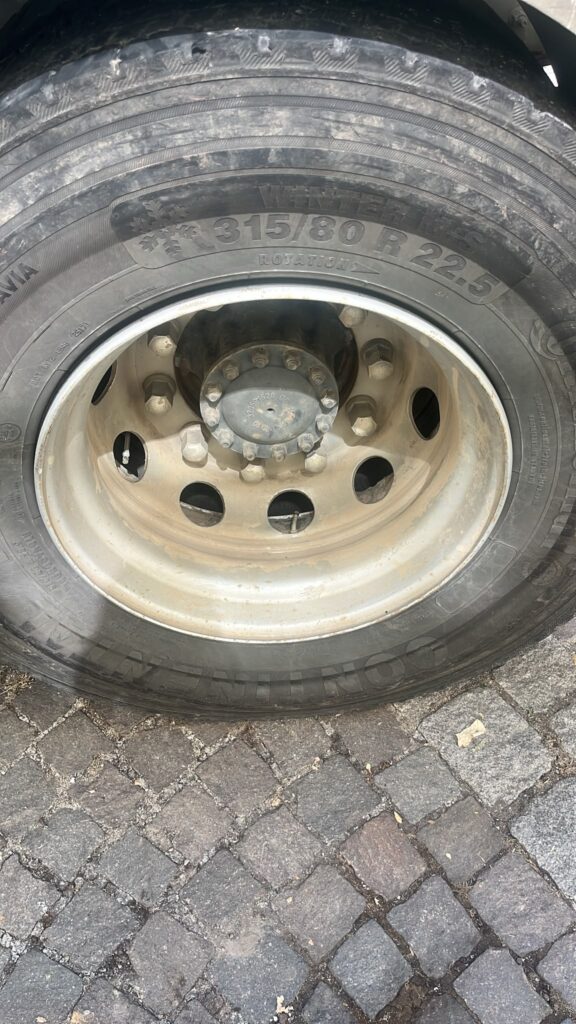
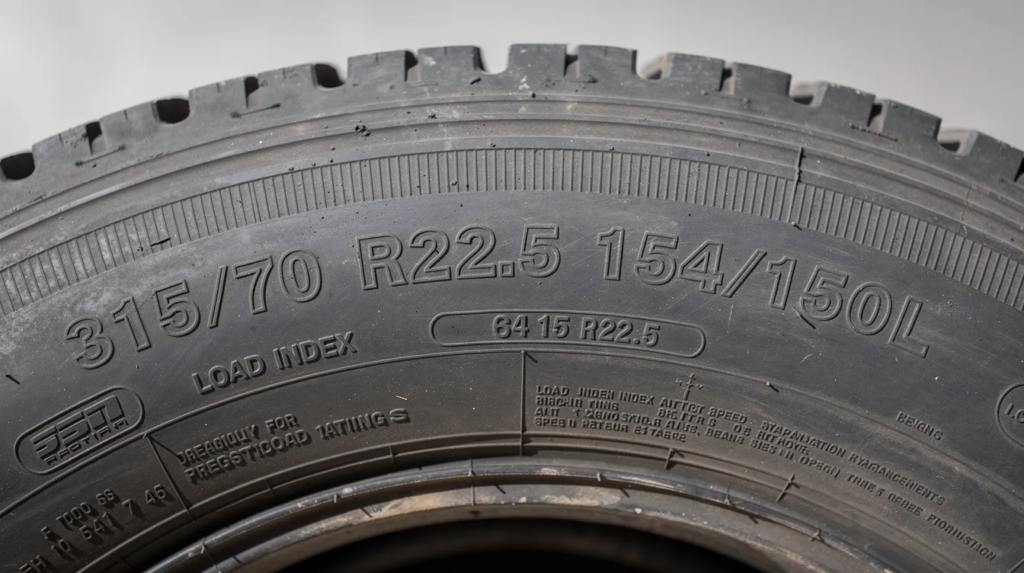
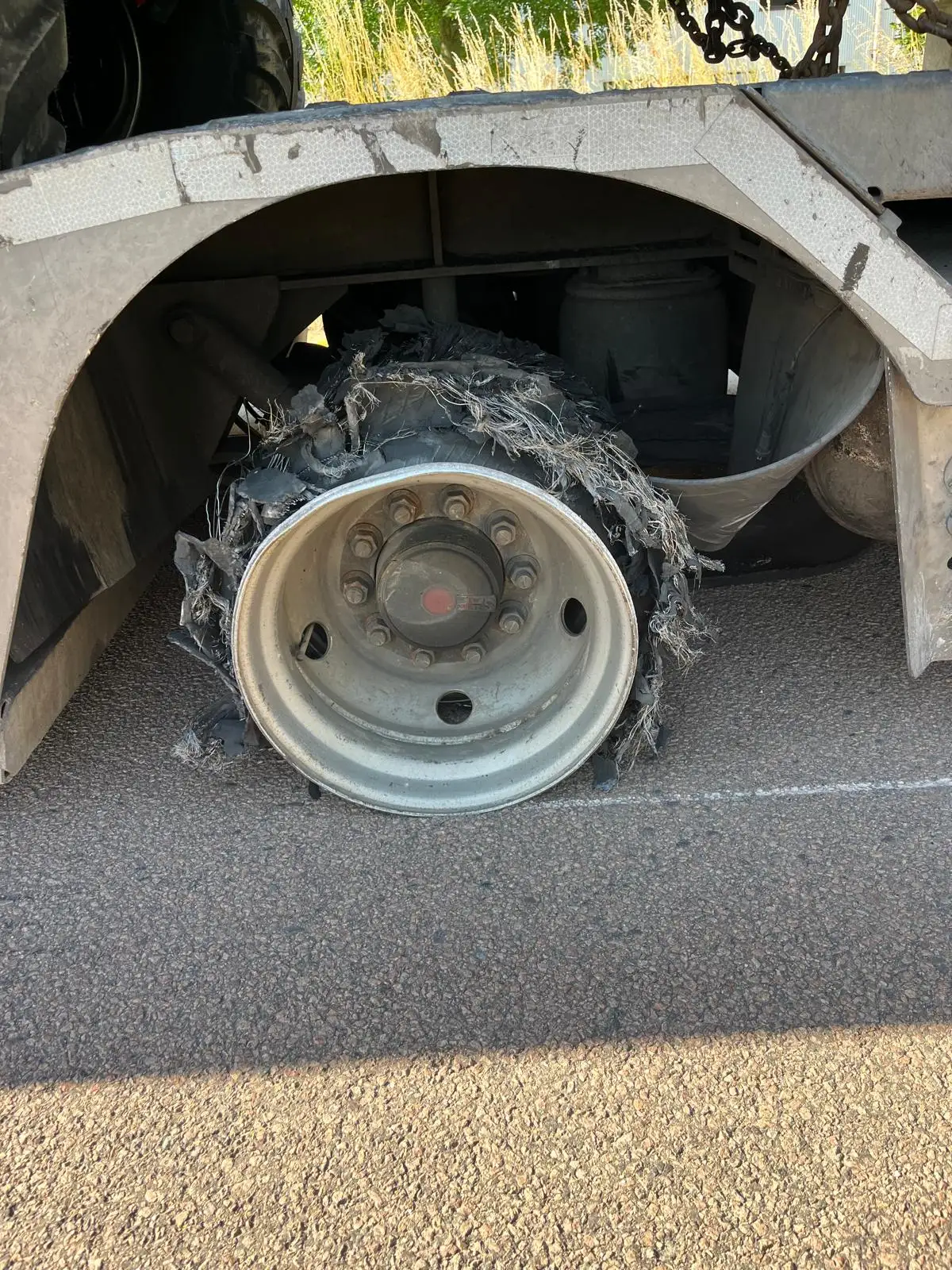
Once the vehicle was safely stopped, the damage was clear: the tyre — a 315/70 R22.5, the standard size fitted to the steer axle of a truck like this — was completely destroyed. Not a slow puncture, not a repairable sidewall nick, but a full carcass failure with the tyre effectively shredded off the rim.
The driver, understandably keen to get moving again without waiting for outside help, tried to change the wheel himself using the truck’s onboard bottle jack. It’s a reasonable first instinct, and plenty of drivers attempt it. But a loaded steer axle on an Iveco Stralis is a different proposition to a car wheel change. The static and dynamic loads on a steer axle are far higher than on a trailer axle, the jacking points need to take that load safely, and a jack rated for occasional light use is not built for lifting a fully freighted 40-tonne combination on a motorway hard shoulder with traffic passing at speed a few metres away. After a few attempts, the driver made the right call and stopped, recognising that this needed a proper mobile tyre service with the correct heavy-duty equipment rather than a workaround that could go badly wrong.
That’s the point at which LKWHelp24 got the call.
How Help Was Organised
LKWHelp24 doesn’t send out a single roaming van and hope it happens to be nearby. The model is a nationwide partner network of vetted, certified truck tyre and breakdown specialists, dispatched by location, so that whichever motorway a driver breaks down on in Germany, there’s very likely a qualified technician within a short drive.
For this case, the steps looked like this:
● Driver calls LKWHelp24’s 24/7 line and gives the location — A8, hard shoulder, direction Munich, near Ulm — plus a description of the damage (steer-axle blowout, 315/70 R22.5, no ability to continue safely).
● Dispatch confirms the vehicle type (Iveco Stralis 480 tractor unit), the exact wheel position (steer axle, front left), and checks that a matching tyre is in stock with a nearby partner.
● A certified LKW-Reifenpartner in the Ulm area is assigned and given an ETA, based on current traffic and distance.
● The driver is told to stay in the cab with hazard lights on, warning triangle placed per German traffic regulations, and to keep away from the live lane while waiting.
● The technician heads out with a fully equipped service vehicle: heavy-duty jack and axle stands rated for truck weights, a suitable replacement tyre, a torque wrench calibrated for wheel nuts, and a mobile compressor for correct inflation on site.
This is the part that’s easy to underrate from the outside: dispatching the right partner, with the right tyre already in stock, to the right spot on a specific carriageway, is what turns a multi-hour ordeal into a job that’s wrapped up before lunch.
The Situation On-Site
A steer-axle tyre failure on the hard shoulder of the A8 is not a job to rush or to under-equip. A few things make this kind of callout genuinely demanding, and worth explaining for anyone who wonders why a mobile tyre service costs what it does.
First, there’s live traffic. The A8 near Ulm carries heavy volumes of both car and lorry traffic, and vehicles pass a stationary breakdown at full motorway speed just metres away. Before any tool touches the truck, the technician has to secure the scene properly — warning triangle positioned well back, hazard lights on, hi-vis worn, and the working area kept as tight and as safe as possible.
Second, there’s the load itself. A steer axle on a fully loaded Stralis 480 carries a substantial static weight, and the jacking and stabilising equipment has to be rated accordingly — this is precisely why the driver’s bottle jack wasn’t adequate and why an amateur attempt at this job is genuinely dangerous, not just inconvenient.
Third, there’s the technical spec of the tyre itself. A 315/70 R22.5 steer tyre is inflated to a working pressure in the region of 8.5 to 9.5 bar, well beyond anything found on a car or van. Getting that pressure wrong — even slightly — affects handling, fuel consumption, and tyre wear, and on a steer axle it directly affects how the truck responds to steering input. This isn’t a tyre you inflate “by eye” with a garage airline; it needs a calibrated gauge and a technician who checks it properly before signing off the job.
Given all of this, the technician assigned to this job worked through the repair methodically rather than quickly for its own sake — which is exactly what you want on a steer axle.
Step-by-Step: What the Crew Did
Step 1 — Assessment and securing the scene. On arrival, the technician confirmed the wheel position, checked the extent of the damage to the tyre and inspected the rim for any signs of impact damage, then secured the area with the warning triangle and hazard lights before touching the vehicle.
Step 2 — Stabilising the vehicle. Heavy-duty jacking equipment rated for the load of a fully freighted steer axle was positioned at the correct jacking points and the tractor unit was raised and stabilised safely, well away from the live carriageway edge.
Step 3 — Removing the damaged wheel. The wheel nuts were released and the destroyed 315/70 R22.5 was removed. With the wheel off, the technician inspected the rim and hub for any secondary damage caused by the blowout — none was found in this case, which is not always guaranteed after a violent tyre failure.
Step 4 — Fitting the replacement. A new 315/70 R22.5 tyre — in this instance a Continental Conti Hybrid HS3, a tyre widely used on German long-haul steer axles for its balance of mileage and wet-weather grip — was fitted to the rim and mounted on the hub.
Step 5 — Final checks. The tyre was inflated to the correct working pressure of 8.5 bar and the wheel nuts were tightened in a star pattern to the manufacturer’s specified torque, which is the only correct method for a steer-axle wheel — tightening nuts in sequence around the circle, rather than one after another, risks an uneven seat and a wheel that can work loose. A final visual and pressure check confirmed the truck was roadworthy before the technician cleared the area.
Full Timeline
| Time | Phase | Action |
|---|---|---|
| 10:30 | Call received | Driver calls LKWHelp24, reports steer-axle blowout on A8 near Ulm |
| 10:42 | Dispatch | Local LKW-Reifenpartner assigned, ETA confirmed |
| 11:18 | Arrival | Technician arrives on the hard shoulder |
| 11:26 | Securing | Scene secured, vehicle safely jacked and stabilised |
| 11:46 | Wheel removed | Destroyed 315/70 R22.5 demounted, rim inspected |
| 12:04 | New tyre fitted | Continental Conti Hybrid HS3 mounted, inflated to 8.5 bar |
| 12:12 | Final checks | Wheel nuts torqued in a star pattern, end inspection |
| 12:15 | Roadworthy | Truck cleared to rejoin the carriageway |
Total elapsed time: roughly 1 hour 45 minutes from call to roadworthy. On-site working time: around 55 minutes.
Cost Breakdown
| Item | Price (EUR) |
|---|---|
| Callout / 24/7 motorway emergency service | 190 |
| Tyre 315/70 R22.5 (Continental Conti Hybrid HS3) | 330 |
| Fitting and balancing on site | 90 |
| Disposal of old tyre | 20 |
| TOTAL | 630 EUR |
A few things worth flagging on price. The callout fee reflects the fact that this is a 24/7 motorway response, not a scheduled workshop booking — the technician, the fully equipped van, and the tyre stock all have to be available at short notice, at any hour, on any day of the week. The tyre itself accounts for over half the bill; premium steer-axle tyres from Continental, Michelin, or Goodyear cost more than budget brands, but on a steer axle this isn’t the place to economise, since tyre quality here has a direct bearing on handling and braking. Fitting and balancing at the roadside, using mobile equipment, typically costs a bit more than the same job done in a workshop bay — that’s the price of not waiting for a flatbed recovery.
For comparison, alternative steer-axle tyres commonly fitted in this size include the Michelin X Line Energy and the Goodyear KMAX S — both solid choices, and LKWHelp24’s partner network carries stock across all three brands so the driver isn’t left waiting for a specific tyre to be shipped in.
Set against the alternative — recovery truck, flatbed transport to a workshop, and the truck sitting off the road for the best part of a day — 630 EUR for a same-morning fix, with the driver back on schedule by lunchtime, is a straightforward calculation for any fleet manager.
Why a Professional Service Is Essential
It’s worth being direct about why the driver’s attempt with the onboard jack was the wrong approach, because it’s a mistake plenty of drivers are tempted to make under pressure:
- A standard truck bottle jack is not rated for the static load of a fully loaded steer axle being lifted on uneven ground at the roadside.
- Working underneath or beside a truck balanced on inadequate equipment, metres from a live motorway lane, is one of the more dangerous situations a driver can put themselves in.
- Wheel nuts tightened without a calibrated torque wrench and the correct star sequence can work loose within a few hundred kilometres — a wheel detaching at speed is catastrophic, not a minor inconvenience.
- Fitting a replacement tyre without checking the rim for hidden damage from the original blowout risks a second failure soon after the first.
- Incorrect tyre pressure on a steer axle changes how the truck responds to steering input, which is not something to guess at with a roadside airline of uncertain accuracy.
None of this is intended to criticise the driver — trying to sort the problem quickly is a natural reaction, and plenty of drivers have managed simpler jobs themselves over the years. But a steer-axle blowout on a loaded artic sits well outside what’s safe to attempt without the right equipment, and recognising that early, as this driver did, is the right call every time.
Typical Breakdown Situations We Handle
LKWHelp24’s partner network covers a wide range of roadside emergencies across Germany, not just tyre blowouts:
- Steer-axle and trailer-axle tyre blowouts and punctures on all major autobahns
- Battery failure and jump-starts for tractor units and trailers with lift axles
- Towing service and recovery for trucks that can’t be moved on site
- Abschleppdienst for accident-damaged or immobilised vehicles
- Lockouts and key issues on modern cab systems
- Fuel and AdBlue issues, including running dry on long stretches without a raststätte nearby
- Air conditioning and cooling system faults on long summer routes
- General mechanical breakdowns requiring diagnosis before towing is even considered
Wherever a driver ends up — a rastplatz on the A7, a parkplatz on the A2, or the hard shoulder of the A8 like in this case — the same dispatch model applies: local partner, right equipment, fast response.
Prevention Tips for Drivers and Fleets
A steer-axle blowout is rarely completely random. A few habits reduce the odds significantly:
- Check tyre pressure on all axles before every long trip, and don’t rely on a visual check alone — a steer tyre can look fine and still be dangerously under-inflated.
- Watch for uneven wear patterns on steer tyres, which often signal alignment or suspension issues that increase blowout risk over time.
- Respect load limits on the steer axle; overloading, even slightly, adds stress that shows up as a sudden failure rather than a gradual one.
- Replace tyres before they’re worn down to the legal minimum, particularly on the steer axle, where the safety margin matters most.
- Keep an eye on tyre age as well as tread — rubber degrades even on tyres that look visually sound, especially after several summers of autobahn heat.
- Know the number for a reliable mobile tyre service before you need it, rather than searching under pressure on the hard shoulder.
For fleet operators, building a scheduled tyre inspection into every service interval, rather than waiting for a driver to report a problem, catches most of these issues before they become a roadside emergency.
Fleet Maintenance and Tyre Options for Steer Axles
Fleet managers running Iveco Stralis, Scania, MAN, or Mercedes-Benz tractor units across German and European routes tend to standardise on a small set of steer-axle tyre brands for good reason: consistency in handling feel across the fleet, predictable wear rates for planning replacement schedules, and availability through partner networks like LKWHelp24’s when something goes wrong on the road.
Continental’s Conti Hybrid HS3, fitted in this case, is a popular choice for mixed long-haul and regional work, offering a solid balance of mileage, wet grip, and steering precision — qualities that matter more on a steer axle than almost anywhere else on the truck. Michelin’s X Line Energy range is frequently specified by fleets prioritising fuel efficiency and total cost per kilometre over the tyre’s working life, while Goodyear’s KMAX S is a common pick for operators who run predominantly motorway routes and want strong wet-braking performance.
Whichever brand a fleet standardises on, the underlying principle is the same: steer-axle tyres are not the place to cut corners on quality, because the consequences of a failure here — as this Ulm case demonstrates — are more severe and more immediate than almost any other component failure on the truck. Regular pressure checks, a sensible replacement interval, and a trusted mobile tyre partner for the inevitable roadside surprise together keep a fleet moving with minimum unplanned downtime.
LKWHelp24: Your Truck Emergency Partner
When a truck breaks down on a German motorway, the driver needs three things fast: someone who answers the phone immediately, a technician who’s genuinely close by, and a fair, upfront price with no surprises on arrival. That’s the entire basis of how LKWHelp24 operates.
- True 24/7 availability — every day of the year, including nights, weekends, and public holidays, because breakdowns don’t check the calendar.
- A certified nationwide partner network, rather than a single van trying to cover the whole country — this is what makes a 48-minute ETA on the A8 near Ulm realistic rather than lucky.
- Transparent, fixed pricing agreed before work starts, so there’s no dispute over the invoice once the job is done.
- Multilingual support, recognising that international hauliers on German autobahns need to be understood clearly and quickly under stressful circumstances.
- Equipment suited to heavy vehicles, not adapted from car breakdown kits — the difference that made this steer-axle job safe and fast rather than a lengthy, risky improvisation.
- Coverage of the full range of breakdown scenarios — tyres, towing, batteries, lockouts, and general mechanical failures — so a driver only needs to remember one number.
Summary
- Vehicle: Iveco Stralis 480 E6 tractor unit
- Tyre size: 315/70 R22.5 (steer axle, front left)
- Location: A8, hard shoulder near Ulm, direction Munich
- Response time: 48 minutes from call to technician on site
- Total job time: approximately 1 hour 45 minutes, call to roadworthy
- On-site working time: approximately 55 minutes
- Total cost: 630 EUR, fixed and transparent
- Secondary damage: none
- Replacement tyre: Continental Conti Hybrid HS3
Request Emergency Assistance Now
If you’re facing a truck tyre blowout, breakdown, or any roadside emergency anywhere in Germany, call LKWHelp24 immediately.
Phone: +49 160 5753826
Website: lkwhelp24.com
Available 24/7 across all of Germany.
You might also be interested in
- Truck Tyre Service on the A3 near Aschaffenburg: Iveco Steer-Axle Emergency
- Steer-Axle Tyre Blowout on the A14 near Leipzig
- Scania Tyre Blowout on the A4 near Dresden: Fast Roadside Response
- How LKWHelp24’s Partner Network Delivers Truck Breakdown Assistance Across Germany
- Understanding Steer-Axle vs Trailer-Axle Tyre Pressure Requirements for Trucks