Skip to content
Incident report: truck stuck in the snow
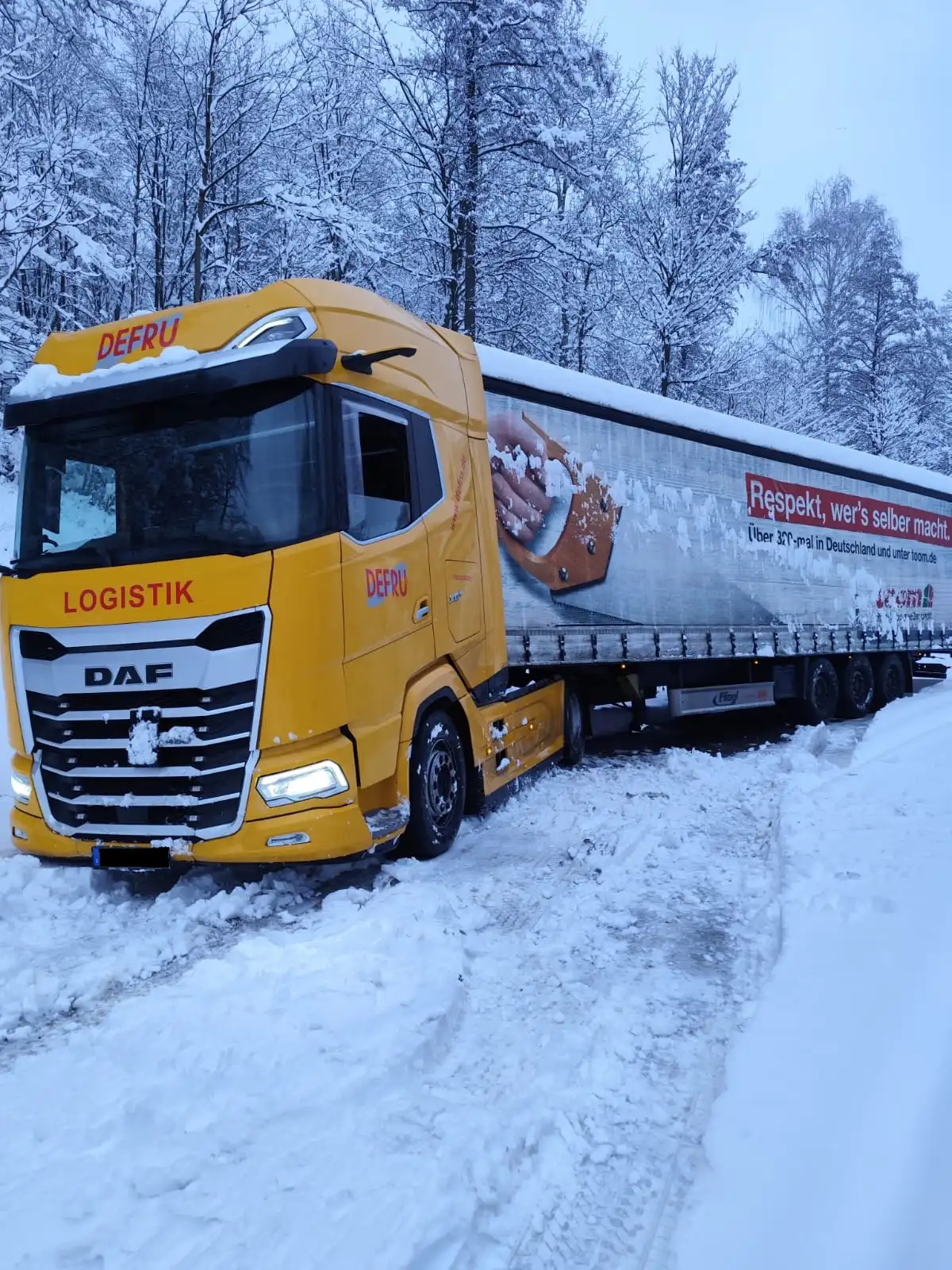
A recent call-out clearly showed just how demanding professional truck towing can be in winter. A fully loaded semi-truck was travelling along a narrow local road when it slid off the carriageway due to snow and ice, and became deeply stuck in a snowdrift, with its wheels losing traction completely and the trailer settling at an awkward angle.
In conditions like these, the obvious question is: what should you do? First and foremost, the vehicle must be brought to a stop in a safe spot so it doesn’t create a hazard for other road users. Throughout the entire towing process, both vehicles must have their hazard lights switched on to warn other traffic. In addition, the connection between the vehicles — for example a tow rope — must be clearly marked, typically with a red cloth or flag.
The situation quickly turned into a complex recovery operation. The driver was unable to free the vehicle on his own — towing was necessary because self-recovery wasn’t possible and the truck posed a risk to traffic. In circumstances like this, roadside assistance must be called, since towing is only permitted in genuine emergencies, for example when a vehicle needs to reach a workshop.
A difficult starting point for roadside assistance
Even at first glance it was clear: this recovery would demand real experience from a professional truck breakdown service, along with the right heavy-duty equipment and a well-thought-out plan of action.
Key challenges:
❄️ Deep snow along the roadside
🚛 Fully loaded trailer (high overall weight)
🛣️ Narrow, unpaved side road
⚠️ Significant tilt of the vehicle
When a truck breaks down in conditions like these, proper preparation is essential. The connection between the vehicles must be made using the designated towing eyes and an appropriate hook.
When towing trucks, choosing the right equipment — a rigid tow bar or a tow rope — is especially important. It must be rated for the vehicle’s weight and must not exceed five metres in length. The actual gross weight of the towed vehicle must not exceed that of the towing vehicle, in line with applicable safety standards. The connection must stay taut and clearly marked at all times to avoid hazards and collisions.
The towed vehicle must have functioning brakes, a working brake pedal, and a functioning steering system. How the braking system performs depends on the vehicle’s technical condition and the type of connection used for towing. On modern vehicles, attention must also be paid to the steering lock, which needs to be released if necessary.
In some cases towing is carried out using a flexible connection, which calls for extra caution and additional safety precautions.
A rigid tow bar offers greater safety for trucks, since it maintains a constant distance and reduces the risk of a collision. A tow rope absorbs jerks better, is cheaper, and easier to transport, whereas a rigid tow bar is heavier and more expensive but transmits braking and pulling forces more directly.
Expert tip: whether you’re using a rope or a rigid tow bar, keep the connection taut at all times. Pull away smoothly and avoid sudden braking. This significantly reduces the risk of an accident.
Towing regulations
Towing a vehicle in Germany is subject to strict legal regulations designed to ensure road safety. Under these rules, the towing vehicle must keep its low-beam headlights on for the entire journey, regardless of the time of day or weather conditions. The speed of the towing vehicle must not exceed 30 km/h in built-up areas and 60 km/h outside built-up areas. This limit is crucial for the safety of both drivers and other road users.
When towing a motor vehicle, the connection between the vehicles must be made in a way that rules out it coming loose while driving. When towing a motorcycle, a flexible connection is required, allowing it to be released easily if needed. Following these rules not only minimises the risk of an accident but also helps avoid fines and other legal consequences. Remember that towing a vehicle should only take place in genuine emergencies and in accordance with the applicable traffic regulations.
Towing on the motorway: special winter challenges
Towing on the motorway is always demanding — in winter, the risk increases markedly. Slippery road surfaces, blowing snow, and reduced visibility turn the whole operation into a serious test for both the driver and the roadside assistance team.
When towing on the motorway, speed must be adapted to winter conditions and a proper distance kept from other vehicles. Hazard lights must be switched on at all times.
Experienced roadside assistance teams know the particular demands of winter motorway towing and ensure the operation runs safely. If in doubt, the operation should be postponed if weather conditions are too dangerous.
On the motorway, towing is only permitted as far as the nearest exit or service area. If the vehicle is seriously damaged or safe towing isn’t possible, a flatbed recovery vehicle should be used instead.
Rules for towing on public roads
Safe towing on public roads requires following specific rules that protect all road users. The towed vehicle should have its sidelights on, and in conditions of poor visibility, the sidelights must remain on at all times. In addition, the towed vehicle may use yellow hazard flashers to increase its visibility to other road users.
With a rigid connection, the distance between the vehicles must not exceed 3 metres, which ensures better control over the combination. If a flexible connection is used, the length should be between 4 and 6 metres, allowing for safe manoeuvring and minimising the risk of a collision. Following these rules is especially important when driving at night or in poor visibility, when it’s easy to miss a towed vehicle. This keeps towing safe and compliant with regulations, without creating a hazard for other road users.
Deploying two heavy recovery vehicles
To recover the vehicle safely, our dispatch team decided to deploy two heavy recovery vehicles. This approach is often necessary with heavy commercial vehicles.
How the operation unfolded:
- securing the scene
- assessment of the situation by technicians
- positioning of two heavy tow trucks
- synchronised pulling of the tractor unit
- stabilisation and return to the road
Thanks to the coordinated work of both vehicles, the truck was freed without any further damage.
What to watch out for when being towed by another vehicle?
Many drivers underestimate what needs to be watched during towing, especially with heavy commercial vehicles, where a single oversight can quickly turn into a costly and dangerous situation.
The most important rules:
- both vehicles must have their hazard lights switched on
- the rope or rigid tow bar must be rated for the vehicle’s weight and no longer than 5 m
- the connection must be clearly marked (e.g. with red cloth)
- towing is only permitted in a genuine breakdown situation
- a vehicle may only be towed to the nearest workshop or a safe location
- the connection must remain taut at all times
- the towed vehicle must have functioning brakes and steering
- a vehicle with defective brakes or a defective steering system must not be towed, unless the towing method makes the use of brakes or steering unnecessary
- only one vehicle may be towed, except for an articulated vehicle
- the combination’s total weight must be taken into account
- use appropriate recovery equipment
- check the stability of the ground
- secure the vehicle against further sliding
- use only professional roadside assistance
- the steering lock must be released
- following the rules is essential for safety
The most common towing mistakes
Towing a vehicle, especially a truck, requires not only the right equipment but also a solid knowledge of the rules and safety regulations. One of the most common mistakes is an improper connection between the vehicles — a tow rope that’s too loose or poorly secured can come loose dangerously while driving. Drivers also frequently forget to switch on their low-beam or sidelights, which significantly reduces the visibility of the combination on the road.
Another serious mistake is towing a vehicle with a faulty braking or steering system. Such negligence can create a genuine hazard for other road users, leading to a loss of control over the vehicle. Ignoring speed limits or driving too fast are further violations that can result in an accident. To tow a vehicle safely, always follow the regulations, regularly check the technical condition of the vehicles, and exercise particular caution on the road.
Assistance insurance
Assistance insurance is invaluable, often indispensable support in the event of a breakdown or accident on the road. With this cover, if technical problems arise, the driver can count on immediate help — from towing the vehicle, to transport to the nearest workshop, to arranging accommodation or a replacement vehicle. In the event of a breakdown, a single call to the insurer is enough to set the entire roadside assistance procedure in motion.
For transport companies and professional drivers, assistance insurance guarantees minimal downtime and a fast return to work. It’s worth checking the general terms and conditions of the policy to make sure the cover includes towing of a heavy goods vehicle and other necessary services. This solution is especially recommended for long-distance routes, when self-towing isn’t an option or when fast, professional help in the event of a breakdown really matters.
Alternatives to towing
Traditional towing isn’t always the best solution — especially for modern vehicles with automatic transmissions, or for electric and hybrid vehicles. Towing such vehicles can cause serious damage to the transmission or other drivetrain components, and can also pose a risk to other road users. In these situations, transporting the vehicle on a flatbed is a much safer option, as it eliminates the risk of further breakdowns.
An alternative to towing can also be an on-site repair, if the fault is minor and doesn’t require a trip to the workshop. Professional roadside assistance, such as LKW Help 24, has the equipment to quickly resolve minor faults without the need for towing. Choosing the right method of transport or repair helps avoid unnecessary costs and hazards for other road users, and ensures the vehicle gets back on the road quickly.
How much does towing a truck cost in a breakdown?
Many customers ask: how much does it cost to tow a truck? It’s worth knowing that towing costs vary depending on the type of vehicle and the situation — towing a passenger car is usually cheaper than towing a truck or a special vehicle.
The cost mainly depends on:
- the weight of the vehicle
- the location of the incident
- accessibility
- the number of recovery vehicles required
- the duration of the operation
In Germany, the cost of roadside assistance for trucks averages 250–300 euros per hour and can be considerably higher for complex winter recoveries. Indicative price ranges and equipment standards for roadside assistance vehicles are published by the German motoring association ADAC.
Specialist equipment instead of a standard tow bar
In situations like this, a standard rigid tow bar isn’t enough. For buried, fully loaded vehicles, you need:
- heavy-duty winches
- high-capacity recovery straps
- synchronised recovery vehicles
- experienced recovery operation leaders
Outcome of the operation
Thanks to a fast response, careful planning, and professional coordination between the two recovery vehicles, the semi-truck was successfully and safely recovered from the snowdrift.
Result:
✅ vehicle freed without damage
✅ driver was able to continue the journey
✅ the road was quickly cleared
✅ no secondary damage
Conclusion: professional, safe truck towing saves time and money
This operation clearly shows: winter recovery operations for heavy vehicles demand real experience, the right technology, and a carefully planned strategy. Improvising in conditions like these can generate very high costs and put both the vehicle and the road users around it at unnecessary risk.
If your truck is stuck in snow, mud, or a ditch, or you simply need fast, reliable help on the road, the experienced experts at LKW Help 24 are available 24 hours a day, 7 days a week, throughout Germany.
Before using a towing service, it’s worth checking the general terms and conditions of your insurance policy to avoid unexpected costs.
📞 24-hour emergency number — fast, reliable help for your truck anywhere in Germany.