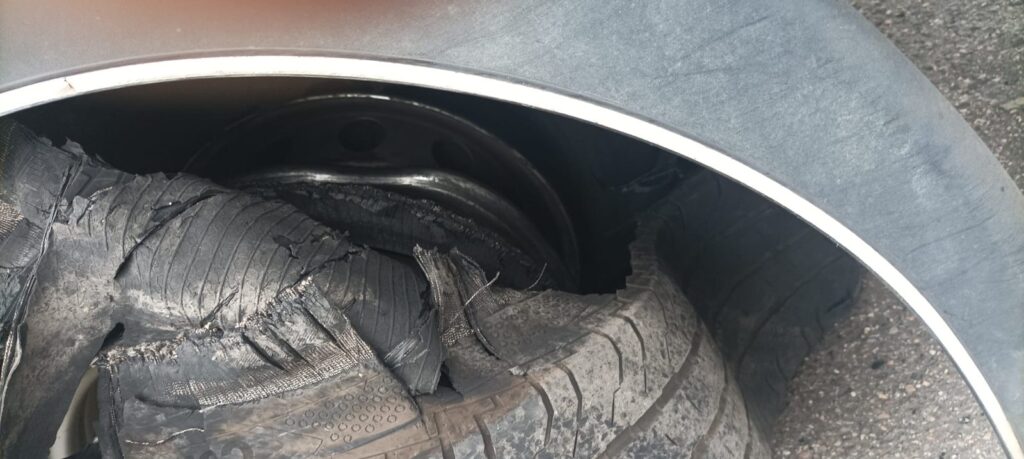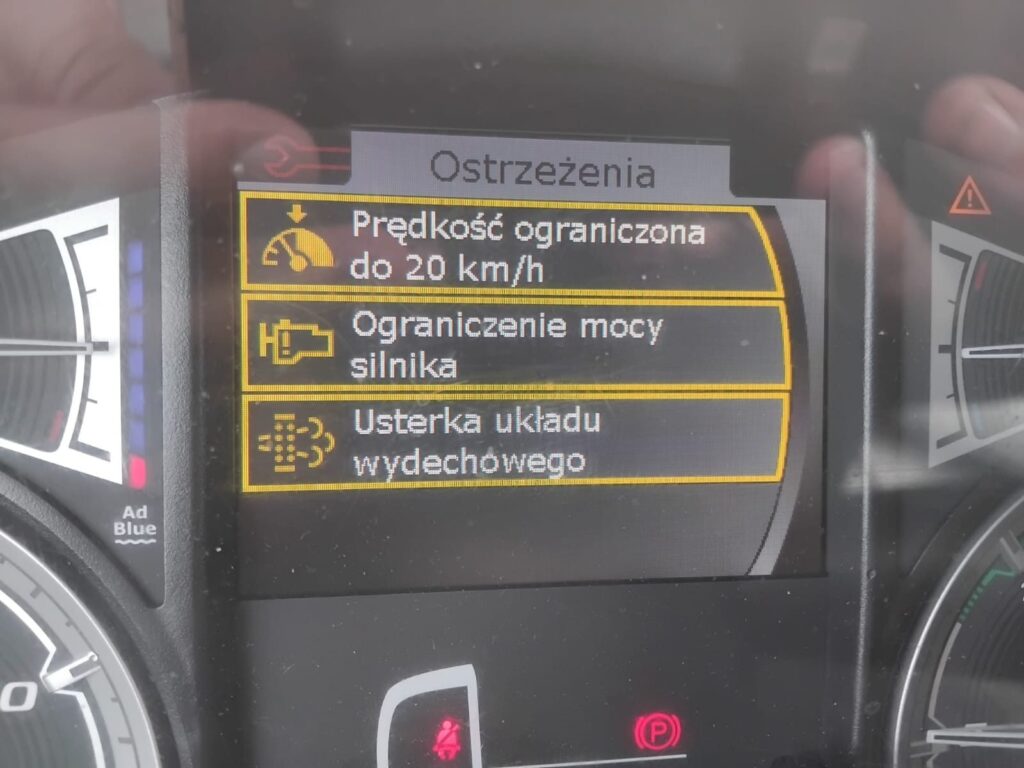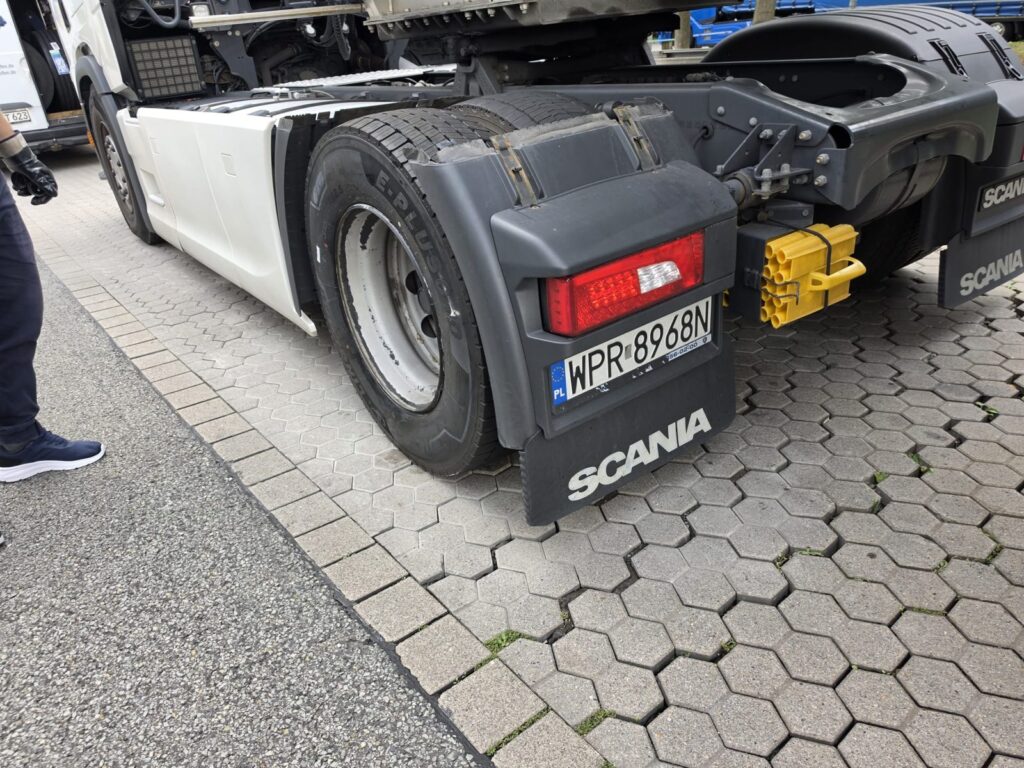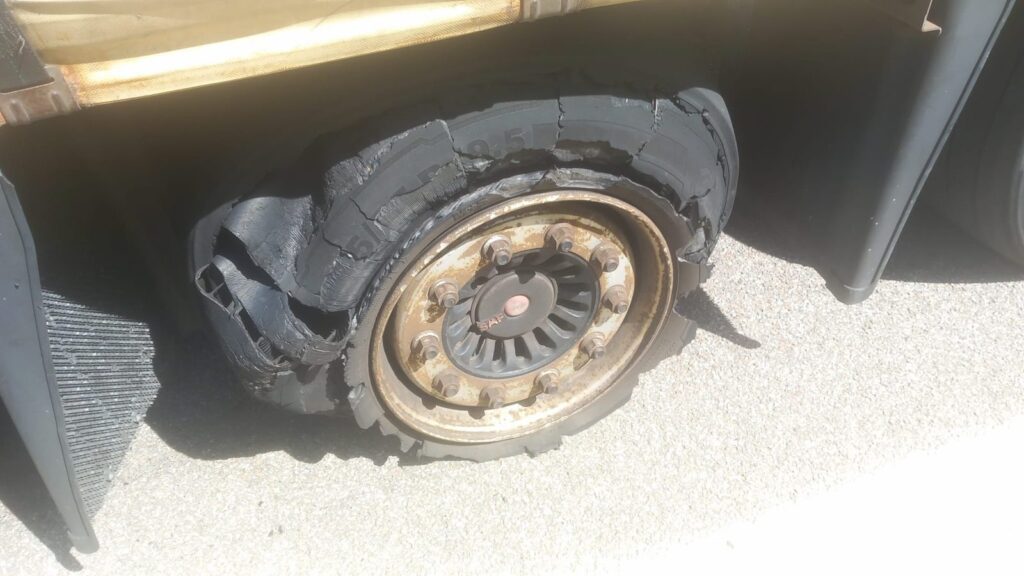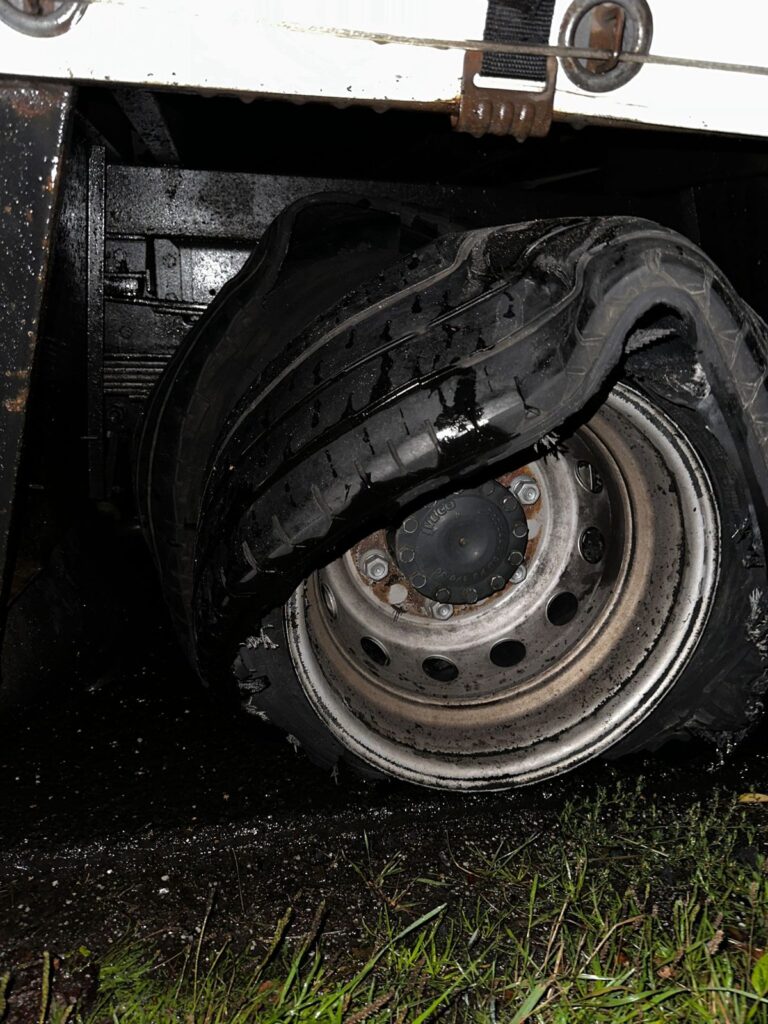
On 26 August 2026 a tractor unit stopped near Montabaur in the Westerwald with a completely shredded tyre on one axle. The driver rang us at 08:10, our partner crew arrived at 09:15, and the lorry was free to leave at 10:35. That is 145 minutes (2 hours 25 minutes) from the first call to a finished job, for €940 net including call-out, labour, a new 295/60 R22.5 tyre and disposal of the old one.
This write-up is for drivers, dispatchers and fleet managers who want to know what a proper truck tyre service looks like when it happens at the roadside in Germany: who does what, how long each phase takes, what it costs and where the real risks are. Every figure comes from the actual job sheet.
A tyre that comes apart on a loaded unit is never just a flat. Shredded casing can wrap round brake hoses, tear sensor cables and gouge the wheel arch, and a driver who keeps rolling on the rim for even a few hundred metres can write off the wheel as well. Here is how the day went and what we would tell any driver in the same spot.
What happened on the A3 near Montabaur?
Short answer: a tractor unit lost a tyre on the A3 heading towards Köln, the driver got off the autobahn safely, and the casing on one axle was torn to pieces.
The unit was a green tractor, running solo, on the Westerwald stretch of the A3 between Frankfurt and Köln, a section with long gradients and heavy lorry traffic at any hour. The driver felt the vibration, heard the tyre go, and did the right thing: he held the wheel straight, eased off the throttle, did not brake hard and rolled to a stop at the first sensible place. He left the autobahn at the next exit and parked on a flat hard-standing next to the road. That decision made everything that followed simpler, because working on an open hard shoulder is where most roadside injuries happen.
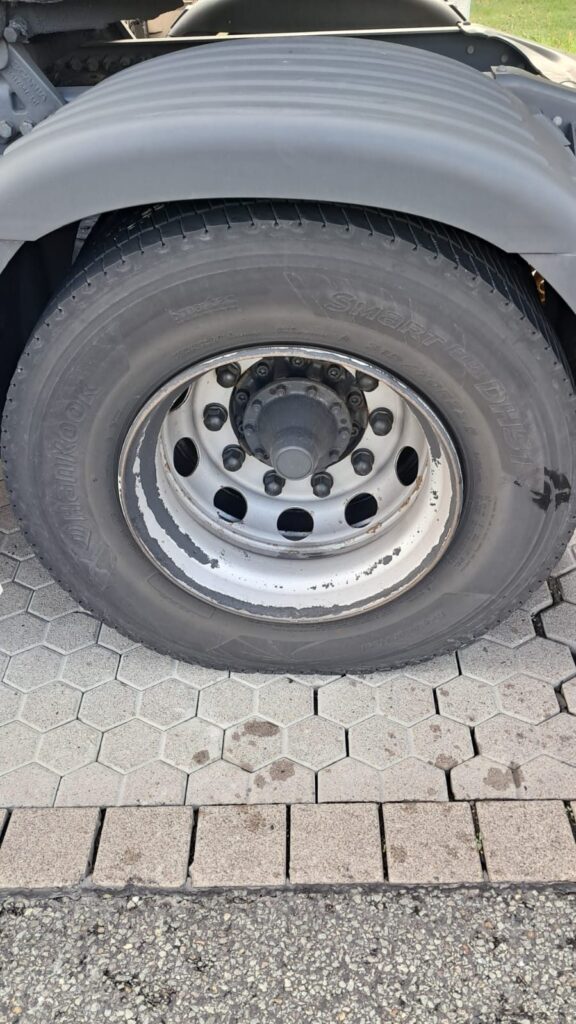
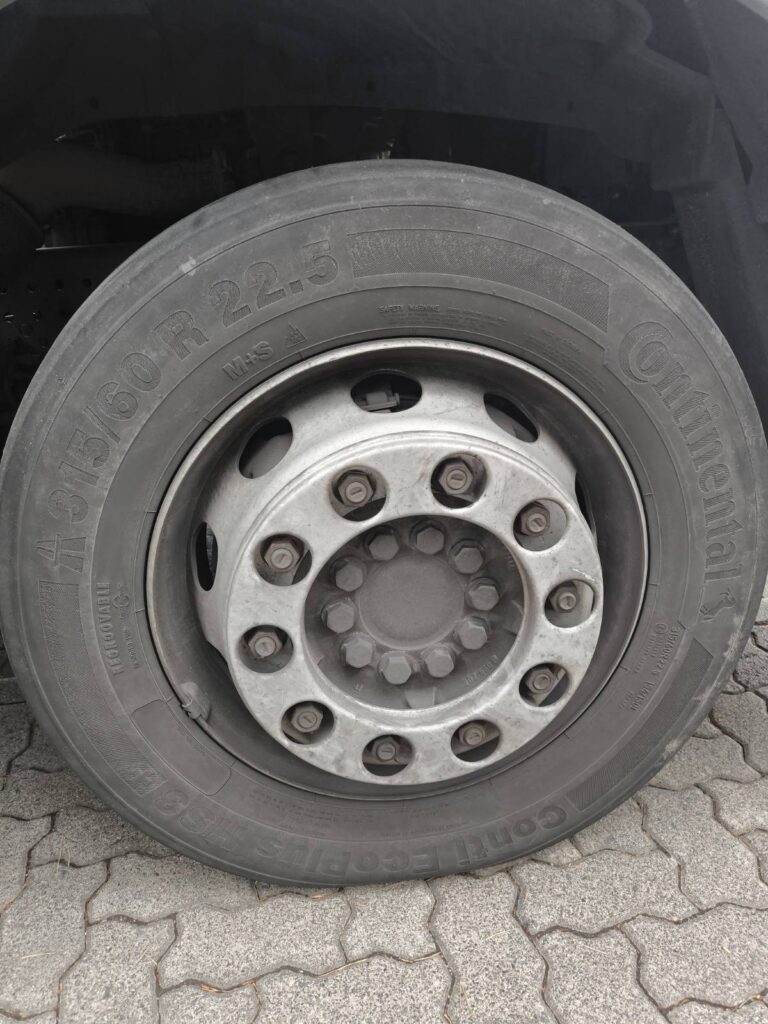
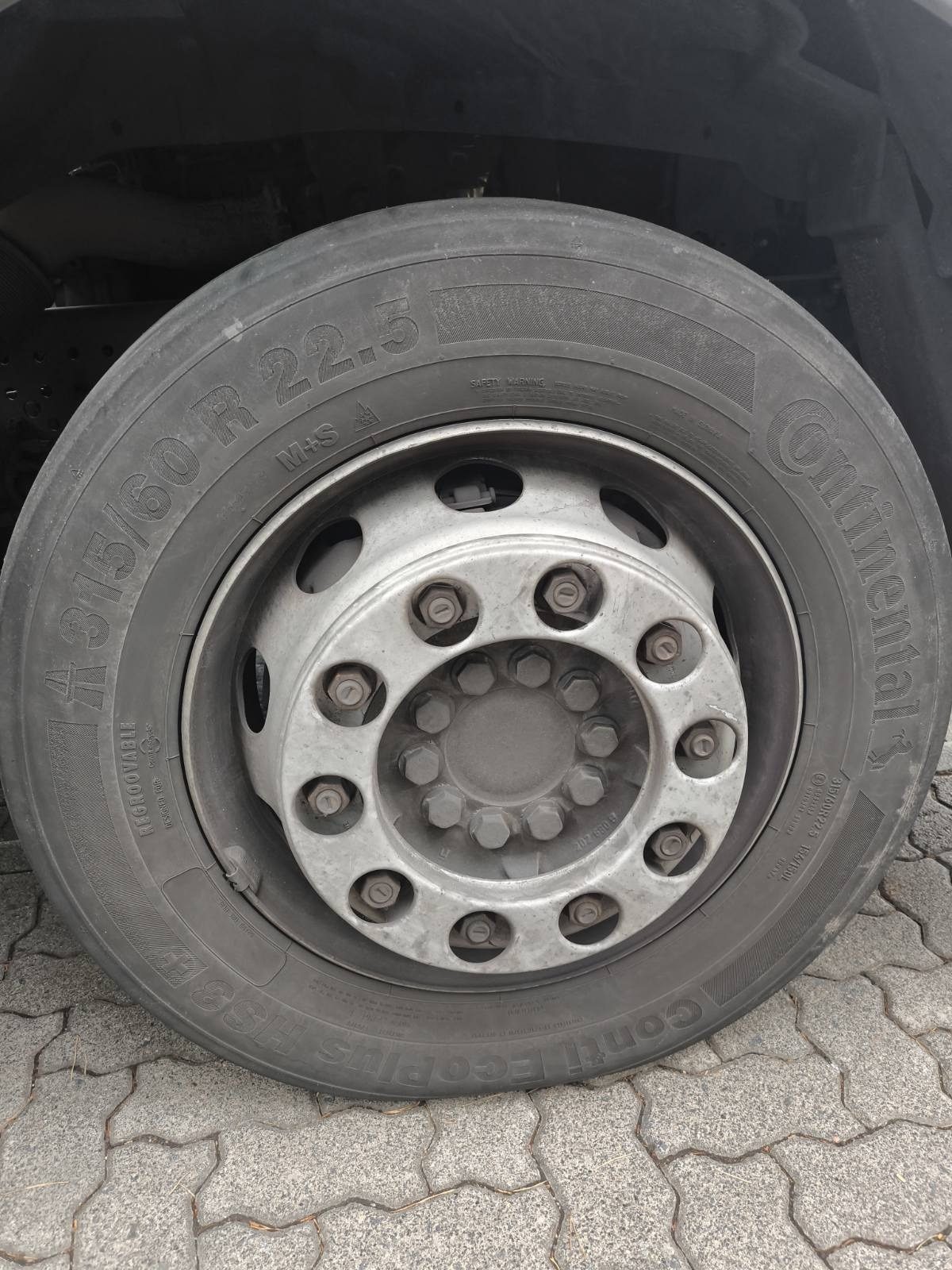
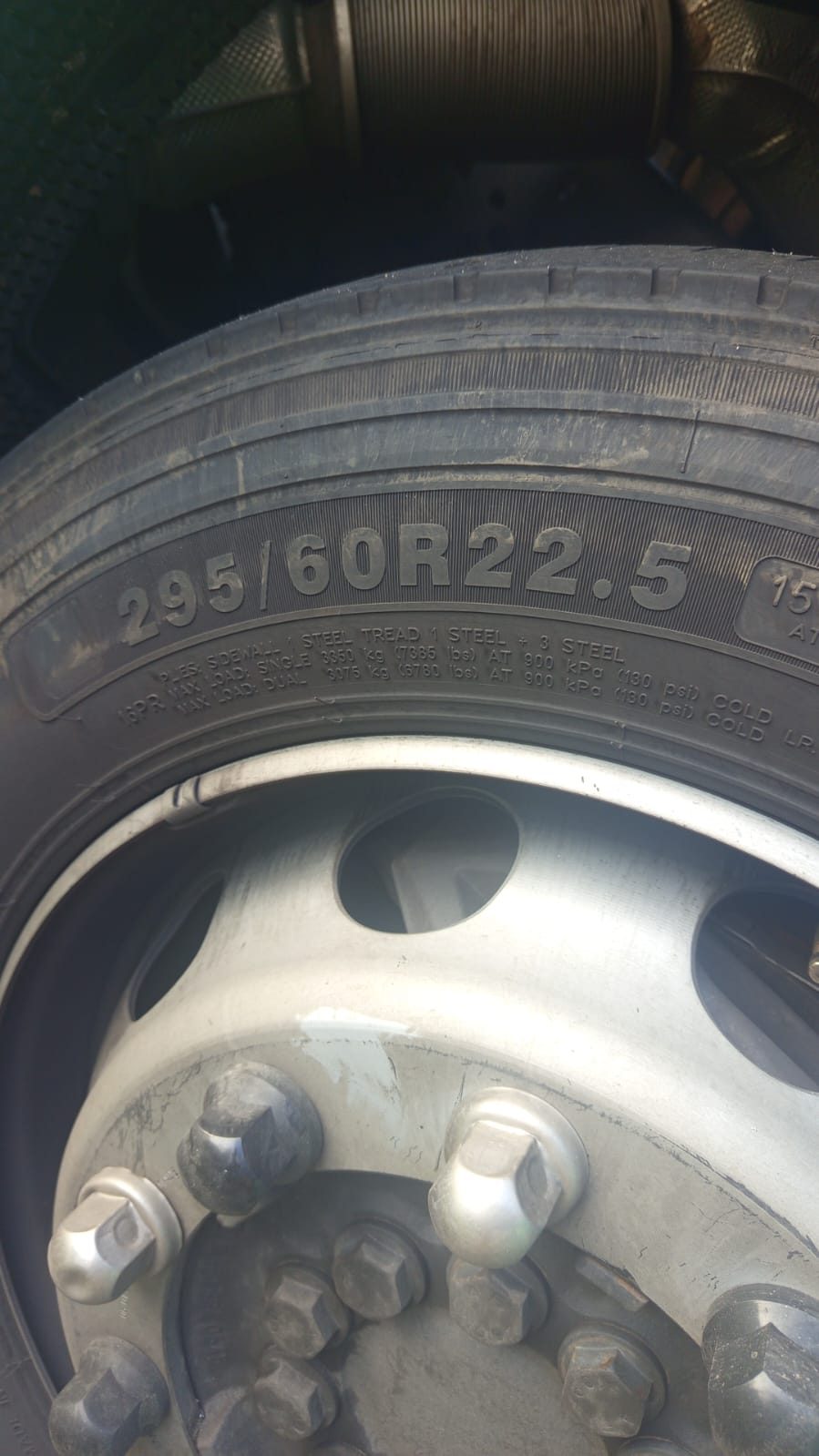
When he walked round the vehicle, the picture was clear. One tyre on the axle was gone from the tread outward, and torn strips of rubber and steel cord were jammed up in the wheel arch. The neighbouring tyre was intact and still carried its moulded markings: 295/60R22.5, 16 ply rating, single load around 3,650 kg and dual load around 3,075 kg, maximum inflation 900 kPa (130 psi). The steel wheel nuts with their caps were all in place. Overcast sky, dry ground, no rain, which matters because wet weather slows every step of a roadside job.
TL;DR: call at 08:10, crew dispatched at 08:25, on site at 09:15, wheel refitted by 10:30, vehicle released at 10:35. Total 145 minutes. Price €940 net.
How did we organise the help?
Short answer: one phone call, a size check, and a mobile crew from our partner network dispatched within 15 minutes.
Our dispatch desk works around the clock, in several languages, and the first minutes of a call decide how fast the job goes. Here is what happened, in order:
- 08:10, the call. The driver reported a destroyed tyre and a stationary tractor. The dispatcher asked the four questions that matter: exact tyre size, which axle, where the vehicle is standing, and whether the unit can be moved.
- Size confirmed from the sidewall. The driver read out 295/60 R22.5 from the neighbouring tyre. Matching the size by phone avoids the classic mistake of a crew arriving with the wrong tyre.
- 08:25, dispatch. We found a mobile crew from our regional partner network, confirmed that a 295/60 R22.5 was in stock on their van, and gave the driver an arrival window. Fifteen minutes from call to dispatch is normal when the size is known.
- Status during the wait. The driver was told to put on his hi-vis vest, keep the warning triangle out if he was near traffic, stay out of the wheel arch area and not to pull at the loose rubber himself.
- 09:15, arrival. The crew needed 50 minutes on the A3, which is typical for the Westerwald corridor at that time of day.
Nobody had to look for a tyre dealer, call three workshops or wait for opening hours. If you want to see how the whole service is set up, our page on mobile truck service in Germany explains the coverage and the response process.
Why you must not drive on after a tyre shreds
Short answer: because the casing debris, the exposed wheel rim and the extra load on the neighbouring tyre can cause far bigger damage within minutes.
A truck tyre runs at roughly 8.5 to 9.5 bar. When it fails, the stored energy is released in a fraction of a second, and the remaining tyre on a twin pair suddenly carries the full axle load. On a drive axle with a 295/60 R22.5 tyre rated for about 3,075 kg in dual fitment, that sudden overload can overheat and destroy the second tyre as well.
The risks of limping on look like this:
- steel cord and rubber strips wrapping round brake hoses, ABS sensor cables and air lines behind the wheel;
- rim edges digging into the road surface, which deforms the aluminium or steel wheel beyond repair;
- fragments thrown backwards at following traffic, a real hazard on an autobahn with 80 km/h lorries and 130 km/h cars;
- heat in the remaining tyre, which can ignite or delaminate;
- police checks: under § 36 StVZO tyres must be roadworthy, and a driver who carries on with a ruined tyre risks a fine and a prohibition on further travel.
If the casing is gone, the vehicle stays where it is until a crew arrives. That is a hard rule in our dispatch, and the reason we ask drivers not to try the spare unless they have the equipment and training for it.
Step by step: how the tyre was replaced
Short answer: inspect, secure, remove, refit, check. Five steps, about 80 minutes on site.
The work started at 09:15 and ended at 10:35. Here is the sequence, with the clock times from the job sheet.
Step 1: inspection (09:26)
The technician checked the wheel, the hub, the wheel arch and the surrounding components before touching anything. He photographed the damage for the record, measured the pressure and condition of the neighbouring 295/60 R22.5, and looked for cuts in brake hoses or cables. Hub and studs were fine. The only visible damage was the destroyed tyre and the debris in the arch.
Step 2: making the vehicle safe (09:35)
Wheel chocks went under the opposite axle, the parking brake was confirmed, and the jack was positioned on a solid point of the axle housing on dry tarmac. Before lifting, the crew cleared the torn casing out of the arch by hand. This sounds like a minor detail but it is not: a strip of steel cord left in the arch can snag again on the first bump after the job.
Step 3: wheel removal (09:50)
The nuts were loosened in sequence, the wheel was lifted off, and the rim was inspected. The alloy rim showed no cracks, no flat spots and no deformation, which is the best possible result after a blowout. The wheel studs (Radbolzen) were checked for stretched threads and damage. All good.
Step 4: new tyre mounting and balancing (10:10)
A new 295/60 R22.5 truck tyre was fitted onto the rim. The bead seat was cleaned, the tyre lubricated and mounted, then inflated to the pressure specified for the axle load. Balancing followed, because even a small imbalance on a drive or steer axle shows up as vibration and uneven wear within a few thousand kilometres.
Step 5: refit, torque and final check (10:30)
The wheel went back on, and the nuts were tightened in a cross pattern (the “star” sequence) with a calibrated torque wrench to the manufacturer’s specification. The crew then checked the inflation pressure on both tyres of the pair and looked one last time at hoses, sensors and the inside of the arch. At 10:35 the lorry was released.
For a deeper look at tightening values, our wheel nut torque table for trucks lists the usual specs by nut size.
Full timeline: from call to driving away
Short answer: 145 minutes, of which roughly 65 were travel and waiting, and 80 were hands-on work.
| Time | Phase | Action |
|---|---|---|
| 08:10 | Call | Driver reports a shredded tyre and a stationary tractor. Dispatcher confirms size 295/60 R22.5, axle and location |
| 08:25 | Dispatch | Mobile crew from the partner network assigned, tyre of the right size confirmed in stock (15 min) |
| 09:15 | Arrival | Crew on site after 50 minutes on the A3 |
| 09:26 | Inspection | Wheel, hub and arch checked, damage photographed, neighbouring tyre measured |
| 09:35 | Securing | Chocks, jack, arch cleared of casing debris |
| 09:50 | Removal | Wheel taken off, rim and wheel studs inspected |
| 10:10 | Mounting | New 295/60 R22.5 on the rim, inflated and balanced |
| 10:30 | Finish | Wheel fitted, nuts tightened in star pattern with torque wrench, pressure checked |
| 10:35 | Done | Tractor unit released |
Total: 145 minutes (2 hours 25 minutes).
A caveat from experience: the arrival time depends heavily on traffic and weather. In rain, in a snow shower or during the Friday afternoon peak, the same journey takes 70 minutes or more. At night the on-site work is slower because of lighting, so we plan an extra 15 to 30 minutes.
What did the job cost?
Short answer: €940 net, which breaks down into call-out €240, labour €140, tyre €540 and disposal €20.
| Item | Price (EUR) |
|---|---|
| Call-out (Anfahrt) | 240 |
| Labour, 1.25 h at €110/h | 140 |
| New truck tyre 295/60 R22.5 | 540 |
| Disposal of the old tyre | 20 |
| TOTAL | 940 |
All amounts are net, plus VAT (zzgl. MwSt.). The invoice shows each line separately, so a fleet accountant can book it without questions.
What drives the price of a truck tyre callout
Four things move the number up or down:
- Distance and time of day. The call-out fee reflects the crew’s travel. At night or on a weekend a surcharge of 25 to 50 per cent usually applies.
- Tyre size and brand. A 295/60 R22.5 sits in the middle of the range. A steer-axle tyre from a premium maker costs more than a budget regional tyre; a wide-base single costs more again.
- Damage beyond the tyre. Here the rim was undamaged. A bent rim, a ruined valve or damaged hoses add parts and time. We tell the driver before the work starts if the picture changes.
- Number of tyres. If the second tyre of a pair is also finished, the labour per tyre drops, but the bill rises.
The comparison most fleets forget
A tractor unit standing idle costs a carrier roughly €800 to €1,200 per day in lost revenue, driver wages, missed slots and contractual penalties. A two-and-a-half-hour fix at €940 is therefore the cheaper outcome even before you count the risk that a shredded tyre damages something more expensive. If you want to compare with workshop prices, our guide to what a truck tyre change costs puts the roadside price in context.
Why a professional crew and not the driver?
Short answer: because a truck wheel weighs 60 to 80 kg, the tyre is under high pressure, and mistakes show up as accidents, not as inconvenience.
Many drivers are capable and have changed wheels before. Yet the reasons to leave this job to a trained crew are practical rather than a matter of pride:
- a 295/60 R22.5 on a steel or alloy rim is heavy and awkward, and a slipped jack on a slope is a serious injury;
- the driver does not carry a calibrated torque wrench that reaches the specified value, and a loose nut can cause a wheel to leave the vehicle;
- inflating a mounted truck tyre needs a safety cage or at least a proper hose and gauge, since a bead failure at 9 bar is dangerous;
- the old casing has to be disposed of legally;
- the driving and rest time clock keeps running while the driver struggles, and a Lenkzeit violation is expensive on its own;
- the manufacturer or insurer may refuse to cover consequential damage after an improvised repair.
We are not saying a driver should never reach for a wheel brace. For a simple trailer wheel on a flat yard with the right kit, it can work. For anything on the autobahn, anything with debris round the hoses, or any dual-axle drive wheel, call a professional.
What if it happens at night or in poor weather?
Short answer: the process is identical, but plan for 30 to 90 minutes more and for a surcharge.
Our dispatch runs 24 hours a day, 365 days a year. At night we tell the driver to stay in the cab with the doors locked until the crew arrives, unless the vehicle is somewhere unsafe. The crew works with floodlights and a portable lamp. In heavy rain, the technician mounts the tyre inside the van where possible, or under a canopy.
A short checklist for any driver stuck outside daylight hours:
- Switch on the hazard lights and put on the hi-vis vest.
- Position the warning triangle according to the local rules on that road class.
- Move away from the vehicle and behind the crash barrier if you are on a hard shoulder.
- Call dispatch and give the tyre size, axle and location.
- Keep the phone charged and the engine off.
Our tyre blowout checklist for the autobahn walks through those steps in more detail.
Typical situations where we are called out
Short answer: most truck tyre callouts in Germany fall into six categories.
Our crews go out all over the country. The jobs that come up most often are:
- Blowouts on the steer or drive axle, as in this case, often from heat after a long run on a hot day;
- Punctures from screws, nails and road debris, which can sometimes be repaired if the damage is in the tread and the casing is sound;
- Trailer tyre failures on reefer or curtain-sider semi-trailers, typically 385/65 R22.5;
- Van tyres on delivery vehicles, 235/65 R16C, where the fix is quick and cheap;
- Rim damage after kerb contact or driving on a deflated tyre;
- Seasonal wheel changes and pre-trip checks for fleets that want to avoid breakdowns on the road.
When the problem is not only the tyre, the same crew can bring in a truck workshop colleague, or arrange recovery if the vehicle cannot be moved safely.
How to prevent tyre failures
Short answer: check pressure weekly, tread depth monthly, and look for cuts and bulges at every walk-round.
Most roadside tyre failures are visible days or weeks before they happen. A short routine saves a lot of money:
- Pressure. Measure cold, with a gauge you trust. A tyre running 15 per cent under pressure overheats and wears fast, and it is the main cause of casing failure on long summer runs.
- Matching twins. Dual tyres should be the same make, size and wear. A difference of more than a few millimetres in diameter makes one tyre carry more than its share.
- Tread depth. The legal minimum for lorries is 1.6 mm, but fleets should replace steer tyres much earlier, around 3 mm.
- Visual checks. Look for cuts, bulges, embedded stones and uneven wear at every stop.
- Correct size. Make sure the replacement matches the markings. The ETRTO publishes the standards for tyre and rim dimensions and load ratings.
- Wheel nuts. Re-torque after any wheel work, usually after 50 to 100 km.
- Valve caps and stems. Missing caps let in dirt and moisture and cause slow leaks.
- Axle alignment and brakes. A binding brake or misaligned axle eats a tyre in weeks.
Fleet managers should also keep a record of tyre age (the four-digit DOT code), retread history and pressure checks. A simple spreadsheet is enough; the point is to see patterns before they cost you a day.
Truck tyres and fleet maintenance: a short overview
Short answer: premium tyres cost more up front but are usually cheaper per kilometre, and retreading extends the life of a good casing.
Brand choice matters. Michelin, Continental, Goodyear and Bridgestone all make long-haul and regional ranges with proven casings. Continental’s HS3 family, for example, is aimed at steer and all-position use on regional and long-haul work, and many fleets stay with a single brand to simplify stock and warranty. You can read about the current ranges on the Continental truck tyre site.
Some practical points when buying and managing tyres:
- Steer, drive and trailer tyres are not interchangeable. Each has a tread pattern and casing optimised for its position.
- Load index and speed symbol. For a 295/60 R22.5 the load index is typically 150/147 for single and dual use; always check the sidewall.
- M+S and 3PMSF. The M+S mark indicates mud and snow capability; the three-peak mountain snowflake is the real winter rating. Germany’s winter rules for commercial vehicles depend on the weather, not on a calendar date.
- Retreading. A sound casing can be retreaded once or twice on drive and trailer axles, which cuts tyre costs by a large margin. Steer axles should usually run new tyres.
- Tyre pressure monitoring. A TPMS system pays for itself the first time it warns of a slow leak on a 40-tonne combination.
- Spares. Carrying a spare on a tractor is rare today, so a roadside contract matters more than a spare in the locker.
For fleets that want a standing arrangement, we also offer a reliable emergency tyre service for trucks on a call-when-needed basis, with no monthly commitment.
Why do drivers and fleets call us?
Short answer: because we answer at any hour, we send a real crew and we show the price before the work starts.
Our approach is straightforward, and the case above is a typical example:
- 24/7 dispatch with staff who speak German, English, Polish and Russian, so a driver from Lithuania or Poland does not have to explain a tyre size through an interpreter;
- a vetted partner network of mobile crews across Germany, selected for equipment and response time rather than the lowest tender;
- price transparency: the call-out, labour, tyre and disposal appear as separate lines, net, with VAT added;
- photographed documentation of the damage, useful for insurers and fleet managers;
- no pressure to buy extras. If the second tyre looks fine, we say so.
If you want to talk to us before you need us, the contact page has all numbers and details.
FAQ: truck tyre service in Germany
How much does a mobile truck tyre replacement cost on the autobahn?
Typically between €750 and €1,400 net for a lorry, depending on size and time of day. In this case it was €940 net for a 295/60 R22.5, including call-out, 1.25 hours of labour and disposal. Night and weekend work carries a surcharge of 25 to 50 per cent.
How long does a truck tyre change at the roadside take?
Expect between 1.5 and 3 hours from the call to the finished job. Dispatch takes 10 to 20 minutes, travel 35 to 70 minutes, and the work itself 45 to 90 minutes. On the A3 near Montabaur the total was 145 minutes.
Can a shredded truck tyre be repaired?
No. When the casing is torn apart, there is nothing to repair, and the tyre must be replaced. Only small punctures in the tread, with an intact casing, can be repaired professionally.
Should I keep driving to the next exit after a blowout?
Only if it is safe, at walking speed, and only to leave the carriageway. Do not drive far on a shredded tyre: the debris can damage hoses and sensors, and the rim deforms quickly. Stop, secure the vehicle and call.
What information does the dispatcher need from me?
Tyre size (read from the sidewall, for example 295/60 R22.5), the axle position, your location with road number and direction, and whether the vehicle can move. With those four points, the crew is on its way within 15 minutes.
Does the price include VAT?
No. All our quotes and invoices are shown net, plus VAT at the statutory rate, which suits companies that can reclaim input tax.
Summary
| Parameter | Value |
|---|---|
| Date | 26 August 2026 |
| Location | A3 near Montabaur (Westerwald), towards Köln |
| Vehicle | Tractor unit, green, solo |
| Fault | One tyre completely shredded, debris in wheel arch |
| Tyre size | 295/60 R22.5, 16 PR, 900 kPa |
| Call received | 08:10 |
| Crew dispatched | 08:25 (15 min) |
| Crew on site | 09:15 (50 min travel) |
| Job finished | 10:35 |
| Total time | 145 minutes (2 h 25 min) |
| Total cost | €940 net |
| Secondary damage | None: rim intact, arch cleared, brake hoses and sensors undamaged |
Call us if a tyre lets you down
If a tyre fails on the road, do not gamble with a limp to the next town. Call us on +49 160 5753826 or visit www.lkwhelp24.com. Our dispatch is available round the clock across Germany, and a crew will be on its way as soon as we have your tyre size and location.
Keywords: truck tyre service | truck tyre replacement | truck tyre change | truck tyre callout | truck tyre roadside assistance | truck tyre repair | truck tyre breakdown Germany | truck tyre blowout | trailer tyre service | mobile truck tyre service | 295/60 R22.5 | A3 Montabaur
Related articles
- Emergency Tire Service for Trucks: Fast Help Around the Clock
- Tire Blowout on the Autobahn: The Immediate Action Checklist for Truck Drivers
- Truck Tire Change Cost: What a New Tire Really Costs
- Emergency Wheel Change on a Truck: What to Do After a Tyre Blowout on the Motorway
- Tyre Blowout on a Mega-Trailer on the A8 near Rosenheim: Why the Hard Shoulder Is the Most Dangerous Place to Work