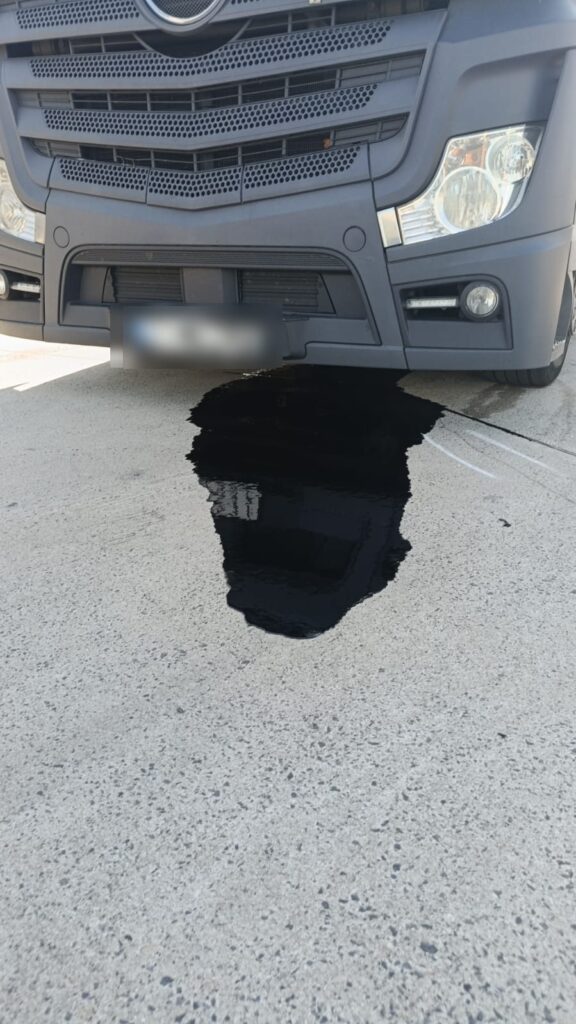
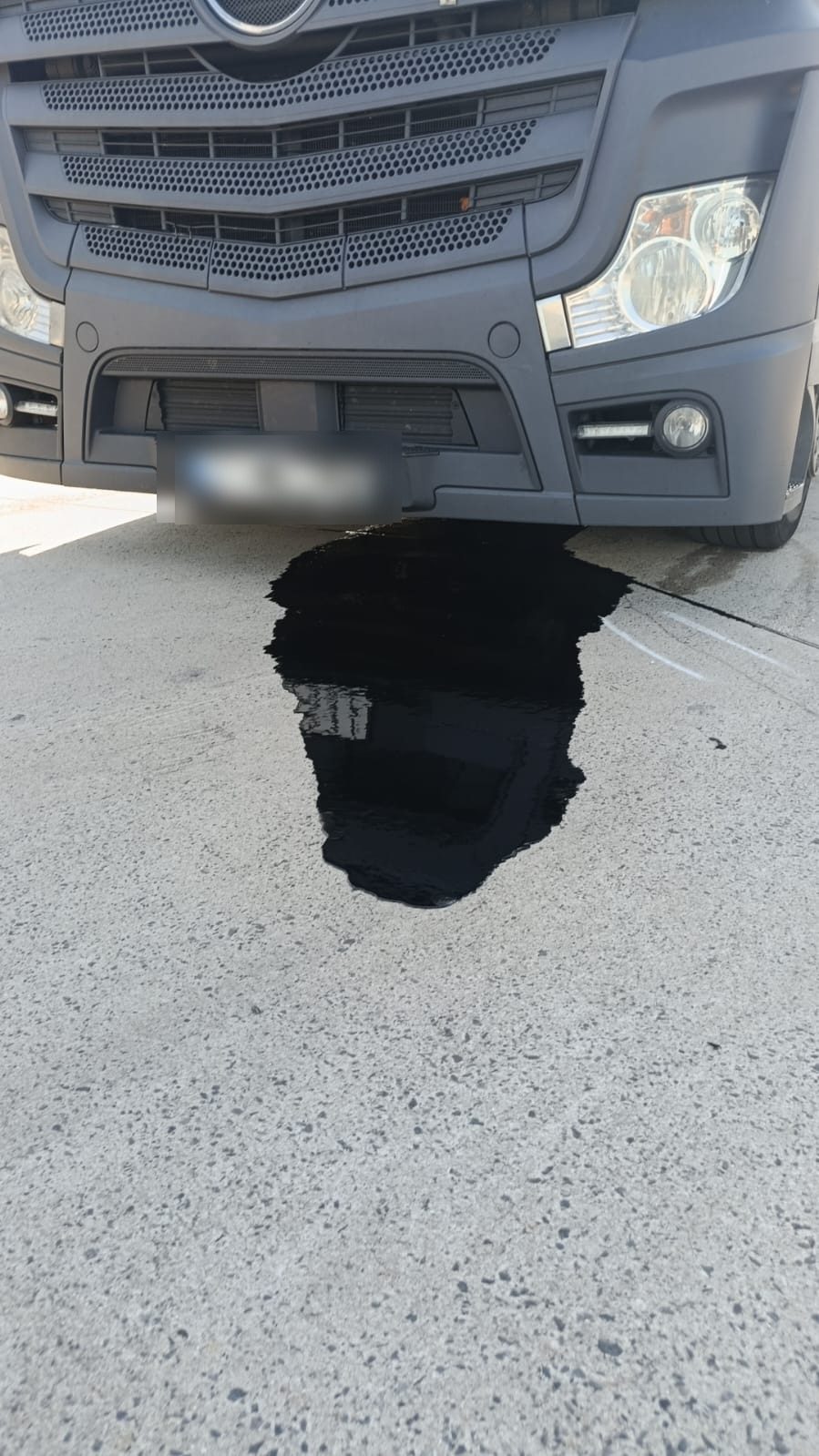
A tractor unit sitting in its own oil is not a minor annoyance. On a bright morning at a car park beside the A5 near Karlsruhe, a driver found a black puddle about a metre across under the front of his Mercedes-Benz Actros, and the engine stayed switched off. Our mobile truck service reached the site 60 minutes after the call, found the leak, replaced the damaged oil line and seals, topped up the engine and released the vehicle after 135 minutes. The net cost was 920 EUR, and no tow was needed.
This write-up follows the job minute by minute. It explains why a leak like this has to be taken seriously, what a roadside diagnosis actually involves, how the price of 920 EUR is made up, and what the alternative would have cost. If you run a fleet or drive a tractor unit yourself, you can use it as a checklist for the next time oil appears where it should not.
What happened: oil under a tractor unit on the A5
The Actros belonged to a Polish haulier and was parked on a hard-standing beside the motorway, heading for Basel. The driver had spent the night in the cab. When he climbed down in the morning to do his walk-round, he saw the pool under the front axle, bright black on pale concrete, with fresh drops still falling from the engine area. He did not start the engine. That single decision saved the vehicle from a much larger bill.
He phoned our dispatch line at 10:26, local time. The weather was dry and clear, which mattered for the job: working under a cab in the rain is slower and less safe. His first message was short and to the point. There was a lot of oil under the lorry, the engine had not been started, and he had no idea where it came from.
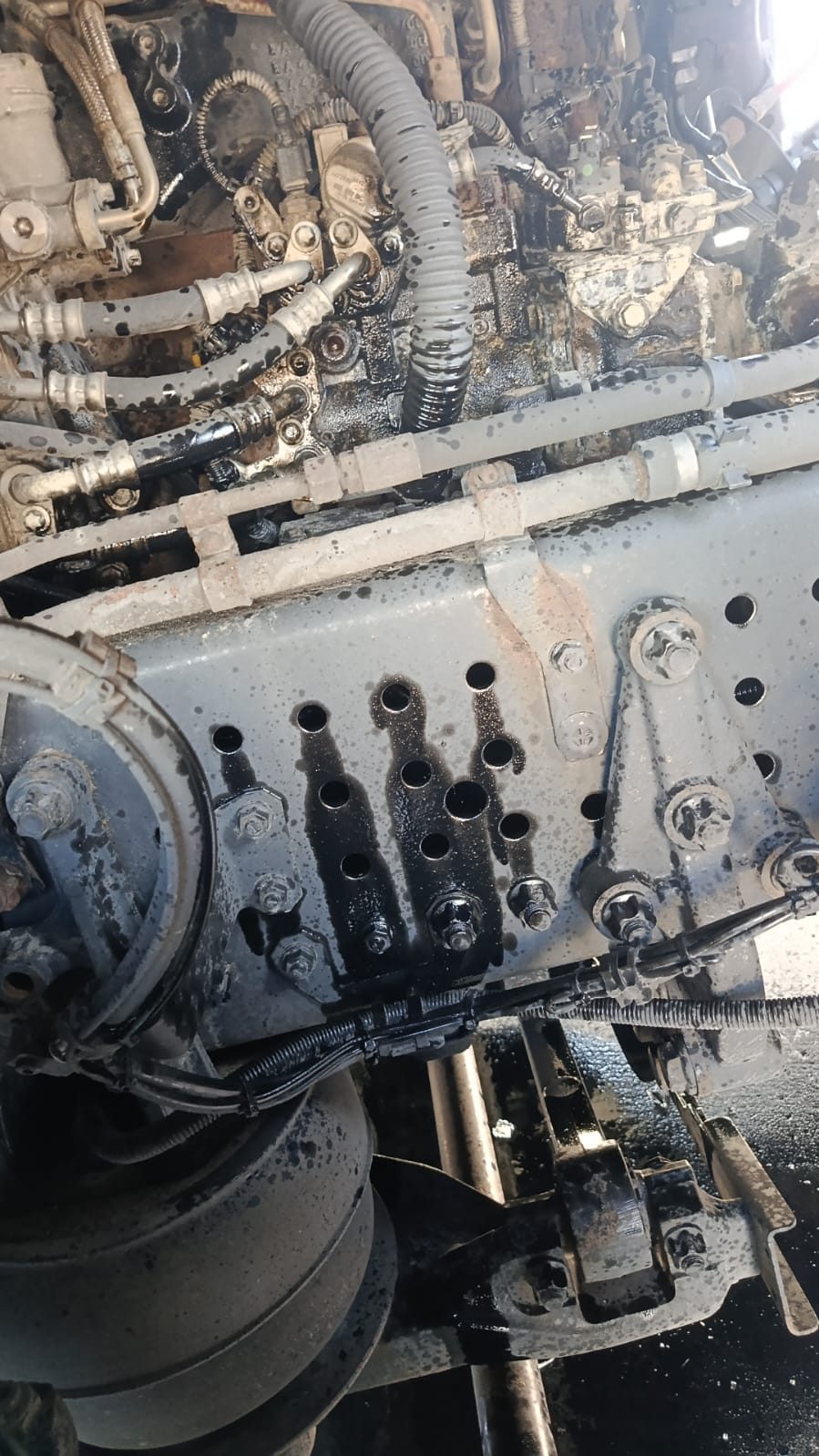
On the photographs taken at the scene you can see the oil collecting under the front and running along the frame crossmember. Further back, the high-pressure fuel components, the hoses and the brackets are all coated in a film of oil. The pattern pointed to a slow seep from an oil line near the engine ancillaries, which had probably been weeping through the night. The most likely cause was a worn seal at a line connection, the kind of failure that builds quietly over thousands of kilometres and then lets go on a cold morning.
Why is an engine oil leak on a truck an emergency?
An engine oil leak is an emergency because a heavy diesel needs a steady oil film at around 4 to 5 bar of pressure to protect its bearings, and a truck engine holds roughly 25 to 40 litres in total. Lose enough of it and the damage is not gradual: bearings, turbocharger and piston cooling fail within minutes of running dry.
There are three further reasons not to drive on.
- Fire risk. Oil on a hot exhaust or turbocharger can ignite. A film of oil spread over the engine bay and the frame is fuel for exactly that.
- Environmental damage. A litre of oil can foul a large area of ground or drainage. On a car park or service area, the operator and the haulier can be held responsible.
- Road safety. Oil dropped on tarmac makes the surface slippery for every vehicle behind you. In Germany, the rules on safe vehicle condition under the road traffic regulations apply from the moment you move off.
The driver did exactly the right thing: engine off, no further attempts, one phone call. That is the whole recipe for keeping a repairable fault from turning into an engine replacement.
How we organised the help
Our dispatch team took the call and worked through a short list of questions before any technician was sent. The aim of those first minutes is to decide whether this is a roadside job or a recovery job, because the two need entirely different equipment.
- Where exactly is the vehicle? A5 near Karlsruhe, car park by the motorway, direction Basel. Easy access, flat concrete, plenty of room for a service van.
- Has the engine been run since the leak was found? No. This kept every option open.
- How much oil is on the ground, and is it still dripping? About a metre of puddle, slow drip.
- What is the dipstick or display reading? The driver checked the level: clearly below the minimum, but not empty.
- Is the lorry loaded, and what is the deadline? The unit was able to wait for a repair, with a delivery slot later that day that the driver wanted to keep.
From these answers dispatch concluded that a seal or line fault was likely, that the vehicle was safe to work on where it stood, and that a mobile team could handle it. Dispatch took 15 minutes in total. We then sent a field crew from our partner network in the region, equipped for engine work, and confirmed the arrival estimate with the driver, who is Polish, in his own language. Our dispatch desk handles German, English, Polish and Russian, so there was no guessing at technical terms over the phone.
If the diagnosis had shown a cracked housing or a serious internal fault, our towing service would have been the fallback. Recovery to a workshop typically costs 900 to 1,600 EUR before any repair starts. We keep that option in reserve, but here it was never needed.
The situation on site: what the crew found
The crew arrived at 1:00 on the timeline, after 45 minutes on the road. They parked at a safe distance from the traffic lane, put out the warning triangle and spread absorbent material around the puddle before touching the vehicle. The first rule of any mobile truck service job is to stop the problem growing: contain the oil, then find its source.
The oily film made inspection harder than it looked. When everything is coated, nothing stands out, so the first 20 minutes went on cleaning. The technician degreased the affected area, wiped down the connections and brackets, and then did something simple that experienced mechanics always do: he let the area dry and watched where the first fresh oil appeared. A UV dye or a sensitive torch can help, but with a fresh leak, a clean surface and a few minutes of patience are usually enough.
The source turned out to be the oil line in the engine ancillaries zone near the fuel system, together with its seal. The seal had hardened and lost its elasticity, the line connection had loosened slightly, and oil had been creeping out under pressure. The technician checked the oil level again and the pressure, found the level well below the minimum, and confirmed that the engine itself had not been damaged because it had never been run after the leak became serious. No metal particles on the dipstick, no abnormal colour.
That was the good news. The less good news is that the oil which had drained out had to be replaced in full: 25 litres went in during the refit.
What about the fuel components?
The photographs show the high-pressure fuel pump area covered in oil, which alarms drivers because it looks like a fuel fault. It was not. The fuel hoses and the pump (a component family made by suppliers such as Bosch) were simply bathed in oil from above. The technician checked them for seepage and leaks of their own and found none. That check is part of the diagnosis fee, because a second, unrelated leak found later would mean another call-out.
The repair step by step
The repair itself took 45 minutes of actual work, split between removal and fitting. Here is how it went.
- Inspection and confirmation (1:00 to 1:20). Clean, dry, observe. Photograph the leak, check oil level and pressure, rule out other sources.
- Securing the vehicle. Engine off, ignition removed, parking brake on, wheel chocks under the rear axle. No one works under a cab without these. Batteries were isolated before any line was opened.
- Removal (1:20 to 1:45). The technician drained what remained in the affected circuit, disconnected the damaged oil line and took out the old seal. He compared both parts to the new ones before fitting, because a part that looks identical can differ in thread or length.
- Fitting (1:45 to 2:05). New line, new seals, fresh fixings. Connections were tightened to the specified torque with a calibrated wrench, not by feel. Over-tightening a fitting on an oil line is as bad as under-tightening it, since a cracked sealing face brings the leak straight back. Then the engine was filled with 25 litres of oil, topped to the correct mark.
- Final check (2:05 to 2:15). A test start, with the engine running at idle and then at raised revs. The crew watched the line, the connections and the gauge, looked underneath for any drip, and let the oil circulate and settle before one last level check. Spilled oil was soaked up and packed for disposal. The driver got a short summary in Polish and the vehicle was released.
Nothing in this sequence is exotic. What makes it work on a car park is preparation: the right line and seals on the van, a torque wrench, absorbent material and a technician who has done this on an Actros before. A truck service in a workshop would have needed the lorry on a lift. We did it on a hard-standing with no lift at all.
Full timeline: 135 minutes from call to release
| Time | Phase | Action |
|---|---|---|
| 0:00 | Call | Driver reports an oil puddle under the tractor unit; engine not started |
| 0:00–0:15 | Dispatch | Clarifying symptoms and oil level, selecting a field crew from our partner network |
| 0:15–1:00 | Travel | Crew drives to the site, 45 minutes on the road |
| 1:00–1:20 | Inspection and diagnosis | Recording the leak, cleaning components, tracing the source, checking oil level and pressure |
| 1:20–1:45 | Removal | Taking out the damaged oil line and seal |
| 1:45–2:05 | Fitting | New parts installed, torque applied, oil topped up |
| 2:05–2:15 | Final check | Test start, leak-tightness check, collecting spilled oil, handover to the driver |
Total: 135 minutes (2 h 15 min) from call to being ready to drive. No tow was needed.
For comparison, the 45 minutes of travel is typical for a motorway job in the south-west when the crew comes from the nearest partner location. In heavy rain or at night, add 15 to 30 minutes. The repair time depends mostly on how easily the source is found, which is why a clean, dry engine bay is so valuable.
How much did this truck service cost?
The job cost 920 EUR net for everything: the call-out, the diagnosis, the labour, the parts, the oil and the disposal. All amounts exclude VAT (zzgl. MwSt.).
| Item | Price (EUR) |
|---|---|
| Call-out / Anfahrt (A5 near Karlsruhe) | 240 |
| Engine diagnosis and leak tracing | 150 |
| Labour, 1.5 hours at 110 EUR per hour | 165 |
| Parts: oil line, seals, fixings | 185 |
| Engine oil, 25 litres, top-up | 120 |
| Oil binder and oil disposal | 60 |
| TOTAL | 920 |
What drives the price of a roadside repair?
Four factors move the figure up or down.
- Distance and time of day. Call-out fees run from 180 to 320 EUR, and nights and weekends carry a surcharge of 25 to 50 per cent. This was a Tuesday morning, so no surcharge applied.
- Parts. An oil line and a set of seals for an Actros is a moderate cost. A turbocharger line, a cooler or a pump housing would multiply it.
- Diagnostic time. A fresh, clean leak is found quickly. A leak that has been smeared for weeks across the underside takes longer.
- Oil quantity. 25 litres of correct-specification oil is not cheap, but it is non-negotiable for a modern Euro 6 engine.
What would the alternative have cost?
The alternative was to tow the lorry to a workshop. A recovery of this kind costs 900 to 1,600 EUR depending on the distance. On top of that come the workshop labour, a place in the queue, and the cost of the vehicle standing still. A tractor unit that is not moving costs a haulier between 800 and 1,200 EUR per day in lost revenue, driver wages and fixed costs. Even at the optimistic end, one tow plus one day of downtime would have put the total close to 2,000 EUR before the repair itself. Fixing it on the spot for 920 EUR, and being back on the road before the afternoon, was roughly half the price and a full day faster.
Why you should not repair this yourself
A driver with a toolbox can top up oil or tighten an accessible clamp. Replacing a pressure-bearing oil line is different, and here is why leaving it to a professional is the safer route.
- Wrong torque. Fittings on an oil line need a defined torque. Too loose and the leak returns, too tight and the sealing face cracks.
- Wrong seal or oil. A seal made of the wrong material swells or hardens within weeks. The wrong oil specification can damage a particulate filter and void a warranty.
- Hidden second fault. The visible leak is rarely the only finding. A professional checks adjacent lines, the turbo supply and the sump gasket.
- Hot components and fire. Working near a recently running engine, with oil on the surfaces, is a burn and fire hazard.
- Disposal rules. Used oil and contaminated absorbent are hazardous waste. They may not go into a bin or a drain.
- Insurance and liability. If a repair you carried out yourself fails, your insurer may argue the vehicle was not roadworthy. Documented work by a qualified team protects you.
Typical situations we attend across Germany
This job is one of many. Our crews are called out around the clock to the following kinds of fault, and most can be dealt with where the vehicle stands.
- Oil, coolant or hydraulic leaks on tractor units and trailers
- Dashboard warning lights and mobile engine diagnostics
- Air system faults and brake pressure loss
- AdBlue and SCR system errors, including blocked or leaking hoses
- Flat batteries and starter problems (jump-starts and replacement)
- Fuel system faults, from air in the lines to blocked filters
- Coupling, steering and axle problems on trailers and car transporters
- Tyre blowouts, which have their own service on our tyre service page
If the fault turns out to be beyond a roadside fix, we arrange recovery to a workshop. The most useful thing you can do is call early, before a leak becomes a failure. Our article on truck repair on the road explains in detail what can and cannot be repaired on the spot.
How to prevent oil leaks and breakdowns
Prevention is cheap compared with a day of downtime. These habits catch most leaks before they leave you stranded.
- Do a proper walk-round every morning. Look under the vehicle before you start the engine. A fresh drop or wet patch is information.
- Check the oil level regularly. Use the dipstick or the display on a flat surface with the engine cold or settled. A level that falls between services is a warning.
- Keep the engine bay clean. A clean engine shows leaks early. A caked engine hides them for months.
- Watch for smells and smoke. Burning oil on a hot surface has a sharp, recognisable smell.
- Service on schedule. Follow the manufacturer’s intervals, and have seals and lines inspected at every service. The brand’s own information at Mercedes-Benz Trucks gives guidance for the Actros range.
- Keep a record. A short log of oil top-ups per thousand kilometres tells you very quickly whether consumption is normal.
- Never run an engine that has lost oil. Switch off, call us, wait.
For fleet managers, the same principles apply at scale. A simple checklist for drivers, a monthly review of oil top-up figures and a pre-agreed emergency number cut downtime considerably. Inspections by independent organisations such as DEKRA can also reveal weeping seals before they become a roadside event.
Truck service for modern fleets: tyres, engines and the rest
A modern fleet is made up of many small details, and the tractor unit is only one part of it. We cover the whole range of roadside needs for commercial vehicles: engines, brakes, air systems, electrics, couplings and tyres. On the tyre side, fleets in Germany typically run premium brands from Michelin, Continental, Goodyear and Bridgestone on steer and drive axles, with regrooved or retread tyres on trailer positions. The sizes we see most often are 315/80 R22.5 on drive axles, 385/65 R22.5 on trailers, and 245/70 R19.5 and 235/65 R16C on lighter vehicles.
The point for planning is simple. Whatever the fault, the sequence is the same: stop, call, diagnose, repair, check. Tyre pressure on a heavy truck sits around 8.5 to 9.5 bar, and a drifting value is as important a warning as a drop in oil level. Tread depth, load index and the condition of the carcass are checked as routinely as fluid levels.
A fleet that treats a breakdown as a process, rather than a crisis, loses less money. That means keeping a short list of numbers in the cab, having the vehicle location ready to share, and knowing which tasks need a workshop and which can be done on the spot. If you want to see how a different fault was handled, our case about a coolant leak on the A38 near Nordhausen follows a similar path.
Frequently asked questions
How much does a truck breakdown call-out cost in Germany?
A call-out fee typically runs between 180 and 320 EUR net, plus labour at 90 to 140 EUR per hour and parts. In this case the total for an oil leak repair was 920 EUR net. Nights and weekends add 25 to 50 per cent.
How long does it take for a truck mechanic to arrive on a motorway?
Usually 35 to 70 minutes from the end of dispatch. Here it took 45 minutes of travel after 15 minutes of dispatch. In bad weather or at night, expect longer.
Can a truck still drive with an oil leak?
No, not if the level is falling. A heavy diesel needs oil pressure at all times, and running low can wreck the bearings in minutes. Switch the engine off and call for help.
Can an oil leak be fixed at the roadside?
Often yes. Seals, oil lines and fittings can be replaced on site with the right parts. A cracked housing or internal engine damage requires a workshop and a tow.
What should I do first if I find oil under my truck?
Do not start the engine. Note the location, check the oil level, take photographs and phone our dispatch line. Mention the vehicle type and when the leak was first seen.
Do you work with Polish and other foreign drivers?
Yes. Our dispatch handles German, English, Polish and Russian, so a driver can describe the fault in his own language and receive a clear estimate.
Why drivers and fleets choose LKWHelp24
We are on call 24 hours a day across all of Germany. Our partner network means a crew is rarely more than an hour away on a main motorway. Prices are quoted before work begins, and the invoice shows each line, as in the table above. If you are not sure whether a fault is serious, a call to the dispatcher costs nothing, and you can read more about us or send a message through our contacts page.
Summary
- Vehicle: Mercedes-Benz Actros tractor unit, Polish haulier
- Location: A5 near Karlsruhe, car park beside the motorway, direction Basel
- Fault: engine oil leak from a worn line seal near the engine ancillaries
- Response time: 15 minutes dispatch plus 45 minutes travel, crew on site at 1:00
- Total time: 135 minutes (2 h 15 min) from call to release
- Cost: 920 EUR net (zzgl. MwSt.)
- Secondary damage: none, because the engine was never run after the leak was found
- Towing: not needed
Call us
If oil is pooling under your lorry, or any other fault has stopped you on the road, do not wait and do not restart the engine. Call +49 160 5753826 or visit www.lkwhelp24.com. Round the clock, all over Germany.
Keywords: truck service | truck service germany | truck breakdown service | truck mobile service | mobile service truck | roadside assistance germany | truck repair | mobile truck maintenance | truck engine repair | mercedes truck service | truck breakdown | truck assistance | trailer service | truck mechanic from poland | emergency roadside