Skip to content
A truck driver heading towards Cologne on the A3 near Limburg noticed the noise before he noticed anything else. It was the afternoon of 23 July, warm, dry, traffic moving at a steady pace, nothing unusual about the road. Then a low roar started coming from underneath the tractor unit, growing louder with every kilometre, and within a few minutes he could smell exhaust fumes seeping into the cab. He pulled onto the hard shoulder and called us.
This callout turned out to be one of the more straightforward jobs in our files, and that is exactly why it is worth writing up. Not every breakdown on the A3 or A5 ends in a four-figure invoice and a night in a workshop. Sometimes a corroded exhaust clamp lets go, the joint separates by a few millimetres, and the fix takes three quarters of an hour with a torque wrench and a new clamp. But a small mechanical failure like this one carries real risk if it is ignored, and it is worth understanding why.
The driver was calm on the phone, mostly annoyed. “It sounds like the truck is trying to talk to me,” he said, describing the noise. He’d also noticed the artic felt sluggish pulling away from a slower vehicle, like the engine was working harder than it should for the same throttle input. That combination, noise plus a flat spot in power delivery, is a classic signature of an exhaust leak upstream of the turbo or the after-treatment system, and it told our dispatcher exactly what kind of technician and parts to send.
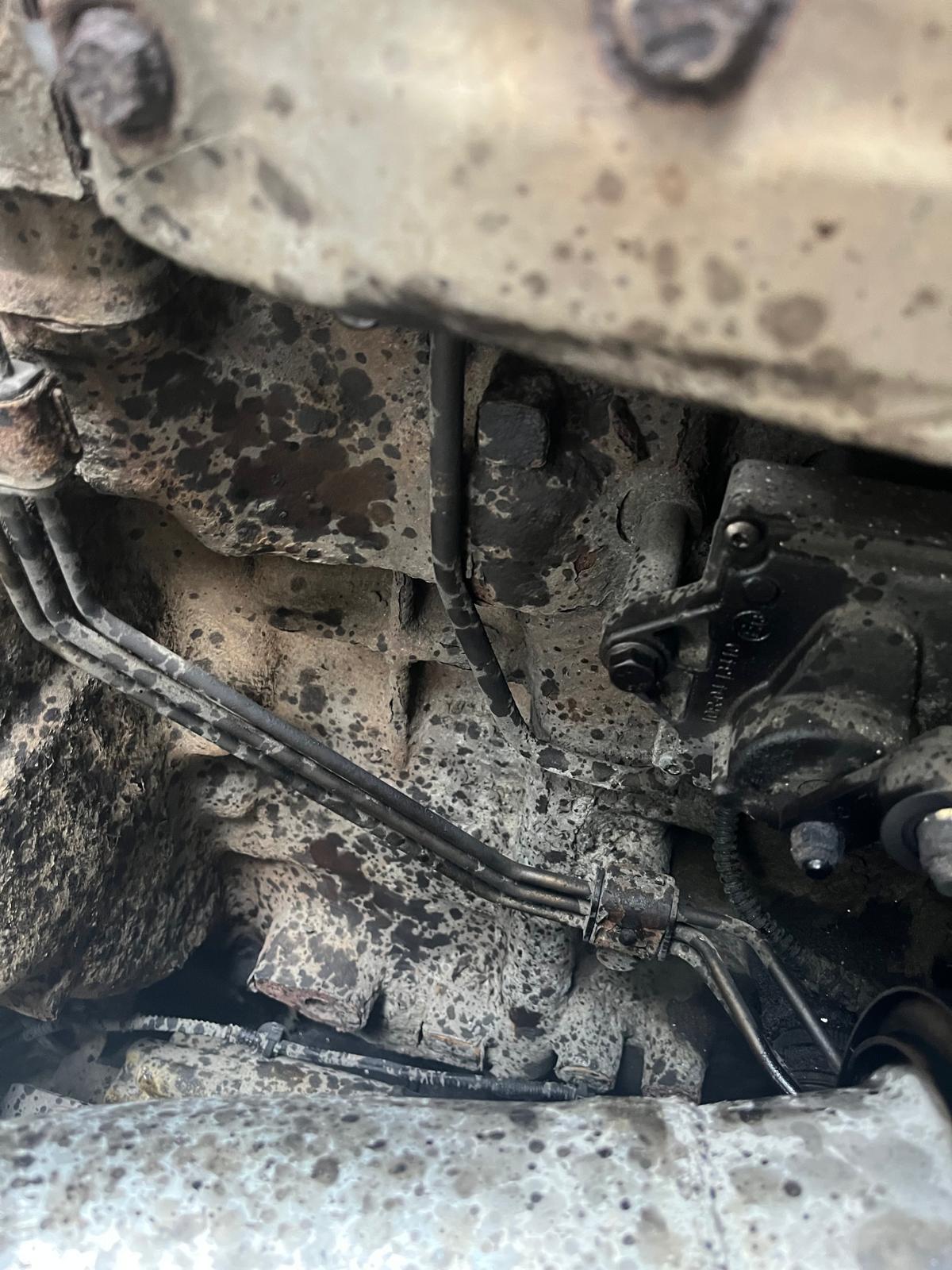
The Emergency Situation on the A3
Exhaust joint failures rarely happen suddenly out of nowhere. They build for weeks, sometimes months, as a clamp slowly loses its grip through corrosion and vibration. The driver later mentioned he’d heard a faint metallic tick under acceleration a few days earlier and put it down to a stone caught somewhere in the wheel arch. By the time he called us, the tick had turned into a full-throated roar, loud enough that he had to raise his voice on the phone over the sound of passing traffic and his own idling engine.
Being stopped on the hard shoulder of the A3 near Limburg is not a comfortable place to sit and wait, especially with fumes drifting into the cab. The A3 in this stretch carries dense long-haul traffic between the Rhine-Main region and the Ruhr, cars and trucks passing at speed just a couple of metres from a stationary vehicle. We told the driver to shut the engine down completely rather than let it idle and keep pumping exhaust gas through the leak, to open the windows, and to stay behind the barrier in his high-visibility vest while he waited. Every minute mattered less for the mechanical problem than for basic safety on a live carriageway.
How the Help Was Organised
Our dispatcher took the call at 09:36, confirmed the vehicle type, the exact location using the kilometre marker the driver read off a roadside post, and the symptoms: loud roaring noise from underneath, loss of power under acceleration, and an exhaust smell in the cab. That last detail moved the case up the priority list immediately, because fumes in the cab are never treated as a minor inconvenience in our dispatch process.
Within twelve minutes we had confirmed a technician from our regional service partner network, based close enough to the Limburg stretch of the A3 to reach the vehicle inside the hour. The technician was briefed on likely causes and loaded a stock clamp kit, high-temperature exhaust sealant, and hand tools before setting off, so there was no need to double back for parts once on site.
This is the advantage of dispatching across a dense partner network rather than a single central depot: on the towing service and mobile truck service side of our operation, response time on federal motorways in western Germany typically runs between 30 and 90 minutes depending on the hour and the exact stretch of road. For this case, the technician arrived at 10:35, just under an hour after the first call.
Situation on Site: What the Technician Found
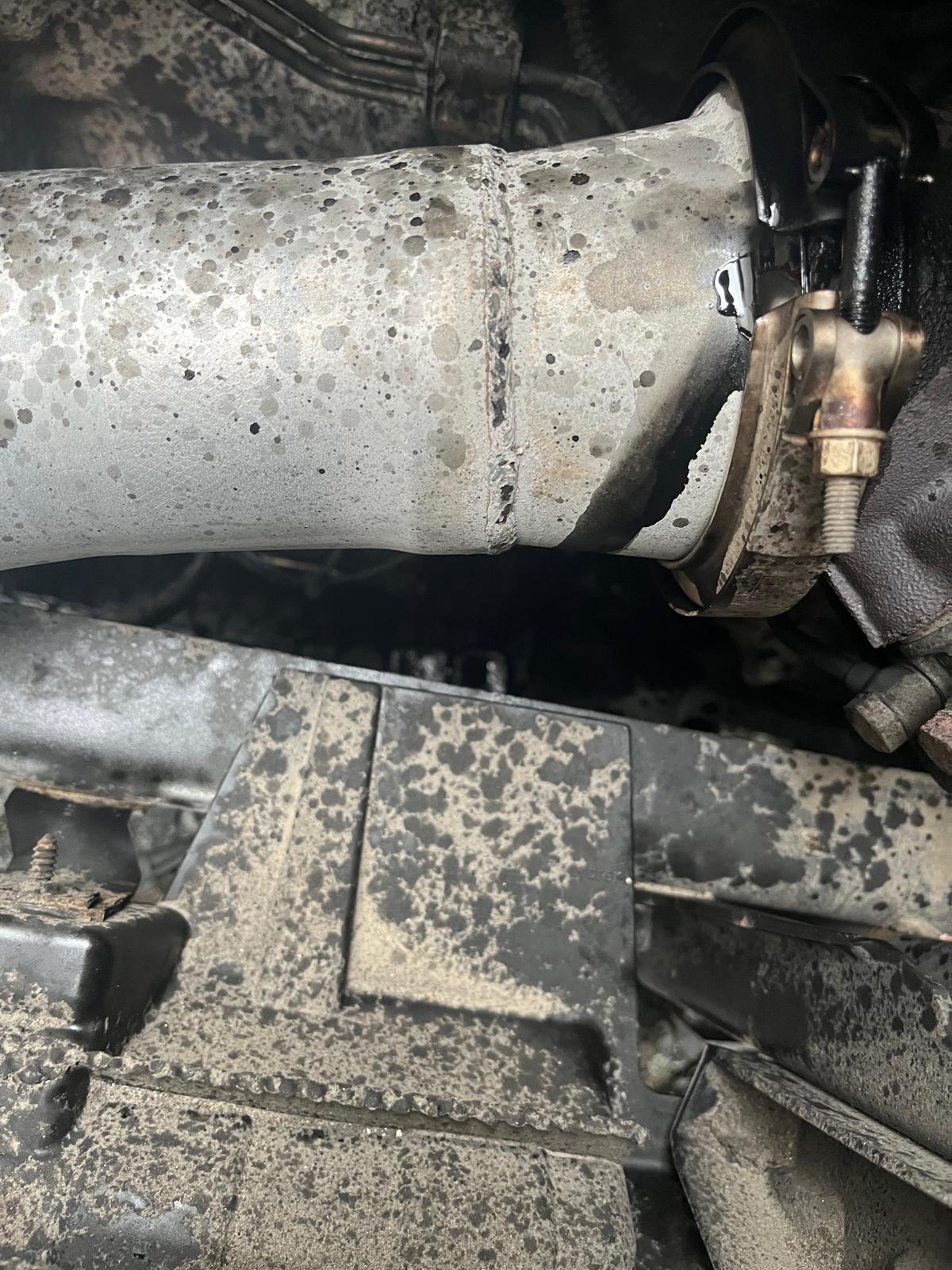
On arrival, the technician did a visual and audible check with the engine idling before touching anything. The roar was coming from a joint roughly midway along the exhaust system, downstream of the turbo but ahead of the diesel particulate filter housing. A clamp holding two pipe sections together had corroded through at one edge and snapped under normal vibration, letting the joint separate by several millimetres. Hot exhaust gas was escaping directly at that point instead of travelling through the rest of the system.
This is a textbook failure mode. Exhaust clamps live in one of the harshest environments on the entire vehicle. They cycle through temperature swings from ambient to somewhere around 500°C and back again every time the truck starts, drives, and stops, expansion and contraction working the metal and the joint face thousands of times over a working life. Add constant vibration from the engine and the road surface, road salt and de-icing chemicals thrown up from the tarmac in winter that never fully rinse off a component tucked up under the chassis, and condensate that collects inside the pipework on shorter runs where the exhaust never gets hot enough for long enough to boil off completely, and you have ideal conditions for corrosion to eat through a clamp band from the inside out. It is rarely one single cause. It is all of them working on the same few square centimetres of metal for years.
The technician confirmed the rest of the exhaust run was sound: no burn-through on the pipe itself, no damage to the silencer body, and the flexible section near the manifold was intact. That mattered, because it defined whether this job could be handled roadside or whether the truck would need recovery to a workshop.
Step-by-Step Repair
- Engine off, vehicle secured with warning triangle and cones, driver clear of the carriageway.
- Exhaust system allowed to cool sufficiently to work safely on the joint by hand.
- Failed clamp removed and the joint faces inspected for pitting or thinning.
- Mating surfaces cleaned of corrosion and old sealant residue.
- High-temperature exhaust sealant applied to the joint to restore a gas-tight seal.
- New clamp fitted and torqued to specification to hold the joint under vibration and thermal cycling.
- Engine started and run through several throttle cycles to check for any residual leak by ear and by hand, checking for exhaust gas escaping at the joint.
- Full visual recheck of the surrounding pipework and mounts before signing the vehicle off as roadworthy.
The whole repair took 45 minutes, and the technician was satisfied there was no detectable leak and no abnormal noise before releasing the truck.
Timeline
| Time | Phase | Action |
|---|---|---|
| 09:36 | Emergency call received | Driver reports roaring noise, power loss, exhaust smell in cab |
| 09:48 | Dispatch confirmed | Technician assigned and en route with clamp kit and sealant |
| 10:35 | Arrival on site | A3 near Limburg, direction Cologne |
| 11:15 | Repair completed | Vehicle back in service, driver continues journey |
Total time from call to departure: 1 hour 39 minutes.
Cost Breakdown
| Item | Price (EUR) |
|---|---|
| Callout | 120 |
| Labour (45 min) | 75 |
| Materials (clamp, sealant, small parts) | 45 |
| TOTAL | 240 EUR (plus VAT) |
This is one of the cheapest callouts in our records for the year. Not every job costs a thousand euros or more, and this case is a useful reminder of that. A snapped clamp caught early, on a system that is otherwise sound, is a fast and inexpensive fix. Compare that 240 euros against the cost of a truck standing idle: a loaded HGV off the road typically costs an operator somewhere between 800 and 1,200 euros a day once you account for missed delivery windows, driver hours, and knock-on scheduling costs across a fleet. Thirty-nine minutes of downtime against a full lost day is not a close comparison.
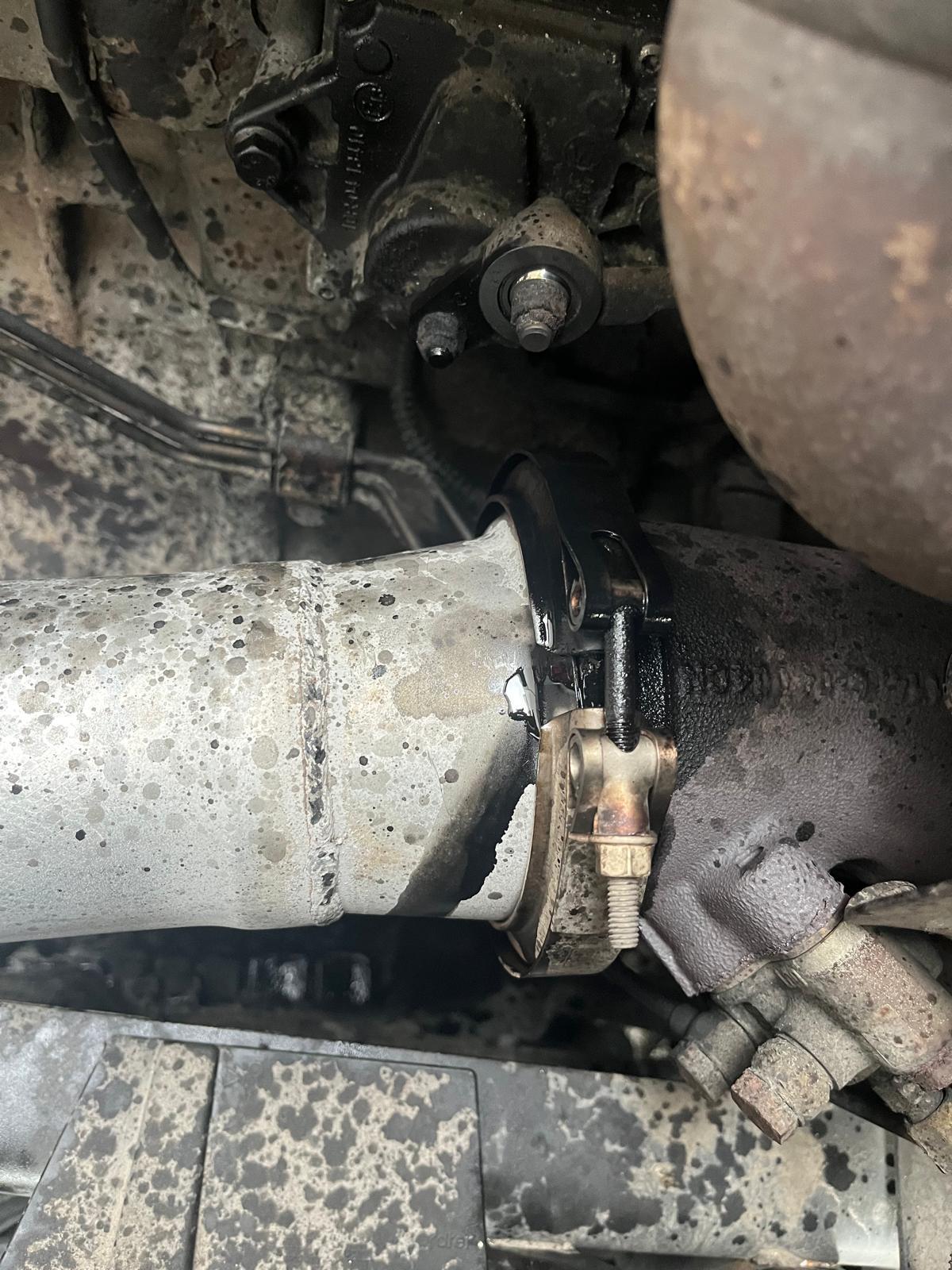
Why an Exhaust Leak Needs a Professional, Not a Delay
It would be easy to dismiss a roaring exhaust as cosmetic, an annoyance rather than a hazard. It is not. There are three separate reasons why this driver was right to stop immediately rather than nurse the truck to the next services.
Cab air quality. A joint separated close to the cab, or a leak that pressurises the underside of the vehicle at speed, can push exhaust gas into the cabin through the ventilation system or gaps in the floor. On a long haul with the windows shut and the driver alone for hours at a time, carbon monoxide exposure is not a comfort issue. It is a slow, cumulative poisoning risk, and drivers have died from exactly this kind of undetected leak on overnight runs. Headache, drowsiness, and nausea behind the wheel of an HGV are dangerous symptoms with an obvious cause once you know to look for it.
Emissions after-treatment confusion. Modern HGVs rely on a chain of sensors reading exhaust gas composition, temperature, and pressure to control the SCR system and the AdBlue dosing that keeps NOx emissions within legal limits, a process built around selective catalytic reduction (SCR) and AdBlue dosing. An unmetered leak upstream of the catalyst throws that data off. Sensor manufacturers like Bosch build these systems around a sealed, predictable gas flow, and once that assumption breaks, the engine control unit often responds by triggering a fault code, entering a limp or derate mode that caps engine power, and increasing AdBlue consumption as it tries to compensate for readings that no longer make sense. That matches exactly what this driver described: noise, plus a noticeable loss of power under load.
Noise limits. German traffic law treats excessive vehicle noise as a specific offence, not a vague nuisance, under provisions such as StVZO §36 governing exhaust and noise emissions. Driving a roaring truck through a residential area at night, or past a routine roadside check by the Bundesamt für Güterverkehr, is a straightforward way to pick up a fine on top of the mechanical problem you already have.
And there is the annual roadworthiness inspection to consider. A vehicle presented for its Hauptuntersuchung with a separated exhaust joint or excessive noise will not pass. Both DEKRA and TÜV test exhaust integrity and noise as standard checkpoints, and a fault like this one is an automatic fail until repaired.
Roadside Fix or Workshop Job: Where the Line Sits
Not every exhaust fault can be resolved on the hard shoulder, and it’s worth being honest about that distinction rather than promising a quick fix for everything. A corroded clamp with sound pipework either side, as in this case, is a clean roadside repair: clean the joint, seal it, clamp it, verify, done. A burnt-through section of pipe, a cracked or perforated silencer body, or a joint close to a turbo where heat damage has spread further along the run usually cannot be trusted to a field repair. Those jobs need the vehicle recovered to a proper truck workshop where a replacement section can be fabricated or fitted correctly, tested on a lift, and checked against manufacturer torque and clearance specifications, information that manufacturers such as MAN publish in detail for their platforms.
Our technicians make that call on site, based on what they actually find, not on what would be quickest to bill. Sending a driver back onto the A3 with a patched-up leak that is going to fail again in fifty kilometres helps nobody.
Typical Exhaust and Underbody Callouts Across Germany
Exhaust clamp and joint failures like this one are one of the more common mechanical callouts our dispatch handles nationwide, alongside blown tyres, alternator failures, and coolant leaks. They tend to cluster on long, fast stretches of motorway where sustained high engine load and vibration accelerate wear on ageing components, the A3 corridor through Hesse being one of the busier examples given the volume of long-haul freight running the Rhine-Main to Ruhr axis. We see the same fault pattern from Bavaria to the North Sea coast, though, wherever an older tractor unit or trailer has covered enough kilometres for salt and vibration to do their work on a clamp that was never inspected closely enough.
If a driver reports a roaring or hissing noise from underneath the vehicle combined with any drop in power or a smell in the cab, our dispatch treats it with the same urgency regardless of region, because the underlying risks, cab air quality and emissions system confusion, do not change with geography.
Prevention: Catching a Clamp Before It Fails
The frustrating part of a case like this is how avoidable it usually is. Exhaust clamps and mounts are cheap, visible components that a routine inspection can check in a couple of minutes: look for surface rust bridging the clamp band, check for movement or play at the joint when the system is cold, and listen for any change in exhaust note during a pre-trip walk-round. A faint tick or rattle that appears under acceleration and wasn’t there last week is worth investigating immediately rather than filed away as background noise.
For fleets running older tractor units, we generally recommend a proper physical check of exhaust clamps and mounting brackets at every scheduled service interval, not just a visual glance during the annual inspection. It is a five-minute check against a full-day recovery and a driver breathing exhaust fumes for two hundred kilometres. Our truck workshop inspection and maintenance service covers exactly this kind of preventive check as part of a standard service, and it is far cheaper than any roadside callout, even one as modest as this 240 euro job.
Why Fleet Operators Choose Us for Cases Like This
A driver stopped on the A3 with fumes in the cab does not want to hear that help is two hours away. Our dispatch model is built around a distributed network of regional service partners across Germany, which is how we got a qualified technician to a stretch of the A3 near Limburg in under an hour on a weekday afternoon. We cover everything from tyre service and towing through to mechanical repairs like this exhaust clamp job, with the same dispatch discipline: confirm the fault type on the phone, brief the technician with the right parts before departure, and make the roadside-versus-workshop call honestly once eyes are on the vehicle. You can see the full range of what we cover on our truck service page, and reach our dispatch directly through the contact page any time, day or night.
Frequently Asked Questions
How do I know if my exhaust noise is serious or just cosmetic?
Any sudden increase in exhaust noise combined with a change in power delivery or any hint of fumes in the cab should be treated as urgent. A gradual, mild change in tone over months is worth a workshop check at the next service; a sudden roar that appeared during a single journey means stop and call for assistance.
Can I keep driving with a leaking exhaust joint?
Not recommended and often not legal. Beyond the noise offence under German traffic regulation, a leak upstream of the after-treatment system can trigger a derate that limits your engine power anyway, and continued driving risks further damage to the pipe or silencer that turns a cheap roadside fix into a workshop job.
Will this fault show up on the Hauptuntersuchung?
Yes. Exhaust integrity and noise levels are standard checkpoints in the German HU inspection carried out by bodies such as DEKRA and TÜV, and a separated joint or excessive noise results in an automatic fail until repaired.
Why did the truck lose power along with the noise?
A leak ahead of the emissions sensors disrupts the readings the engine control unit relies on for SCR dosing and NOx monitoring, which commonly triggers a protective limp or derate mode. Fixing the leak restores normal sensor readings and normal power.
How much does a callout like this typically cost?
This case, at 240 euros net for callout, labour, and materials, sits at the lower end of our pricing. More involved exhaust repairs, especially ones requiring workshop recovery for a damaged pipe section or silencer, cost significantly more, but this shows a fast roadside fix is often possible.
How quickly can you reach a breakdown on the A3?
For this callout near Limburg, our technician arrived 59 minutes after the initial call. Response times across the federal motorway network in western Germany generally run between 30 and 90 minutes depending on time of day and exact location.
Summary
A corroded exhaust clamp on the A3 near Limburg turned into a roaring noise, a loss of power, and fumes in the cab, serious enough for the driver to stop immediately and call for help. Our technician arrived within an hour, diagnosed a snapped clamp on an otherwise sound exhaust system, and completed a full roadside repair, cleaning the joint, applying high-temperature sealant, and fitting a new clamp, in 45 minutes. Total time from call to the truck rejoining the A3: 1 hour 39 minutes. Total cost: 240 euros net, one of the most affordable callouts of the season, and a fraction of what a day of downtime would have cost.
Need Roadside Assistance on a German Motorway?
If you hear an unusual noise, smell exhaust fumes in the cab, or notice a sudden loss of power, stop safely and call us straight away. AUTOHELP 24 dispatches technicians 24/7 across Germany for exhaust faults, tyre failures, towing, and general mechanical breakdowns.
Call now: +49 160 5753826
www.lkwhelp24.com
Keywords: HGV exhaust repair Germany, exhaust clamp failure truck, A3 breakdown Limburg, roadside exhaust repair, truck exhaust leak cab fumes, mobile truck service Germany, 24/7 HGV assistance