Skip to content
Introduction: What a modern truck workshop must deliver today
Since 2020, the demands on freight forwarders, construction companies and logistics providers have risen massively: growing transport volumes driven by e-commerce, stricter inspection intervals under EU requirements, and fuel prices that turn every unplanned standstill into an economic burden. A specialised truck workshop has thus become a strategic partner that delivers far more than classic repair work.
A modern workshop services all common types of commercial vehicles: tractor units, 18-tonners, construction site tippers, refrigerated vehicles, vans up to 7.5 t, as well as trailers and semi-trailers. This is not just about technical expertise, but also about availability, flexibility and digital connection to your fleet.
This article is aimed at fleet managers and owner-operators with a clear question: how do I find the right truck workshop, which services are really important, and what costs should I realistically expect?
Services of a truck workshop for commercial vehicles of all brands
A professional truck workshop covers a broad range of services that goes far beyond the classic oil change. You should be able to expect the following core services when choosing your partner:
Inspection and maintenance according to manufacturer specifications
Specific maintenance intervals apply to brands such as Mercedes-Benz, MAN, DAF, Scania, Volvo Trucks, Iveco and Renault Trucks – typically every 60,000 to 120,000 km for long-haul trucks. A qualified workshop works according to these specifications and documents all work in full.
Mechanical truck repair
- Engine and transmission overhauls
- Axle, clutch and brake systems (disc and drum brakes)
- Frequent repair cases since 2021: AdBlue systems, particulate filter regeneration, turbocharger
Electrics and electronics
Fault-finding is carried out with modern diagnostic tools such as Bosch KTS or WABCO workshop testers. Typical areas of application:
- ABS/EBS systems
- Driver assistance systems
- Lighting systems and onboard electrical diagnostics
- Tachographs and telematics modules
Air conditioning and refrigeration unit service
Maintenance and leak testing of cab air conditioning systems as well as trailer refrigeration units (e.g. Thermo King, Carrier). The statutory inspection requirement for refrigerants makes regular checks unavoidable.
Bodywork and superstructure work
Repair of tarpaulin bodies, box bodies, crane superstructures and tail lifts after accidents or wear, often supplemented by a specialised 24/7 truck workshop tarpaulin repair service in Germany. Specialised operations often work together with superstructure manufacturers here to guarantee factory-level quality.
Types of truck workshops: independent workshop, authorised workshop & mobile services
The choice between an independent truck workshop, a brand-authorised workshop and mobile workshop vehicles depends on your fleet, your budget and your requirements for response times. Each type has its own place – and its own specific advantages.
Independent truck workshop
Independent workshops work with original and equivalent parts regardless of manufacturer. The hourly rate in 2025 is often 85-110 € net – a clear advantage for companies with mixed fleets of different brands. Flexibility in scheduling and solution approaches is often greater than at brand-bound operations.
Authorised workshop
Specialising in specific brands such as Mercedes-Benz Trucks, MAN or FUSO gives direct access to manufacturer-specific data, software updates and goodwill handling. For leasing fleets, being tied to authorised workshops is often contractually required. Prices are typically higher, but you receive guaranteed quality and original parts.
Mobile truck workshop / breakdown service
Fully equipped service vehicles for deployment on motorways, at company depots or construction sites, or complemented by comprehensive 24/7 truck roadside assistance in Germany. The focus is on starting problems, tyre breakdowns, minor repairs and temporary fixes that allow the journey to continue.
All-round truck workshop
An all-round workshop bundles typical standard work under one roof: inspection, oil change, brake service, chassis work, simple electrics and statutory inspections under § 57b/§ 57d (tachograph, distance recorder), or is organised via a centrally coordinated 24/7 truck service in Germany.
Typical jobs:
- Brake pad and brake disc replacement on a 40-tonne truck
- Spring replacement on the rear axle
- Replacement of worn air bellows
- Repair of faulty lighting
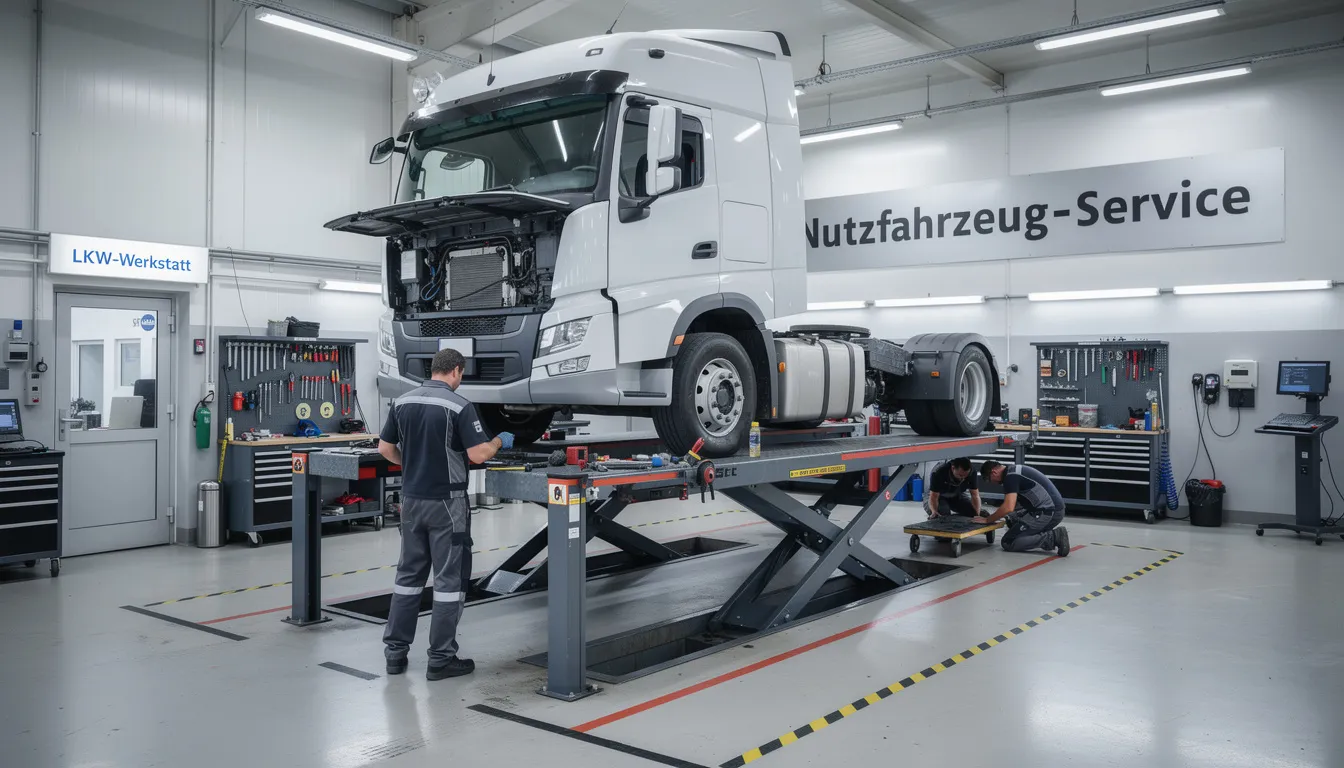
Such workshops usually have several commercial vehicle lifting platforms with a load capacity of up to several dozen tonnes, inspection pits, brake test rigs and a wheel alignment system. The team consists of mechanics and mechatronics technicians specialising in commercial vehicle technology.
Specialist workshop for hydraulics and superstructures
These workshops specialise in hydraulic systems on tippers, cranes, roll-off and skip loaders – essential for construction and waste disposal companies.
Typical services:
- Replacement of hydraulic hoses
- Overhaul of hydraulic pumps and cylinders
- Pressure testing with a test rig
- Seal replacement on crane cylinders
Practical example: Repairing a leaking tipper body on a 4-axle tipper, or a faulty tail lift on a 2019 refrigerated trailer, requires special expertise and tools that not every workshop keeps on hand.

Mobile express and breakdown workshop
Mobile workshop vehicles operate around the clock, especially on busy routes such as the A1, A3, A5 or A7, supported by a specialised 24/7 mobile truck service in Germany. They are the lifeline when delivery deadlines are tight and every hour of downtime costs money.
Core services:
- Jump-starting after a battery failure
- Air line repairs
- Minor electrical repairs
- On-site tyre changes with support from a specialised 24/7 truck tyre service in Germany
- Temporary repairs to allow the journey to continue
Typical response times are 30-60 minutes within a 50 km radius. In the event of serious damage, towing services are brought in to bring the vehicle to the nearest suitable workshop; a Europe-wide available 24/7 mobile truck service in Germany can additionally speed up these processes. A reliable delivery service can make the difference here between a missed delivery deadline and satisfied customers.
Mandatory inspections and statutory safety checks at the truck workshop
Alongside classic repair work, truck workshops also carry out legally required inspections arising from the StVZO, DGUV and EU regulations. These inspections are not optional – they are mandatory, and are regularly covered in our current news and guides on truck roadside assistance and safety. The legal basis for the main and safety inspections is set out directly in § 29 StVZO.
Inspection type | Interval | Legal basis |
|---|---|---|
Main inspection (HU) | Annually (from 7.5 t) | § 29 StVZO |
Safety inspection (SP) | Every six months for certain vehicles | § 29 StVZO |
Tachograph inspection | Every 2 years | § 57b StVZO |
Accident prevention (UVV) inspection | Annually | DGUV Regulation 70 |
Tail lift/crane inspection | Annually | BetrSichV |
Tachograph inspection: Digital tachographs must be inspected and calibrated every 2 years. Since the introduction of Smart Tachograph Version 2 in 2023, extended requirements apply. The workshop needs manufacturer certification and authorisation from the Federal Office for Goods Transport (BAG) for this. |
UVV inspections under DGUV Regulation 70 apply to all commercially used vehicles and also cover loading cranes, tail lifts and forklifts at the depot. Depending on the sector, the responsible body is the Berufsgenossenschaft Holz und Metall (BGHM). A TÜV stamp alone is not sufficient here.
Tyre service and wheel alignment for heavy commercial vehicles
Professional truck tyre services combine fitting, balancing, breakdown assistance and tyre storage into one complete offering; many rely on a 24/7 truck tyre service in Germany for this. For typical tyre sizes such as 315/80 R22.5 or 385/65 R22.5, special equipment is essential.
Considering usage profiles:
- Long-haul: mileage-optimised tyres
- Construction site: reinforced sidewalls, coarser tread
- Regional transport: a balanced compromise
Benefits of regular wheel alignment:
- Lower tyre wear
- More stable handling
- Fuel savings of 3-5% with correctly set tracking
Unevenly worn tread is a clear signal that the tracking is off. Scaled up to a fleet of 20 trucks, the savings from correct wheel alignment quickly add up to several thousand euros per year.

How to choose the right truck workshop
Since 2022, rising costs and driver shortages have turned the choice of a reliable workshop into a strategic decision. An unreliable partner costs not just money – it endangers your delivery capability and your reputation with customers.
Several factors should be evaluated together: scope of service, availability, opening hours, qualifications, prices and digital connectivity. Approach the workshop selection like a small project:
- Draw up a shortlist of 3-5 workshops in the relevant catchment area
- Compare the scope of services and specialisation
- Assign trial jobs to test quality and reliability
- Gather experience from your team and from other companies
Checking the service offering and specialisation
Define in advance which vehicle types are present in your fleet and which work occurs frequently. An example: 10 tractor units, 5 solo 3-axle trucks, 4 refrigerated trailers, 3 tippers.
Questions to ask potential workshops:
- Do you cover at least 80-90% of our typical requirements (brakes, electronics, hydraulics, refrigeration, breakdown service)?
- Do you have experience with ADR vehicles?
- Do you service municipal vehicles such as refuse trucks or winter service vehicles?
- Which brands can you service fully?
- Are appointments available at short notice?
A workshop that does a bit of everything is often the worse choice compared to a specialised partner with a genuine portfolio in your area.
Qualifications, certifications and equipment
Certifications such as ISO 9001 or manufacturer approvals for specific brake systems and superstructure manufacturers are quality indicators that point to a systematic way of working and regular training.
Look for modern diagnostic and testing technology:
- OBD interfaces for all common brands
- Brake test rig for commercial vehicles
- Emissions tester
- Air conditioning service equipment
- Wheel alignment systems
When visiting a workshop, it’s worth looking at how the workstations are organised, cleanliness, and visible training records. Staff who regularly attend seminars (documented from 2020/2021 onwards) bring current expertise to your commercial vehicle service.
Price structure and cost control
Transparent prices are a sign of trust between workshop and customer. Here is an overview of typical hourly rates for 2024/2025:
Workshop type | Hourly rate (net) |
|---|---|
Brand-authorised workshop | 95-130 € |
Independent truck workshop | 80-110 € |
Specialised workshop | 100-140 € |
Specific price examples: |
- Oil change on a 13-litre engine (parts + labour): 250-450 € net
- Brake service on one axle: 400-800 € net (depending on make)
- HU + SP combination: 150-250 € net
Recommendations for cost control:
- Always request written cost estimates
- Negotiate flat rates for standard work
- Structure consolidated invoices for the entire fleet
- Bundle maintenance work to reduce trips and downtime
Digital services and appointment management at the truck workshop
Since 2020, digital tools have increasingly become standard at professional truck workshops. For a fleet manager with 20-30 vehicles, this means: better predictability, fewer breakdowns, a transparent history.
Online appointment management
The ability to view service slots, sync bookings with your own calendar (Outlook, Google Calendar) and receive confirmations by email or SMS saves time and reduces coordination effort – especially when working with a multilingual 24/7 mobile truck service in Germany.
Digital vehicle file
Documentation of all work, inspection reports (HU, SP, UVV) and invoices – ideally exportable as PDF for internal audits or when selling a vehicle. This gives you everything at a glance in one place.
Telematics integration
Modern fleet management systems automatically report service needs based on mileage, fault codes and operating data. The workshop can proactively suggest appointments before a problem becomes a breakdown. This mobility of data creates a real business advantage.

Fleet service and workshop contracts
Individual service contracts or framework agreements can offer significant advantages for fleets:
Typical contract scope:
- Fixed hourly rates for the contract term
- Preferred appointment slots (e.g. night or weekend service)
- 24/7 breakdown hotline with guaranteed response times
- Regular inspections according to the manufacturer’s schedule
- Statutory inspections included
- Tyre service and breakdown assistance bundled together
Benefits for your company:
- Predictable costs through monthly billing
- Less downtime through priority handling
- Fixed contact persons at the workshop
- Less administrative effort in dispatch
Tips for efficient collaboration with your truck workshop
Communication between dispatch, drivers and the workshop determines whether breakdowns and additional costs can be avoided. With the right approach to organisation, you save time and money.
Create an annual overview of maintenance and inspection intervals:
- HU/SP appointments
- Tachograph inspection (every 2 years)
- UVV inspections
- Oil changes and major maintenance
- Tyre changes (summer/winter)
Systematic fault reporting by drivers:
Drivers should report faults via digital checklists or apps. This allows the workshop to bundle several items into every scheduled visit – saving trips and downtime.
Regular feedback meetings:
Hold meetings with your workshop every six months to optimise processes, reduce waiting times and identify cost drivers. The best experts on the workshop side appreciate customers who actively engage.
Checklist: What to prepare before every workshop appointment
You can use this list directly for your internal organisation:
- [ ] Copy vehicle registration document(s) or have them ready digitally
- [ ] Note current mileage readings
- [ ] Compile the latest inspection reports (HU, SP, UVV)
- [ ] Create a fault list from driver feedback
- [ ] Check the driving profile and planned trips for the coming weeks
- [ ] Identify preventive work (e.g. before winter season, before a longer trip abroad)
- [ ] Set clear priorities: what needs to happen immediately, what can wait?
- [ ] Get budget for repairs approved
The better prepared you are, the more efficient the collaboration – and the faster your trucks are back on the road.
Choosing the right truck workshop is a strategic decision that affects the cost-effectiveness and reliability of your entire fleet. Use the information and checklists from this article to proceed systematically. Start today by reviewing your workshop partnerships and planning maintenance intervals ahead of time – your drivers, your customers and your budget will thank you.