Skip to content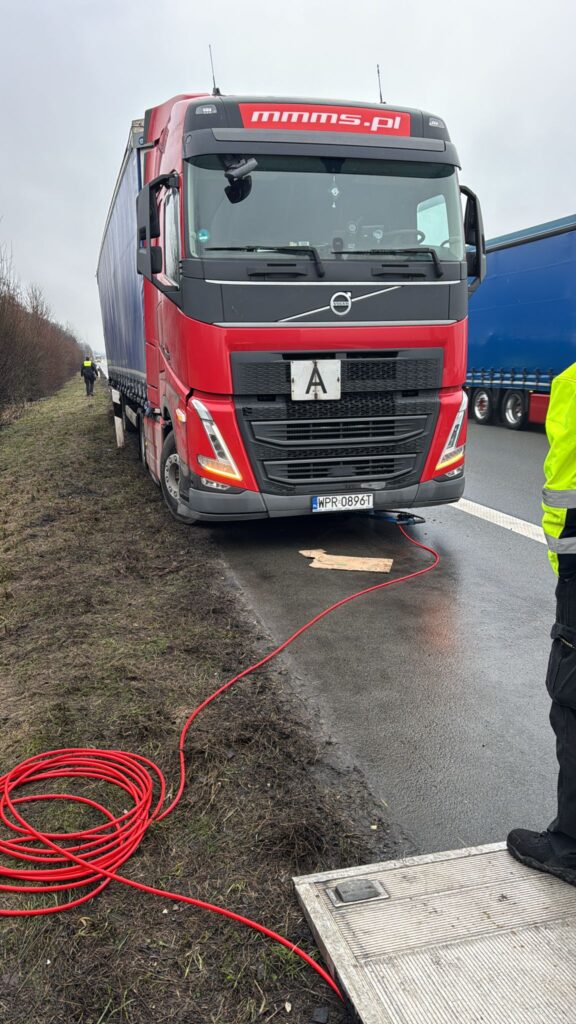
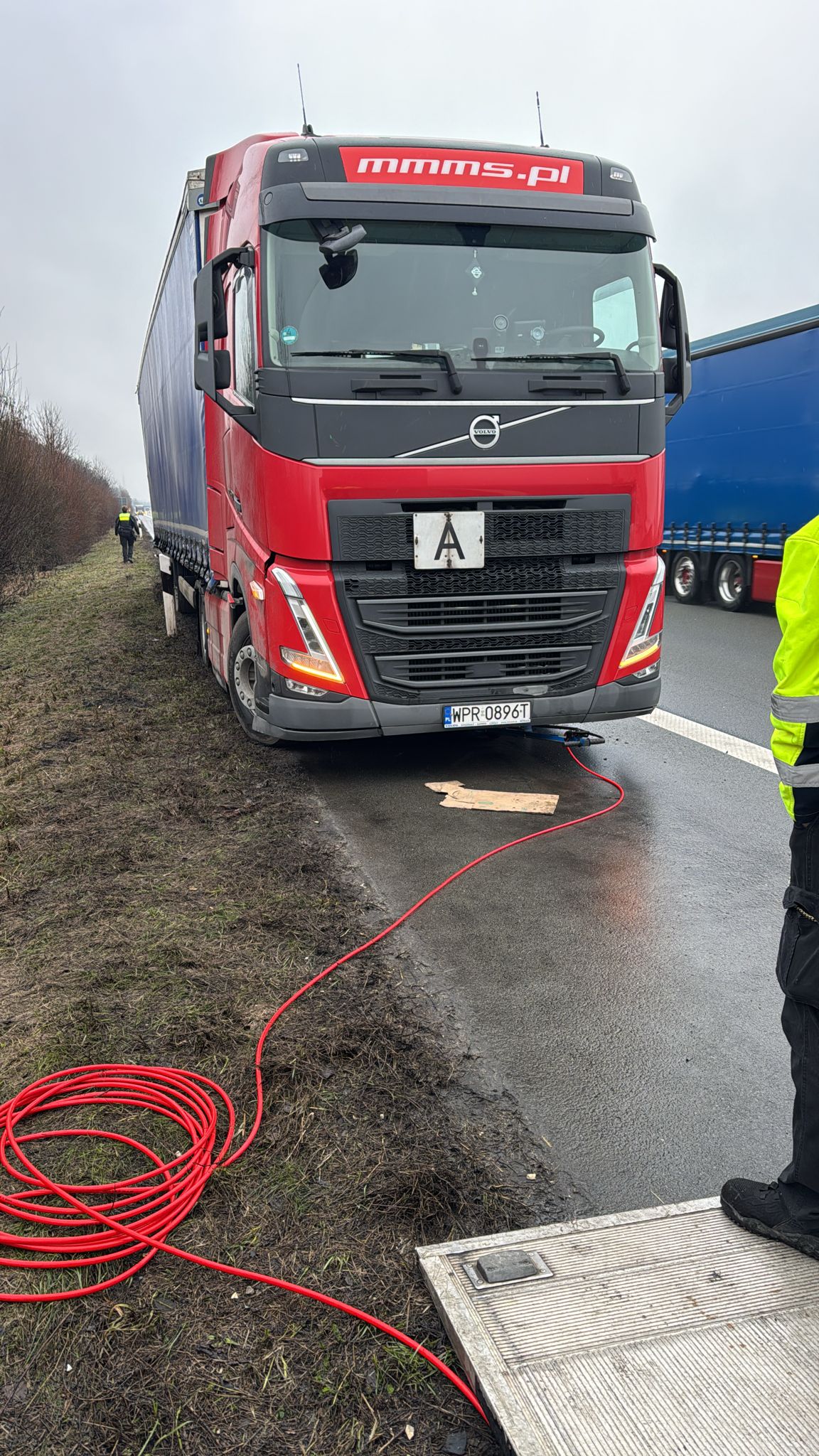
A Volvo tractor unit refused to start on a wet, cold hard shoulder of the A39 near Salzgitter, Lower Saxony, early on 12 February. The call reached LKWHelp24 dispatch at 05:42. By 08:05 the truck was running on a stable charge and back on the road, 2 hours and 23 minutes after the first call. This is the story of a 24V jump start done properly, and why that job is far less simple than it looks.
Cold mornings are when trucks fail. A lorry that started fine the previous evening can sit dead by dawn once the surface temperature drops and the battery capacity quietly falls away overnight. That is roughly what happened here: a driver pulled onto the hard shoulder before sunrise, tried to restart the engine, and got nothing but a weak crank from the starter motor.
This case study walks through the diagnosis, the correct 24V jump-start procedure, the full timeline, and the costs — and explains why jump-starting a heavy goods vehicle carries risks that a car driver never has to think about.
The emergency situation on the A39
The breakdown happened on the A39 in the direction of Braunschweig, on the hard shoulder near Salzgitter. It was still dark, the road surface was wet, and the air temperature sat close to freezing — the kind of morning that finishes off a battery that was already borderline.
The vehicle was a Volvo tractor unit, running a standard 24-volt electrical system with two 12V batteries wired in series. The driver reported that the engine cranked, but weakly, then died. No warning lights suggested a diesel-side fault, and the driver had not noticed anything unusual the previous evening.
Early morning breakdowns like this are common on German motorways in winter. A driver parks for a rest period, runs a fridge unit or a parking heater overnight to stay warm, and by the time the engine needs to fire up again, the starter battery voltage has slipped below what a 24V starter motor needs to turn a diesel engine over with any authority.
How the help was organised
LKWHelp24 operates a 24/7 dispatch service across Germany, coordinating a verified partner network so a technician reaches a stranded lorry as quickly as the traffic and weather allow. The process for this callout followed the same structure we use for every roadside job:
- Call taken at 05:42, location on the A39 near Salzgitter confirmed with the driver
- Vehicle type and symptoms logged — Volvo tractor unit, weak crank, no diesel warning signs
- Nearest available partner team assigned and dispatched within 16 minutes
- Driver advised to set out a warning triangle and put on a hi-vis vest, and to wait behind the crash barrier where possible
- Partner team briefed en route on the likely 24V jump-start job so the right equipment was already loaded
Dispatch speed matters more on a motorway hard shoulder than almost anywhere else. Every minute a lorry sits exposed on the verge in the dark, with rush-hour traffic building, is a minute of real collision risk for the driver and for the technician who eventually has to work beside the carriageway. For background on how we handle winter recoveries more broadly, see our guide to truck recovery in winter.
Why a 24V jump start is technically tricky
A truck’s electrical system is not simply a bigger version of a car’s. Most heavy goods vehicles run on 24 volts, produced by two 12V starter batteries connected in series rather than in parallel. That single design difference changes almost everything about how a jump start has to be done.
Try to jump-start a 24V lorry from a 12V car battery and one of two things happens: nothing, because there simply is not enough voltage to turn a diesel starter motor against compression, or damage, because a mismatched connection can push current through control units and sensors never designed for it. You need either a genuine 24V power source — another truck, a 24V-rated auxiliary battery pack, or a professional booster unit — or the job should not be attempted at all.
Our partner unit for this callout carried a 24V booster capable of delivering roughly 400 amps, enough to turn over a cold diesel engine without straining the donor source. That current capacity is the difference between a jump start that works cleanly and one that just produces smoke and disappointment.
The connection order that keeps everyone safe
Polarity matters, but so does sequence and location. The standard, safe procedure is:
- Connect positive to positive first
- Connect the negative lead to an earth point on the chassis, well away from the flat battery — never to the negative terminal of the dead battery itself
That last point is not a formality. Charging or cranking a battery generates hydrogen gas around the cells, and a spark right at the terminal, which is exactly where the final connection is made, can ignite it. Earthing the negative lead somewhere else on the chassis means any spark happens away from the gas. It is a small detail with a genuinely dangerous downside if skipped.
What must never be done
A few shortcuts turn a routine breakdown into a serious incident, and our technicians rule them out categorically:
- Bump-starting or tow-starting a truck with an automated gearbox — modern automated manual transmissions are not built to be push-started, and trying it risks drivetrain damage
- Using thin, undersized cables that overheat under 400 amps of cranking current
- Revving the donor engine hard while the leads are still being connected, which spikes the charging voltage unpredictably at exactly the wrong moment
None of these are theoretical risks. Each one shows up in breakdown reports every winter, usually from drivers or well-meaning bystanders trying to help without the right kit.
Step-by-step: the jump-start procedure used on site
- Assess and secure the area. Warning triangle placed well back, hi-vis worn, vehicle hazards on, work carried out from the verge side away from live traffic wherever the hard shoulder width allowed.
- Measure before touching anything. Battery voltage was checked with a multimeter first: 11.2 V at rest, well below the roughly 12.6 V a healthy 24V system’s individual battery should hold, confirming a genuine electrical fault rather than a fuel issue.
- Connect the booster in the correct order. Positive to positive, negative to a chassis earth point away from the battery, following the sequence above precisely.
- Bring up the charge, then attempt the start. The booster was allowed to feed current into the system briefly before cranking, rather than cranking immediately, to reduce strain on both the flat battery and the starter motor.
- Run and verify. Once the engine caught, it was kept running for a supervised run-on period while charging voltage was checked under load to confirm the alternator was doing its job.
Full timeline: call to completion
| Time | Phase | Action |
|---|---|---|
| 05:42–05:58 | Dispatch (16 min) | Call taken, location confirmed, partner team assigned |
| 05:58–06:47 | Response drive (49 min) | Cold wet road, early rush-hour traffic |
| 06:47–07:05 | Diagnosis (18 min) | Battery voltage measured 11.2 V, weak crank, diesel fuel problem ruled out |
| 07:05–07:50 | 24V jump-start + charge check (45 min) | Correct connection sequence, charging, work area secured |
| 07:50–08:05 | Final check & run-on (15 min) | Engine running stable, charging voltage confirmed at 25.4 V |
Total: 05:42–08:05 = 2 hours 23 minutes from call to job complete.
The diagnosis phase deserves a second look, because it is where a jump start gets decided against a battery replacement, or against a fuel-system call-out entirely. A weak, slow crank with a low resting voltage points to the battery. A starter motor that cranks strongly but the engine simply will not catch points somewhere else, usually towards the diesel fuel line in cold weather.
Costs and what drives them
| Item | Price (EUR) |
|---|---|
| Callout (early hours, cold/wet surcharge) | 260 |
| Electrical/cold-start diagnosis | 150 |
| 24V jump-start (labour + materials) | 140 |
| TOTAL | 550 |
All prices net, plus VAT. Three factors set the price on a job like this: the early-hours callout surcharge, the cold and wet surface adding time and risk to every step, and the diagnosis needed to rule out a fuel-side fault before committing to a jump start rather than a tow.
Set against that €550, downtime for a tractor unit typically runs €800–1,200 per day once you account for the missed delivery window, driver hours, and the knock-on effect on the next job in the schedule. A same-morning restart is not just convenient — it is usually the cheaper outcome by a wide margin.
Why you should not attempt this yourself
A flat 24V truck battery on a motorway hard shoulder is not a job for improvisation, and there are specific reasons why:
- Mismatched voltage sources can destroy sensitive electronics on modern Volvo trucks, turning a battery problem into an expensive control-unit problem
- Hydrogen gas builds up around charging battery cells, and a spark at the wrong terminal is a real ignition risk
- Standing on a wet hard shoulder in the dark with early rush-hour traffic passing metres away carries genuine slip and collision risk
- Bump-starting a vehicle with an automated gearbox can cause drivetrain damage that costs far more than any roadside callout
- A jump start that masks a genuinely dead battery, rather than a temporary cold-weather dip, leaves the truck likely to strand again at the very next stop
Our technicians measure resting voltage and charging voltage before and after the fix precisely so the driver knows whether they are good to continue or whether a battery replacement should be scheduled before the next long haul. We have covered the general rules of safe jump starting, for cars and trucks alike, in more detail in our guide to jump-starting a vehicle correctly.
Typical winter callouts LKWHelp24 handles
Winter on German motorways brings a fairly predictable set of breakdown calls, and this job sits squarely among the most common:
- Flat or weak 24V starter batteries after cold overnight parking
- Diesel gelling or wax formation clogging the fuel filter in hard frost
- Winter tyre and traction issues on ungritted stretches of hard shoulder
- Alternator faults that leave a battery chronically undercharged even before the cold arrives
- Parking heater failures that push drivers to run electrics harder overnight, draining the battery faster
For tyre-related winter callouts specifically, see our overview of HGV winter tyre requirements and safety in Germany.
Battery, cold start and fleet maintenance: the wider picture
Cold weather does not just make starting harder, it genuinely reduces what a lead-acid battery can deliver. According to manufacturer data cited by ADAC, a conventional lead-acid starter battery can lose 30–50% of its usable capacity in hard frost. A battery that would comfortably start an engine in summer can fail outright at -5°C or below, even without any underlying fault.
That is why the diagnosis step matters as much as the jump start itself. A resting voltage of 11.2 V, as measured here, is low enough to explain a weak crank on its own, but it does not automatically mean the battery is failing — cold alone can produce a reading like that on an otherwise healthy battery near the end of a long overnight parking heater run. The real test is what happens after charging: this battery came back to 12.6 V resting and the system held 25.4 V under load once the alternator was doing its job, both solid readings for a 24V truck electrical system.
Fuel-side cold problems look different from the driver’s seat. Diesel gelling, where paraffin wax crystals form in the fuel at low temperatures, tends to clog the fuel filter and produces a strong, confident crank with an engine that simply will not fire. A battery fault produces the opposite pattern: a slow, weak crank that struggles to turn the engine over at all. Telling the two apart in the first few minutes on site is what separates a 45-minute jump start from a much longer job involving fuel filter work or a tow.
Parking heaters and cold-start aids play a genuine role here too. A working parking heater keeps the cab warm without leaning on the starter battery, and a functioning glow plug or cold-start system on the engine itself reduces the current the starter motor demands on a cold morning. When either is neglected or failing, the starter battery ends up carrying a load it was never sized for, and mornings like this one on the A39 become far more likely.
None of this is guesswork drivers need to carry alone. Hauliers who run a proper autumn winter check across the fleet — battery load testing, alternator inspection, a switch to winter-grade diesel, and a check of the parking heater and cold-start system — see noticeably fewer roadside callouts once temperatures drop. It is a modest cost against the alternative of a flat battery on a live hard shoulder at 05:42 on a wet February morning.
Prevention advice for fleets and drivers
A little seasonal maintenance goes a long way toward avoiding a repeat of this callout:
- Load-test starter batteries every autumn before the first hard frosts arrive, not after the first breakdown
- Switch to winter-grade diesel in good time to avoid gelling on the coldest mornings
- Have the alternator and charging system checked, since a battery that never charges properly will fail regardless of its own condition
- Limit overnight parking heater and fridge unit use where battery condition is already uncertain
- Keep jump leads or a 24V-rated booster on board, but treat them as a bridge to a proper check, not a permanent fix
For general mobile servicing that covers checks like these on the road, our mobile truck service can carry out battery and charging system inspections without the vehicle needing to reach a workshop.
Why choose LKWHelp24
LKWHelp24 runs a 24/7 dispatch operation across Germany, backed by a verified partner network of technicians equipped for exactly this kind of electrical fault, not just tyre and towing work. Every callout is priced transparently before work begins, dispatch is multilingual so drivers from anywhere in Europe can explain the problem clearly, and our technicians carry the diagnostic equipment to tell a battery fault from a fuel fault in minutes rather than guessing.
Related services include our truck breakdown service for wider mechanical faults and our towing service for the cases where a jump start genuinely is not enough and the vehicle needs recovery instead.
FAQ
Can I jump-start a 24V truck from a car battery?
No. A 12V car battery cannot supply enough voltage to reliably turn a heavy diesel starter motor, and a mismatched connection risks damaging the truck’s electronics. You need a proper 24V source, either another truck or a rated booster unit.
Why did my truck start fine yesterday but not this morning?
Cold overnight temperatures reduce battery capacity, sometimes by 30–50% in hard frost according to ADAC-cited manufacturer data. Combined with overnight parking heater use, a marginal battery that worked yesterday can simply run out of reserve by dawn.
Is a jump start a permanent fix?
Not always. If the battery has genuinely lost capacity rather than just being cold, the truck can strand again at the next stop. Our technicians check resting voltage and charging voltage after the jump start to advise whether a replacement is needed soon.
How do I know if it’s the battery or the diesel fuel that’s the problem?
A weak, slow crank usually points to the battery. A strong crank where the engine simply will not catch usually points to a fuel-side issue such as diesel gelling in cold weather. Our diagnosis step measures voltage first to tell these apart.
Is it safe to work on the hard shoulder in the dark?
It carries real risk from passing traffic, wet surfaces and low visibility, which is why our technicians secure the site with a warning triangle and hi-vis vest and work from the verge side wherever the hard shoulder allows.
How fast can LKWHelp24 reach me on a German motorway?
Response times depend on location and traffic, but in this case dispatch took 16 minutes and the partner team was on site within 49 minutes of leaving. We operate 24/7 across Germany with a wide partner network.
Summary
A Volvo tractor unit stranded on the A39 hard shoulder near Salzgitter with a flat 24V electrical system was diagnosed, jump-started, and verified running with a stable 25.4 V charging voltage within 2 hours and 23 minutes of the first call at 05:42. Total cost came to €550 net, against a typical downtime cost of €800–1,200 per day for a tractor unit — with no secondary damage to the vehicle’s electronics thanks to the correct 24V connection sequence.
Need a 24V jump start or breakdown assistance on a German motorway?
Call LKWHelp24 on +49 160 5753826 or visit www.lkwhelp24.com — 24/7 across Germany.
Keywords: 24V lorry jump start Germany | truck jump start service | tractor unit battery breakdown | HGV cold start assistance | hard shoulder truck recovery | starter battery jump start Autobahn | diesel gelling winter breakdown | Volvo truck roadside assistance
Related articles
- Important jump-start rules: how to jump-start a vehicle correctly
- Truck recovery in winter: towing services explained
- HGV winter tyre requirements and safety in Germany
- Truck breakdown assistance across Germany
- Rest areas and rest stops on the German Autobahn
According to ADAC, cold weather is one of the leading causes of winter battery failure on German roads. Truck electrical systems, unlike a lead-acid car battery, run at 24 volts and demand specialist equipment and knowledge — see Volvo Trucks for manufacturer guidance on tractor unit electrical systems, and Bosch Mobility for background on starter and charging technology. Securing a breakdown site on a German motorway is a legal requirement under §15 StVO.