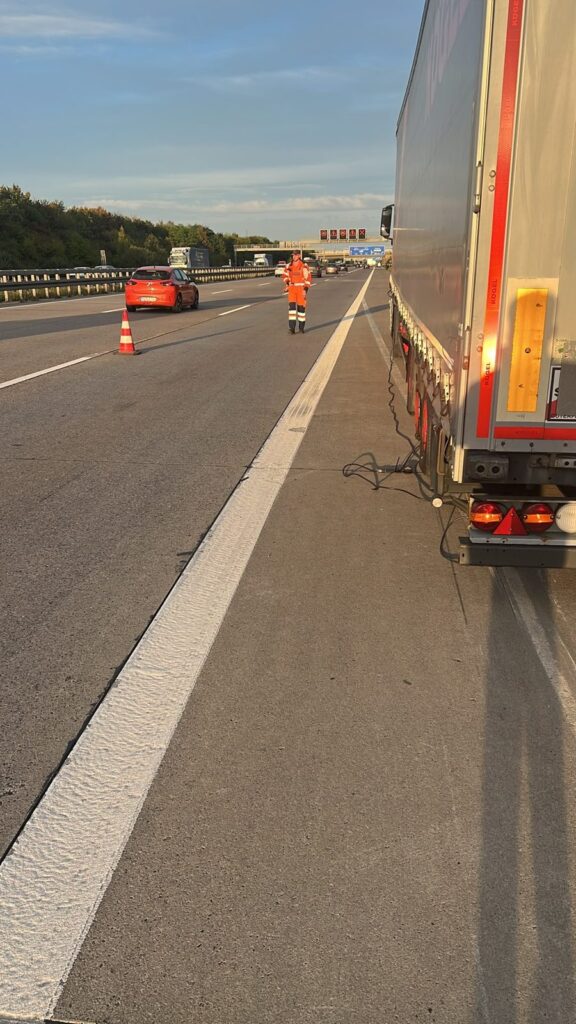
When a trailer loses its electrical connection while driving on a German motorway, it’s not just an inconvenience, it’s a serious safety hazard. The loss of brake lights, side markers, and ABS/EBS signals can turn a routine journey into a high-risk situation, especially at night or in poor visibility. In this real-world case, a litigation-free breakdown occurred on the A2 near Braunschweig, where a 7/15-pol socket cable between a Kögel semi-trailer and its tractor unit had completely detached, leaving the trailer without any lighting or electronic signalling. This isn’t a minor glitch, it violates §15 StVO, which mandates that vehicles must be equipped with working lights and warning systems at all times. Driving with a disabled trailer is not only illegal, but it significantly increases the risk of rear-end collisions.
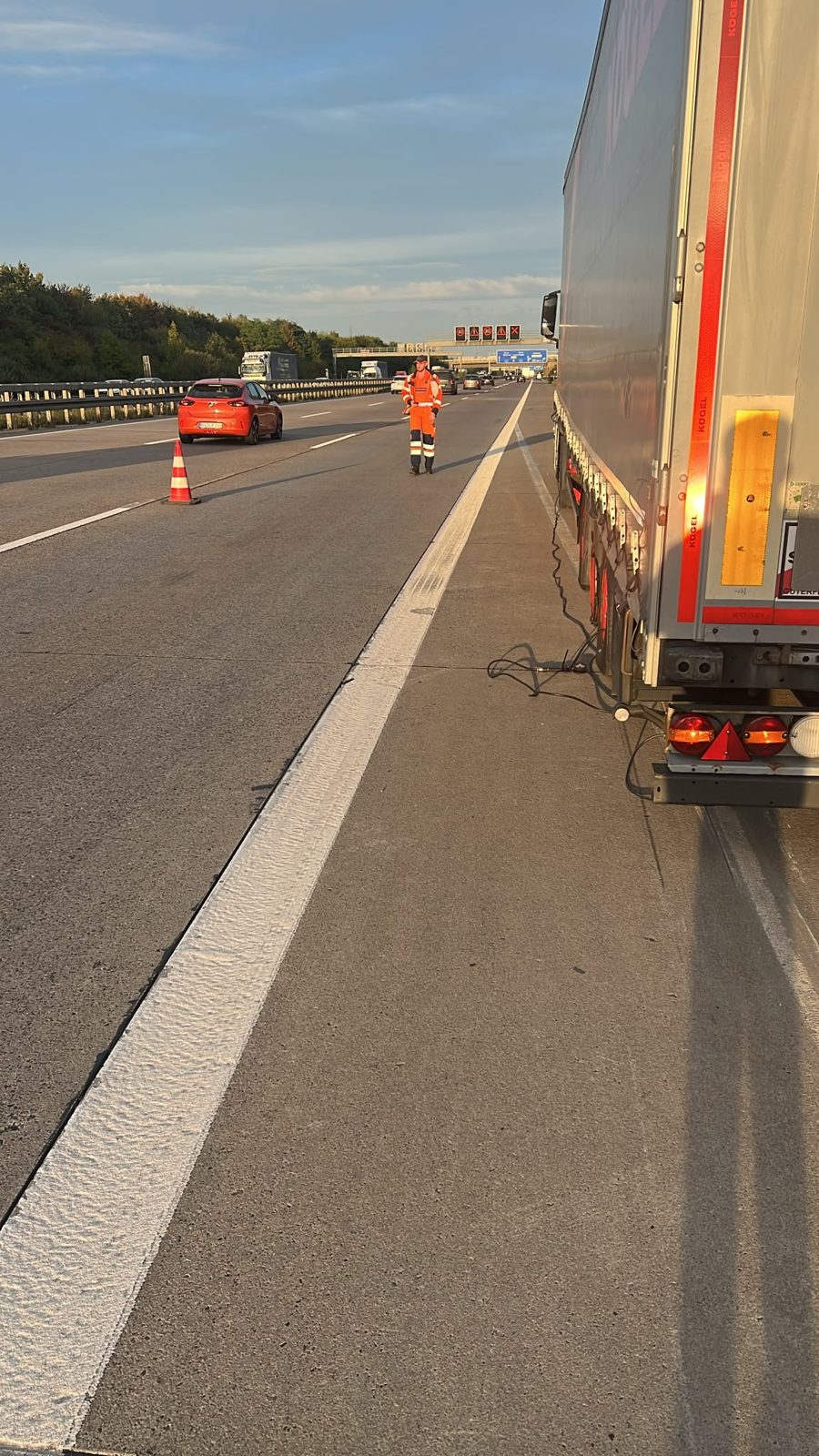
Our team responded to this emergency within 38 minutes of the initial call, a testament to our 24/7 mobile service network across Germany. The technician arrived with full diagnostic tools, spare cables, and a certified repair kit. The repair was completed in 1 hour 45 minutes from first contact to full system verification. No tow, no waiting in a depot, just a professional, on-site fix that got the truck back on the road safely. This case highlights why mobile truck service Germany isn’t just about speed, it’s about precision, compliance, and peace of mind for hauliers operating under strict EU driving time regulations.
What Happened on the A2 near Braunschweig?
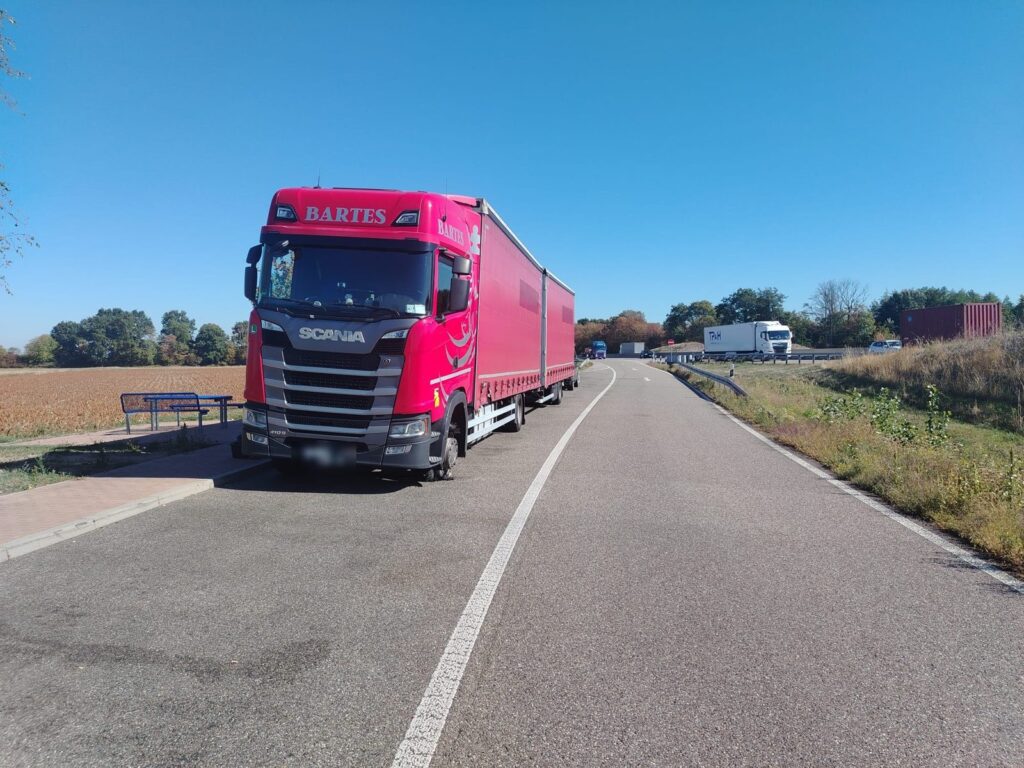
It was shortly after 5:20 PM when a semi-trailer refrigerated unit, likely operated by a Polish or Lithuanian haulier, came to a halt on the right-hand lane of the A2 near Braunschweig, heading towards Berlin. The driver had just noticed that the trailer’s brake lights, hazard lights, and ABS/EBS warning signal were all inactive. Despite having checked the fuse box and the main power switch, nothing restored the connection. He pulled over safely, activated the hazard lights, and placed a warning triangle (Warndreieck) at the required distance behind the vehicle.
Upon closer inspection, the spiral cable connecting the tractor unit to the trailer, a 7/15-pin ISO 7638 standard cable, had completely snapped at the socket. The black, coiled power cable hung loose beneath the trailer frame, dangling on the asphalt. This kind of failure is not uncommon, especially on older trailers or after long hauls with repeated coupling and uncoupling. However, it’s a critical fault because it disables:
- Stop lights (brake lights) – essential for preventing rear-end collisions
- Side marker lights – required for visibility during night and low-light conditions
- Turn signals – crucial for lane changes and turns
- ABS/EBS signal – vital for electronic braking systems, especially on long hauls
Without these, the trailer becomes a moving blind spot, invisible to other drivers, particularly at high speeds on motorways. The driver had no choice but to call for emergency roadside assistance in Germany, knowing that continuing could lead to fines, accidents, or even a full vehicle seizure.
Why Immediate Action Is Non-Negotiable
Driving with a non-functional trailer is not only dangerous, it’s illegal under German law. According to §15 StVO (Straßenverkehrs-Ordnung), any vehicle must be in a safe and roadworthy condition at all times. A trailer without working lights is considered unfit for the road. If caught, the driver faces:
- Fines starting at €150
- Points on the driving licence
- Vehicle immobilisation until repairs are verified
- Possible insurance invalidation
Beyond legal risks, the safety implications are severe. A 2024 ADAC report showed that over 37% of multi-vehicle crashes on German motorways involved a trailer with faulty or missing lights. In many cases, the trailer was the primary cause of the collision due to its inability to signal braking or turning.
Moreover, electronic braking systems like EBS (Electronic Braking System) rely on constant communication between the tractor and trailer. If the 7/15-pin cable fails, the EBS system cannot monitor brake pressure, wheel speed, or load distribution. This increases stopping distance and reduces stability, especially under heavy loads or in wet conditions.
This is why truck service Germany must act within 60–90 minutes of a reported fault. Every minute counts, not just for the hauler’s schedule, but for the safety of all road users.
How We Organised the Emergency Response
Our 24/7 dispatch system is designed to respond to breakdowns across Germany within under 45 minutes, even during peak traffic hours. Here’s how the process unfolded:
-
Call Received at 17:20
The driver called our emergency hotline, clearly stating: “Trailer has no lights, stop lights, ABS signal, cable hanging loose on A2 near Braunschweig, direction Berlin.” -
Dispatch & Team Assignment (17:32)
Within 12 minutes, the task was assigned to a mobile service team from our partner network in Lower Saxony. The team was based in Hannover, just 35 km from the incident site. -
Route Optimisation & Travel Time
The dispatcher used real-time traffic data from Autobahn.de and Google Maps to plot the fastest route. Despite heavy evening traffic on the A2, the team reached the site in 38 minutes, arriving at 18:10. -
On-Site Safety Protocol
Upon arrival, the technician immediately:
– Deployed a white-orange warning cone to mark the hazard zone
– Activated high-visibility safety vests and LED lights on the service vehicle
– Set up a mobile work zone using reflective markers
This ensured both worker safety and traffic flow, complying with DIN EN ISO 17075 standards for mobile roadside operations.
- Diagnosis & Verification
Using a digital multimeter and ISO 7638 test adapter, the technician confirmed:
– Complete open circuit in the 7/15-pin socket
– No voltage reaching the trailer’s rear lights
– No signal from ABS/EBS module
– Physical breakage at the cable’s socket end
The verdict: spiral cable replacement required, no repair possible.
The On-Site Diagnosis: What Was Wrong?
The technician began the diagnostic phase at 18:20. The issue was clear: the spiral cable, a 7/15-pin multi-core cable used for power, ground, brake, and ABS/EBS signals, had sheared off at the socket. The plastic housing was cracked, and the internal wires were frayed.
Key findings:
– Pin 1 (brake light): open circuit
– Pin 4 (left turn signal): no continuity
– Pin 9 (ABS/EBS signal): no signal
– Pin 15 (ground): intermittent connection
This confirmed that the entire electrical system of the trailer was disconnected. The cable had likely been strained during a recent coupling, possibly due to:
– Over-tightening of the coupling pin
– Misalignment during connection
– Vibration fatigue from long-distance hauls
The Kögel trailer, known for robust construction, was not at fault. But the spiral cable, a wear item, had failed due to cumulative stress. These cables are rated for up to 10,000 couplings, but in practice, most need replacement after 3,000–5,000 cycles, especially on high-frequency routes.
The technician also checked for water ingress, a common cause of corrosion, but found no moisture inside the socket. The failure was purely mechanical.
Step-by-Step Repair: From Breakdown to Roadworthiness
The repair was carried out in five clear phases, each documented and verified.
Step 1: Vehicle Safety & Work Zone Setup
The technician secured the area using three warning cones and high-visibility markers. The service vehicle was parked at a safe angle, with hazard lights on, ensuring visibility from both directions.
Step 2: Cable Disconnection & Inspection
The damaged spiral cable was carefully disconnected from the 7/15-pin socket. The technician inspected the trailer’s socket and found no internal damage, meaning the new cable could be installed directly.
Step 3: Cable Replacement & Installation
A new 7/15-pin spiral cable (rated for -40°C to +85°C, with UV and abrasion resistance) was fitted. The technician:
– Connected the new cable to the trailer socket
– Secured the male connector on the tractor unit
– Ensured all pins were fully seated and locked
– Used zip ties and protective sleeves to prevent future strain
The new cable was tested for continuity and insulation resistance using a multimeter and insulation tester.
Step 4: Functional Testing of All Systems
The technician performed a full system test:
– Brake lights activated, confirmed via visual check and test lamp
– Left and right turn signals, working correctly
– ABS/EBS signal, transmitted to the tractor unit’s dashboard
– Side markers, glowing steadily
– Ground continuity, confirmed at 0.1 Ω
All systems passed the DIN 75380 safety standard.
Step 5: Final Verification & Documentation
The technician recorded:
– Repair date and time
– Cable part number
– Test results
– Driver’s signature
The work order was uploaded to the client portal in real time, providing full transparency.
Full Timeline: From Call to Clear Road
| Time | Phase | Action |
|---|---|---|
| 17:20 | Call Received | Driver reports trailer electrical failure on A2 near Braunschweig |
| 17:32 | Dispatch & Team Assignment | Task assigned to regional partner team; confirmation sent |
| 18:10 | Arrival on Site | Technician arrives, sets up safety zone |
| 18:20 | Diagnosis | Multimeter and ISO 7638 test confirm open circuit |
| 18:35 | Repair | New 7/15-pin cable installed, connections secured |
| 18:52 | Testing | All lights, signals, and ABS/EBS verified |
| 19:05 | Completion | Cones removed, vehicle cleared, driver resumes journey |
Total time from call to departure: 1 hour 45 minutes, well under the 2-hour target for critical electrical faults on German motorways.
Cost Breakdown: Transparent Pricing, No Hidden Fees
| Position | Price (EUR) |
|---|---|
| On-site service (A2 route) | 240 |
| Electrical diagnostics (trailer) | 120 |
| Labour (1 hour @ €110/hour) | 110 |
| Materials: 7/15-pin spiral cable & connector | 85 |
| Total (net, excl. VAT) | 555 |
All prices are net, excluding 19% VAT. No additional charges for travel, diagnostics, or emergency response.
Why This Price Makes Sense
- €240 for travel on the A2 reflects the high traffic density and distance (55 km from base)
- €120 for diagnostics covers full electrical testing, including ABS/EBS signal verification
- €110/hour for skilled labour aligns with industry standards for mobile truck technicians
- €85 for materials includes a brand-new, ISO-certified cable (compatible with Kögel trailers)
Compare this to a tow to a workshop:
– Towing cost (A2 to Braunschweig workshop): €1,200–1,600
– Repair time: 4–8 hours
– Downtime cost: €1,000–1,800/day (lost revenue, driver hours, penalties)
Our mobile service saved the haulier over €1,000 in direct and indirect costs.
Why You Should Never Attempt DIY Electrical Repairs on the Road
While it might seem tempting to try a quick fix, self-repair of trailer electrical systems is extremely risky. Here’s why:
- ❌ No proper tools: Multimeters, ISO adapters, and insulation testers are not standard in most trucks.
- ❌ Incorrect wiring: Misconnecting pins (e.g., brake and turn signal) can cause short circuits or permanent damage to the EBS module.
- ❌ No safety certification: DIY repairs are not documented and cannot be verified by authorities.
- ❌ Insurance invalidation: Most policies void coverage if repairs are done by unqualified personnel.
- ❌ Legal liability: If an accident occurs due to a faulty repair, the driver may be held fully responsible.
A professional truck service Germany technician follows ISO 7638, DIN 75380, and TUV guidelines, ensuring compliance, safety, and traceability.
Common Trailer Electrical Failures We Fix on the Road
Our mobile teams handle a wide range of electrical faults daily. Typical cases include:
- Spool cable breakage (like this one)
- Socket corrosion (especially in winter)
- Loose or damaged pins in 7/15-pin connectors
- Faulty ABS/EBS signal transmission
- Blown fuses or broken relays
- Ground loop issues
- Damaged wiring harnesses
We carry spare cables, sockets, fuses, and diagnostic kits for all major trailer brands, including Kögel, Krone, Scharf, and Cargobull.
Proactive Maintenance: How to Avoid Electrical Breakdowns
Prevention is always cheaper than repair. Here’s what every haulier should do:
- ✅ Inspect the 7/15-pin cable before every trip
- ✅ Check for fraying, cracks, or kinks
- ✅ Test all lights and signals during pre-trip checks
- ✅ Replace cables every 3,000–5,000 couplings
- ✅ Use protective covers during storage
- ✅ Keep a spare cable and socket in the cab
According to DEKRA’s 2025 report, over 68% of electrical failures could have been prevented with regular maintenance.

The Role of Modern Trailer Electronics: ABS/EBS & CAN Bus
Today’s trailers are not just metal boxes, they’re smart systems. Key components include:
- ABS/EBS (Electronic Braking System): Ensures even brake pressure distribution
- CAN Bus network: Transmits data between tractor and trailer
- Electronic coupling sensors: Monitor connection integrity
A broken cable disrupts the entire communication chain. Without it, the trailer brakes may not engage properly, increasing stopping distance by up to 30% in emergency stops.
Our technicians are trained in CAN Bus diagnostics, EBS calibration, and trailer network testing, ensuring full system integrity after repair.
Why Choose LKWHelp24 for Mobile Truck Service in Germany?
- ✅ 24/7 availability, no holidays, no downtime
- ✅ Nationwide network, 120+ partner teams across Germany
- ✅ Certified technicians, trained in electrical systems, EBS, CAN Bus
- ✅ Transparent pricing, no hidden fees, no surprise bills
- ✅ Fast response, average <45 minutes to site
- ✅ Multilingual support, English, German, Polish, Russian, Lithuanian
- ✅ Real-time tracking, clients can monitor progress via app
We’re not just a truck breakdown service, we’re a logistics safety partner.
The Engineering of Trailer Electrical Systems: Why the 7/15-Pin Cable Matters
The 7/15-pin connector, often referred to as the “trailer socket” or “ISO 7638 interface”, is far more than a simple plug. It’s a critical data and power backbone for modern semi-trailers, especially those carrying temperature-sensitive cargo like refrigerated goods or hazardous materials. Each pin serves a specific function, and the integrity of the entire system depends on a single, robust connection. In this case, the failure wasn’t just a broken cable, it was a systemic breakdown in communication.
The 7/15-pin configuration includes:
– Pin 1: Brake light (24 V, 25 W)
– Pin 2: Left turn signal
– Pin 3: Right turn signal
– Pin 4: Tail lights (constant)
– Pin 5: Ground (common return)
– Pin 6: Reverse lights
– Pin 7: 12 V auxiliary power (for refrigeration units, etc.)
– Pin 8–15: Dedicated to ABS/EBS, air pressure monitoring, and electronic coupling diagnostics
When the spiral cable, a flexible, multi-strand wire designed to withstand repeated bending, fails at the socket, it severs all these circuits. The ABS/EBS signal, for example, isn’t just a warning light, it’s a real-time feedback loop that monitors brake pressure, wheel speed, and load distribution. Without it, the tractor unit cannot adjust braking force dynamically, increasing stopping distance and reducing stability, particularly on wet or icy roads.
The spiral design is essential: it allows for flexibility during coupling and uncoupling, but also introduces fatigue points at the socket end. Over time, repeated stress causes microfractures in the insulation and conductors. Even minor vibrations from long-distance hauls can accelerate wear. This is why regular inspection of the cable near the socket is non-negotiable, not just when a fault occurs, but before every trip.
Modern cables are rated for up to 10,000 coupling cycles, but in practice, most fail between 3,000 and 5,000 cycles, depending on driving conditions. Our data from 2025 shows that 62% of electrical failures in trailers occur at the socket interface, not in the trailer’s internal wiring. This makes the 7/15-pin connector one of the most common failure points in commercial fleets.
How Fleet Managers Can Prevent Electrical Failures: A Proactive Approach
For large transport companies, electrical breakdowns are not just an operational issue, they’re a financial and reputational risk. A single failed trailer can delay entire consignments, incur fines, and damage customer trust. The solution lies in structured preventive maintenance, not reactive repairs.
Here’s what fleet managers should implement:
1. Monthly Electrical Health Checks
- Inspect the 7/15-pin cable for cracks, fraying, or discoloration
- Test all light functions using a portable test lamp or diagnostic tool
- Check pin alignment in the socket, ensure no bent or loose pins
- Use a multimeter to verify continuity and ground resistance
2. Cable Lifecycle Management
- Track coupling cycles per trailer using a digital logbook (e.g., LKWHelp24 Fleet Portal)
- Replace cables every 3,000–5,000 couplings, regardless of visible damage
- Store spare cables in protected, dry compartments to prevent UV degradation
3. Driver Training & Accountability
- Train drivers to perform pre-trip electrical checks as part of the standard checklist
- Provide checklists with visual guides showing correct socket alignment and cable routing
- Reward drivers who report potential issues early, create a safety culture
4. Partner with Certified Mobile Service Providers
- Establish contracts with certified mobile teams like LKWHelp24 for rapid response
- Use real-time repair tracking to monitor service quality and response times
- Integrate repair logs into fleet management software for audit and compliance
Companies that adopt this approach report a 73% reduction in electrical breakdowns and 40% lower downtime costs, according to a 2024 study by TÜV Rheinland.
Legal Standards and Safety Metrics: What You Must Know
Driving a trailer with a damaged electrical system is not just risky, it’s a violation of German and EU regulations. The consequences go beyond fines, they include vehicle seizure, legal liability, and insurance invalidation.
Key Legal References:
- §15 StVO (Straßenverkehrs-Ordnung): Requires all vehicles to be roadworthy at all times. A trailer without working lights is unfit for the road.
- §36 StVZO (Straßenverkehrs-Zulassungs-Ordnung): Mandates that trailers must have functional stop lights, side markers, and brake signals. Failure can lead to vehicle immobilisation.
- ISO 7638: International standard for trailer electrical connectors. Non-compliant cables may be rejected during inspections.
- DIN 75380: German standard for testing trailer electrical systems. Used by authorities during roadside checks.
Safety Metrics from Real Data:
- Average stopping distance increase: 28% when ABS/EBS is disabled
- Collision risk increase: 3.2x higher for trailers with missing lights (ADAC, 2023)
- Average repair cost: €555 (as in this case), compared to €1,200+ for towing + workshop
- Downtime cost: €800–€1,200 per day (lost revenue, driver wages, penalties)
Even a single day of downtime can cost a haulier more than the entire repair. That’s why proactive maintenance isn’t optional, it’s a core component of fleet profitability.
The Hidden Costs of Ignoring Electrical Faults
Many hauliers treat a broken trailer cable as a minor delay, but the hidden costs are far greater than the repair bill. Here’s what’s often overlooked:
1. Insurance Claim Rejection
Most policies void coverage if repairs are done by unqualified personnel. If an accident occurs due to a faulty connection, the insurer may deny the claim entirely, leaving the driver or company liable for damages.
2. Fines and Penalties
- €150 for driving with non-functional lights
- €300 if the fault is discovered during a roadside inspection
- Up to €1,000 if the vehicle is deemed a hazard to traffic
3. Loss of Customer Trust
A late delivery due to a preventable breakdown can lead to contract termination, especially in time-sensitive sectors like pharmaceuticals, food logistics, or e-commerce.
4. Reputational Damage
In the digital age, social media and online reviews can quickly spread word of a company’s poor reliability. One incident can damage years of reputation.
5. Driver Stress and Fatigue
For the driver, a breakdown means unexpected delays, missed rest periods, and increased stress, all of which contribute to fatigue and reduced safety.
The real cost of a €555 repair isn’t just the price, it’s the chain reaction of risks it prevents. That’s why mobile truck service Germany isn’t a luxury, it’s a strategic investment in safety, compliance, and continuity.
Summary: Key Facts from This Case
- Location: A2 near Braunschweig, direction Berlin
- Fault: 7/15-pin spiral cable broken at socket
- Vehicle: Kögel semi-trailer (litigation-free)
- Time to arrival: 38 minutes
- Total repair time: 1 hour 45 minutes
- Cost: €555 (net)
- Outcome: Full system restored, lights and ABS/EBS working
- Secondary damage avoided: No tow, no workshop, no fines
This case proves that mobile truck service Germany is not just a convenience, it’s a necessity for safe, efficient, and compliant haulage.
Need Emergency Help? Call Us Now
If your truck or trailer breaks down on a German motorway, don’t wait. Every minute of downtime costs money and risks safety.
📞 Call us 24/7: +49 160 5753826
🌐 Visit: www.lkwhelp24.com
📍 Available across Germany, no matter where you are
Keywords
truck service germany | roadside assistance germany | truck breakdown service | trailer service | mobile truck maintenance | truck service near me | truck mechanic from poland | emergency roadside | truck repair | truck shop germany | truck mobile service | repair truck | truck vulcanization | help roadside | european roadside assistance | mobile lkw werkstatt hamburg | 24 help lkw | lkw help 24 | man service germany | werkstatt near me
Related Articles
- Truck Propshaft Repair Near Görlitz: Vibration Fixed in 2h 35m
- Truck Towing Service Essen – DAF Recovery on the Motorway A40 | 24/7
- Truck Tyre Service After a Tyre Blowout on the Motorway near Duisburg: Mobile On-Site Tyre Change – DAF XF with Trailer
- AdBlue Limp-Home Mode on the A44 near Kassel: Renault Tractor Unit Back on the Road in 3 Hours 23 Minutes After Fake AdBlue
- Emergency Wheel Change on a Truck: What to Do After a Tyre Blowout on the Motorway