In short: on 3 September 2026 a curtainsider semi-trailer lost an entire tyre on the A4 near Eisenach, heading towards Erfurt and Dresden. The driver rang us at 16:30, our partner crew arrived after 62 minutes, and the trailer rolled on again at 18:32. Total: 122 minutes from call to departure. Bill: 925 EUR net. Collateral damage: none.
A trailer tyre that has shredded itself is never just a flat. Strips of tread whip around at motorway speed, the casing tears apart, and a lump of rubber the size of a coffee table can end up on the carriageway behind you. The driver in this case did the right thing: hazard lights on, slow onto the hard shoulder, stop against the crash barrier. Nobody was hurt and nothing else was hit.
What follows is a full account of that callout. It is meant for drivers, dispatchers and fleet managers who want to know how a truck tyre service on a German autobahn actually works, what it costs, how long it takes and where the time goes. All figures come straight from the job file. Nothing has been rounded to look better.
The emergency: a destroyed trailer tyre on the A4
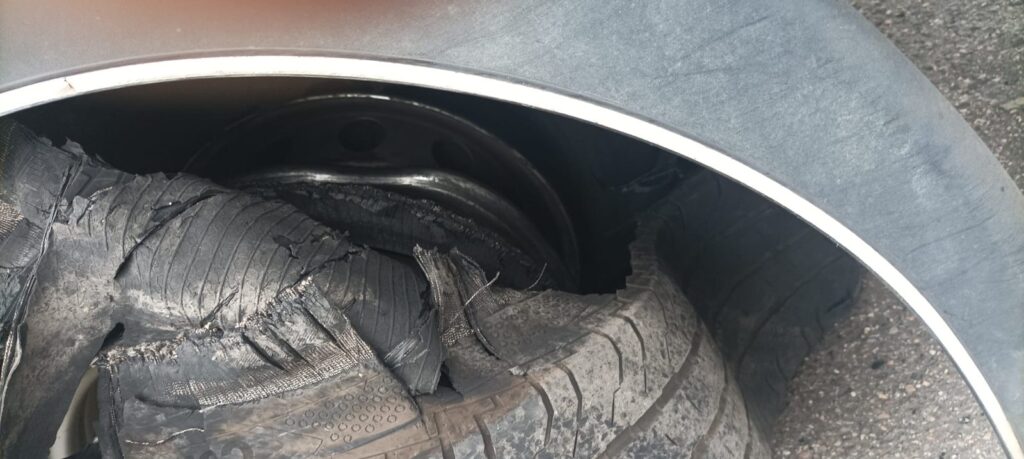
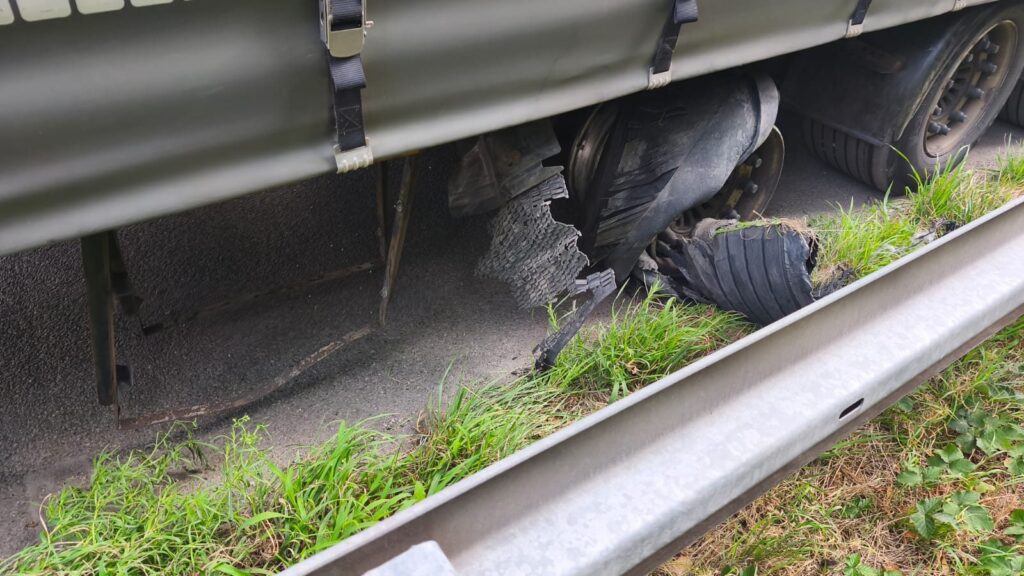
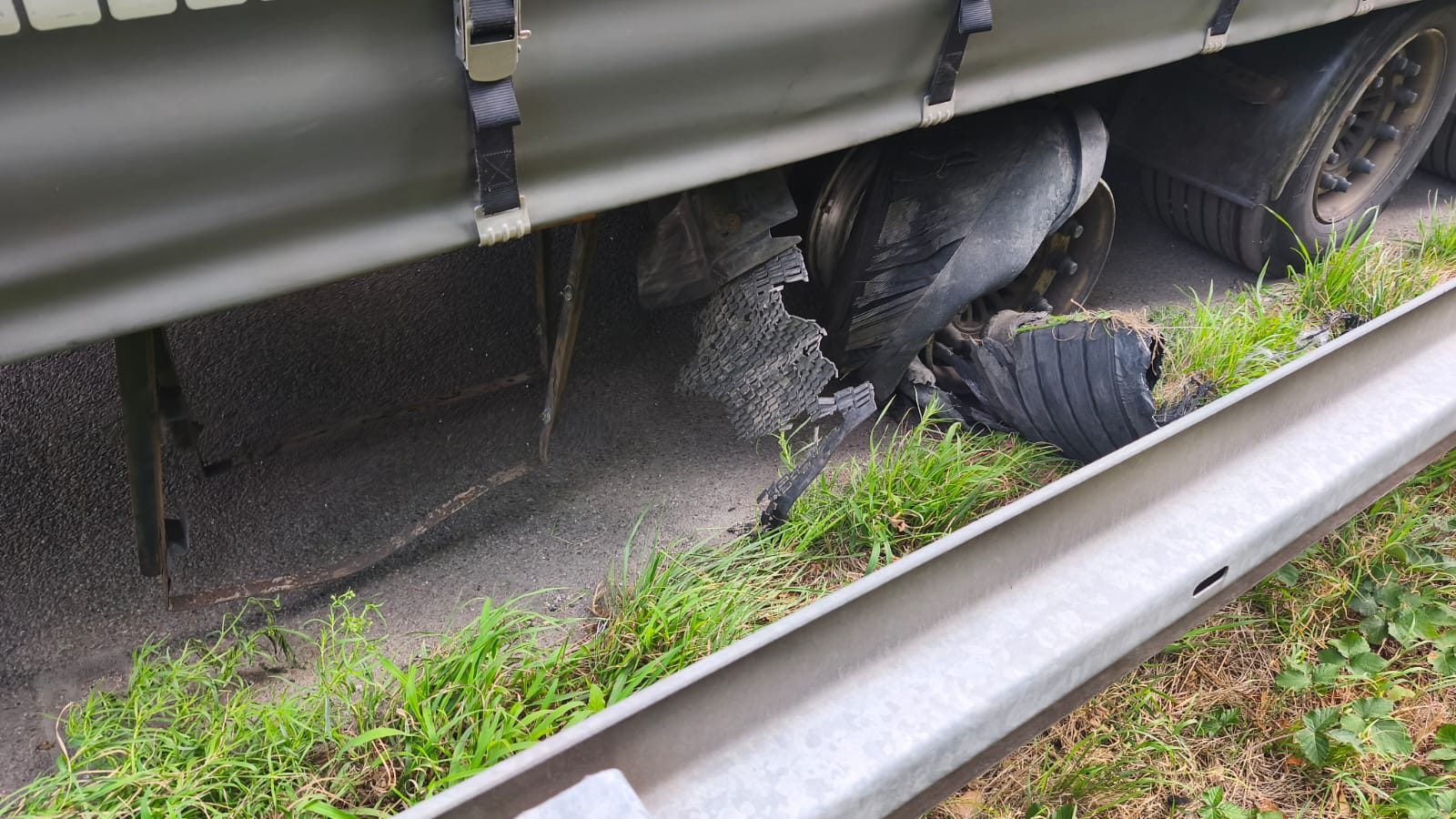
The photo from the roadside tells the story better than a paragraph could. A tarpaulin-sided semi-trailer (a curtainsider, or Planenauflieger in German) stands tight against the galvanised crash barrier. The tyre on one trailer axle is completely gone. The tread has torn off and hangs in ribbons, the casing is split open, and the sidewall lies in shreds across the grass verge and the tarmac. The rim and hub were still in place. Beside the wreck, the intact twin wheel of the neighbouring axle sat there with its black wheel nuts, almost mocking the damage next to it.
The tyre size could not be read from the picture. For planning and pricing we assumed 385/65 R22.5, the standard single tyre on a trailer axle, and the crew loaded exactly that. It turned out to be the right call.
It was dry, bright and warm, around 16:30 on an early September afternoon. That matters, because it was the easy version of this job. In rain, in the dark or in winter the same breakdown takes longer, and we say so honestly later in this article.
Quick definition: a tyre burst (Reifenplatzer) means sudden loss of air pressure with structural damage to the casing. A slow puncture, by contrast, lets the tyre deflate over hours. Only the burst forces a driver to stop within seconds.
How we organised the help: from phone call to crew on the road
The call came in at 16:30 and the dispatch desk had 12 minutes to turn a worried driver into a crew on the road. That is the part customers never see, so here it is in order.
- Listen first. Which axle, which side, what is the tyre size, how heavy is the load, where exactly is the vehicle? The driver gave us the motorway, the direction and the nearest junction.
- Check safety. Is the unit fully on the hard shoulder? Hazard lights on? Warning triangle placed at the right distance? Hi-vis vest on, driver standing behind the barrier? In this case, yes to all of it.
- Pick the nearest crew. Out of our partner network we chose the mobile team closest to the A4 near Eisenach, one that already had a 385/65 R22.5 on the van. No crew with the right tyre on board means a wasted round trip to a depot.
- Confirm the price. Before anyone drives anywhere, the call-out fee, the labour estimate and the tyre price are agreed with the driver or the haulier. No surprises on the invoice.
- Dispatch and stay in contact. The crew leaves, the driver gets an estimated time of arrival, and we call back if anything changes.
By 16:42 the crew was rolling. Our dispatch desk works 24/7 and speaks German, English, Polish and Russian, which spares everyone the translation game when a Lithuanian or Polish driver is standing at the roadside with a dead phone battery and half a sentence of German.
If you want the full picture of what we do across the country, the mobile truck service page explains the network and the typical response areas.
The 50-minute drive: why a good crew still needs time
The crew needed 50 minutes on the A4 from the moment they left. That is not slow. It is simply what an autobahn between Thuringia towns looks like at 16:42 on a weekday: lorries, commuters, a few slow stretches, and a job at the far end of the corridor.
The driver used the wait sensibly. He had already put out the warning triangle and put on a vest, and he stayed behind the barrier instead of hovering next to the wreck. That is the textbook behaviour, and it is the reason we start the clock with a calm conversation, not an emergency.
Many drivers ask whether they can drive on slowly to the next lay-by. In practice, no. A destroyed tyre on a trailer axle can bring the second tyre of the pair under double load, damage the rim edge, and cut brake hoses or the ABS sensor cable with flying rubber. Every extra kilometre turns a 925 EUR job into something with a four-figure tail.
What the scene demands: why you cannot ignore a burst trailer tyre
A burst trailer tyre needs attention immediately because the dual-wheel partner next to it now carries the load of two tyres. Stay on the road, and the second tyre overheats and may fail as well.
A few numbers to put this in perspective. Truck tyres in this class run at 8.5 to 9.5 bar, which is roughly eight times the pressure in a family car tyre. A 385/65 R22.5 on a trailer axle is rated for a heavy axle load, and the three axles of a semi-trailer share the weight of a fully loaded 40-tonne train. Once one tyre is gone, the neighbouring tyre on the same axle takes the remaining load while the rim, if driven on, can be ground against the asphalt.
Rubber debris is a second danger. The remains of a truck tyre are heavy and unpredictable. The ADAC and the German motorway authorities warn about them regularly, and the Autobahn GmbH publishes traffic information for the very stretches where such debris appears. If you can safely remove a fragment from the lane, do so only with a warning in place. If you cannot, report it.
The hard shoulder itself is a risky workplace. Our crew therefore did not simply pull in and start spinning wrenches. They positioned the service vehicle as a protective screen, switched on the beacon, and set out cones. This is the same procedure we describe in the article on tyre blowouts on a mega trailer near Rosenheim, where the exposure to passing traffic is the main subject.
Truck tyre replacement step by step
Here is how a roadside truck tyre change works in practice, using this callout as the example. The tyre was beyond any repair, so this is a full replacement, not a patch.
Step 1: Inspect the damage
Before anyone touches a wheel nut, the technician walks around the axle. The checklist covers the rim for cracks and bends, the hub for scoring, the brake hoses, the ABS sensor, the mudguard, and the neighbouring tyre. Torn tyre material often wraps around the axle and hides damage behind it.
In this case the rim, hub and brake lines were intact. The report from the crew after the inspection: no secondary damage. That is the best result you can get from a burst, and it is common when the driver stops straight away instead of limping on.
Step 2: Secure the scene
The crew parked the van so that it shielded the working area, then switched on the roof beacon and placed cones. A jack goes under the axle only when the trailer is stable and the brakes are applied, with the trailer braked and wheel chocks in place.
This part took 13 minutes together with the inspection. It is the least visible step and the one we never skip.
Step 3: Remove the remains
The torn tread strips and the rest of the casing came off first. The tarmac and the verge had to be cleared too, because loose rubber left on a lane is a hazard for the next driver. Then came the rim: a close visual check for flat spots and edge damage, a look at the valve, and a check of the bead seat.
Step 4: Fit the new tyre
The new 385/65 R22.5 went on the rim, was seated and inflated to the correct pressure, and the wheel was lifted onto the hub. This is heavy work. A mounted truck wheel weighs well over 50 kilograms, so the crew uses a wheel lift and trolley rather than muscle alone.
Removal of the remains, rim check, mounting and inflation together took 40 minutes (17:45 to 18:25).
Step 5: Final check
Once the wheel sits on the hub, the nuts are tightened in a cross pattern (the “star” sequence) with a calibrated torque wrench, then checked a second time. The tyre pressure was set to 8.5 to 9.0 bar depending on the load. Everything was written down in a short job report.
This final check took 7 minutes, and it is non-negotiable. A wheel nut that is a few Newton-metres off can loosen after the first 50 kilometres. For the exact values per axle type, our guide on the truck wheel nut torque table is a useful reference.
By 18:32 the trailer was back on the A4 and the driver continued his journey.
Full timeline: 122 minutes from call to departure
Here is the complete timeline of the callout, exactly as logged.
| Time | Phase | Action |
|---|---|---|
| 16:30 | Call | Driver rings: trailer axle tyre burst, vehicle on the hard shoulder against the barrier, hazard lights on |
| 16:30 – 16:42 | Dispatch (12 min) | We check tyre size, axle, position and safety. We choose the nearest partner crew, confirm the price and send them out |
| 16:42 – 17:32 | Drive (50 min) | The crew travels on the A4 with a 385/65 R22.5 on board. The driver has set out a warning triangle and wears a vest |
| 17:32 – 17:45 | Inspection and safety (13 min) | Van positioned as a screen, beacon and cones set. Assessment of rim, hub, brake hoses, mudguard and ABS sensor. Jack under the axle |
| 17:45 – 18:25 | Removal and fitting (40 min) | Remains and tread strips removed, lane cleared, rim checked, new tyre fitted and inflated |
| 18:25 – 18:32 | Final check (7 min) | Wheel nuts tightened in a star pattern with a torque wrench, pressure 8.5 – 9.0 bar, documentation and job report |
| 18:32 | Done | Semi-trailer back on the road. Total from call to departure: 122 minutes |
Two things stand out. First, the working time on site was only 60 minutes (13 + 40 + 7). The rest was dispatch and travel. Second, those 62 minutes before the crew arrived are what you control by calling early and giving precise information. A driver who can say “A4, towards Erfurt, just after the junction, hard shoulder on the right” saves several minutes of dispatch.
What a truck tyre callout costs: the full price breakdown
The final bill was 925 EUR net. Here it is, line by line.
| Item | Price (EUR) |
|---|---|
| Call-out (Anfahrt), A4 Eisenach, weekday, daytime | 260 |
| Labour, 1.5 h x 110 EUR/h (inspection, removal, fitting, check) | 165 |
| New truck tyre 385/65 R22.5 | 480 |
| Disposal of the tyre remains | 20 |
| TOTAL | 925 |
All amounts are net, plus VAT (zzgl. MwSt.).
What drives the price up or down
Call-out fee: the single biggest variable. It depends on distance from the nearest crew, time of day and day of the week. A daytime weekday callout like this one sits at the lower end. At night or on a weekend, expect a surcharge of 25 to 50 percent on the call-out.
Labour: charged by time actually worked. A tyre only needs 1.5 hours when the rim and hub are fine. If the rim is bent or the stud is damaged, the job grows.
The tyre itself: 480 EUR for a new 385/65 R22.5 trailer tyre. Premium brands cost more, budget brands less. We fit what is on the van and tell you the brand before we start.
Disposal: 20 EUR for the remains. Legally someone has to pay for it, and it is better done by the crew than left at the roadside.
What it saves
Compare 925 EUR with the alternative. A semi-trailer that stands for a day costs the haulier 800 to 1,200 EUR in lost revenue, driver time and missed delivery slots. Two hours of downtime cost a fraction of that. That is the economic argument for mobile truck tyre service instead of waiting for a tow to a depot.
For more on the general price picture, our article on truck tyre change cost breaks it down by tyre size and time of day.
Why a professional should do it: the risks of a DIY wheel change
Driver-changed tyres on a lorry are rare and with good reason. A truck wheel is heavy, the pressures are high, and the consequences of an error are serious. Here is what can go wrong when someone without the kit and training tries it.
- Injury from the lift. A wheel and tyre together weigh over 50 kg, often a lot more. A back or a hand is quickly hurt.
- Wrong jack position. A trailer lifted at a weak point can slip off the jack. People have been trapped.
- Incorrect torque. Without a calibrated wrench the nuts are either too loose or overtightened and cracked at the stud.
- Overinflated or underinflated tyre. At 8.5 to 9.5 bar, a mounting error can burst a bead with real force.
- Hidden damage missed. A bent rim or a cut brake hose looks harmless until the brakes fail on a downhill stretch.
- Insurance and liability. If something later goes wrong, a documented professional repair protects the haulier. A guess does not.
An honest caveat: for a simple, undamaged spare wheel on a rigid truck with a proper jack, some experienced drivers do manage. For a burst trailer tyre on a motorway shoulder, it is the wrong job to attempt alone.
Typical situations we attend across Germany
This A4 callout is typical, but it is one of many. Our crews are regularly called to:
- trailer and truck tyre bursts on autobahns and slip roads;
- slow punctures found at a motorway services or truck stop;
- tipper truck tyres damaged by screws and construction debris;
- coach and bus tyre damage with passengers on board;
- seasonal wheel changes on a depot or private property;
- tyre checks on a whole fleet, with 8, 20 or more wheels in one session;
- wheel nut and rim problems after kerb strikes;
- mobile engine, brake and electrical faults that are not about tyres at all.
Some of these have their own write-ups. For example, a livestock lorry tyre blowout on the A29 shows how we handle a time-critical load, and a screw in the shoulder of a lorry tyre on the A71 explains why a repair is sometimes not allowed.
If a vehicle cannot be repaired on the spot, the next step is recovery. That is a different service, and our towing service page covers it.
Prevention: advice for drivers and fleet managers
Most tyre bursts do not come from nowhere. They announce themselves. These habits cut your risk noticeably.
Check pressure with a gauge, not by eye. A tyre that looks “fine” can be 2 bar low. Under-inflation is the most common cause of heat build-up inside the casing. Check cold, before the trip, and check again on long runs.
Look at tread depth and condition. German law (see § 36 StVZO) sets minimum tread depths for commercial vehicles. Beyond the legal minimum, look for cuts, bulges, exposed cords and uneven wear. Uneven wear usually points to alignment or axle trouble.
Mind the twin pair. Dual wheels should be matched in make, size and wear. A mismatched pair overloads the bigger tyre. Our write-up on twin tyre checks on 20 dual-wheel pairs shows what problems turn up when you actually look.
Remove stones and debris. Gravel at rest areas can lodge in the tread grooves and, over hundreds of kilometres, drill into the casing.
Keep a written inspection routine. For fleets, a weekly walk-round with a checklist catches 90 percent of what a burst would reveal too late.
Know your numbers before you call. Tyre size, axle position, location and direction. A driver who has these ready cuts several minutes from dispatch.
Truck and trailer tyres: what fleets should know
Choosing and maintaining commercial tyres is a topic of its own, and it is worth a short overview here because it ties back to every callout we do.
A truck tyre is built around a steel-belted casing, and that casing is what makes retreading possible. A good casing can be retreaded once or twice, which cuts tyre cost per kilometre. This only works when the casing has not been run flat or overheated, which is one more reason to stop at the first sign of trouble.
The major manufacturers each have different strengths. Continental and Michelin are known for fuel-efficient long-haul tyres, Goodyear and Bridgestone for a broad range across steer, drive and trailer positions, and several European makers add regional and winter ranges. For the specification of your own fleet, the manufacturer’s site is the right place to read the load index and speed rating tables; our own explainer on the 385/65 R22.5 size is a shortcut to the numbers on the sidewall.
Position matters. Steer axle tyres need good lateral grip and even wear. Drive axle tyres need traction and a tread pattern that releases water and snow. Trailer tyres, such as the one in this case, are designed for low rolling resistance and high load capacity, and they take a beating on kerbs and in tight yards.
For fleets with mixed vehicles, a few practical rules help:
- keep a log of fitting dates, brands and tread depth for each wheel position;
- rotate tyres between positions according to the manufacturer’s advice;
- set a replacement threshold earlier than the legal minimum, especially for winter and wet conditions;
- carry a spare of the most common size, such as 385/65 R22.5 or 315/80 R22.5, on the service vehicle, which is exactly what made this callout fast.
On the van side, smaller vehicles use sizes such as 235/65 R16C, and the same principles apply: right pressure, right load rating, and prompt replacement after any serious damage.
Truck tyre fitting in Germany: what to ask any provider
If you hire a roadside tyre fitter, whether ours or someone else’s, a few questions separate a reliable service from a gamble.
- Is the price confirmed before the crew leaves? If not, expect a surprise.
- Does the crew carry the right size? A vehicle with only a generic range may have to return to a depot.
- Is the work documented? A short report with torque, pressure and time protects you.
- Can they work safely on an autobahn? Beacon, cones and a positioned van are standard.
- Do they speak your driver’s language? In an emergency, this matters more than people think.
Our crews work with torque wrenches checked on schedule, and the truck workshop side of the network can take over if a vehicle needs more than a tyre.
Why drivers and fleets choose LKWHelp24
We are not the biggest name in the business. What we offer is specific:
- 24/7 availability across Germany, including nights, weekends and public holidays;
- a tested partner network of mobile crews who carry common truck and trailer sizes;
- a fixed price agreed before dispatch, shown net, with the breakdown you saw above;
- a multilingual dispatch desk in German, English, Polish and Russian;
- written documentation of every job, with times, pressures and torque.
The A4 callout above was routine for us, and that is the point. The aim is a stranded driver who gets a clear answer within minutes and a working vehicle within a couple of hours.
FAQ: truck tyre breakdown questions from drivers
How much does a truck tyre replacement cost on the autobahn?
For a trailer tyre such as 385/65 R22.5, expect roughly 750 to 1,400 EUR net all in. In this case the bill was 925 EUR: 260 EUR call-out, 165 EUR labour, 480 EUR for the tyre and 20 EUR disposal. Nights and weekends cost more.
How long does a truck tyre callout take?
From the phone call to departure, plan on 1.5 to 3 hours. This one took 122 minutes: 12 minutes dispatch, 50 minutes drive, 60 minutes on site. At night or in bad weather it takes longer.
Can I drive on with a burst trailer tyre?
No. A burst tyre can damage the rim, the brake lines and the neighbouring tyre, and loose rubber is dangerous for other road users. Stop as soon as it is safe, switch on the hazard lights and call for help.
What should I tell the dispatcher?
Give the motorway number, the direction, the nearest junction or exit, the axle position, the tyre size if you know it, and whether the vehicle is fully on the hard shoulder. A clear description saves minutes.
Does a burst tyre always mean rim damage?
No. In this case the rim and hub were undamaged because the driver stopped immediately. Driving on after a burst is what typically bends rims and cuts brake hoses.
Do you also help with roadside truck tyre repair, not only replacement?
Yes, where it is legal and safe. A puncture in the tread area can sometimes be repaired, but damage in the sidewall or shoulder normally means replacement. We tell you honestly which applies before we start.
Summary: the key figures
- Vehicle: curtainsider semi-trailer, axle tyre assumed 385/65 R22.5
- Location: A4 near Eisenach, Thuringia, direction Erfurt and Dresden, hard shoulder
- Date: 3 September 2026, call at 16:30
- Response: 12 minutes dispatch, 50 minutes travel, crew on site at 17:32
- Total time: 122 minutes from call to departure (2 hours 2 minutes)
- Cost: 925 EUR net, plus VAT
- Secondary damage: none (rim, hub and brake lines intact)
Need a truck tyre service right now?
If a tyre has burst on your truck or trailer, do not wait and do not drive on. Switch on the hazard lights, get to safety behind the barrier, and call us.
Phone: +49 160 5753826
Website: www.lkwhelp24.com
Round the clock across Germany.
If you prefer to write or find a regional point of contact, our contact page lists all the ways to reach us.
Keywords: truck tyre service | mobile Reifenservice | truck tyre replacement | truck tyre change | truck tyre callout | truck tyre roadside assistance | truck tyre repair | trailer tyre service | truck tyre burst | truck tyre breakdown | trailer flat tyre | truck tyre Germany | mobile truck tyre service
Related articles
- Emergency Tire Service for Trucks: Fast Help Around the Clock
- Tire Blowout on the Autobahn: The Immediate Action Checklist for Truck Drivers
- Emergency Wheel Change on a Truck: What to Do After a Tyre Blowout on the Motorway
- Truck Tyre Service on the A28 near Westerstede: Irish DAF Artic Back on the Road in 2 Hours 15 Minutes