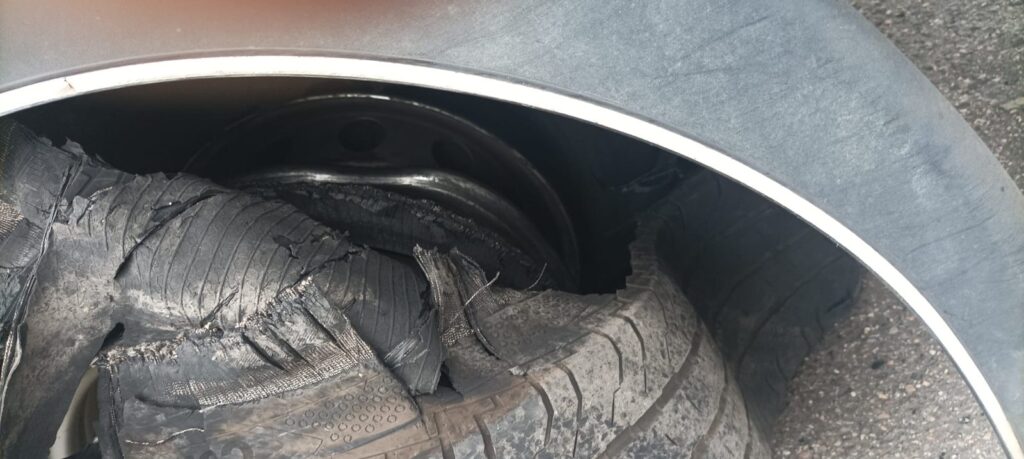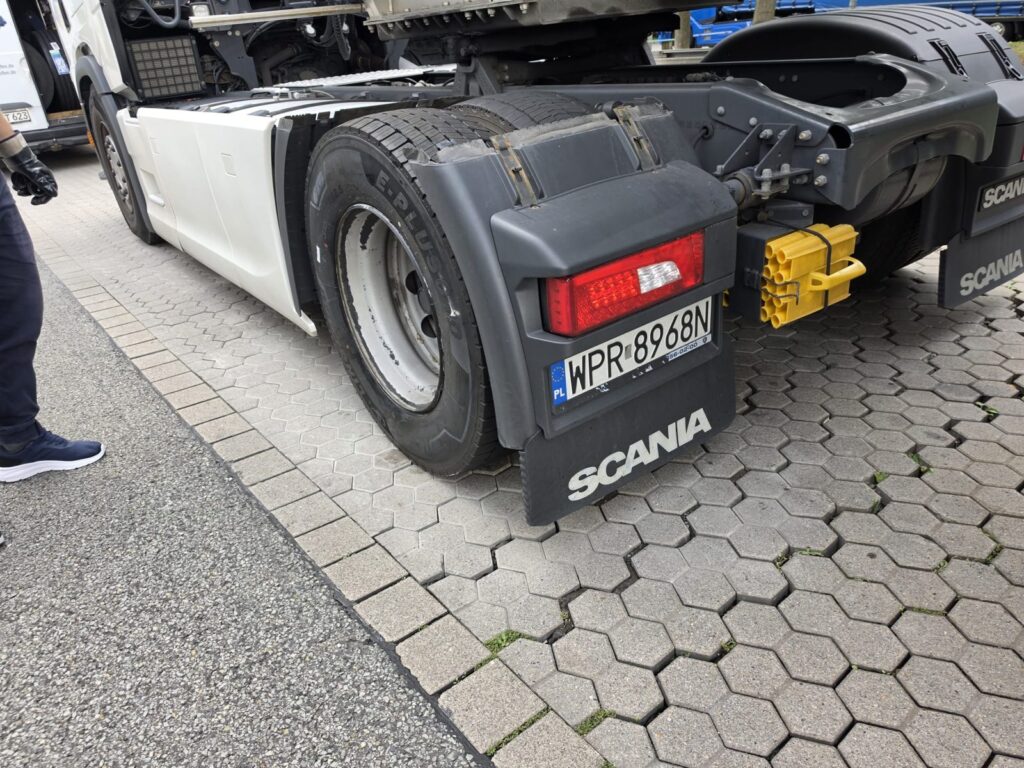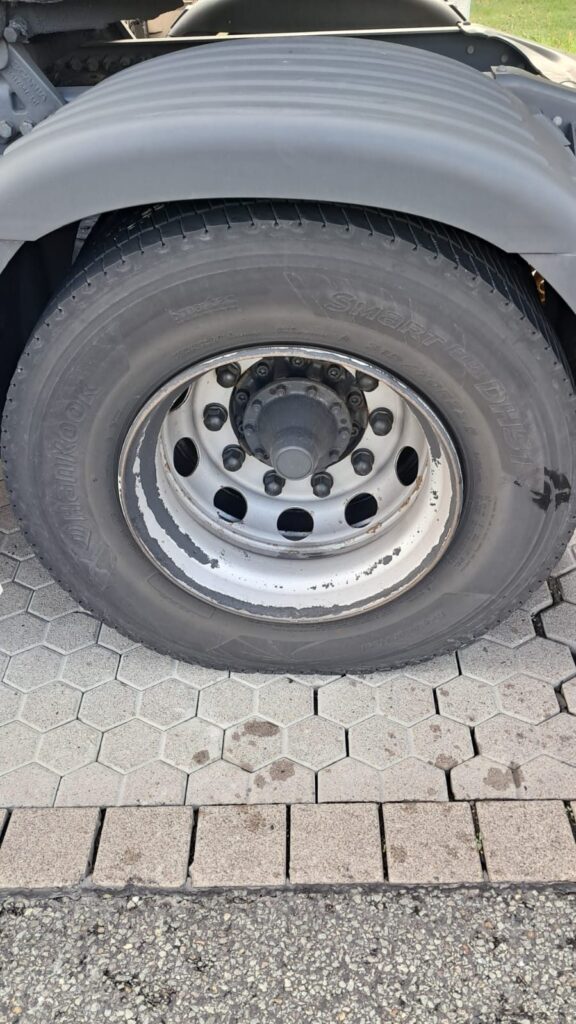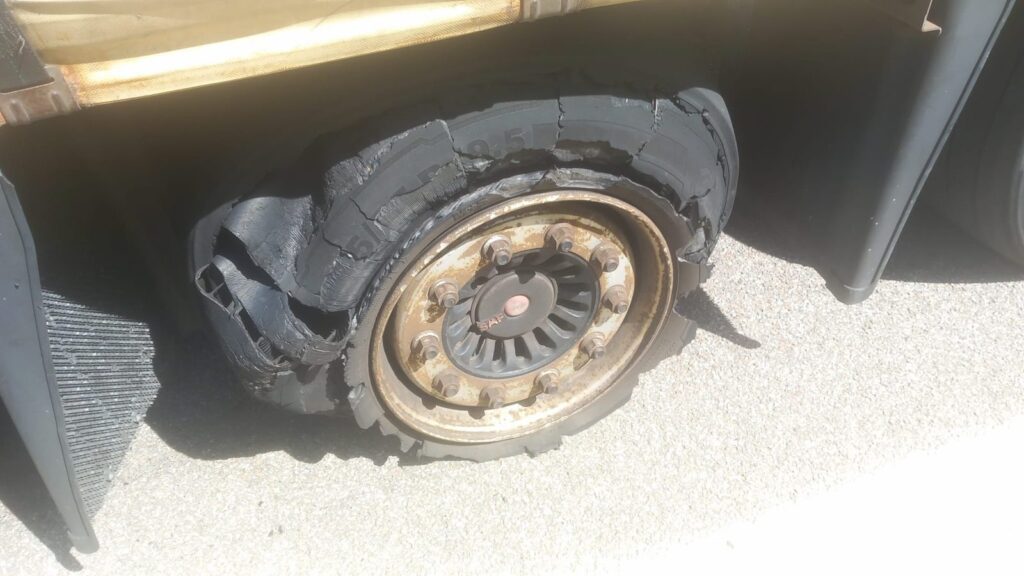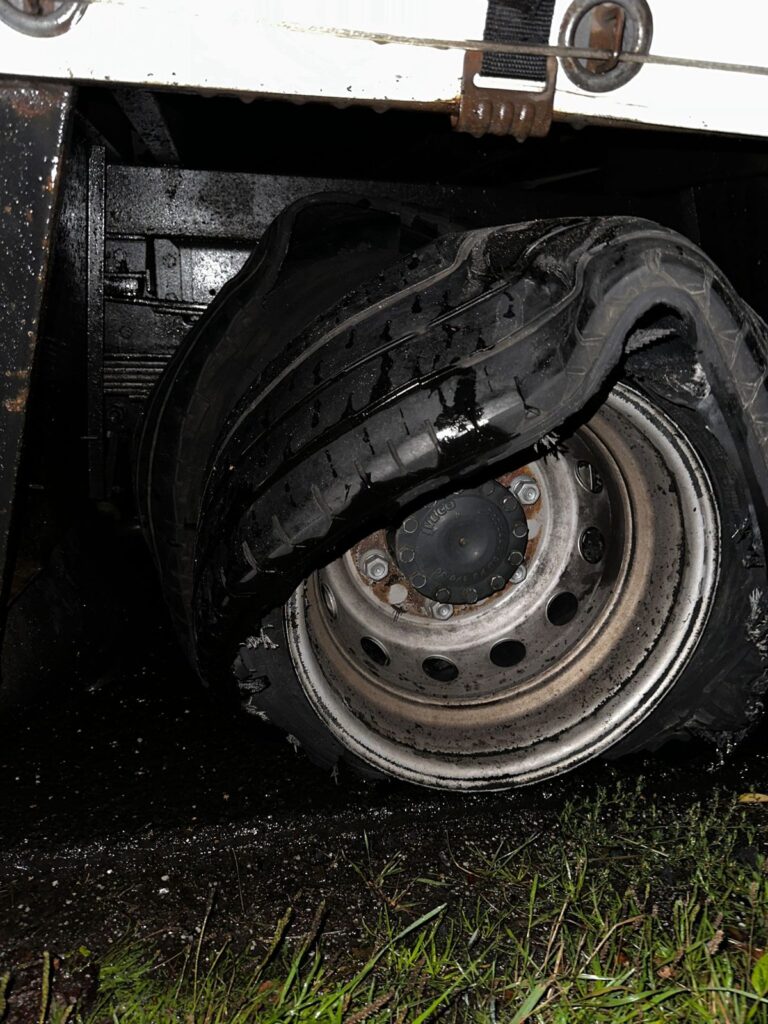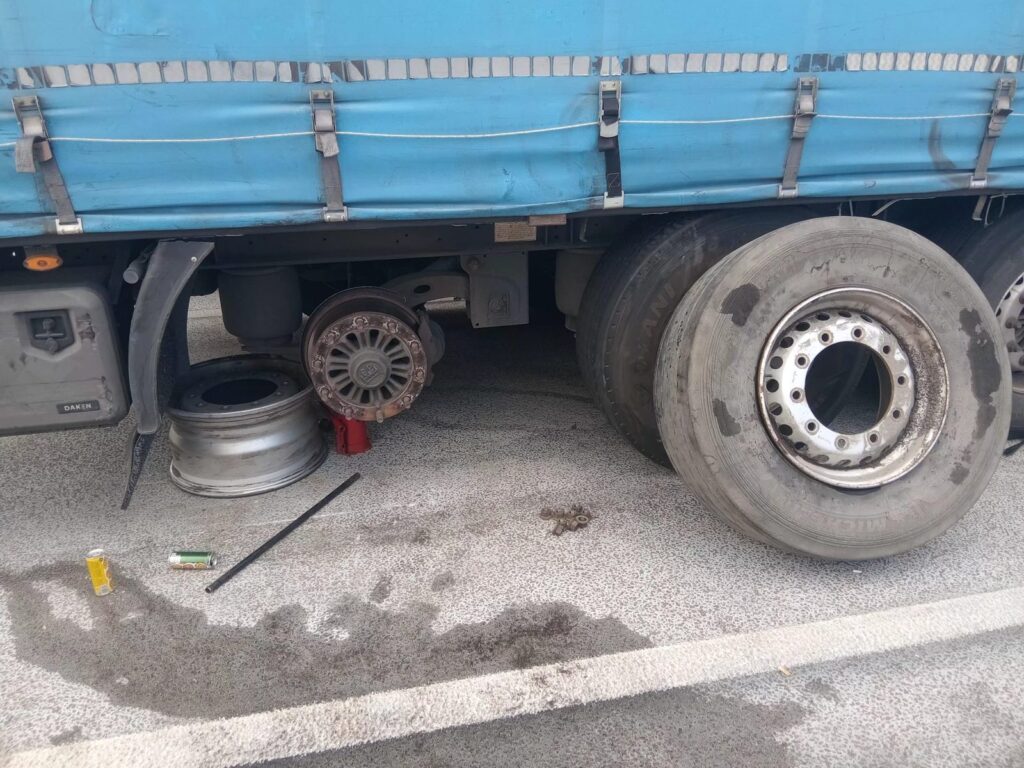
A curtainsider lorry with a worn tyre on a rear axle was parked at a rest area on the A7 near Kassel, heading towards Hannover. Our truck tyre service took the call at 14:20 on 26 August. By 16:35 a new 315/80 R22.5 tyre was fitted, balanced and torqued, and the driver was rolling again: 135 minutes from call to departure, 965 EUR net, no damage to the rim or hub.
This is a full walk-through of that callout, written for drivers, dispatchers and fleet managers. You will find the timeline minute by minute, the complete invoice, the reasoning behind each step and a set of practical rules for avoiding the same situation. If you run trucks in Germany and need a truck tyre service that comes to you, this is what the process looks like from the inside.
The emergency: a worn tyre and a driver who stopped in time
The driver pulled into a rest area on the A7 south of Kassel because something felt wrong with the rear axle, and he was right to stop. He called us at 14:20, told us the wheel had a problem and described the vehicle: a curtainsider lorry with a blue tarpaulin, load straps in place and air suspension on the rear axle. Whether it was a tractor unit with a trailer or a rigid three-axle truck made no difference to the job, so we treated it simply as a Planen-LKW.
What he did next saved him money. He did not try to nurse the vehicle to the next workshop. A worn truck tyre that is already showing damage can fail without warning, and on a loaded vehicle at 80 km/h a failure takes the tread, the mudguard and sometimes the air lines with it. A tyre blowout of that kind turns a 965 EUR callout into a four-figure bill plus a recovery.
The rest area was dry, level and wide enough for a service vehicle to park alongside. That matters more than it sounds. A hard shoulder is the most dangerous place to work on a lorry, and a proper parking bay lets the crew place the jack on solid asphalt instead of on gravel or a sloping verge.
What the tyre looked like
The wheel that came off was fitted with a heavily worn Michelin tyre. The tread was low and the casing showed the kind of wear that appears after years of fully loaded runs on the autobahn. Michelin builds good casings, but even the best truck tyre has a limit, and this one had reached it. Once the wheel was off, the rim was clean and straight, the hub cover intact and the studs undamaged. Nothing else on the axle needed attention.
How we organised the help
Dispatch took 12 minutes, from 14:20 to 14:32, and covered four questions. Where exactly is the vehicle? Which axle is affected? What tyre size does the lorry run? Which fitter nearest to the location has the right tyre on board?
We work through a network of mobile crews across Germany, and the nearest team to Kassel was already equipped with 315/80 R22.5 tyres, a mobile compressor, a hydraulic jack rated for the axle load and a calibrated torque wrench. That is what a good mobile truck tyre service looks like in practice: the right stock on the van before it leaves the yard.
The steps behind the scenes were these:
- The driver gives location, vehicle type and a description of the damage. We confirm the rest area by name and direction of travel.
- Dispatch checks the tyre size from the driver’s description and the registration document, because a wrong size means a second trip.
- We select the closest crew with matching stock and give the driver a realistic arrival window.
- The crew sets off with tyre, tools and warning equipment.
- The driver receives a call with a time estimate, so he can plan his break and his tachograph hours.
That last point matters to a driver who is counting down his driving time. Knowing that help arrives in about 45 minutes lets him rest properly instead of staring at the road. For more on how our crews operate, see our page on mobile truck service across Germany.
Why a tyre like this cannot be ignored
A truck tyre on a drive or trailing axle runs at 8.5 to 9.5 bar, roughly four times the pressure in a car tyre. That stored energy is the reason a failed casing is so violent. When the carcass breaks, the tyre does not just go flat: it can burst, throw steel cords and strip the bodywork nearby.
Three technical facts explain why we recommend stopping straight away.
- Axle load. A rear axle on a loaded curtainsider can carry up to 10 to 11.5 tonnes. If one tyre of a twin pair fails, its partner suddenly carries both loads and overheats within minutes.
- Rim damage. Driving on a soft or damaged tyre scores the rim flange. A scored 22.5 inch steel rim may be scrap, and a new one adds 150 to 300 EUR plus fitting.
- Legal minimum. Under § 36 StVZO the tread depth on lorry tyres must be at least 1.6 mm over the full running surface. Many fleets set an internal limit of 3 mm or more, because a tyre at 1.6 mm has almost no wet grip left.
A wheel in this condition is not a “keep going until the depot” problem. It is a stop-now problem, and the driver made the right call. If you want a longer list of what to do in the first minutes, our checklist for a tyre blowout on the autobahn covers it.
Step by step: how the truck wheel change was done
The crew arrived at 15:15, 43 minutes after leaving. Here is how the next 80 minutes went.
Step 1: Inspection and securing the site (10 minutes)
The technician parked the service vehicle so that it shielded the working area, set a warning triangle, put chocks behind the wheels that stayed on the ground and checked the parking brake. Then came a visual inspection of the tyre, the rim, the hub and the studs. This is the moment where a good fitter decides whether a simple tyre swap is enough or whether the axle needs a closer look.
Step 2: Lifting the axle and loosening the nuts (about 15 minutes)
With the vehicle on the flat, the technician cracked the wheel nuts slightly while the wheel was still on the ground, then placed the red bottle jack under the axle at the correct jacking point. Because the rear axle uses air suspension, he also released the air bellows pressure so the axle would not drop unexpectedly. This is a detail that separates routine work from improvised work.
Step 3: Removing the wheel and the old tyre (about 25 minutes)
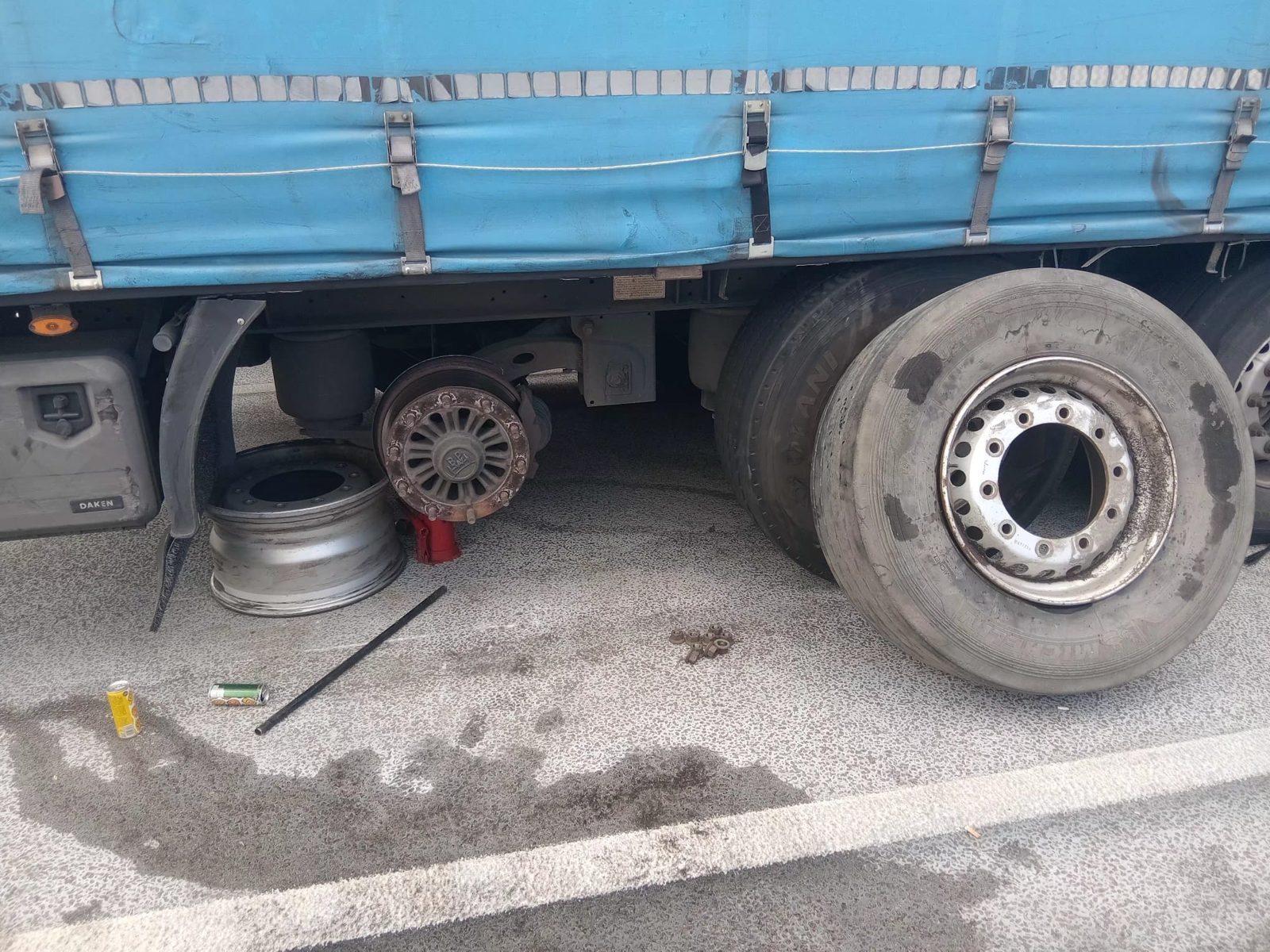
The wheel came off the hub. The studs and hub face were checked and cleaned. The old tyre was then broken off the rim on the mobile tyre changer, and the bead seat of the rim was cleaned of rust and rubber residue. This was the moment recorded in our photo: wheel off, hub open, rim and old tyre lying on the asphalt, jack still in place.
Step 4: Mounting and balancing the new tyre (15 minutes)
A new 315/80 R22.5 tyre went onto the rim. After lubricating the beads, the crew inflated it to the specified working pressure, checked the seating and balanced the wheel. Balancing matters even on a lorry: an unbalanced steer or drive wheel wears the tyre unevenly and loads the wheel bearings. If you are interested in why this size is so common, our guide to R22.5 tyre sizes explains the markings, and Continental publishes technical data for each of its truck lines.
Step 5: Refitting and final check (15 minutes)
The wheel went back on the hub. The nuts were tightened in a star pattern with a torque wrench, in stages, to the value specified by the axle manufacturer. For most heavy-duty axles that is somewhere between 600 and 700 Nm, though you should always follow the figure in the axle documentation. BPW, for example, publishes torque specifications for its trailer axles.
After lowering the axle, the technician re-checked the pressure, ran a leak test with soapy water on the valve and bead, marked the nuts with paint so any loosening would be visible, and handed the vehicle back with a reminder to re-torque after 50 to 100 km. The driver left at 16:35.
Full timeline: 135 minutes from call to departure
The table shows every phase of this truck tyre callout, exactly as it happened.
| Time | Phase | Action |
|---|---|---|
| 14:20 | Call | Driver reports a problem with a wheel and says the lorry is parked at a rest area, vehicle with tarpaulin |
| 14:20 – 14:32 | Dispatch (12 min) | Location confirmed, axle and tyre size clarified, nearest mobile crew in the partner network selected |
| 14:32 – 15:15 | Arrival (43 min) | Crew drives to the site with tyre and tools, driver receives a time estimate |
| 15:15 – 15:25 | Inspection and securing (10 min) | Chocks, warning triangle, check of tyre, rim, hub and studs |
| 15:25 – 16:05 | Wheel removal (40 min) | Jack under the axle, nuts loosened, wheel removed, old tyre taken off the rim |
| 16:05 – 16:20 | Tyre mounting (15 min) | New tyre on rim, seats cleaned, wheel balanced, inflated to working pressure |
| 16:20 – 16:30 | Wheel refitting (10 min) | Wheel on hub, nuts tightened in a star pattern with a torque wrench |
| 16:30 – 16:35 | Final check (5 min) | Pressure, leak test, re-tightening, marking, handover to the driver |
The total is 135 minutes from the first call to the lorry leaving the rest area, with roughly 80 minutes of actual work on site. Arrival time on a motorway callout depends heavily on traffic and weather, and a night or rain would have added time.
What the callout cost: invoice in full
The invoice for this callout came to 965 EUR net (plus VAT). There were no hidden extras, no call-out surcharge on top of the travel fee and no separate charge for the compressor.
| Item | Price (EUR) |
|---|---|
| Anfahrt (callout, motorway) | 240 |
| Arbeitszeit, 1.5 hours at 110 EUR | 165 |
| Truck tyre 315/80 R22.5 (new, fitted and balanced) | 540 |
| Disposal of the old tyre | 20 |
| Total | 965 |
All amounts are net, excluding VAT.
What drives the price of a truck tyre callout
- Distance and time of day. The callout fee in our network runs from 180 to 320 EUR. Nights, weekends and public holidays add 25 to 50 per cent.
- Tyre size and brand. A 315/80 R22.5 usually costs between 480 and 620 EUR depending on make and line, a 385/65 R22.5 trailer tyre 420 to 540 EUR.
- Labour. We charge 90 to 140 EUR per hour. Here, 1.5 hours was billed at 110 EUR.
- Complications. A seized nut, a damaged valve or a bent rim adds time and parts.
The comparison that matters
A standing truck costs a haulier somewhere between 800 and 1,200 EUR per day in lost revenue, driver wages and missed delivery slots. Against that, 965 EUR for a repair finished in about two hours is cheaper than waiting for a workshop slot the next morning. If you want a broader view of pricing, our article on truck tyre change cost goes through typical figures.
Why you should leave a truck wheel change to professionals
Anyone who has tried to loosen a 600 Nm wheel nut with a vehicle’s own tools knows why this is not a job for the roadside improviser. The risks are real:
- Wrong jack or wrong jacking point. A car jack or a weak bottle jack can slip under a loaded axle. The consequences for the person underneath are obvious.
- Under-torqued or over-torqued nuts. Too loose and the wheel can work free, too tight and the studs stretch and snap.
- Poor bead seating. A tyre that is not seated correctly can fail while being inflated, and the energy released is considerable.
- No balancing. Unbalanced wheels wear tyres and bearings quickly.
- Air suspension errors. Releasing or leaving the bellows under pressure at the wrong moment can drop the chassis suddenly.
- Disposal. Used tyres must go to registered recyclers, not into the nearest bin.
Professional fitters carry a calibrated torque wrench, a mobile tyre changer and a compressor for exactly these reasons. That is the real value of a mobile truck tyre fitting service: not convenience, but a controlled process.
Typical situations where we fit tyres across Germany
This callout on the A7 is one of many. In a normal month our mobile crews are called out for the following kinds of truck tyre breakdown:
- Slow punctures from nails, screws or stones lodged in the tread. We explain how to judge whether such a puncture is repairable in our guide to truck tyre repair.
- Sudden blowouts on drive axles, often after a long run in summer heat.
- Trailer tyre service at depots, where a flat tyre has been found during the morning check.
- Damaged valves and valve stems that leak slowly.
- Bead and rim damage after kerb contact or after driving on a flat tyre.
- Tyre replacement before a long trip, when the tread depth is already close to the limit.
- Seasonal wheel changes at the fleet yard, where a van would otherwise take a vehicle off the road for a day.
Our crews cover the main corridors: A1, A2, A3, A5, A7, A8, A9, A45 and the Ruhr area, and they reach many sites in the countryside too. For the A7 between Hamburg and Würzburg, Kassel is a natural meeting point, because several crews are based within an hour of it.
Prevention: how to avoid a roadside wheel change
Most roadside tyre failures start days or weeks earlier. These habits cost almost nothing and prevent most callouts.
- Check tyre pressure every week, cold and with a calibrated gauge. A tyre running 1 bar under its target pressure loses a noticeable share of its life and heats up much faster.
- Measure tread depth at the start of each week. Replace the tyre before it reaches 3 mm on steer axles if your route includes wet roads.
- Look at the sidewalls. Cuts, bulges and cracks are a reason to stop, even with plenty of tread left.
- Check twin pairs. Mismatched diameters or a stone wedged between two tyres can overheat them.
- Re-torque after any wheel change at 50 to 100 km, and keep a record.
- Keep a spare plan, not a spare wheel. Most modern lorries carry no spare, so save a mobile service number in your phone before you need it.
- Rotate and retread sensibly. Premium casings can be retreaded, which lowers cost per kilometre if the carcass is sound.
Fleets that follow a written tyre inspection schedule typically see far fewer roadside failures. Our guide to truck tyre pressure lists the correct values for common sizes.
Truck tyres in the fleet: brands, sizes and maintenance
Choosing the right truck tyre is a balance between purchase price, mileage and fuel use. The big manufacturers each have their strengths: Michelin is known for casing durability and retreadability, Continental for low rolling resistance and wet performance, Goodyear for long-haul mileage and Bridgestone for consistent quality on regional routes. For fleets that care about cost per kilometre, premium casings that can be retreaded often win over the cheapest option.
The most common sizes in German haulage are 315/80 R22.5 for drive and steer axles, 385/65 R22.5 for trailer axles and 295/80 R22.5 for mixed use. Smaller distribution trucks run 245/70 R19.5, and vans 235/65 R16C. The load index and speed rating printed on the sidewall must always match or exceed the figures in the vehicle registration. If you are not sure how to read them, our explanation of truck tyre markings walks through each code.
A sensible fleet maintenance routine covers:
- weekly pressure and visual checks by the driver,
- monthly tread-depth records per axle position,
- an annual alignment check, especially after a kerb strike,
- matching tyre makes within a twin pair,
- planned replacement of ageing tyres, whatever the remaining tread.
Age matters as much as wear. Rubber hardens over time, and a tyre that is more than six or seven years old deserves a close look even if the tread seems fine. The date is stamped on the sidewall as the DOT code.
Why drivers and fleets choose Lkwhelp24
We work around the clock, every day of the year, throughout Germany. That sounds like a slogan, so here is what it means in practice:
- 24/7 dispatch. A person answers the phone, not a menu. The call on the A7 was taken immediately and the crew was assigned within 12 minutes.
- Tested network. We work with fitters who carry the right stock and the right equipment, and who have worked on heavy vehicles for years.
- Transparent prices. You get the price structure before the crew sets off: callout, labour, tyre, disposal. No surprises on the invoice.
- Multilingual dispatch. Many drivers on German roads do not speak German. Our dispatchers speak German, English, Polish and Russian.
- One contact. Towing, tyre service and workshop repairs are arranged by the same team, so you do not have to explain your situation three times.
If a breakdown turns out to be bigger than a tyre, we can switch to towing or arrange a repair in a partner workshop. You can also look at our truck service page for the full range.
Frequently asked questions
How much does a truck tyre change on the autobahn cost?
A truck tyre change on the autobahn typically costs between 750 and 1,400 EUR net, depending on tyre size, distance and time of day. In this case the total was 965 EUR net: 240 EUR callout, 165 EUR labour, 540 EUR for a new 315/80 R22.5 tyre and 20 EUR for disposal. Night and weekend work adds 25 to 50 per cent.
How long does a mobile truck tyre service take to arrive?
Arrival on a motorway usually takes 35 to 70 minutes after dispatch. On the A7 near Kassel, the crew needed 43 minutes. Dispatch itself takes 10 to 20 minutes. In heavy traffic, bad weather or at night, expect longer. We always give the driver a realistic estimate.
Can I drive a lorry with a worn or damaged tyre to the next workshop?
Not safely. Tyres at 8.5 to 9.5 bar can fail suddenly, and a damaged tyre puts extra load on its twin partner. Below 1.6 mm of tread you are also breaking the legal minimum. Stop at the next rest area and call for a truck tyre callout.
What should I do before the tyre service arrives?
Park on level ground, switch on the hazard lights, apply the parking brake and put on a high-visibility vest. Set up the warning triangle at a safe distance, keep clear of the traffic side and stay away from the damaged wheel. Have the vehicle registration and tyre size ready for the dispatcher.
Do you stock all common truck tyre sizes?
Our crews carry the most common sizes: 315/80 R22.5, 385/65 R22.5, 295/80 R22.5, 245/70 R19.5 and 235/65 R16C. If your vehicle uses a rare dimension, we confirm availability during the first call and tell you honestly whether a delay is likely.
Is the price net or gross?
All prices in this article are net, excluding VAT. VAT is added on the invoice at the statutory rate. Businesses with a valid VAT number can usually reclaim it.
Summary
- Vehicle: curtainsider lorry (Planen-LKW) with air suspension on the rear axle
- Location: rest area on the A7 near Kassel, Hesse, towards Hannover
- Tyre: 315/80 R22.5, new, fitted and balanced
- Reaction time: 12 minutes dispatch, 43 minutes arrival
- Time on site: about 80 minutes
- Total time: 135 minutes from call (14:20) to departure (16:35)
- Cost: 965 EUR net (callout 240, labour 165, tyre 540, disposal 20)
- Secondary damage: none, the rim, hub and studs were undamaged
Need a truck tyre service in Germany?
If your truck has a tyre problem, do not wait for it to get worse. Call us now: +49 160 5753826. Our dispatchers are on the phone around the clock and send the nearest mobile crew straight away. More details, including the contact options, are on our contacts page and at www.lkwhelp24.com.
Round the clock, throughout Germany.
Keywords: truck tyre service | mobile truck tyre service | truck tyre change | truck tyre replacement | truck tyre callout | truck tyre breakdown | truck tyre roadside assistance | truck tyre repair | truck tyre fitting | truck wheel change | trailer tyre service | truck tyre emergency | truck tyre germany | truck tyre help | A7 Kassel
Related articles
- Emergency Tire Service for Trucks: Fast Help Around the Clock
- Truck Wheel Nut Torque: Table and Correct Mounting Procedure
- Mobile Truck Tyre Service Near Cloppenburg: Milk Tanker Back on the Road in 2 Hours 10 Minutes After a Blowout
- Emergency Wheel Change on a Truck: What to Do After a Tyre Blowout on the Motorway