Skip to content
Why Wheel Nut Torque Is Not a Detail You Can Skip
A truck wheel is held on by a handful of nuts, and every one of them has to carry its share of a load that can run into several tonnes once the trailer is full. Get the torque wrong on even one nut and the balance of forces across the whole hub changes. Drivers who have never thought twice about torque values usually learn about them the hard way, at the roadside, after a wheel starts wobbling on the autobahn.
Correct clamping force keeps the wheel pressed tight against the hub face. Too little of it, and the wheel begins to move under load, even by fractions of a millimeter at first. That tiny movement wears the mating surfaces, the nuts back off further, and eventually the wheel can separate from the vehicle entirely while it is moving. Too much clamping force is just as damaging in a different way: it stretches the studs beyond their design limit, distorts the wheel disc, and can crack the rim around the bolt holes. Neither failure mode announces itself loudly in advance. That is exactly why a table of torque values and a proper mounting procedure matter more for trucks than for almost any other type of vehicle on the road.
This article walks through what correct torque means for truck wheels, how steel and aluminum wheels differ, what a realistic torque table looks like, why nuts need to be rechecked after every wheel change, and what to do if a stud actually fails while you are driving. If you already had a wheel come loose or heard a metallic knock from a wheel arch, you may want to jump straight to our guide on emergency wheel changes on trucks, which covers the practical side of getting back on the road safely.
What Actually Happens When Torque Is Wrong
Picture a wheel nut as a spring. When you tighten it to the correct value, the stud stretches by a tiny, precise amount, and that stretch is what generates the clamping force holding the wheel against the hub. The nut itself barely matters, it is the stretched stud doing the real work. If torque is too low, the stud never stretches enough, and the joint stays loose under vibration and load cycling.
On the road this shows up gradually. First there is a faint knocking noise from the wheel, sometimes mistaken for a stone stuck in the tread. Then the wheel starts to wobble, visible in the mirror on longer trailers. Metal shavings can appear around the bolt holes, a telltale sign called witness marks, which mechanics look for during any inspection. Left unaddressed, the stud holes elongate, the nuts fall off one by one, and the wheel departs from the truck. At highway speed a detached truck wheel is not a minor incident. It is a heavy rolling object with enough energy to total another vehicle, and there have been fatal cases across Europe traced directly back to under-torqued wheels after a tire change or repair.
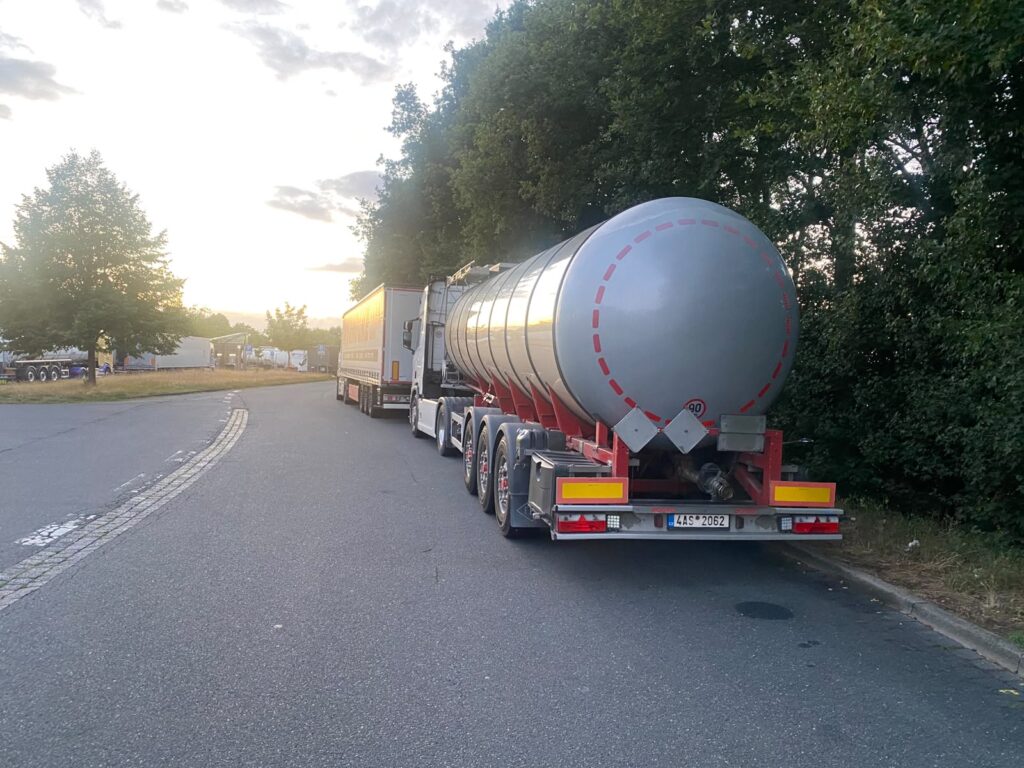
Over-torquing gets less attention but causes its own kind of failure. A stud tightened well beyond spec can yield, meaning it stretches past its elastic limit and never returns to its original length. From that point on it can no longer generate the clamping force it was designed for, even though the nut feels tight. Overtightening also warps aluminum wheels more easily than steel ones, and it is a common cause of the hairline cracks that later show up around bolt holes. We have written in detail about one such case, a cracked wheel stud that stopped a semi-trailer on the A2 near Frankfurt, which illustrates how a problem that started small during mounting ended up parking a fully loaded truck on the shoulder.
Steel Versus Aluminum Wheels: Not the Same Job
Steel and aluminum wheels behave differently under a torque wrench, and treating them the same is a common mistake among drivers who do their own emergency wheel swaps.
Steel is a relatively soft, ductile material compared to the hardened surfaces it clamps against. When you tighten a steel wheel, the disc and the hub face compress slightly at the high points of contact, a process called settling. That settling continues for the first few dozen kilometers of driving as vibration works the surfaces flatter against each other, which is one reason steel-wheeled trucks need a retorque check early after any wheel work.
Aluminum wheels are lighter, harder in some respects, but far more sensitive to heat and pressure concentration. Aluminum expands and contracts with temperature more than steel does, and it also creeps, meaning it slowly deforms under sustained clamping pressure even without extra heat. Because of this, aluminum wheels are commonly torqued to somewhat lower values than steel wheels of a comparable size, and manufacturers increasingly specify flange nuts or two-piece nut systems for aluminum to spread the load over more contact area and reduce local stress. Aluminum wheels also tend to need retorquing more consistently than steel ones, since the deformation from creep continues even after the initial settling phase most steel wheels go through.
None of this replaces the manufacturer’s own figures. It only explains why the numbers differ from one wheel material to the next and why a torque wrench setting that was correct on your last truck may be wrong on this one.
Truck Wheel Nut Torque Table (Guideline Values Only)
The table below reflects typical ranges seen in practice on commercial trucks with 22.5 inch wheels, the size most common on vehicles above 7.5 tonnes. These are practical, general figures gathered from field experience, not numbers published by any single manufacturer, and they are not a substitute for the torque spec printed in your vehicle or wheel documentation. If you want to understand the wheel sizing itself first, our article on 385/65 R22.5 truck tire dimensions explains what those numbers mean and how they relate to the wheel that carries the tire.
| Wheel type | Typical stud count | Approximate torque range | Notes |
|---|---|---|---|
| Steel disc wheel, 22.5″ | 10 studs | roughly 600 to 700 Nm | Most common on trailers and rigid trucks; check manual for exact figure |
| Steel disc wheel, 22.5″ | 8 studs | roughly 500 to 650 Nm | Older or lighter axle configurations |
| Aluminum disc wheel, 22.5″ | 10 studs | roughly 500 to 650 Nm | Often slightly below steel equivalent; flange nuts common |
| Aluminum disc wheel, 22.5″ | 8 studs | roughly 450 to 600 Nm | Check for two-piece nut design and specific torque |
| Steel wheel, smaller commercial (17.5″ to 19.5″) | 8 or 10 studs | roughly 300 to 450 Nm | Common on light and medium trucks near the 7.5 t threshold |
| Aluminum wheel, smaller commercial | 8 or 10 studs | roughly 280 to 420 Nm | Lower end of range typical, confirm before mounting |
Every one of these ranges is a starting point for a conversation with the manual, not an instruction to set your torque wrench and walk away. The actual figure for your truck depends on the vehicle model, the wheel size, whether the wheel is steel or aluminum, and the number of wheel nuts holding it on. Continental’s own guidance on this, found in their retorquing wheels reference, is explicit that the exact torque spec has to come from the vehicle or wheel manufacturer’s documentation for that specific configuration. Treat the table above as a sanity check, not a substitute.
The Mounting Procedure: Sequence Matters as Much as the Number
Getting the right final number on the torque wrench display means nothing if the nuts were tightened in the wrong order. Truck wheels have five, eight, or ten studs arranged in a circle, and pulling one nut fully tight before touching the others pulls the wheel disc out of alignment against the hub. That misalignment shows up later as vibration, uneven tire wear, or a wheel that never seats flat no matter how tight the last nut goes.
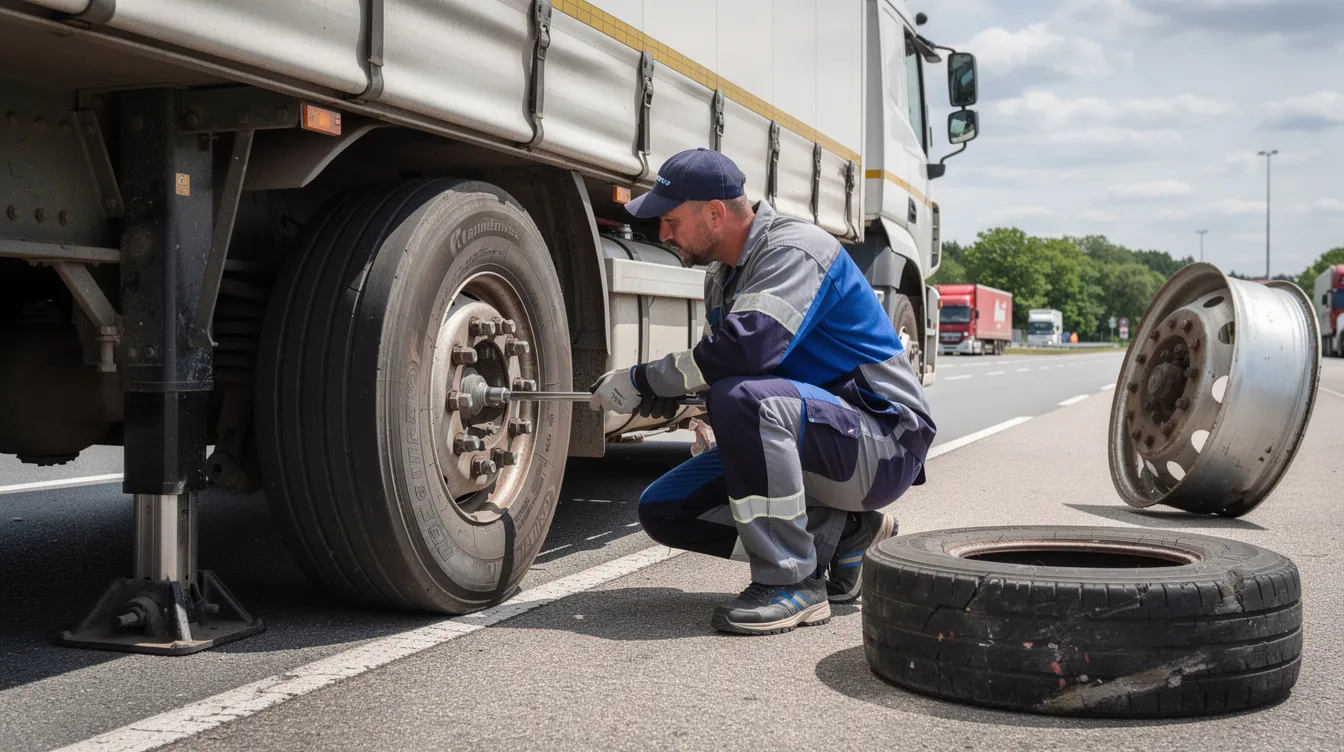
The correct method, confirmed in Continental’s own procedure, works in two passes. First, every nut is tightened to roughly half of the final target torque, moving in a criss-cross pattern across the wheel on a four-stud pattern, or a star pattern that jumps across the circle on a five-stud or ten-stud pattern rather than working around the rim in order. This first pass seats the wheel evenly against the hub. Only after every nut has had its half-torque turn does the second pass bring each one up to full, final torque, again working in the same crossing sequence rather than sequentially around the circle.
Skipping the first pass, or tightening nuts in the order they happen to be reached with the wrench, is one of the most common mistakes made during roadside wheel changes, especially under time pressure or bad weather. It costs an extra two or three minutes and prevents a lopsided wheel that will need attention again within the first fifty kilometers regardless.
Tools: A Torque Wrench Is Not Optional
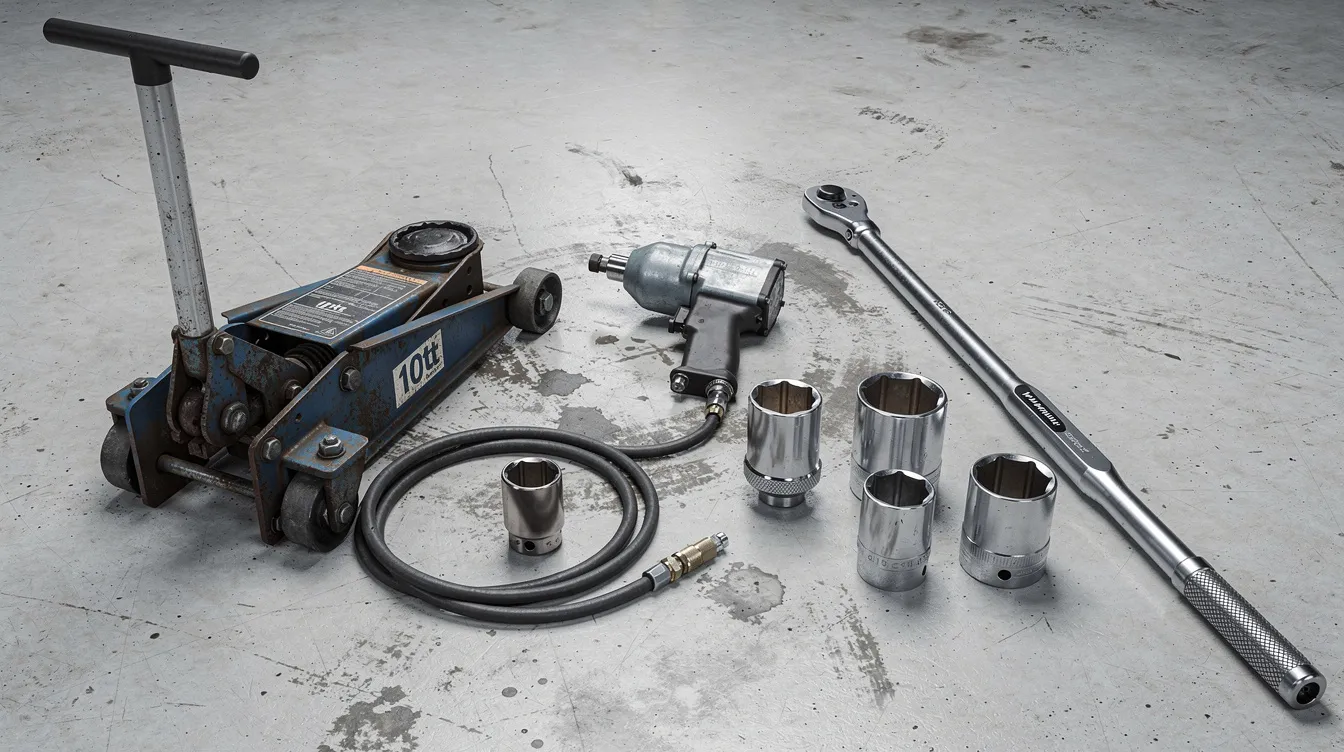
An impact wrench is fast, and it has its place for removing seized nuts or doing the rough initial tightening before the final pass. What it cannot do reliably is deliver a specific, repeatable torque figure. Impact wrenches vary their output depending on air pressure, battery charge, socket friction, and how long the trigger is held, which makes them unsuitable for the final tightening step on a truck wheel no matter how experienced the operator is.
A calibrated torque wrench is the only tool that belongs in that final step. Click-type torque wrenches need periodic calibration checks, typically annually or after a set number of uses, since the internal spring mechanism drifts over time and a wrench reading 650 Nm can genuinely be delivering considerably more or less. Anyone doing wheel work professionally should know when their own wrench was last checked, not assume it is accurate because it clicks convincingly.
Beyond the torque wrench, a proper wheel change needs a stable jack rated for the axle weight, axle stands if the wheel will be off the ground for any length of time, and a wheel wrench sized correctly to the nut, since a worn or mismatched socket rounds off nut corners and makes future removal far harder. If tire pressure is part of what you are checking during the same stop, our guide on truck tire pressure covers the numbers that matter there, since pressure and torque are both part of the same roadworthiness check after any wheel work.
Retorquing: The 50 to 100 Kilometer Rule
This is the step most drivers skip, and it is the one Continental specifically calls out. After a wheel has been mounted, even correctly, the surfaces between the wheel disc and the hub have not yet fully seated against each other. Microscopic high points on both metal surfaces compress under the first real driving loads, and as they compress, the clamping force on the nuts drops slightly even though nothing was physically loosened.
Continental’s guidance is to check and, if necessary, retorque the wheel nuts after roughly fifty kilometers of driving. For a truck that just had a wheel changed at the roadside and continues its route, that means the first fuel stop, rest break, or loading point after the repair is the moment to put a torque wrench on those nuts again, not next week’s scheduled service. Skipping this step is one of the most frequent root causes behind wheels that come loose days after what seemed like a completely normal repair.
This is also why any workshop or mobile service doing wheel work on your truck should tell you, out loud, when and where to get the retorque check done, and why a driver doing an emergency swap alone at the roadside should treat the next stop as mandatory, not optional. If the original tire failure was already stressful, our page on finding emergency tire service nearby is worth bookmarking before you need it rather than during the event.
Reading the Wheel and Tire Before You Torque Anything
Before any nut goes back on, it is worth actually reading what is stamped on the wheel and the tire sidewall, since load index, size, and construction all interact with how the wheel carries force through those studs. Our breakdown of truck tire markings, load index, and DOT codes is a useful companion to this article if you are not confident reading a sidewall at a glance. A wheel and tire combination that does not match the axle rating puts extra strain everywhere in the assembly, torque included.
What Happens When a Wheel Stud Actually Fails on the Autobahn
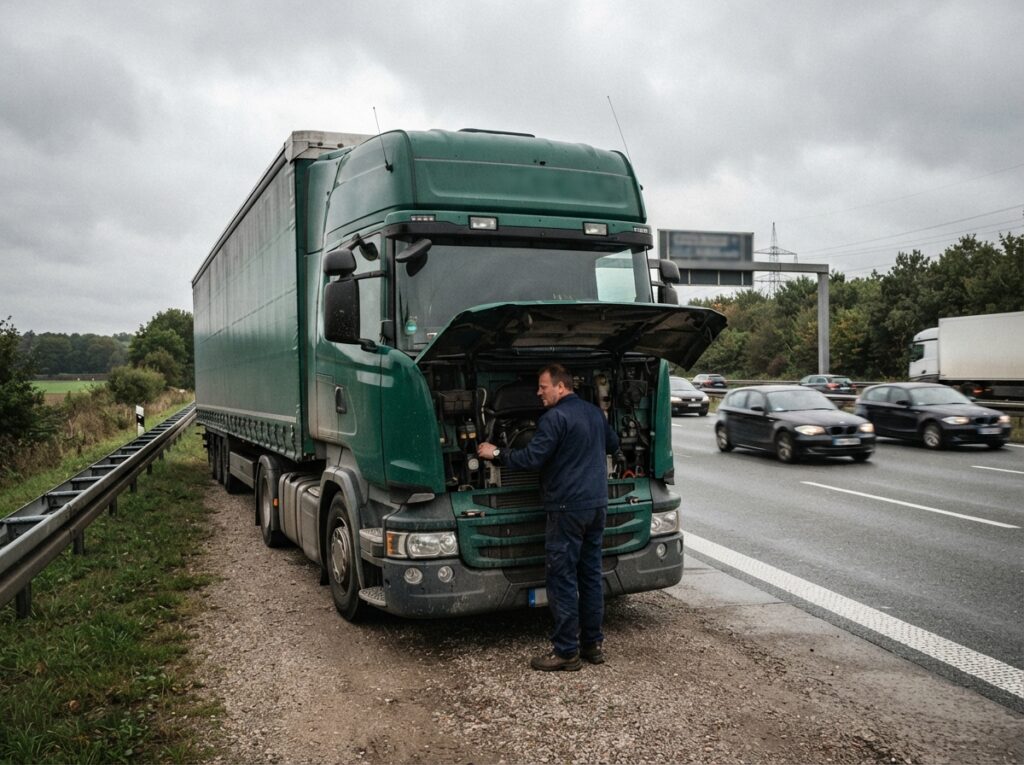
This is the scenario mobile roadside services get called out to more often than most drivers expect. A stud that has been slowly weakened by under-torque, over-torque, or metal fatigue eventually snaps, usually one at a time rather than all at once. The first sign from inside the cab is often a rhythmic thumping or a vibration through the steering that gets worse with speed. Some drivers notice a wheel that looks subtly off-center in the mirror. Others do not notice anything until a second or third stud goes and the wheel starts visibly wobbling.
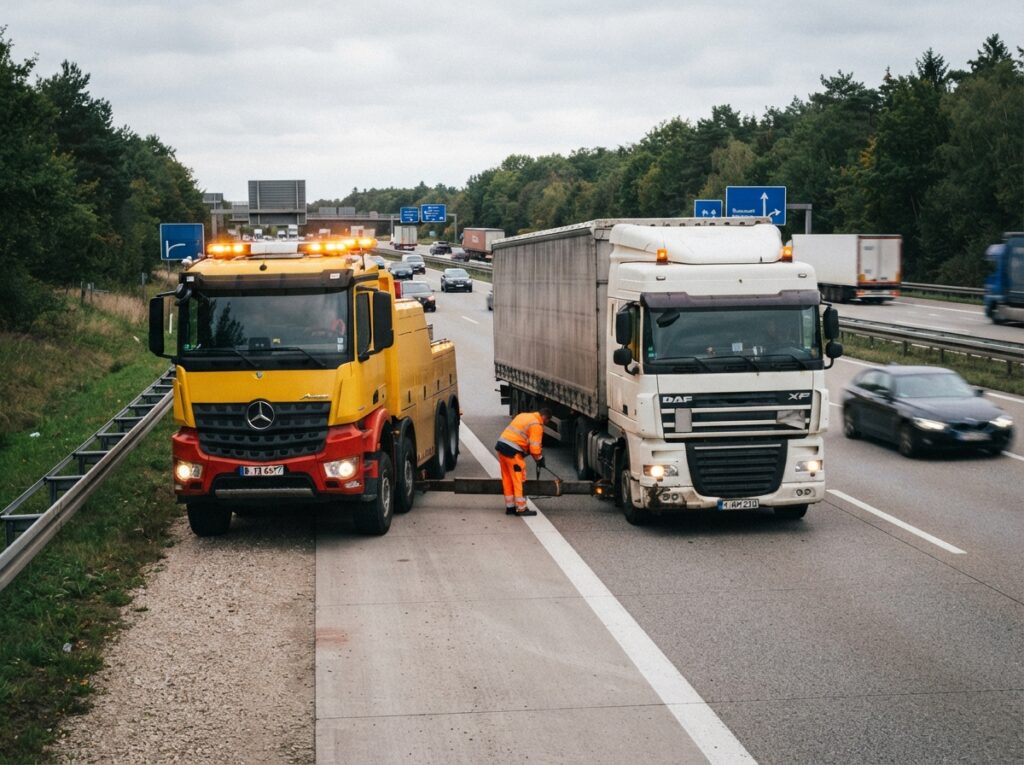
Continuing to drive on a wheel with one or more broken studs concentrates even more load onto the remaining ones, and the failure accelerates fast, sometimes within a few kilometers. The safe response is the same every time: get off the live lanes as soon as it is physically possible, onto the hard shoulder or an exit, put on hazard lights and a warning triangle well back from the vehicle, and stop driving on that wheel entirely. A truck creeping along the autobahn on a failing wheel is a serious hazard to itself and to everyone behind it, particularly at night or in poor visibility.
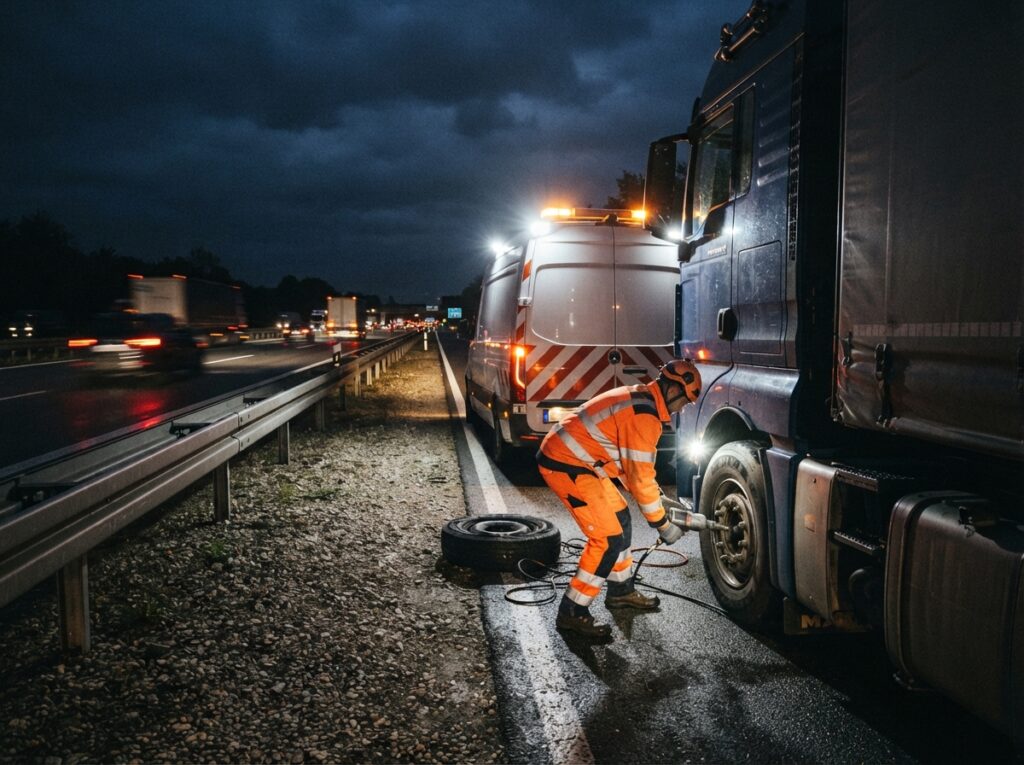
This is precisely the kind of call LKWHelp24 exists for. Our technicians carry the torque wrenches, spare studs and nuts for common truck wheel patterns, and the experience to diagnose whether a wheel can be safely re-mounted at the roadside or whether the truck needs to be recovered on a low-loader instead. If the situation has gone further and the vehicle genuinely cannot continue under its own power, our article on truck towing costs explains what to expect from that side of things. Message us directly on WhatsApp at +49 160 5753826 and we will talk you through what to do while help is on the way, in German, English, Polish, or Russian, any hour of the day or night.
Why This Connects Directly to Highway Safety
A truck above 7.5 tonnes carries enough mass that a wheel failure is never a minor event. At 80 or 100 km/h, a detached wheel becomes a projectile with the kinetic energy of a small car, and it does not stop where the truck stops. It bounces, rolls, and can travel a considerable distance across lanes before coming to rest, often into the path of vehicles that had no warning at all.
Germany’s road traffic licensing regulation, the StVZO, sets out the general requirement that a vehicle, including its wheels and tires, has to be kept in a roadworthy condition at all times, not just at the point of registration or inspection. Wheel attachment falls squarely inside that obligation, alongside tire tread and general vehicle condition. The broader StVO sets the wider framework for road safety that every driver operates under, and a truck operator who knowingly continues driving on a wheel showing warning signs is not just risking a mechanical failure, they are operating outside what the law expects of a roadworthy vehicle.
Beyond the legal angle, there is a simple practical one. Truck drivers spend more hours on the road than almost anyone else, and a five minute torque check at a rest stop is a small price against the alternative of losing a wheel at speed with a loaded trailer behind you.
A Word on Wheel Suppliers and Replacement Parts
Where the wheel and studs come from matters more than most drivers assume. Mismatched studs, wrong nut seat angles, or wheels not rated for the axle load all make correct torque impossible to achieve even with a perfectly calibrated wrench, because the geometry of the joint itself is wrong. If you are sourcing replacement wheels or need a supplier who understands truck-specific specifications rather than passenger car parts, our overview of truck tire wholesalers and mobile tire service partners is a good starting point.
Frequently Asked Questions
How often should truck wheel nuts be checked, even if nothing seems wrong?
Beyond the mandatory retorque after fifty to one hundred kilometers following any wheel work, a visual and torque check during regular maintenance intervals is good practice. Many fleets build a torque check into every service stop, since it takes a few minutes and catches problems long before they become roadside emergencies.
Can I use the same torque value for steel and aluminum wheels on the same truck?
No. Aluminum wheels typically require a somewhat lower torque than steel wheels of the same size and stud count, and the two materials settle differently once mounted. Always check the specific figure for the wheel material actually fitted, since assuming one number for both is a common cause of loose aluminum wheels.
Is it safe to use an impact wrench for the whole job?
An impact wrench is fine for removing old nuts and for a rough initial tightening pass, but the final torque should always come from a calibrated torque wrench. Impact wrenches cannot reliably hit a specific Nm figure, and guessing on the final pass defeats the purpose of having a torque spec at all.
What does it mean if a wheel nut looks rusty or has a witness mark around it after driving?
A witness mark, often a rust streak or a slight gap forming between the nut and the wheel surface, usually indicates the nut has loosened slightly and moved. It should be treated as an early warning sign and checked with a torque wrench immediately, not left until the next scheduled stop.
Why do new trucks or newly mounted wheels need retorquing so soon, when the wheel was tightened correctly the first time?
Even a correctly torqued wheel has microscopic surface contact points between the disc and the hub that compress further under the first real driving loads. That settling reduces clamping force slightly, which is exactly why Continental and most wheel manufacturers specify an early recheck rather than assuming the first tightening holds forever.
What should I do if I hear a knocking sound from a wheel while driving on the autobahn?
Reduce speed gradually, signal, and move to the hard shoulder or the nearest safe exit as soon as possible rather than continuing to your original stop. A knocking wheel can indicate a loosening nut or a cracked stud, and continuing to drive on it risks a full wheel failure. Call for mobile roadside assistance rather than attempting to diagnose it yourself on a live carriageway.
Getting Help When You Need It
Correct torque is not a detail for the workshop alone, it follows the truck onto every road it drives afterward. Drivers who understand the numbers, the sequence, and the retorque rule catch problems long before they turn into a wheel separation at highway speed. Keep a torque wrench in the cab if you regularly handle your own tire changes, know your wheel’s specification sheet, and never skip the recheck after the first fifty kilometers.
If a wheel starts making noise, feels off in the steering, or you simply are not confident finishing a roadside repair to the correct spec, LKWHelp24 is available around the clock for trucks from 7.5 tonnes upward across Germany. Reach us on WhatsApp at +49 160 5753826, in German, English, Polish, or Russian, and a technician with the right tools and torque values for your specific truck will be on the way.