Skip to content
A semi truck lying in a ditch is not a job for a regular tow truck. Neither is a tanker stuck sideways on an icy incline, nor a trailer with a locked axle that will not roll a single centimeter after a crash. In moments like these, a driver needs something beyond a winch and a strong pull. What is needed is a mobile crane, a low loader, a trained crew, and quite often the police as well. This is called heavy recovery, and it differs from ordinary towing in almost every respect, from the equipment used to the time it takes and the price at the end.
At LKWHelp24 we run both kinds of jobs every day: the simple breakdown solved with a tire change in 40 minutes, and the heavy recovery that takes six hours, needs three vehicles on site, and leaves a highway lane closed for the duration. This article explains where the line between these two worlds actually sits, which equipment gets used and when, how cooperation with the police typically unfolds, what a heavy recovery costs, and what a driver or dispatcher should do the moment this kind of situation happens.
Recovery is not towing, and the difference matters more than people think
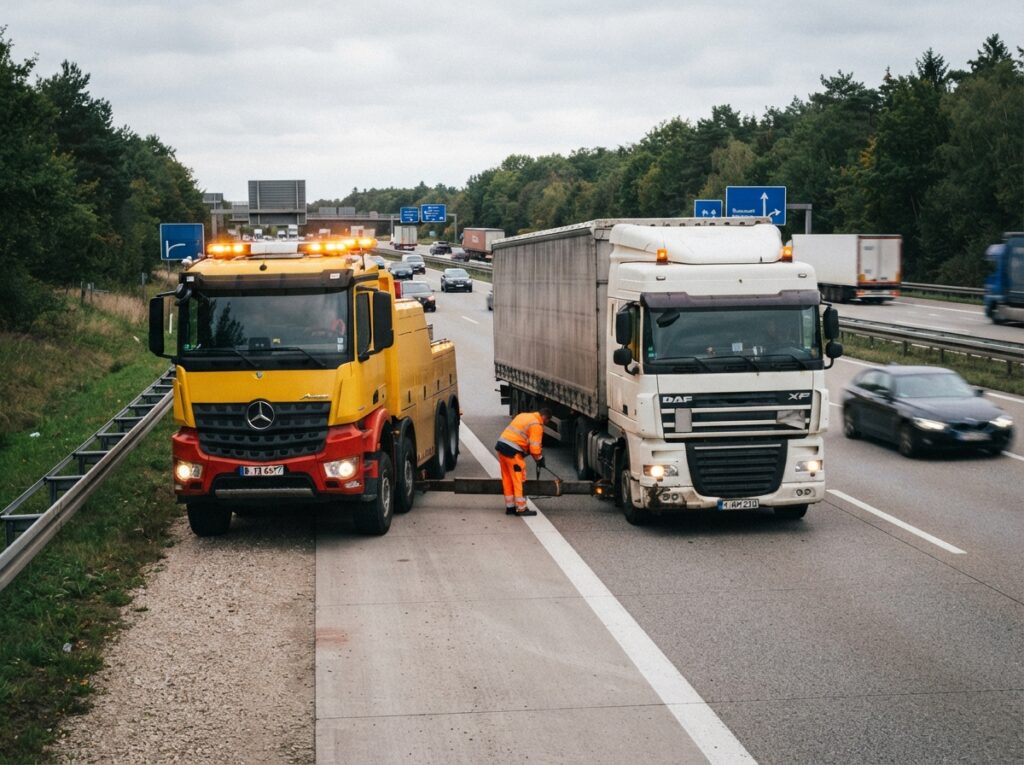
Towing, at its core, means a vehicle is sitting on the road or the shoulder, still able to roll, and simply needs to get from point A to point B. A tow truck with a winch or an underlift covers the vast majority of these cases without drama. We covered the practical details of what to watch out for during towing in our German language guide on what matters when towing a truck, which applies just as much on a German highway regardless of the driver’s nationality.
Recovery begins exactly where that simple logic stops working. The vehicle has rolled over, is hanging halfway down an embankment, is buried up to the axle in mud or snow, or an axle is mechanically locked and will not turn. In every one of these cases, a straight pull forward will not do. The vehicle has to be lifted, rotated, stabilized, and sometimes partially disassembled before transport can even be considered.
The difference also shows up in crew and equipment. A tow truck usually needs one driver. A crane recovery normally needs a team of two to four people: the crane operator, at least one spotter directing the lift, often a second technician handling the rigging, and on larger jobs additional staff for traffic safety. We documented exactly this kind of setup during a recovery after a front axle failure on the A2 near Braunschweig, where a Volvo FH first had to be stabilized before it could be moved with specialized equipment at all.
When you actually need a crane, instead of a winch or hydraulic jack
Not every difficult situation calls straight for a mobile crane. There is a kind of ladder of equipment, and the right choice depends on the terrain, the vehicle weight, and its condition.
A winch is enough when the vehicle is stuck on flat or slightly sloped ground but can still move in the direction of the pull. The classic case is a truck that slid off the road in icy conditions and ended up on the shoulder without rolling over. Those situations are close to what we describe in our report on a winter recovery of a stuck semi tractor.
A hydraulic jack or air bag comes into play when a vehicle is lying on its side or an axle needs to be lifted without room for a large crane to approach, for example in a tight yard entrance or on soft ground. Reinforced fabric air bags can lift several tonnes and work particularly well where a crane truck cannot be positioned because of space constraints.
A mobile crane becomes necessary once one or more of these conditions apply:
- The vehicle has rolled over or is lying on its side.
- It is below road level, for example in a ditch or an embankment.
- The cargo needs to be recovered separately before the vehicle itself, because it is too heavy or unstable to move together with the truck.
- An axle is locked and the vehicle cannot be moved on its own wheels.
- The total weight exceeds what any available winch can safely pull.
In practice we see this most often with semi trucks that lose control on an incline, for instance after an overheated clutch as in our recovery after clutch overheating on the B65 near Bückeburg, or with vehicles that sink into unpaved ground, as with the recovery of a MAN semi truck from a courtyard in Duisburg.
The equipment in detail: mobile crane, low loader, winch, and air bags
A mobile crane used for truck recovery has a lifting capacity anywhere between 30 and over 100 tonnes depending on the model, mounted on its own truck chassis so it can reach a highway or country road under its own power. Recovering a semi truck weighing roughly 15 to 20 tonnes empty does not require the largest crane on the market, but it does require enough reserve capacity to lift the vehicle safely at an awkward angle or out of an embankment without the crane itself tipping over.
The low loader comes in once the recovered vehicle can no longer roll on its own wheels. A locked axle, a broken frame, or serious suspension damage all mean the truck has to be loaded and transported lying down or sitting on its own wheels but unable to drive. Loading it onto the low loader usually happens with its own ramp or in combination with the crane, which adds considerably to the total time on site.
The winch still plays a role even during crane operations, though usually a supporting one: aligning the vehicle, moving it the last stretch onto the loading bed, or preventing it from sliding while it is being lifted.
Air bags and lifting cushions are mainly used to relieve pressure at one specific point, for example under a sunken wheel arch, before the crane takes over. They are light, can be carried by two people, and are well suited to situations where heavy equipment cannot yet reach the vehicle.
A realistic picture of how these tools work together appears in our report on the coach recovery after an engine fire on the A3 near Montabaur, where several of these tools were used one after another before the coach was fully recovered.
Working with the police: when a lane has to be closed
Once a crane recovery takes place on a highway or a major road, the police are almost always involved, and for good reason. A mobile crane with its outriggers extended and a load in the air routinely blocks at least one lane, often more.
The typical sequence looks like this. The police first secure the accident site with warning vehicles and, if necessary, a traffic diversion. Once the recovery crew arrives, the police incident commander and the crane operator agree on the exact position of the closure, usually with an extra safety margin following the recommendations of Germany’s Federal Highway Research Institute on work zones along motorways. The legal framework for closures, signage, and behavior at the recovery site comes from the German Road Traffic Regulations (StVO), specifically the provisions on hazard zones and the duty to secure them.
During the actual lift, the closed lane usually stays shut until the recovery is finished, because a vehicle hanging from a crane hook represents a significant risk to passing traffic. The police document the accident in parallel, if one occurred, which is almost always the case with recoveries that follow a road accident. Only once the vehicle is safely on the low loader, or able to drive away under its own power, is the closure lifted step by step.
From our experience, coordinating with the police and setting up the closure alone often takes 30 to 45 minutes before the crane even starts lifting. This is one reason a heavy recovery is rarely finished in under two hours, as was the case with the recovery on the A7 near Hildesheim, where the entire operation took roughly six hours from start to finish.
What a heavy recovery costs, and why
The price gap between an ordinary truck tow and a crane recovery is substantial. A standard tow with LKWHelp24 starts at 290 euros during the day and 429 euros in the evening, at night, or on weekends. A detailed breakdown of everything that influences the final price is available in our article on truck towing costs.
A heavy recovery with a crane, by contrast, starts at around 1000 euros, and the final price depends on several factors individually: the crane class needed, how long the job takes, how many vehicles are involved, whether a low loader is required, and whether closing a highway lane calls for additional traffic safety measures. In complex cases, such as when cargo has to be recovered separately or the operation stretches over several hours at night, the total can be considerably higher.
Why is it so much more expensive than a regular tow? A mobile crane costs a multiple of a tow truck to buy, uses more fuel, needs regular technical inspection, and requires qualified operators with specific training. Then there is the sheer duration of the job: while a flat tire gets fixed in 40 to 90 minutes, a crane recovery rarely takes less than two hours and often runs four to six, as shown by several of our documented jobs, including the recovery of a concrete mixer truck near Sindelfingen, which took over two hours on its own.
One point that gets overlooked often: when the recovery follows a traffic accident, the liability insurance of the party at fault, or the truck owner’s own comprehensive coverage, frequently covers the cost. The German Insurance Association (GDV) publishes general information on claims settlement, though the exact reimbursement always depends on the individual case and who is found at fault. Freight companies should always keep the recovery invoice and submit it to the relevant insurer promptly.
Safety at the recovery site: rules for drivers and the crew
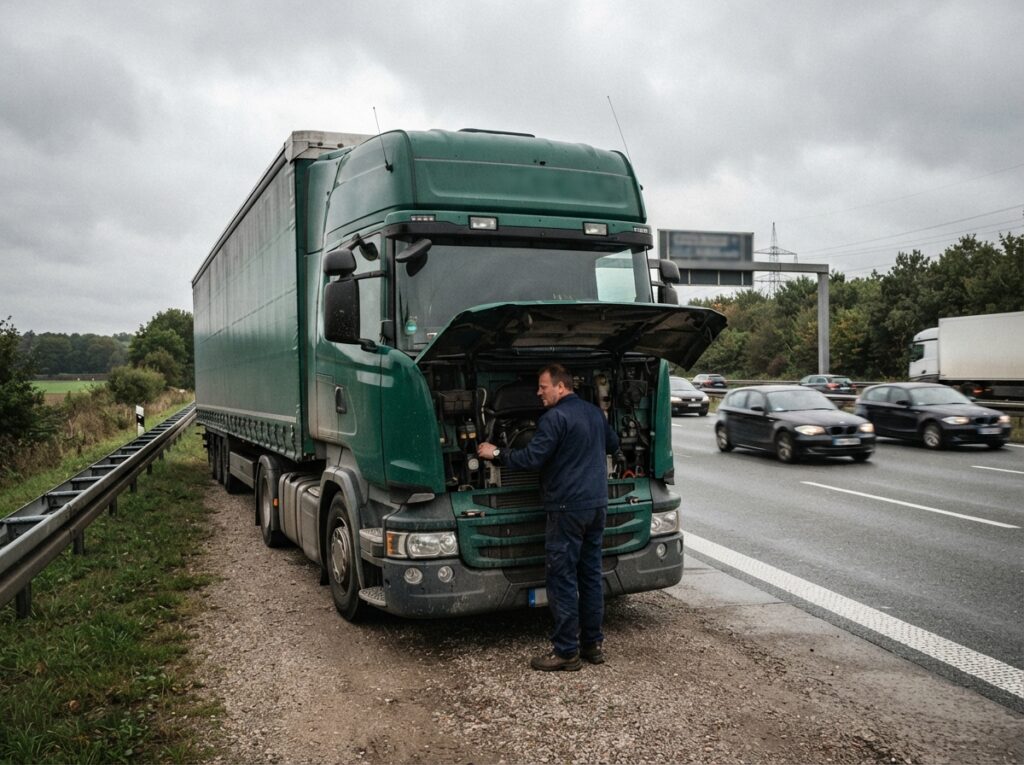
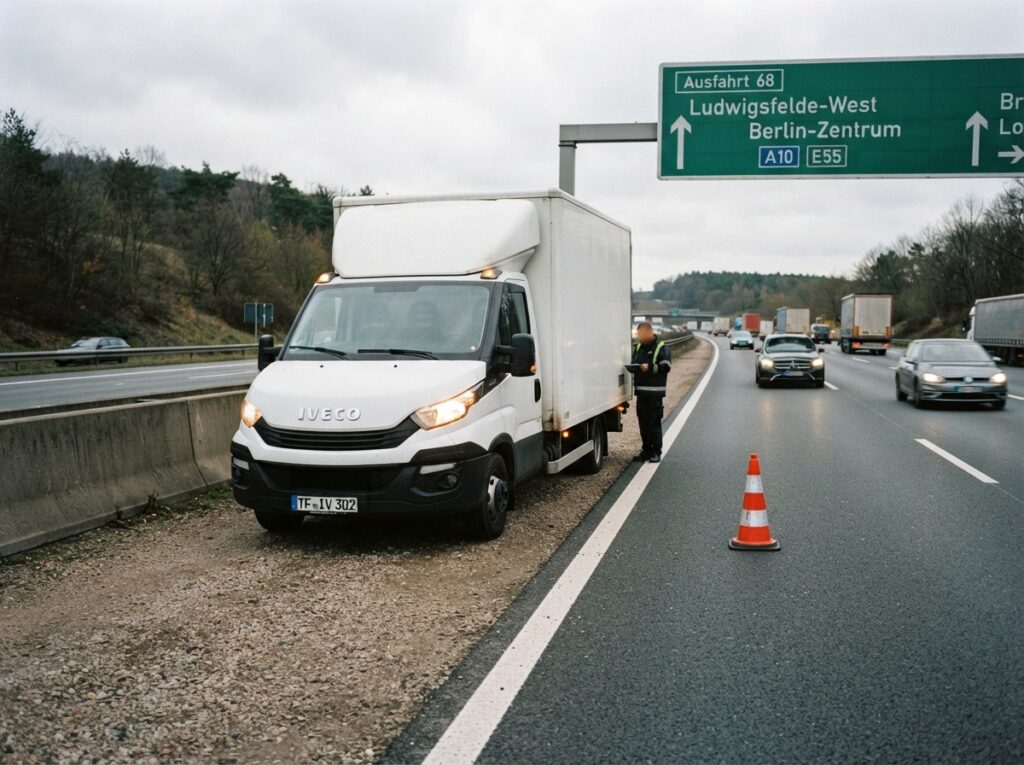
A crane recovery site has several hazards happening at once: live traffic right next to the closure, a vehicle suspended from the crane hook, tensioned cables and chains, and often leaking fluids such as diesel or hydraulic oil. For the driver of the stranded truck, the same basic rules apply as for any breakdown: switch on the hazard lights, put on a high visibility vest, set up a warning triangle, and get behind the guardrail to safety. We cover the exact rules on this, including what the hazard warning lights can indicate under German traffic law, in a separate guide.
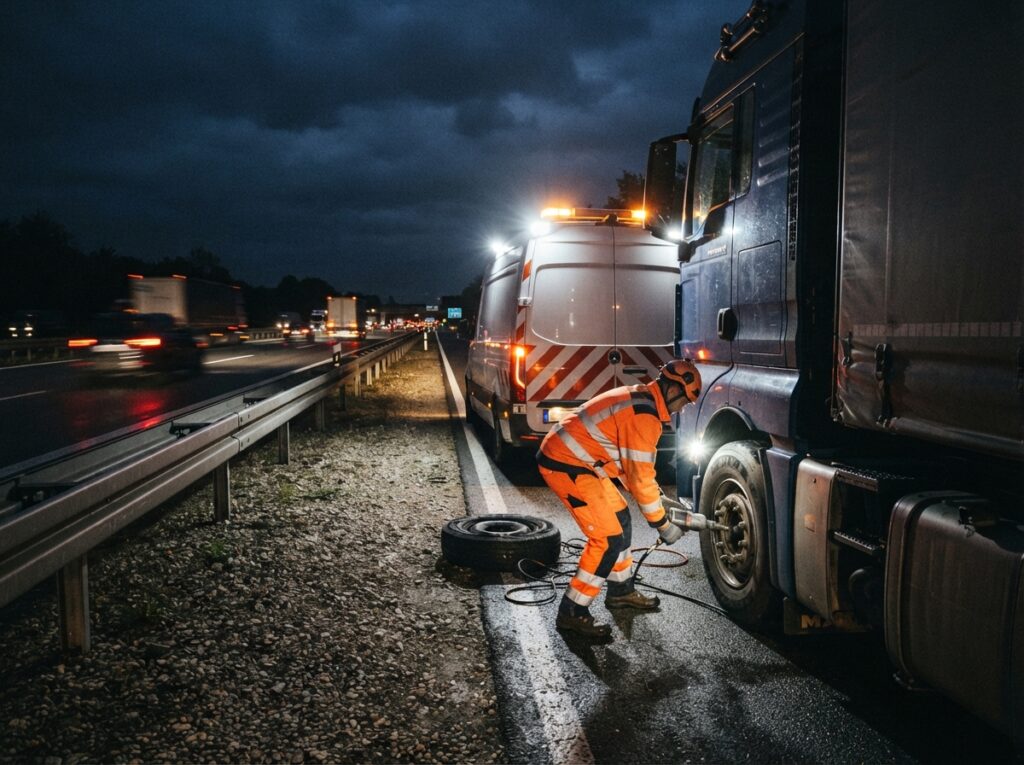
The recovery crew follows additional rules. Nobody stands under or near the suspended load while the crane is moving. Rigging equipment such as chains and straps is inspected before every lift, since a failure under several tonnes of load would be lethal. The crane operator always works on eye contact or radio command with the spotter, never on their own judgment alone. During night operations, which are common with truck breakdowns, extra lighting is set up to warn both the crew and passing traffic in time.
Cargo is another concern. With semi trucks carrying dangerous goods or heavy bulk freight, it has to be checked before the vehicle recovery even starts whether the cargo is securely fixed or needs to be removed first. This check is normally carried out by the incident commander together with the police, before the crane starts working at all.
Weather plays a bigger role than most people assume. Rain destabilizes the ground under the crane’s outriggers, frost can make chains and cables more brittle, and strong wind changes how a suspended load behaves considerably. Experienced crane operators adjust lifting speed and load distribution to the weather, and when in doubt, a lift gets postponed until conditions are safe enough. That costs extra time, but it is the only sensible way to avoid risk to both the crew and passing traffic. Lighting at the site is part of the same safety planning, especially at dusk or in fog, when visibility for other drivers drops sharply.
Case study: heavy recovery after a highway accident
A good example of a typical sequence is our job on the A7 near Hildesheim. A semi tractor left the road during the day and came to rest in a position where a winch and a rope could no longer pull it free, the slope of the embankment made a straight pull impossible without damaging the frame or the axles.
After arriving on site, our team coordinated the lane closure with the police right away. At the same time, the vehicle’s position was assessed to determine the correct rigging technique and crane placement. The mobile crane was positioned outside the edge of the embankment, with enough reserve lifting capacity for the unfavorable angle of the lift.
The actual lift then took just over an hour, including repeated checks of the rigging along the way. Only once the tractor unit was safely back on the road did the crew determine whether it could drive on its own or needed to be loaded onto a low loader. In this case the damage was severe enough that transport to the partner workshop required a low loader. The entire operation took just over six hours from arrival to full lane reopening.
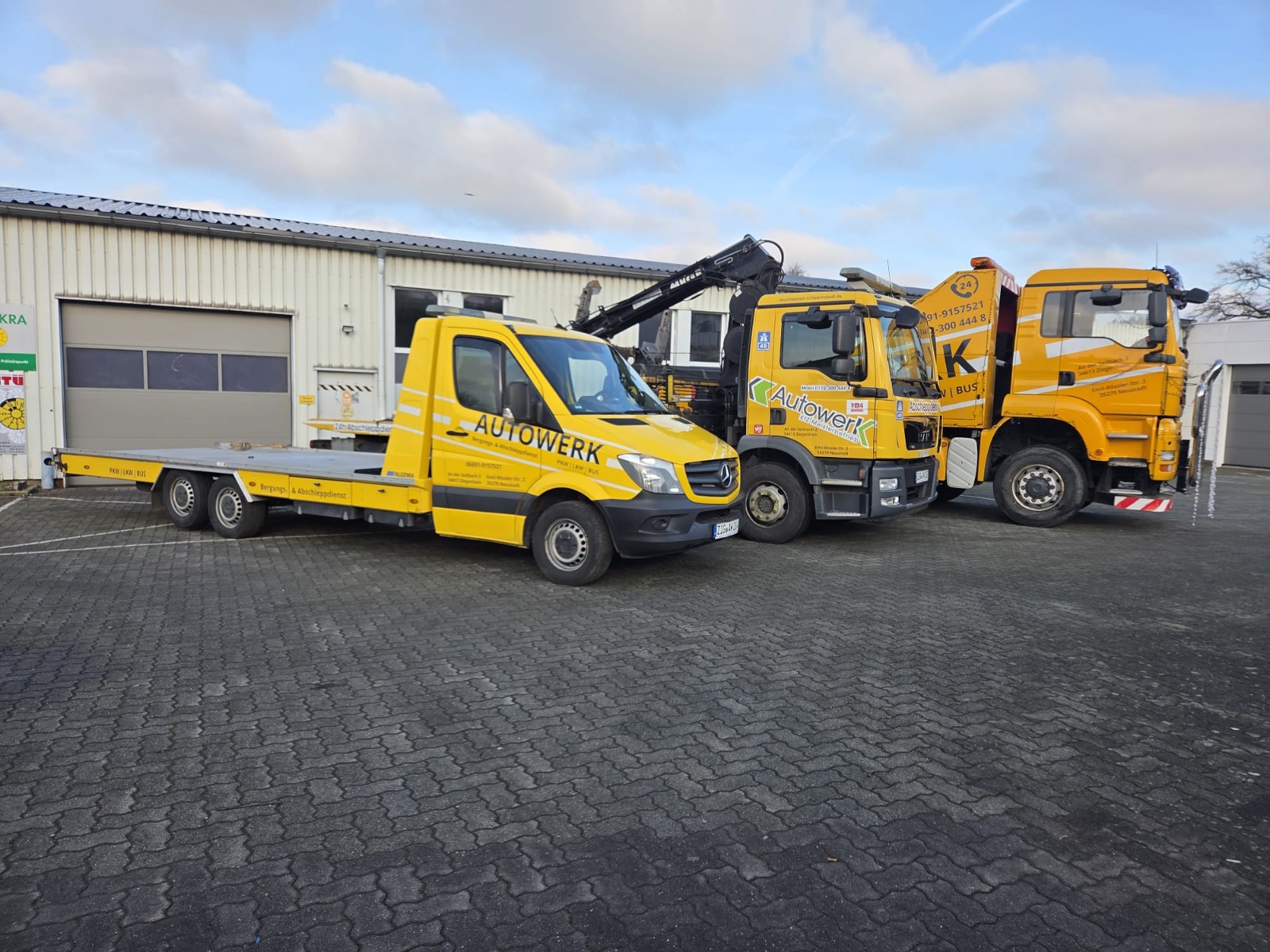
Cases like this show why a heavy recovery can never be estimated on the same timeline as a routine breakdown. Anyone who needs to judge a similar situation, whether a driver or a dispatcher, can find useful background on weight classes and typical weak points in our overview of truck models, drivetrains, and roadside assistance from 7.5 tonnes upward.
When it is not an accident, but the terrain itself
Not every heavy recovery follows a traffic accident. Just as often, a semi truck sinks deep enough into unpaved ground, a construction site, or a farm track that its own drive axle loses all traction. That exact scenario is documented in our report on the recovery of a MAN semi truck from the pavement of a Duisburg yard, as well as the recovery of a Scania from mud near Regensburg.
In these cases a combination of air bags, load spreading boards, and a winch often gets used before a crane becomes necessary at all. The reason is that soft ground does not just trap the truck, it also complicates positioning the heavy recovery vehicle itself. A mobile crane weighing several tonnes can sink in on its own if the ground has not been stabilized first.
When a tire change is enough, and when it is not
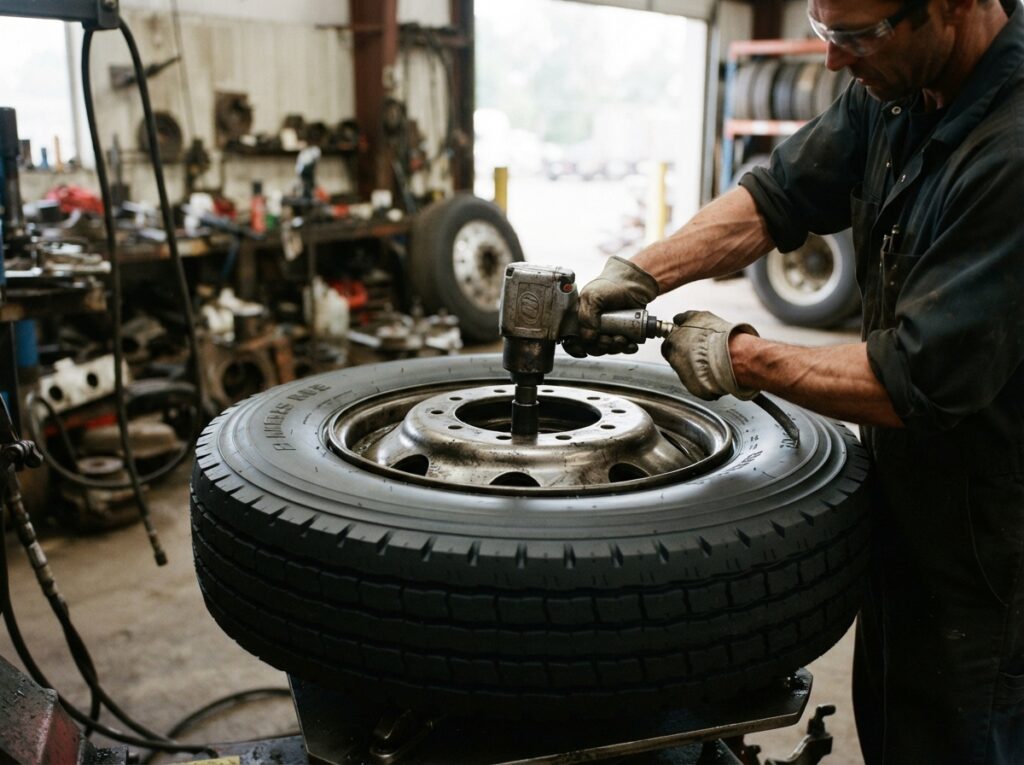
It is worth drawing the line clearly, because many drivers under stress fail to distinguish between the two scenarios. A blown tire, even on the drive axle of a heavy semi, is in the vast majority of cases a job for mobile emergency tire service nearby rather than a full recovery. These jobs usually take 40 to 90 minutes and require neither a crane nor a police closure, as long as the vehicle is safely parked on the shoulder.
Correct truck tire pressure also plays a role in whether a tire failure happens at all, and in the worst case whether it leads to a driver losing control of the lane. Fleets that work with a reliable truck tire wholesaler and keep an eye on tire condition reduce the chance of ever ending up in a situation that requires a heavy recovery in the first place.
The picture changes the moment a vehicle has left the road, rolled over, or has a locked axle. At that point it becomes a recovery job regardless of what triggered it, whether a blown tire, ice, or a mechanical fault. A good example of how quickly a simple tire failure can escalate into something more complex is our job involving an Iveco Eurocargo after a tire blowout and recovery from the shoulder near Augsburg.
How LKWHelp24 handles a heavy recovery
Our process starts with a message on WhatsApp, because drivers under stress usually type faster than they can talk, and because photos of the situation can be sent along instantly. The number +49 160 5753826 is staffed around the clock, and the team answers in German, English, Polish, and Russian.
Based on the photos and description, the dispatcher decides whether a regular tow truck is enough or whether a crane crew with a low loader should be sent out immediately. This early judgment call often saves an hour or more, because the right vehicle arrives on the first trip instead of having to be requested later once the initial crew realizes it cannot handle the job. On highway jobs, our team also contacts the responsible police unit directly to prepare the closure in a coordinated way before the crane even arrives.
An important note for freight companies and fleet operators: LKWHelp24 works exclusively with commercial vehicles from 7.5 tonnes upward, meaning trucks, semi trucks, coaches, and comparable commercial road transport. Anyone interested in the broader legal framework for commercial freight transport can find general information from Germany’s Federal Office for Goods Transport (BAG), which regulates and controls commercial road freight in the country.
For comparison, it is also worth looking at roadside assistance for cars and light vehicles offered by services such as ADAC. At 7.5 tonnes and above, equipment, permits, and hands on experience with semi trucks belong to an entirely different field, and that is exactly where our team specializes. A dispatcher who regularly deals with weights beyond 15 tonnes needs a different set of references than a typical roadside helper for private cars.
Fleet operators who want to plan ahead rather than only react should also look at typical damage patterns seen in vehicles that end up needing recovery more often than average, for example oversized loads or specialized bodies such as car transporters. One such case is described in our report on a car transporter breakdown near Wiesbaden, where the combination of cargo and vehicle size made planning the operation considerably more complex.
Frequently asked questions about heavy truck recovery
How long does a heavy crane recovery usually take?
Between two and six hours, depending on the vehicle’s position, weather conditions, and whether a highway lane needs to be closed. Coordinating with the police and setting up the closure alone can take 30 to 45 minutes.
What does a crane recovery cost roughly?
Prices start at around 1000 euros and are calculated individually depending on the crane class, the duration of the job, additional equipment such as a low loader, and how complex the traffic safety measures are.
Does insurance cover the cost of a recovery?
When the recovery follows a traffic accident, the liability insurance of the party at fault, or the truck’s own comprehensive coverage, often covers the cost. The exact reimbursement depends on the individual case and who is found responsible, which is why the invoice should always be submitted to the relevant insurer promptly.
Does the police have to be present at every recovery?
Not necessarily, but as soon as a highway or major road is involved and a lane has to be closed, the police are almost always present for traffic safety reasons.
From what vehicle weight does LKWHelp24 operate?
From 7.5 tonnes upward, covering trucks, semi trucks, coaches, and comparable commercial vehicles.
What should a driver do before help arrives?
Switch on the hazard lights, put on a high visibility vest, set up a warning triangle at a safe distance, and get off the road and behind the guardrail. Sending photos of the situation via WhatsApp to +49 160 5753826 speeds up planning the right response considerably.
A heavy crane recovery is not a routine job, but when one becomes necessary, correctly assessing the situation from the first phone call decides how many hours and how many hundreds of euros are on the line. Anyone unsure whether a situation calls for a crane or whether a regular tow truck will do should simply call or send a message with photos of the scene. Our team is available around the clock for exactly this reason.