Skip to content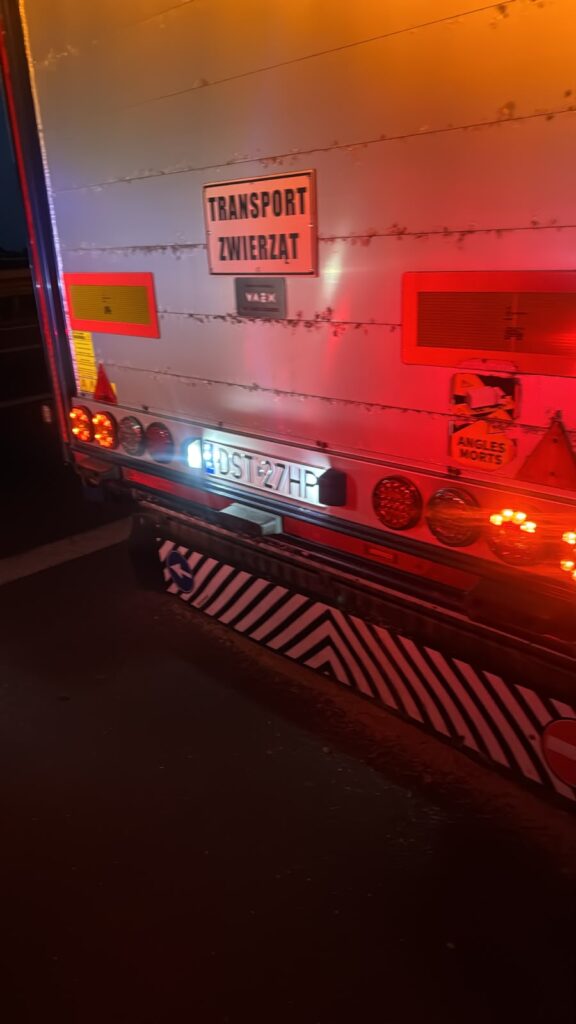
TL;DR: On the night of 15 July, a loaded livestock transporter suffered a trailer tyre blowout on the A29 near Oldenburg, direction Wilhelmshaven, at 23:40. Our regional partner team reached the site by 01:05 and had the lorry cleared to continue at 02:05 — 2 hours 13 minutes from the emergency call. New tyre: 385/65 R22.5.
What happened on the A29 that night?
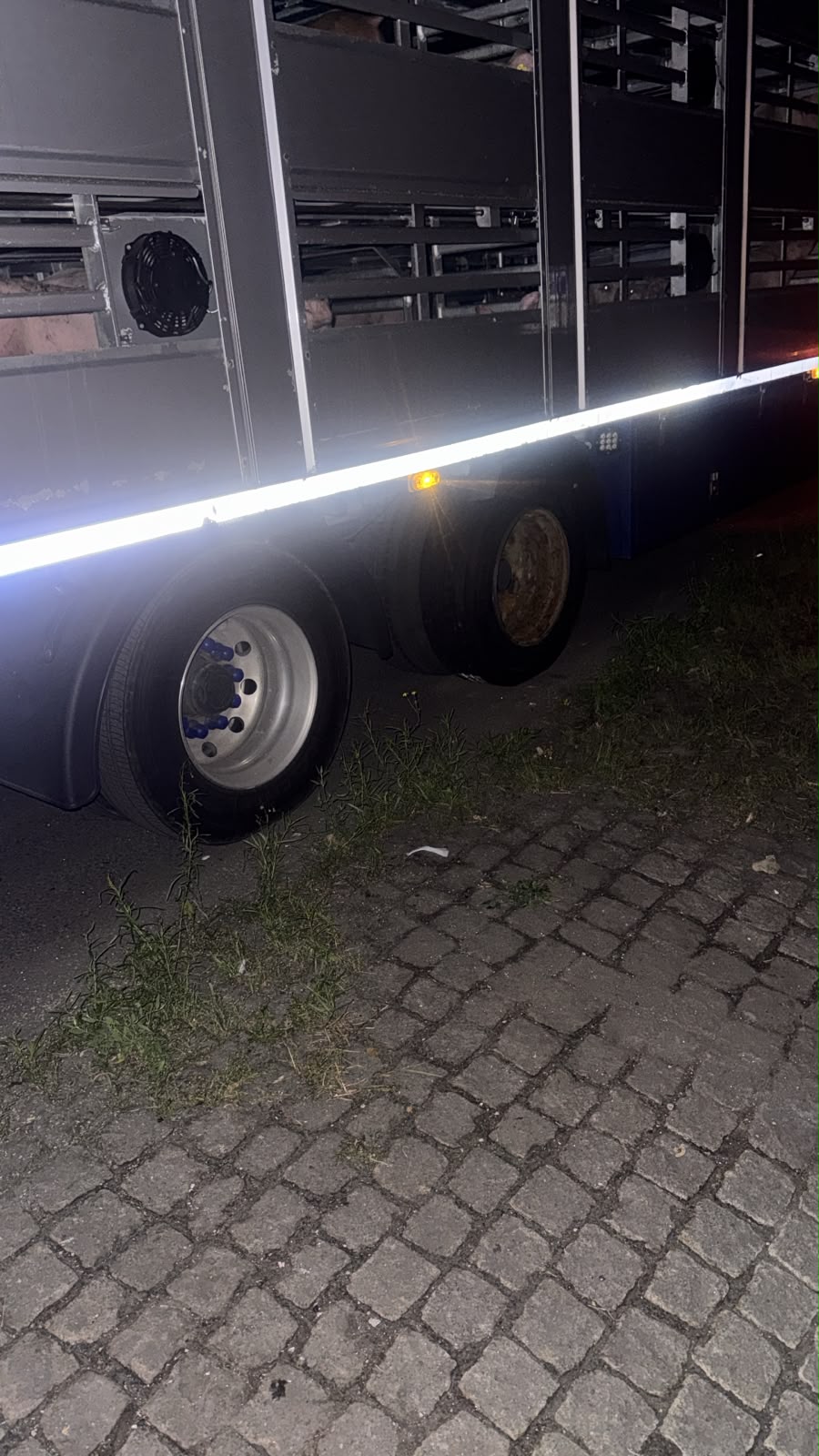
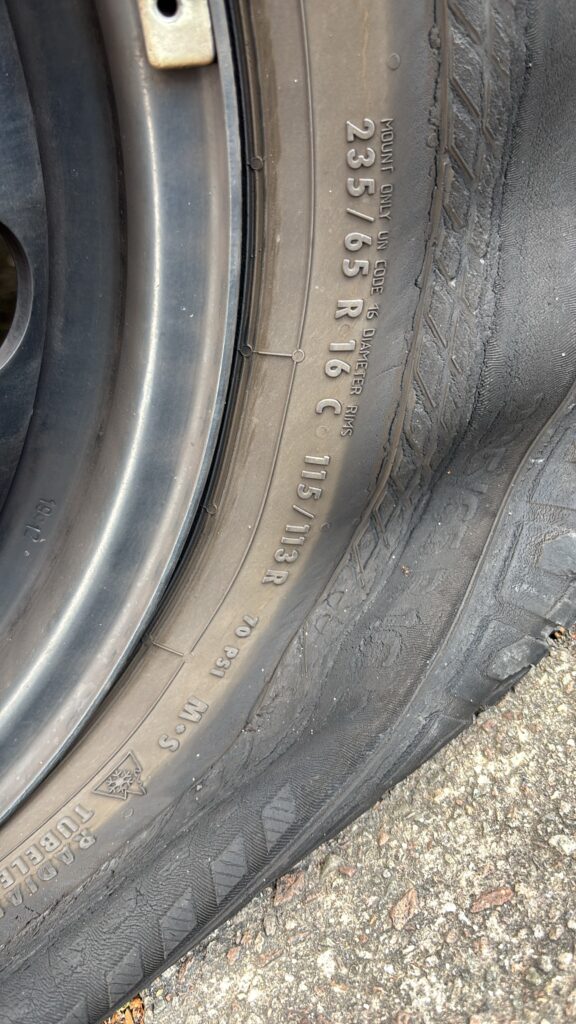
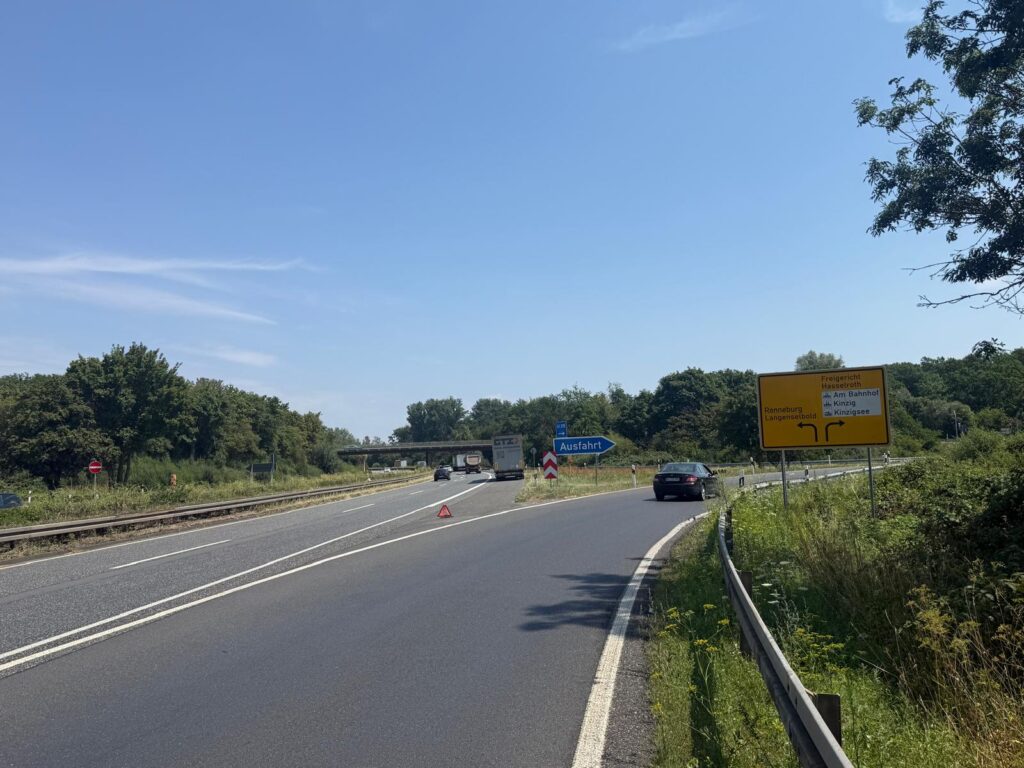
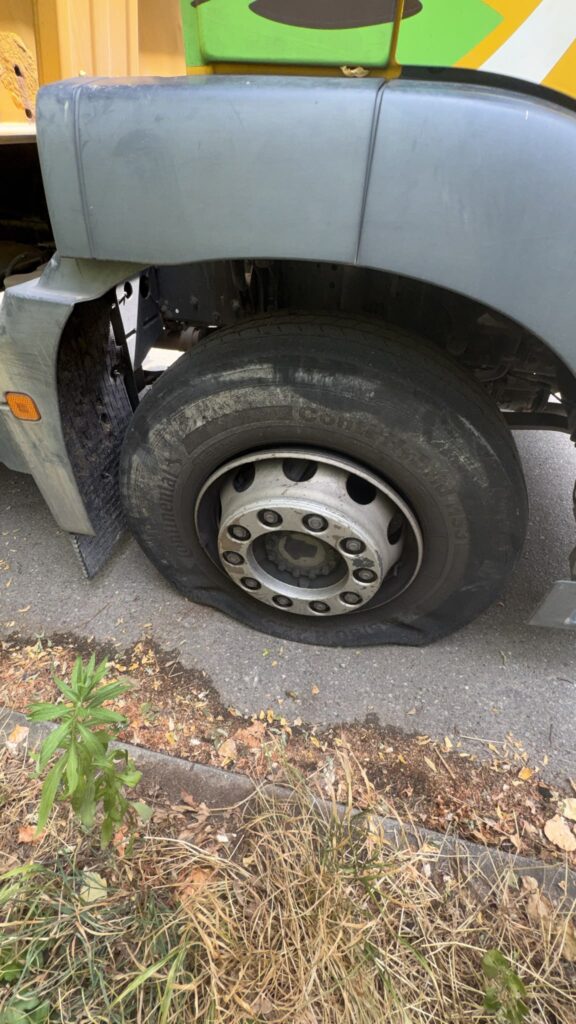
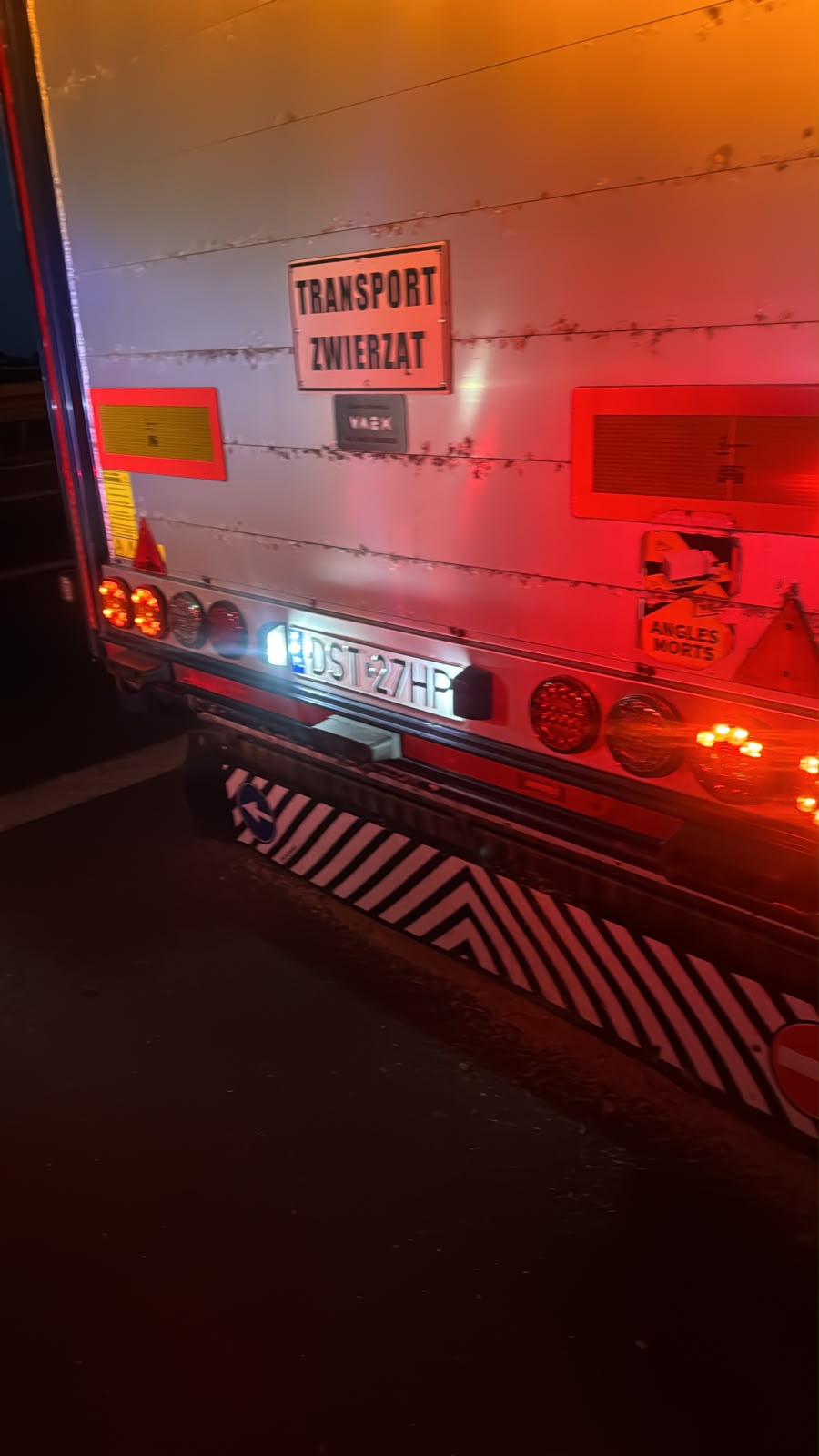
A semi-trailer livestock transporter, fully loaded, suffered a sudden tyre blowout on the trailer axle while travelling on the A29 near Oldenburg towards Wilhelmshaven. The driver felt the vehicle pull and heard the report of the tyre failing at roughly 23:40, and managed to bring the combination safely onto the hard shoulder without further incident.
This was not a routine tyre callout. A stationary livestock transporter on a warm July night is a different category of emergency from a stranded curtainsider or a refrigerated unit with a spare pallet run. Once the wheels stop turning, so does the airflow that keeps the animals inside comfortable, and the clock starts running against welfare, not just against schedule. That single fact shaped every decision our dispatch and technician team made over the following two hours, and it is why this case is worth documenting in detail rather than filing as “just another tyre job”.
Why is a livestock transporter breakdown a race against time?
A livestock transporter breakdown is time-critical because forced ventilation on most trailers of this type depends on motion — airflow through side vents and roof louvres is generated largely by the vehicle moving forward, not by a powered fan system alone. The moment the lorry stops on the hard shoulder, that natural air exchange collapses.
In summer, the internal temperature of a stationary, loaded livestock trailer can climb quickly, particularly with the engine off and no breeze crossing the vents. The animals do not suffer because of the tyre failure itself — a blowout, unpleasant as it sounds, causes them no direct harm if the driver keeps control, which happened here. What harms them is what follows: heat build-up, poor air exchange, and stress from an extended, unexplained stop. Every minute the trailer sits still without supplementary ventilation adds risk, which is why speed of response, not just competence, is the measure that matters most in this category of breakdown.
That is also the reason our team treats these jobs differently from the moment the phone rings. There is no “we’ll get to it after the current job” for a loaded livestock trailer. Dispatch reprioritises immediately, and every subsequent decision — vehicle sent, route taken, tools loaded — is made with the ventilation clock in mind rather than the standard commercial-tyre-job clock.
What do EU rules say about animal transport during a breakdown?
Under Regulation (EC) No 1/2005 on the protection of animals during transport, hauliers and drivers carrying live animals across the EU are bound by specific journey-time limits, mandatory watering and rest intervals, and minimum requirements for ventilation and stocking density. The regulation was written precisely for situations like this one, where a mechanical failure threatens to turn a compliant journey into a non-compliant one through delay alone.
The rules do not simply cover the driving portion of a trip. They also anticipate breakdowns, traffic hold-ups, and other disruptions, requiring that vehicles maintain adequate ventilation and space throughout the entire journey, including unplanned stops. A prolonged stop without functioning ventilation is treated as a welfare failure regardless of the original cause, which places real legal as well as ethical weight on how quickly a stranded livestock trailer gets moving again.
Key obligations under the framework include:
- Journey-time limits that vary by species and vehicle type, with mandatory rest and watering breaks built into longer routes.
- Minimum ventilation and stocking-density standards that must be maintained for the duration of the journey, not only while the vehicle is moving.
- Documentation requirements, including journey logs, that must reflect any unplanned delay and the measures taken to protect the animals during it.
- Competent-authority notification in cases of significant delay or animal distress, depending on the member state and the load in question.
Because of this framework, a livestock breakdown callout is never purely a mechanical matter. It sits at the intersection of roadside repair, animal welfare law, and carrier liability, and every party involved — driver, transporter, and roadside assistance provider — has a defined role to play within it.
What must the driver do during a forced stop?
The driver’s first responsibility during a forced stop is to activate any autonomous or independent ventilation system fitted to the trailer, if the vehicle carries one, since this is the only air exchange available once forward motion stops. Many modern livestock trailers carry a battery- or engine-powered ventilation unit precisely for this scenario, and switching it on immediately buys valuable time before the interior temperature becomes a concern.
Beyond ventilation, the driver’s checklist during a breakdown of this kind typically includes:
- Positioning the vehicle safely on the hard shoulder with hazard lights and a warning triangle, following standard StVZO roadside-safety requirements.
- Activating any onboard ventilation or cooling system and monitoring cab or trailer temperature readouts if fitted.
- Reporting the breakdown immediately to dispatch with precise location, direction of travel, and cargo type, so the response can be prioritised correctly from the first call.
- Contacting the assigned veterinary service or the consignee if the anticipated delay looks set to exceed a short window, so downstream parties can adjust receiving times or arrange veterinary attendance.
- Avoiding unnecessary engine shutdown for longer than needed, since idling can support auxiliary systems, subject to local rules on roadside idling.
None of this replaces a rapid roadside repair — it simply buys the time needed for one to happen. In this case, the driver’s prompt call at 23:52, only twelve minutes after the tyre failed, gave our dispatch team the earliest possible start on the clock.
Why does this type of callout get top priority from dispatch?
A livestock callout gets top priority because the cost of delay is measured in the physical condition of a living cargo, not in euros or contractual penalties. Our truck breakdown service fields many types of night calls — engine faults, coupling failures, standard tyre blowouts — and under normal circumstances jobs are queued by arrival time, distance, and severity. A livestock transporter breaks that queue entirely.
The honest answer to how priorities get set is that dispatch weighs urgency against available resources in real time. A loaded livestock trailer sitting on a hard shoulder in July heat outranks a parked curtainsider waiting for a coupling repair, and it will typically outrank a straightforward tyre job on an empty flatbed too, because the downside of delay is irreversible in a way that a late delivery is not. This is not a marketing claim; it is how the team is trained to think, and it is reflected in the timeline below, where the partner team was alerted at 23:58 — six minutes after the emergency call was logged — and rolling within seventeen minutes of that.
That prioritisation extends to which technician and vehicle get dispatched. Where possible, the team sent to a livestock job carries the tools and tyre stock suited to heavy semi-trailer axles without a return trip to base, because a second delay caused by missing equipment is exactly the outcome the initial prioritisation was meant to prevent.
How is a livestock trailer different to work on?
A livestock transporter is taller, heavier, and has a shifted, less predictable centre of gravity compared with a standard box or curtainsider trailer, and the animals inside continue to move and shift their weight even while the vehicle is stationary. That combination changes how a technician approaches jacking, stabilising, and wheel changes on site.
Standard procedure on our tyre service calls involves positioning jacks and axle stands on firm, level ground and lifting in a controlled, incremental sequence. On a livestock trailer, that sequence has to account for a load that is never fully static — a herd shifting weight from one side to the other mid-repair can alter the load on jack points in a way that never happens with a pallet of machine parts. Sudden lifting, or lifting without first checking for movement inside, risks destabilising the trailer at exactly the moment a technician is underneath it.
For this reason, our team follows a deliberately cautious sequence on livestock jobs:
- Assess ground conditions and position the trailer as level as possible before any lifting begins.
- Use additional stabilising support at the axle in question, accounting for the raised and shifting centre of gravity.
- Lift gradually, pausing to reassess stability rather than jacking in one continuous motion.
- Keep a spotter aware of trailer movement throughout the wheel change, communicating any shift immediately.
In this case, the site was secured and the trailer stabilised by 01:15, ten minutes after arrival, before any work began on removing the damaged 385/65 R22.5 tyre.
Why does noise and light discipline matter at night?
Working near a loaded livestock trailer at night calls for a deliberately calm approach, because unnecessary noise and flashing light increase panic among the animals inside, which in turn makes the trailer itself less stable to work on. Impact wrenches, raised voices, and unshielded work lights all register to animals confined in an unfamiliar, stationary vehicle, and a startled reaction inside the trailer can translate directly into the kind of load shift discussed above.
Our technicians on this job worked with hand tools where practical during the initial stabilisation phase, kept work lighting angled away from the trailer’s sides where possible, and avoided leaving hazard beacons cycling directly toward the vents. None of this slowed the repair meaningfully — the tyre swap itself ran on the same schedule as any heavy-axle 385/65 R22.5 change — but it kept the animals calmer throughout, which mattered both for welfare and for the practical stability of the vehicle during the lift.
This is a detail that rarely appears in a standard mobile truck service callout report, but on a livestock job it is treated as part of the technical procedure, not an afterthought.
When does transferring animals to a replacement vehicle become necessary?
Transferring animals to a replacement vehicle becomes necessary only when the original trailer cannot be made roadworthy within a timeframe compatible with animal welfare and journey-time limits, and it is treated as a last resort because the transfer process itself carries real risk. Loading and unloading livestock outside a controlled facility, at night, on a motorway hard shoulder, exposes the animals to stress, the possibility of injury during handling, and a logistical chain that most transporters would rather avoid if at all possible.
A transfer also triggers its own paperwork burden. Under EU animal transport rules, moving a consignment between vehicles typically requires updated journey logs, veterinary sign-off in some circumstances, and coordination with the consignee to confirm the new vehicle and any change to expected arrival. None of that is quick to arrange in the middle of the night, which is precisely why a fast, competent roadside repair is the preferred outcome in the overwhelming majority of cases — including this one, where the tyre swap and clearance were completed well within a window that made a transfer unnecessary.
In this instance, because the response was fast enough and the repair straightforward — a single tyre replacement rather than a structural or mechanical failure — a transfer was never on the table. The trailer was roadworthy again by 02:05, with the animals having spent well under two and a half hours stationary from the moment the tyre failed.
What is the carrier’s liability if something goes wrong?
A carrier remains liable for the condition of the animals throughout the journey, and any death or injury during a breakdown exposes the operator to both a direct financial loss and potential scrutiny from regulatory authorities. This is a heavier liability profile than most freight categories carry, since a damaged pallet of goods is an insurance claim, while an animal welfare incident during transport can trigger an investigation, reporting obligations, and reputational consequences that outlast the immediate financial cost.
That liability structure is another reason the industry, including services like ours, treats livestock breakdowns with such urgency. A technician arriving forty minutes later than necessary is not simply a slower service — it is additional exposure for the carrier at every level, from the welfare of the animals to the paperwork that follows if anything goes wrong. Fast, careful roadside response is as much risk management for the transport operator as it is a technical repair.
Timeline: from tyre blowout to cleared departure
| Time | Phase | Action |
|---|---|---|
| 23:40 | Breakdown | Tyre blowout on the trailer; driver pulls onto the hard shoulder |
| 23:52 | Emergency call | Driver reports the breakdown to dispatch, A29 near Oldenburg, direction Wilhelmshaven |
| 23:58 | Prioritisation | Live animal transport classified as a top-priority callout; partner team alerted |
| 00:15 | Departure | Service vehicle departs for the site |
| 01:05 | Arrival | Situation check, contact with driver, ventilation and temperature check inside the trailer |
| 01:15 | Site secured | Trailer stabilised and supported, accounting for raised centre of gravity and moving load |
| 01:25 | Old tyre removed | Damaged tyre (385/65 R22.5) taken off the trailer axle |
| 01:45 | New tyre fitted | Replacement tyre mounted and torqued in a star pattern |
| 01:55 | Final check | Tyre pressure, torque values, and visual inspection of the livestock transporter |
| 02:05 | Cleared | Lorry cleared to continue its journey |
Total time from the emergency call at 23:52 to departure at 02:05: 2 hours 13 minutes.
What did the repair cost?
| Item | Price (EUR) |
|---|---|
| Callout (night, priority) | 260 |
| Tyre 385/65 R22.5 | 480 |
| Fitting/labour | 150 |
| Night surcharge | 90 |
| Priority livestock callout | 70 |
| Old tyre disposal | 20 |
| TOTAL | 1070 (net, plus VAT) |
The figures reflect a night-time, priority-classified callout on a heavy semi-trailer axle, with a premium 385/65 R22.5 tyre and the surcharges typical of after-hours German truck tyre service work. According to ADAC, night and weekend callouts across the German breakdown-assistance market generally carry a premium over daytime rates, and a livestock-priority classification adds a further line reflecting the resourcing required to guarantee the fastest possible response.
Frequently asked questions
How long can a livestock transporter legally stay stationary during a breakdown?
There is no fixed “stationary limit” in isolation, but under Regulation (EC) No 1/2005 any delay must not compromise ventilation, watering, or overall journey-time limits. In practice, this means minutes matter, and roadside assistance providers treat these calls as top priority.
Why did this callout cost more than a standard tyre job?
The total of 1070 EUR net reflects the night surcharge, priority-response resourcing, and the size of the 385/65 R22.5 tyre fitted to a heavy semi-trailer axle, on top of standard callout and fitting charges.
Does every livestock trailer have autonomous ventilation?
Not every trailer on the road carries a powered auxiliary ventilation system, though many modern units do. Where fitted, activating it immediately after a forced stop is one of the driver’s first priorities.
What happens if the repair cannot be completed quickly enough?
If the trailer cannot be made roadworthy within a welfare-compatible timeframe, the animals are transferred to a replacement vehicle. This is treated as a last resort because of the added stress, injury risk, and veterinary paperwork it triggers.
Who is liable if an animal is injured or dies during a breakdown?
The carrier remains liable throughout the journey. An incident can mean both a direct financial loss and involvement of regulatory authorities, which is why fast, competent roadside response matters as much for liability as for welfare.
Is this response time typical for livestock breakdowns in Germany?
2 hours 13 minutes from call to departure is on the faster end for a heavy semi-trailer tyre repair at night, achieved here through immediate prioritisation and a partner team already positioned within reach of the A29 corridor.
Summary
A loaded livestock transporter suffered a trailer tyre blowout on the A29 near Oldenburg, direction Wilhelmshaven, at 23:40 on the night of 15 July. The driver reported the breakdown at 23:52; dispatch classified it as a top-priority livestock callout six minutes later and had a partner team on the road by 00:15. The team arrived at 01:05, secured and stabilised the trailer by 01:15, removed the damaged 385/65 R22.5 tyre at 01:25, fitted and torqued the replacement by 01:45, completed final checks by 01:55, and cleared the lorry to continue its journey at 02:05 — a total of 2 hours 13 minutes from the initial call, at a net cost of 1070 EUR plus VAT. Throughout, ventilation and animal condition, not just the mechanical repair, drove every decision on site.
Need fast, priority roadside assistance for livestock or other specialist transport?
Call +49 160 5753826 any hour of the day or night, or visit www.lkwhelp24.com. We cover breakdowns across all of Germany, 24/7, with response teams trained to prioritise time-sensitive cargo from the first phone call.
Keywords: livestock transporter breakdown, tyre blowout A29 Oldenburg, truck breakdown assistance Germany, 385/65 R22.5 tyre replacement, night tyre service Germany, animal transport EU regulation 1/2005, priority roadside assistance lorry