Skip to content
TL;DR: On 5 August, a Mercedes-Benz Actros tractor unit stopped on the A5 near Baden-Baden, direction Basel, after its digital tachograph stopped recording driving and rest times. LKWHelp24 dispatched a partner technician in 15 minutes, diagnosed the fault on site, briefed the driver on manual record-keeping, and had the vehicle escorted to an accredited workshop within 2 hours 25 minutes of the first call. Net cost: €490.
A tachograph fault does not look dramatic. No smoke, no flat tyre, no warning triangle needed at the side of the road. The lorry can often still drive. That is exactly what makes it dangerous: a driver who keeps going without a fallback procedure is committing one of the costliest offences on German roads, and often does not realise it until an inspector at a roadside check pulls up the data.
This case is about a driver who did the right thing. He stopped, called for help, and asked what he was legally allowed to do next. The answer involves a piece of paper, a pen, and a rule most drivers have heard of but never had to use.
What Happened on the A5 Near Baden-Baden
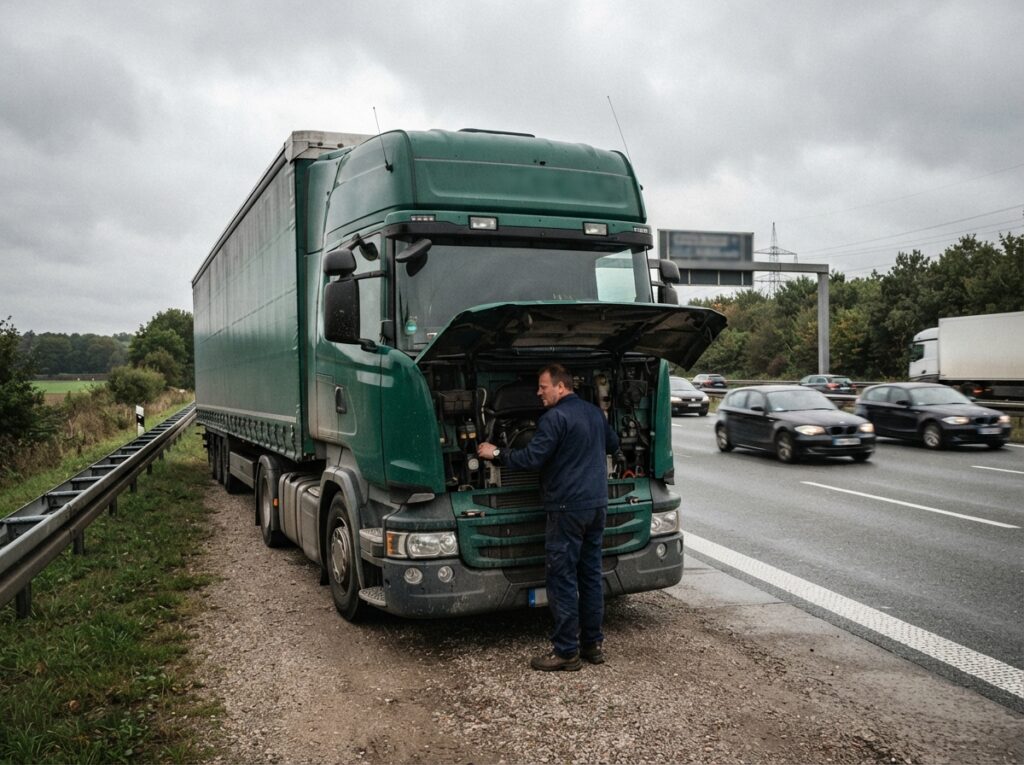
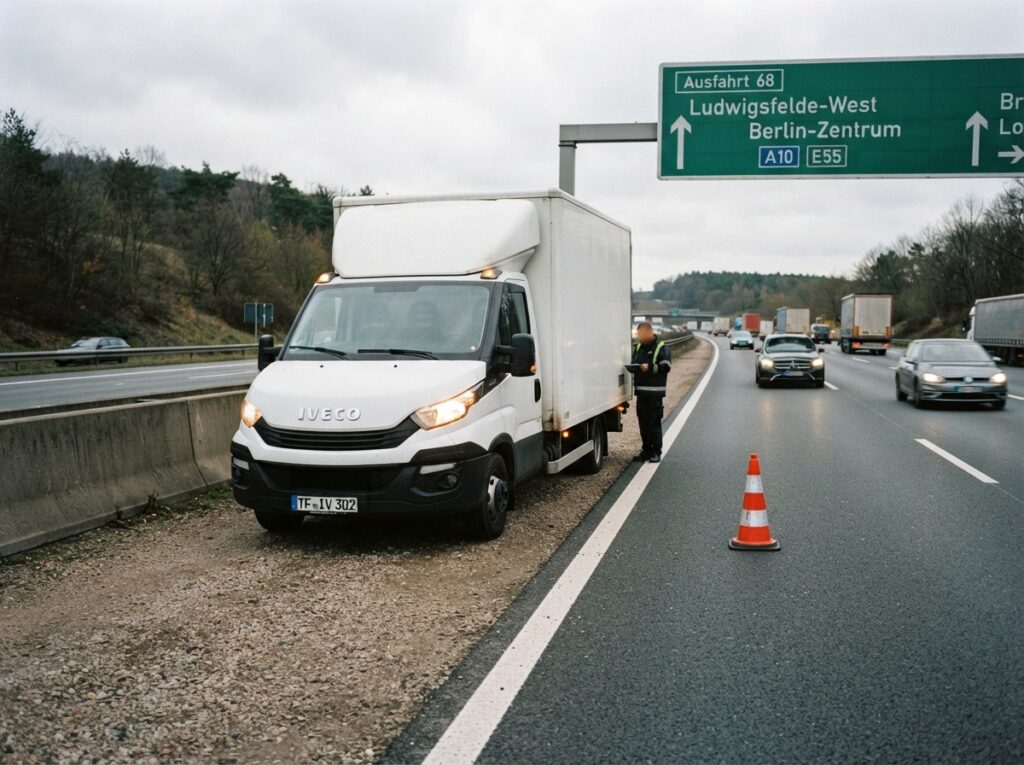
Direct answer: A Mercedes-Benz Actros tractor unit lost tachograph recording while driving on the A5 near Baden-Baden, direction Basel, on the afternoon of 5 August. The driver noticed the display had frozen and pulled onto the hard shoulder.
The vehicle itself was in working order. Engine, brakes, steering, tyres — nothing mechanical had failed. The problem sat entirely in the electronics: the digital tachograph, the small recorder behind the dashboard that logs every kilometre, every stop, and every hour a driver spends behind the wheel, had simply stopped writing data.
For a private car this would be a non-event. For a commercial lorry over 3.5 tonnes it is a legal problem, because German and EU law treat an unrecorded journey the same way they treat a journey with falsified records: as a compliance failure that can be fined on the spot. The driver had covered a short distance with a blank recorder before he noticed, called his dispatcher, and was told to stop and call for professional help rather than continue and hope for the best.
What a Digital Tachograph Is and Why It Matters
Direct answer: A digital tachograph is a legally mandated recording device fitted to lorries and buses that logs driving time, breaks, rest periods, and vehicle speed, and stores that data for roadside and company inspections.
Every EU-registered goods vehicle over 3.5 tonnes engaged in international transport must carry one. Since 2019, newly registered vehicles use the second-generation “smart” tachograph, which can transmit basic data to enforcement officers remotely via short-range radio, even before the vehicle is pulled over. The device is directly linked to a driver’s card, which stores personal activity data, and to the vehicle unit, which stores technical and journey data.
The tachograph exists because driving time and rest time are safety issues, not administrative ones. A fatigued driver behind an articulated lorry weighing up to 40 tonnes is a hazard to everyone on the road. The recorder is the evidence that a driver actually took the breaks the law requires, not just a box-ticking exercise for the haulier’s paperwork.
EU Drivers’ Hours Rules in Brief
Direct answer: Under EU Regulation 561/2006, a driver must take a break of at least 45 minutes after 4.5 hours of driving, may drive a maximum of 9 hours per day (extendable to 10 hours twice a week), and must take 11 hours of daily rest, reducible to 9 hours up to three times a week.
Weekly rest must be at least 45 hours, though it can be shortened under specific compensation rules. These limits are set out in EU Regulation 561/2006 on driving times and rest periods, which applies directly across all member states and does not require national transposition to take effect.
| Rule | Limit |
|---|---|
| Break after continuous driving | 45 minutes after 4.5 hours |
| Maximum daily driving | 9 hours (10 hours, twice a week) |
| Daily rest | 11 hours (9 hours, up to 3 times a week) |
| Weekly rest | At least 45 hours |
These figures are what the tachograph is designed to prove. Without a working recorder, a driver has no automatic way to demonstrate compliance, which is exactly the situation the Actros driver found himself in on the A5.
Consequences of Driving With a Faulty Tachograph
Direct answer: Continuing a journey with a non-recording tachograph, without switching to manual records, is treated as driving without valid proof of rest times and is one of the most expensive categories of offence for both driver and haulier under German transport law.
Fines are assessed separately against the driver and the operating company, and they scale with the number of days affected. A single unrecorded shift is one thing; a pattern of unrecorded driving over several days, discovered during a routine check by the Bundesamt für Güterverkehr, can trigger a much larger penalty and put the haulier’s operating licence under review.
There is a sharper line as well. A malfunctioning tachograph is a technical fault. Deliberately tampering with one — magnets, jammers, manipulated sensors — is a different category of offence entirely, and can lead to criminal proceedings against the driver and the company, plus the vehicle being grounded on the spot. Enforcement officers are trained to distinguish a genuine fault from manipulation, and they do it by checking exactly the kind of diagnostic trail our technician generated on site.
What to Do If the Tachograph Fails En Route
Direct answer: A driver whose tachograph stops recording must switch immediately to manual record-keeping on the back of a printout or a separate sheet, noting start and end times, breaks, and odometer readings by hand — this is a recognised legal fallback, not an improvisation.
Most drivers know a tachograph exists. Far fewer know that EU Regulation 165/2014 explicitly anticipates equipment failure and requires the driver to record activity manually for the remainder of the journey, rather than simply carrying on unrecorded or, worse, stopping the lorry indefinitely at the roadside. The regulation also sets a time limit: the vehicle must be brought to an authorised workshop for repair as soon as reasonably possible, generally within a matter of days, and the driver must be able to show manual records covering every day the fault persisted.
This is the single most useful piece of information in this case. The Actros driver had heard of the tachograph rules in the abstract but had never been shown, step by step, how to fill in a manual record correctly. Our technician walked him through it: date, driver name, start location, times, breaks, and end location, entered by hand and kept with his other transport documents. That one conversation turned a legal grey area into a compliant, defensible journey.
How Long You Can Legally Drive on Manual Records
Direct answer: A driver may continue on manual records for as long as it takes to reach a suitable workshop, provided the detour does not exceed what is reasonably necessary and the fault is not the result of deliberate tampering.
An inspector at a roadside check will ask for three things: the manual record sheet covering the period since the fault, some indication of when the fault occurred, and evidence that the driver is en route to a repair, not simply avoiding the issue. A dated diagnostic note from a recognised roadside service, of the kind our technician issued, supports exactly that evidence trail. Drivers who cannot explain why the tachograph has been blank for several days, with no record and no paperwork, face the full weight of the fine — this is the scenario the fallback procedure exists to prevent.
Common Tachograph Faults
Direct answer: The faults we see most often are a driver card that will not read, a printer that jams or runs out of paper, a motion sensor error, a depleted internal backup battery, and damaged sensor wiring between the gearbox and the recording unit.
- Driver card not read — often a dirty or worn card chip, sometimes a card reader fault
- Printer failure — no physical fault to the log itself, but no way to print a control sheet on demand
- Motion sensor error — the unit loses its speed and distance signal from the gearbox
- Internal battery depleted — the backup power that keeps the clock and short-term memory running fails
- Sensor wiring damage — corrosion, a chafed cable, or a loose connector near the gearbox interrupts the signal
On the Actros, our technician traced the fault to an intermittent signal loss between the motion sensor and the vehicle unit, most likely a connector issue rather than a failed sensor itself. That distinction matters, because it changes what the workshop needs to have in stock before the vehicle arrives.
Seals and Calibration: What We Can and Cannot Do
Direct answer: The tachograph housing is sealed by law, breaking that seal without authorisation is prohibited, and only an accredited workshop may open, repair, and recalibrate the unit — our team diagnoses the fault and arranges safe onward transport, nothing more.
We say this plainly because drivers sometimes ask whether a roadside technician can simply fix the tachograph there and then. The honest answer is no. The seal exists precisely to prevent unauthorised access, and an accredited calibration centre is the only party legally permitted to remove it, repair the internal components, and reseal and recalibrate the unit before it goes back into service. What we can do — and did, in this case — is confirm the fault is genuine rather than a display glitch, document it, and get the vehicle safely to a workshop that can finish the job.
Tachograph Manipulation: Why It Is a Dead End
Direct answer: Magnets, signal jammers, and other manipulation devices are reliably detected during roadside checks using dedicated scanning equipment, and the consequences — fines, vehicle grounding, and potential criminal liability — are far more severe than the cost of a genuine repair.
It might seem tempting, when a lorry is losing paid driving hours, to bridge a fault with a cheap fix bought online. Enforcement authorities have caught up with this. Modern roadside checks include specific scans for magnetic interference and signal anomalies, and a manipulated unit is flagged immediately, with none of the leniency shown to a documented technical fault. The gap between “my tachograph broke and I have manual records plus a diagnostic report” and “my tachograph shows signs of tampering” is the gap between an inconvenience and a serious legal problem.
Downtime From a Tachograph Fault: Why Speed of Decision Matters
Direct answer: With a tachograph fault, the real cost is not the repair itself but the time spent deciding whether to continue, stop, or wait, because every hour of hesitation adds to downtime that a fleet estimates at €800–1,200 per day for a stationary tractor unit.
Unlike a blown tyre or a dead battery, a tachograph fault does not force an immediate stop. That flexibility is also a trap: drivers who are unsure of the rules sometimes keep driving out of habit, or stop completely and wait for instructions that take hours to arrive. Getting a qualified technician on site quickly, confirming the fault, and briefing the driver on manual records in one visit collapses that decision time to minutes rather than hours, and lets the vehicle keep moving toward the workshop instead of sitting idle on the hard shoulder.
Prevention: Three Habits That Avoid This
Direct answer: Regular tachograph data downloads, checking the calibration due date every two years, and keeping spare printer paper in the cab prevent most of the faults that strand a driver on the motorway.
- Download data on schedule — drivers must download their card data periodically and companies must download the vehicle unit data at set intervals; skipped downloads sometimes mask an intermittent fault that would otherwise be caught early
- Track the calibration date — the tachograph must be recalibrated at an accredited workshop every two years; a unit running past that date is both a compliance risk and more likely to develop sensor drift
- Carry spare printer paper and a manual record template — a printer fault should never turn into an unrecorded journey when a blank sheet and a pen solve it in minutes
Fleet managers who build these three habits into a driver’s routine checklist see far fewer roadside tachograph incidents than those who treat the device as something that only gets attention when it breaks.
How We Organised Help
Direct answer: From the first call to a technician on site took 15 minutes of dispatch coordination, followed by a 55-minute drive to the breakdown location on the A5.
- Emergency call logged at 11:40, vehicle type, location, and symptom description taken
- Nearest available partner technician identified and assigned by 11:55
- Technician briefed en route on the likely fault category based on the driver’s description
- Arrival on site at 12:50, 55 minutes after dispatch was confirmed
- Driver briefed on hazard warning lights and hard-shoulder positioning while diagnostics began
Our dispatch runs 24/7 and coordinates a partner network across Germany, which is what kept the response time to under an hour on a route where breakdown assistance can otherwise take considerably longer to reach.
Situation on Site
Direct answer: The Actros was parked safely on the hard shoulder with hazard lights on and a warning triangle placed behind it; the technician’s first task was scene safety before touching any electronics.
Baden-Baden southbound on the A5 carries heavy through-traffic toward Basel and the Swiss border, and the hard shoulder there narrows in places. Scene safety came first: hazard lights confirmed, warning triangle checked and repositioned, high-visibility vests worn throughout. Only once the stop was secured did the technician move to the dashboard to confirm the driver’s description — a blank tachograph display with no error code showing, which pointed toward a sensor or wiring fault rather than a software crash.
Step-by-Step: What the Technician Did
Direct answer: The response followed four stages — visual check and scene safety, electrical diagnostics, manual record-keeping briefing, and escort arrangement to the accredited workshop — completed in 85 minutes on site.
- Visual check and scene safety (12:50–13:15): confirmed hazard positioning, inspected the tachograph unit and surrounding wiring for visible damage, checked for any fault codes on the dashboard
- Electrical and tachograph diagnostics (13:15–13:45): traced the signal path from the gearbox-mounted motion sensor to the vehicle unit, isolated an intermittent connection as the likely cause, ruled out driver card and printer faults
- Handover briefing (13:45–14:05): explained the manual record-keeping requirement in detail, filled in the first entry together with the driver, and set up the escort arrangement to the nearest accredited workshop for a full repair and recalibration
- Departure: vehicle left the A5 hard shoulder at 14:05, escorted toward the workshop under manual record-keeping
No tools were needed to open the sealed housing, because that step belongs to the accredited workshop, not to a roadside visit.
Full Timeline
| Time | Phase | Action |
|---|---|---|
| 11:40 | Call received | Emergency call logged, symptoms and location taken |
| 11:55 | Dispatch completed | Partner technician assigned (15 min) |
| 12:50 | Arrival on site | A5 near Baden-Baden, direction Basel (55 min response) |
| 12:50–13:15 | Visual check | Scene safety, initial diagnosis (25 min) |
| 13:15–13:45 | Diagnostics | Electrical and tachograph fault-tracing (30 min) |
| 13:45–14:05 | Handover | Manual record-keeping briefing, escort arranged (20 min) |
| 14:05 | Departure | Vehicle en route to accredited workshop |
Total elapsed time: 2 hours 25 minutes (145 minutes) from first call to departure.
Cost of the Callout
Direct answer: The total cost of the roadside diagnosis, briefing, and escort to the workshop was €490 net; had the vehicle not been fit to continue, towing would have replaced the escort fee at €850–1,600 depending on distance.
| Item | Net Cost (EUR) |
|---|---|
| Call-out fee | 220 |
| Electrical/tachograph diagnostics (1 hr) | 120 |
| Escort/coordination to accredited workshop | 150 |
| Total | €490 |
All figures are net, plus statutory VAT. The price reflects diagnosis and safe onward movement of the vehicle, not the tachograph repair itself, which is billed separately by the accredited workshop that carries out the recalibration.
Had the fault been severe enough to make continued driving unsafe or non-compliant even under manual records, the alternative would have been towing rather than escort, at €850–1,600 depending on distance to the nearest suitable workshop. That range is roughly double to triple the escort fee, which is why a fast, accurate diagnosis on site — confirming the vehicle was fit to continue under manual records — saved real money on this call.
Why You Need a Professional for a Tachograph Fault
Direct answer: A roadside professional distinguishes a genuine technical fault from a compliance trap, documents the fault for enforcement purposes, and knows the manual record-keeping procedure that most drivers have never had to apply.
- Risk of continuing blind: a driver who keeps going without documentation cannot prove the fault was genuine if stopped later
- Risk of stopping indefinitely: waiting at the roadside for hours without professional advice adds downtime with no compliance benefit
- Risk of self-repair: opening the sealed housing without authorisation is itself an offence, regardless of intent
- Risk of manipulation shortcuts: even a well-meaning quick fix can look identical to tampering under inspection
A technician who diagnoses the fault, documents it with a timestamp, and briefs the driver on the legal fallback removes all four risks in one visit.
Typical Tachograph Situations We Handle
Direct answer: Beyond this Actros case, our partner network responds to driver card faults, printer failures, sensor wiring damage, and calibration-expiry warnings across German motorways every week.
- Driver card unreadable at the start of a shift, requiring a manual-record start until a replacement card is issued
- Printer jams that prevent a control sheet from being produced during a roadside check
- Intermittent display errors that come and go, making the fault hard for the driver to describe accurately
- Calibration due-date warnings discovered mid-journey, requiring a workshop visit before the deadline
Each of these follows the same pattern: diagnose fast, confirm whether manual records apply, and get the vehicle to the right workshop with minimal downtime.
Extended Notes on Fleet Maintenance
Direct answer: A tachograph fault rarely happens in isolation from the rest of a fleet’s maintenance routine, which is why tyre condition, wiring integrity, and electronic system checks belong in the same inspection cycle.
Vehicles that go long stretches without a full inspection tend to accumulate small electrical faults across several systems at once, tachograph wiring included. Tyre brands such as Continental, Michelin, Goodyear, and Bridgestone all publish maintenance intervals that fleet managers can align with tachograph calibration checks, so a vehicle visits a workshop once for several inspections rather than being pulled off the road repeatedly for isolated faults. Modern electronic systems on vehicles like the Actros, including tachograph sensors, share wiring harnesses and connectors with braking and stability systems from suppliers such as Bosch, which is one reason a qualified diagnostic check matters more than a guess based on symptoms alone.
Why Choose Us
Direct answer: LKWHelp24 runs a 24/7, multilingual dispatch network across Germany with vetted partner technicians, transparent net pricing agreed before work starts, and no hidden call-out surcharges.
We coordinate roadside assistance for tyres, towing, mobile mechanical repairs, and electrical faults including tachographs, across the whole country. Every case gets a fixed quote before work begins, dispatch operates around the clock in several languages for international drivers, and our partner network is chosen for response time and documented workmanship, not lowest bid. For lorries with a fault that keeps them technically compliant but not immediately dangerous, like this tachograph case, our priority is minimising downtime while keeping the driver on the right side of the law.
Frequently Asked Questions
Can I keep driving if my tachograph stops working?
Only under manual record-keeping, noting times and breaks by hand, and only for as long as it takes to reach a suitable workshop. Continuing without any record is a fine risk for both driver and haulier.
How much does a tachograph roadside diagnosis cost?
In this case, the full callout, diagnostics, and escort to the workshop came to €490 net. Costs vary with distance and time of day.
Who can repair and recalibrate a digital tachograph?
Only an accredited workshop authorised to break the tachograph seal, carry out repairs, and reseal and recalibrate the unit. Roadside technicians can diagnose but not open the sealed housing.
What happens if an inspector finds a blank tachograph with no manual records?
It is treated as an unrecorded journey, which typically results in a fine for the driver and a separate assessment against the haulier, scaling with how many days are affected.
How often does a tachograph need recalibration?
Every two years at an accredited workshop, regardless of whether a fault has occurred, under EU tachograph regulations.
Is tachograph manipulation ever worth the risk?
No. Roadside enforcement equipment reliably detects magnets and signal interference, and the penalties, including possible criminal liability and vehicle grounding, far outweigh any time saved.
Summary
- Vehicle: Mercedes-Benz Actros tractor unit
- Location: A5 near Baden-Baden, direction Basel
- Date: 5 August, daytime
- Fault: digital tachograph stopped recording
- Response time: 55 minutes to arrival on site
- Total time: 2 hours 25 minutes, call to departure
- Cost: €490 net
- Secondary damage: none — mechanical systems unaffected, driver briefed and escorted under manual records
Get Help Now
A tachograph fault does not wait for a convenient moment, and neither do we. If your vehicle stops recording anywhere in Germany, call +49 160 5753826 for 24/7 roadside assistance, or visit www.lkwhelp24.com for our full range of truck breakdown services. Available around the clock, across the whole country.
For tyre or towing emergencies alongside electrical faults, our towing service, tyre service, and mobile truck service teams work from the same dispatch network, so one call covers the whole breakdown, not just one symptom.
Keywords: truck tachograph failure Germany | digital tachograph fault autobahn | LKW tachograph roadside assistance | manual record keeping tachograph | Mercedes-Benz Actros breakdown A5 | EU drivers hours regulation | tachograph calibration workshop Germany | truck roadside diagnostics A5 Baden-Baden
Related Articles
- Truck Breakdown Assistance in Germany – 24/7 Emergency Service
- Truck Towing Service in Germany – 24/7 Heavy-Duty Assistance
- Truck Tire Service Near Me – 24/7 Mobile Truck Tire Service in Germany
- How Much Does Trucks Towing Service Cost in Germany in 2026?
- Towing Service Case Study: How LKW Help 24 Rescued a Stranded Semi-Truck on the A3