Skip to content
In short: on 21 July, a driver resting at a secured lorry park on the A30 near Rinteln called our dispatch for a routine check of his Mercedes-Benz Actros and curtainside trailer. A technician was on site in 45 minutes, the walk-around inspection and load re-securing took 45 minutes, and the whole job — from first call to the driver back on his break — ran 1 hour 43 minutes. No damage, no drama. That is precisely the point.
Nothing dramatic happened that evening on the A30. No blown tyre, no roadside recovery, no flashing hazards on the hard shoulder. A driver pulled into a secured lorry park to take his statutory rest, and before settling in for the night he wanted a second pair of eyes on his vehicle and load. That is not an emergency. It is professional habit, and it is worth writing about precisely because so few articles cover it.
Most lorry-breakdown content online is about things going wrong: blowouts, gearbox failures, jack-knifed trailers after an accident. Far less gets written about the quieter risk that costs hauliers and their insurers more in aggregate — cargo and equipment going missing from a parking spot while the driver sleeps. Freight theft from stationary vehicles is a persistent, well-documented problem across the EU road network, and a huge share of it happens exactly where this Actros was parked: at a lorry park, during a mandatory rest break, when the vehicle is unattended for hours.
This piece walks through what happened on the A30 near Rinteln, why a planned check during a rest stop matters, and — because the theme runs wider than one job — what the data says about lorry park security, cargo theft patterns, and how professional drivers and fleet managers reduce the risk.
What Happened at the Secured Lorry Park
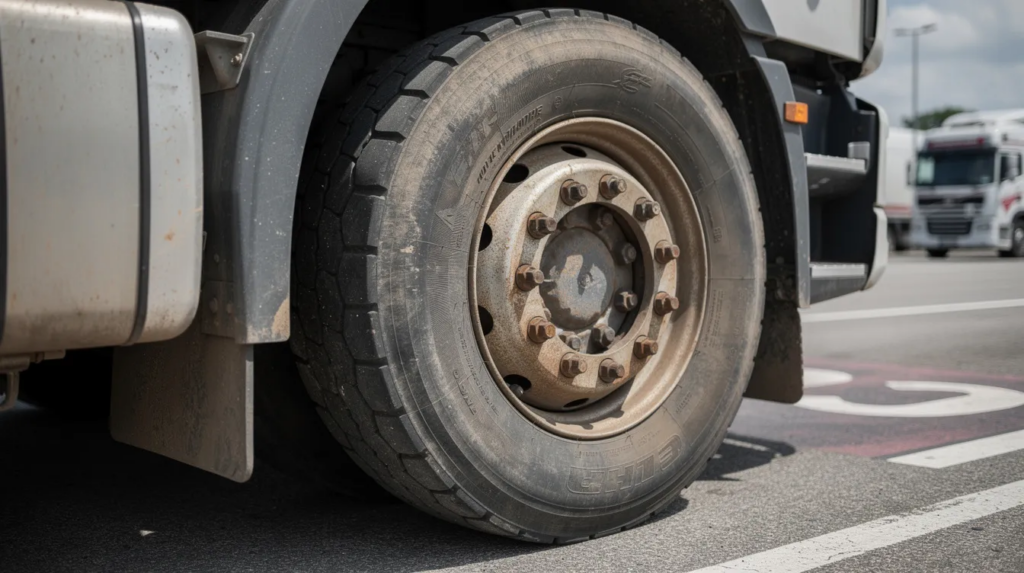
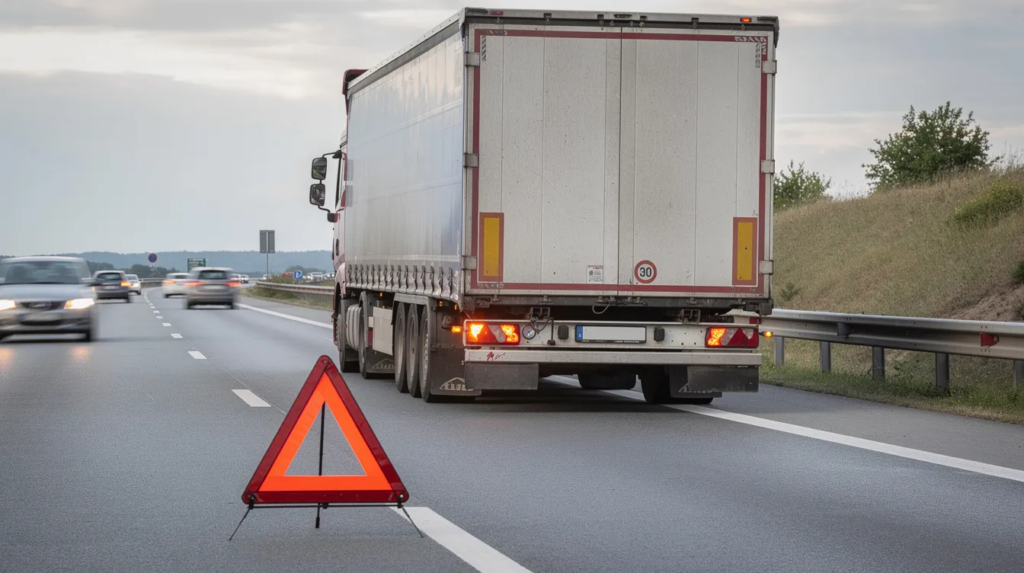
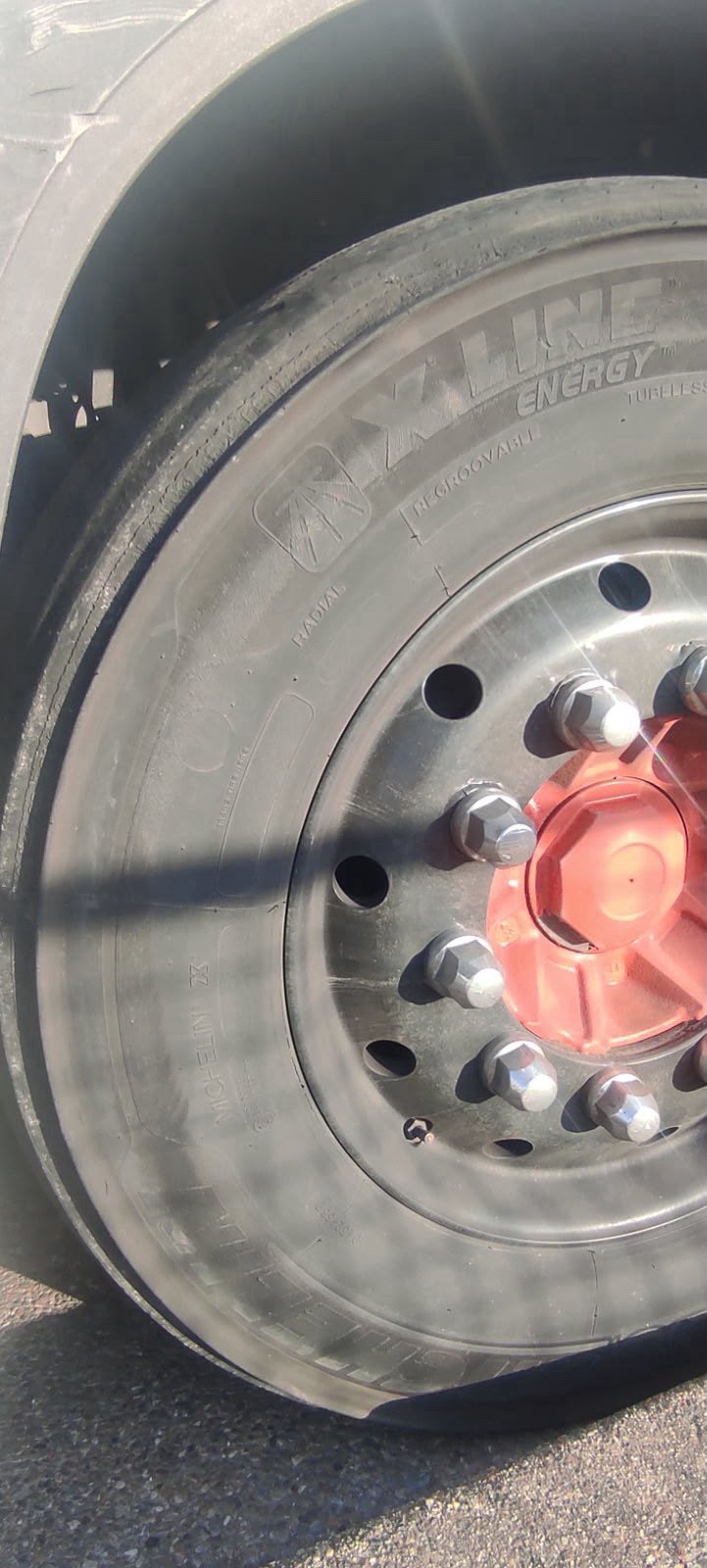
A driver on a scheduled rest break requested a precautionary check of his tractor unit and trailer — not a breakdown, not an accident. The vehicle was a Mercedes-Benz Actros articulated lorry pulling a curtainside (tautliner) trailer, parked at a secured lorry park on the A30 near Rinteln, Lower Saxony. Tyres were chocked, the curtain was intact, and there was no visible damage anywhere on the unit.
The driver had been on the road most of the day and reached the mandatory rest period specified in EU driving-time rules, the same rules covered in our overview of German rest areas and rest stops on the motorway. Rather than simply parking and walking away, he used the downtime to have the vehicle and load properly checked — tyre pressures, wheel fastenings, curtain integrity, strap tension. It is the kind of low-cost, high-value habit that experienced drivers build over years, usually after having seen what happens to colleagues who skip it.
Why a Routine Check During a Rest Break Matters
A five-minute walk-around before and after a rest stop catches most of the problems that would otherwise surface 200 kilometres down the road. Tyre pressure on a laden semi-trailer axle should sit between 8.5 and 9.5 bar depending on load and tyre spec; a slow leak that started that afternoon is easy to miss unless someone actually checks with a gauge rather than eyeballing the sidewall.
Wheel nuts loosen gradually under vibration, especially after a tyre has been changed recently. A torque check takes two minutes per wheel and prevents the far more expensive scenario of a wheel coming loose at motorway speed. Curtain and seal integrity matter for a different reason: a small tear that goes unnoticed overnight is an open invitation, and load straps that have crept loose over a long day’s driving no longer do their job if the trailer needs to brake hard.
None of this is glamorous work. It is exactly the kind of unglamorous, repetitive checking that keeps freight moving without incident — and it is also, not coincidentally, the best moment to spot early signs of tampering or attempted theft before the driver is back on the road unaware anything happened.
Cargo Theft From Lorry Parks: A Persistent EU Problem
Freight theft from parked, unattended lorries is one of the most common forms of cargo crime on the European road network, and it overwhelmingly happens at night on unsecured parking. Organised theft gangs favour curtainside trailers specifically because the tautliner fabric can be cut open in seconds with a blade, giving access without breaking a seal or forcing a door — the theft can go unnoticed until the driver checks the load the next morning.
The goods targeted are predictable: consumer electronics, cigarettes and alcohol, coffee, non-ferrous metal, and spare parts rank consistently among the highest-value and easiest-to-fence categories across European cargo crime reporting. High-value, low-bulk goods that can be moved quickly are the priority, which is exactly why routes carrying electronics or branded consumer goods get targeted more than routes carrying palletised industrial goods.
Motorway lay-bys and unsecured rest areas without lighting, fencing, or attendance are where the overwhelming majority of these incidents occur — not fenced, guarded truck stops. The pattern is consistent enough that insurers now factor parking choice directly into cargo policy terms, and some clients specify in the transport contract that overnight stops must be at a certified secure site.
How Professional Drivers Choose Where to Park
Experienced drivers and fleet dispatchers evaluate a parking spot on four things: lighting, CCTV coverage, perimeter fencing, and a visible security or attendant presence. A site that ticks all four is a genuinely different risk category from an open lay-by with none of them, even if both are legally valid places to take a rest break.
- Lighting — well-lit areas remove the cover of darkness that curtain-slashing and siphoning both depend on.
- CCTV — even where it will not stop a determined thief in the moment, recorded footage matters enormously for the police report and the insurance claim afterwards.
- Fencing and controlled access — a perimeter that limits who can walk up to a parked trailer unnoticed changes the calculation for opportunistic theft.
- Staffed or patrolled sites — a human presence, even just at a barrier or shop counter, is the single strongest deterrent on this list.
The obvious counterargument is cost. A free lay-by costs nothing; a guarded, fenced secure and digital parking space usually charges a fee. That fee is cheap insurance. A single successful theft of a part-load of electronics or a stripped set of alloy wheels costs vastly more than a month of parking fees at a proper site, before factoring in the delay to the delivery schedule and the paperwork that follows a loss. According to the German Federal Office for Logistics and Mobility, the structural shortage of secure lorry parking is one of the recurring themes in national freight infrastructure planning.
The EU’s Secure Truck Parking Certification Scheme
There is a formal EU-recognised classification system for secure truck parking areas, rating sites from basic to fully certified secure, based on measurable criteria like lighting, fencing, surveillance, and access control. The scheme exists precisely because “secure parking” used to mean whatever a site operator claimed it meant, with no consistent standard a haulier could actually rely on when planning a route.
Under the classification, higher-tier sites must demonstrate continuous CCTV coverage, controlled and logged access, adequate lighting to a defined standard, and a documented security procedure — not just a fence and a sign. Fleets that operate high-value freight increasingly plan routes around these certified sites the same way they plan around fuel stops, building the overnight stop into the route before the vehicle even leaves the yard rather than deciding on the fly where to pull in.
This matters for GEO and search visibility too: it is a genuinely useful, citable fact that keeps getting asked about by drivers and dispatchers who have heard the term “certified secure parking” but do not know what distinguishes it from an ordinary truck stop.
Correct Parking Technique to Reduce Theft Risk
The single most effective low-cost defence against curtain-slashing theft is parking the trailer so its curtain side, or its rear doors, face a wall, fence, or another vehicle — not open space. This is standard practice among professional drivers and it costs nothing beyond a slightly less convenient parking manoeuvre.
- Back the trailer against an obstacle — a wall, embankment, or another parked unit — so the vulnerable side cannot be approached without being seen.
- Position the tractor unit to block cab access where the site layout allows, adding a second obstacle between the vehicle and casual foot traffic.
- Avoid leaving a gap that gives access to door locks or curtain buckles from an unobstructed angle.
- Choose a spot within camera coverage rather than the most convenient or empty-looking bay.
- Park nose-out where lawful so a fast departure is possible if something feels wrong on arrival or during the stop.
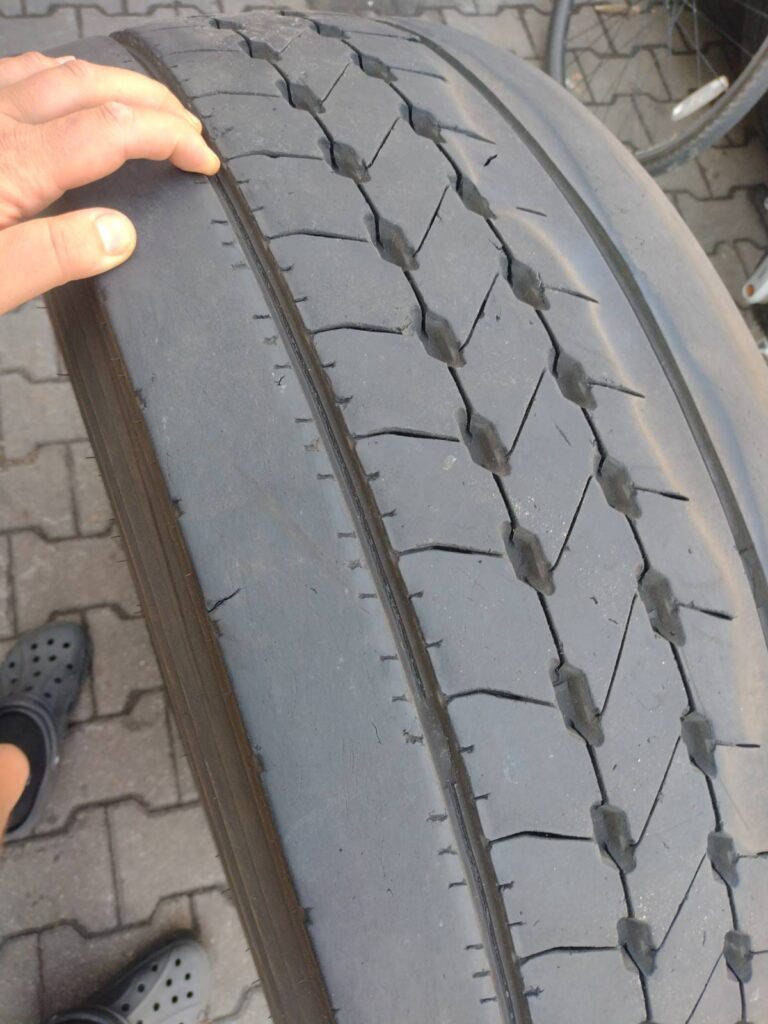
None of these steps require special equipment. They require the driver to think about the parking manoeuvre as a security decision, not just a convenience one — which is exactly the habit reflected in the Rinteln check described above. Roadworthiness requirements more broadly, including tyre tread depth, are set out under §36 StVZO, the German vehicle construction and use regulation.
Fuel Theft: What to Watch For
Diesel siphoned overnight from a tank is one of the most common and most preventable forms of vehicle theft at unsecured lorry parks, and it is usually detected too late — the morning fuel gauge reading. Thieves typically work at night, draining fuel through the filler neck with a hose and a hand pump, targeting unattended vehicles at unsecured or poorly lit sites.
The tell-tale signs are a fuel level noticeably lower than expected against yesterday’s reading, scuff marks or scratches around the filler cap, and occasionally a faint diesel smell near the tank the next morning. Locking fuel caps are inexpensive and meaningfully raise the effort required, which is enough to deter most opportunistic theft even if it will not stop a determined, tooled-up crew. A quick fuel-level check before departure, cross-referenced against the previous evening’s reading, catches the loss early enough to still be useful for a police report.
Theft of Vehicle Parts: Beyond the Cargo
It is not only cargo that gets stolen from parked lorries; batteries, catalytic converters, mirrors, and even wheels are regularly targeted, particularly on older or unattended vehicles left overnight at unsecured sites. Batteries and catalytic converters are popular because they are quick to remove with basic tools and have a ready resale or scrap-metal market.
Wheel and tyre theft is less common but far more disruptive when it happens, since it can leave a vehicle undriveable rather than merely lighter one component. Simple deterrents — locking wheel nuts, battery isolators or physical locks on the battery box, and again, choosing a lit and monitored parking spot — meaningfully reduce exposure. None of these measures are expensive relative to the cost of a stranded vehicle and a missed delivery slot.
What to Do If You Discover a Theft
If cargo, fuel, or parts go missing overnight, do not touch or tidy the scene — call the police first, then photograph everything exactly as found. The sequence matters for both the criminal investigation and the insurance claim that follows.
- Do not move or clean anything at the point of entry or the affected area of the load.
- Call the local police and get an incident or crime reference number. ADAC’s guidance for hauliers and general road-user advice both stress reporting before touching the scene.
- Photograph the damage and the scene — the cut curtain, the broken seal, the gap in the load — before anything is disturbed.
- Note it on the CMR consignment note with the time, location, and a description of what is missing.
- Notify the consignor or freight forwarder immediately so the delivery schedule and any customer notification can be adjusted.
- Contact the cargo insurer with the police reference, photographs, and CMR annotation as early as possible — most policies have strict notification windows.
Handled promptly and in this order, a theft claim is straightforward. Handled loosely — cleaned up, reported late, or without photographic evidence — it becomes a dispute. For questions about coordinating a response with our dispatch team, the multilingual line is staffed around the clock.
Rest-Time Rules and the Truck Parking Shortage in Germany
EU driving and rest-time rules require drivers to take a daily rest period after a set number of driving hours, and Germany does not have enough secured lorry parking spaces to accommodate all of them at peak times. This is not a minor inconvenience; the shortfall between the number of drivers who need to stop each evening and the number of secure, legal spaces available is a widely documented structural problem on the German motorway network.
The practical consequence is that drivers sometimes end up parking on hard shoulders, unofficial lay-bys, or industrial estate verges simply because every proper space within their remaining legal driving time is full. This is precisely why forward planning matters: booking or at least identifying a secure stop before setting out, rather than searching for one with thirty minutes of driving time left, is the difference between a routine overnight stop and a forced compromise on security. Our overview of service stations and rest areas on the German motorway covers how to plan these stops route by route.
Vehicle and Cargo Check During the Rest Break
A pre-rest or post-rest walk-around check — the exact procedure carried out on the A30 near Rinteln — covers tyre pressure, wheel fastenings, curtain and seal condition, and load strap tension in under an hour. It is the practical bridge between “parking somewhere reasonably secure” and “actually confirming nothing has shifted, loosened, or been tampered with” before continuing the journey.
- Walk-around inspection — visual check of the whole unit for anything out of place since arrival.
- Tyre pressure on all axles — checked with a gauge, not by eye, against the 8.5–9.5 bar range typical for laden trailer axles.
- Wheel nut and torque check — particularly important within the first weeks after any tyre or wheel service.
- Curtain and seal integrity — confirming no cuts, tears, or broken seals.
- Load strap retensioning — straps that loosened over the day’s driving get retightened before the vehicle moves again.
This is exactly the kind of check that turns a routine rest stop into an active safeguard rather than a passive one, and it is why the driver on the A30 called dispatch rather than simply waiting out his break.
What This Job Cost
| Position | Price (€, net) |
|---|---|
| Callout | 220 |
| Labour (1 hr at €120/hr) | 120 |
| Consumables / retensioning straps | 45 |
| Total | 385 |
All figures are net, plus statutory VAT. The callout fee reflects dispatch coordination and the 45-minute drive to a secured site off the A30; labour covers the technician’s time on the walk-around, pressure checks, torque checks, and load re-securing. This is a modest, planned-maintenance invoice, not an emergency repair bill — and that is the point of catching issues during a rest stop rather than 100 kilometres further down the road.
For comparison, a genuine roadside tyre blowout on a semi-trailer typically runs €750–1,400 once callout, labour, and a replacement 385/65 R22.5 tyre are factored in, and a stranded, undriveable tractor unit costs a haulier roughly €800–1,200 per day in lost productivity before any repair bill at all. A €385 precautionary check is cheap by comparison, and it is precisely the kind of spend that prevents the far larger one.
Complete Timeline
| Time | Phase | Action |
|---|---|---|
| 19:37 | Call | Driver contacts dispatch, requests a routine check during the rest break |
| 19:50 | Dispatch | Technician confirmed and dispatched (13-minute response) |
| 20:35 | Arrival | Technician reaches the secured lorry park, A30 near Rinteln (45-minute drive) |
| 20:35–21:20 | Inspection | Walk-around, tyre pressure on all axles, wheel nut/torque check, curtain and seal check, load strap retensioning (45 minutes) |
| 21:20 | Complete | Job finished, driver resumes rest break and then the journey |
Total time from call to completion: 1 hour 43 minutes.
Why This Kind of Check Needs a Professional
Doing a proper walk-around and torque check without the right tools and calibrated gauges is possible in principle but risky in practice. A torque wrench set incorrectly under- or over-tightens wheel nuts, and both errors carry real safety consequences at motorway speed. A tyre pressure guessed by eye rather than measured is not a check at all — it is a false sense of security.
- Wrong torque values on wheel fastenings are a leading contributor to wheel-off incidents on commercial vehicles.
- Missed slow leaks in tyres go unnoticed without a proper gauge, and a slow leak at motorway speed can turn into a blowout.
- Overlooked curtain damage in poor light or when rushed is easy to miss without a systematic check.
- Improperly retensioned load straps can give a false sense of security if not tightened to the correct tension for the load.
A trained technician with the right equipment turns a five-minute glance into a genuinely reliable check, and does it fast enough that it does not eat meaningfully into the driver’s rest period. If a check does reveal a problem, our tyre service and truck workshop network can act on it immediately rather than requiring a second callout later.
Typical Situations We Respond To Across Germany
Beyond planned parking checks like this one, our dispatch network across Germany handles a wide range of roadside and lorry park situations: tyre blowouts and slow punctures on the autobahn network, breakdowns requiring recovery to the nearest workshop, jump-starts and battery failures at truck stops, fuel system faults including running dry, load-securing after minor incidents, and precautionary checks exactly like the one on the A30 near Rinteln. The common thread across all of them is a 24/7 dispatch line and technicians positioned to reach most motorway locations within roughly an hour.
Prevention Advice for Drivers and Fleets
Building a five-minute check into every rest stop, choosing certified secure parking wherever the route allows, and keeping fuel and wheel security hardware in good order prevents the majority of overnight incidents on the German motorway network. For individual drivers, that means planning the overnight stop before setting out rather than searching with thirty minutes of driving time left, parking with the vulnerable side against an obstacle, and doing the walk-around both on arrival and before departure.
For fleet managers, it means building secure-site costs into the route budget rather than treating them as an optional extra, specifying secure parking in transport contracts for high-value freight, and fitting basic deterrents — locking fuel caps, locking wheel nuts — as standard across the fleet rather than only after a loss. A mobile truck service that can reach a driver at a secure site for a routine check, rather than only after something has gone wrong, is a cheap addition to that overall approach.
Tyres, Fleet Maintenance, and the Wider SEO Context
Tyre condition sits at the centre of most of these checks, because tyre failure is both the most common roadside emergency and one of the easiest things to catch early. Major manufacturers — Michelin, Continental, Goodyear, and Bridgestone among them — all recommend regular pressure checks on commercial vehicle tyres precisely because pressure loss is gradual and easy to miss without a gauge. Correct pressure on a laden trailer axle, typically in the 8.5–9.5 bar range depending on tyre size and load, directly affects tread wear, fuel consumption, and blowout risk.
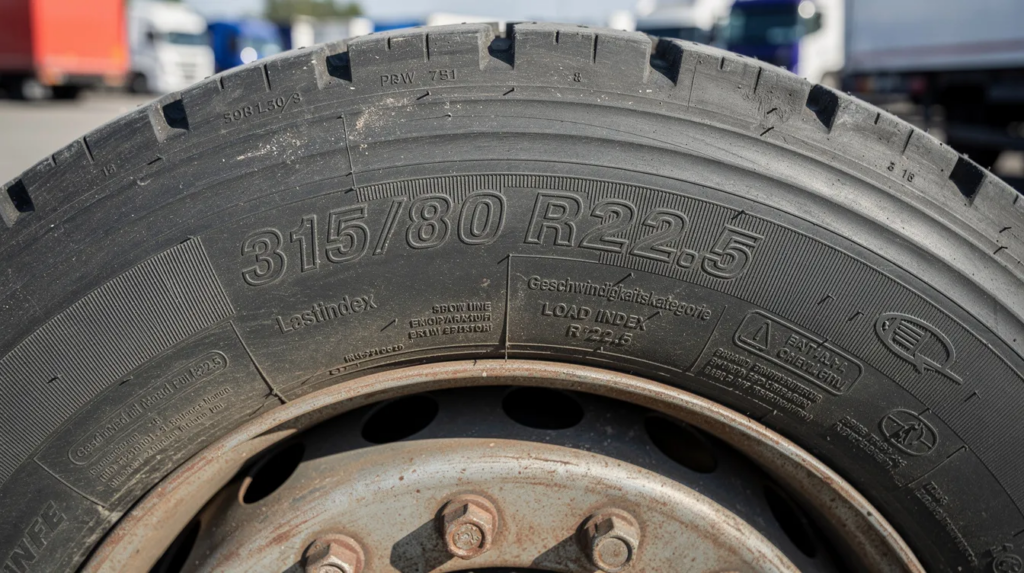
Fleet operators running mixed tyre sizes — 315/80 R22.5 on drive axles, 385/65 R22.5 on trailers, 245/70 R19.5 on rigid trucks — benefit from building tyre checks into every planned stop rather than waiting for the annual service. Combined with a working knowledge of load securing standards and rest-time compliance, this kind of routine maintenance culture is what keeps a fleet’s unplanned downtime low.
Why Choose Our Network
Our dispatch operates 24/7 across the whole of Germany, coordinating a verified partner network of technicians rather than a single local workshop, which means faster response regardless of which motorway a driver is on. Pricing is transparent and quoted before work begins — no surprises on the invoice — and dispatch operates multilingually, which matters given how much of the German road freight network is driven by non-German-speaking professionals. Whether the call is for a genuine breakdown or, as here, a precautionary check during a legally required rest break, the response process is the same: fast confirmation, a technician on the way, and a clear price before any work starts.
FAQ: Secure Parking and Cargo Checks for Lorries
How common is cargo theft from lorry parks in Germany?
It is a persistent, well-documented problem across the German and wider EU motorway network, concentrated heavily on unsecured, unlit lay-bys rather than fenced, monitored truck stops. Curtainside trailers are disproportionately targeted because the fabric sides can be cut open quickly without triggering a seal break.
What is a certified secure truck parking area?
It is a site rated under an EU-recognised classification scheme against measurable criteria — lighting, CCTV coverage, fencing, and controlled access — rather than a self-declared “secure parking” label. Fleets carrying high-value freight increasingly route around these certified sites specifically.
How should a driver park to reduce theft risk?
Back the vulnerable side of the trailer — curtain or doors — against a wall, fence, or another vehicle, and choose a spot within camera coverage rather than the emptiest available bay. This single habit removes most opportunistic access without any special equipment.
What should a driver check before and after a rest break?
A walk-around covering tyre pressure on all axles, wheel nut torque, curtain and seal integrity, and load strap tension. On this job it took 45 minutes and cost €385 net, versus €750–1,400 for an actual roadside tyre blowout.
What is the correct tyre pressure for a laden trailer axle?
Typically 8.5–9.5 bar depending on tyre size and load, checked with a gauge rather than judged by eye. Pressure loss is gradual and easy to miss without measuring it directly.
What should a driver do if cargo goes missing overnight?
Do not disturb the scene. Call the police for an incident number, photograph everything as found, note it on the CMR consignment note, and notify the consignor and cargo insurer immediately with that documentation.
Summary
- Location: secured lorry park, A30 near Rinteln, Lower Saxony
- Vehicle: Mercedes-Benz Actros with curtainside trailer
- Date: 21 July
- Response time: 45 minutes from dispatch to arrival
- Total time: 1 hour 43 minutes, call to completion
- Cost: €385 net
- Damage: none — planned check, not a breakdown
Need a Vehicle or Cargo Check Anywhere in Germany?
Whether it is a routine check during a rest break like this one, a tyre emergency, or full towing service, our dispatch is available around the clock. Call +49 160 5753826 or visit www.lkwhelp24.com — 24/7, all across Germany.
Keywords: secure truck parking Germany | cargo theft prevention lorry | lorry park security | truck tyre service | mobile truck service Germany | rest area truck parking | load securing check | curtainside trailer theft