Skip to content
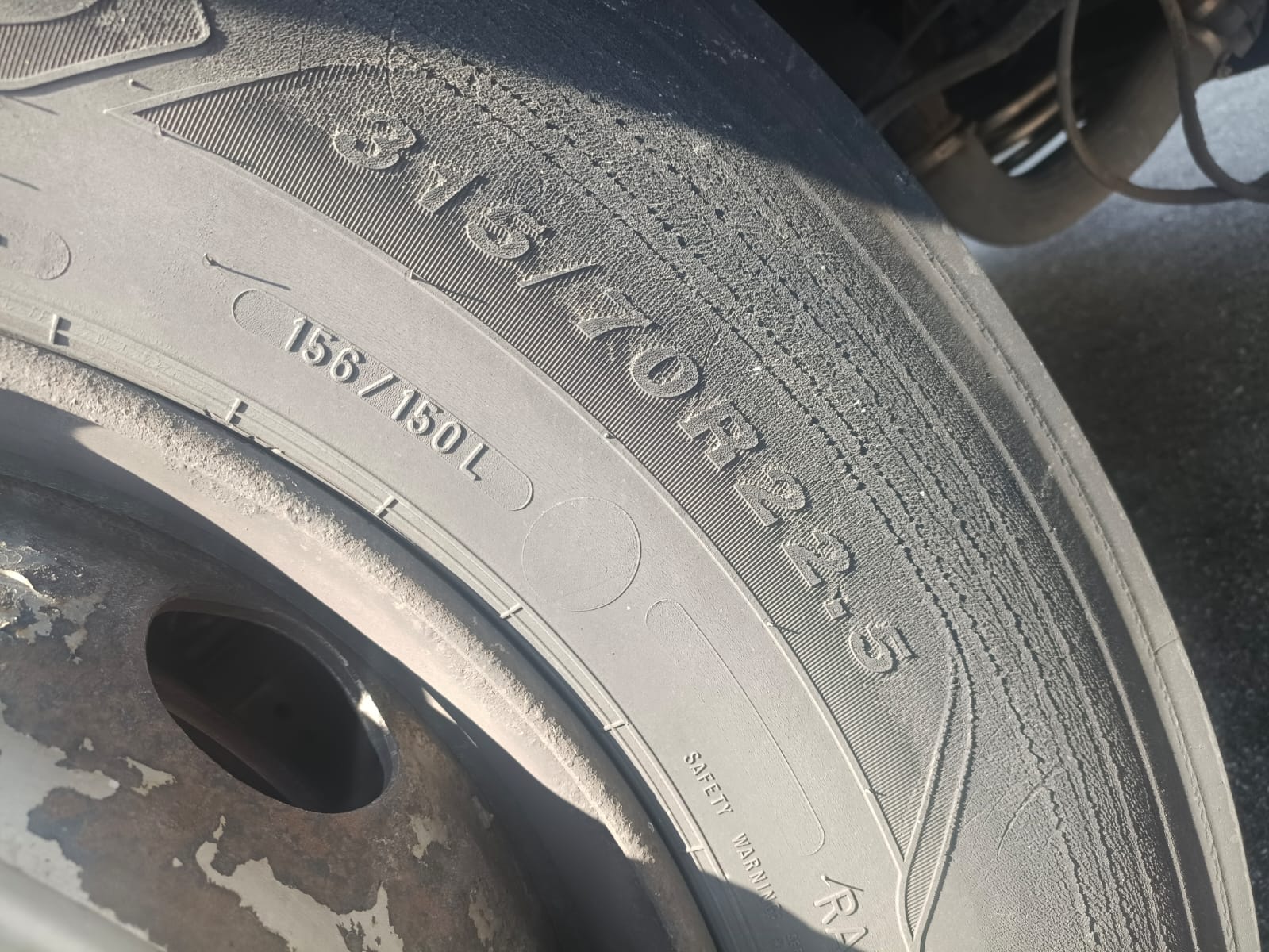
TL;DR: The sidewall of every lorry tyre carries a size code (e.g. 315/80 R22.5), a Load Index (e.g. 156/150), a speed symbol, a DOT date code, an M+S or 3PMSF snowflake mark, and EU tyre label ratings. Read these numbers to a dispatcher over the phone and the correct tyre can usually be reserved within minutes — no guesswork, no wrong parts.
Why the Sidewall Matters More Than It Looks
A heavy goods vehicle tyre carries more technical data than most dashboard displays. Size, load capacity, speed rating, manufacturing date, axle designation and EU label values are all stamped into a few centimetres of rubber. A driver or fleet manager who cannot decode these marks risks ordering the wrong tyre or missing an ageing risk that isn’t visible in the tread.
This matters most during a breakdown on the motorway, where every minute of standing time counts. A driver who reads the size and Load Index straight off the sidewall lets the dispatcher reserve the correct tyre before the service vehicle even leaves the depot. This guide breaks down every mark on the sidewall, one self-contained section at a time.
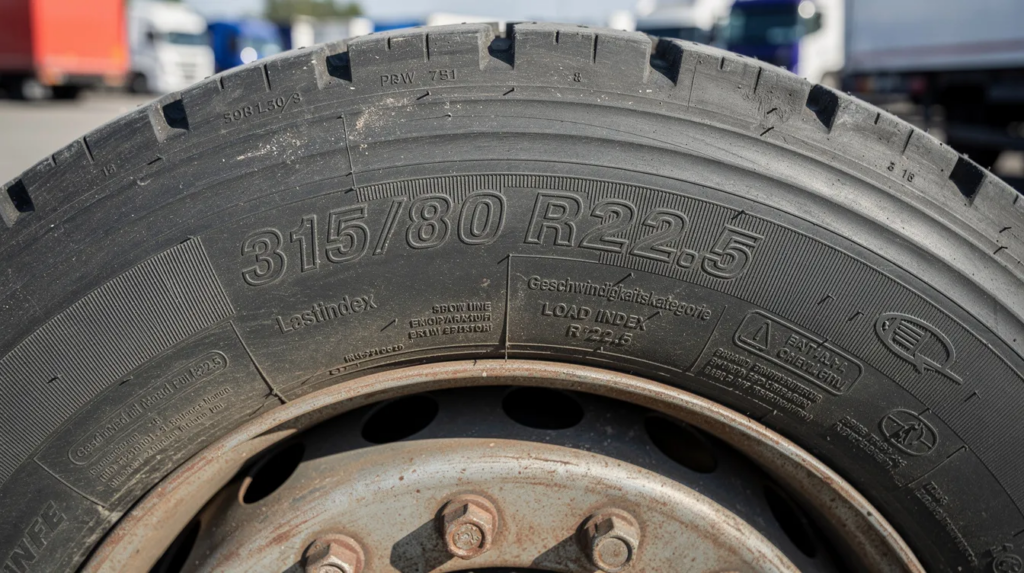
What Does 315/80 R22.5 Mean? The Basic Size Explained
315/80 R22.5 breaks into four parts: 315 is the tyre width in millimetres, 80 is the aspect ratio (sidewall height as a percentage of width), R means radial construction, and 22.5 is the rim diameter in inches.
Sidewall height is calculated from that ratio: 80% of 315 mm equals 252 mm. The R before the rim size confirms the carcass cords run radially, across the direction of travel, rather than diagonally — diagonal-ply construction has effectively disappeared from long-haul trucking.
The decimal in the rim size (22.5 rather than a round number) is a legacy of commercial vehicle standardisation: truck rims were historically set in half-inch steps (16, 17.5, 19.5, 22.5, 24) to allow finer gradations in load capacity and brake disc clearance than the passenger-car inch series permits. Typical long-haul sizes are 315/80 R22.5 on the drive axle, 385/65 R22.5 on trailer axles, and 245/70 R19.5 on lighter distribution trucks.
Load Index: How to Read 156/150
156/150 works as a pair: 156 is the Load Index for single-fitment use, 150 for dual (twin) fitment — each number maps to a fixed load capacity in kilograms under the ETRTO standard.
Load Index 156 equals 3,750 kg per tyre when fitted singly. Load Index 150 equals 3,075 kg per tyre when fitted as a dual pair. The second figure is always lower because two tyres mounted side by side share the axle load, and manufacturers build in a safety margin for uneven weight distribution between the pair. If only one number appears, the tyre is rated for single fitment only — typical of steer axles.
A quick reference table for common values:
| Load Index | kg (single) | kg (dual) |
|---|---|---|
| 146 | 3,000 | 2,725 |
| 152 | 3,550 | 2,900 |
| 154 | 3,650 | 3,000 |
| 156 | 3,750 | 3,075 |
| 160 | 4,000 | 3,250 |
| 164 | 4,250 | 3,450 |
Misreading the Load Index, or fitting a lower-rated tyre than required, risks overload at full payload — with consequences for tyre temperature, wear rate and, in the worst case, a blowout.
Speed Symbol: Why L, M or K on a Truck Tyre?
The speed symbol is the letter directly after the Load Index and states the maximum sustained speed at full load capacity. L means 120 km/h, M means 130 km/h, K means 110 km/h.
These ratings look low next to passenger-car letters like V (240 km/h) or W (270 km/h), but truck tyres are engineered for sustained heavy load, not top speed. Germany’s advisory speed limit for lorries over 7.5 t sits at 80 km/h anyway, so an L-rated tyre with a 120 km/h ceiling has plenty of margin built in.
For mixed axle setups, the lowest-rated tyre fitted anywhere on the vehicle governs the whole combination. A single K-rated tyre (110 km/h) among otherwise M-rated fitments limits the entire vehicle to 110 km/h, regardless of the other tyres’ ratings.
DOT Code and Manufacturing Date: Why Age Beats Mileage
The DOT code ends in four digits showing the week and year of manufacture — for example, 2423 means week 24 of 2023. Those four digits are the single most reliable age indicator on a tyre, independent of tread condition.
Rubber ages chemically even without mileage. Plasticisers evaporate, the carcass loses elasticity, and micro-cracks develop in the compound — a process that hits parked trailers, swap bodies and rarely-moved semi-trailers harder than tyres in constant use. A tyre carrying an eight-year-old DOT code can look structurally fine and still be compromised underneath.
Industry rule of thumb: tyres over ten years old should be replaced regardless of tread depth, while low-mileage trailer tyres often warrant a professional inspection from as early as six years. Anyone buying a used semi-trailer or scheduling a tyre change should check the sidewall date, not just the tread gauge.
M+S vs. 3PMSF: What’s the Difference, and What Applies in Germany?
M+S (Mud and Snow) is a manufacturer self-declaration with no standardised test behind it. The 3PMSF snowflake (Three Peak Mountain Snow Flake) is a certified mark proving a minimum braking performance on snow against a reference tyre.
This distinction is not academic. A tyre marked M+S without the snowflake can carry a winter-style tread pattern without any measurable braking advantage over a summer tyre in real snow. Under Germany’s amended road traffic licensing regulation, M+S-only tyres manufactured before 1 January 2018 retained legal use until the end of September 2024; any tyre made after that date requires 3PMSF certification for winter conditions. Driving on plain M+S tyres without the snowflake in snow, ice or black-ice conditions risks a fine under §2 StVO combined with the technical requirements of §36 StVZO. For international haulage fleets, the snowflake has become the de facto standard, since countries such as Austria and Italy no longer accept plain M+S marking in winter.
Axle Marking: Why a Tyre Can’t Go on Just Any Position
Truck tyres frequently carry an axle designation printed on the tread name or sidewall: S for Steer, D for Drive, T for Trailer, and All Position for use across all three.
This is a genuine engineering distinction, not marketing language. Steer axle tyres need a stiff, low-block tread for precise tracking and even wear through corners. Drive axle tyres need deep, aggressive lugs for traction under acceleration and braking loads. Trailer tyres are optimised for low rolling resistance and long tread life, since they aren’t driven and rarely brake under heavy load. Fitting a drive-axle pattern to the steer axle noticeably degrades steering response and extends braking distance; fitting a steer tyre to the drive axle loses traction quickly in wet conditions. All Position tyres are a compromise for fleets with mixed duty cycles but rarely match a specialised tread’s peak performance in its intended role.
EU Tyre Label: Fuel Efficiency, Wet Grip, Noise
The EU tyre label rates three values on an A (best) to E (worst) scale: fuel efficiency (rolling resistance), wet grip (braking distance on wet roads), and external rolling noise in decibels with a class A to C.
An A-rated tyre for fuel efficiency measurably cuts rolling resistance versus an E-rated one, which adds up in diesel savings across tens of thousands of kilometres for a long-haul fleet. Wet grip ratings aren’t mandatory on trailer tyres under the regulation but are required on steer and drive axle tyres, since they directly affect stopping distance. The official rating methodology and current thresholds sit in the EU tyre label framework, available via the European Union’s official tyre label database. Fleet managers checking the label before a bulk purchase matter: a two-class efficiency gap across a hundred-vehicle fleet translates into noticeable fuel costs over a year.
Retreading, ECE Approval Marking and TWI Wear Indicators
Retreading describes the process of applying a new tread to a structurally sound carcass, identifiable by an additional “Retreaded” stamp or certification number on the sidewall. On trailer axles, retreading is standard practice in long-haul operations because the carcass sees less structural stress than on drive axles.
ECE marking (the letter E in a circle, followed by a country code and approval number) confirms the tyre has passed type approval under UN-ECE Regulation 54 for commercial vehicle tyres and is legal for road use across Europe. A tyre without this mark cannot legally be driven on public roads in the EU.
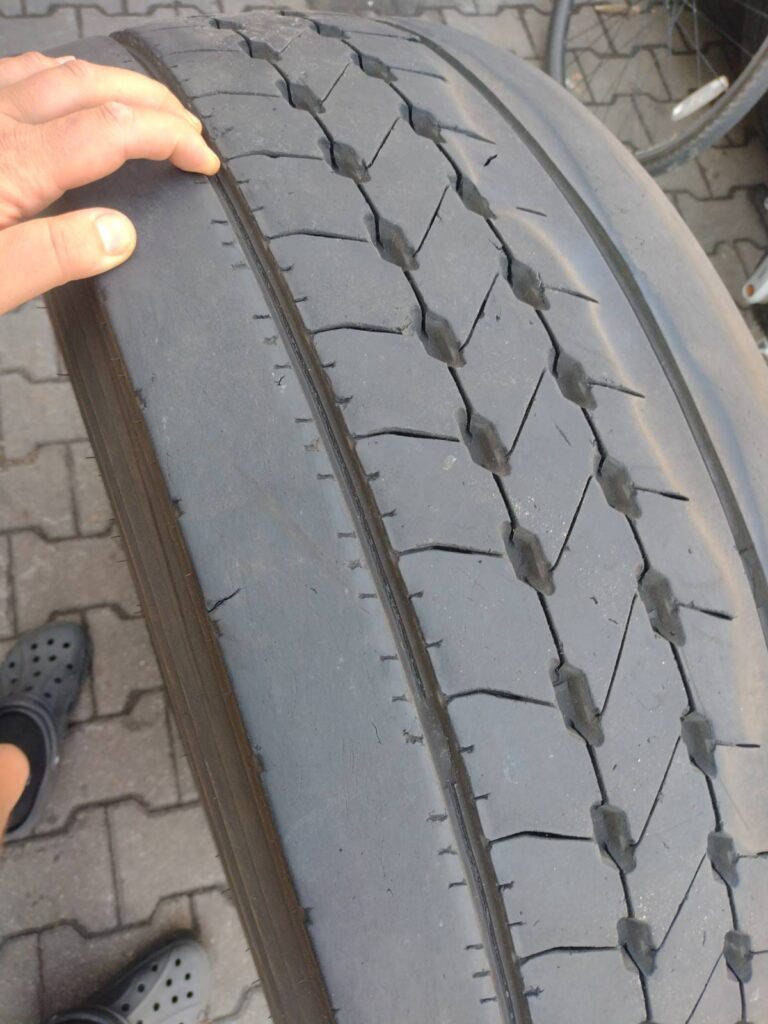
The TWI (Tread Wear Indicator) is a small triangle symbol on the sidewall edge pointing to bars moulded into the tread grooves. On truck tyres, these bars sit at 1.6 millimetres of remaining depth, Germany’s legal minimum under §36 StVZO. Once the tread wears down to the level of these bars, the tyre must be replaced. In practice, most manufacturers and organisations such as ADAC recommend replacement at around 3 to 4 millimetres of remaining depth for adequate wet grip, well before hitting the legal limit.
C, CP and Special Markings for Light Commercial and Camper Tyres
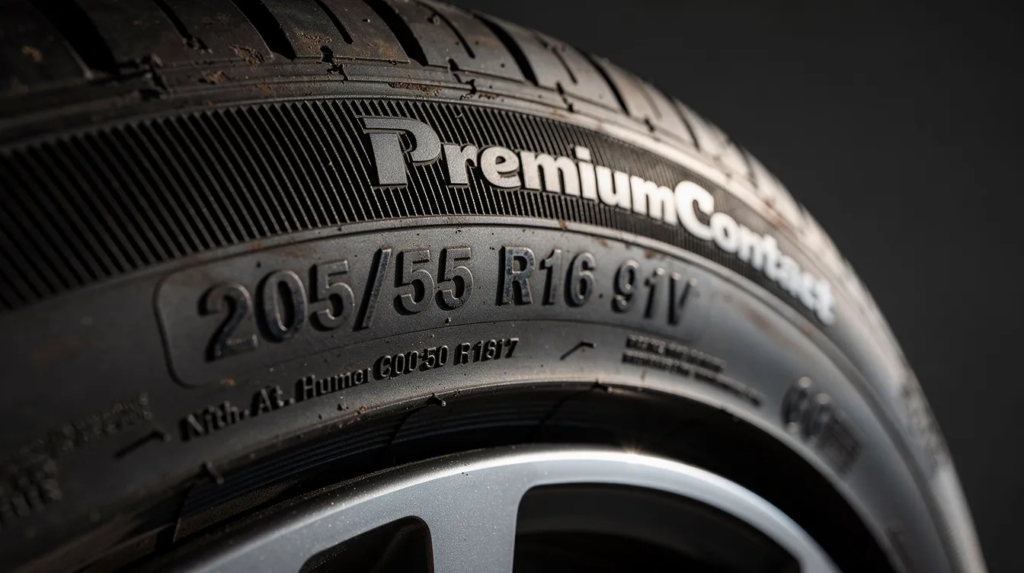
C appended to a size (for example 235/65 R16C) marks a reinforced tyre designed for light commercial vehicles such as vans, with higher load capacity than an equivalent non-C passenger tyre of the same size. CP designates camper tyres, engineered specifically for motorhomes, prioritising high static load capacity through long standing periods and low rolling resistance over cornering dynamics.
The difference is structural, not cosmetic. A C-rated tyre has a reinforced carcass and higher Load Index than the standard version of the same size, because commercial vans in daily use regularly run close to their maximum payload. Fitting a standard passenger tyre without C marking to a fully loaded van quickly exceeds the tyre’s rated capacity without any visible warning sign.
Why Reading the Sidewall Speeds Up a Roadside Tyre Change
A driver who reads out size, Load Index and speed symbol during a breakdown call — for example, “315/80 R22.5, 156/150 L” — lets dispatch reserve the correct tyre from the partner network before the service vehicle even reaches the motorway. Without that information, the technician has to measure on-site and then request stock, which can add 20 to 40 minutes to the standing time.
Axle position (steer, drive or trailer), vehicle type (tractor unit, semi-trailer, van) and whether the fitment is single or dual round out the information needed. These few details are usually enough to rule out a wrong-part order entirely.
Common HGV Sizes: Indicative Pricing
The table below shows typical net price ranges for standard sizes including fitting, excluding call-out and old tyre disposal (figures in EUR, net):
| Size | Typical Use | Price Range (EUR, net) |
|---|---|---|
| 315/80 R22.5 | Drive axle, articulated lorry | 480–620 |
| 385/65 R22.5 | Trailer axle | 420–540 |
| 385/55 R22.5 | Trailer axle (low-profile) | 450–580 |
| 245/70 R19.5 | Distribution truck, lighter artic | 320–420 |
| 235/65 R16C | Van/Sprinter class | 180–260 |
These ranges vary by brand (premium brands such as Continental, Michelin or Bridgestone sit at the top, budget brands lower), tread type (drive-axle tyres cost noticeably more than all-position patterns), and whether the tyre is new or a quality retread. Workshops typically add EUR 15–25 for proper disposal of the old tyre.
Practical Sequence: How to Read the Sidewall Step by Step
- Size first — the four-part code such as 315/80 R22.5 identifies width, aspect ratio, construction and rim diameter.
- Check the Load Index — single and dual values (e.g. 156/150) set the allowed load per tyre.
- Read the speed symbol — the letter right after the Load Index, usually L, M or K.
- Locate the DOT code — the final four digits give production week and year.
- Check the extras — M+S, 3PMSF snowflake, EU label classes, axle designation and TWI position.
In practice, these five steps take under two minutes and cover everything needed for a fast, correct tyre replacement.
FAQ: Common Questions About Truck Tyre Markings
What does the 22.5 mean on a truck tyre?
It’s the rim diameter in inches. Unlike passenger tyres, truck tyres commonly use a decimal (16, 17.5, 19.5, 22.5, 24) because commercial vehicle standardisation uses half-inch steps for finer load capacity gradations.
How do I tell how old a truck tyre is?
Check the DOT code on the sidewall: the last four digits show the calendar week and year of manufacture, e.g. 2423 for week 24 of 2023. Age matters more than mileage for trailers that sit parked for long periods, since rubber ages chemically regardless of use.
What’s the difference between M+S and the 3PMSF snowflake?
M+S is an uncertified manufacturer claim; the 3PMSF snowflake is a certified mark proving minimum braking performance on snow. Under the amended StVZO, the snowflake is now the governing standard for winter conditions.
Can I fit a drive-axle tyre on the steer axle?
Not recommended. Drive-axle tread patterns are more aggressive, designed for traction, and degrade steering precision and braking distance when fitted to the steer axle. Tyres are engineered for their specific axle position.
What does a 315/80 R22.5 truck tyre cost?
Net prices typically run EUR 480–620 per tyre including standard fitting, depending on brand and tread type. Call-out and old tyre disposal are usually billed separately.
What does Load Index 156/150 mean?
156 applies to single fitment (3,750 kg capacity), 150 to dual fitment (3,075 kg per tyre). The dual figure is lower because two tyres share the axle load with a built-in safety margin.
Summary: Key Markings at a Glance
- Size: 315/80 R22.5 — width, aspect ratio, construction, rim diameter
- Load Index: 156/150 — single/dual load capacity in kg
- Speed symbol: L (120 km/h), M (130 km/h), K (110 km/h)
- DOT code: four digits for production week/year
- M+S vs. 3PMSF: manufacturer claim vs. certified winter test
- Axle marking: S/D/T or All Position
- EU label: efficiency, wet grip, noise, A to E
- TWI: 1.6 mm legal minimum, replacement recommended at 3–4 mm
- Price range: EUR 180–620 depending on size, net
A Note for Fleet Managers
Fleets running mixed vehicle types benefit from a simple internal log: size, Load Index, DOT code and fitment date for every tyre, tracked per vehicle. That makes it possible to check tyre age across the whole fleet at a glance instead of re-reading every sidewall at each inspection. For trailers that sit idle on a yard for weeks before redeployment, this small habit stops an over-aged tyre from quietly re-entering long-haul service unnoticed.
Why LKWHelp24 Always Asks for the Sidewall Details
Our dispatch team operates 24/7 across Germany and specialises in fast tyre solutions. Reading the sidewall details to us during a breakdown call lets us reserve the correct tyre from our truck tyre service partner network before our team even sets off — typically saving 20 to 40 minutes of standing time compared with a call-out that needs on-site measurement first.
Alongside our mobile truck tyre service near Berlin, we also offer towing service and access to our truck workshop network for deeper repairs. Our dispatchers work in multiple languages and know the technical terms in English, German, Polish and Russian — useful when international drivers want to read their tyre markings in their own language.
Conclusion: Reading the Sidewall Saves Time and Money
The markings on a truck tyre aren’t decoration — they’re the complete technical specification in shorthand. Drivers and fleet managers who can confidently read size, Load Index, speed symbol and DOT code make better purchasing decisions, catch ageing risks early, and speed up every phone-in tyre order considerably. During a motorway breakdown, that knowledge pays off directly in minutes saved — and minutes cost real money when a loaded artic is standing still.
Contact for Urgent Tyre Problems
Every minute counts during a tyre failure. Call us on +49 160 5753826 — we’re available 24/7 across Germany and coordinate the right tyre service as soon as you’ve read us the sidewall details. More information at www.lkwhelp24.com.
Keywords: truck tyre markings | HGV tyre sidewall codes | load index truck tyres | 315/80 R22.5 | DOT code tyre | 3PMSF snowflake | EU tyre label | mobile truck tyre service
Related Reading
- Truck Tire Service Near Me – 24/7 Mobile Truck Tire Service in Germany
- Winter Tyres for HGVs in Germany – Legal Requirements, Safety & Service
- Mobile Truck Tire Service in Germany 24/7 – We Arrived and Helped
- Truck Tyre Service for Blowout and Rim Damage on the Motorway near Trier
- Truck Tire Roadside Assistance Across Germany