Skip to content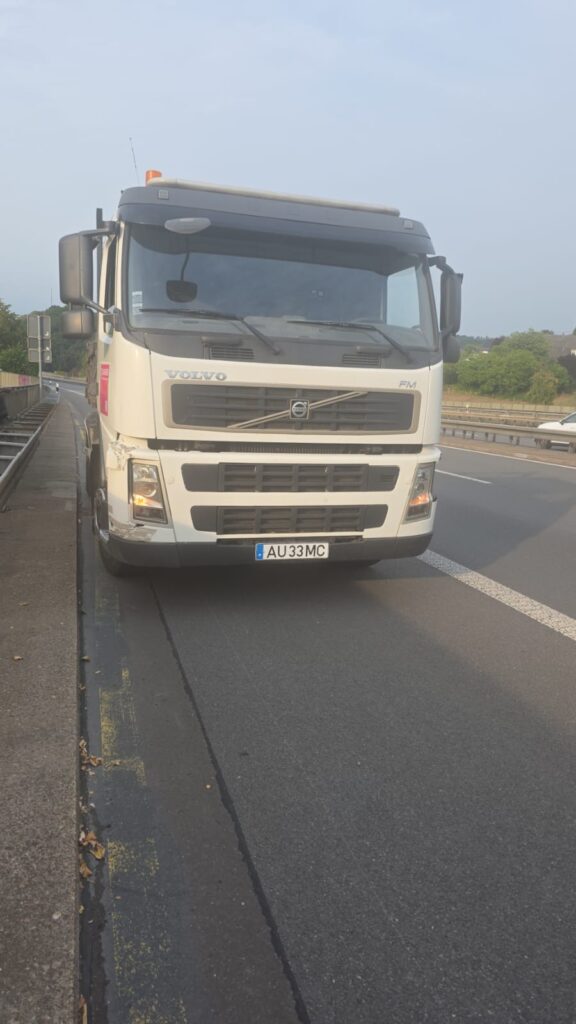
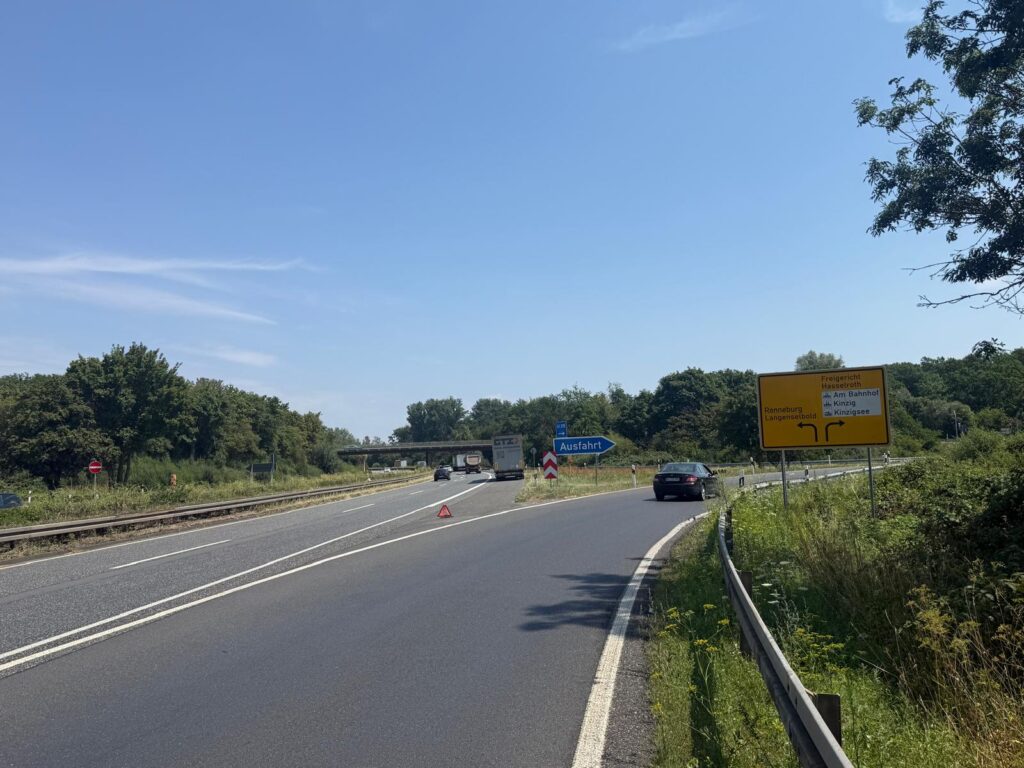
A destroyed wheel on the steer axle is not a job for a tyre van. When the hub itself is damaged or the axle geometry is thrown out, a semi tractor cannot move under its own power, and any attempt to tow it will only make things worse. That is exactly what happened on the A24 near Wittenberge, heading towards Hamburg, on 15 August.
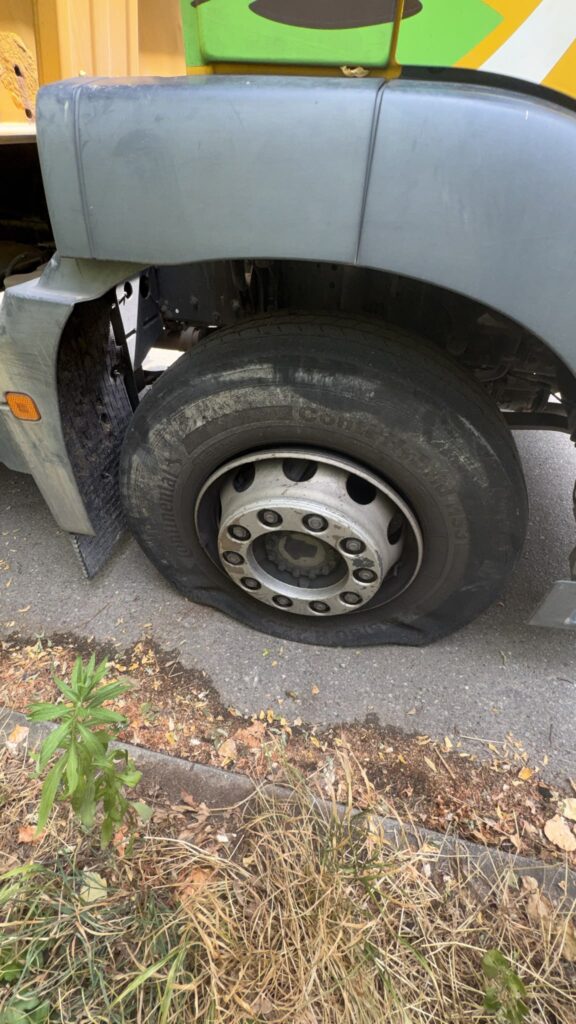
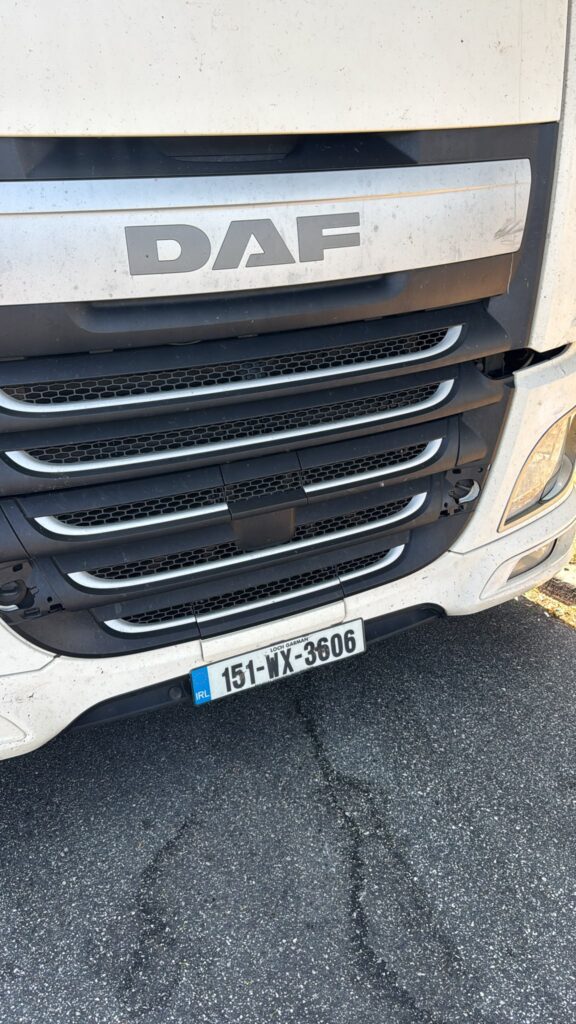
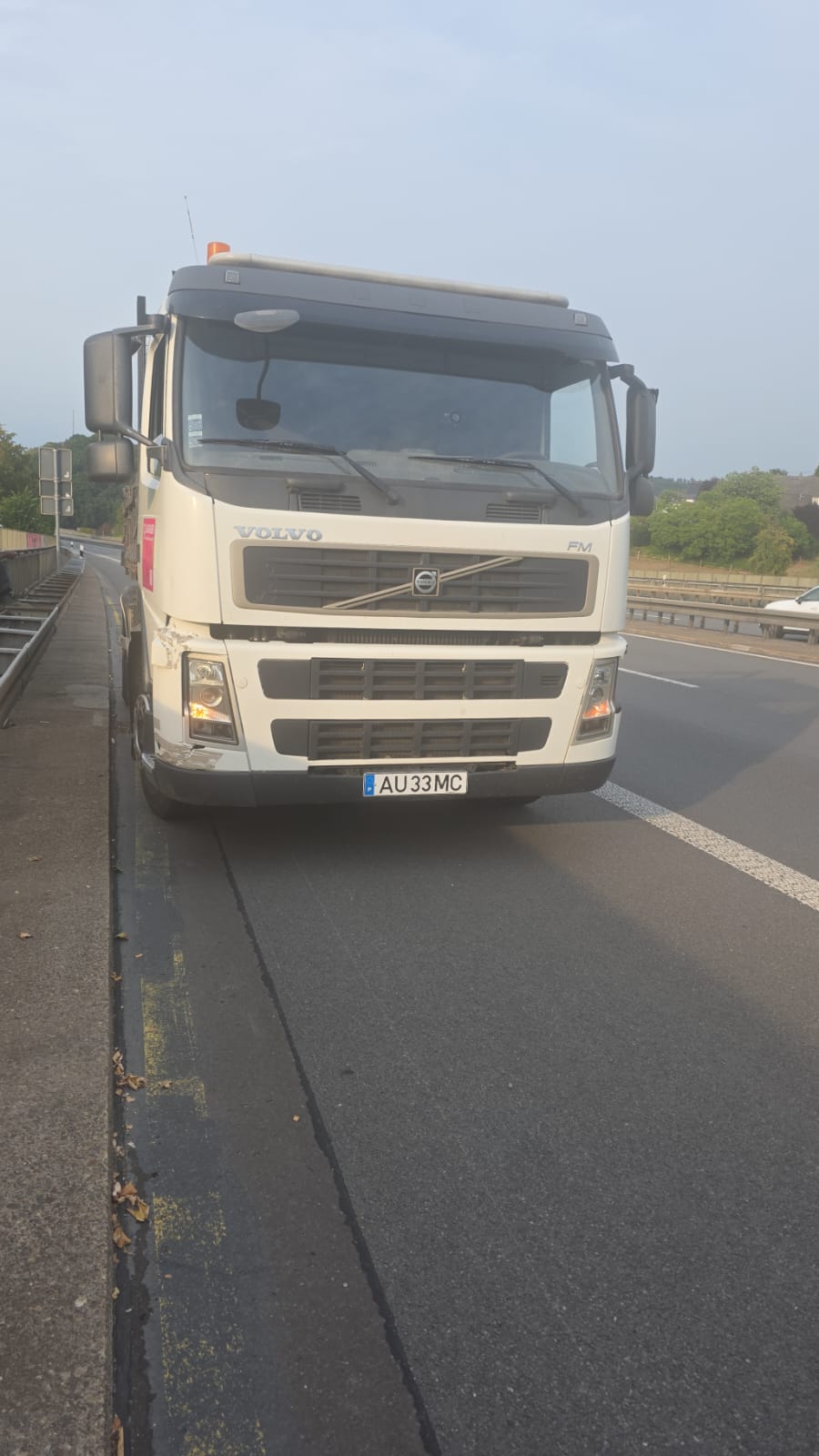
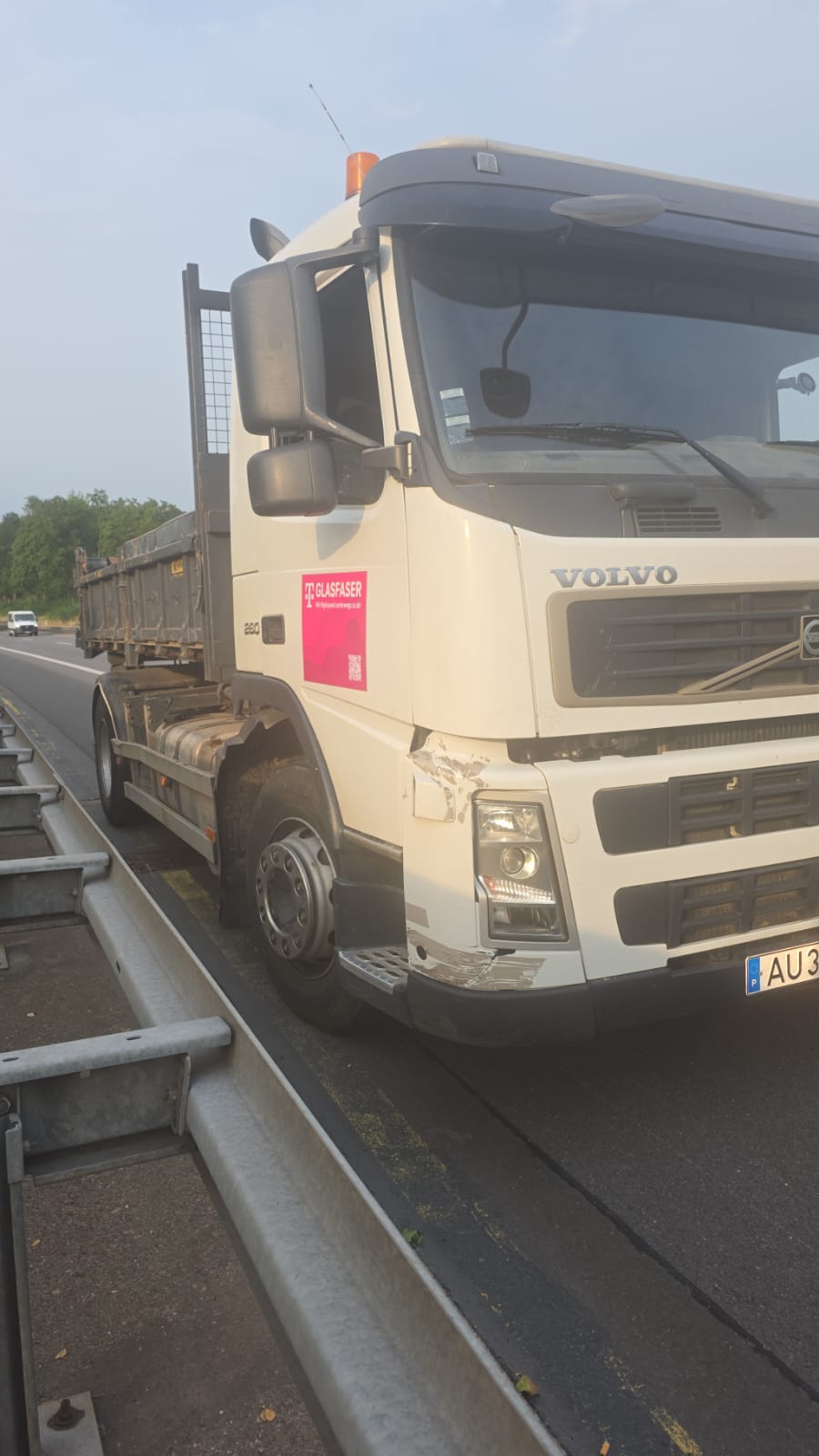
A Volvo FM tractor unit hit an obstacle on the carriageway during daylight hours. The front end was crushed, and the wheel on the steer axle was gone: the rim bent, the tyre torn off the carcass. The driver was unhurt, but the lorry sat sideways on the hard shoulder, undriveable.
There is no shortcut for cases like this. What is needed is recovery on a flatbed or low-loader, not a standard tow. That distinction shapes everything that follows: which vehicle turns up, how long the job takes, and what ends up on the invoice.
The situation on the motorway
The call came in around midday. The driver was calm but the facts were unambiguous: front-end damage, one wheel on the steer axle completely destroyed, the lorry no longer tracking straight. On a Volvo FM pulling a loaded semi-trailer, that is not a minor complaint — the steer axle carries a substantial share of the combination’s total weight, and losing a wheel there changes the whole balance of the rig.
The situation was clear enough over the phone that we already knew a standard breakdown call would not cut it. Our dispatcher worked through the questions that matter for this type of vehicle:
- Is the tractor unit standing stable, or is there a risk it tips?
- Is the semi-trailer still coupled and roadworthy?
- Has the police already been notified?
- Is there cargo damage that needs documenting straight away?
The driver confirmed police were already on the way to secure the carriageway — standard procedure for a broken-down articulated lorry on the motorway, regardless of the specific damage.
Why ordinary towing does not work here
Under standard towing rules (§ 15a StVO in Germany), a vehicle is pulled on a bar or rope while it rolls on its own wheels. That only works if every wheel is intact and free to turn. With a destroyed rim or a damaged hub, that condition is simply not met.
Two options remain in a case like this:
- A wheel dolly under the damaged axle — viable if the hub itself is undamaged and only the tyre or rim is wrecked. The lorry is then towed on a dolly while the other axles roll normally.
- Full loading onto a flatbed or low-loader — necessary if the hub or axle geometry itself is compromised, or if the on-site condition cannot be judged with confidence.
After a quick inspection at the scene, the crew went with the second option for this Volvo FM. The hub showed visible damage, and towing on a dolly would have risked a full axle failure mid-transport. In the trade, this is the “drive or load” call — and it is always made on-site, never over the phone.
The gap between towing (pulling on a bar or rope, vehicle stays on the road) and recovery on a flatbed (vehicle is lifted clear and transported) is more than terminology. It decides which vehicle gets dispatched, how long preparation takes, and what the final bill looks like.
What happens to the semi-trailer
One point people often underestimate in a tractor unit recovery: the trailer is a separate problem. It cannot simply stay hitched to a damaged tractor once that tractor goes onto a low-loader.
The crew decided to uncouple the tractor from the trailer on site. Uncoupling a loaded semi is itself a technical job — the landing legs need to take the full weight cleanly, the air lines and electrical connection have to be disconnected without losing system pressure that will be needed later. The trailer stayed secured on the hard shoulder until a second vehicle from our partner network was arranged for a separate transport.
That extra task is why a recovery involving front-end damage and a destroyed axle wheel takes longer and costs more than a straightforward trailer tyre change. It is effectively two jobs in one: recover the tractor unit, then secure and move the trailer separately.
Recovery process, step by step
Step 1: Initial assessment on the phone. The dispatcher asks about vehicle type, damage pattern, location and traffic conditions. Any sign of axle damage means a recovery vehicle gets dispatched instead of a standard breakdown van.
Step 2: Approach and scene safety. The crew sets up warning triangles and hi-vis, and coordinates with police already on scene. On a motorway, securing the site always comes before any technical work.
Step 3: The “drive or load” check. The technician inspects the hub, the axle and the steering. Only if all three are sound does a wheel dolly come into play. Here, it was ruled out.
Step 4: Uncoupling the trailer. Landing legs down, air and electrical lines disconnected, fifth wheel released. The trailer is secured with its own wheel chocks.
Step 5: Loading the tractor unit. The flatbed is lowered, and the damaged Volvo FM is winched up the ramps. The damaged wheel needs particular care here so the rim does not jam further during loading.
Step 6: Arranging the second vehicle. For the trailer, the dispatcher requests another vehicle from the partner fleet, usually a standard tractor unit that hauls the trailer on normally.
Step 7: Handover at the workshop. Both parts of the combination are coordinated to the nearest suitable heavy-vehicle workshop, with full photo documentation for the insurer.
Full timeline
| Time | Phase | Action |
|---|---|---|
| 0 min | Call | Driver reports front-end damage and a destroyed steer-axle wheel on the A24 |
| 0–15 min | Dispatch | A recovery vehicle, and if needed a second vehicle for the trailer, is requested |
| 15–65 min | Approach | Recovery vehicle reaches the scene near Wittenberge |
| 65–85 min | On-site check | “Drive or load” decision, coordination with police |
| 85–125 min | Uncoupling | Fifth wheel released, trailer secured, landing legs set |
| 125–170 min | Loading | Tractor unit winched onto the flatbed and secured |
| 170–210 min | Transport & handover | Journey to the workshop, handover with documentation |
Total time from call to handover: roughly 3 hours 30 minutes.
That is noticeably longer than a straightforward roadside tyre change, which usually runs 1.5 to 2 hours. For a recovery involving uncoupling, two vehicles and a workshop handover, a 3 to 4 hour window is realistic — longer still in rain or heavy traffic.
Cost breakdown
| Item | Price (EUR) |
|---|---|
| Callout for recovery vehicle | 240 |
| Tractor unit recovery (flatbed/low-loader) | 1350 |
| Uncoupling and preparation | 150 |
| Second vehicle for trailer transport | 380 |
| Total (net, plus VAT) | 2120 |
The recovery itself sits within the 850 to 1600 euro range, depending on distance, the weight of the combination and how accessible the scene is. In this case the tractor unit was reasonably accessible on the hard shoulder, which made loading easier — a lorry down in a ditch or on soft ground would push the price higher.
For comparison, a full standstill day for a broken-down articulated lorry typically costs a haulier between 800 and 1200 euros in lost freight and demurrage. A prompt recovery is as much a financial call as a technical one.
Why this is not a DIY job or a standard tow
A destroyed wheel on the steer axle of a semi tractor rules out improvised fixes. The risks of getting the recovery wrong:
- Further axle damage if the vehicle is towed despite a damaged hub
- Snapped air lines from careless uncoupling, dropping pressure across the whole system
- Tip-over risk during loading without proper ramps and a winch
- Missing documentation, which causes problems with the insurer later
A standard car recovery truck cannot move a 40-tonne combination in the first place. A tractor unit needs recovery vehicles with the right towing capacity and flatbed capability — a different class of equipment from the usual breakdown van.
Typical jobs of this kind across Germany
Axle-damage recoveries are among the more demanding jobs our partner network handles, and the same patterns recur:
- Front-end damage from hitting debris on the motorway — cargo lost from other vehicles, animal carcasses, wreckage
- Axle failures caused by potholes or uneven roadworks transitions
- Articulated lorries tipped or run off the carriageway after evasive manoeuvres
- Electronic faults that lock an axle and make towing impossible
In every one of these, the same rule applies: check the axle first, then decide whether to tow or load.
What stands out is how different the starting conditions can be despite similar symptoms. Axle damage from a pothole often develops gradually — the driver first notices the lorry pulling to one side before the wheel actually seizes. Front-end damage like this Volvo FM case happens instantly, with no warning at all. For dispatch, that means any report of unusual steering behaviour on the front axle is worth a follow-up question: should this vehicle keep moving at all before the damage gets worse?
Prevention for drivers and fleets
Front-end damage on a motorway can rarely be avoided altogether, but the risk can be reduced:
- Regular checks of the steer axle and wheel bearings, particularly on older tractor units
- Adjusting speed in poor visibility or on known hazard stretches
- Reporting unusual noise from the front axle immediately, before it becomes a full failure
- Briefing drivers in advance on what to report if axle damage occurs, so dispatch gets fast, precise information
A fleet that prepares its drivers for scenarios like this, and that can call on a mobile service partner when things go wrong, saves valuable minutes on every incident — and on a motorway closure, minutes are money.
It also helps to give every driver a short checklist for exactly this situation: hazard lights on, warning triangle placed at a safe distance, hi-vis vest on before leaving the cab, only then the emergency call. That order sounds obvious, but under stress it gets scrambled surprisingly often, with real consequences for personal safety on a busy motorway like the A24.
Communication with the haulier’s own office counts as prevention too, in a broader sense. If dispatch at the haulage company is informed immediately, they can get moving in parallel with the recovery itself: lining up a replacement vehicle, notifying the customer about the delay, preparing freight paperwork for onward transport. That shortens the time from incident to the load moving again in a way that matters commercially.
Documentation for the insurer
For damage on this scale, a phone call to the insurer is not enough. Our technicians photograph the scene from several angles before any tool is picked up — the damaged wheel, the front end, the vehicle’s position on the hard shoulder. Only after that does the actual work begin.
Additional records kept on every job like this:
- Time of the call and time of arrival on scene
- Name and service number of the attending police officer, where present
- Exact motorway marker for the incident location on the A24
- Condition of the trailer at handover, including any cargo damage
- Driver’s signature confirming the measures carried out
This paperwork goes digitally to the haulier and, on request, straight to the insurer. In our experience, complete photo documentation speeds up claims processing considerably — insurers routinely ask for exactly these details after an axle-damage recovery, and having them ready from the start saves follow-up questions and delay.
One point that gets overlooked in practice: cargo condition inside the trailer needs recording separately, even when the trailer itself comes through undamaged. A hard impact with an obstacle can shift cargo internally without any visible sign from the outside.
Tyres and axles in a fleet context
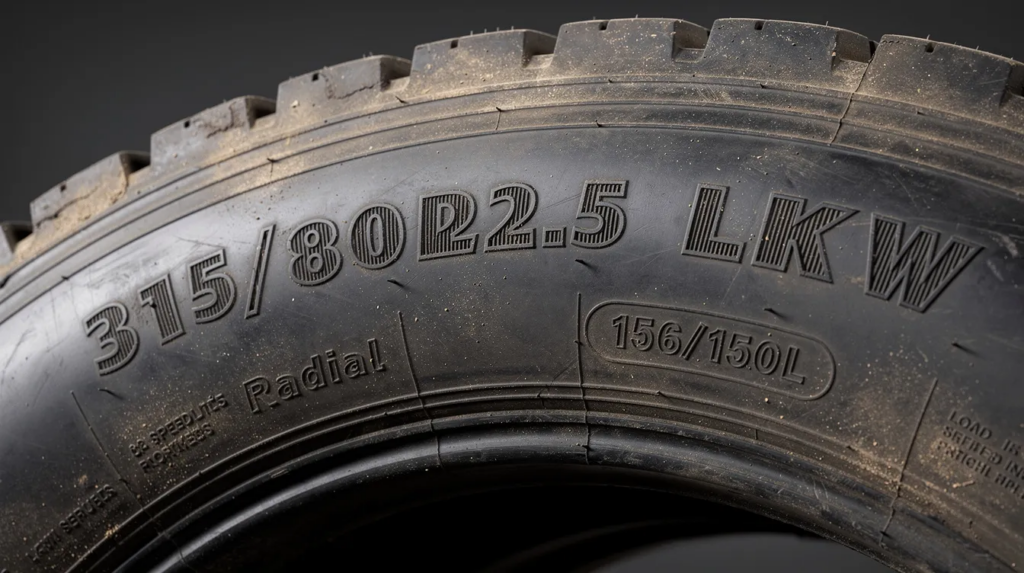
This was not a simple tyre puncture, but the wheel hub is closely tied to tyre condition on any heavy lorry. A destroyed wheel on a tractor unit’s steer axle usually involves sizes like 315/80 R22.5, the typical standard for the front axle of heavy trucks. Manufacturers such as Michelin, Continental and Bridgestone publish clear guidance on tread depth and inflation pressure, but a structural hub failure is not something a new tyre alone fixes — the whole axle geometry needs checking.
Regular checks of tyre pressure (8.5 to 9.5 bar for heavy truck tyres), tread depth and carcass condition belong in every fleet’s basic maintenance routine. Germany’s statutory minimum tread depth requirement is set out in § 36 StVZO, the regulation that applies to any lorry operating on German roads regardless of country of registration.
Why LKW Help 24
We are reachable around the clock, including on public holidays and in the middle of the night. Our dispatchers speak German, English, Polish and Russian, which matters for international hauliers whose drivers are not always fluent in German. Our nationwide partner network keeps recovery vehicles for tractor units on standby, not just standard breakdown vans. Prices are agreed before the job starts, with no hidden line items on the final invoice.
Summary
- Vehicle: Volvo FM tractor unit
- Location: A24 near Wittenberge, direction Hamburg
- Damage: Front-end damage, destroyed steer-axle wheel, undriveable
- Response time: roughly 50 minutes to reach the scene
- Total time: around 3 hours 30 minutes to workshop handover
- Cost: approximately 2120 euros net, including uncoupling and a second vehicle for the trailer
- Extra work: separating tractor unit and trailer, transporting them independently
FAQ
How much does recovering a tractor unit on the motorway cost?
Between 850 and 1600 euros for the recovery itself, depending on distance and complexity, plus callout and potentially a second vehicle for the trailer. In this case the total came to roughly 2120 euros net.
How long does a recovery after axle damage take?
Realistically 3 to 4 hours from the call to handover at a workshop, considerably longer than a standard roadside tyre change.
Who decides whether to tow or load the vehicle?
The technician on site, after checking the hub, axle and steering. That call cannot be made over the phone.
What happens to the trailer when the tractor unit is loaded onto a flatbed?
It is uncoupled, secured, and usually hauled separately to the workshop or destination by a second vehicle.
Does the police need to be informed for an incident like this on the motorway?
Yes. For a broken-down articulated lorry blocking a lane, police attend to secure the site as standard procedure, regardless of the exact damage.
Will insurance cover the recovery costs?
Usually yes, provided there is proper documentation with photos and an incident log. We supply this paperwork on every job.
Get help now
Axle damage on the motorway does not wait. Call us on +49 160 5753826 or visit www.lkwhelp24.com — available around the clock, every day, across Germany.
Keywords: tractor unit recovery | towing A24 Wittenberge | Volvo FM front-end damage | truck recovery motorway | § 15a StVO towing | semi tractor axle damage | truck breakdown assistance Germany
Truck Service in Your Region
Our workshop and roadside service network also covers Alsfeld, Altenburg and Amberg.
Related articles
- Towing Service Case Study: How LKW Help 24 Rescued a Stranded Semi-Truck on the A3 in Germany
- Towing Services: Truck Recovery in Winter
- How Much Does Trucks Towing Service Cost in Germany in 2026?
- Truck Towing Service Near Munich – Recovery of a Fully Loaded Semi-Trailer
- Truck Breakdown Assistance in Germany 24 7 Emergency Service from LKW Help 24: Real Example