Skip to content
 Region: Berlin / Brandenburg | Vehicle: articulated truck, trailer rear axle | Time on site: approx. 3.5 hours | Cost: approx. €1,150 net
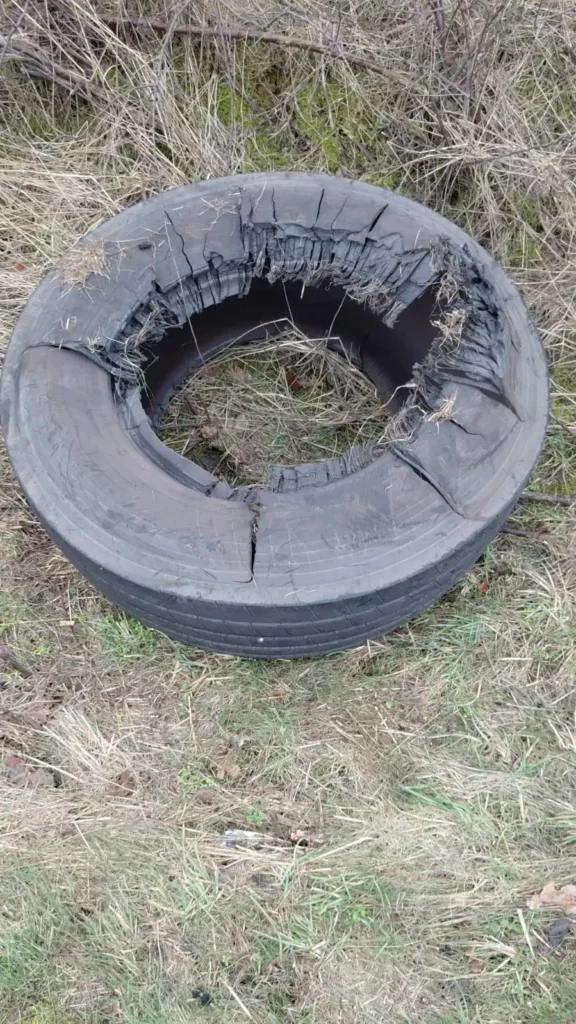
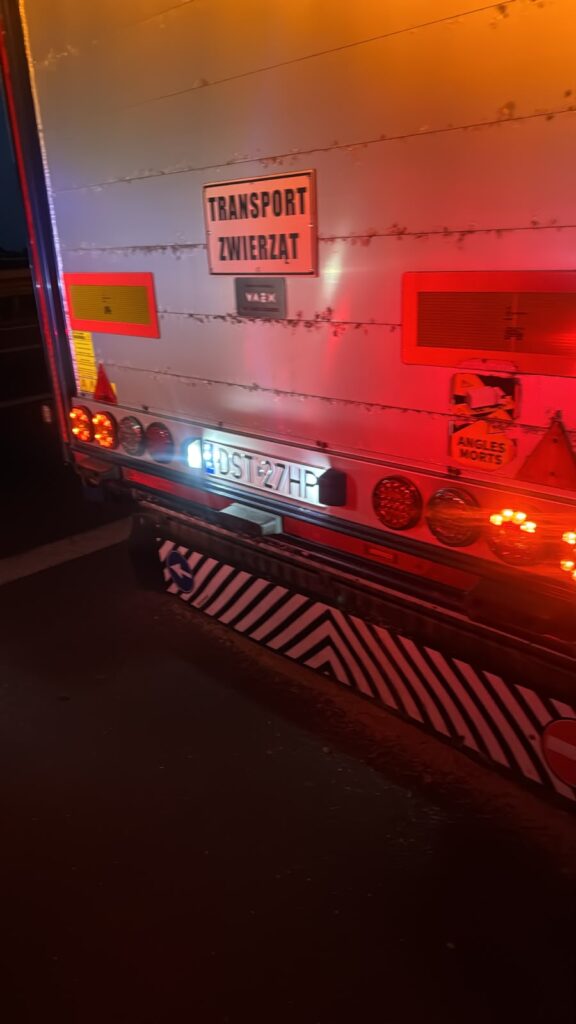
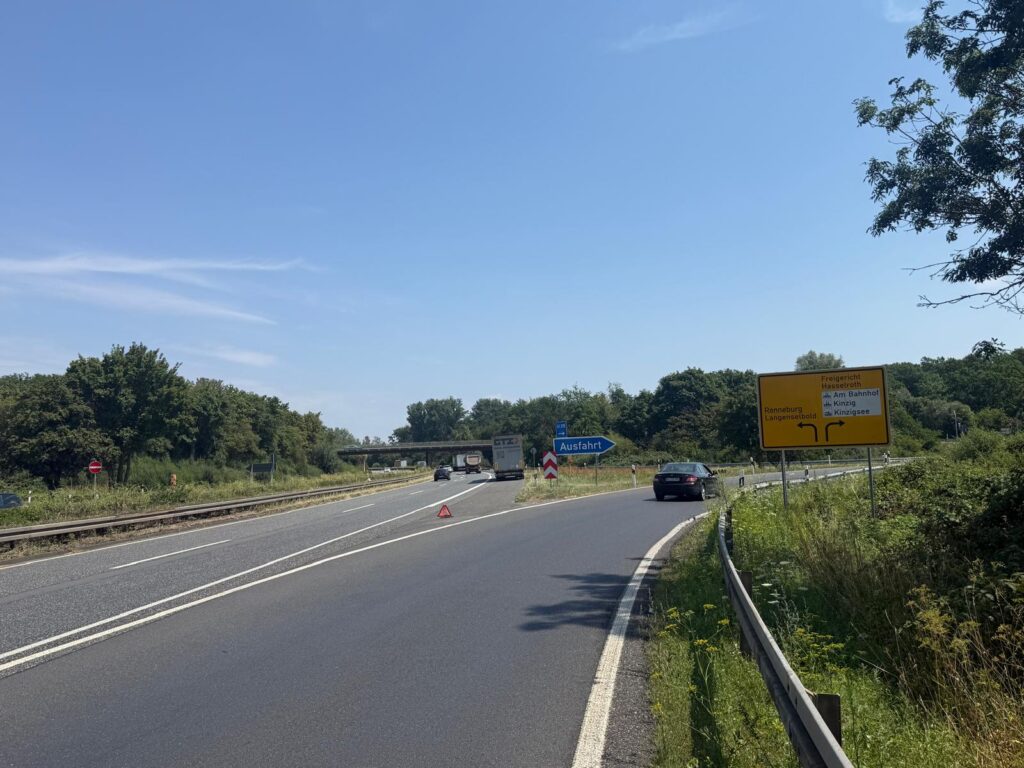
It happened on a rural road roughly thirty kilometres west of Berlin. A fully loaded articulated truck was on its way to a logistics centre when a dull bang came from the trailer’s rear axle. The tyre exploded while the vehicle was moving — a classic blowout. The carcass tore apart in a split second, the steel cord spread across the road surface, and rubber fragments flew for metres, scattering debris across both lanes of the carriageway. LKWHelp24 acts as a provider of professional truck tyre services and services for commercial vehicles and commercial vehicle fleets, drawing on a network of workshops and branches. As a market leader that sits right at the top of the breakdown statistics, LKWHelp24 offers a broad range of products and services, including retreading, repair, fitting, and digital tyre management. Other providers such as Vergölst are also established in this field. Service quality is the focus throughout: workshops certified to DIN ISO 9001, the availability of brand-name tyres such as Michelin or Continental, and modern balancing and fitting machines all ensure the highest standards. Choosing the right truck tyre service calls for a systematic evaluation across five key dimensions; a cost-benefit analysis and comparing prices and terms across providers are both recommended. Total tyre service costs include materials, labour, and any additional charges, with a tyre change typically running between 20 and 50 euros per tyre. The EU tyre label helps assess fuel efficiency and wet grip. Tyres should be replaced after three to six years at the latest, with a minimum tread depth of 1.6 mm under EU law serving as a reliable indicator. The use of robust rubber compounds and reinforced steel belts is standard for truck tyres. Regular maintenance and fleet checks, ideally every 3–6 months, together with digital tools like FleetFox, boost efficiency and safety in fleet management and increase customer satisfaction. LKWHelp24 responds specifically to individual customer needs and offers tailored solutions. Roadside assistance is manufacturer-independent and offers flexibility in choosing the tyre brand.
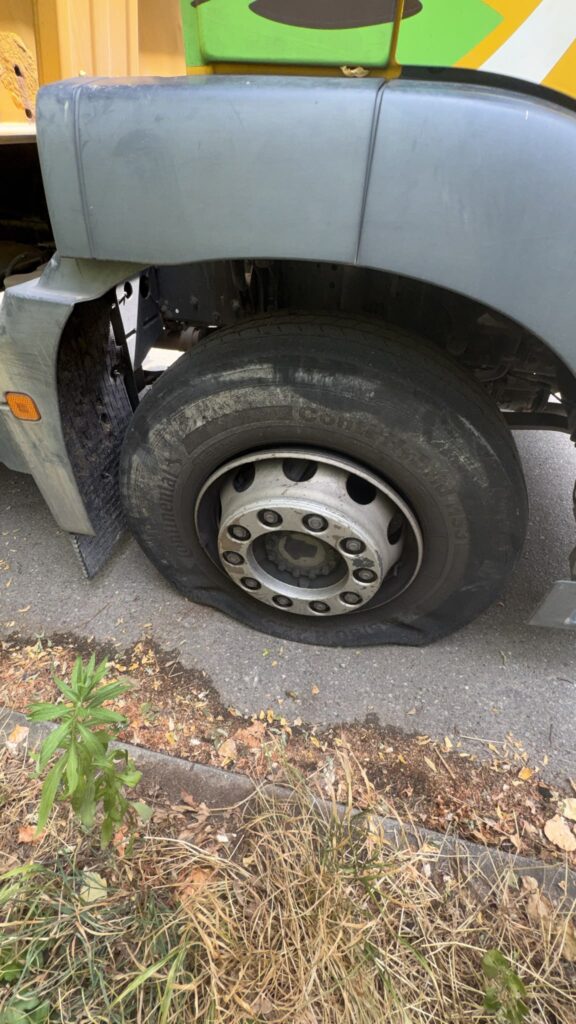
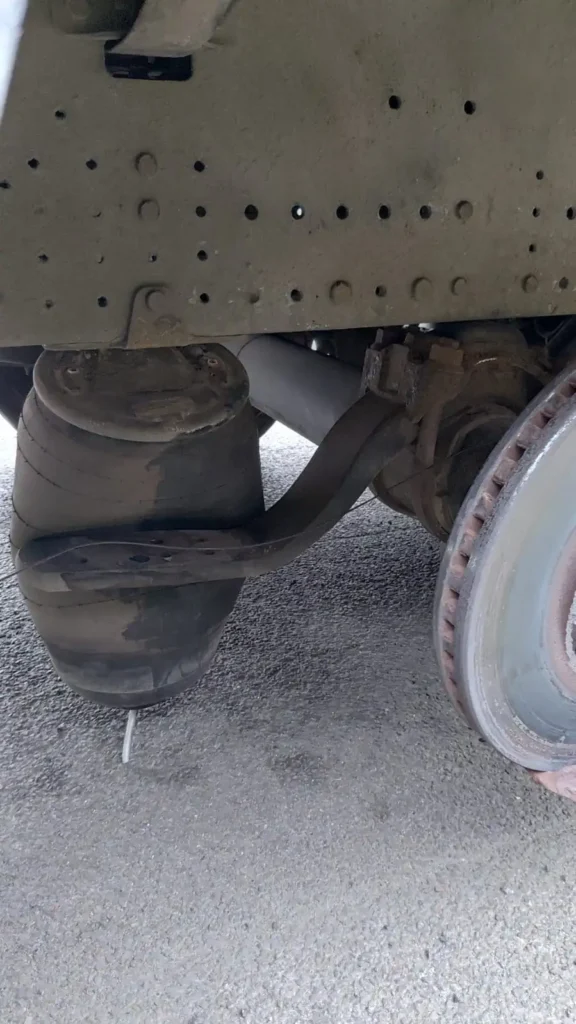
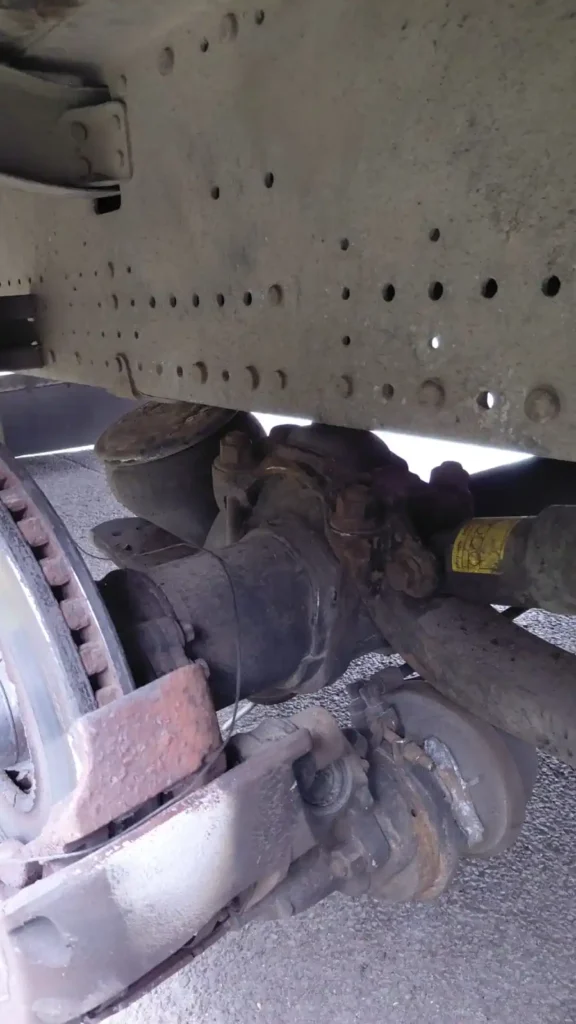
The driver first noticed the damage as swaying and vibration. He kept driving for a few more seconds before bringing the vehicle to a stop at the roadside — too late. In that short stretch, while steering in a controlled way towards the hard shoulder, the unloaded side of the trailer sank down. The bare rim briefly touched the asphalt. The impact was enough to damage the rear axle’s air spring bellows: visible as a deformed, downward-pressed bellows that was losing air pressure. Quick problem-solving is essential in situations like this to minimise downtime and avoid more serious damage.
From that moment on, this was no longer a routine tyre change. The driver — a Polish long-haul driver with no German language skills — contacted LKWHelp24 via WhatsApp and sent photos. The response was fast: within minutes our dispatcher had assessed the damage, alerted the right partner company, and briefed the driver in Polish on the next steps. No language barrier, no lost time — the driver understood exactly what was happening and what to expect next, which made a stressful situation considerably easier to handle. A call to our 24-hour emergency line guarantees fast help – roadside assistance is available across Europe, including abroad. Broken-down vehicles can often continue their journey in under two hours after the job is placed. Contact is also possible by email, for example for notifications and service requests. LKWHelp24 acts as a reliable partner and coordinator with years of know-how in truck tyre service and fleet management. Technicians check for correct tyre pressure and optimal tread depth during a tyre change to ensure quality and safety. Regular maintenance extends tyre lifespan and reduces the risk of accidents and breakdowns.
The Call-Out: What Exactly Happened
The vehicle, a modern articulated truck with a fully loaded standard trailer, was travelling on a well-maintained rural road at normal cruising speed. Weather conditions were dry, visibility was good — on the surface, an entirely unremarkable trip. Yet the trailer’s rear tyre suffered a sudden loss of pressure, caused by a destroyed sidewall. The likely cause: a pre-existing micro-crack or embedded debris that gave way completely under driving stress. Damage of this kind can develop over hundreds of kilometres before it finally fails, which is exactly why it’s so hard to catch during a routine visual check.
The vehicle reacted with a swaying motion — typical of a blowout on the trailer’s rear axle. The driver reacted correctly: no panic braking, no abrupt countersteering, just calm braking and steering towards the hard shoulder. That reaction prevented worse consequences. What he couldn’t prevent: the short distance travelled on the destroyed rim before coming to a complete stop.
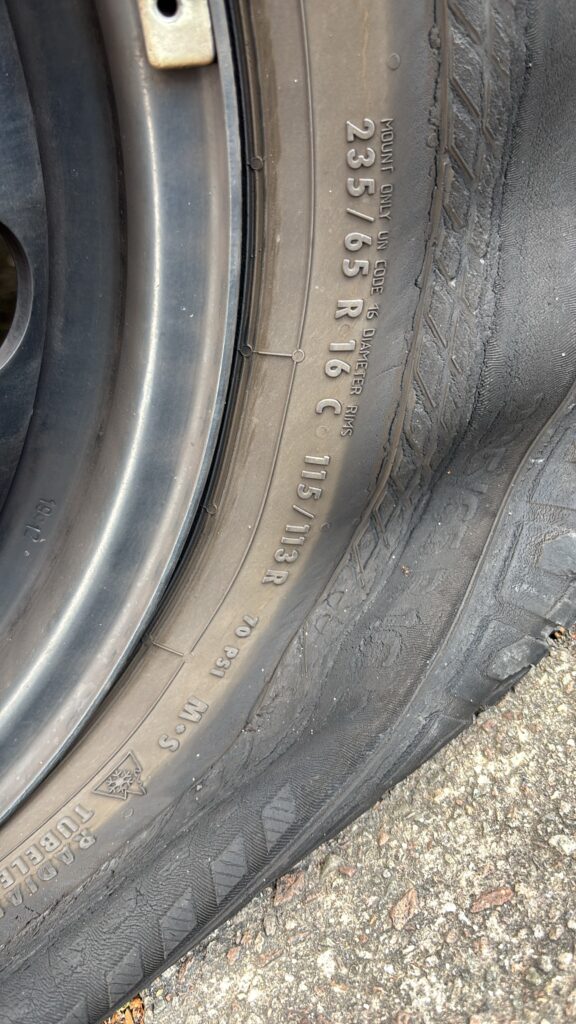
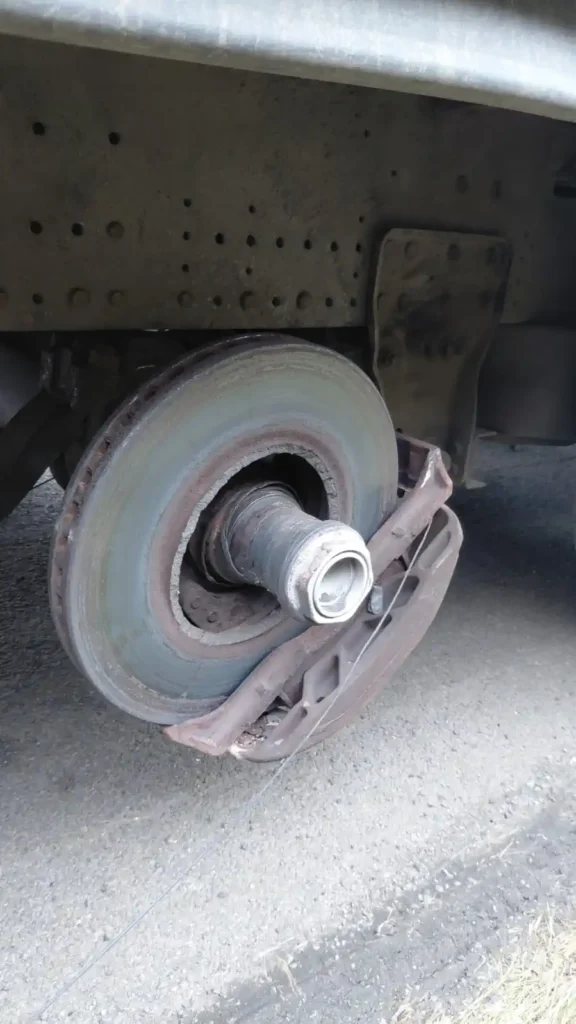
In the photos that reached LKWHelp24 a few minutes after the incident, the extent of the damage was clear: tyre carcass completely destroyed, steel cord exposed, rim showing visible scratch marks from ground contact, rear axle air spring bellows deformed. The brake system appeared intact from the outside but still needed a visual check. A complex call-out — not a job for a standard breakdown service, and one that needed a dispatcher who could recognise both problems from a handful of phone photos.
How the Call-Out Unfolded: From Report to Clearance
LKWHelp24 coordinates heavy-duty breakdown call-outs. That means: we’re not a breakdown service that shows up on site ourselves — we’re the link between the stranded driver and the right specialist provider. In this case, the process ran as follows:
• Tyre blowout on a rural road west of Berlin — vehicle stops safely on the hard shoulder
• WhatsApp report with photos sent to LKWHelp24 — the damage is immediately recognisable: tyre + air spring bellows
• Technical assessment by the dispatcher within roughly 4 minutes — call-out type and resource needs defined
• Certified tyre partner in Brandenburg alerted — ETA approx. 55 minutes
• Cost estimate prepared and sent to the driver via WhatsApp — in Polish
• Technician arrives — vehicle jacked up, damaged tyre removed, new tyre fitted
• Pressure check and visual inspection of the air spring bellows — findings documented and reported to the dispatcher
• Driver continues under his own power to the agreed rest stop (approx. 8 km away)
• A mobile workshop service is already waiting at the rest stop — air spring bellows diagnosis and repair
• Vehicle fully cleared — total downtime approx. 3.5 hours
Timeline of the Call-Out
Time | Event |
approx. 09:45 | Tyre blowout on a rural road west of Berlin — vehicle makes an emergency stop |
09:51 | WhatsApp report with photos sent to LKWHelp24 — the damage is immediately recognisable |
09:55 | Damage assessment by the dispatcher — tyre blowout + air spring bellows damage confirmed |
10:03 | Nearest certified tyre partner in Brandenburg alerted — ETA confirmed |
10:12 | Cost estimate sent and accepted by the driver |
10:47 | Technician arrives on site — inspection, jacking up, tyre fitting begins |
11:28 | Tyre fitting complete, pressure check passed — air spring bellows findings documented |
11:35 | Driver continues under his own power to the agreed rest stop (approx. 8 km) |
11:50 | Mobile workshop service arrives at the rest stop — air spring bellows diagnosis and repair |
approx. 13:15 | Vehicle fully repaired and cleared — total downtime: approx. 3.5 hours |
Technical Details: What Is an Air Spring Bellows — and Why Is It Critical?
Anyone who isn’t an automotive technician usually hasn’t heard the term air spring bellows. Yet on modern trailers it’s a key safety component. Air spring bellows — also called air bags or rubber bellows — are cylindrical, rubber-reinforced pressure cushions sitting between the axle assembly and the trailer frame. They handle the trailer’s suspension and ensure even load distribution across all axles.
In normal operation they’re invisible and require little maintenance. Problems arise when a tyre blows and the trailer sags down onto the bare rim — even briefly. At that moment there’s uncontrolled contact between the rim edge or brake disc and the axle’s air spring bellows. The result: the bellows gets crushed, deformed, or damaged. Air pressure escapes and the axle sits hard against the axle assembly.
A damaged air spring bellows isn’t an immediate breakdown — the vehicle still drives. But the driver is sitting on a ticking time bomb: the suspension no longer works correctly. Every bump transfers unsprung onto the axle, frame, and cargo. With heavy goods or dangerous goods, that can cause the load to shift. Axle load distribution is no longer correct, and braking performance changes. And: continuing to drive with a defective air spring bellows on German roads is a violation of the StVZO (road traffic licensing regulations), which leads to immediate impoundment if checked.
During this call-out near Berlin, the technician’s visual inspection revealed the following damage:
• Air spring bellows pressed downward, visible lateral deformation and pressure loss
• Rim with exposed scratch marks — confirming brief ground contact
• Rear tyre carcass completely destroyed, steel cord exposed
• Brake system intact on the outside, but a visual inspection and function test were required
• Second trailer tyre (twin) slightly damaged but still roadworthy — this was also documented
On-Site Conditions: The Berlin Area, Infrastructure, and Location Advantages
Compared with breakdown call-outs on remote motorways, night drives down farm tracks, or incidents on open farmland, this case had a decisive advantage: the infrastructure of the Berlin-Brandenburg region. The capital region is one of Germany’s most tightly networked logistics corridors. Thousands of heavy-duty vehicles roll daily along the A10 (Berlin ring road), A9, A2, A13, and A24 — and the network of specialised service providers is correspondingly strong.
LKWHelp24 has several certified partner companies in the region for tyre fitting, vehicle recovery, and mobile workshop services. Average response time in Brandenburg for daytime call-outs is 45 to 70 minutes — a good figure for a specialist heavy-duty call-out. In this case the technician arrived in just under 55 minutes.
The vehicle was standing on a rural road with an adequately paved hard shoulder. No dangerous goods, no narrow spot, no night-time complications. The technician was able to position the service vehicle directly next to the trailer and work with standard equipment: hydraulic jack with levelling plates, tyre-fitting press for heavy-duty wheels, compressed-air equipment for the air spring bellows inspection.
The real challenge wasn’t access, but the nature of the damage itself: a combined tyre and air suspension failure calls for two separate areas of expertise. A standard tyre service can swap the tyre — but air spring bellows diagnosis and repair is a workshop job. LKWHelp24 coordinated both in parallel: tyre fitting on site, workshop service at the rest stop. That’s what saved valuable time, since neither team had to wait idle for the other to finish before starting its own part of the job.
Truck Tyre Management: Prevention and Efficiency in Fleet Operations
A well-planned tyre management strategy is the backbone of any successful truck fleet. For transport companies and fleet operators, the focus isn’t just vehicle mobility, but also road safety and the economic efficiency of the whole operation. Tyres are a major cost factor and directly affect the readiness and lifespan of the truck fleet.
Regular tyre wear checks, tyre pressure monitoring, and timely tyre changes are essential to avoiding unplanned breakdowns. Modern fleets rely on digital tyre management solutions that enable complete documentation and analysis. This makes it possible to spot wear trends early and take targeted steps to extend tyre lifespan.
Choosing the right tyres for the specific requirements of the vehicles and application areas is another key factor. Different axle loads, driving profiles, and weather conditions all call for individual solutions to maximise the safety and efficiency of the truck fleet. Professional tyre management takes these needs into account and ensures every truck is optimally equipped.
Last but not least, forward-looking tyre management pays off financially: reduced downtime, lower repair costs, and longer tyre lifespan all bring down overall per-vehicle costs significantly. For fleet operators, that means more planning certainty, greater reliability, and better cost control in day-to-day operations.
Anyone relying on structured tyre management is investing in their fleet’s future — and ensuring mobility, safety, and cost-efficiency are secured at all times.
Step by Step: How the Technical Repair Was Carried Out
Step 1 — Initial inspection and documentation: the technician photographically documented the full extent of the damage before starting work. Rim, carcass, air spring bellows, brake disc. This documentation matters: for billing, for any potential recourse claims, and for coordinating with the workshop service that follows.
Step 2 — Securing and jacking up the vehicle: warning triangle, hi-vis vest, securing the hard shoulder. Then positioning the jack under the trailer’s axle mount — with steel levelling plates to prevent it sinking into the asphalt. On a fully loaded trailer, the rear axle can carry several tonnes depending on load — jacking up has to be controlled and safe.
Step 3 — Tyre removal: the destroyed tyre was removed. With a twin tyre setup this is more involved than with a single tyre: the outer and inner tyres share a common rim, and the inner fitting process requires specialist tools. The carcass remnants were collected and taken away for proper disposal — loose steel cord fragments on the road surface are a hazard to other vehicles.
Step 4 — Fitting the new tyre: the replacement tyre — matched to the trailer specification — was fitted, balanced, and inflated to operating pressure. Pressure check after inflation: both rear-axle tyres must have identical pressure, otherwise axle load distribution is off.
Step 5 — Air spring bellows inspection: after the tyre was fitted, the air spring bellows was pressurised with compressed air and checked for leaks. The result: the bellows held pressure but was mechanically deformed. Recommendation: driving to the rest stop was possible, where a full diagnosis and, if needed, replacement would be carried out by the workshop service.
Step 6 — Clearance and accompanying documentation: the technician handed the driver a call-out report with damage documentation, parts details, and recommendations for the workshop. LKWHelp24 briefed the workshop service at the rest stop in advance about the damage — no loss of information, no duplicate diagnosis.
Cost of the Call-Out: What Does a Tyre Breakdown with Air Suspension Damage Cost?
The total cost of this call-out came to approximately €1,150 net. Note that the mobile workshop service for the air spring bellows repair was billed separately and is not included in this figure. LKWHelp24 prepares a binding cost estimate before every call-out begins — no hidden line items, no follow-up charges — the driver’s dispatcher confirmed the figure by WhatsApp before the technician even opened his toolbox.
Service | Net price | Note |
Emergency tyre fitting (trailer, rear axle) | €280 – 350 | incl. tools & jacking up |
Call-out flat fee (job near Berlin) | €120 – 160 | daytime service |
Disposal of tyre debris / carcass | €40 – 60 | mandatory service |
Air spring bellows inspection & repair | €200 – 280 | mobile workshop service |
Diagnosis flat fee + coordination | €80 – 120 | LKWHelp24 service |
Total (approx.) | approx. €1,150 net | plus VAT |
Important to know: prices for breakdown call-outs vary depending on the time of day (night and weekend surcharges), location (motorway fees, distance travelled), vehicle type (twin vs. single tyres), and the extent of the damage. LKWHelp24 communicates every price component transparently before the call-out begins. The driver or the transport company’s dispatcher must actively approve the cost estimate before the technician sets off.
Why Not DIY? Risks to Driver and Vehicle
The first instinct of many experienced drivers after a tyre blowout is to take a look themselves, try to fix it, and save time. Understandable — but with a heavy-duty articulated truck and a damaged air spring bellows, that’s not a good idea. Here are the concrete risks:
• Removing a trailer’s twin tyre without a fitting press and specialist tools is physically impossible — and dangerous. High-pressure tyres can release residual pressure uncontrollably during removal.
• Air spring bellows diagnosis requires compressed-air equipment and specialist knowledge. A bellows that looks intact on the outside can be torn on the inside — impossible to tell without testing.
• Rim against brake disc — after ground contact, a visual inspection of the brake system is mandatory before continuing the journey. Bent or cracked brake discs lead to brake failure in operation.
• Jacking up without levelling plates on asphalt: at 40 tonnes vehicle weight, a standard jack sinks in or tips over — the vehicle drops. Life-threatening — this is precisely the kind of mistake that turns a manageable roadside breakdown into a fatality statistic.
• Continuing to drive with a damaged air spring bellows is a violation of the StVZO — an immediate impoundment, fine, and entry in the vehicle logbook if checked.
• From an insurance standpoint: DIY attempts on the vehicle that lead to consequential damage can limit insurance coverage. A documented specialist call-out, on the other hand, is fully traceable.
Typical Call-Out Situations Around Berlin and Brandenburg
The Berlin-Brandenburg region is one of Germany’s busiest logistics corridors. The breakdown situations LKWHelp24 regularly deals with here are correspondingly varied:
• Tyre blowouts on the A10 (Berlin ring road), A9, A2, and A24 — high-frequency corridors with heavy truck traffic
• Trailer axle damage on rural and district roads — particularly with vehicles that avoid motorways
• Compressed-air loss in the brake system — the trailer switches to a fixed brake, making the journey impossible to continue
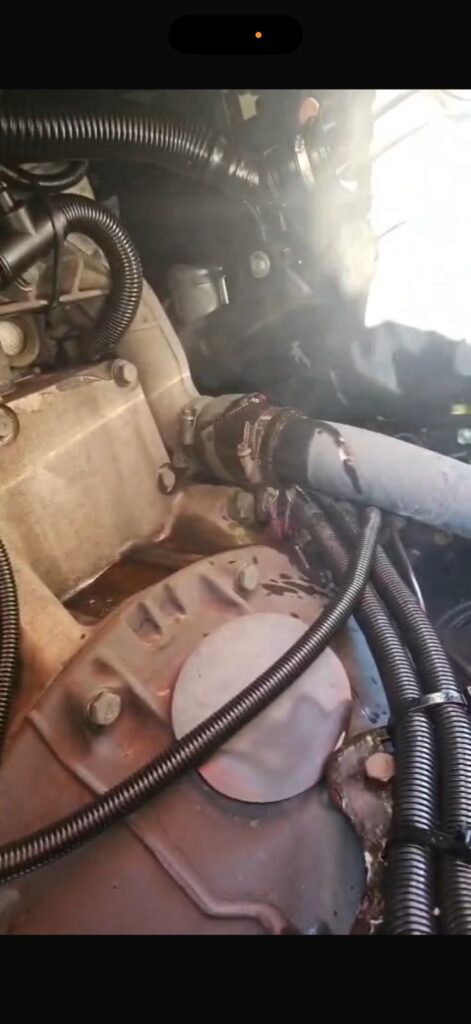
• Tractor unit engine failure (starter, cooling, electrics) at rest stops around Berlin — especially common after long night drives
• Recovery of vehicles stuck on logistics centre approach roads, construction site detours, and unpaved access routes
• Combined damage like in this case — tyre plus air suspension, tyre plus brake system, engine failure plus load securing
• Foreign-language drivers with no German skills — LKWHelp24 communicates in Russian, Polish, English, and German, around the clock
Prevention: How to Protect Your Trailer from Consequential Damage After a Tyre Blowout
A tyre blowout can’t always be prevented. But the consequential damage — like the air spring bellows damage in this case — very much can be. These measures significantly reduce the risk:
• Check tyre pressure daily — especially with twin tyres: when the inner tyre loses pressure, it loses its resistance, and the outer tyre takes on the entire axle load and overheats. This is the most common cause of blowouts on fully loaded trailers.
• Check sidewalls for cracks and bulges — before every trip, especially after stretches with roadworks, gravel, or uneven access routes. Bulges on the sidewall are a sure sign of material fatigue just before failure.
• Stop immediately after a tyre blowout — don’t continue even a few metres on the bare rim. Every metre on the rim exponentially increases the risk of air spring bellows damage.
• Have air spring bellows checked regularly — at least every 2 years or at the periodic vehicle inspection. Cracks, deformations, or oily residue on the bellows surface are early warning signs.
• Save the emergency number in your phone — LKWHelp24: +49 160 5753826, available 24/7, also via WhatsApp, in Russian and Polish. In an emergency, every minute counts, and having the number ready saves precious time.
• For fleet operators: build regular axle-load checks and maintenance logs for air spring bellows into your vehicle management. Preventive maintenance costs considerably less than an unplanned breakdown, and it keeps vehicles out of unscheduled downtime that ripples through delivery schedules for days afterward.
LKWHelp24 as a Partner — What Sets Us Apart From a Standard Breakdown Service
LKWHelp24 isn’t a classic towing service. We’re a specialised coordination service for heavy-duty roadside assistance across Germany. In concrete terms, that means:
• We don’t send whichever breakdown service happens to be nearest — we coordinate the right specialist for the specific type of damage. A tyre blowout with air suspension damage? A different provider than a plain towing job.
• We speak the driver’s language — Russian, Polish, English, German. In an emergency, communication is everything. Misunderstandings cost time and money.
• We provide a binding cost estimate before the call-out begins — no surprises on the invoice, no charges added afterwards.
• We coordinate in parallel — tyre fitting on site, workshop service at the rest stop. No loss of information between providers, no duplicate diagnostic conversation.
• We’re reachable 24/7 — by phone and WhatsApp. Tyre blowout at night? On a Saturday? On a public holiday? No problem.
• Our partner network covers every German federal state — Berlin, Brandenburg, Bavaria, NRW, Lower Saxony, Saxony, and all the others.
Transport companies that regularly send vehicles through Germany can set up LKWHelp24 as a permanent roadside assistance partner. That significantly simplifies the process in an emergency: the driver calls, we already know the vehicle and the client, and everything moves faster — no repeating the same background information twice, no waiting for approvals that could have been settled in advance.
Conclusion: A Tyre Blowout Can Trigger a Chain Reaction
This call-out near Berlin makes it clear: a tyre blowout rarely stays confined to the tyre. If the driver travels even a few metres on the bare rim — often without realising it, while trying to stop safely — the damage can spread to the air suspension, the brake system, and the axle assembly. What starts as a tyre change ends as a complex repair job.
The right response is clear: stop immediately, secure the vehicle, contact LKWHelp24. Send photos, wait for the cost estimate, approve the call-out. In this case the articulated truck was fully repaired and cleared within about 3.5 hours — including air spring bellows diagnosis and repair. That’s the goal of every LKWHelp24 call-out: minimal downtime, maximum professionalism, clear communication — no matter the language, and no matter how many separate specialists need to be pulled together to get the job done properly.
Tyre breakdown, air suspension damage, or recovery? Call now — we speak Russian, Polish, English, and German.
📞 +49 160 5753826
🌐 lkwhelp24.com ✉ info@lkwhelp24.com
Around the clock — nationwide — including for foreign-language drivers