Skip to content
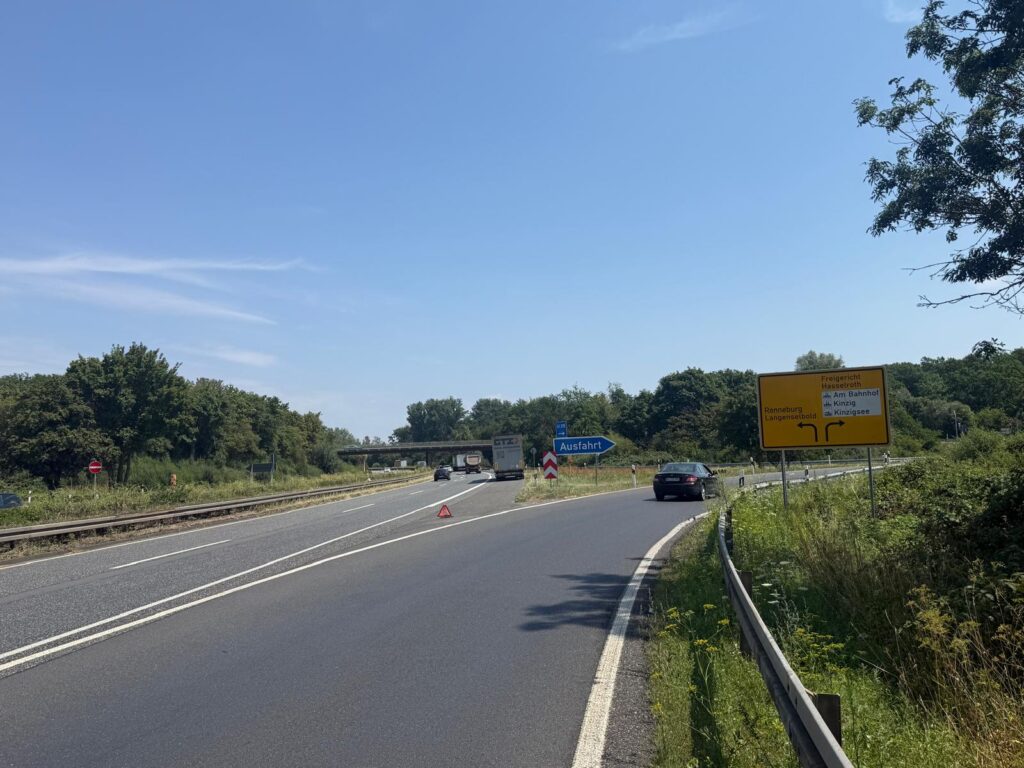
A Ford Trucks F-Max tractor unit, roughly 400,000 km on the clock, pulled onto the hard shoulder of the A9 near Bayreuth with the dashboard flashing a warning the driver could barely read in the low winter light. He is Romanian, the truck\’s display was set to Romanian, and the message on screen read: \”AVERTIZARE – Purificare gaze arse defectă.\” Translated, that is a warning that the exhaust after-treatment system has failed. Within minutes the engine dropped into limp mode, power fell away, and a faint haze of white vapour drifted from the exhaust stack into the cold 11°C air of Upper Franconia.
For a driver hundreds of kilometres from home, on a motorway he does not know, reading a fault code in a language that is not his own, this is precisely the moment when a fast, competent, English-and-German-speaking breakdown service earns its keep. LKWHelp24 took the call at 10:50 and had the truck released and back on the road by 12:55, a total job time of two hours and five minutes with just over an hour of that spent working on the vehicle itself.
An SCR/AdBlue fault is one of the more misunderstood breakdown causes on German motorways. It rarely stops a truck dead in the way a blown tyre or a snapped fan belt does. Instead, the engine\’s control unit quietly throttles power output to protect the emissions system and the engine itself, so the driver is left with a vehicle that still moves but no longer has the strength to hold speed on a gradient, overtake safely, or keep pace with motorway traffic. Combined with a foreign-language warning message and unfamiliar roads, that ambiguity is exactly what turns a technical fault into a genuine emergency.
The consequences for a haulage operation are just as real as any mechanical breakdown. A derated tractor unit crawling along the inside lane of the A9 is a hazard to itself and to other traffic, a delivery slot gets missed, and a driver sitting on the hard shoulder unsure whether to keep going or wait for a tow starts burning hours he does not have. Getting a qualified technician to the vehicle quickly, diagnosing the fault correctly, and clearing it on the spot where possible is very often the difference between a short delay and a lost day.

The Emergency
The driver had noticed nothing untoward until the warning appeared: no unusual noises, no loss of coolant, nothing dripping under the vehicle. Then the Romanian-language message lit up the instrument cluster, the throttle response went soft, and the truck slowed no matter how far he pressed the accelerator. That is the classic signature of an emissions-related derate: the engine management system has detected a fault in the SCR (Selective Catalytic Reduction) circuit, the AdBlue-based system that neutralises NOx emissions, and has cut engine torque as a protective measure until the fault is addressed.
At the same time, he saw white smoke or vapour trailing from the exhaust. On a cold 11°C day this can look alarming, and it is often mistaken for something far more serious, such as a blown gasket or coolant entering the combustion chamber. In this case it was consistent with the after-treatment fault rather than a separate mechanical failure, but a driver on the hard shoulder of the A9 with a dashboard he cannot fully read has no reliable way to tell the difference himself. Pulling over safely, switching on hazard lights, and calling for professional help was exactly the right call.
How Help Was Organised
LKWHelp24 operates a partner network of mobile commercial-vehicle diagnostics and repair technicians spread across Germany, so a call from the A9 near Bayreuth is not routed to a generic breakdown truck that then has to work out what it is dealing with. It goes to a partner already equipped for exactly this kind of fault.
- 10:50 – call received, exact location and vehicle details taken from the driver
- 11:05 – nearest available partner in the Bayreuth/Upper Franconia area dispatched, ETA confirmed
- Dispatcher relayed the Romanian dashboard message so the technician knew in advance to expect an SCR/AdBlue fault, not a random unspecified failure
- Driver advised to keep the vehicle stationary, hazards on, and warning triangle set out, rather than attempt to continue in limp mode
Because the fault description came through clearly even in translation, the technician arrived already carrying the diagnostic equipment and AdBlue system components most likely to be needed, rather than discovering the nature of the problem only after arriving on site.

The Situation On-Site
By 11:45 the technician was alongside the F-Max on the hard shoulder. The first step was a full read-out of the fault memory using a professional diagnostic tool connected to the vehicle\’s OBD port. This confirmed what the Romanian warning message had already indicated: an active fault in the SCR/AdBlue after-treatment circuit.
Modern Euro VI diesel engines rely on AdBlue, a urea-based fluid injected into the exhaust stream, to convert NOx gases into nitrogen and water vapour before they leave the tailpipe. The system depends on several components working correctly together: the dosing valve that meters AdBlue into the exhaust, one or more NOx sensors that measure emissions before and after the SCR catalyst, and the AdBlue itself, which must be of the correct quality and concentration and present in sufficient quantity. If any of these fall outside tolerance, the engine control unit assumes it can no longer guarantee compliant emissions and deliberately reduces engine power. This is not a fault in the engine\’s mechanical performance; it is a safeguard built into the emissions system, and that is precisely why the truck could still move, just not at full strength.
The technician worked through the SCR circuit methodically: checking the dosing valve for correct operation, verifying the NOx sensor readings, confirming AdBlue level and fluid quality, and inspecting the associated lines and connectors for damage or contamination. The fault traced back to the SCR/AdBlue dosing circuit rather than a sensor wiring issue, consistent with the type of failure this Ford Trucks F-Max model can develop after roughly 400,000 km of motorway use.
Step-by-Step
Step 1 — Secure the vehicle. Hazard lights on, warning triangle placed, driver kept clear of live traffic on the hard shoulder.
Step 2 — Read the fault memory. A diagnostic tool was connected to pull the stored fault codes and confirm the SCR/AdBlue after-treatment fault flagged on the Romanian dashboard.
Step 3 — Diagnose the SCR/AdBlue circuit. The dosing valve, NOx sensors, AdBlue level and fluid quality, and the connecting lines were all checked in sequence to isolate the exact source of the fault.
Step 4 — Repair and replenish. The faulty component in the dosing circuit was repaired/replaced on-site, and the AdBlue level was checked and topped up where needed.
Step 5 — Clear codes and test. Fault codes were cleared, the engine was run through a test cycle, the power derate lifted, and the truck was released to continue its journey, with a workshop follow-up recommended for a full system check.
Full Timeline
| Time | Phase | Action |
|---|---|---|
| 10:50 | Call received | Driver reports Romanian dashboard warning, power loss, white smoke |
| 11:05 | Dispatch | Nearest partner technician dispatched, ETA given |
| 11:45 | On site | Technician arrives on the A9 near Bayreuth |
| 12:00 | Fault read-out | Diagnostic tool confirms SCR/AdBlue after-treatment fault |
| 12:40 | Repair | Dosing circuit component repaired/replaced, AdBlue checked and topped up |
| 12:55 | Test run | Fault codes cleared, engine tested, derate lifted |
| 12:55 | Released | Truck cleared to continue its journey |
Total time from call to release: 2 hours 5 minutes. Time spent working on the vehicle at the roadside: roughly 1 hour 10 minutes.

Cost
| Item | Price (EUR) |
|---|---|
| Call-out / 24-7 service | 190 |
| Diagnostics / fault read-out on site | 160 |
| SCR/AdBlue repair (sensor/dosing valve) | 260 |
| Sundries / AdBlue | 80 |
| TOTAL | 690 |
The price of a callout like this depends on several straightforward factors: the distance the technician has to travel, the time of day (a mid-morning weekday callout is generally cheaper than a night or weekend one), the complexity of the fault once diagnosed, and whether any parts need replacing rather than simply repairing or adjusting. AdBlue system faults sit in the middle of the cost range: more involved than a jump start or a puncture, but far less costly than an engine rebuild.
Set against the alternative, the numbers make the case for themselves. Recovering a 40-tonne combination from the A9 to a workshop, much like the tyre and cooling repair on a DAF near Amberg, typically runs into several hundred euros in towing costs alone, before any diagnostic or repair work has even begun, and before accounting for the lost transit time, missed delivery windows, and the driver sitting idle for the best part of a day. Fixing the SCR fault at the roadside for 690 EUR in just over two hours kept the truck, the load, and the schedule moving.
Why a Professional Service Is Essential
It might be tempting for a driver to simply keep going once the derate kicks in, since the truck still moves, just more slowly. This is a poor idea for several reasons. Continuing to drive with an active SCR/AdBlue fault can, depending on the specific failure, allow the underlying condition to worsen, potentially causing knock-on damage to the SCR catalyst, the dosing valve, or associated wiring that would have been avoidable with an early, correct repair. It also means driving underpowered in live motorway traffic, which is a safety risk to the driver and to everyone else on the road. And on many trucks the derate becomes progressively more severe the longer the fault memory logs the active fault, so a manageable limp-mode speed can degrade further the longer it is ignored.
A correctly equipped mobile technician, by contrast, can read the exact fault code rather than guess at it, distinguish an SCR/AdBlue issue from a mechanical problem that happens to produce a similar warning, and fix the actual cause rather than simply clearing a code and hoping the derate lifts on its own.

Typical Breakdown Situations We Handle
LKWHelp24\’s partner network across Germany deals with the full range of commercial-vehicle breakdowns on motorways, industrial estates, and rest stops, including scenarios like the Scania steer-axle blowout on the A2 near Bielefeld:
- Engine power reduction and derate/limp-mode warnings caused by SCR, AdBlue, or NOx sensor faults
- Exhaust after-treatment and DPF-related warning lights
- Battery failures and jump starts for tractor units and trailers
- Coolant leaks, overheating, and cooling-system hose failures
- Electrical faults affecting lighting, dashboards, or control units
- Tyre blowouts and roadside tyre replacement
- General diagnostics for foreign-plated vehicles whose drivers do not speak German
Prevention Tips
A number of SCR/AdBlue faults are preventable with routine attention rather than specialist knowledge:
- Use only AdBlue that meets the ISO 22241 standard; poor-quality or contaminated fluid is a common cause of dosing valve and sensor faults
- Keep the AdBlue tank topped up rather than running it close to empty, since low fluid level itself can trigger warnings and, eventually, a derate
- Do not ignore an amber after-treatment warning in the hope it clears itself; an early check often prevents a full power reduction
- Have NOx sensors and the dosing system inspected as part of scheduled maintenance, particularly on vehicles well past 300,000 km

SCR, AdBlue, and Mobile Truck Diagnostics: What Drivers and Fleets Should Know
The SCR system, sometimes marketed under names like Denoxtronic, is now standard across almost every Euro VI diesel truck on German roads, which means exhaust after-treatment faults are one of the most common reasons for a roadside call to a truck breakdown assistance service. When a NOx sensor drifts out of calibration, when a dosing valve sticks, or when AdBlue quality falls short, the result is the same: an engine power reduction that a driver cannot fix without a proper diagnostic tool and someone who understands the system.
This is exactly where our mobile truck diagnostics earns its value. Rather than a tow to the nearest workshop and a wait for a service bay, a technician with a laptop-based diagnostic tool and a stock of common AdBlue system parts can often resolve the fault at the roadside, on the A9, on an industrial estate, or at a rest stop, in a fraction of the time and cost of a full workshop visit.
For fleet operators running international routes, help for foreign drivers is a particular priority. A Romanian, Polish, or Turkish driver reading a dashboard warning in their own language still needs a technician who can explain the fault, the fix, and the recommended follow-up in terms they understand, ideally without a language barrier slowing down an already time-critical situation. A 24 hour breakdown service that can dispatch quickly, communicate clearly, and diagnose an SCR system fault correctly the first time, as with the steer-axle case handled on the A20 near Bad Segeberg, is worth building into any fleet\’s contingency planning, wherever in Germany the breakdown happens to occur.
Manufacturers such as Ford Trucks and component suppliers such as Bosch Mobility, whose Denoxtronic dosing systems are fitted across much of the European truck fleet, publish detailed guidance on AdBlue system maintenance, and a good mobile technician will draw on exactly that kind of manufacturer-level knowledge rather than guesswork.
Why LKWHelp24
LKWHelp24 exists for exactly this kind of situation: a truck stranded on a German motorway with a fault the driver cannot diagnose himself, a language barrier that makes the situation more stressful than it needs to be, and a clock ticking on a delivery. Our partner network covers the whole of Germany, much as it did during the track-rod repair near Augsburg, and our dispatchers take a clear description of the fault at the first call so the right technician with the right equipment is sent out, and our technicians are equipped to read fault memories, diagnose SCR/AdBlue and other after-treatment issues, and carry out the repair on-site wherever that is possible, rather than defaulting straight to a tow.
Summary
- Vehicle: Ford Trucks F-Max tractor unit, approximately 400,000 km, Romanian driver
- Fault: SCR/AdBlue after-treatment fault causing engine power reduction (derate) and visible exhaust vapour
- Location: A9 near Bayreuth, Upper Franconia, Bavaria
- Total time: 2 hours 5 minutes, call to release
- On-site time: approximately 1 hour 10 minutes
- Total cost: 690 EUR
- Outcome: fault diagnosed and repaired at the roadside, AdBlue topped up, derate lifted, truck released with a recommended workshop follow-up

Request Emergency Assistance Now
Stranded with a power reduction, an AdBlue warning, or any other truck breakdown anywhere in Germany? See a similar case on a Volvo FH near Ingolstadt, or visit our contacts page. Call +49 160 5753826 or visit lkwhelp24.com.
Available 24/7 across all of Germany.