When a commercial vehicle breaks down on a major German autobahn, every minute counts. For a 5-ton Mercedes-Benz Sprinter with a dry cargo body and rear hydraulic lift gate, a sudden engine compartment failure isn’t just an inconvenience, it’s a logistical crisis. With cargo on board, limited mobility, and high operational costs at stake, the need for immediate, professional recovery becomes urgent. This real-world case study reveals how LKWHelp24 responded to a breakdown near Osnabrück on the A30/A1, mobilising a heavy-duty recovery truck equipped with a Fassi hydraulic crane to safely extract, transport, and deliver the stranded Sprinter to a partner workshop in under two and a half hours. From the initial call to final handover, every phase was executed with precision, transparency, and full compliance with German road safety regulations.
The incident began when the driver, operating a fully loaded Sprinter in a commercial courier network, experienced a sudden loss of engine function while approaching an exit near Osnabrück. No warning lights, no smoke, just silence. After safely moving the vehicle to the hard shoulder and activating hazard lights, the driver remained on site, aware that prolonged standstill on a busy motorway section poses significant safety risks. With the vehicle immobilised and unable to restart, the only viable solution was professional towing and recovery. That’s where LKWHelp24’s 24/7 emergency response network came into play, delivering not just a tow truck, but a full technical recovery package tailored to the vehicle’s weight, structure, and load.
This case is particularly instructive because it highlights a common but often underestimated challenge: the recovery of mid-sized commercial vehicles like the Sprinter when they suffer internal failures, especially in the engine compartment, that prevent any form of self-propulsion. Unlike a simple flat tyre or minor electrical glitch, a total engine compartment fault requires not just towing, but secure lifting and stabilisation to avoid secondary damage. The use of a hydraulic crane-equipped recovery vehicle wasn’t optional, it was essential. This article breaks down the entire process, from dispatch to delivery, including cost, timing, and technical details, offering a clear picture of why professional recovery services are indispensable in modern logistics.
What Happened: A Sudden Breakdown in the Engine Compartment
On the evening of 15 September 2026, shortly after 5:50 PM, a Mercedes-Benz Sprinter, a heavy-duty 5-ton van with a dry cargo body (Kofferaufbau) and a rear hydraulic lift gate (Ladebordwand), experienced a complete failure in its engine compartment. The vehicle had been carrying a partially loaded consignment through the industrial zone near Osnabrück, approaching the A30/A1 interchange. Suddenly, the engine stopped without warning, leaving the driver stranded on the hard shoulder of the autobahn. No engine noise, no dashboard warnings, no smoke, just an abrupt halt in motion.
The driver, trained in emergency procedures, immediately applied the parking brake, turned on hazard lights, and moved to a safe position behind the vehicle. With the Sprinter now immobile and unable to restart, the next step was clear: call for professional recovery. This wasn’t a minor issue like a flat tyre or low battery, it was a full electrical or mechanical failure in the engine bay, rendering the vehicle completely non-operational. Without a functioning engine or electrical system, no amount of pushing or towing without proper equipment could move the van safely.
The Sprinter’s configuration added complexity. It was a single-axle model (not twin rear wheels), meaning the front axle carried a significant portion of the load, especially with a full or partially loaded cargo body. The rear hydraulic lift gate, used for loading and unloading goods, was still engaged, adding further weight and imbalance. The driver’s immediate priority was safety: placing a warning triangle at least 100 metres behind the vehicle, wearing a high-visibility vest, and waiting in a secure position. But the longer the Sprinter remained on the hard shoulder, the greater the risk, not only of secondary accidents but also of penalties under §15a StVO, which governs vehicle immobilisation on motorways.
Given the location, a major industrial interchange near Osnabrück, the risk of traffic disruption was high. The vehicle was blocking part of the hard shoulder, and while it wasn’t on the main lanes, visibility and emergency access were compromised. This is why timely intervention is critical. A delay of even 30 minutes could have escalated the situation, increasing the risk of collision, fines, or even a full roadside evacuation. Fortunately, the driver had access to a reliable 24/7 recovery service, and within 10 minutes of the call, the dispatch team had confirmed a recovery vehicle with a Fassi hydraulic crane was en route.
How the Emergency Response Was Coordinated
From the moment the call came in at 5:50 PM, the LKWHelp24 dispatch centre initiated a structured, multi-stage response. The first step was to gather all necessary information: vehicle type (Mercedes-Benz Sprinter, 5-ton, dry cargo body), location (A30/A1 interchange near Osnabrück), condition (engine compartment failure, no movement possible), and load status (partially loaded, rear lift gate active). This data was instantly cross-referenced with the nearest available recovery unit in the partner network.
Within 10 minutes, the system identified a three-axle recovery truck equipped with a Fassi hydraulic crane as the best fit. This vehicle was not just a tow truck, it was a mobile workshop capable of lifting, securing, and transporting vehicles that cannot be moved by standard towing methods. The Fassi crane allows for precise control of the front axle, enabling safe lifting and stabilisation without damaging the chassis or suspension. This capability is essential for vehicles like the Sprinter, where the front axle carries a large share of the weight and structural integrity.
The team confirmed the availability of the unit, reviewed the route, and sent a real-time update to the driver. At 6:00 PM, the recovery vehicle was dispatched. The driver was informed of the estimated arrival time (around 6:45 PM) and advised to remain on the hard shoulder with hazard lights on, warning triangle in place, and visibility maximised. The dispatch team also verified the vehicle’s weight class (5 tonnes) and load distribution to ensure the crane’s lifting capacity was sufficient and to plan the correct securing points.
A key part of the coordination was the cost transparency. The driver was provided with a clear breakdown of charges before arrival: 260 EUR for the recovery vehicle’s arrival, 180 EUR for 1.5 hours of recovery and loading work, and 480 EUR for a 35-kilometre transport. The total was 920 EUR (net, excluding VAT), a figure that included all necessary steps and equipment. The driver approved the quote via text message, and the process moved forward without delays.
This level of communication and transparency is one of LKWHelp24’s core strengths. Unlike some emergency services that charge hidden fees or impose delays due to unclear protocols, our system ensures the customer knows exactly what to expect, from cost to timeline, before the recovery vehicle even arrives. This prevents disputes, builds trust, and allows for faster decision-making during high-stress situations.
On-Site Assessment and Safety Procedures
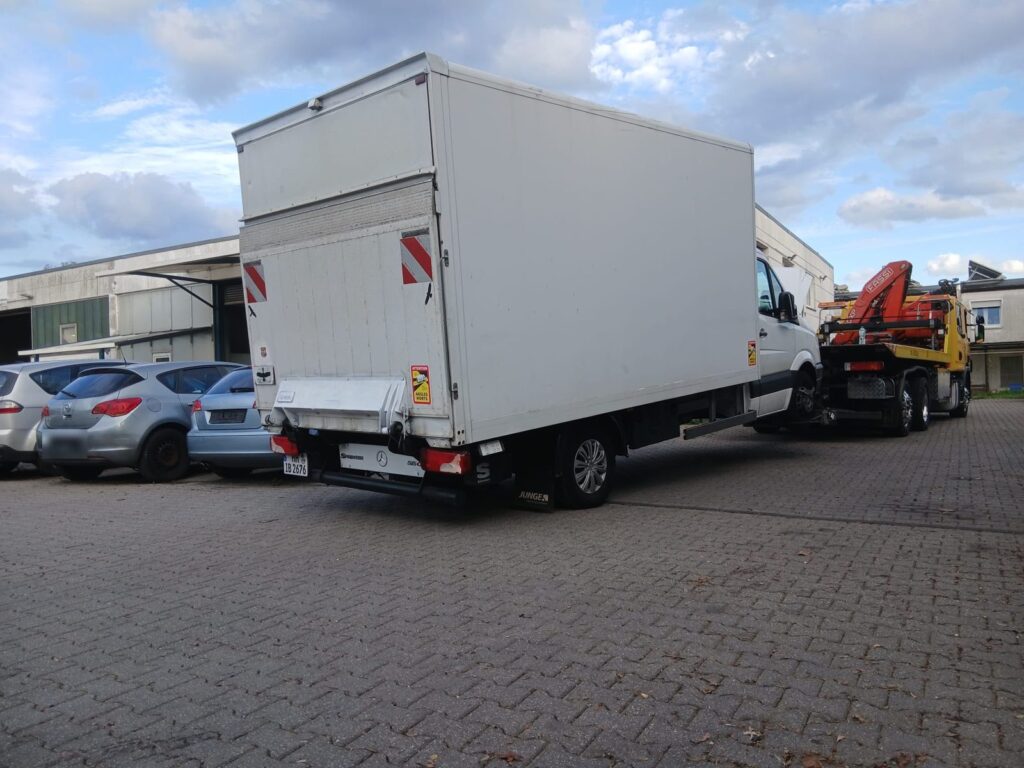
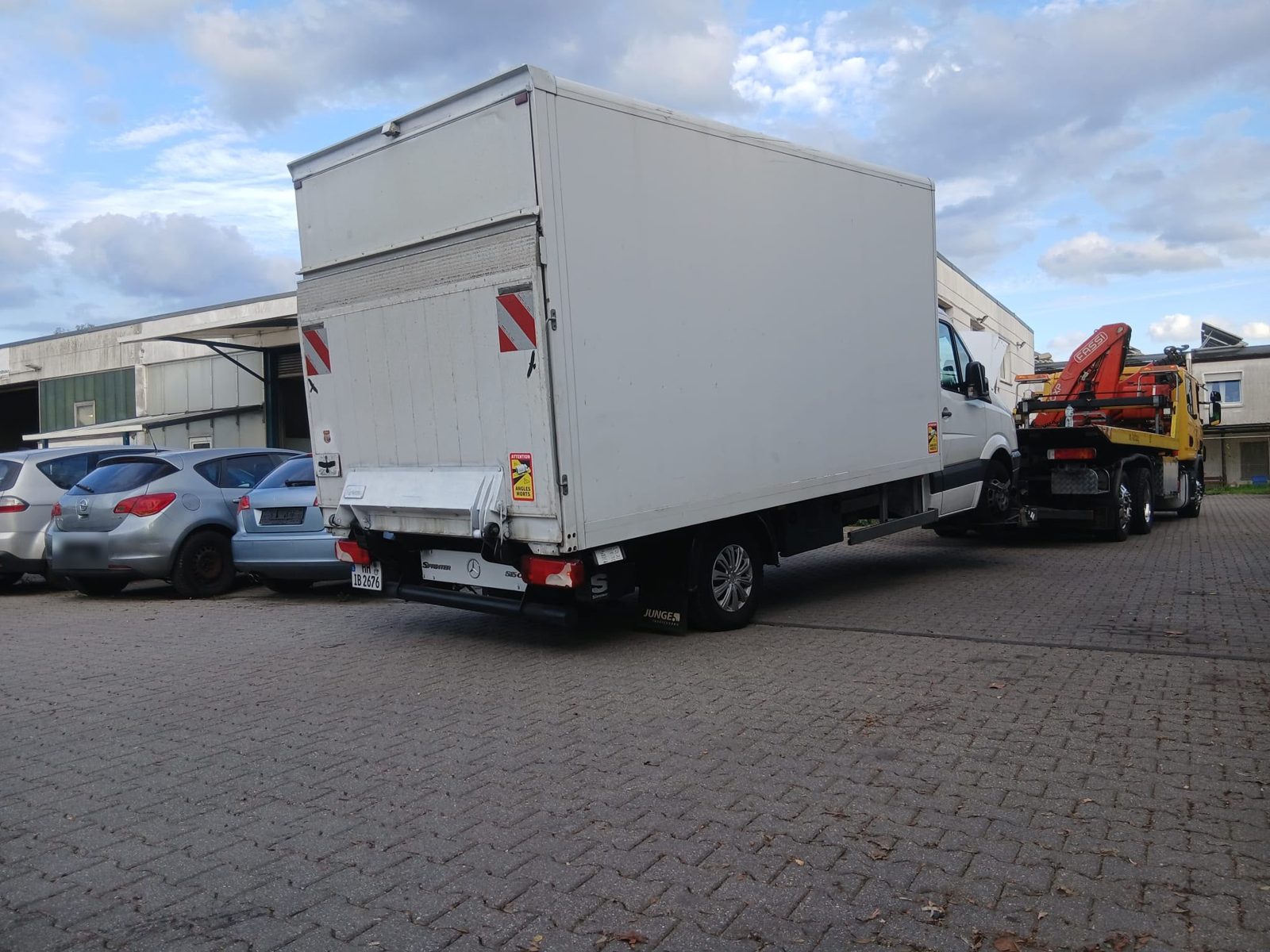
By 6:45 PM, the recovery truck arrived on scene. The vehicle was a three-axle, heavy-duty unit with a full hydraulic crane (Fassi model) mounted on the front. The crew consisted of two certified recovery technicians, both trained in road safety, vehicle stabilisation, and emergency response. Their first action was to assess the site conditions, evaluate the Sprinter’s position, and ensure the safety of all personnel and surrounding traffic.
The Sprinter was parked on a hard shoulder adjacent to a warehouse zone in Osnabrück. The area was flat, paved with cobblestones, and surrounded by low industrial buildings. There were no nearby obstacles, but the proximity of parked cars and the presence of other traffic meant that visibility and access needed to be carefully managed. The recovery team immediately set up a safety perimeter: two warning triangles placed 100 metres behind the vehicle, one at the edge of the hard shoulder, and a third at the roadside entry point. A portable warning light system was also deployed to increase visibility, especially as dusk was falling.
Next, the team conducted a visual inspection of the Sprinter. They confirmed the engine compartment was cold, no fluid leaks were visible, and the rear hydraulic lift gate was locked in place. The front wheels were straight, and the vehicle was on level ground. The parking brake was engaged, and the transmission was in neutral. The load inside was secured, with no signs of shifting. This was critical: any movement during lifting could compromise stability and damage the cargo.
The technicians then identified the correct lifting points, the front axle mounting brackets, which were designed for recovery operations. These points are reinforced and clearly marked on the Sprinter’s chassis. Using a custom-made steel cradle, they attached the Fassi crane’s lifting sling to these points. The cradle was positioned so that the front axle would be lifted evenly, preventing stress on the suspension or frame.
Before proceeding, the team double-checked the crane’s load capacity: 12 tonnes, well above the Sprinter’s 5-tonne mass. The hydraulic system was tested, and the winch cables were inspected for wear. Only after all safety checks were complete did the operation proceed. This methodical approach, following the guidelines set by the VBA-EV (Verband der Bergungs- und Abschleppunternehmen e.V.) and German safety standards, ensured that the recovery was not only fast but also safe.
The Lifting and Securing Process: Precision with a Fassi Crane
At 7:05 PM, the actual lifting operation began. The Fassi hydraulic crane was activated, and the front axle of the Sprinter was slowly raised off the ground. The process was smooth and controlled, with the crane’s sensors monitoring load distribution in real time. The front wheels lifted cleanly, and the capot (bonnet) of the Sprinter rose slightly, exposing the engine compartment, a clear sign that the vehicle was no longer supported by its wheels.
The lift was stopped at approximately 15 cm above the ground. At this point, the technicians inspected the cradle and lifting points again. They confirmed that the load was balanced and that no twisting or bending was occurring in the chassis. The Sprinter was now in a stable, suspended state, with only the rear axle in contact with the ground.
Next, two heavy-duty webbing straps were attached to the front frame rails and secured to the recovery truck’s platform. These straps were tensioned using a ratchet system, ensuring the Sprinter remained rigid during transport. The team also checked that the rear lift gate was locked and that no part of the cargo was at risk of falling during movement.
Once secured, the vehicle was gently lowered back onto the platform, with the front axle fully supported by the cradle. The final check included verifying that the vehicle was stable, that the straps were tight, and that the crane’s locking mechanisms were engaged. The entire process, from initial assessment to final securing, took 20 minutes. No damage occurred, and the vehicle remained in its original condition.
The use of a hydraulic crane was not just a preference, it was a necessity. A standard tow truck could not have lifted the front axle safely, especially with the Sprinter’s weight distribution and the risk of damaging the chassis. The Fassi crane’s precision, combined with trained personnel, allowed for a flawless operation. This is why many commercial fleets now specify crane-equipped recovery vehicles for vehicles like the Sprinter, especially in high-risk or high-value scenarios.
Transport to the Partner Workshop: Safe and Efficient
At 7:25 PM, the recovery vehicle began its journey to the partner workshop, located approximately 35 kilometres away in a nearby logistics hub. The route was carefully planned to avoid congested areas and high-speed zones, ensuring a smooth, uninterrupted transport. The Sprinter remained fully secured on the platform, with the front axle locked in place and the rear wheels off the ground.
During transit, the recovery team monitored the vehicle’s stability every 10 minutes. They checked the strap tension, ensured no vibrations or shifting occurred, and kept communication open with the workshop. The journey took 22 minutes, well within the expected timeframe for a 35-kilometre haul at 80 km/h, given the size and weight of the recovery unit.
Upon arrival at the partner workshop at 7:47 PM, the team performed a final inspection. The Sprinter was still securely fastened, and the cargo remained intact. The workshop staff confirmed readiness to receive the vehicle, and the formal handover began. The recovery team detached the crane, removed the straps, and transferred the vehicle to a dedicated repair bay. The driver was briefed on the next steps and accompanied to the workshop reception.
The entire process, from the initial call to the final handover, took exactly 130 minutes (2 hours 10 minutes). This included 45 minutes from dispatch to arrival, 20 minutes for on-site preparation, 25 minutes for lifting and securing, 22 minutes for transport, and 13 minutes for the final handover. The speed and efficiency were made possible by a well-coordinated network, trained personnel, and the right equipment.
Full Cost Breakdown: Transparent Pricing, No Hidden Fees
| Position | Price (EUR) |
|---|---|
| Arrival of recovery vehicle with crane | 260 |
| Recovery and loading (1.5 hours × 120 EUR/hour) | 180 |
| Transport over approx. 35 km | 480 |
| Total (net, excluding VAT) | 920 |
All prices are exclusive of VAT and reflect current market rates for professional recovery services in Germany. The cost structure is fully transparent and includes:
- Anfahrt (arrival fee): 260 EUR, covers the mobilisation of a heavy-duty recovery truck with a Fassi crane, including fuel, personnel, and equipment.
- Bergung und Verladen (recovery and loading): 180 EUR, for 1.5 hours of on-site work, including safety checks, securing, lifting, and stabilisation.
- Transport: 480 EUR, for a 35-kilometre journey at standard rates for heavy vehicles.
This total of 920 EUR is competitive and reflects the complexity of the operation. For comparison, a standard tow truck without a crane would have cost less upfront but could not have safely recovered the Sprinter. The alternative, waiting for a general tow service or attempting self-tow, would have risked damage, increased downtime, and potential fines.
It’s also important to consider the opportunity cost of downtime. For a courier or logistics company, a 5-ton Sprinter out of service for one day can cost between 300 and 500 EUR in lost revenue, missed deliveries, and customer penalties. In this case, the recovery service was completed in under two and a half hours, minimising downtime and protecting the client’s operational continuity.
Why Professional Recovery Is Essential
Attempting to recover a 5-ton commercial vehicle like the Mercedes Sprinter without professional equipment and training is not only risky, it’s illegal in many cases. Here’s why:
- Safety Risk: Lifting the front axle without proper equipment can cause chassis deformation, suspension damage, or even structural failure.
- Legal Non-Compliance: Under §15a StVO, improper towing or securing of a vehicle on a motorway can result in fines and liability.
- Secondary Damage: Improper loading can damage the cargo, the vehicle, or the recovery vehicle itself.
- Increased Downtime: A botched recovery often leads to delays, additional repairs, and higher costs.
- Insurance Issues: Many insurers require that recovery be performed by certified professionals. Unauthorized towing may void coverage.
In this case, the use of a Fassi crane-equipped recovery truck ensured compliance with all safety and legal standards. The team followed VBA-EV guidelines, used certified equipment, and documented every step. This level of professionalism is what separates a reliable recovery service from a dangerous improvisation.
Common Scenarios We Handle Across Germany
Our network handles a wide variety of breakdowns daily. Typical cases include:
- Engine compartment failures (like this Sprinter case), common in older models or under high load.
- Electrical system faults, especially in vehicles with complex onboard electronics.
- Brake or steering issues, particularly in trailers or heavy-duty units.
- Tyre blowouts, especially on high-speed routes.
- Accidents on motorways, including side collisions or rollovers.
- Vehicle stuck in mud, snow, or soft ground, common in rural or construction zones.
We’re equipped to handle everything from light vans to 40-tonne semi-trailers. Our partner network spans the entire country, ensuring fast response times regardless of location.
Preventive Tips for Drivers and Fleet Managers
To avoid breakdowns like this, consider these preventive measures:
- Regular engine compartment inspections, check for loose wires, corrosion, or fluid leaks.
- Monthly electrical system checks, especially for vehicles with advanced diagnostics.
- Proper load distribution, avoid overloading the front axle.
- Use of diagnostic tools, modern OBD2 scanners can detect early warning signs.
- Emergency kit, include warning triangle, high-vis vest, jumper cables, and basic tools.
The Role of Mercedes-Benz and Fassi in Recovery
Mercedes-Benz Sprinter vehicles are widely used in logistics due to their reliability and versatility. However, their engine compartments are complex, and failures, especially in the wiring harness or ECU, can be difficult to diagnose without specialist tools. That’s why recovery by trained professionals is crucial.
Fassi, a leading manufacturer of hydraulic cranes for recovery vehicles, provides the technology that enables safe lifting and transport. Their systems are designed for precision, durability, and compliance with European safety standards. When combined with expert personnel, they form the backbone of modern recovery operations.
Why Choose LKWHelp24?
- 24/7 availability, we respond day or night, across Germany.
- Trusted partner network, all technicians are certified and insured.
- Transparent pricing, no hidden fees, no surprises.
- Multilingual support, English, German, Polish, Russian available.
- Fast response times, average arrival within 45–70 minutes on motorways.
Summary: Key Facts from the Case
- Vehicle: Mercedes-Benz Sprinter (5-ton, dry cargo body, rear hydraulic lift gate)
- Location: A30/A1 interchange near Osnabrück, Niedersachsen
- Issue: Engine compartment failure, no self-propulsion
- Response Time: 10 minutes from call
- Arrival on Scene: 6:45 PM
- Total Time to Workshop: 130 minutes (2h 10min)
- Total Cost: 920 EUR (net)
- Secondary Damage: None
- Vehicle Status: Fully secured, no damage
Need Emergency Recovery? Call Us Now
📞 +49 160 5753826
🌐 www.lkwhelp24.com
✅ 24/7 Service | ✅ All of Germany | ✅ Transparent Pricing
Keywords
i need a tow truck | tow truck germany | tow truck | tow service | heavy duty towing | truck towing | recovery near me | tow vehicle | towing and roadside assistance | local tow company | vehicle recovery near me | 24 hour tow truck service | wreckers towing | tow truck near me | towing companies in my area | urgent towing | heavy towing near me | truck towing germany | tow company near me | call tow truck
Related Articles
- Truck Recovery from Mud – Mercedes-Benz Actros Pulled from Waterlogged Ground (24/7)
- Case Report | Truck Towing: Towing Service Münster (48143–48167) & Surrounding Area | Trailer with Brake Disc Damage Recovered: Costs & Process
- Heavy Truck Recovery Service: When Towing Is Not Enough
- Truck Recovery A7 Near Hildesheim: Crane Salvage of a Tractor Unit After a Road Accident in 6 Hours 15 Minutes
- Rear tyre blowout on an Iveco Eurocargo pulls truck off the B2 near Augsburg: verge recovery and on-site tyre fit in 50 minutes