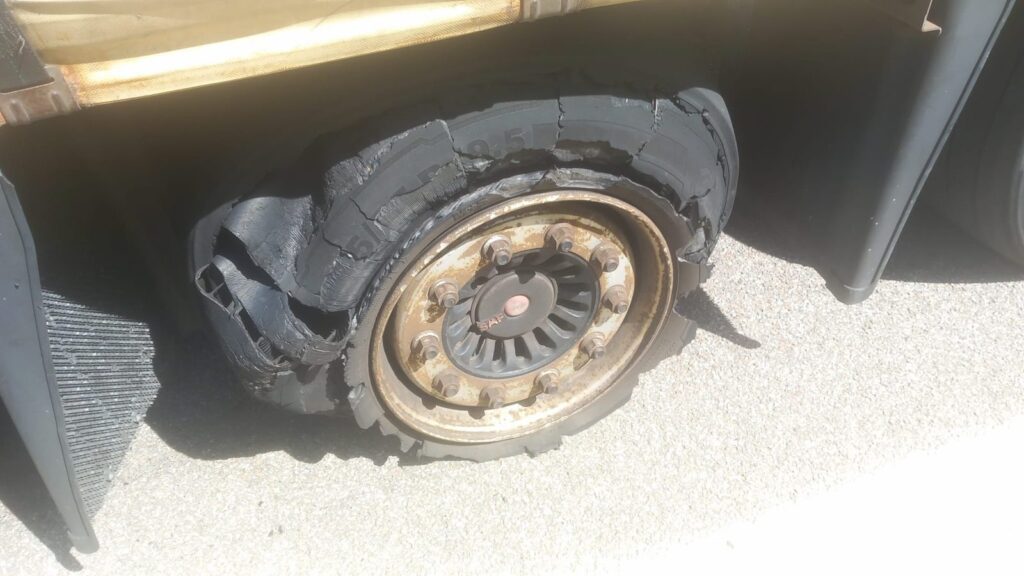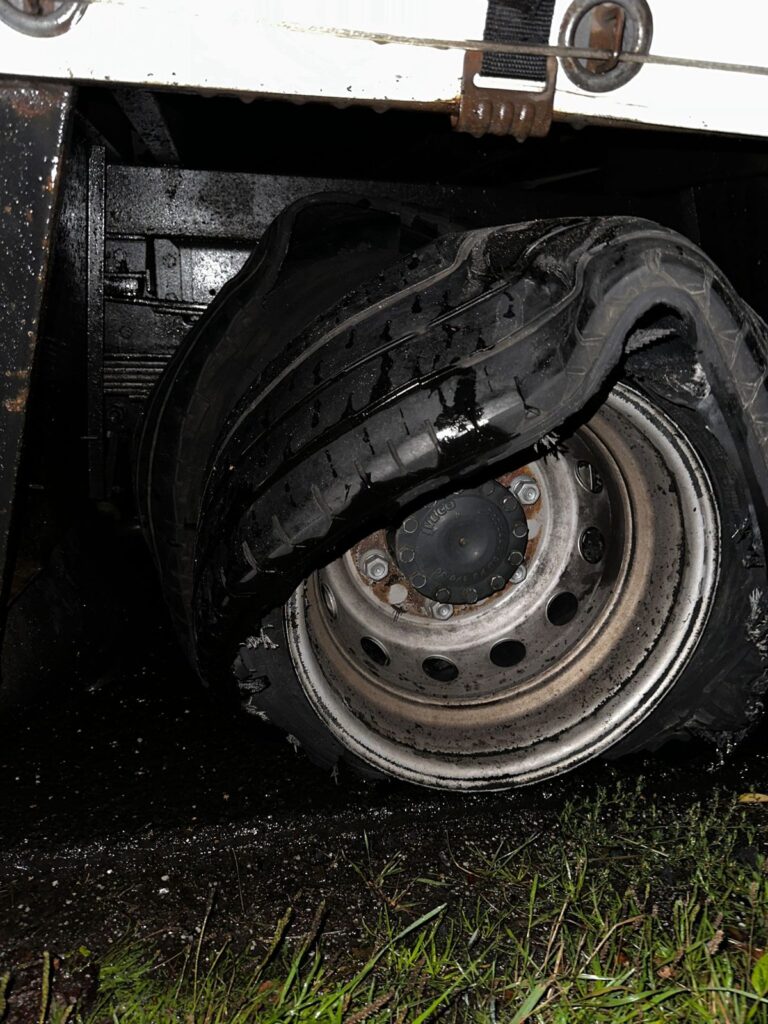
In short: on the evening of 1 September 2026 the rear tyre of an Iveco light commercial vehicle burst on the A5 near Karlsruhe, heading towards Basel. Our dispatcher took the call, sent a mobile crew from our partner network within 12 minutes, and the crew arrived 40 minutes later in rain and fading light. A new 235/65 R16C tyre was fitted on the roadside, and the driver rolled on after 1 hour 50 minutes from the first ring. The bill was 565 EUR net, and nothing else was damaged.
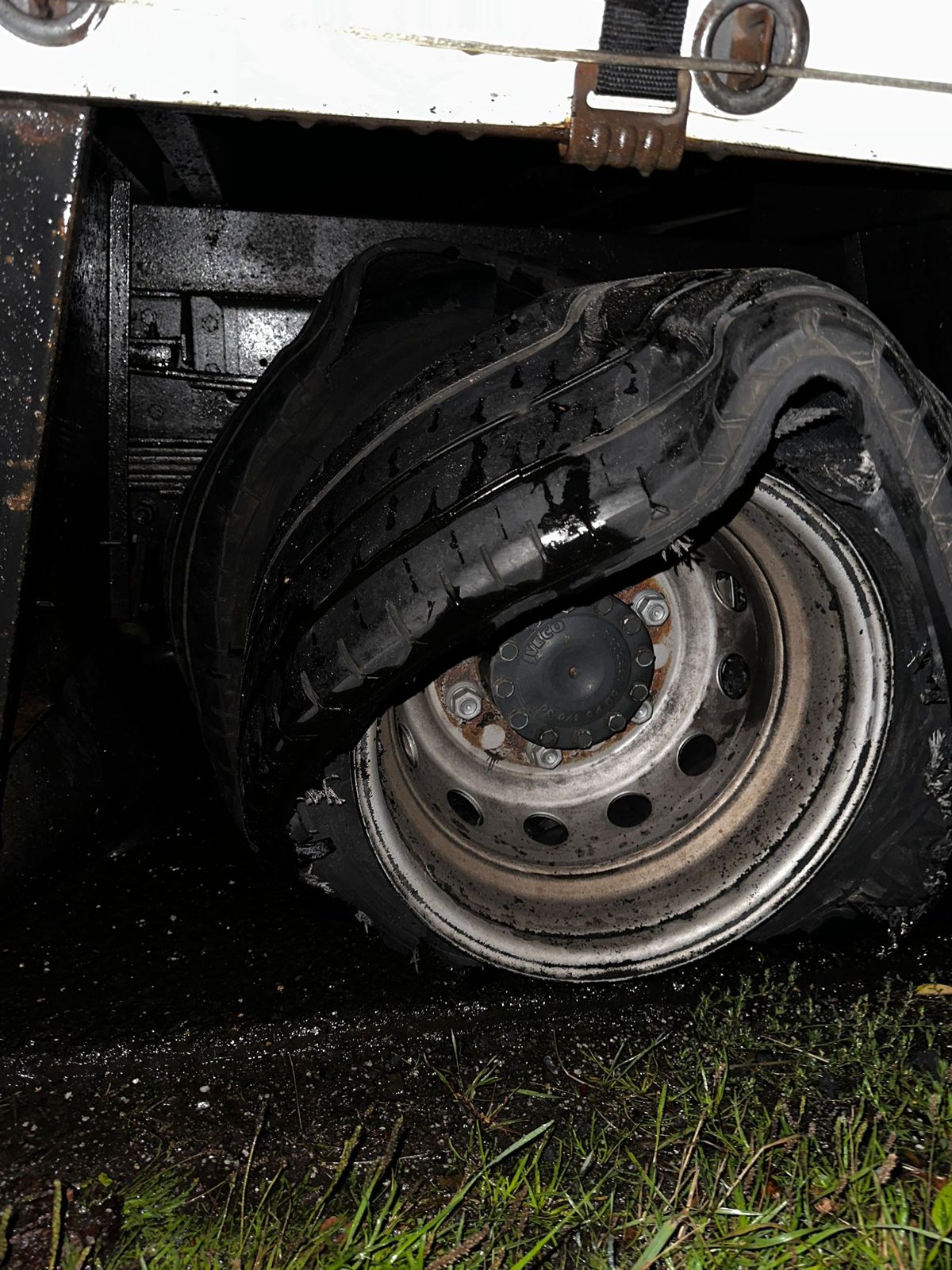
A tyre that comes apart at motorway speed is never a small problem, even on a van. The tread peels off, the sidewall flaps, and loose cord whips against the wheel arch, brake hoses and wiring. Our truck tyre service gets calls like this every week, and this case shows how a mobile tyre service should work when the light is going, the road is wet and the driver is standing on the hard shoulder with a delivery waiting.
The short version for anyone reading on a phone at the roadside: stop safely, switch on the hazards, put out the warning triangle, and call us. The long version, with the full timeline, the price breakdown and some honest advice on prevention, follows below.
The emergency: a rear tyre blowout on the A5
The vehicle was an Iveco light truck of the Daily class, a flatbed with a white body, tie-down eyes and a strap across the load. It was travelling south on the A5 near Karlsruhe, towards Basel, when the left rear tyre let go. The driver felt the back end twitch, lifted off the throttle, held the wheel straight and coasted onto the hard shoulder. That reaction is exactly right, and it is the reason this story ends with a price list and not an accident report.
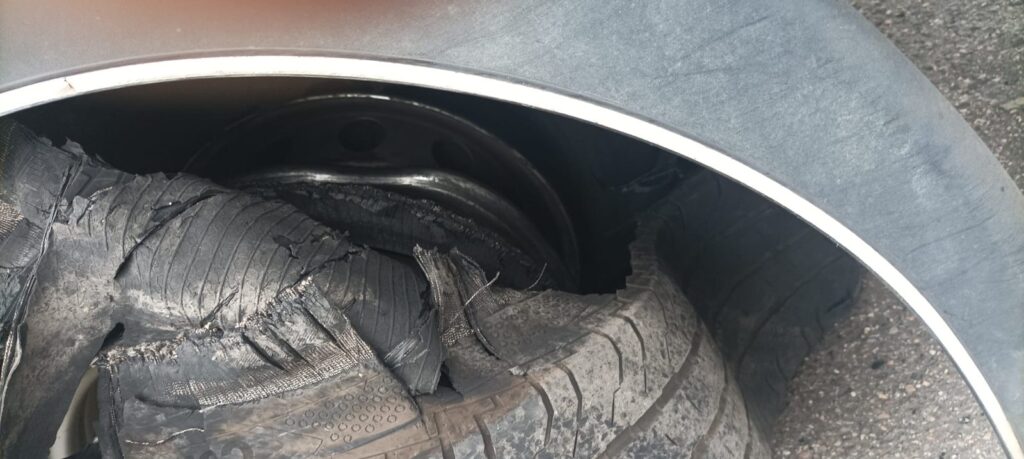
Once the van stood still, the damage was plain to see. The tyre had burst completely: the sidewall and carcass were turned inside out, strips of cord hung from the bead, and the tread had torn away from the edge. The steel rim looked intact, though a rim can hide a bend that only shows once the tyre is off. The wheel studs wore a coat of surface rust, which is normal on a working vehicle.
The size was not readable on the remnants, so we planned with 235/65 R16C, the standard fitment for vans in this class. The “C” matters. It marks a commercial tyre built for heavier loads and higher pressures than a passenger car tyre of the same diameter, so a car tyre is never an acceptable substitute.
The conditions were poor. It was dusk, the tarmac was wet, and spray from passing lorries hung in the air. Anyone who has stood next to a motorway at that hour knows how little room there is and how fast the traffic moves. This is why we treat the first call as a safety matter before it becomes a tyre matter.
How we organised the help
The call came in at 0:00 on our clock. The driver reported a burst rear tyre, said he had stopped on the hard shoulder, switched on the hazard lights and set out the warning triangle. He had done all of it before calling, which saved time and kept him safe.
Our dispatcher then worked through a short checklist, in this order:
- Location. Motorway, direction of travel, nearest junction or rest area, and which side of the carriageway the van stood on.
- Vehicle and tyre. Make and model, axle, and the size if the driver could read it. Here he could not, so we confirmed the Daily class and planned with 235/65 R16C.
- Spare wheel. Whether a usable spare was on board. A spare can sometimes make the job faster, but this one was not suitable for a safe repair, so we brought a new tyre.
- Driver safety. Where he should stand (behind the crash barrier, not in the vehicle) and what to do if conditions worsened.
- Crew and arrival time. The nearest mobile crew from our partner network, and an honest estimate given to the driver.
By 0:12 the job was assigned and the driver had his arrival window. Twelve minutes sounds like a lot until you consider what happens in them: a call is taken in the driver’s language, a crew is checked for availability and stock, and a confirmation goes back before the driver starts to worry. Our dispatch desk works around the clock and handles German, English, Polish and Russian, which in practice means most drivers on German roads can explain their problem without a struggle. You can read more about this service on our page for mobile truck service.
The crew drove 40 minutes in the rain and arrived at 0:52. That is a realistic figure for a motorway call in the Karlsruhe region in the evening. In heavy weekday traffic or in snow, it can take longer, and we say so when we confirm the job.
The situation at the roadside
Why not just drive on? Because a destroyed tyre on a rear axle is not a cosmetic problem. A van in this class runs its tyres at roughly 5 to 6.5 bar depending on load, and a heavy lorry tyre at 8.5 to 9.5 bar. At those pressures a tyre that has lost its sidewall cannot carry load at all, and the rim would run directly on the road. Within a few hundred metres the steel is bent, the bead seat is damaged and the wheel is ruined.
There is more. A blown tyre leaves the loose belt and cord wrapped around the wheel arch. These fragments can cut brake hoses, snag ABS sensor cables and tear at the wheel arch lining. A crew that only swaps the tyre without checking these parts may leave a hidden defect that shows itself weeks later at the worst moment.
There is also the legal side. Under § 36 StVZO, tyres must be suitable for the vehicle and in a roadworthy condition. Driving on a torn tyre would breach this rule and also put the driver and everyone behind him at risk. In short, the van was not going anywhere until the wheel was fixed, and the only question was how fast and how safely that could be done.
Two points on the vehicle itself. The Iveco carried a flatbed body and a strapped load, so the weight sat mostly over the rear axle. That makes a rear blowout more demanding than one on an empty van, because the loaded axle puts more stress on the rim and the remaining tyre of the twin pair, if fitted. We checked all of this before lifting the vehicle. For background on this vehicle family, see Iveco emergency service and typical breakdowns.
Step by step: how the tyre was replaced
Every mobile truck tyre change we do follows the same five steps. The order never changes, whatever the size of the vehicle.
Step 1: inspection
The crew arrived at 0:52 and spent the first eight minutes looking, not lifting. They checked the rim for cracks and bends, the hub and wheel studs for damage, the wheel arch, the brake hoses and the ABS cable. The rim was undamaged, the studs were sound, and the hoses had survived without a nick. This inspection decided the whole job: had the rim been bent, the bill would have been higher and the job longer.
Step 2: securing the site
Before touching the vehicle, the crew placed their own vehicle behind the van with its warning beacon running, laid out cones and made sure the driver stood behind the crash barrier. On a wet motorway shoulder, this takes a few minutes and is not optional. The hard shoulder is the most dangerous place to work, a point we cover in our article on a tyre blowout on the autobahn and what to do first.
Step 3: removing the wheel
At 1:12 the axle went up on a hydraulic jack set on a firm plate (soft verge ground is no place for a jack). The wheel nuts were loosened, the wheel came off, and the remains of the old tyre were cut away from the rim. The rubber and cord fragments were collected and bagged. We leave nothing on the shoulder.
Step 4: fitting the new tyre
By 1:30 the new 235/65 R16C was seated on the rim. The crew cleaned the bead seat, fitted a new valve, inflated the tyre to the pressure given on the vehicle’s placard and balanced the wheel. Balancing is skipped by cheaper callouts, and it shows later as a shimmy through the steering column and uneven wear. Then the wheel went back on the hub.
Step 5: final check
At 1:42 the wheel nuts were tightened crosswise (in a star pattern, never in a circle) with a calibrated torque wrench to the figure in the manufacturer’s handbook. The pressure was checked once more. At 1:50 the job was signed off and the Iveco rejoined the traffic towards Basel. The correct nut sequence and values are explained in our guide to truck wheel nut torque.
Full timeline: from call to departure
The table shows exactly how the 110 minutes were spent.
| Time | Phase | Action |
|---|---|---|
| 0:00 | Call | Driver reports a burst rear tyre, has stopped on the hard shoulder, switched on the hazard lights and set out the warning triangle |
| 0:12 | Dispatch | Location, tyre size and spare wheel confirmed; partner crew sent; driver given the arrival time |
| 0:52 | Arrival | Mobile crew on site after 40 minutes on the road in dusk and rain |
| 1:00 | Inspection and securing | Rim, hub, wheel arch and brake hoses checked for damage from cord fragments; site secured |
| 1:12 | Removal | Axle jacked up, wheel removed, remains of the tyre taken off the rim |
| 1:30 | Fitting | New 235/65 R16C fitted, inflated, balanced and mounted |
| 1:42 | Final check | Wheel nuts tightened crosswise with a torque wrench, pressure checked |
| 1:50 | Done | Van continues its journey |
Total: 110 minutes (1 hour 50 minutes) from the call to departure. Of this, 52 minutes were taken up by dispatch and the drive, and 58 minutes by work at the roadside. The work itself was quick because the rim was sound and a tyre of the right size was on the truck. If either had been different, we would have added time and told the driver at once.
What did it cost?
The cost of a truck tyre callout depends on the distance, the time of day, the tyre and the labour. In this case the figures were as follows. All amounts are in euros and net, plus VAT (zzgl. MwSt.).
| Item | Price (EUR) |
|---|---|
| Callout (Anfahrt to the motorway) | 220 |
| Labour (1 hour of mobile tyre fitting) | 110 |
| New tyre 235/65 R16C (van) | 220 |
| Disposal of the old tyre | 15 |
| Total | 565 |
The rim did not need replacing, so no wheel costs appear. The invoice is clear, and the driver knew the figure before the crew set off.
What drives the price up or down
Four things move the total. Distance and time of day: a callout at night, at the weekend or on a public holiday carries a surcharge of 25 to 50 per cent. Tyre size: a 315/80 R22.5 for a tractor unit costs roughly 480 to 620 EUR on its own, a 385/65 R22.5 trailer tyre 420 to 540 EUR, a 245/70 R19.5 about 320 to 420 EUR, while the van tyre here was 220 EUR. Damage to the rim or hub: a bent rim means a new wheel and a longer job. Extra work: a second tyre on the same axle, or a lost valve cap, adds time.
For a heavy lorry, a typical roadside tyre job on the motorway comes to 750 to 1,400 EUR. A van lies at the lower end, between 350 and 600 EUR, and this job at 565 EUR sits within that range. If you want a broader view of numbers, our truck tyre change cost article goes through the factors in more detail.
Compared with the alternative
What would waiting have cost? A van that stands still earns nothing, and a heavy lorry stuck for a day costs its operator somewhere between 800 and 1,200 EUR in lost revenue, driver hours and missed deliveries. Towing a vehicle to a workshop would have added hundreds of euros, taken longer, and left the vehicle off the road until the workshop had the tyre in stock. The 565 EUR for a roadside repair was the cheapest option in every sense.
Why you should not change the wheel yourself
Every driver can in theory change a wheel, and for a passenger car on a quiet lane it is fine. For a commercial vehicle on a motorway shoulder in the dark, we advise against it, for these reasons:
- Traffic. Working next to fast traffic is where most roadside injuries happen. A vehicle of this weight leaves almost no space between the wheel and the lane.
- Wrong jack. The scissor jack in the toolkit is made for light loads, not for a loaded flatbed. A slipping jack under a rear axle is a serious hazard.
- Torque. Nuts tightened by hand or with an impact wrench to a guessed figure either loosen on the road or stretch the studs.
- Hidden damage. The inspection of hoses, cables and the rim is what makes the repair safe. Most drivers do not know where to look.
- Tyre pressure and bead seating. Inflating a tyre badly can make it burst while being fitted.
- Disposal and paperwork. Old tyres are waste and have to be handled properly.
In summary, a trained crew with the right equipment works faster and with fewer risks than a driver on his own. If you wish to read about what a professional does for a driver on the spot, our page on tyre service lists the options.
Typical situations we attend across Germany
This job was a van on the A5, but the calls vary from week to week. The most common cases are:
- Truck tyre burst on a tractor unit, often on the drive axle, after a long run at high temperature or after running underinflated.
- Trailer tyre service after a puncture from a nail, a screw or road debris, especially on a semi-trailer standing in a rest area.
- Flat tyre on a rest area found by the driver after a break, with no spare and no tools.
- Emergency wheel change after kerb damage, a cracked rim or a missing wheel nut.
- Damage from a collision with a pothole on the construction sites of the A5, A8 and A3, which can destroy a sidewall without any warning.
- Tyre damage in winter, from frozen slush, snow chains or sudden temperature changes.
- Night callouts, when the nearest tyre shop is closed and the driver has to be on the road at six.
Tyre problems are not limited to heavy goods vehicles. Vans, coaches, car transporters and motorhomes also come to us. You will find examples among our emergency tyre service for trucks cases.
Prevention: how drivers and fleets avoid a blowout
Most blowouts are not sudden at all. They are the end of a slow process that someone could have spotted. These habits cut the risk sharply.
Check the pressure. Cold pressure should be checked at least every two weeks and before every long trip. A tyre running 20 per cent below its pressure builds heat quickly, and heat is the main cause of blowouts. Our guide to truck tyre pressure shows the values and how to measure them.
Look at the tyre. Walk around the vehicle before leaving. Look for cuts, bulges in the sidewall, embedded objects and uneven wear. The minimum tread depth in Germany is 1.6 mm for most vehicles, but many fleets replace earlier, at 3 mm or more, for better grip on wet roads.
Respect the load rating. The load and speed index on the sidewall is a limit and not a suggestion. An overloaded axle heats the tyre from within. Light commercial vehicles with a flatbed body, like the Iveco in this case, often carry more on the rear axle than drivers realise.
Mind the age. A tyre loses elasticity even when it is not used. Tyres older than six years deserve a close inspection by a specialist, whatever the tread says.
Fit matching tyres. Twin tyres on one axle should be the same size, make and similar in wear. A mismatch makes one tyre carry the other’s load.
Keep the wheel nuts checked. After a wheel change, nuts should be re-torqued after 50 to 100 km. Loose nuts are a quiet cause of serious accidents.
Plan for the call. Save the number of a 24-hour service in your phone and your fleet documents before you need it. Drivers who know whom to ring lose less time.
Tyres, brands and fleet care
A short word on the tyres themselves. The market for commercial tyres is led by a handful of manufacturers, among them Michelin, Continental, Goodyear and Bridgestone. All four sell tyres for vans, for tractor units and for trailers, and all four have models designed for regional work, long-haul and mixed use. We fit what the customer’s vehicle needs and what we can obtain quickly, which on a motorway callout usually means a well-known premium or mid-range brand in the right size.
For vans such as the Iveco Daily, the 235/65 R16C is a very common size, and a C-rated tyre has a reinforced carcass for a higher load. When selecting a tyre, the load index and speed rating on the vehicle registration are the numbers to match. A tyre with a lower load index than the original is not an option, however good the price. If the markings look like code to you, our article on reading truck tyre markings explains the size, load index and DOT code.
For fleets, the best investment is regular inspection. A planned check of every wheel in the depot costs a fraction of one roadside callout and takes the pressure off the dispatcher. Tyre rotation between axles, pressure monitoring and retreading of casings in good condition all cut the cost per kilometre. Many operators also keep a small supply of the most common sizes at the yard so that a replacement is ready when a driver reports a problem.
The manufacturer’s own service network is also worth knowing. Iveco publishes service guidance for its vehicle range on iveco.com, and for unusual faults or warranty questions this is the first stop. For a tyre blowout on a motorway, however, you want a crew at your side in an hour, and that is where a mobile service helps. For vehicles with bigger faults, our truck workshop can take over the repair.
FAQ: questions drivers ask us
How long does a truck tyre change on the motorway take?
From the call to the departure, expect 1.5 to 3 hours. In this case it was 110 minutes: 12 minutes of dispatch, 40 minutes of driving for the crew and 58 minutes of work. Rain, darkness, heavy traffic and rim damage all add time, and we tell the driver at the start.
What does a mobile tyre service cost in Germany?
For a van, expect roughly 350 to 600 EUR net, and for a heavy lorry 750 to 1,400 EUR net. The case above came to 565 EUR net for an Iveco van: 220 for the callout, 110 for labour, 220 for the tyre and 15 for disposal. Night and weekend work carries a surcharge of 25 to 50 per cent.
Can I drive a short distance on a burst tyre?
No. Even a few hundred metres on a destroyed tyre ruins the rim, can cut brake hoses and may cause you to lose control. Stop safely, switch on the hazards, set out the warning triangle, stand behind the crash barrier and call for help.
Do you work at night and at weekends?
Yes, our truck tyre callout service runs 24 hours a day, 365 days a year, anywhere in Germany. Night and weekend jobs carry a surcharge, but the response is the same. Dispatch is handled in German, English, Polish and Russian.
Do I need to know the tyre size when I call?
It helps, but you do not need it. The dispatcher will ask for the vehicle make, model and axle, and the size is on the tyre sidewall, for instance 235/65 R16C or 315/80 R22.5. If the tyre is destroyed, we can work out the size from the vehicle type or the registration document.
Is a tyre repair possible, or must the tyre be replaced?
A burst tyre cannot be repaired. A small puncture in the tread area of a truck tyre sometimes can be, if the casing is intact. Our article on truck tyre repair explains when it works and when it does not.
Why drivers and fleets choose us
Our service is built around a few simple things. We answer the phone at any hour, we say honestly how long the job will take, and we give the price before the crew leaves. We work with a network of vetted partner crews across Germany, so the nearest team is usually less than an hour away on a motorway. The dispatch desk speaks four languages, so a Polish or a Lithuanian driver does not need to hunt for the right words at the roadside.
We also take care over the boring parts: a torque wrench on every job, a documented invoice, correct disposal and a check of the parts nearby that a blown tyre may have damaged. None of this is glamorous, but it is why most drivers who call us once call us again.
Summary
- Vehicle: Iveco light commercial vehicle (Daily class), flatbed body, rear tyre blowout
- Tyre: 235/65 R16C (assumed size for this vehicle class)
- Location: A5 near Karlsruhe, towards Basel, hard shoulder
- Conditions: dusk, rain, wet tarmac
- Response: dispatch in 12 minutes, crew on site after 52 minutes (40 minutes of driving)
- Work at the roadside: 58 minutes, from inspection to final torque check
- Total time: 110 minutes (1 hour 50 minutes) from call to departure
- Cost: 565 EUR net (callout 220, labour 110, tyre 220, disposal 15)
- Secondary damage: none, rim, hub and brake hoses intact
Need help now?
If a tyre has burst, stop safely, switch on the hazard lights, set out the warning triangle and call us. Our dispatchers will find the nearest crew and give you a time and a price before anyone sets off. You can also find the contact details on our contacts page.
Call +49 160 5753826
www.lkwhelp24.com
Around the clock, all over Germany.
Keywords: truck tyre service | mobile tyre service | truck tyre replacement | truck tyre change | truck tyre callout | truck tyre roadside assistance | truck tyre repair | truck tyre burst | truck tyre breakdown | truck tyre blowout | trailer tyre service | van tyre replacement | emergency wheel change | A5 Karlsruhe | Iveco tyre blowout | mobile Reifenservice