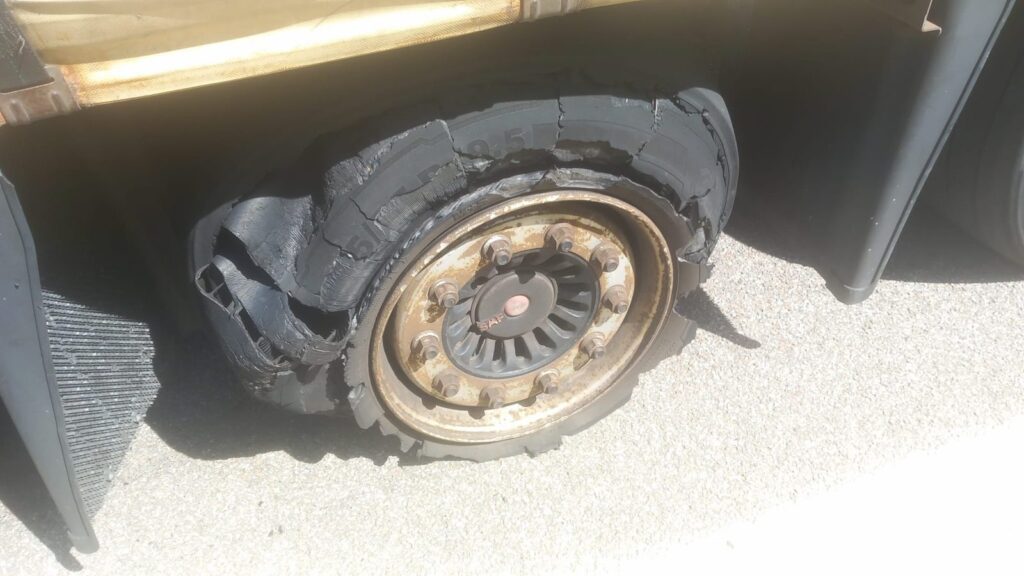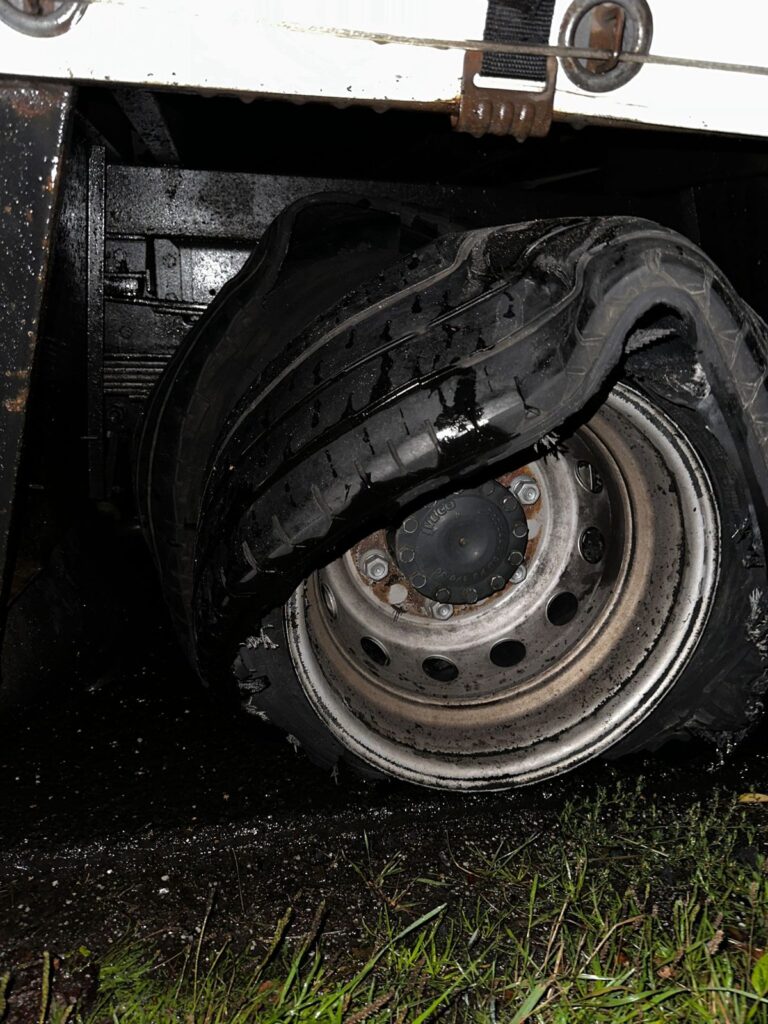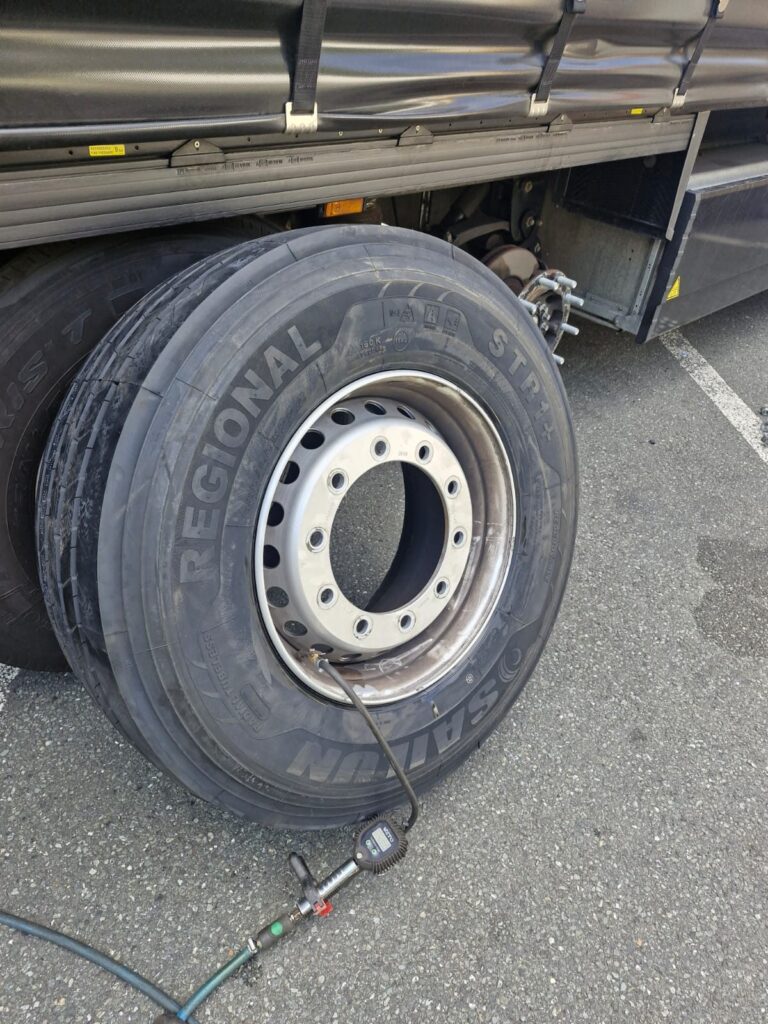
In short: a curtainsider semi-trailer lost air in one of its tyres on the A7 near Kassel. The driver pulled into a lay-by beside the crash barrier at 08:55 and rang us. Our partner crew arrived 60 minutes later, fitted a checked spare wheel, and the rig was rolling again at 11:10. Total time from call to departure: 135 minutes. Total cost: 525 EUR net, with no secondary damage to the axle, hub or rim.
A slow puncture is the kind of fault that rarely looks dramatic. There is no bang, no shredded rubber across three lanes, just a tyre that sits a little lower each hour. That is exactly why it is dangerous: a 385/65 R22.5 tyre running at half pressure heats up, flexes its sidewall and can fail without warning. Here is how a calm, well-organised truck tyre service call went from first phone call to the driver’s next delivery.
The emergency: a slow leak on the A7 near Kassel
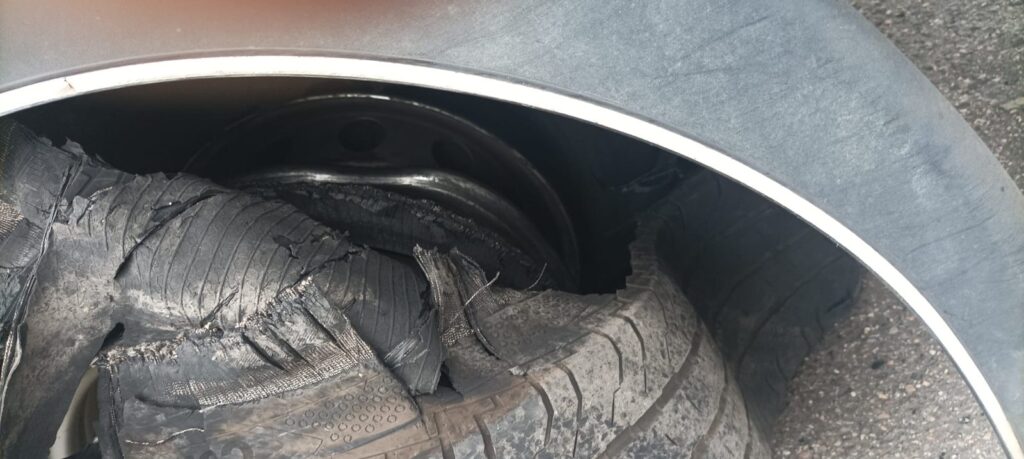
A semi-trailer tyre on the A7 south of Kassel, heading towards Göttingen and Hanover, was losing pressure steadily because of a faulty valve. The driver noticed the drop on the tyre pressure display and the feel of the trailer, and he did the sensible thing: he left the carriageway at the next lay-by and stopped beside the crash barrier.
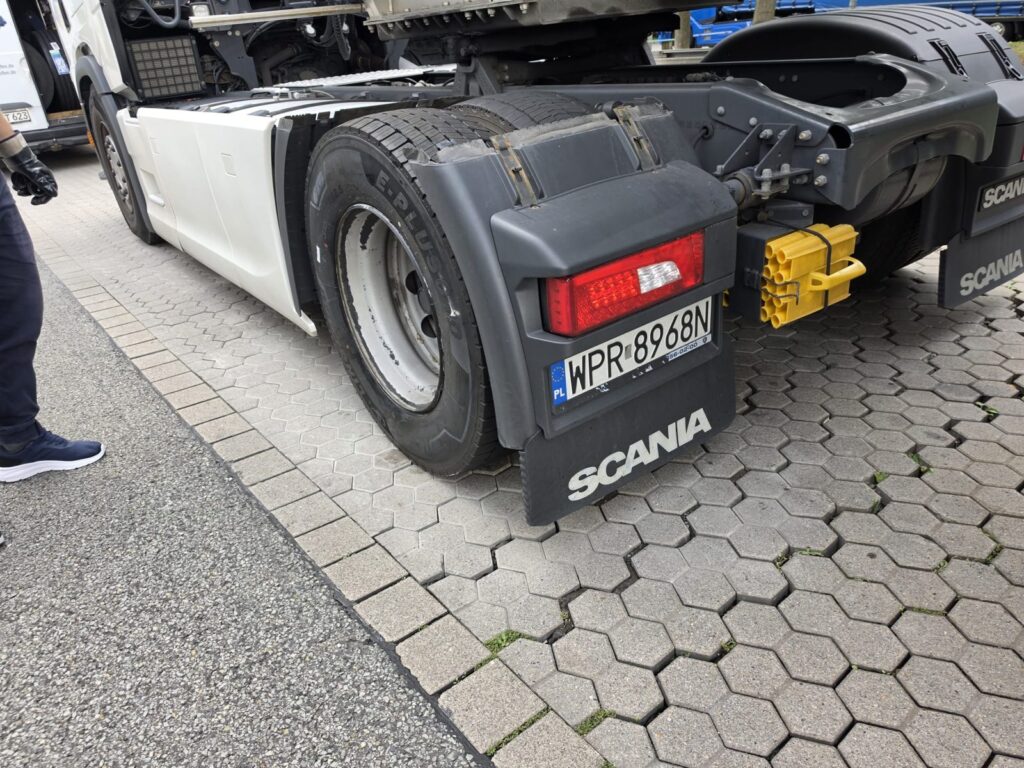
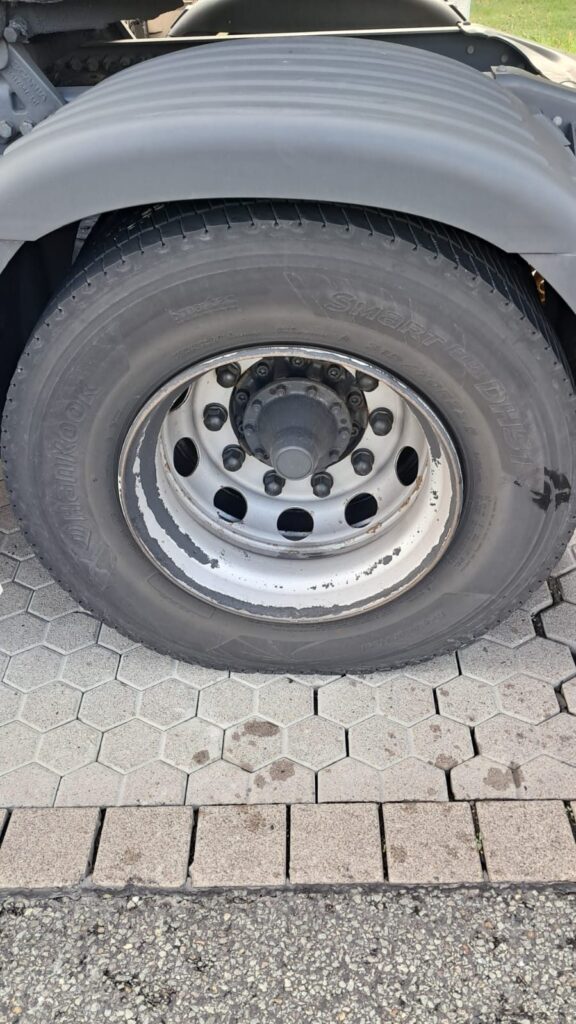
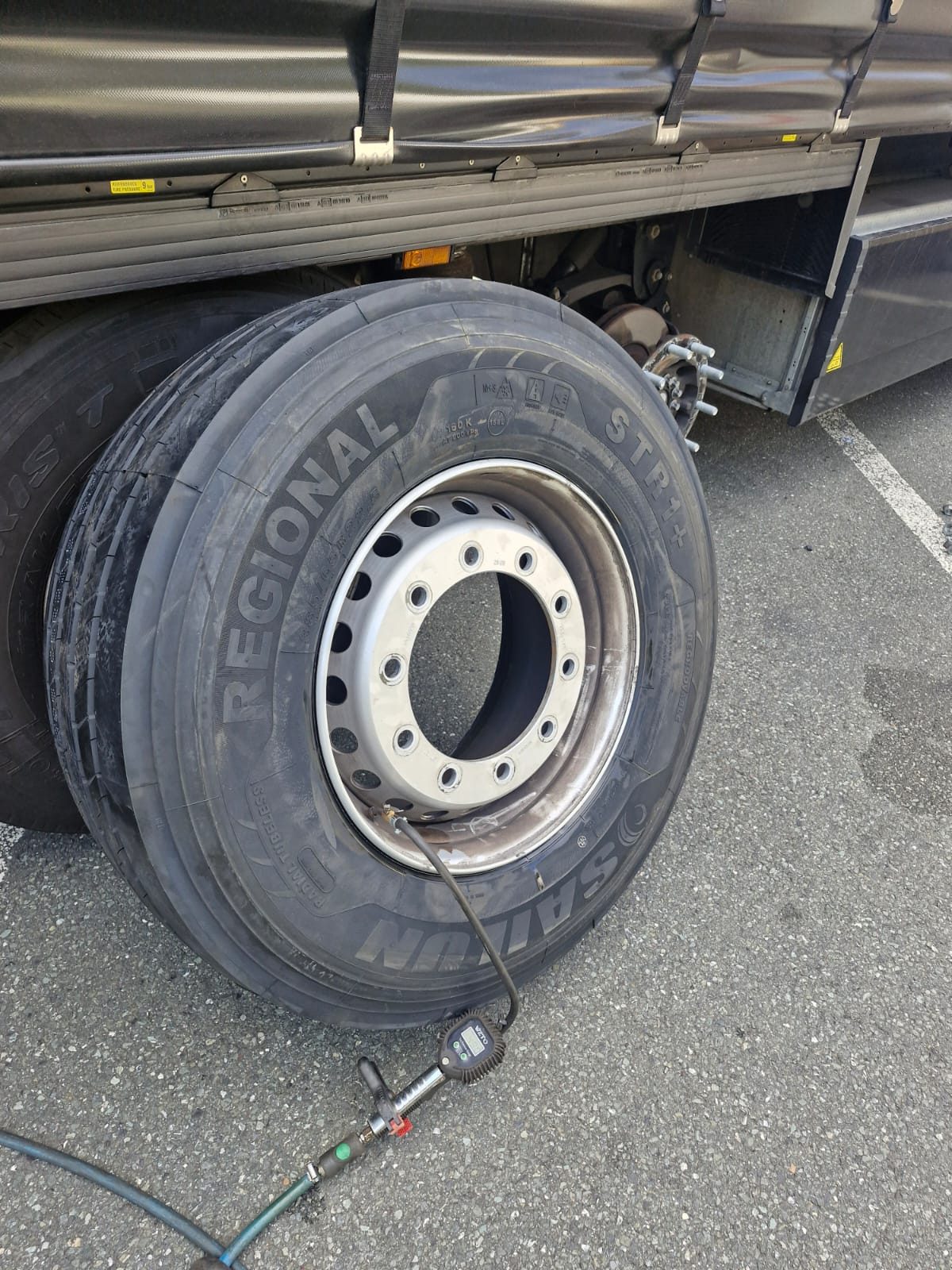
The vehicle was a standard curtainsider combination: a tractor unit with a dark grey tarpaulin semi-trailer, strapped down and fully loaded. The affected wheel carried a Sailun Regional STR1+ tubeless radial, size 385/65 R22.5 (marked 160 K, which matches the size), on an aluminium and steel rim with ten stud holes. A sticker on the trailer recommended 9 bar.
There was no puncture in the tread and no cut in the sidewall. The culprit turned out to be a worn valve core and seal, a part worth a few euros that can ground a 40-tonne combination. If you have ever wondered how much trouble a tiny component can cause, our write-up of a 12-euro valve failure near Saarbrücken tells a very similar story.
The weather was clear and dry, which helped. Wet tarmac and spray from passing lorries would have made the same job slower and noticeably less pleasant for everyone at the roadside.
How we organised the help
The dispatch process took 15 minutes and followed the same steps we use on every motorway callout. The driver gave us four facts, and everything else followed from them.
- Position: A7 near Kassel, direction Göttingen/Hanover, lay-by with a crash barrier.
- Vehicle: semi-trailer combination, one trailer wheel affected.
- Tyre: 385/65 R22.5, tubeless, spare wheel available on board.
- Condition: vehicle stopped safely, hazard lights on, driver outside the carriageway.
At 09:10 the dispatcher had matched the job to a mobile crew from our partner network that was already working in the region. The price was agreed with the driver before anyone left the depot, and the dispatcher gave an arrival estimate of about 45 minutes. In the end the crew needed 60 minutes, which is a realistic figure for a Friday-morning commuter flow around Kassel.
Our dispatch desk speaks German, English, Polish and Russian, so the driver explained the problem in his own language and did not have to translate technical terms on a motorway verge. That matters more than people think. A wrong word about axle position or tyre size can send the wrong equipment to the wrong place. If you want to know how our callout service works in general, the page on mobile truck service in Germany explains it in a few paragraphs.
While waiting, the driver did three things correctly: he placed the warning triangle at a proper distance, put on a hi-vis vest, and stayed away from the traffic side of the vehicle. Those habits are not optional, and the Autobahn Checklist after a tyre blowout covers them in more detail.
Why you cannot ignore a tyre that is losing air
A truck tyre that has lost pressure is a rapidly growing risk, not a minor inconvenience. Heavy goods vehicle tyres normally run at 8.5 to 9.5 bar, which is roughly four times the pressure in a car tyre. At that pressure the carcass is held rigid. At 5 or 6 bar the same tyre flexes much more with every revolution, and the friction heats the rubber from the inside.
Here is what happens if the driver carries on regardless:
- the sidewall overheats and the inner liner starts to separate from the carcass;
- the twin tyre on the same axle takes more of the load and can fail in turn;
- the rim edge touches the road, bends and may crack, turning a cheap fix into a rim replacement;
- the vehicle pulls to one side, braking distances grow, and a sudden blowout can throw the trailer into the next lane;
- the tachograph clock keeps running while the driver waits for a second, more expensive callout.
The legal side is just as clear. Section 36 of the German vehicle licensing regulations (§ 36 StVZO) requires tyres to be suitable for the vehicle, in a safe condition and with enough tread. A tyre that is visibly under-inflated or damaged will fail a roadside inspection, and the driver, not the fleet manager, is the first person asked to explain.
Tyre pressure – the air pressure inside a tyre, measured in bar, which must match the axle load and the manufacturer’s recommendation. For a trailer tyre of this size, the usual operating range is 8.5 to 9 bar.
We covered the numbers in more depth in our guide to correct truck tyre pressure, which is worth printing out for the cab.
Step by step: how the crew changed the wheel
The crew followed the same five-step routine we use for every truck tyre change on the roadside. Nothing was improvised, and nothing was skipped because the job looked simple.
Step 1: inspection and assessment
The technician walked around the trailer and checked the affected tyre, the opposite wheel on the axle, the hub area and the brake components. He used a pressure gauge to confirm that the tyre had dropped to around 4 bar. Then he checked that the wheel nuts were all present and none had loosened. This inspection took about ten minutes and ruled out a damaged bead, a hidden cut or a bent rim.
Step 2: securing the working area
A truck tyre job at a lay-by is only as safe as the preparation. The crew parked the service vehicle so that it shielded the working area, put out the warning triangle, switched on the amber beacon and chocked the wheels of the trailer on the opposite side. Nobody worked on the traffic side, and the trailer’s supports were checked before lifting.
Step 3: removing the wheel
The crew lifted the axle with a hydraulic jack rated well above the axle load. They loosened the wheel nuts in a cross pattern, took the wheel off and set it down on the tarmac. With the wheel off, they could see the hub, the ten studs and the brake drum. The studs were clean and undamaged, the hub face was true, and the rim showed no cracks. This was the moment the diagnosis became certain: the leak came from the valve, not from the tyre or the wheel.
Step 4: inflating and checking the spare
Here the photo for this article was taken. The spare wheel, a second Sailun Regional STR1+ in the same size, belonged to the haulier and had been riding on board for some time. Before fitting it, the technician connected the compressed air line from the service van to the valve, fitted a digital manometer and brought the tyre to 9 bar. He checked the sidewalls, the tread depth and the valve, and replaced the valve core and seal. A spare wheel that has not been tested is not a spare wheel, it is a hope.
Step 5: fitting and final check
The crew lifted the spare onto the hub, tightened the wheel nuts in a star sequence with a calibrated torque wrench, and lowered the axle. After a short wait they re-checked the torque and measured the pressure again. Only then did they release the vehicle. The driver signed the job sheet at 11:10 and drove on to his next unloading point.
If you are curious about the torque values and the correct tightening sequence, our wheel nut torque table lists the numbers for common hub types.
Full timeline of the callout
The whole job took 135 minutes, split almost evenly between travel to the site and work on the vehicle. The table shows every phase.
| Time | Phase | Action |
|---|---|---|
| 08:55 | Call | The driver rings, and the dispatcher records axle, tyre 385/65 R22.5 and location on the A7 near Kassel |
| 09:10 | Dispatch | A mobile crew from the partner network is selected, the price is agreed and an estimated arrival time is given |
| 09:55 | Arrival | The crew is on site, inspects the vehicle and secures the area (warning triangle, hi-vis vest, wheel chocks) |
| 10:05 | Removal | The axle is jacked up, the under-inflated wheel is removed, and hub, studs and rim are inspected |
| 10:37 | Spare wheel inflation | The Sailun Regional STR1+ spare is inflated to 9 bar with a digital manometer, and the valve core is replaced |
| 11:00 | Fitting | The wheel is fitted and the nuts are tightened in a star pattern with a torque wrench |
| 11:10 | Done | Pressure and torque are checked, and the driver continues his journey |
Total time: 135 minutes from call to departure. The crew reached the site in 60 minutes and spent 75 minutes on the vehicle. That is a normal result for a daytime callout on a busy motorway. At night or in heavy rain you should allow another 30 to 90 minutes.
What does it cost to change a truck tyre at the roadside?
A roadside wheel change with a spare cost 525 EUR net (zzgl. MwSt.) in this case. All figures below are net, and no new tyre was purchased because the haulier’s own spare was used.
| Item | Price (EUR) |
|---|---|
| Call-out (Anfahrt to the A7, daytime) | 260 |
| Labour, 2 hours at 110 EUR (removal, inflation, fitting, final check) | 220 |
| Valve core and seal (material) | 25 |
| Disposal and inspection of old parts | 20 |
| Total | 525 |
The biggest item is the call-out, and that is not a surprise. The crew drives a fully equipped service vehicle with compressor, jack, torque wrench and spare equipment, and the distance on the autobahn can be considerable. Daytime callouts usually cost between 180 and 320 EUR. Night and weekend jobs carry a surcharge of 25 to 50 per cent.
Labour is charged at 90 to 140 EUR per hour, depending on the region and the time. If the job needs a new tyre, the price changes a lot: a 385/65 R22.5 trailer tyre costs between 420 and 540 EUR on top, and a drive-axle tyre in 315/80 R22.5 between 480 and 620 EUR. A damaged rim adds still more.
Compare that with the alternative. A standing truck on a motorway costs between 800 and 1,200 EUR per day in lost revenue, driver hours, late-delivery penalties and cold-chain risk. In this case the job cost half of that, and the vehicle moved the same morning. For a more detailed look at replacement tyre prices, see our overview of what a truck tyre change really costs.
What drives the price up or down?
- Time of day: nights, weekends and public holidays carry a surcharge.
- Distance: the further the crew has to travel, the higher the call-out fee.
- Tyre size and brand: a premium tyre from Michelin or Continental costs more than a budget model.
- Condition of the rim: a cracked or bent rim means a second part and a longer job.
- Access: a lay-by is simple, a narrow hard shoulder with traffic at 90 km/h is slower and needs more safety measures.
Why professional help beats a do-it-yourself fix
Changing a truck wheel is a job for two people with proper equipment, not for one driver with a car jack. A wheel for a 385/65 R22.5 tyre weighs well over 70 kilograms, and the vehicle behind it can weigh 40 tonnes.
The risks of a self-made repair are easy to list:
- an unsuitable jack can slip, and an axle falling onto a person causes injuries that cannot be undone;
- hand-tightened wheel nuts work loose, and a wheel that comes off at 85 km/h is a danger to everybody behind;
- an unmeasured pressure leads to a second failure within a few hundred kilometres;
- a driver who works on the traffic side of the vehicle is within reach of passing lorries;
- insurers and employers may refuse to cover damage caused by an improper repair.
Our crews carry calibrated torque wrenches, certified jacks, compressors and the spare parts that matter most: valve cores, seals and wheel nuts. They finish every job with the same two checks: pressure and torque. For a deeper look at what happens during a mobile wheel service, have a look at the page about our truck tyre service.
One more thing worth saying. A mobile crew is not a substitute for a workshop. If the rim is cracked, if the brake drum shows heat damage or if the hub is worn, a workshop visit follows. A good technician says so honestly, and that honesty is part of the service.
Typical situations we attend across Germany
We cover motorways and trunk roads from Flensburg to Munich, and the callouts fall into recurring patterns.
- Slow puncture or valve leak: the case described here. A tyre loses a few tenths of a bar per hour, the driver notices it at a parking area and needs a quick fix.
- Tyre blowout on a drive axle: a heavy tractor unit with a shredded tyre on the hard shoulder, often with debris on the carriageway.
- Trailer tyre damage from kerbs or debris: typical on building sites and in rest areas with gravel.
- Wheel change on a rim with damaged studs: requires extra tools and sometimes a second visit.
- Coach and van tyres: smaller sizes such as 245/70 R19.5 or 235/65 R16C, usually quicker to deal with.
- Pre-trip checks at a yard: the fleet manager books a tyre inspection before a long-haul run.
- Seasonal wheel changes: summer to winter tyres on a whole fleet at the depot.
When a tyre is beyond repair and the vehicle cannot move at all, a recovery vehicle may be needed. We keep towing and recovery available around the clock for these cases, so the driver does not have to call a second company.
Prevention: how drivers and fleets avoid roadside tyre problems
Most roadside tyre failures give warning signs days or weeks beforehand. The following habits catch them early.
- Check pressure weekly, cold, with a calibrated gauge, and write the figures down. A tyre that loses more than 0.2 bar per week has a slow leak.
- Look at the valves. Replace valve cores and caps at every tyre change. The part costs next to nothing compared with a callout.
- Measure tread depth on every axle at least once a month. German law sets a minimum tread depth, and many fleets replace tyres well before that limit.
- Inspect the sidewalls for cuts, bulges and cracks, especially after parking on a kerb or driving across a building site.
- Carry a tested spare or arrange a service contract. A spare that has never been inflated or checked is useless when you need it.
- Keep a record of torque checks after every wheel change. Wheel nuts should be re-tightened after the first 50 to 100 kilometres.
- Take a quick walk-round before every trip. A two-minute check in the yard is cheaper than a two-hour wait on the A7.
For fleets, a regular inspection programme from an approved testing body such as DEKRA can add an independent view. Axle components that support the wheels, for instance trailer axles from BPW, also have their own inspection intervals, which are worth keeping in your maintenance calendar.
Truck tyres in detail: sizes, brands and what the markings mean
A tyre marking such as 385/65 R22.5 looks like a code, but it is simple once you read it from left to right. The first number is the section width in millimetres, the second the aspect ratio (the sidewall height as a percentage of the width), the letter R stands for radial construction, and 22.5 is the rim diameter in inches. The size standards are maintained by the European Tyre and Rim Technical Organisation, which publishes the permitted rim and tyre combinations.
The load index and speed symbol that follow, such as 160 K, tell you the maximum load per tyre and the permitted speed. Our article on how to read truck tyre markings goes through each symbol, including the DOT date code that shows how old a tyre is.
The most common truck tyre sizes in Germany are:
| Size | Typical use |
|---|---|
| 315/80 R22.5 | Drive and steer axles on tractor units |
| 385/65 R22.5 | Trailer axles and super-single applications |
| 245/70 R19.5 | Distribution lorries and smaller trucks |
| 235/65 R16C | Vans and light commercial vehicles |
Premium manufacturers such as Michelin, Continental, Goodyear and Bridgestone dominate the long-haul segment, and each offers casings that can be retreaded. Budget and mid-range brands, including Sailun, are widely used on trailer axles, where the load is steady and the steering demands are lower. The brand matters less than the maintenance: a well-inflated mid-range tyre outlasts a neglected premium one.
Retreading, valve maintenance and regular rotation extend tyre life considerably. A fleet that checks pressure every week typically sees fewer roadside callouts, lower fuel consumption and more even wear across axles. Under-inflation of just 1 bar can raise rolling resistance noticeably and shorten tyre life by several per cent, so the weekly gauge check pays for itself.
If you are still choosing between a repair and a replacement, our article on truck tyre repair, when it works and when it does not is a good starting point. In short: tread punctures in the central zone can often be repaired, but sidewall damage and cuts near the shoulder usually mean a new tyre.
Frequently asked questions
How long does it take to change a truck tyre on the motorway?
The work itself takes 60 to 90 minutes. In this case it took 75 minutes on site. From the first phone call to departure, plan for 1.5 to 3 hours, depending on traffic, weather and distance. Night callouts and heavy rain add time.
What does an emergency truck tyre change cost on the autobahn?
A daytime job with a spare wheel cost 525 EUR net in our case. A new tyre adds roughly 420 to 620 EUR depending on size. Night and weekend jobs carry a 25 to 50 per cent surcharge. All prices exclude VAT.
Can a truck tyre that has lost air be driven on?
No. A tyre running below its recommended pressure of 8.5 to 9.5 bar overheats within minutes, can damage the carcass and the rim, and may burst. Stop at the next safe place, switch on the hazard lights and ring for help.
Do you need to carry a spare wheel?
It is not a legal requirement for trucks, but it saves the cost of a tyre purchase at the roadside. A spare must be pressure-tested and fitted with a good valve. Otherwise it cannot be relied upon.
Which tyre pressure is correct for a 385/65 R22.5 trailer tyre?
The correct pressure depends on axle load and the manufacturer’s table. Most trailer tyres of this size run between 8.5 and 9 bar. In this case the trailer sticker recommended 9 bar, and the crew inflated the spare to that value.
Does your service cover the whole of Germany?
Yes. We work round the clock through a network of vetted partner crews, and our dispatch desk speaks German, English, Polish and Russian. Call +49 160 5753826 from anywhere in Germany.
Why drivers and fleets choose Lkwhelp24
- Round-the-clock availability: the phone is answered at 3 a.m. on a Sunday as it is at 10 a.m. on a Tuesday.
- A tested partner network: crews are equipped for trucks, trailers and coaches, not just cars.
- Price clarity: the price is agreed before the crew sets off, and every line on the invoice has a reason.
- Multilingual dispatch: drivers explain their problem in their own language.
- One contact for everything: tyre, repair, diagnosis or recovery, all through one phone number.
We do not promise miracles. In heavy traffic a crew may need longer, and in winter the job takes more time. What we promise is an honest estimate, a clear price and a proper repair.
Summary
- Location: A7 near Kassel, direction Göttingen/Hanover, lay-by at the crash barrier
- Vehicle: curtainsider semi-trailer, trailer axle
- Tyre: Sailun Regional STR1+, 385/65 R22.5 (marking 160 K), valve fault
- Time to arrival: 60 minutes after the call
- Time on site: 75 minutes
- Total time: 135 minutes (08:55 to 11:10)
- Cost: 525 EUR net (zzgl. MwSt.)
- Secondary damage: none, hub, studs and rim intact
- Pressure after the job: 9 bar
Need help with a truck tyre? Call now
If your tyre is losing air, if you have had a blowout or if you simply need a quick check before a long run, call us. We answer day and night, we speak your language, and we tell you the price before the crew leaves.
Phone: +49 160 5753826
Website: www.lkwhelp24.com
Round the clock across Germany
You can also find all contact options on our contacts page.
Keywords: truck tyre service | mobile truck tyre service | truck tyre replacement | truck tyre change | truck tyre callout | truck tyre roadside assistance | truck tyre repair | trailer tyre service | mobile reifenservice | truck tyre breakdown germany | A7 Kassel | 385/65 R22.5