Skip to content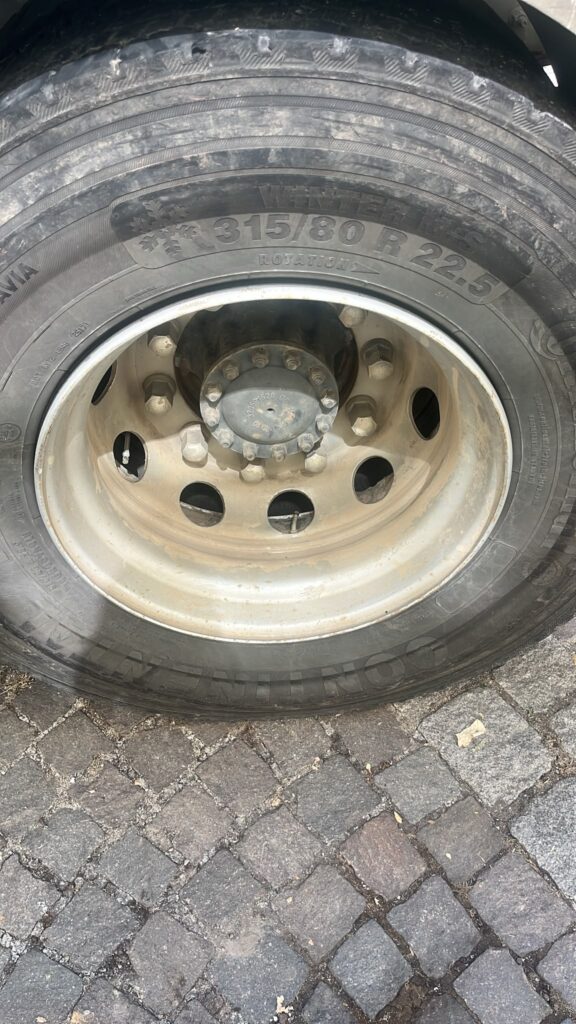
TL;DR: On 14 August, a French haulier reported a semi-truck at its depot near Saarbrücken with a tyre slowly losing pressure. The Continental 315/80 R22.5 tyre had no puncture at all — the fault was a leaking valve. Our technician arrived in 40 minutes, replaced the valve, checked pressure, and had the truck cleared in 1 hour 35 minutes total. Cost: €235 net, the cheapest call-out in our case series.
A tyre that goes a bit soft overnight looks harmless to most drivers. That’s exactly the trap: a weeping valve behaves like a slow-burning fuse. Left unnoticed, chronic underinflation overheats the carcass, and a two-euro cause turns into a full blowout on the motorway.
This case shows the opposite outcome — caught early, diagnosed correctly, fixed in under two hours, for a fraction of what a blowout would have cost the fleet.
What Happened Near Saarbrücken on 14 August
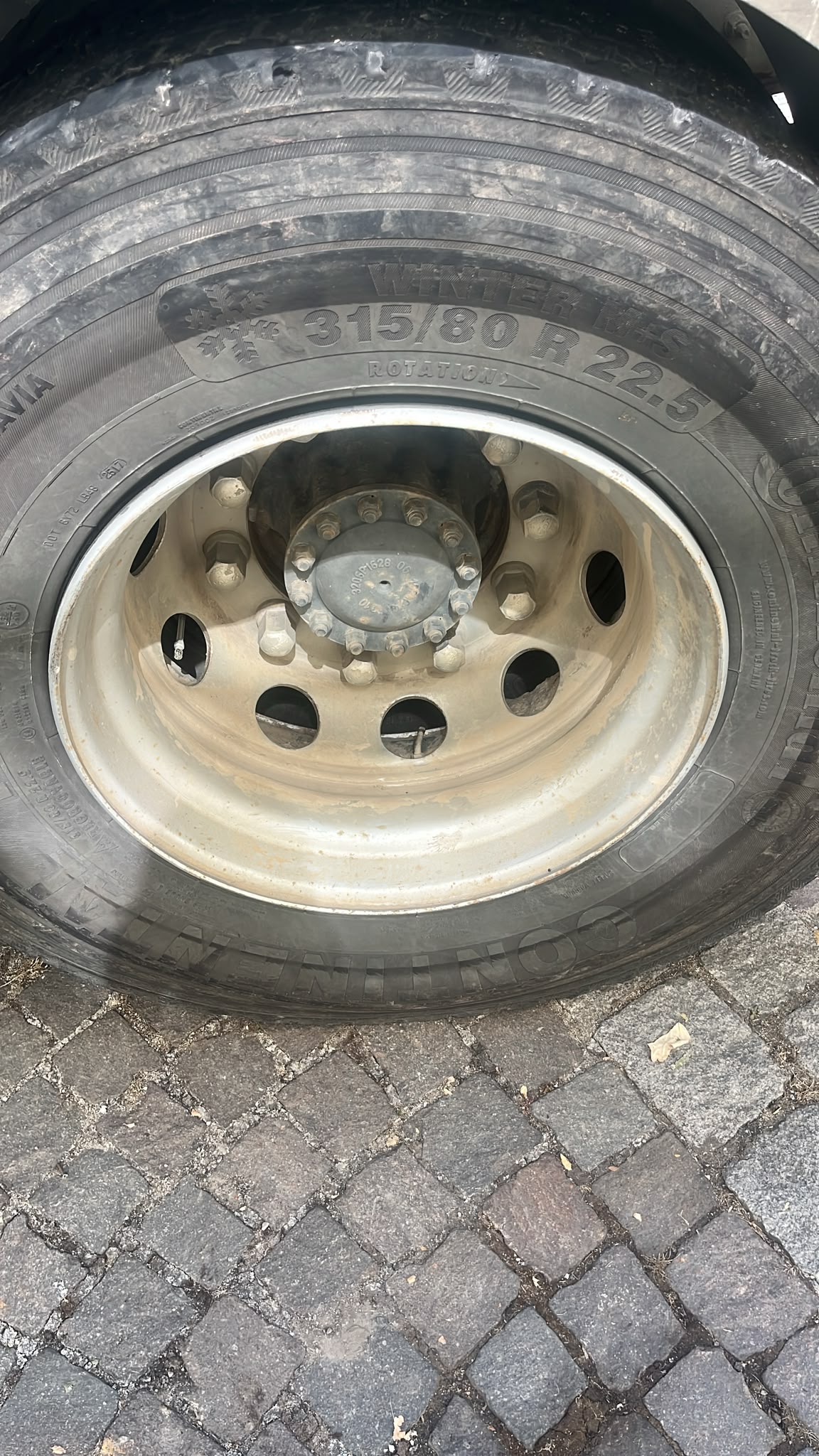
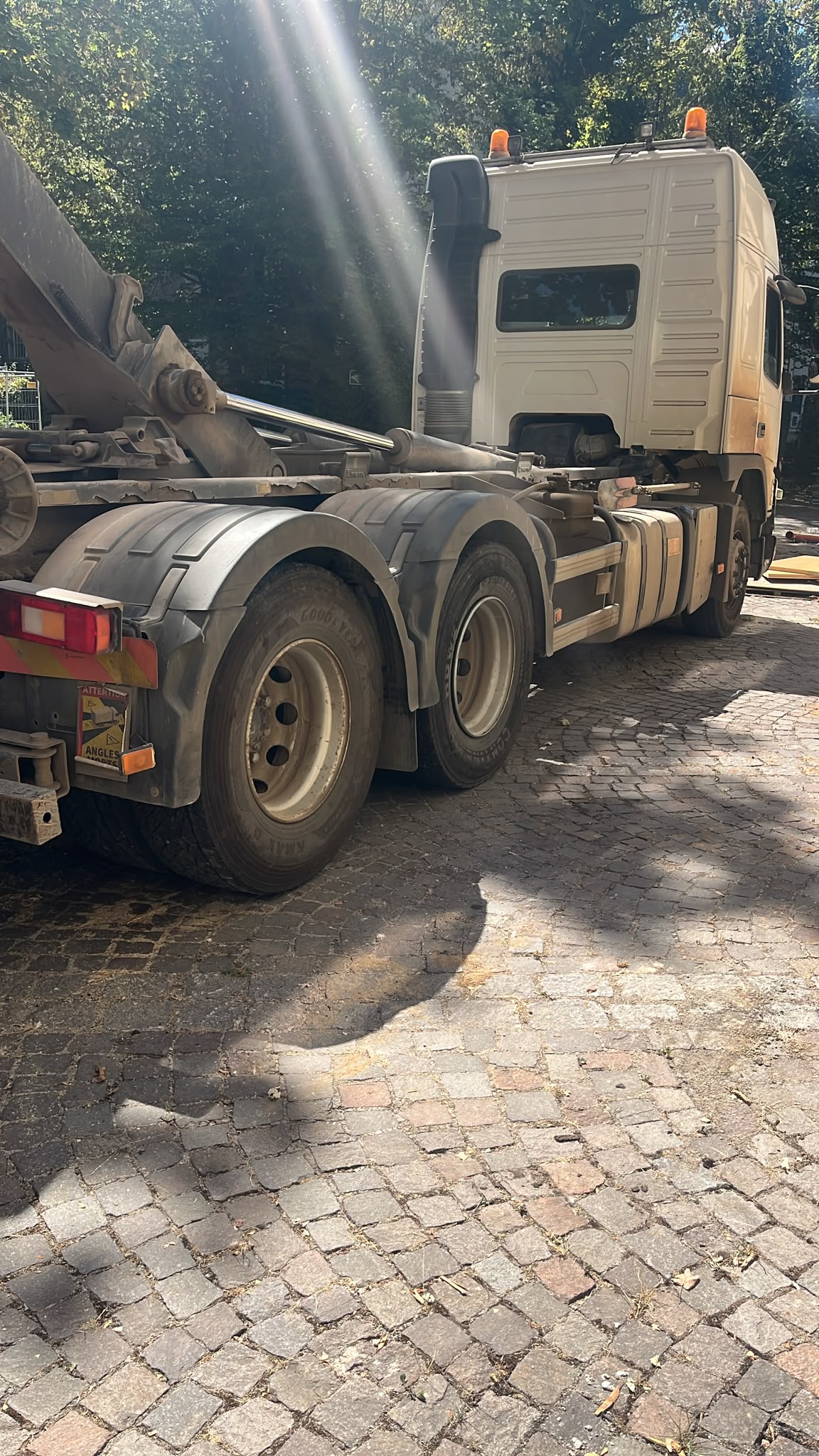
The incident happened not on a motorway but at the depot of a French haulage company near Saarbrücken, Saarland. That morning, the driver of an articulated lorry noticed one drive-axle tyre looked softer than it had the day before. The tyre in question: a Continental 315/80 R22.5, with a recommended cold pressure of roughly 8.5 to 9.0 bar for that axle load.
A visual check turned up nothing on the tread, no foreign object, no cut on the sidewall. Yet the pressure was clearly down. That exact pattern — a tyre with no outward damage but pressure bleeding away over hours rather than seconds — is the classic signature of a faulty valve, not a tyre fault.
The haulier called our emergency line rather than sending the truck off regardless. That single decision mattered: what many drivers dismiss as “top it up tomorrow” could have turned into a roadside failure on the way to France.
How the On-Site Diagnosis Worked
A tyre can lose pressure for three reasons: through the tread (a nail, a cut), through the sidewall (impact damage, age-related cracking), or through the valve. Our technician always works through this order before considering a tyre swap — a new tyre runs €480–620, a new valve €12–20. The gap is wide enough to make a careful diagnosis worth the extra five minutes.
The method itself is simple enough for any driver to try: soapy water on the valve stem and cap. If bubbles form there, the answer is clear without ever removing the tyre. On this job, a steady stream of bubbles appeared right at the join between the valve body and the rim — a textbook sign of a perished rubber seal.
Why the Valve Gets Underestimated
A truck valve costs between €10 and €20 to buy. Next to a €500 tyre or a multi-thousand-euro axle, it looks like the least important part on the whole vehicle. That underestimation is exactly the problem: to the driver, a failed valve looks and feels like “the tyre’s flat” — triggering the same alarm, the same workshop call, the same lost hours as an actual tyre failure.
The difference sits only in the repair, not in the call-out effort. A service van still has to drive out, a technician still has to inspect the wheel, and the truck still sits idle until someone looks at it. That’s why it pays to treat the valve as its own component rather than an afterthought bolted to the tyre.
How to Tell It’s the Valve, Not the Tyre
A tyre with a failed valve loses pressure slowly over hours to days while staying visibly undamaged. That sets it apart from a blowout, which happens instantly and loudly, and from a nail in the tread, which often only shows up days later.
A practical check any driver can run without tools:
- Compare tyre pressure morning and evening — a drop over 0.3 bar within a single day is a warning sign.
- Apply soapy water or leak-detection spray to the valve tip, stem, and cap.
- Watch for bubbling — even small, steady bubbles count as a leak.
- Check the sidewall and tread in parallel for foreign objects, cracks, or bulges.
- If unsure, remove the cap, gently retighten the valve core with a valve tool, and re-test.
If the bubbles at the valve stop once the core is retightened, the cause is confirmed and the fix is usually a matter of minutes.
Why Valves Fail in the First Place
A truck valve isn’t a passive hole in the rim — it’s a small precision part holding 8 to 10 bar of internal pressure while facing road salt, brake dust, vibration, and temperature swings from minus 15 to plus 60 degrees. Five causes come up most often in practice:
- Rubber seal ageing: after several years the seal turns brittle and develops microscopic cracks.
- Corrosion on the metal body: road salt and moisture attack unpainted or damaged valve bodies, especially in winter operation.
- Mechanical damage: a tight turning angle, a kerb strike, or a rough jet wash can bend or knock the valve.
- Overtightened cap: forcing the cap on distorts the thread, so it no longer seals properly.
- Vibration fatigue: on twin-wheel setups and long motorway mileage, the valve core loosens fractionally over tens of thousands of kilometres — enough for a slow leak.
None of these give warning. The valve holds until, suddenly, it doesn’t.
Types of Truck Wheel Valves
A truck valve is always a threaded metal valve, never a snap-in rubber valve like on a car. The reason comes down to pressure: car tyres run at 2.0 to 2.8 bar, truck tyres at 8.0 to 10.0 bar. A rubber valve, standard on passenger cars, would not hold that pressure reliably over time and isn’t permitted on commercial vehicles.
| Valve type | Application | Detail |
|---|---|---|
| Short metal valve (TR series) | Single fitment, steer axle | Screws directly into the rim |
| Angled metal valve | Twin fitment, outer wheel | Eases access for the airline |
| Flexible extension | Twin fitment, inner wheel | Prone to kinking and leaks |
| Rigid metal extension | Twin fitment, inner wheel | More durable, needs more clearance |
The Extension Problem on Twin Wheels
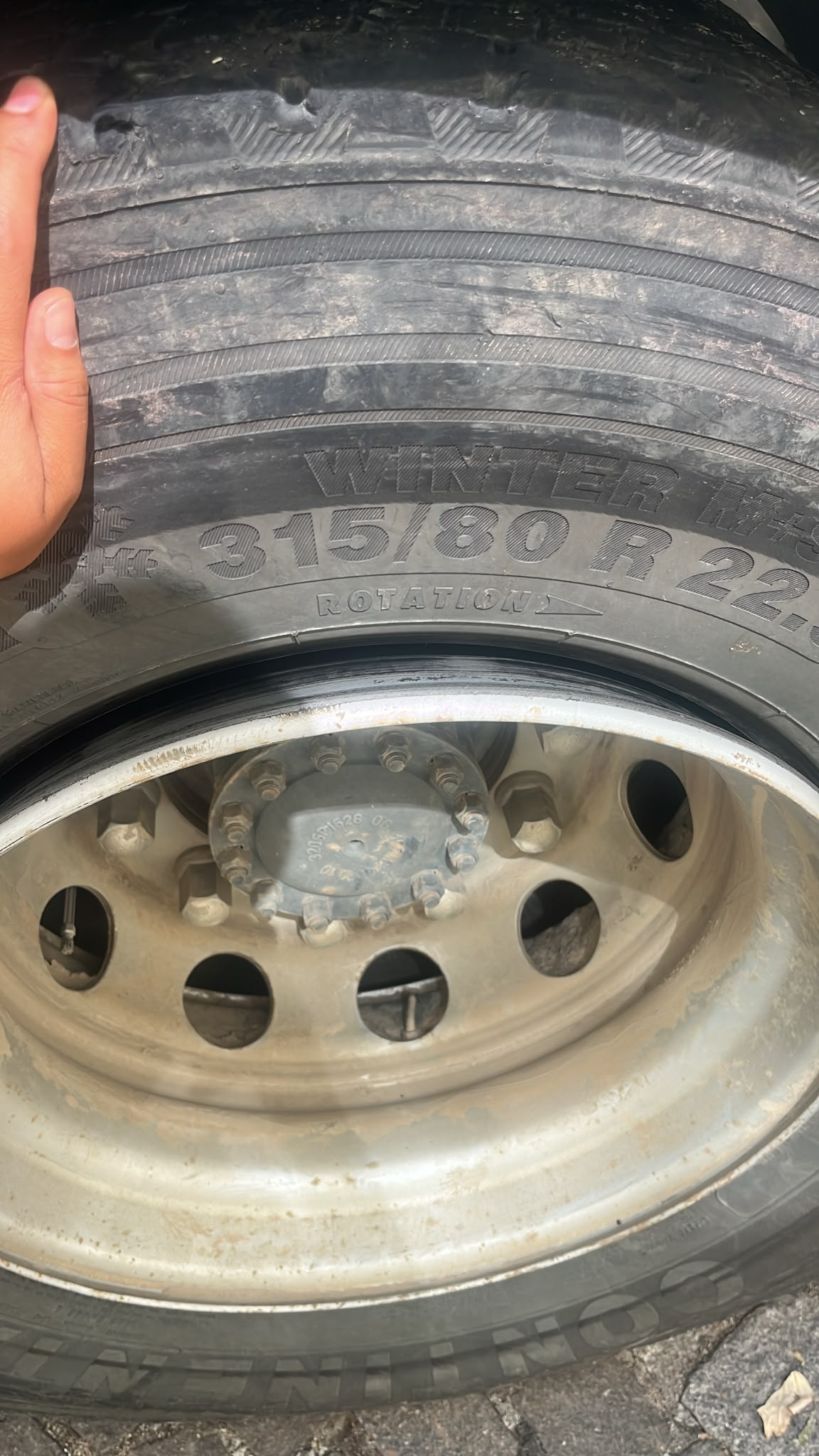
On twin-wheel setups, the inner valve sits behind the outer wheel and is almost impossible to reach without an extension. The obvious fix — a flexible extension hose — turns out to be exactly the part that fails most often on its own. The hose kinks slightly with every steering movement, the material fatigues at the kink point, and after a year or two that same soapy-water test shows bubbles there rather than at the valve body itself.
Rigid metal extensions cost more upfront and need more clearance but last considerably longer and are rarely the fault point. Fleets running a lot of twin-wheel mileage should check these extensions specifically at every major inspection — they’re easy to overlook because they “hang off the wheel” without technically being the tyre.
The Valve Core: the Smallest Part, the Biggest Headache
Inside the valve body sits the valve core — a spring-loaded seal barely bigger than a grain of rice that lets air flow one way only. This tiny part is, in a large share of “leaking valve” cases, the actual culprit rather than the valve body itself.
A weeping valve core is about the cheapest repair possible on a commercial vehicle if caught in time: a new core costs a few euros, swapping it takes under two minutes with the right tool, and doesn’t even require fully deflating the tyre. Miss it, and weeks of chronic underinflation can cause carcass damage that no longer repairs — only replaces.
The Valve Cap Isn’t Decoration
Plenty of drivers treat the cap as cosmetic and run for years without one. That’s a mistake: the cap is the second sealing layer. It keeps road grime, moisture, and salt off the valve core and stops dirt settling into the valve seat where it can later cause a leak. Without a cap, the core visibly corrodes faster, especially through winter salting.
A missing or loose cap isn’t cosmetic, then — it’s a direct warning sign during a visual check, and it belongs on the inspection list every time a tyre gets looked at.
Our Rule: Replace the Valve Every Time the Tyre Comes Off
We replace the valve as standard practice every time a tyre is changed, regardless of whether the old one still looks sound. The logic is straightforward economics: fitting a new valve while a tyre change is already underway adds only a few euros to the job. Reusing an old valve that’s already several years worn raises the odds it fails weeks or months later — as a standalone call-out with full travel time, full downtime, and full cost.
A serious tyre service builds the valve into the price by default rather than treating it as an optional upsell. Cutting corners here saves on the wrong end: the material cost is negligible, while the cost of a second failure is not.
What a Slow Leak Does to the Tyre
A valve leak feels less dramatic than a blowout because nothing happens instantly. That’s exactly where the real danger sits: a chronically underinflated tyre flexes more than its carcass is built to handle on every corner and every braking event. That extra flexing generates heat, and the heat breaks down the tyre’s internal structure — a process that runs silently for weeks until the tyre fails without warning on the motorway.
Under § 36 StVZO, tyres on motor vehicles and trailers must be kept in roadworthy condition — a chronically underinflated tyre fails that standard even when it looks intact from the outside. That’s why a pressure check counts as a safety inspection, not a convenience item.
Our Five-Step Repair Sequence
- Visual wheel check: inspect sidewall, tread, and valve area for foreign objects and damage.
- Soapy-water test: check valve tip, thread, and cap for bubbling, and feel the sidewall for anything unusual.
- Valve replacement: fully deflate, remove the old valve, fit a new metal valve with the correct core.
- Inflate to spec: fill the tyre to the pressure required for the axle load, accounting for cold pressure.
- Final check: re-run the soapy-water test, visually inspect all four wheels on the axle, hand the truck back with a short explanation for the driver.
Full Timeline
| Time | Phase | Action |
|---|---|---|
| 09:40 | Call | Haulier reports the issue to the dispatch line |
| 09:40–09:55 | Dispatch | Job assigned to the nearest partner near Saarbrücken |
| 09:55–10:35 | Travel | Technician reaches the depot |
| 10:35–10:50 | Diagnosis | Visual check, soapy-water test, cause confirmed |
| 10:50–11:10 | Repair | Valve replacement and inflation |
| 11:10–11:15 | Close-out | Final check, hand-over, technician departs |
Total time from call to sign-off: 1 hour 35 minutes.
The Cost Breakdown
| Item | Price (EUR, net) |
|---|---|
| Call-out | 150 |
| Labour (30 min) | 55 |
| Truck valve incl. core | 18 |
| Pressure check and inflation | 12 |
| Total | 235 |
All figures are net, plus statutory VAT. For comparison, a tyre change after an actual blowout typically runs €750–1,400 with us once tyre cost, longer downtime, and sometimes rim damage are added. A day off the road for a semi is usually costed at €800–1,200 in the haulage industry. Against that yardstick, a €235 call-out that ends with the truck running fine is about the best outcome available.
Why It Pays to Call a Professional
DIY is possible in theory but carries real risk on commercial tyres:
- Without a valve tool and the correct replacement core, the repair stays incomplete and the leak comes back.
- Wrong post-fill pressure leads to overheating or uneven wear.
- Damaged rims or worn valve bores go unnoticed without a trained eye.
- Working on a pressurised wheel without proper restraint carries injury risk.
- A botched repair can put the vehicle’s roadworthiness at risk.
Prevention: Keeping Valves Under Control
Regular checks are the single most effective defence against valve failures during operation. Fleets that build tyre pressure and valve inspections into fixed maintenance intervals avoid most of the unplanned downtime this small component can cause.
Specifically, we recommend:
- A soapy-water test on every valve at each major inspection, not only when something looks off.
- Replacing the valve as standard practice with every tyre change, regardless of its outward condition.
- Checking twin-wheel valve extensions as a separate inspection point, distinct from the tyre itself.
- Keeping valve caps fitted at all times and replacing them immediately if lost.
- Checking tyre pressure with a calibrated gauge rather than guessing by feel, ideally weekly on high-mileage vehicles.
Manufacturers such as Continental recommend regular pressure checks as a standard part of commercial tyre care, and component suppliers like Bosch note, in the context of tyre pressure monitoring systems, that a large share of pressure loss on commercial vehicles traces back to valves rather than the tread. Building these checks into the regular workshop routine cuts blowout risk substantially, at negligible extra cost.
Drivers themselves can also make a real difference: a quick walk-around before setting off, combined with a finger check on valve caps, catches a large share of these issues before they become a problem. That handful of minutes is nothing compared with the cost of a failure on the road.
Typical Jobs We Handle
Beyond valve issues, our regular call-outs include motorway blowouts, tyre failures with rim damage, sheared wheel bolts, tyre changes at depots exactly like this one near Saarbrücken, and breakdowns where trucks are stuck on unpaved ground. Straightforward pressure checks and quick call-outs without an outright failure are part of the daily routine for our partner network too.
Frequently Asked Questions
How do I know it’s the valve and not the tyre itself?
The tyre stays visibly undamaged but loses pressure slowly over hours to days. A soapy-water test on the valve tip and cap shows bubbling, while the tread and sidewall check out clean.
What does a mobile truck valve replacement cost?
On this job the total came to €235 net, covering call-out, labour, valve, and pressure check. The exact figure depends on distance and time of day.
How long does a valve replacement take on-site?
The repair itself takes 15 to 20 minutes. Including travel and diagnosis, this job took 1 hour 35 minutes start to finish.
Should the valve automatically be replaced with every tyre change?
Yes, we recommend it as standard. The added cost is minimal, whereas a separate valve failure weeks later means a full second call-out with travel time and downtime.
Can I keep driving on a slightly leaking valve?
Short distances are technically possible but risky: pressure loss continues, and sustained underinflation leads to tyre overheating. We recommend checking the valve before continuing and replacing it immediately once confirmed.
Are extensions on twin wheels an extra failure point?
Yes. Flexible extension hoses kink over time and leak more often than the valve body itself. Rigid metal extensions are more reliable and should be checked specifically during inspections.
Summary
- Location: Haulier’s depot near Saarbrücken, Saarland
- Vehicle: Semi-trailer truck, French haulier
- Tyre: Continental 315/80 R22.5
- Cause: leaking valve, no tyre damage
- Response time: 40 minutes to arrival
- Total time: 1 hour 35 minutes
- Cost: €235 net
- Damage avoided: a potential blowout (€750–1,400) plus downtime (€800–1,200/day)
Why LKWHelp24
We’re reachable 24/7 across Germany, backed by a vetted partner network of mobile tyre technicians and workshops. Our dispatch team works in multiple languages, so international drivers — like the French haulier in this case — get help without a language barrier. Pricing is transparent upfront, with no surprise add-ons once the technician arrives.
A tyre that goes soft overnight isn’t a reason to panic — it’s a reason to act. Call us on +49 160 5753826 before a €235 fix turns into a motorway blowout. More on our services at www.lkwhelp24.com — around the clock, across Germany.
Keywords: truck valve failure | mobile truck tyre service | truck valve replacement | Continental 315/80 R22.5 tyre pressure | truck valve core | truck breakdown assistance Saarbrücken
Related Articles
- Truck Tire Service Near Me – 24/7 Mobile Truck Tire Service in Germany
- Truck Tire Service Near Me: HGV Tyre Blowout on the Motorway near Duisburg – DAF XF Artic On-Site Replacement
- 24/7 Mobile Truck Tire Service Near Me — Fast Emergency Tire Change & Repair Across Germany
- Truck Tire Service Near Me: Emergency Response to Mobile Crane Tyre Blowout on Autobahn A46 in Under 2 Hours
- Truck Service – Reliable Maintenance for Commercial Vehicles