Skip to content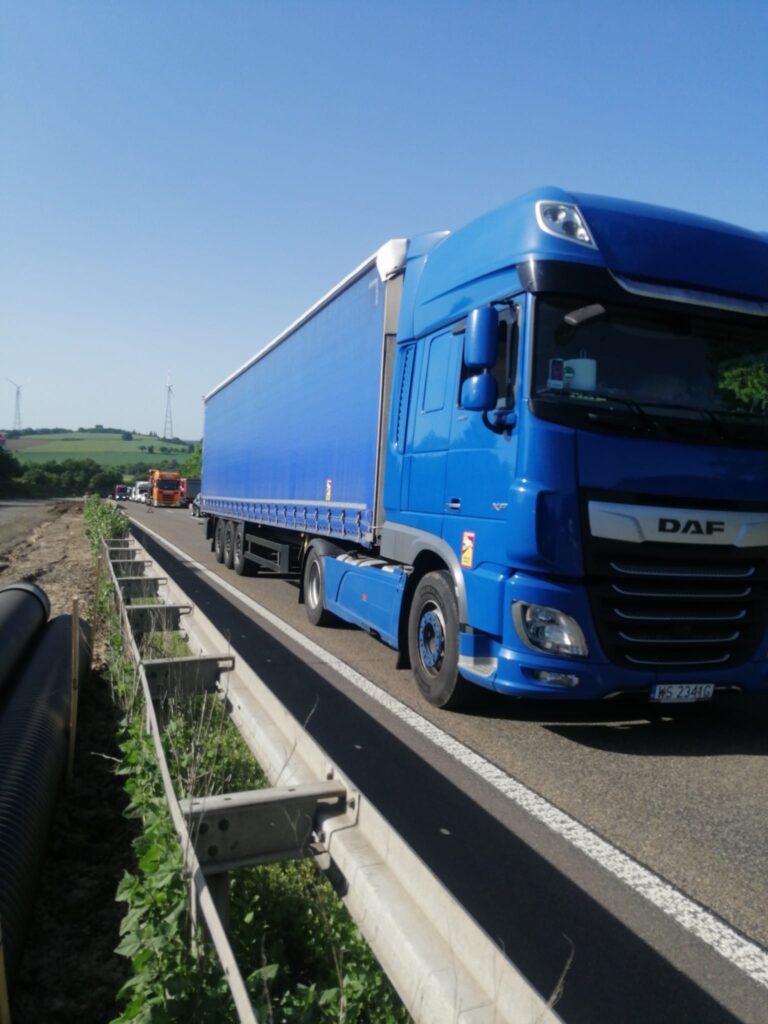
TL;DR: On 26 May, a DAF XF articulated lorry overheated in stationary traffic on the A5 near Bad Homburg, at the Frankfurt interchange, and dropped into limp-home mode. Our team reached the vehicle in 70 minutes despite the jam, checked and flushed the cooling system, topped up coolant, and had the artic back on the road after 2 hours 25 minutes in total. Cost: €575 net.
For most road users, a motorway traffic jam is simply lost time. For a fully loaded articulated lorry it is something more demanding: a stress test for the engine that never arises on the open road. That is exactly what happened on 26 May at the Frankfurt interchange (Frankfurter Kreuz), one of Germany’s busiest motorway junctions.
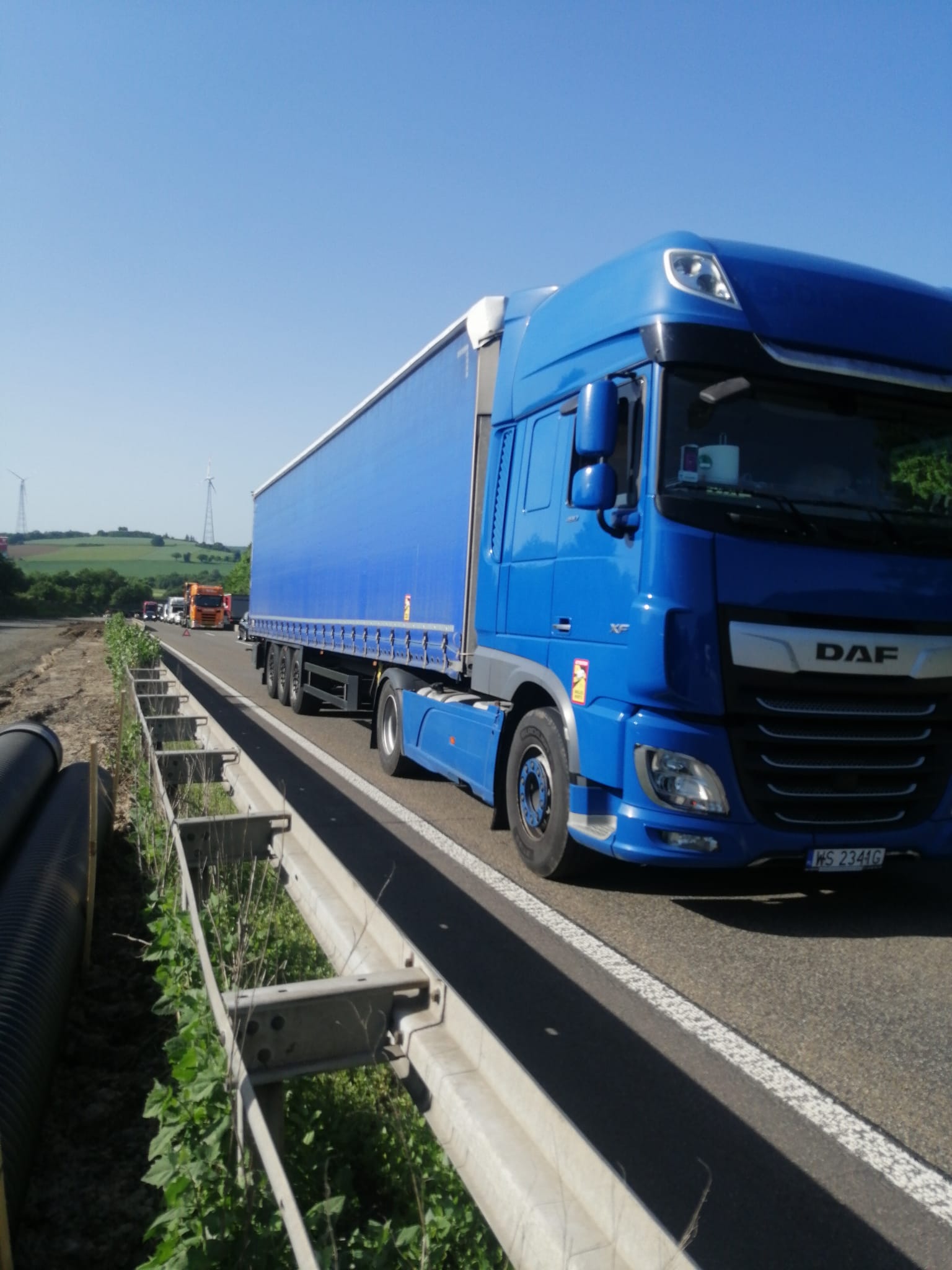
A DAF XF with a curtainside semi-trailer sat in slow-moving afternoon traffic for over an hour in summer heat when the coolant temperature warning lit up and the engine management system forced the unit into limp-home mode. What follows is not a dramatic crash report but a technical scenario that can happen to any professional driver, and it shows why standing still in a jam is often harder on a vehicle than driving on the open road.
The emergency: heat, gridlock, limp-home mode
The driver called our dispatch at 13:10. He was on the A5 near Bad Homburg, just before the Frankfurt interchange, heading towards Kassel, and had been stuck for over an hour in the kind of afternoon congestion this junction sees regularly. The dashboard showed a coolant temperature warning, and shortly after, the engine control unit automatically switched to limp-home mode, cutting available power.
The vehicle: a DAF XF tractor unit with a curtainside (tautliner) semi-trailer, fully loaded. The driver did the right thing by taking the warning seriously instead of pushing on, which is exactly what prevents a stuck-in-traffic warning light from turning into a genuine engine failure.
Why does an engine run hotter in a jam than on the motorway?
A lorry engine cools itself two ways on the move: ram air through the radiator grille, and the mechanical fan when needed. Stop the vehicle, or let it crawl at walking pace, and the ram air disappears entirely. The fan and its viscous coupling then have to do all the cooling work alone, and that assembly was never designed for sustained full-load operation under direct sun.
A fully loaded articulated lorry makes the problem worse. In stop-start traffic the engine spends more time working under partial load at higher revs, which generates extra heat exactly when less heat is being carried away. After an hour stationary in summer temperatures, a limp-home event is not a rare fluke; it is a predictable consequence of basic thermodynamics.
What else suffers when a lorry is stuck in traffic?
Overheating is the most visible problem in a jam, but far from the only one. Constant creeping and stopping loads several components at once:
- Clutch – every creeping start generates friction heat; over time the friction material wears noticeably faster than during steady driving.
- Brakes – stop-start crawling means repeated braking from low speed, which stresses pads and discs more than a steady motorway run.
- Battery and alternator – running air conditioning at idle to fight summer heat keeps the alternator near its output limit while engine revs stay low.
- Fuel – a lorry engine idling with the air conditioning running can burn several litres an hour without covering a single kilometre.
None of these effects alone causes an immediate failure. Combined with heat and a long standstill, though, they explain why a jam costs an articulated lorry’s mechanical systems more wear than the distance travelled would suggest.
What does limp-home mode actually mean for the driver?
Limp-home mode (derate) is not an engine failure; it is a deliberate protection function. The engine control unit detects a critical coolant temperature and automatically cuts power and revs to protect the pistons, cylinder head gasket, and turbocharger from heat damage.
For the driver, it often feels more dramatic than it technically is: acceleration drops noticeably, sometimes top speed is capped at 60–80 km/h, and a warning appears on the dash. It is worth knowing this reduction is usually reversible. Once temperature falls, for example after a coolant top-up or once the engine gets proper airflow again, the power limitation typically lifts on its own. Ignoring the warning and continuing under full load, on the other hand, risks a genuine and expensive engine failure.
What should a driver do in a jam as temperature climbs?
A few simple steps can help before the situation becomes critical:
- Turn the cabin heater to maximum. It sounds absurd in summer heat, but it genuinely works: the cabin heat exchanger draws extra heat out of the coolant circuit and takes measurable load off the engine.
- Don’t switch the engine off immediately after stopping. While the engine idles, coolant keeps circulating through the water pump. An abrupt shutdown interrupts that circulation while the engine block is still hot.
- Check the radiator face from outside. Insects, pollen, and road dust build up on the radiator front and cut airflow significantly, especially in early summer.
- Open a window rather than pushing the air conditioning harder. This reduces extra load on the alternator without leaving the driver exposed to the full heat.
None of this replaces professional diagnostics, but it often bridges the most critical stretch until help arrives.
Does time stuck in a jam count as rest time?
No. Standing time in a traffic jam counts as working time under EU law, not rest time. Regulation (EC) 561/2006 draws a clear line between driving time, other working time, and rest time. A forced standstill in a jam only counts as rest if the driver can genuinely use that time freely, which is rarely the case in dense traffic.
For correct logging, the reason for the standstill should be recorded on the digital tachograph as “other work” or under the relevant activity code, not mistakenly booked as rest. That distinction matters during a roadside check or in a dispute with an employer, and a jam that also triggers a technical fault extends the actual downtime further, which should be documented accordingly.
Frankfurter Kreuz as a trouble spot
The Frankfurter Kreuz, where the A3 and A5 cross, is one of the busiest motorway interchanges in Europe. According to the Autobahn GmbH des Bundes, several hundred thousand vehicles pass through it on a typical weekday, a substantial share of them heavy goods traffic serving the Rhine-Main economic region. Multi-hour jams during weekday rush hour are not an exception here; they are a regular occurrence, especially with added pressure from roadworks or incidents nearby.
For our dispatch planning, that means a call from the Frankfurter Kreuz area automatically triggers a more realistic time estimate than a report from open road. In this case, travel to the vehicle took 70 minutes, considerably longer than raw distance would suggest, because the team had to route itself around the jam.
How does a recovery team even reach a vehicle deep in a jam?
An articulated lorry stuck deep inside a multi-hour jam cannot be reached directly by a service vehicle. Our regional partner team uses several strategies at once in cases like this:
- Take the exit before the back of the queue and approach from local roads.
- Use back roads and parallel routes that standard satnav rarely prioritises but that local knowledge covers.
- Coordinate with the police when access is only possible via the emergency corridor (Rettungsgasse), which may only be used with authorisation and in coordination with emergency services on site.
An honest caveat belongs here: in a deep jam, arrival time cannot be predicted precisely. Our dispatch calculates realistic windows but cannot forecast exactly how long the jam will run or whether alternate routes will also be blocked. In this case, the actual 70-minute travel time sat at the upper, but realistic, end for this kind of situation.
Diagnostics and repair on site: step by step
After arriving at 14:35, the team worked through a fixed sequence:
- Read the fault code. Check the fault code and temperature history through the engine control unit to distinguish between genuine coolant loss, a faulty thermostat, and a straightforward overload situation.
- Visually inspect the cooling system. Check hoses, radiator, and expansion tank for leaks; in this case, none were found.
- Flush the cooling system and check the thermostat and viscous coupling. Both components were functioning correctly in principle but had reached their limit under sustained overload.
- Top up coolant and verify the mixing ratio against the manufacturer’s specification.
- Run a test cycle, watching the temperature curve for several minutes and only releasing the vehicle once it held steady.
By 15:35, the artic was fully roadworthy again, with no power restriction.
The full timeline
| Time | Phase | Action |
|---|---|---|
| 13:10 | Call-out | Driver reports coolant temperature warning and limp-home mode |
| 13:10–13:25 (15 min) | Dispatch | Job handed to the regional partner team |
| 13:25–14:35 (70 min) | Travel | Route around the jam via the nearest exit and back roads |
| 14:35–15:35 (60 min) | On-site work | Diagnostics, cooling system flush, thermostat/viscous coupling check, coolant top-up, test run |
| 15:35 | Done | Artic fully roadworthy again, no power restriction |
Total time from call to completion: 2 hours 25 minutes.
What did the callout cost?
| Item | Price (EUR, net) |
|---|---|
| Callout (Rhine-Main area, traffic surcharge) | 260 |
| Engine/cooling system diagnostics | 150 |
| Labour (60 min, €110/h) | 110 |
| Coolant + small parts | 55 |
| TOTAL (net, plus VAT) | 575 |
The traffic surcharge on the callout reflects the longer, harder approach through the Frankfurt interchange. For comparison, a stranded articulated lorry typically costs the haulier around €800–1,200 a day in pure downtime, before accounting for missed delivery windows or contractual penalties. €575 for a full diagnosis and repair inside 2.5 hours is modest against that backdrop.
Why call a professional instead of handling it yourself?
A driver working on an overheated engine without the right knowledge risks making things worse:
- Opening the radiator cap on a hot engine can cause serious scalding from escaping steam.
- Misdiagnosis – simply topping up coolant without checking the thermostat and viscous coupling often misses the real cause, risking a repeat overheating within a few kilometres.
- Continuing to drive in limp-home mode without addressing the root cause can cause piston seizure or a blown cylinder head gasket, pushing repair costs into four figures instead of €575.
- Missing equipment – professional diagnostic tools read exact fault codes that a driver without workshop equipment cannot interpret.
Typical situations we respond to at the Frankfurt interchange and across Germany
Alongside overheating in traffic, our regular work includes:
- Tyre blowouts on the motorway, such as our callout near Trier with simultaneous rim damage
- Gearbox failures at service areas, such as near the Polish border by Frankfurt (Oder)
- Electrical system failures, such as the IVECO S-Way case in Frankfurt
- Sheared wheel bolts with wheel loss, documented in our case near Hannover
Prevention: how to avoid overheating in a jam
Regular maintenance sharply reduces the risk of a limp-home event in traffic:
- Flush the radiator before summer – residue from winter driving affects heat exchange efficiency.
- Check the fan and viscous coupling regularly – a sluggish fan often only shows up under full load in a jam, never during normal driving.
- Change coolant to manufacturer spec, not just by topping up volume, but checking anti-freeze and anti-corrosion values.
- Clean the radiator grille before the travel season, especially for fleets that spend a lot of time around major conurbations.
These maintenance items cost comparatively little as part of a routine inspection, considerably less than an unplanned breakdown in traffic followed by a repair.
Fleets that regularly pass through conurbations such as Frankfurt, Cologne, or Munich benefit from a fixed maintenance interval before the warm season starts. A cooling system checked and, if necessary, flushed in April copes far more reliably with a multi-hour jam in July than one left untouched since last winter. Fleet managers should also keep an eye on refrigeration units fitted to reefer trailers, not just the tractor unit, since these generate their own heat load while stationary.
Tyres and fleet care: what else belongs in summer preparation
Alongside cooling, it is worth checking the whole vehicle before the hot season. Tyre pressure rises disproportionately in heat combined with long standstills in traffic, and manufacturers such as Continental, Michelin, and Goodyear recommend regular checks specifically during summer months, since over- or under-inflation puts extra strain on the carcass. Tread depth deserves attention too: for HGV tyres, a minimum tread depth of 1.6 mm applies, though workshops typically recommend replacement well before that limit. Our truck tyre service also checks adjacent systems such as brakes and suspension during every callout, because a failure rarely occurs in isolation.
Why hauliers and drivers choose us
Our advantage does not sit in a single tool; it sits in the system behind it: multilingual dispatch reachable at night, a nationwide partner network of vetted workshops and recovery teams, and transparent pricing with no hidden line items. Anyone who calls today knows the costs in advance; the net total is communicated before work begins, not after.
Our mobile truck service covers electrical systems, brakes, and suspension alongside cooling systems, so a single callout often checks several potential follow-on problems at once. For larger failures, our truck workshop network arranges appointments for deeper diagnostics, without the driver having to search on their own.
Frequently asked questions about engine protection and overheating in traffic
Is limp-home mode an engine failure? No. Limp-home mode is a protective function of the engine management system that reduces power before actual damage occurs. It signals that action is needed, but it is not itself a fault.
What does fixing overheating in a jam cost? In our documented callout, the total came to €575 net for travel, diagnostics, labour, and coolant. If the thermostat or viscous coupling also needs replacing, costs rise accordingly with parts.
How long does a callout for overheating in traffic take? In this case, 2 hours 25 minutes passed from the call to completion, of which 70 minutes was travel time through the jam alone. With clear access, travel time is usually shorter.
Does standing time in a jam count as rest time? No, generally not. Under Regulation (EC) 561/2006, forced standstill in traffic counts as working time unless the driver can genuinely use the time freely, and it should be logged accordingly on the tachograph.
Should I keep the air conditioning running in a jam if the engine is running hot? Better not continuously. Air conditioning adds extra load to the engine and alternator; if the temperature gauge climbs, switching the cabin heater to maximum instead helps, since it draws heat out of the coolant circuit.
How do I avoid overheating in the next jam? Regular radiator flushing, checking the fan and viscous coupling, and changing coolant to manufacturer spec cut the risk significantly, especially ahead of summer.
Do I need to stop immediately in limp-home mode? Not necessarily immediately, but as soon as reasonably possible. As long as the display stays within the limp-home range and no further warning lights appear, the vehicle can usually be moved carefully to the next safe spot. If temperature keeps rising or further fault messages appear, stop straight away and leave the engine idling until help arrives.
Summary: the key numbers at a glance
- Vehicle: DAF XF articulated tractor unit with curtainside semi-trailer
- Location: A5 near Bad Homburg, Frankfurt interchange, direction Kassel
- Cause: overheating and limp-home mode after a prolonged standstill in traffic during hot weather
- Response time: 70 minutes travel despite the jam
- Total time: 2 hours 25 minutes from call to completion
- Cost: €575 net
- Follow-on damage: none, thanks to the driver’s timely reaction and a functioning limp-home system
Get help now
Is your vehicle stuck in a jam with the temperature gauge climbing? Don’t wait for limp-home mode to kick in or real damage to occur. Call us on +49 160 5753826, available around the clock, anywhere in Germany. Find out more about our services at www.lkwhelp24.com.
Keywords: mobile truck tyre service | truck breakdown assistance motorway | engine protection mode HGV | DAF artic limp-home mode | truck cooling system overheating | Frankfurt interchange traffic jam | truck towing service Frankfurt | radiator flush articulated lorry
Related articles
- Truck Breakdown Assistance in Germany – 24/7 Emergency Service from LKW Help 24
- IVECO S-Way Electrical Failure in Frankfurt – Emergency Trucks Towing Service in Germany
- Truck Tire Service Near Me: Tyre Blowout and Rim Damage on the Motorway Near Trier
- Trucks Towing Service for Truck Gearbox Failure Frankfurt (Oder)
- Truck Loses 2 Wheels Near Hannover – Sheared Bolts | 24/7 Mobile Roadside