Skip to content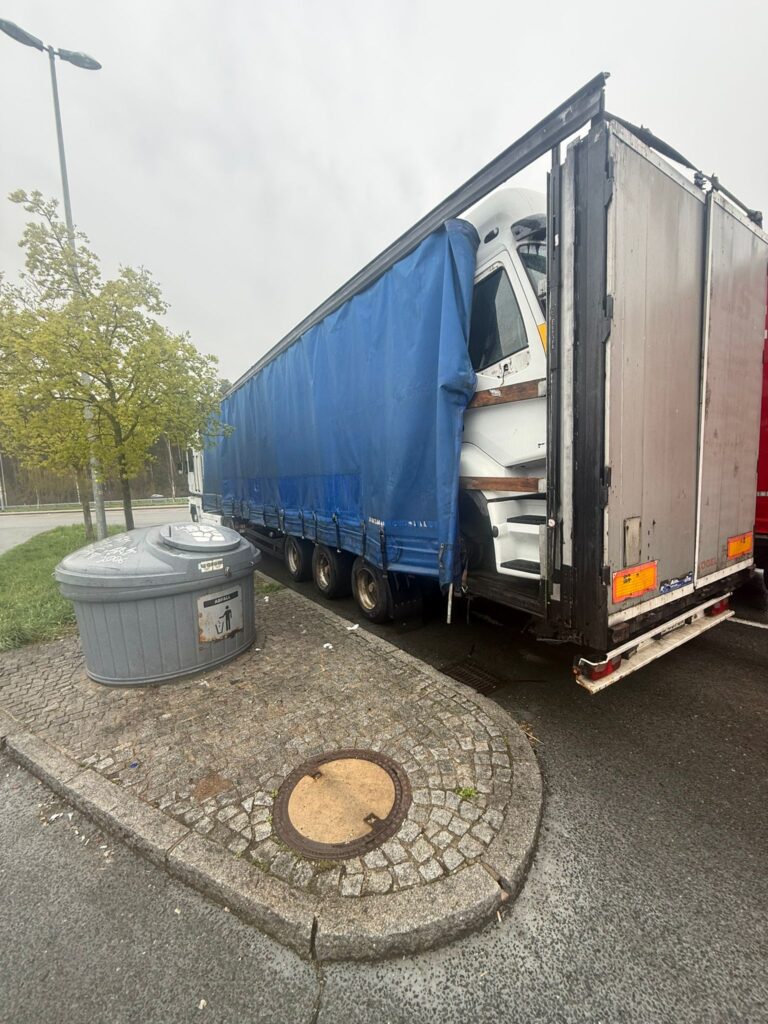
In short: On 10 April, the curtain tarpaulin of a semi-trailer tore near the headboard at a rest area off the A44 near Werl, North Rhine-Westphalia. Rain was forecast, the cargo was exposed. From the call to the finished temporary repair with reinforced PVC tape and patches, 3 hours 10 minutes passed, at a cost of €515 net.
A tear in a curtain looks harmless until it starts raining. Once it does, the cargo gets wet within minutes, and a minor material fault turns into an insurance claim with a CMR liability dispute attached. That was exactly the risk building up near Werl this spring afternoon.
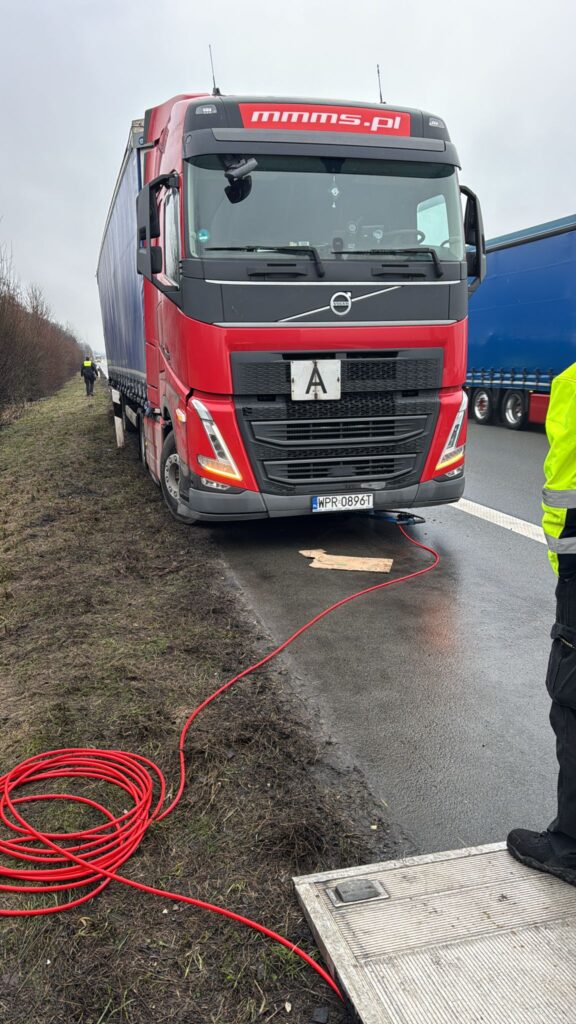
The driver of a curtainsider semi-trailer was checking his rig during a mandatory rest break at the Autohof — routine housekeeping. He noticed a tear roughly the width of a hand near the front edge of the curtain, close to the headboard transition. The wooden battens that stiffen the frame there had splintered and were sticking outward. The sky over the Sauerland region was already darkening.

What happened at the rest area near Werl?
The tear was spotted during a stop, not while driving — which limited the damage but still made the situation urgent. The semi-trailer, a curtainsider unit with a blue curtain, was parked in the lot of an Autohof away from the motorway when the driver noticed the split. The load was mixed general cargo, partly moisture-sensitive.
A torn curtain panel grows worse with every kilometre driven, because airflow catches under the loose edge and rips it further open. Parked, the damage stayed roughly stable — but only as long as nobody drove off and no gust hit from the wrong angle. The driver made the right call: stop, don\’t drive, get help.
The afternoon forecast for the Sauerland region called for rain. With exposed cargo, a twenty-minute shower is enough to permanently ruin cardboard, paper goods, or textiles. That was the window our dispatch had to close.
How was the assistance organised?
The call reached our dispatch centre at 09:10, and a technician from our partner network was on site at 11:15 — 55 minutes travel time from job confirmation. Step by step:
- Driver calls in with location (Autohof, A44, near Werl) and describes the damage, sends photos.
- Dispatch assessment: tear size, cargo type, weather forecast — flagged \”urgent, not a total breakdown\”.
- A technician from the regional partner network with tarpaulin repair kit on board is assigned.
- Estimated arrival time confirmed with the driver, so he could plan his standing time realistically.
- Travel to site, on-site diagnosis on arrival.
Dispatch took roughly 15 minutes — short, because the phone description of the damage was already clear and no recovery vehicle was needed, unlike a full breakdown case.
Why a tarpaulin tear is not a minor issue
A tear in a curtain is not cosmetic — it is an active weather-protection failure racing against the clock. Two things drive the urgency: the tear growing while driving, and the risk of wet cargo.
Run a curtainsider with a torn tarp on the motorway and at 80 km/h the airflow treats the loose edge like a sail. Within a few kilometres, a 30-centimetre tear can become a metre-long opening. The frame of aluminium bows and wooden battens loses additional stability, because the curtain stops carrying tension evenly.
The second risk hits the cargo directly. Moisture-sensitive goods — cardboard, paper rolls, textiles, electronics, food packaging — often absorb water from light drizzle alone. Once the load is soaked, it usually turns into a claim under CMR carrier liability, complete with value depreciation, replacement delivery, and reputational damage with the client. A tear patched in time costs a few hundred euros. A soaked cargo consignment costs several times that.
What is a truck curtain made of, and why does it tear?
A curtainsider tarpaulin is made of PVC-coated polyester fabric, typically weighing 650 to 900 grams per square metre. The polyester weave carries the tension load; the PVC coating provides waterproofing and UV resistance. Cheap curtains with thinner fabric and a lighter coating tend to tear along the seams first, because the needle holes from stitching form built-in weak points. Higher-grade curtains with welded rather than stitched seams and higher fabric weight stretch under load before they tear — often buying the driver the extra kilometres needed to reach the next safe stop.
Typical causes of curtain tears — the most common cases we see in the field:
- Airflow on a poorly tensioned curtain: A loosely tensioned curtain flaps, slaps against the frame, and fatigues the material at the same spots until it splits.
- Snagging on branches or warehouse gate posts: Manoeuvring in yards or tight loading docks, a single protruding branch is enough to slit the fabric instantly.
- Wear on tension rails and curtain-slider rollers: Sharp edges on rollers or bows abrade the fabric over months until a fine tear develops.
- Hail: Larger hailstones puncture thin curtains in isolated spots, especially on the roof area.
- Forklift contact during side loading: A fork tip catching the curtain during dock manoeuvres usually rips it vertically.
- Vandalism and slashing during cargo theft: A serious topic on its own on German rest areas — covered below.
How do you temporarily repair a tarpaulin tear on the spot?
On site, the tear is sealed with reinforced PVC tape and a self-adhesive patch — this takes 45 to 90 minutes depending on tear size and holds until the next workshop stop. The sequence our technician followed near Werl:
- Clear and degrease the area: dust, grease, and moisture are removed with cleaning solution and a lint-free cloth — skip this step and no adhesive bonds properly.
- Trim the edges: frayed edges get squared off with scissors so the tear doesn\’t keep spreading while patching.
- Cut the patch with rounded corners: sharp corners are the first thing to peel — a squared corner lifts off first. The patch overlaps the tear by at least 5 centimetres on each side.
- Bond both sides: a patch applied from outside alone holds; a patch applied from both inside and outside holds much longer, because both faces withstand airflow and moisture independently.
- Press down with a roller: air bubbles under the patch are the most common cause of early peeling, so pressure is applied from the centre outward.
This repair is explicitly a stopgap — it\’s meant to secure the journey to the next workshop or delivery point, not to be a permanent fix. Done well, a patch like this holds for several weeks and several thousand kilometres; under heavy mechanical stress, such as a curtain-slider system in constant use, it holds noticeably less.
When do you need hot vulcanising or a whole new curtain panel?
Past a tear of roughly 40 to 50 centimetres, or with several tears in the same panel, a taped repair stops being worth it — that\’s when hot vulcanising or a full curtain replacement at a workshop takes over. Hot vulcanising fuses PVC material to the existing curtain under heat and pressure, creating a molecular bond that\’s just as tear-resistant as the original material, unlike a taped joint. Depending on tear size, that takes 30 to 90 minutes at a workshop with the right equipment.
If the curtain itself is already several years old, brittle, or patched in multiple places, replacing the whole panel is often more economical than another individual repair. A new curtain panel for a standard trailer costs between €800 and €1,800 net depending on cut and branding — an investment that pays off on a trailer with several more years of service life ahead.
The curtain is not a load-securing device — a common misconception
A side curtain on a truck is not a load-securing device by design; it is weather protection. This misconception persists among drivers and loaders: because the curtain visually \”encloses\” the load, it\’s assumed to hold it mechanically too. In reality, load securing under the relevant standards (including VDI 2700) requires form-fit or friction-fit securing via lashing straps, locking bars, anti-slip mats, and the side walls themselves. If the curtain tears, the actual load securing doesn\’t change — provided it was done correctly from the start. If, on the other hand, the load was only being \”held\” by the curtain, a securing fault already existed before the tear, and it\’s the kind of thing that gets flagged during a roadside check.
What should you check during a daily curtain inspection?
A thorough curtain check takes five minutes and covers four weak points: seams, eyelets, tensioning straps, and the roof panel. This is the order that has worked well on our jobs:
- Seams and welds — check for fraying or early pinholes, especially at the transitions to the front and rear panels.
- Eyelets and rings on the tensioning straps — check for tearing out or early rust, since a torn-out eyelet leaves the whole curtain sagging at that point.
- Tensioning straps themselves — check for stretch and loose sections, because a poorly tensioned curtain flaps and tears faster.
- Curtain-slider mechanism (where fitted) — jammed or bent rollers abrade the fabric with every operation.
- Roof panel — barely visible from the ground, but disproportionately likely to tear, from branch contact under low clearances or from hail. A quick check from a ladder or elevated position is worth doing before any longer trip.
How do you recognise a slashed curtain from cargo theft?
A deliberate slash leaves a clean, straight cut rather than an irregular tear — that\’s the key distinction from ordinary material damage. Cargo theft through slashed curtains remains a persistent issue at unwatched rest areas in Germany, particularly along heavily used east-west and north-south corridors. Typical signs:
- A vertical or diagonal cut, often in the rear third of the trailer, at reaching height.
- Missing or displaced cargo near the cut.
- Footprints or marks on the ground beside the trailer that don\’t match the driver\’s own movements.
- A second, smaller test cut nearby — offenders often check first whether the load is even accessible.
If theft is suspected: call the police, photograph the damage before touching anything, notify the haulage company and the insurer before any repair begins. That\’s one more reason to prefer guarded lots or well-lit, well-overlooked Autohöfe over unwatched rest areas along the open road.
Full timeline
| Time | Phase | Action |
|---|---|---|
| 09:10 | Report | Driver calls in the tear, sends photos |
| 09:10–09:25 | Dispatch | Assessment, technician assigned from partner network |
| 09:25–11:15 | Travel | Technician drives to the rest area near Werl (A44) |
| 11:15–11:30 | Diagnosis | Tear size, material condition, repair plan |
| 11:30–12:20 | Repair | Degreasing, edge trimming, patch bonded on both sides |
| 12:20 | Completion | Visual check, cleared to continue |
Total time from report to clearance: 3 hours 10 minutes.
Cost of the emergency repair
| Item | Price (EUR, net) |
|---|---|
| Callout | 220 |
| Labour (1.5 hrs at €110) | 165 |
| Materials (reinforced PVC tape, patch kit) | 85 |
| Temporary cargo cover during repair | 45 |
| Total | 515 |
All figures net, excluding VAT. For comparison: an unplanned standing day for a semi-trailer typically costs a haulier €800 to €1,200 — meaning the emergency repair pays for itself the moment it avoids even a single hour of downtime. For a permanent repair via hot vulcanising at a workshop, budget an additional €200 to €450; for a full curtain replacement, €800 to €1,800.
Cost factors in detail: callout fees vary with the distance to the nearest partner workshop, with a 25 to 50 percent surcharge overnight and at weekends. Material cost depends on tear size — a small tear needs one patch, a long one needs several. The temporary cargo cover is only billed when rain is actually threatening during the repair itself.
Why shouldn\’t you repair it yourself?
A botched DIY repair often holds for only a few kilometres and can compound the load-securing risk. The typical mistakes we see:
- Wrong tape: ordinary duct tape doesn\’t withstand UV exposure and airflow, and peels off within hours.
- Skipping degreasing: bond over road grime or grease and the patch never adheres properly in the first place.
- Squared instead of rounded patch corners: squared corners peel first and the tear keeps spreading from there.
- One-sided repair only: a patch applied outside alone holds noticeably less than a patch applied on both sides.
- Underestimated tear size: what looks like ten centimetres from below is often twice as long up on the roof — without a full check, part of the damage goes untreated.
- Continuing to drive with no repair at all: the tear grows with every kilometre, and a small material fault quickly turns into a write-off panel.
Typical jobs around curtains and superstructures
Beyond curtain tears, we regularly attend related trailer and body issues:
- Torn-out eyelets and rings on tensioning straps.
- Faulty rollers and jammed mechanisms on curtain-slider systems.
- Damage to bows and roof rails after branch contact or low clearances.
- Water damage to cargo from unnoticed small tears in the roof area.
- Combined jobs where tyre service is needed right after a curtain repair, because the same stop uncovers more than one problem.
Prevention for drivers and fleets
A weekly visual curtain check from a ladder meaningfully cuts the risk of unnoticed roof damage, because that\’s exactly where most tears go undetected. More recommendations from our field experience:
- Check the curtain for fresh scuffs or punctures after every manoeuvring session, not just after long drives.
- Retighten tensioning straps regularly — a loosely fitted curtain flaps and fatigues faster.
- For fleets with multiple trailers: log curtain age and make a deliberate call between continued use and replacement after roughly five to seven years of service.
- At rest areas, choose well-lit, well-overlooked spots where possible, to cut the risk of slashing-related theft.
- Carry a repair kit (tape, patches, cleaner) on board to seal small tears immediately as a stopgap.
Curtains, tyres, and fleet upkeep: the bigger picture
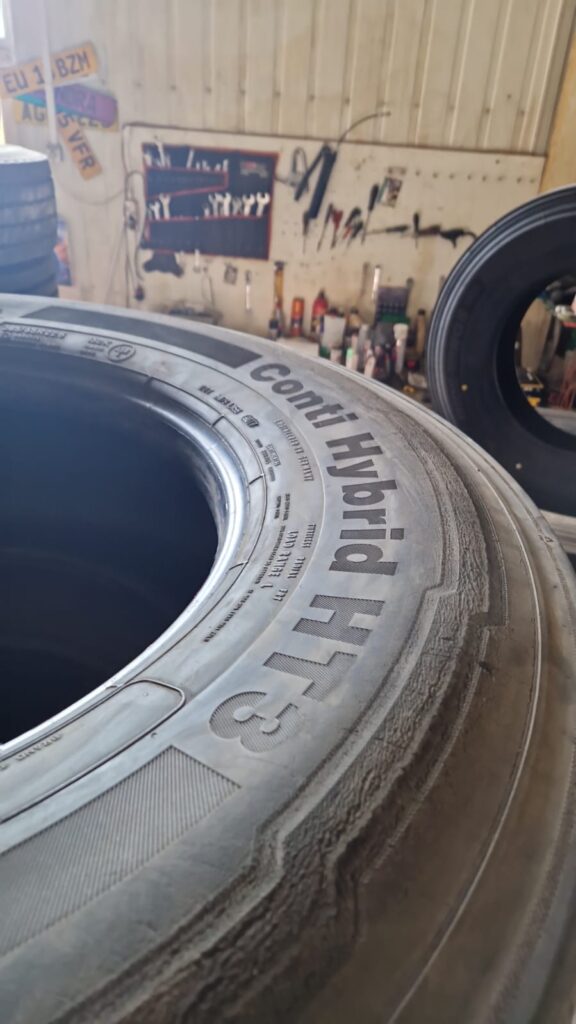
Curtain damage rarely happens in isolation — fleets that neglect their trailer bodywork often have catching up to do on tyre condition too. Tyre makers such as Michelin, Continental, Goodyear, and Bridgestone recommend a combination of regular visual checks and documented maintenance for semi-trailers, because small faults in tyres, brakes, and bodywork otherwise accumulate unnoticed. Steer-axle tyres typically run at 8.5 to 9.5 bar; drive-axle pressures usually sit a bit lower. As with the curtain, the pattern holds: regular checks catch damage before it becomes a costly emergency. Fleets that get both — bodywork and tyres — checked regularly see a noticeable drop in unplanned downtime. Our mobile truck service covers both areas in a single visit whenever one stop uncovers more than one issue.
Why choose LKWHelp24 for this kind of job
We\’re reachable 24/7 across Germany, with a partner network that covers curtain repairs and tyre changes equally well. Dispatch is staffed multilingually, pricing is transparent before the job starts, and our truck breakdown assistance responds the same way whether it\’s a blown tyre, a mechanical breakdown, or — as near Werl — bodywork damage. For larger damage, our towing service takes over onward transport to a specialist workshop when needed.
Frequently asked questions about roadside curtain repair
What does an emergency truck curtain repair cost?
A temporary repair including callout, labour, and materials typically runs €400 to €650 net, depending on tear size and travel distance. In the case described here near Werl, the total came to €515 net.
How long does a taped curtain repair last?
Done properly — degreased, bonded on both sides, rounded corners — a patch holds for several weeks and several thousand kilometres. Under heavy mechanical stress, such as a curtain-slider system, its lifespan is shorter.
Can a torn curtain get a truck pulled off the road?
There\’s no blanket ban, but during a roadside check, badly damaged curtain fabric can be flagged as a safety defect, particularly if cargo is visibly protruding or the tear compromises the actual load securing.
Does a curtain tear count as a load-securing violation?
Not automatically. The curtain itself is not a securing device, so a tear doesn\’t change the actual securing done via straps and side walls — provided that securing was correct to begin with.
Who pays for cargo damage caused by a torn curtain?
It depends on the case: material wear typically falls under the fleet\’s own comprehensive insurance, while proven theft or vandalism falls under CMR carrier liability combined with cargo insurance. Fast on-site documentation matters either way.
When is a full curtain replacement more sensible than another repair?
Once a panel has several patches on it, or the curtain is more than five to seven years old, replacement is usually more economical than yet another individual repair.
Summary
- Location: rest area off the A44 near Werl, North Rhine-Westphalia
- Date: 10 April
- Vehicle: curtainsider semi-trailer (the trailer)
- Damage: torn curtain near the headboard, frame battens broken
- Response time: 15 minutes dispatch, 55 minutes travel
- Total duration: 3 hours 10 minutes
- Cost: €515 net
- Secondary damage: none, cargo stayed dry
Get help now
A curtain tear turns into cargo damage fast once the rain starts. Call us before the next shower hits: +49 160 5753826, available 24/7 across Germany. More information at www.lkwhelp24.com.
Keywords: truck curtain tear | mobile tarpaulin repair | curtainsider trailer repair | semi-trailer curtain | truck load securing | Autohof A44 Werl | truck breakdown assistance 24/7 | curtain vulcanising | truck tyre service | truck towing service
Related articles
- Truck Breakdown Assistance in Germany – 24/7 Emergency Service from LKW Help 24
- Truck Tyre Service Near Me: How LKWHelp24 Fixed a Semi-Truck Blowout on the A2 Near Hannover in 1 Hour 42 Minutes
- Truck Loses 2 Wheels Near Hannover – Sheared Bolts | 24/7 Mobile Roadside
- Truck Recovery Near Me: How LKWHelp24 Towed a Broken-Down Lorry to a Workshop Near Regensburg in 2 Hours 20 Minutes