Skip to content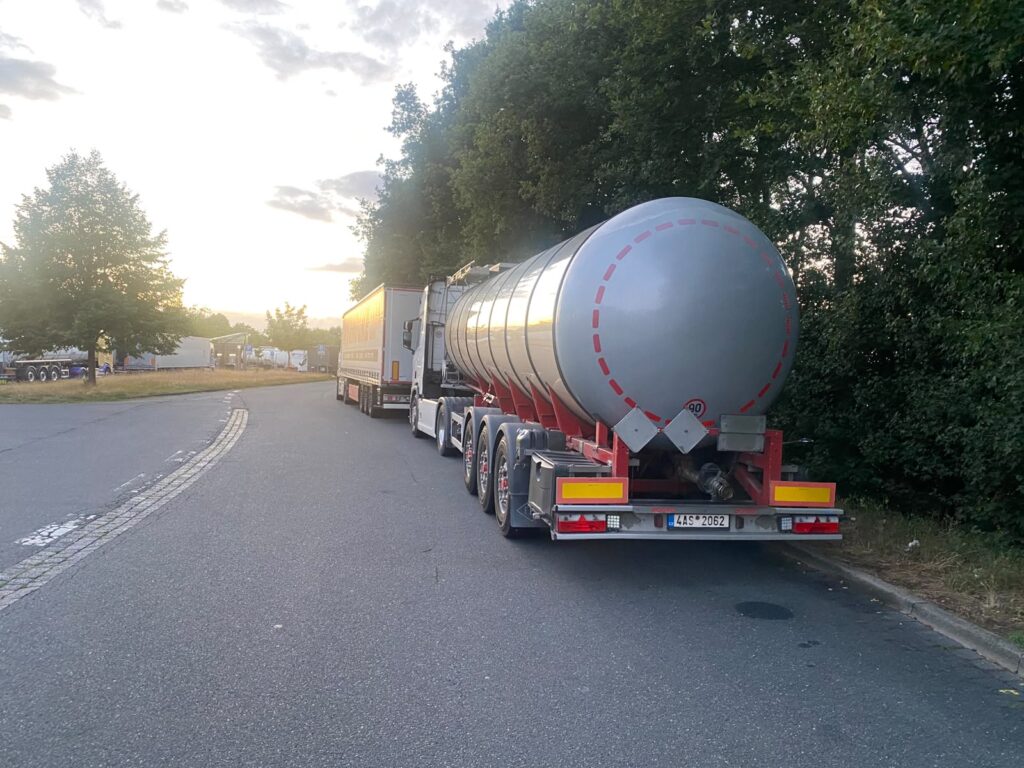
A dashboard countdown to engine derate is not a suggestion. On the night of 10 August, an articulated tractor unit pulled into an Autohof on the A2 near Helmstedt, heading towards Berlin, with an SCR/AdBlue fault message and a remaining-distance counter ticking down towards forced power limitation. The driver called dispatch at 22:58. By 00:45 the lorry was back on the road, released after diagnosis, an AdBlue top-up, a line check and a test run. Total time from call to release: 1 hour 47 minutes.
The story here is not a broken part. It is a clock. Modern emissions systems don’t fail silently — they warn, then throttle, then, if ignored long enough, they can refuse to let the engine restart at all. That last stage is what turns a five-minute fix into a recovery job, and it’s why the decision a driver makes in the first ten minutes after the lamp comes on matters more than almost anything else in the breakdown.
Bildunterschrift
The Emergency: A Warning Light with a Ticking Clock
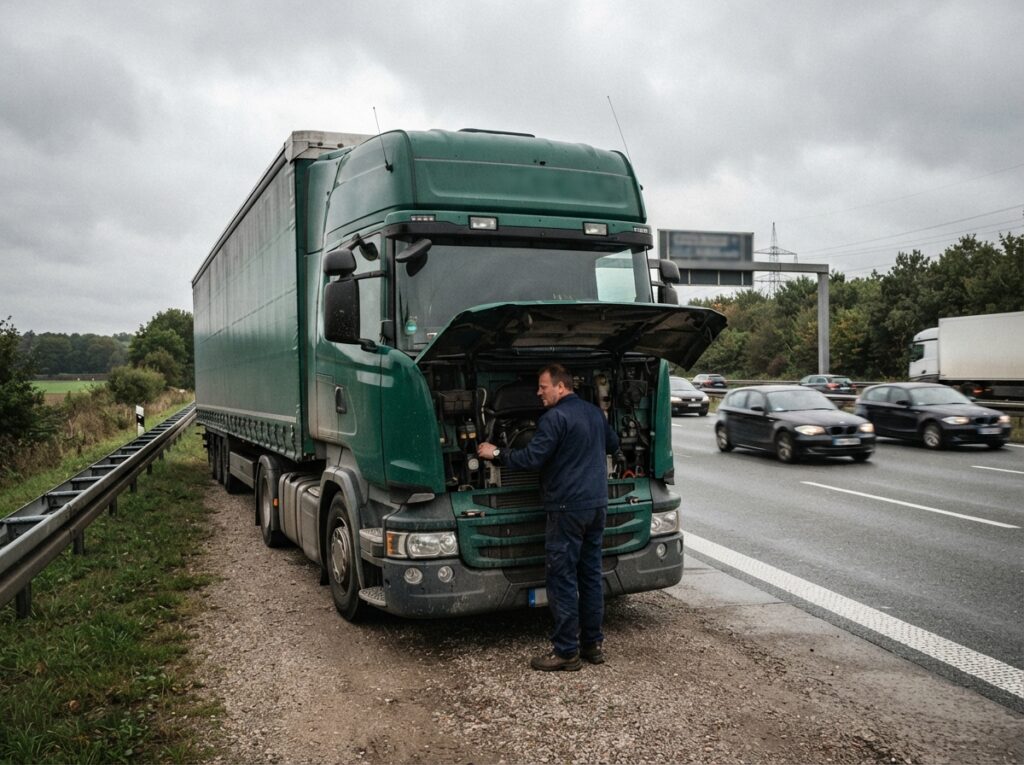
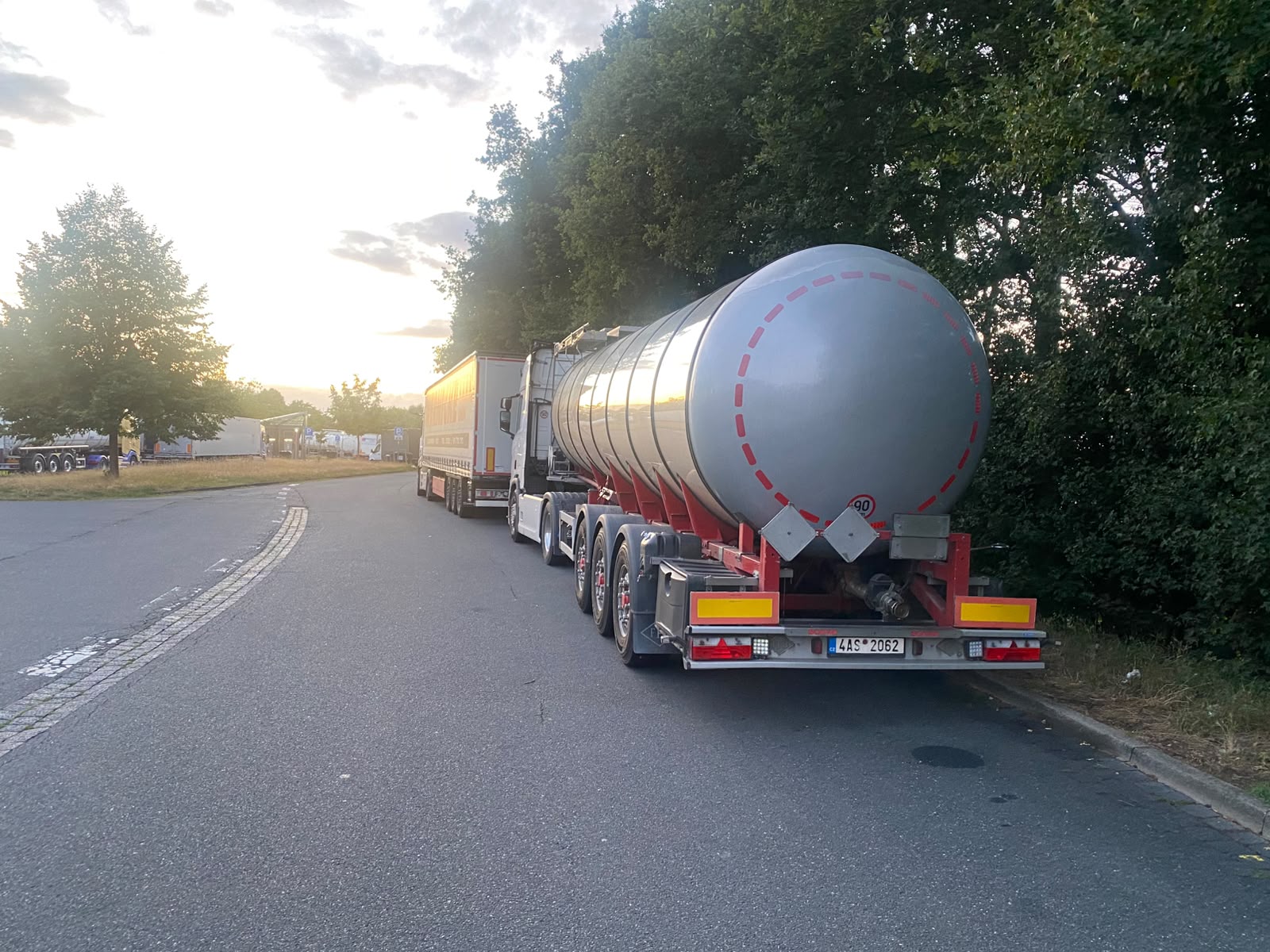
Just before 23:00 on 10 August, the driver of an articulated tractor unit stopped at a motorway service area on the A2 near Helmstedt, Lower Saxony, on the run towards Berlin. The dashboard showed an SCR/AdBlue fault message alongside a remaining-distance and remaining-time counter — a warning that power output would be automatically reduced once the allowance ran out.
This wasn’t a vague “check engine” light. Trucks built to Euro VI standards display an explicit countdown once the after-treatment system flags a fault: so many kilometres, or so many engine starts, before the software cuts torque. The driver had no idea whether the number on the display meant he had two hours or twenty minutes. That uncertainty, at night, alone at a service area, is the actual emergency — not the fault itself.
He called our dispatch line at 22:58.
How We Organised Help
Getting a technician to a stranded tractor unit at night, on a stretch of the A2 few workshops cover after hours, means working the phone before working the tools. Here’s what happened between the call and the technician’s arrival:
- 22:58 – Driver calls, describes the warning message and the countdown reading on the display.
- 23:00–23:10 – Dispatcher runs a remote diagnosis: asks for the exact wording of the fault, the AdBlue tank level shown on the dash, and whether torque reduction had already started.
- 23:10 – A technician from our regional service partner network is alerted and briefed on likely causes: low AdBlue level, a blocked or leaking dosing line, or a genuine SCR sensor fault.
- 23:10–23:45 – Technician drives to the Autohof — a 35-minute run.
- 23:45 – Arrival on site, vehicle identified, driver briefed on next steps.
Remote diagnosis by phone matters here because it decides what the technician brings. A scanner and spare AdBlue are standard kit, but knowing in advance that torque had already dropped, rather than just a lamp being lit, changes how urgently the job gets treated.
Why the Situation on Site Couldn’t Wait
By the time the technician arrived at 23:45, the tractor unit was still driveable but already limited. This matters because emissions derate follows a staged cascade, not a single on/off switch.
Stage one is a warning lamp or message on the dash — no performance change yet. Stage two is torque reduction, where the engine still runs but delivers noticeably less power, enough to struggle on gradients or when fully loaded. Stage three is a hard speed limitation, often capping the vehicle at around 20 km/h — effectively undriveable on a motorway. Stage four, the one that turns a breakdown into a recovery job, is a restart lockout: once the engine is switched off at this stage, it may refuse to start again until the fault is fixed.
That fourth stage is the reason nobody should switch off and wait until morning once torque reduction has begun. A driver who parks up, shuts down the engine and tries to sleep through the problem can wake up to a truck that won’t start — at which point the only options are a workshop visit or a tow, and the AdBlue tank or blocked line that could have been sorted in half an hour on-site becomes an appointment days away.
Fault codes read via scanner at 00:00 confirmed the cause: an AdBlue level low enough to trigger the fault, combined with a partially restricted dosing line. Fifteen minutes of diagnosis is what separates guessing from fixing.
Reading the Warning Cascade: What Each Stage Actually Means
What does a torque reduction warning mean on a truck? It means the engine control unit has detected an emissions fault it cannot self-correct and is deliberately cutting available power, in stages, to force the fault to be addressed before full performance is restored.
The stages aren’t arbitrary. They follow a logic built into every Euro VI emissions after-treatment system: first, warn the driver and give them a chance to fix it cheaply — top up AdBlue, get a diagnostic check. Second, reduce torque, which discourages continued driving without actually stranding the vehicle. Third, cap speed hard enough that motorway travel is no longer realistic. Fourth, once the vehicle is switched off at a late stage, block the restart entirely.
Each stage buys the driver less room to manoeuvre. A lamp at stage one might allow another 1,000 km before anything changes. By stage three, the countdown might read single-digit kilometres. Waiting to “see how it goes” only makes sense in stage one.
The Remaining-Distance Counter: Can You Make It to a Workshop?
How much time does the AdBlue countdown actually give you? The remaining-distance figure is a hard limit set by the vehicle software, not an estimate — once it hits zero, torque reduction or speed limitation begins immediately, regardless of where the truck happens to be.
That number is calculated from the specific fault and the manufacturer’s software, so there’s no universal figure that applies across all trucks. Some counters give a few hundred kilometres, others considerably less once the fault has been active for a while. The practical rule we give drivers is this: don’t treat the counter as a target to reach. If a workshop or depot is close and reachable well within the remaining distance, driving there calmly is sensible. If the counter is uncertain, dropping fast, or the destination is more than half the remaining distance away, stop and get a technician instead. Running the countdown down to the last kilometre and hoping to coast into a depot at reduced speed is a bet nobody in this trade recommends.
Step-by-Step: What We Did on Site That Night
What can be fixed on the roadside at night for an AdBlue fault? A technician with a diagnostic scanner and spare AdBlue can usually resolve a low-level or minor-line fault on-site within an hour — but only after confirming the fault code, never by clearing it blind.
- Read the fault codes. The scanner pulled the stored codes at 00:00, distinguishing a genuine system fault from a simple low-level warning.
- Check the AdBlue tank. The level was low enough on its own to have triggered part of the warning cascade.
- Inspect the dosing line. A partial restriction was found — not a full blockage, but enough to affect dosing accuracy.
- Top up AdBlue and clear the restriction. Around 10 litres were added; the line was checked and cleared.
- Clear the fault code — only once the cause was fixed. Clearing a code before fixing the underlying issue is pointless: the system re-detects the fault within minutes and the countdown resumes, often from a worse position.
- Run a test drive. A short test confirmed torque had returned to normal and no fault re-appeared before releasing the vehicle back into service at 00:45.
Full Timeline
| Time | Phase | Action |
|---|---|---|
| 22:58 | Fault | Warning appears on the dash, the driver calls dispatch |
| 23:10 | Dispatch | Remote diagnosis by phone, a technician is alerted |
| 23:45 | Response | Technician arrives at the Autohof on the A2 near Helmstedt (35-minute drive) |
| 00:00 | Diagnosis | Fault codes read via scanner, root cause identified (15 min) |
| 00:35 | Repair | AdBlue topped up, line checked, fault cleared (35 min) |
| 00:45 | Verification | Test run, vehicle released back into service |
Total time from call to release: 1 hour 47 minutes.
What the Repair Cost
| Item | Price (EUR) |
|---|---|
| Callout (night response) | 260 |
| Scanner diagnostics | 150 |
| AdBlue top-up (material, approx. 10 l) | 45 |
| Labour: line check/system check (1 hr) | 140 |
| TOTAL (net) | 595 |
All prices net, plus VAT. Downtime for an articulated lorry runs roughly €800–1,200 per day once you count the load sitting idle, the driver’s hours and the missed delivery slot. A €595 night repair is well below that, and it kept the truck moving rather than parked until morning.
Honest caveat: not every AdBlue fault ends this cheaply. If the dosing line needs full replacement or an SCR component — the injector, the NOx sensor, the catalyst itself — has actually failed, it’s not always fixable roadside. That calls for a workshop appointment, with parts and, if the vehicle can no longer be driven, towing on top: budget €900–1,600 depending on distance. This case was on the cheaper end because the fault was caught early, at stage two, before speed limitation set in.
Why This Needs a Professional, Not Guesswork
Drivers sometimes ask whether they can just top up AdBlue themselves and carry on. Sometimes that’s enough. Often it isn’t, and here’s why calling a technician beats guessing:
- The fault code tells you what’s actually wrong — a low-level sensor issue and a failed dosing valve look identical from the driver’s seat but need completely different fixes.
- Clearing a code without fixing the cause resets nothing. The system re-flags the fault, usually faster the second time, and the countdown often restarts from a worse position.
- Tampering with the emissions system is illegal under German and EU regulation, and it doesn’t stay hidden — a manipulated or defeated SCR system is picked up during the periodic technical inspection under §36 StVZO, and the vehicle fails.
- A wrong diagnosis wastes the remaining countdown. Guessing at the fix, failing, and trying again eats into the distance the vehicle has left before hard limitation.
Typical Situations We’re Called Out For
We see this warning cascade across Germany in a handful of recurring patterns:
- AdBlue tank run genuinely empty — the simplest case, fixed with a top-up alone.
- A blocked or leaking dosing line — like this case, needing inspection before the code is cleared.
- A failed NOx sensor — the system reads a fault even though the actual emissions output is fine, requiring sensor replacement rather than a top-up.
- Contaminated AdBlue — crystallised residue in the tank or lines, usually from long standing time or an old, degraded fill.
- Genuine SCR catalyst faults — rarer, and almost always a workshop job, not a roadside one.
Each of these triggers the same dashboard cascade, which is exactly why reading the fault code matters more than reading the symptom.
Low AdBlue Level vs. an Actual System Fault: How to Tell Them Apart
Is my AdBlue level low, or is the system actually faulty? A low-level warning shows a simple tank icon or percentage with no torque reduction attached, while a system fault shows a specific SCR/NOx warning message and typically starts the countdown to derate immediately, even with fuel-equivalent range still available.
The distinction matters because the fix is completely different. A low level is solved with a top-up at any truck stop. A system fault needs a scanner to identify which component triggered it — sensor, line, dosing module or catalyst — before anything gets cleared. Driving on a low-level warning for too long can itself trigger a secondary system fault once the tank runs genuinely dry, which is one more reason not to let the level run to empty in the first place.
Why Trucks Are Forced to Derate at All
Why does a truck lose power over an AdBlue fault instead of just showing a warning? Because EU emissions law requires it — a malfunctioning after-treatment system that isn’t corrected must trigger increasingly severe engine power restrictions, a mechanism defined in the EU’s heavy-duty vehicle emissions type-approval framework to stop hauliers from simply ignoring faults and running dirty.
This is not an engine failure and not a manufacturer being difficult. Euro VI heavy-duty vehicles are legally required to actively limit performance when the SCR system can no longer guarantee compliant NOx output. The countdown, the torque cut, the speed cap — all of it exists so that a truck with a broken emissions system physically cannot keep running at full output on public roads. Understanding that changes how a driver reacts to the warning: it’s not a bug to route around, it’s a compliance mechanism doing exactly what it’s designed to do.
Why the Decision Gets Harder at Night
At 23:00 on a Sunday into Monday, most independent workshops near the A2 are closed, parts counters won’t open until morning, and the nearest depot might be an hour or more away. That’s the real decision point in cases like this: fix it here, limp on towards the destination, or park up and wait until daylight.
Each option carries a real trade-off. Fixing on-site works when the fault is simple — low AdBlue, a minor line issue — and a technician can reach the vehicle before the countdown runs out. Limping on only makes sense if the destination is close and the countdown comfortable; pushing a marginal countdown towards a distant depot risks getting caught by speed limitation halfway there, on a motorway shoulder rather than a service area. And sometimes, honestly, waiting until morning is the right call — if the fault is minor, the truck is already parked safely, and a workshop nearby opens in a few hours, calling out a night technician for a job that can wait costs more than it saves.
What makes waiting risky is only the restart lockout at a late stage. If torque reduction has already started, switching off is a gamble on whether the engine restarts. If the warning is still at stage one with no torque loss, parking overnight at a safe, lit Autohof and dealing with it in daylight is often the sensible, cheaper choice.
Extended Guidance: Fleets, AdBlue and the Wider Maintenance Picture
Emissions after-treatment faults sit alongside tyre pressure, brake wear and load securing as one of the most common reasons a lorry gets pulled off the road mid-route. Fleet managers running mixed brands — Euro VI tractor units from any major manufacturer — all face the same SCR logic, because it’s set by EU type-approval rules, not by individual OEMs. AdBlue quality, tank hygiene and dosing-line condition matter more than most operators assume: a line that’s slightly restricted today is a line that fails outright in three months if nobody checks it.
Fleets that build AdBlue checks into their standard pre-trip routine — alongside tyre pressure and lights — catch low-level warnings before they escalate into system faults. It’s a five-minute check that avoids a five-hundred-euro night callout.
Why Drivers Choose Us
- 24/7 dispatch across Germany, with a multilingual team so the fault gets described accurately regardless of the driver’s first language.
- A vetted regional partner network, meaning a technician with the right diagnostic kit is usually within reach even on quieter motorway stretches at night.
- Transparent, itemised pricing — the invoice matches the estimate given by phone, net plus VAT, no surprises at 1am.
- Diagnosis before clearing anything — we don’t clear fault codes blind, because a code cleared without fixing the cause just restarts the countdown.
Our mobile truck service covers exactly this kind of on-site emissions diagnostic work, and our truck service network handles the cases that need a proper workshop bay instead. When a vehicle genuinely can’t be repaired on-site, our towing service picks up from there.
Summary
- Location: Autohof on the A2 near Helmstedt, Lower Saxony, towards Berlin.
- Vehicle: Articulated tractor unit.
- Fault: SCR/AdBlue system warning with a remaining-distance countdown to power derate.
- Time of incident: Night of 10 August, around 23:00.
- Response time: 35-minute drive to site, technician on scene by 23:45.
- Total time, call to release: 1 hour 47 minutes.
- Total cost (net): €595.
- Secondary risk avoided: restart lockout that would have required towing.
Frequently Asked Questions
What happens if I ignore the AdBlue countdown warning?
Power output drops in stages — first torque, then a hard speed cap around 20 km/h. If you switch the engine off after torque reduction has begun, it may refuse to restart, turning a roadside fix into a recovery or towing job.
Can I just clear the fault code myself and keep driving?
No. Clearing a code without fixing the cause doesn’t remove the fault — the system re-detects it within minutes, and manipulating the emissions system is illegal and gets caught at the next roadworthiness inspection.
How long does an AdBlue roadside repair take?
In this case, 1 hour 47 minutes from the first call to the vehicle being released, including a 35-minute technician response, 15 minutes of diagnosis and 35 minutes of repair.
Is a low AdBlue warning the same as a system fault?
No. A low-level warning is a simple tank reading with no torque loss. A system fault triggers the countdown immediately and needs a scanner to identify the actual cause.
What does a night AdBlue callout cost?
In this case, €595 net: €260 callout, €150 diagnostics, €45 AdBlue material and €140 labour. A workshop repair with parts or towing runs €900–1,600 depending on distance.
Should I always fix an AdBlue fault immediately at night?
Not always. If the warning is at the earliest stage with no torque loss and the vehicle is parked safely, waiting until a nearby workshop opens can be the more sensible choice.
Get Help Now
If your dashboard is showing an emissions system warning with a countdown, don’t wait for it to reach zero. Call +49 160 5753826 — we’re available 24/7 across Germany, and a technician with a scanner can usually tell within fifteen minutes whether you’re looking at a five-minute top-up or a workshop job. More at www.lkwhelp24.com.
Keywords: AdBlue warning truck | SCR system fault lorry | emissions derate countdown | truck power limitation AdBlue | AdBlue breakdown A2 Helmstedt | truck emergency roadside diagnostics | night truck breakdown Germany | AdBlue top-up service | SCR sensor fault lorry | truck restart lockout