Skip to content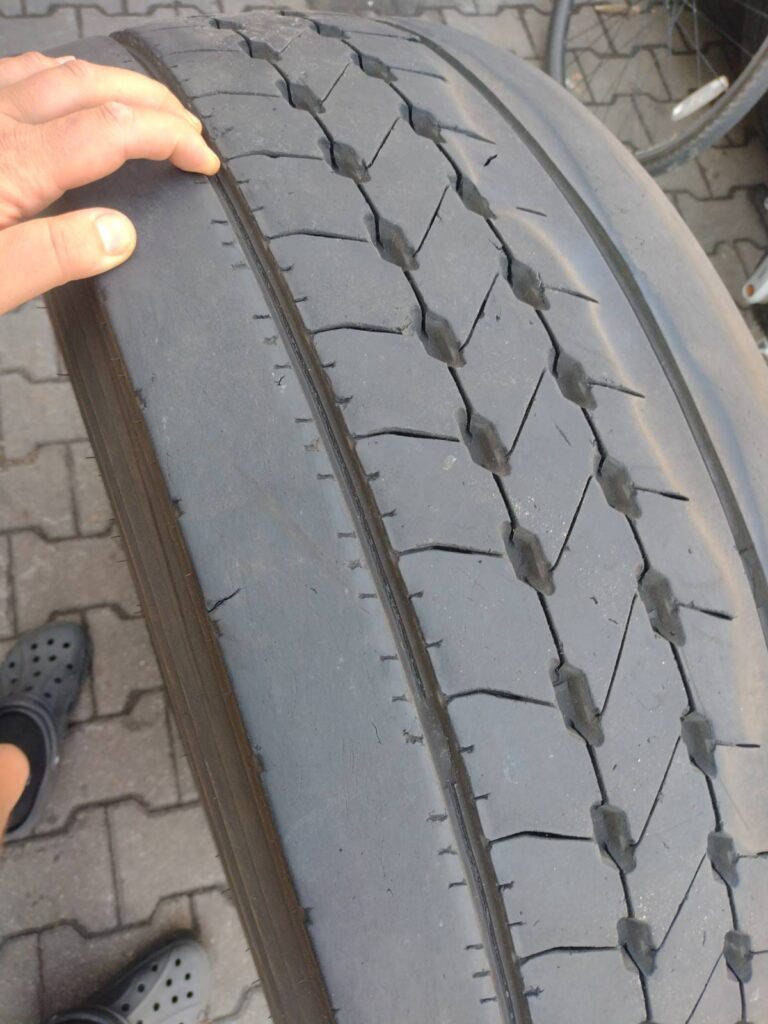
A tyre blowout on a diesel lorry is routine work. A tyre blowout on an LNG-powered tractor unit is a different job entirely, because the technician has to work around cryogenic gas tanks that sit close to the wheel arch and cannot be treated like an ordinary fuel tank. On 4 August, our regional service partner handled exactly that on a Volvo LNG tractor unit parked in a logistics yard off the A2 near Recklinghausen, in the Ruhr region. Total time from the first phone call to the driver being cleared to move was 2 hours 5 minutes, and the final invoice came to €1,110 net.
Gas-powered lorries are becoming a normal sight on German roads, and the reasons are financial as much as environmental. LNG and CNG tractor units cost less to refuel than diesel equivalents, they qualify for toll relief under Germany’s federal scheme for alternative drivetrains as set out by the Federal Ministry for Digital and Transport, and their CO2 output per kilometre is meaningfully lower. Fleets are switching for the balance sheet, not just for the badge. What often gets underestimated is the roadside support chain behind these vehicles: not every workshop, and not every recovery technician, is trained or equipped to work on them.
This case shows what a routine wheel change looks like once you add a gas tank to the equation, why the extra 45-90 minutes are non-negotiable, and what any haulier running LNG or CNG stock should know before the tyre actually fails.
The situation on site
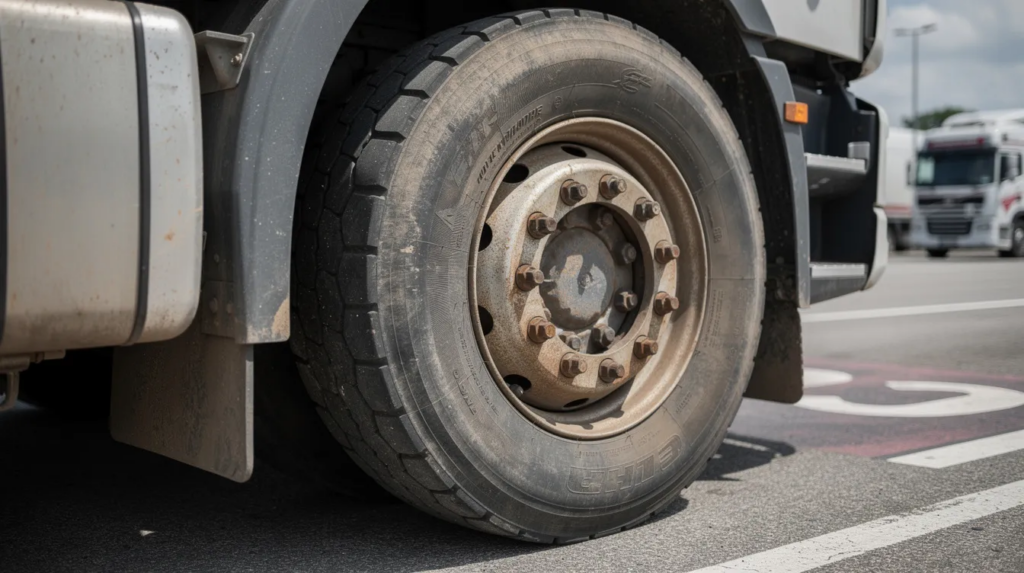
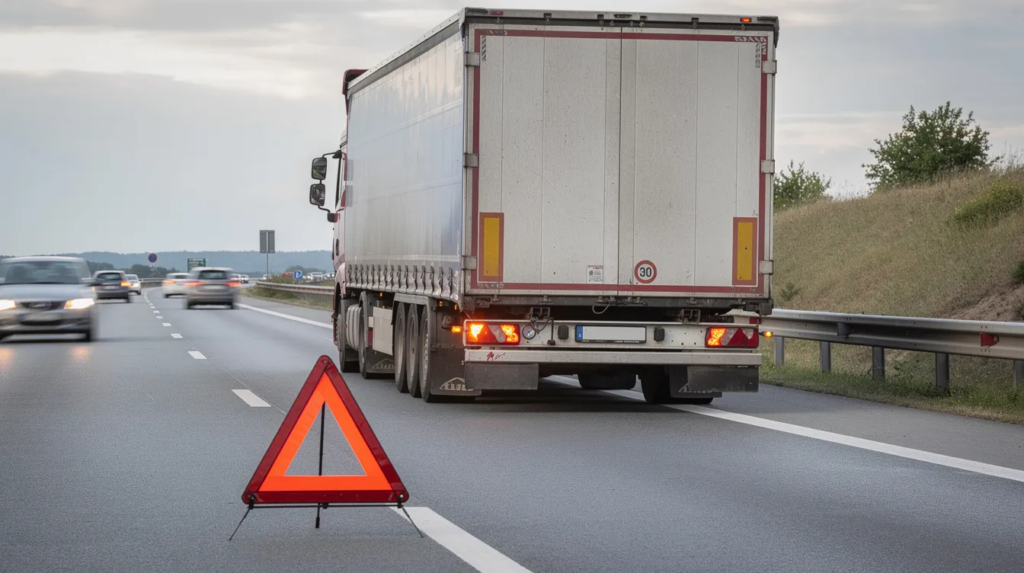
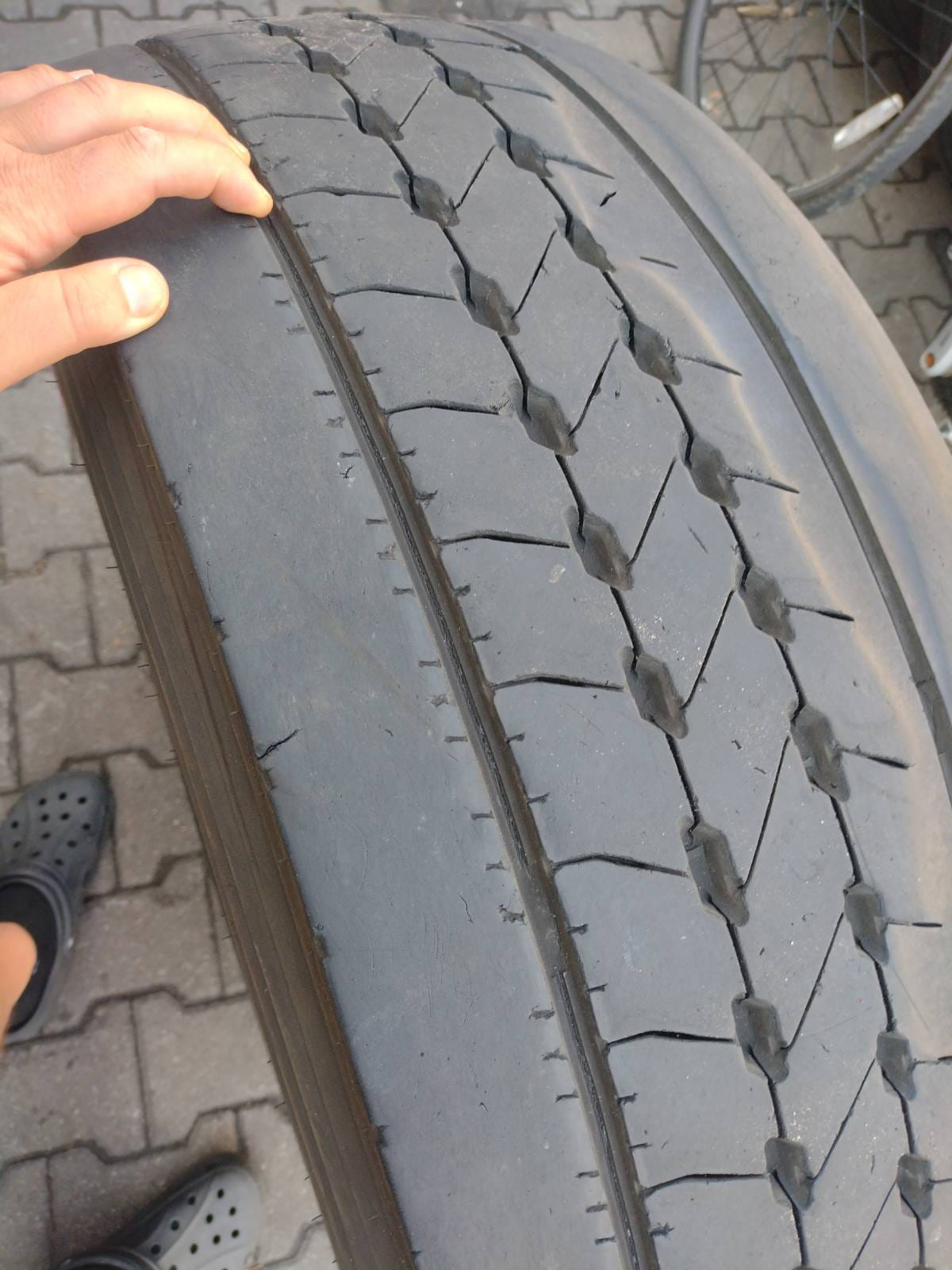
The driver had parked the Volvo tractor unit on his own initiative at a logistics yard just off the A2 near Recklinghausen after noticing a slow loss of pressure on the right steer axle. That decision alone saved time and reduced risk, because changing a tyre on hard shoulder gravel next to moving traffic is a far worse environment for any job involving a gas vehicle than a flat, enclosed yard with room to work.
By the time our partner’s technician arrived, the tyre was down to a soft bulge rather than a full flat, still holding the rim off the ground but clearly unsafe to run on. The unit’s LNG tanks, mounted behind the cab on the chassis rail, were intact with no frost, no hissing, and no smell — a normal state, but one that still had to be confirmed rather than assumed.
Yard surface was solid concrete, dry, good lighting from the depot’s own floodlights even though the job ran in daylight, and no other vehicles were queued close enough to interfere. Conditions were about as favourable as a gas-vehicle callout gets.
Why gas vehicles change the whole job
Working near an LNG tank is not the same as working near a diesel tank, and the difference is physical, not procedural window-dressing. Diesel is a liquid at ambient temperature and pressure. LNG is methane cooled to roughly -162°C until it liquefies, then held in a double-walled, vacuum-insulated cryogenic tank. CNG, by contrast, stays gaseous and is simply compressed to around 200 bar in thick-walled cylinders at normal temperature. Both need respect, but LNG’s cryogenic nature adds a hazard diesel and CNG techs don’t usually deal with: frostbite from contact with the liquid or with frosted metal fittings, which can damage skin instantly, on contact, the way a burn would. For that reason the crew treats every valve, line and fitting on the tank as something you look at, not touch, unless you are specifically trained and equipped to service it.
The second thing every technician has to understand before opening a toolbox near one of these trucks is boil-off. LNG in the tank gradually warms and some of it evaporates even when the vehicle is standing still and not being used. As pressure builds, a relief valve vents the excess gas automatically. This is normal operation, not a fault, but a technician who doesn’t know about boil-off can easily mistake the hiss of a venting valve for a leak, or worse, position himself or his equipment directly under the vent path while it happens to open. The rule on any gas vehicle job is simple: identify the venting zone first, keep the crew and tools clear of it, and never work directly beneath a relief valve. The underlying physics is described in more detail in the Wikipedia entry on liquefied natural gas, which covers why the -162°C storage temperature demands the multi-layer vacuum insulation these tanks carry, and how that differs from compressed natural gas, which stays gaseous and simply sits under high pressure at ambient temperature.
For a technician trained on diesel drivetrains, the mental model has to shift completely. A diesel fuel system fault is mechanical and forgiving of a wrong first guess. A gas system fault is thermodynamic, and a wrong first guess near a relief valve or a frosted fitting can cause real injury within seconds, which is exactly why our dispatch team treats “which drivetrain” as the first question on any tyre or breakdown call, not an afterthought asked once the technician is already on site.
Ignition sources are the other non-negotiable. No open flame, no spark-producing tools, no smoking anywhere near the tanks or their fittings, and equipment isn’t parked or stacked close enough to obstruct the venting path. If a technician ever suspects an actual leak rather than normal boil-off — a sustained hiss with a strong gas smell, frost forming somewhere it shouldn’t, or a reading on a gas detector — the response is to step back immediately, not start the engine, avoid anything that could spark, and call the emergency services. Natural gas is lighter than air and disperses upward in the open, which is one reason yard settings are safer than enclosed workshops for this kind of standstill, but it can still pool dangerously in confined spaces.
None of this is optional extra caution. It’s the reason the tyre service call-out for a gas vehicle takes a trained technician, not whoever happens to be nearest with a torque wrench. Roadworthiness and load-securing rules for commercial vehicles operating on German roads are set out under §36 StVZO, and while the regulation doesn’t single out gas drivetrains, it underlines the same principle: a vehicle only returns to the road once it demonstrably meets the required safety standard, and for an LNG tractor unit that standard includes the tank system, not just the tyre.
How help was organised
08:15 — The driver called our dispatch line and described a slow leak on the front right tyre, tractor unit running on LNG, parked in a private yard off the A2.
08:15-08:30 — Dispatch spent fifteen minutes, not five, because the priority was finding a technician from our partner network who was actually certified for gas-vehicle work, not simply the nearest available crew. On a diesel truck this step is close to instant; on a gas unit it’s the single biggest variable in total response time.
08:30-09:15 — Forty-five minutes on the road to the Recklinghausen yard, with the technician carrying a gas detector alongside standard tyre-fitting kit.
The fifteen-minute dispatch window is worth dwelling on, because it’s the number most fleet managers underestimate when they think about total downtime on a gas-vehicle breakdown. On a diesel job, dispatch is close to a lookup problem: find the nearest available crew, confirm the tyre size in stock, send coordinates. On a gas job it becomes a filtering problem first — of the technicians within reasonable driving distance, which ones actually hold current training on LNG or CNG systems, carry a gas detector, and know the venting procedure for the specific manufacturer. Get that filtering wrong and the callout either stalls on site while the wrong crew waits for backup, or worse, proceeds with someone improvising around a system they don’t fully understand. Building that qualified list in advance, rather than searching for it mid-callout, is the single biggest lever we have over total response time on these jobs.
Step-by-step: what happened on site
Step 1 — Securing the area and checking gas status. Before touching the wheel, the technician walked the tank line, checked for frost or unusual sound, confirmed no venting was in progress, and marked out a clear working zone away from the relief valve path. This took fifteen minutes and is not skippable regardless of how straightforward the tyre damage looks.
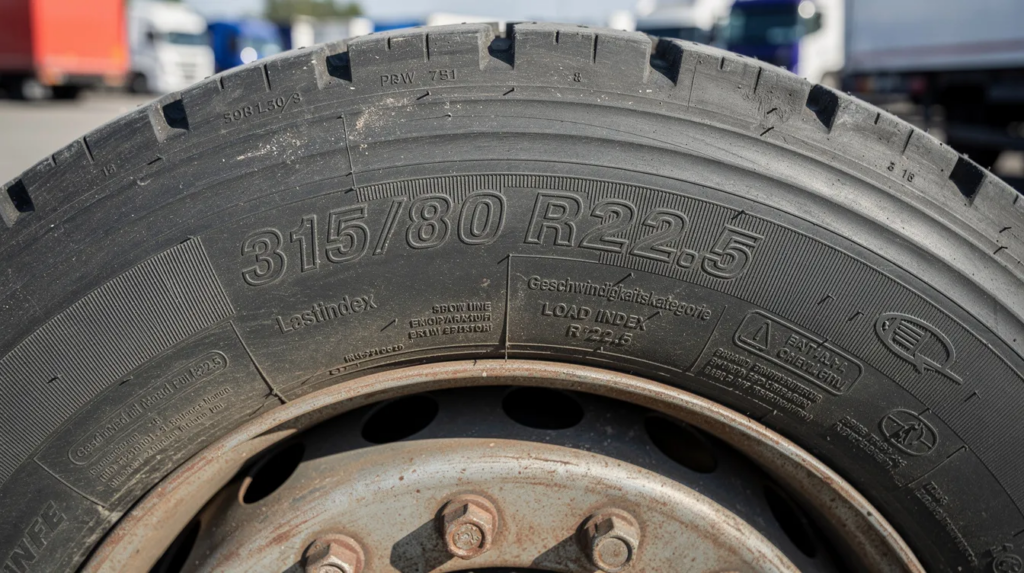
Step 2 — Removing the damaged tyre. With the area confirmed safe, the wheel was chocked, jacked, and the 315/70 R22.5 tyre broken down and removed in fifteen minutes — close to normal pace once the safety check was done.
Step 3 — Fitting the new tyre. A matching 315/70 R22.5 replacement was mounted, seated, and inflated to the correct pressure over twenty minutes, slightly longer than a diesel job because tyre loading on a gas tractor unit isn’t identical to a standard configuration.
Step 4 — Torque and inspection. Wheel nuts were tightened in cross pattern to spec, checked a second time, and the tank area re-inspected before sign-off. Fifteen minutes.
Step 5 — Paperwork and release. The driver received the job sheet and was cleared to move by 10:20.
Timeline at a glance
| Time | Phase | Action |
|---|---|---|
| 08:15 | Call received | Driver reports slow leak, LNG tractor unit, private yard |
| 08:15-08:30 | Dispatch (15 min) | Locating a technician certified for gas vehicles |
| 08:30-09:15 | Drive to site (45 min) | Travel to Recklinghausen yard off the A2 |
| 09:15-09:30 | Safety check (15 min) | Securing area, checking gas status and boil-off |
| 09:30-09:45 | Tyre removal (15 min) | Breaking down and removing the damaged tyre |
| 09:45-10:05 | Fitting (20 min) | Mounting and inflating the 315/70 R22.5 replacement |
| 10:05-10:20 | Sign-off (15 min) | Cross-pattern torque check, final inspection, paperwork |
Total elapsed time: 2 hours 5 minutes, call to completion.
What it cost
| Item | Price (EUR) |
|---|---|
| Call-out | 260 |
| Tyre 315/70 R22.5 | 520 |
| Labour (fitting incl. safety procedure) | 220 |
| Old tyre disposal | 20 |
| Gas-vehicle safety-procedure surcharge | 90 |
| TOTAL | €1,110 net (excl. VAT) |
Three things push this above a comparable diesel tyre job. The tyre itself is a premium 315/70 R22.5 steer-axle pattern, priced at market rate. Labour includes the extended safety window baked into every gas-vehicle call-out, not billed separately but reflected in the higher fixed labour rate. And the surcharge specifically covers the certified technician’s training, the gas detector equipment, and the additional fifteen minutes of pre-work inspection that a diesel job doesn’t need.
Set against that, a tractor unit standing idle in Germany typically costs a haulier somewhere between €800 and €1,200 per day once you count lost revenue, driver time, and knock-on delivery penalties. A €1,110 repair completed within two hours is, in blunt terms, cheaper than half a day of standstill.
Why this isn’t a job for just anyone
- Certification matters. Technicians working on LNG or CNG tanks need specific training most general tyre-fitting crews don’t have, covering cryogenic hazards, venting behaviour, and emergency response.
- Equipment differs. A gas detector and knowledge of the tank’s relief-valve layout are as essential as the tyre jack itself.
- Axle loading is different. Gas tanks add weight on the chassis, which shifts axle load distribution compared with an equivalent diesel unit, and that affects both tyre selection and inflation pressure — get it wrong and you’re back on site within weeks.
- Refuelling infrastructure is thinner. Germany’s LNG station network is real but nowhere near as dense as diesel coverage, so a breakdown away from a hub city means you can’t simply “top up a jerry can” the way you can with diesel — recovery and repair have to happen on the spot or the truck has to be towed.
Typical LNG/CNG call-outs we see
Gas-vehicle jobs tend to fall into a handful of recurring categories: tyre damage exactly like this case, minor tank-sensor fault codes that need a trained eye to distinguish from an actual leak, standard mechanical faults (brakes, electrics, cooling) complicated only by the need to keep any hot work away from the tank zone, and occasional refuelling-related issues when a driver misjudges range between stations. Straightforward mechanical work like brake pads or an alternator swap can often be handled through our mobile truck service without extra gas-specific procedures, provided the tank area itself isn’t involved.
Refuelling range is a category worth flagging on its own. Germany’s LNG station network has grown steadily along the main freight corridors, but it’s still sparse compared with diesel coverage, and it thins out fast once a route leaves the motorway network for regional roads. A diesel driver who misjudges range can limp to almost any filling station or wait for a jerry can. An LNG driver who misjudges range has no equivalent fallback — there’s no roadside top-up, and towing to the nearest station, sometimes well over a hundred kilometres away depending on the region, becomes the only option. Fleet planners running LNG routes through less-served regions such as parts of the Ruhr, Lower Saxony, or the eastern states need to build station stops into the route plan itself, not treat range the way a diesel dispatcher would.
Tank-sensor fault codes deserve a mention too, because they’re one of the more common reasons a gas vehicle ends up parked and waiting rather than continuing its route. A pressure or temperature reading outside expected range can mean genuine boil-off building faster than usual, a faulty sensor, or in rare cases an actual system issue, and distinguishing between those three from the cab isn’t something most drivers are equipped to do. The safe default, and the one we advise every driver of a gas unit to follow, is to treat any unexpected warning light on the tank system the same way as a tyre pressure warning: pull over safely, don’t attempt to diagnose it yourself, and call a technician who can actually read the system.
Prevention tips for gas-vehicle drivers and fleets
- Know your nearest certified gas-vehicle service partner before you’re stranded, not after — not every roadside contract covers LNG/CNG work.
- Check tyre pressures against the vehicle’s actual axle loading, which differs from the diesel version of the same chassis due to tank weight.
- Treat any hissing or venting sound as boil-off until proven otherwise, but still keep your distance and never work under a relief valve.
- Plan routes with LNG station coverage in mind on longer hauls, since range anxiety on gas is a real operational factor in Germany, not a theoretical one.
- Carry your vehicle’s gas-system documentation in the cab so any responding technician can confirm tank specification and relief-valve location immediately.
Tyres, fleet maintenance and drivetrain differences
Steer-axle tyres on any tractor unit, gas or diesel, carry the steering load and take the brunt of kerb strikes, potholes and uneven yard surfaces, which is why premium patterns from Michelin, Continental, Goodyear or Bridgestone are the usual specification for this position rather than budget alternatives. On a gas-powered unit the calculation gets an extra variable: the tank package adds mass, generally concentrated behind the cab, and that shifts static axle loads compared with the diesel version of the same chassis. A fleet running mixed diesel and LNG units should not assume identical tyre pressures or replacement intervals across the two, and a workshop unfamiliar with the difference can under- or over-inflate a steer tyre without realising the load profile has changed.
Regular inspection matters more on gas fleets simply because the margin for a wrong assumption is narrower — a slow leak ignored on a diesel unit is an inconvenience, the same leak ignored near a gas tank installation is a safety question. Our truck service covers scheduled inspection work alongside emergency callouts, and for fleets running LNG or CNG vehicles we flag tank-adjacent components specifically during routine visits rather than treating them as a standard mechanical item.
Independent testing organisations such as TÜV publish periodic technical assessments of gas-vehicle safety systems, and manufacturers including Volvo Trucks design their LNG range with the tank package integrated into the chassis rather than bolted on as an afterthought, which is part of why axle loading on these units follows a predictable, documented pattern rather than being guesswork for the fitting technician. Knowing the manufacturer’s published axle-load figures for the specific model in the yard is standard practice for any technician quoting tyre pressure on a gas unit, and it’s one more reason a generalist crew without access to that data shouldn’t attempt the job unsupervised.
Why choose LKWHelp24
We maintain a partner network across Germany that includes technicians specifically trained for gas-vehicle work, not just general lorry mechanics who happen to be nearby. Dispatch knows which vehicles in the fleet are LNG or CNG powered and routes the call accordingly from minute one, which is what kept the delay on this job to fifteen minutes rather than an hour of phone calls trying to find someone qualified. Our towing service is available as a fallback when a gas vehicle’s fault can’t be resolved on site safely, and every callout, gas or diesel, runs on the same 24/7 basis across the autobahn network and off it.
Frequently asked questions
Can any tyre-fitting company work on an LNG truck? No. Working near cryogenic tanks requires specific training in gas hazards, boil-off behaviour, and emergency response. A general tyre-fitting crew without that training should not attempt tank-adjacent work, and most won’t take the job.
Is the hissing sound from an LNG tank dangerous? Usually not — it’s boil-off, gas venting automatically through a relief valve as pressure builds during standstill. It’s still wise to identify the source and keep clear of the vent path rather than assume it’s harmless without checking.
Why does a gas-vehicle tyre change cost more than a diesel one? The surcharge covers certified technician training, gas-detection equipment, and the mandatory pre-work safety inspection, roughly an extra 15-20 minutes of checks that a diesel job skips entirely.
What should a driver do if they smell gas near the tanks? Step back immediately, don’t start the engine, don’t smoke or use anything that could spark, and call emergency services. Gas disperses upward outdoors but can be dangerous if it pools in an enclosed space.
Does LNG really cost less to run than diesel? Generally yes, on a per-kilometre basis, and LNG/CNG tractor units also benefit from toll relief for alternative drivetrains in Germany, which is part of why more fleets are adding them despite the higher purchase price.
Is it safe to touch the tank fittings if they look frosted? No. Frost on a fitting usually means it’s carrying extremely cold liquid or gas, and contact can cause instant frostbite-type skin damage. Only trained technicians should handle tank-adjacent hardware.
Summary
An LNG Volvo tractor unit with a damaged 315/70 R22.5 steer tyre was back on the road from a Recklinghausen yard in 2 hours 5 minutes, for €1,110 net, because the driver parked safely off the autobahn and dispatch sent a technician actually trained for gas-vehicle work rather than the nearest available crew. The extra fifteen minutes of safety inspection and the €90 surcharge are the price of doing this correctly around a cryogenic tank — cheap next to a full day of standstill, and considerably cheaper than getting it wrong.
Need a technician who actually knows gas vehicles? Call +49 160 5753826 any hour, any day, or visit www.lkwhelp24.com for 24/7 breakdown support across Germany.
Keywords: LNG truck tyre service Germany | gas vehicle breakdown assistance | Volvo LNG tractor unit repair | 24/7 truck tyre change Recklinghausen | CNG LNG safety procedure lorry | cryogenic tank truck breakdown | Ruhr region truck tyre service | mobile tyre fitting gas truck