Skip to content
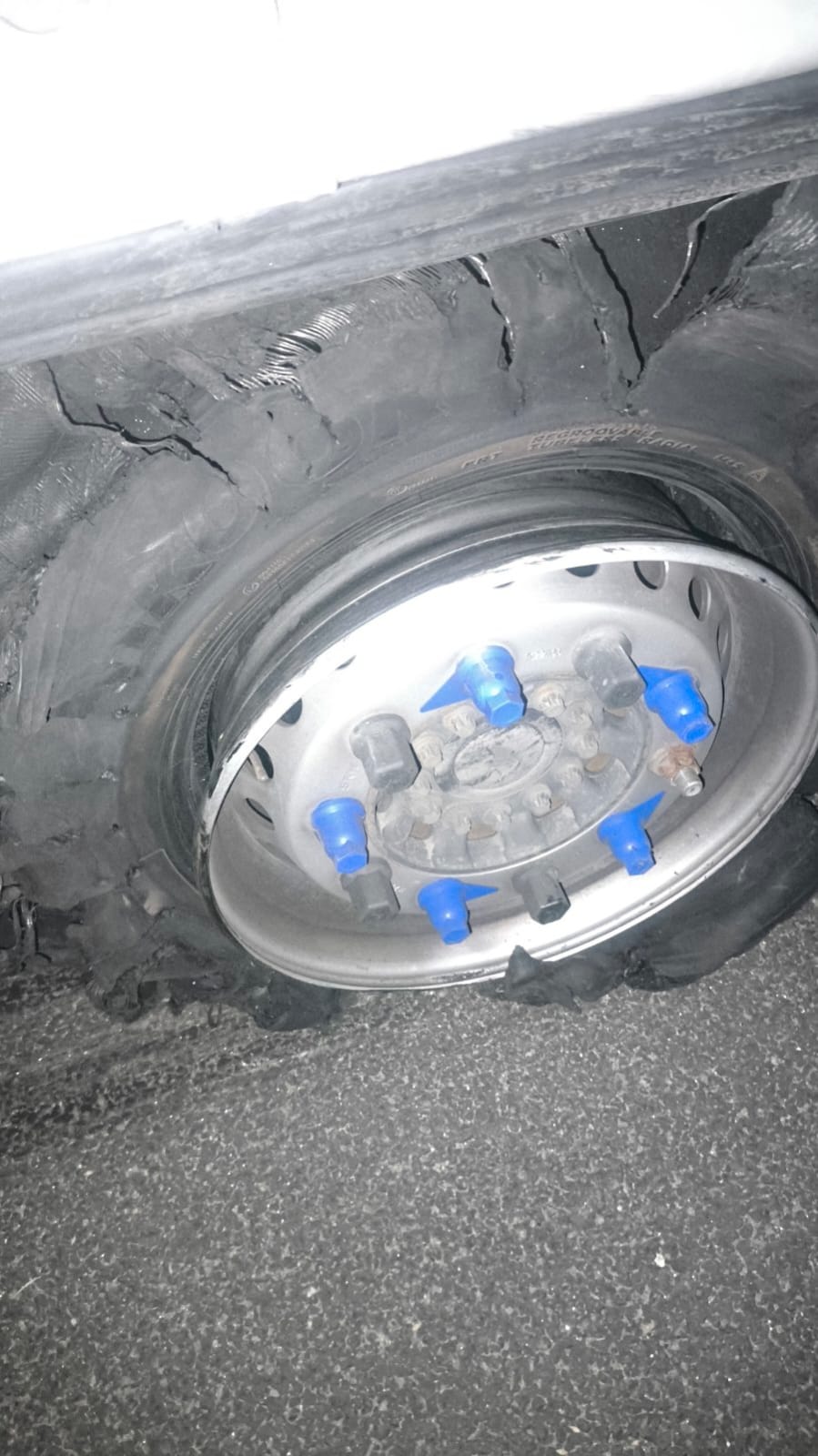
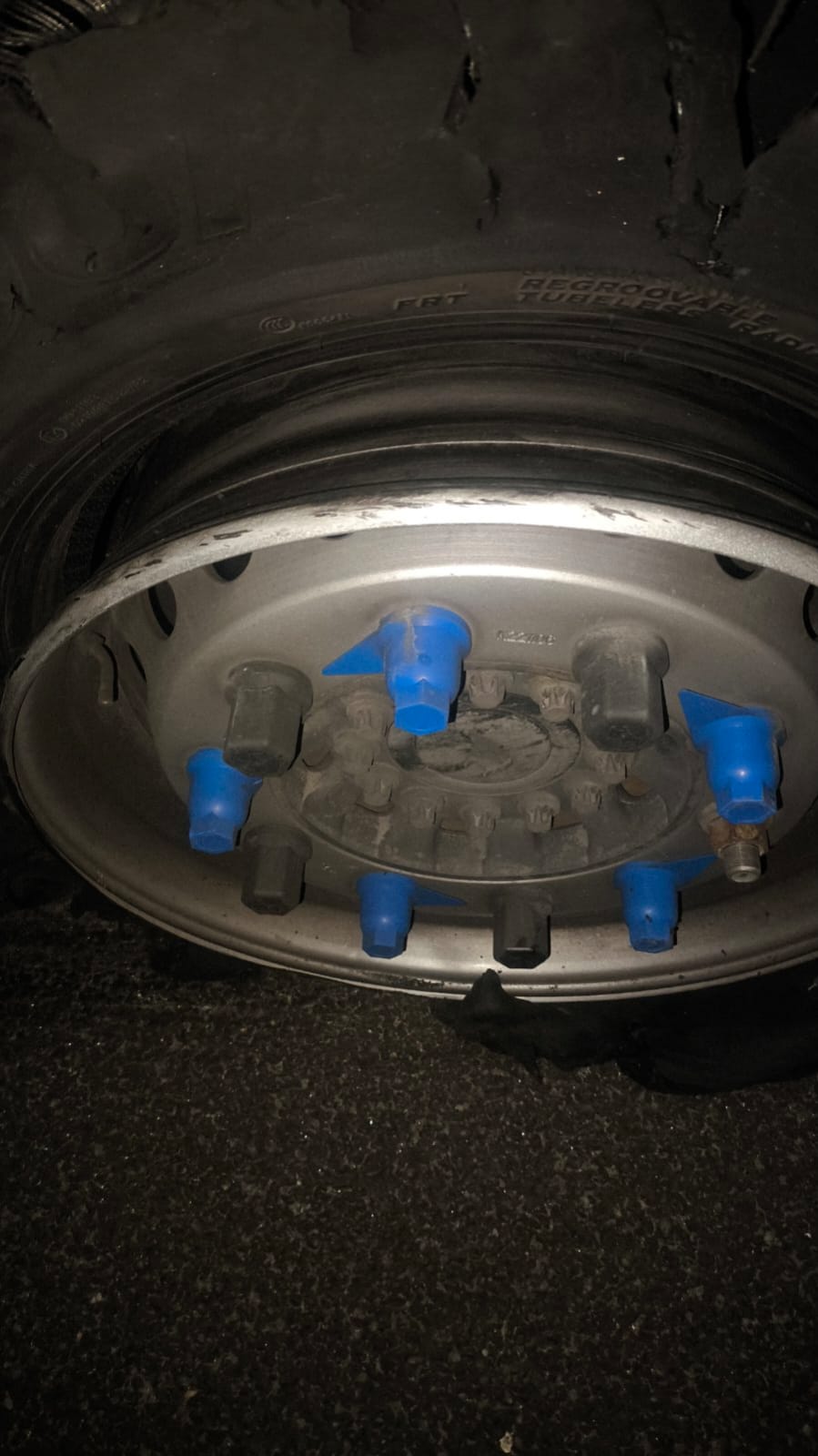
It was 02:07 on 11 August when the phone rang at our dispatch desk: a driver on the A9 near Lutherstadt Wittenberg, heading towards Berlin, had just felt his articulated truck lurch sideways. A tyre on the semi-trailer had blown out on the hard shoulder, in the dark, with lorries still thundering past at motorway speed.
This is the short version. Our truck tyre service located a partner crew already carrying the correct 385/65 R22.5 size, sent it out, and had the driver back on the road in 2 hours and 8 minutes from the first call to departure. No towing, no waiting for a warehouse to open, no lost day.
The longer version is more interesting, because the real obstacle at 2 a.m. on a German motorway is rarely the darkness itself. It’s whether the right tyre is sitting on a service van within reach. This case is a good illustration of why parts logistics, not visibility, decides how long a night breakdown actually takes.
What happened on the A9 near Lutherstadt Wittenberg
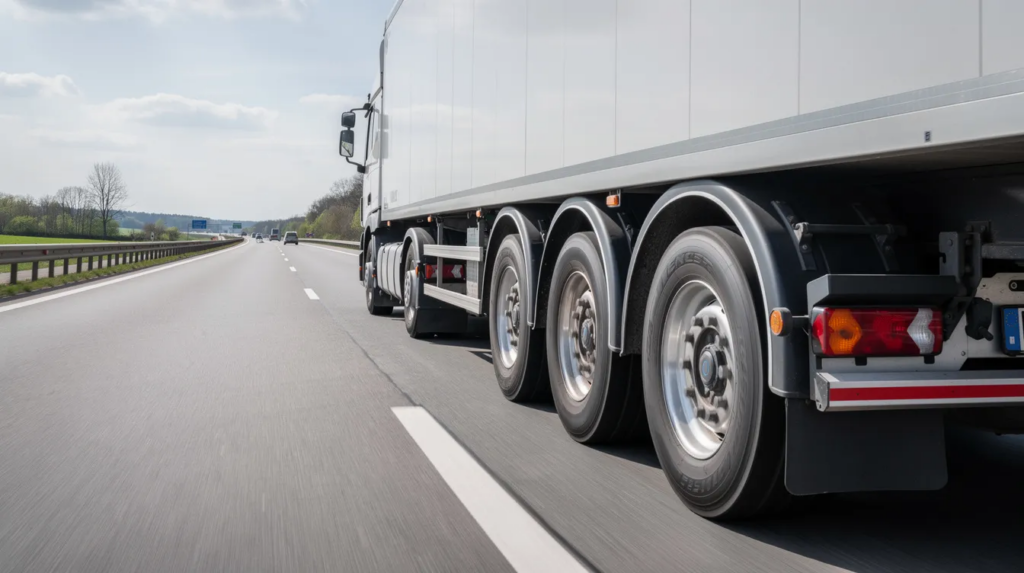
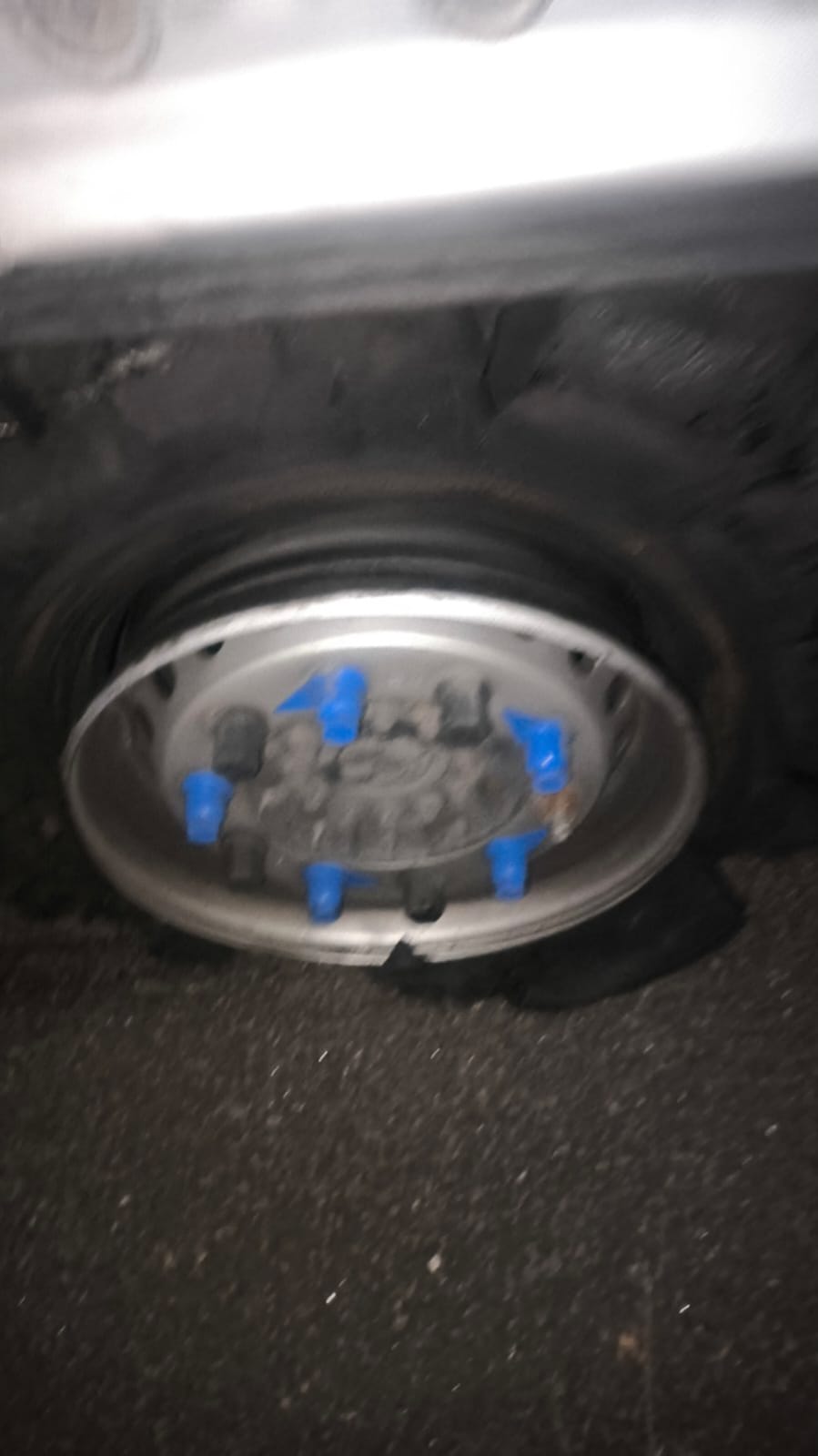
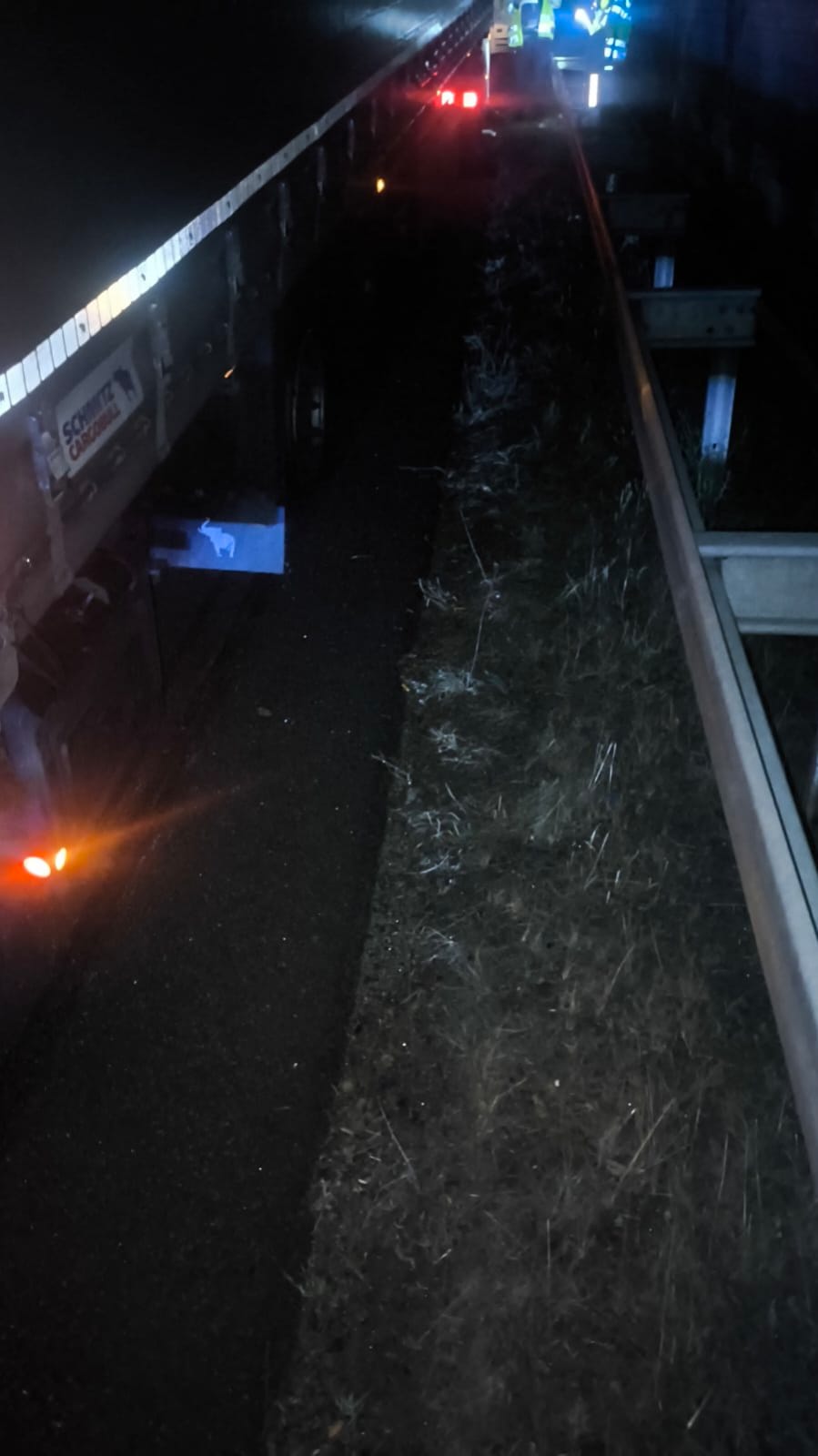
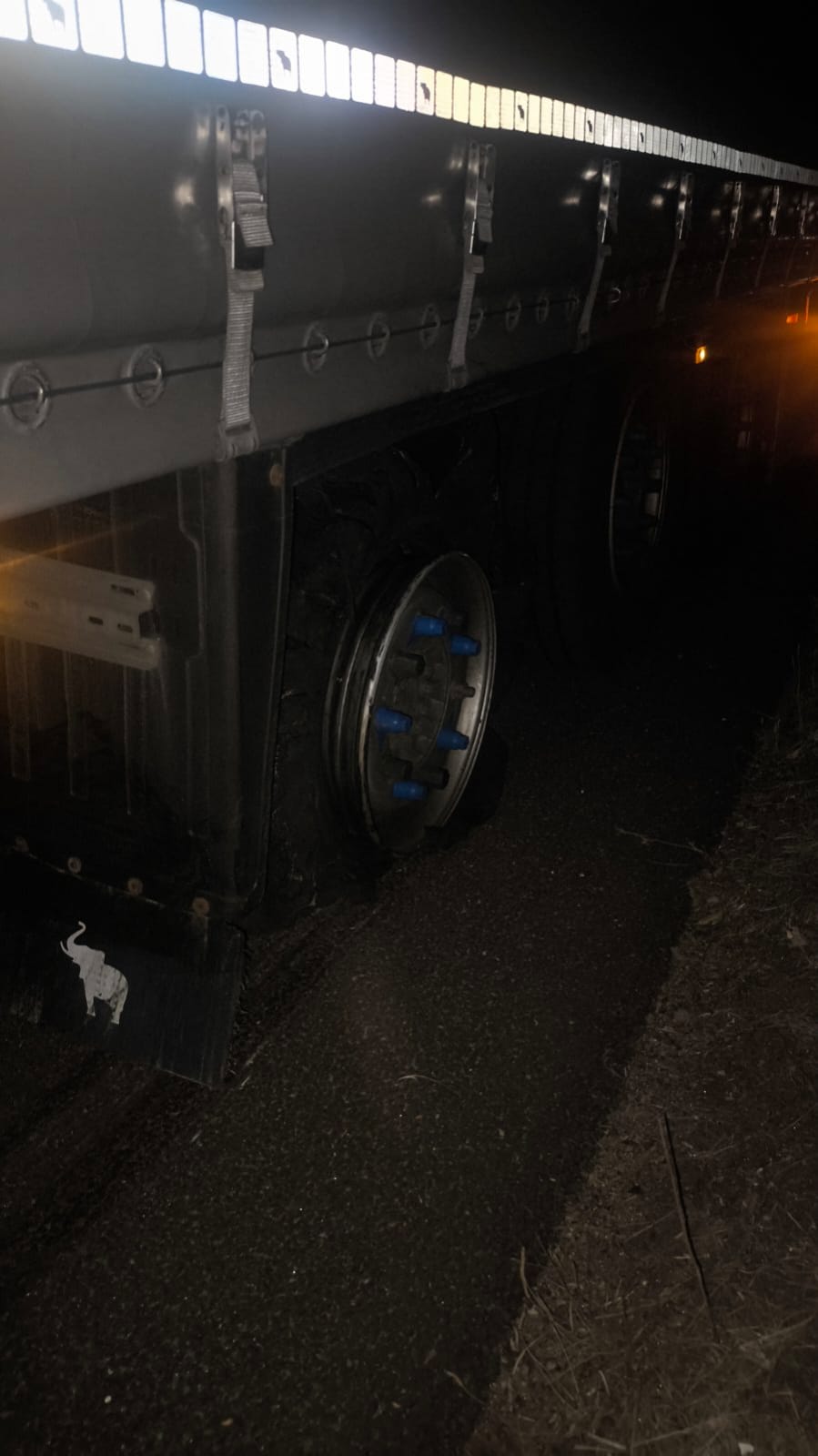
At around 02:00 on the night of 11 August, an articulated truck — a tractor unit pulling a semi-trailer — was travelling on the A9 towards Berlin when a tyre on the semi-trailer failed. The driver felt the trailer pull and heard the bang before he saw anything in the mirrors. He managed to bring the combination onto the hard shoulder without incident, switched on the hazard lights, and called our emergency line at 02:07.
The tyre involved was a 385/65 R22.5, the standard size fitted to most trailer axles on German roads. That detail mattered more than almost anything else in this case. A semi-trailer runs on multiple axles, and a blown tyre on one of them changes how the load is carried across the remaining tyres on that axle — which is exactly why it can’t be left until morning, even if the vehicle can technically still roll.
The stretch of A9 near Lutherstadt Wittenberg carries heavy long-haul traffic overnight, much of it running to beat morning delivery windows in Berlin or further north. A stationary lorry on the hard shoulder there, at night, in August traffic, is a genuine hazard — for the driver stepping out to inspect the wheel, and for anyone drifting too close in the dark.
How the help was organised
Getting a crew to the A9 quickly wasn’t the hard part — Berlin-Wittenberg is well within our partner network’s coverage. The harder question, at 02:07, was which nearby vehicle actually had a 385/65 R22.5 tyre loaded. Our dispatcher worked through it in a fixed sequence:
- Logged the call, GPS-approximate location, and tyre size given by the driver
- Checked which regional service partner had a matching tyre already on the van, not just in a warehouse
- Confirmed the crew’s real-time position against the A9 breakdown site
- Briefed the crew on the axle position and the driver’s description of the failure
- Kept the driver on the line with an ETA and instructions to stay behind the barrier
That check — tyre on the van, not on a shelf somewhere — took 15 minutes, from 02:07 to 02:22. It’s the step most drivers never see, but it’s the one that decides whether “we’re on our way” means an hour or a next-day appointment.
Why night-time tyre changes are a logistics problem, not a lighting problem
The honest answer is that darkness is manageable — head torches, vehicle floodlights, and hi-vis vest and reflective cones solve visibility. What can’t be improvised is a tyre that simply isn’t there. Tyre wholesalers and regional warehouses are closed overnight, so if the size a service crew needs isn’t already loaded, the truck sits until a supplier opens, sometimes six or eight hours later.
That’s why a serious truck tyre service operates around standby stock, not around office hours. Service vans on night rotation carry the sizes that cover the bulk of German HGV and trailer fleets, restocked from regional depots during the day so they go into the night full. The plan only works if someone has already decided, days in advance, what goes on the van.
Which tyre sizes are typically carried on a night van?
Most night-service vehicles stock 385/65 R22.5, 315/80 R22.5, and 385/55 R22.5 as standard, because these three cover the large majority of trailer and drive-axle fitments on German roads. Rarer sizes, low-profile fitments, or specific brand-and-model requests are usually special order.
That distinction is the honest difference between a company promising “there in an hour” and one that quietly means “we’ll have it tomorrow morning.” On the night of 11 August the 385/65 R22.5 was a common size, which is precisely why the crew already had one loaded and could commit to a response drive rather than a special order.
Why the exact tyre size matters when you call
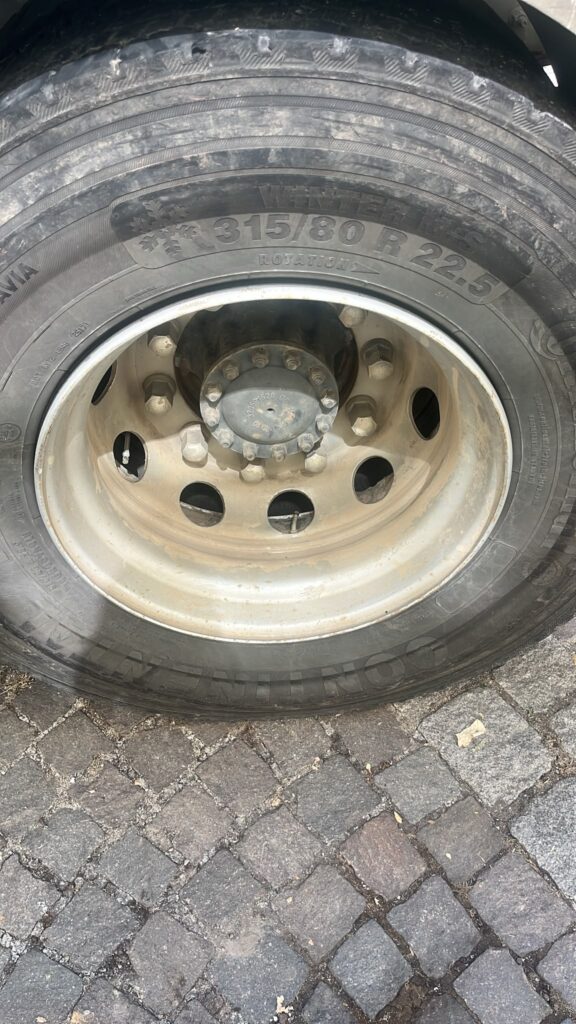
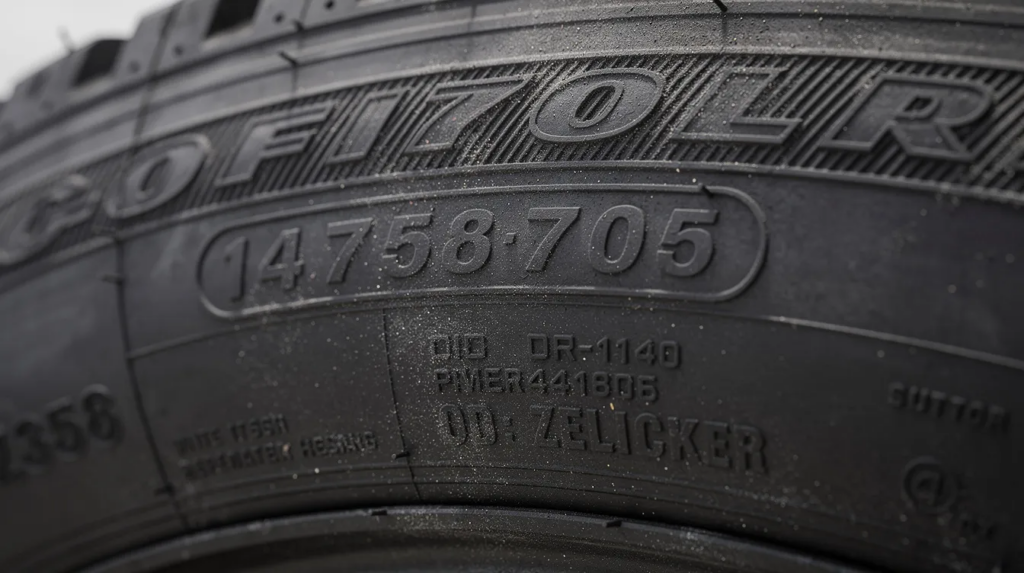
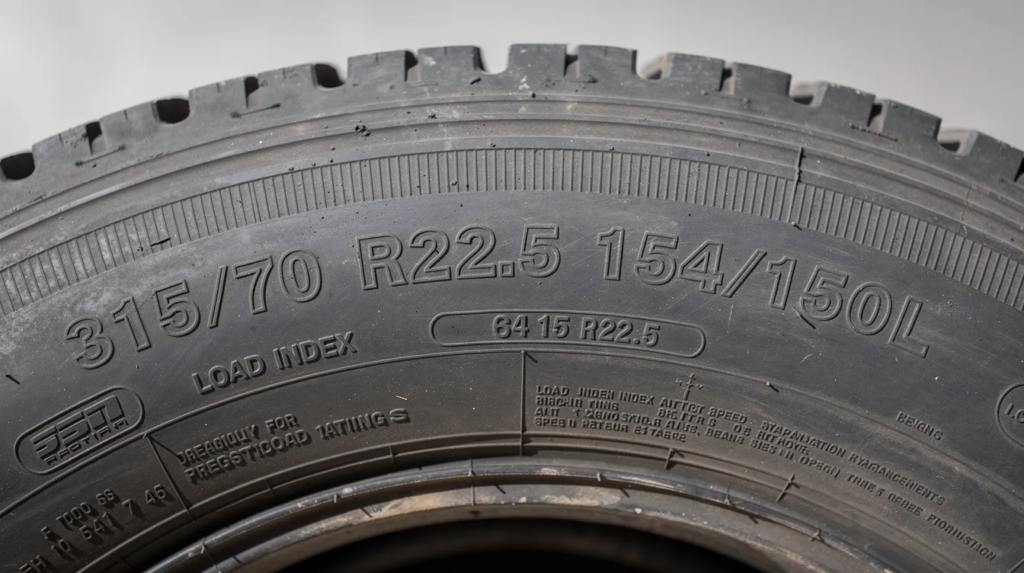
Reading the size code off the sidewall the moment you call — for example 385/65 R22.5, along with the load index and speed rating — lets the dispatcher check stock and pick the right vehicle in seconds instead of guessing. It’s the single fastest thing a stranded driver can do to shorten the wait.
The format is worth knowing cold: the first number is the tyre’s width in millimetres, the second is the aspect ratio (sidewall height as a percentage of width), and the final figure is the rim diameter in inches. A load index and speed rating usually follow, and a DOT code on the sidewall shows the tyre’s date of manufacture. On this call the driver read out “385/65 R22.5” within the first minute, which let the dispatcher rule out a special-order delay immediately.
On-site situation: why a blown trailer tyre can’t wait
A blown tyre changes how load is distributed across an axle immediately, and HGV tyres run at 8.5–9.5 bar, so a sudden pressure loss is a structural event, not a cosmetic one. Continuing to drive on a flat or badly damaged tyre can heat the rim, distort the bead seat, and in the worst cases damage the wheel hub or wheel bolts — turning a tyre job into an axle repair.
There’s also the neighbouring tyre to think about. Trailer axles typically run twin wheels, and if the remaining tyre on that axle absorbs the full load for any distance, its casing and tread can suffer accelerated wear or heat damage. According to guidance from bodies like ADAC on breakdown assistance, drivers are advised not to continue past the nearest safe stopping point once a tyre has failed, precisely because of this knock-on risk.
Step-by-step: the tyre change on the hard shoulder
- Inspection — the technician checked the damaged tyre, the rim, and the axle for secondary damage before touching anything, confirming there was no bent rim or hub issue that would change the job.
- Securing the scene — warning triangle placed well back on the hard shoulder, hi-vis vest on, and a visual sweep of the surrounding traffic before anyone worked near the live carriageway.
- Removal — wheel bolts loosened in sequence, wheel lifted clear, and the damaged casing checked once more for the cause of the blowout.
- Fitting — the replacement 385/65 R22.5 tyre was mounted and balanced on the rim, matched against the paired tyre on the axle.
- Final check — wheel nuts torqued in a star pattern to the correct spec, tyre pressure checked and set, and paperwork completed before departure.
Full timeline: call to departure in 2h 8min
| Time | Phase | Action |
|---|---|---|
| 02:07 | Emergency call | Driver reports a tyre blowout on the semi-trailer on the A9 near Lutherstadt Wittenberg |
| 02:07–02:22 | Dispatch | Control centre locates an available service crew carrying the matching 385/65 R22.5 tyre (15 min) |
| 02:22–03:19 | Response drive | Service crew drives to the scene on the A9 (57 min) |
| 03:19–03:25 | Securing the scene | Warning triangle, hi-vis vest, visual check of tyre, rim, axle (6 min) |
| 03:25–03:35 | Removal | Damaged tyre removed (10 min) |
| 03:35–04:05 | Fitting | New 385/65 R22.5 tyre fitted and balanced (30 min) |
| 04:05–04:15 | Final check | Wheel nuts torqued in a star pattern, tyre pressure checked, paperwork (10 min) |
Total time from call to departure: 2 h 8 min. The single largest block was the 57-minute response drive, a reminder that even with the right tyre in stock, distance still sets the floor on how fast help can arrive on a rural stretch of motorway at night.
What does a night-time tyre change on the motorway cost?
A night call-out for a single trailer tyre on the A9 came to €950 net, covering the call-out fee, labour, the tyre itself, disposal of the old casing, and a night surcharge. Every line reflects a real cost of running a crew at 2 a.m., not padding.
| Item | Price (EUR) |
|---|---|
| Call-out (night shift) | 260 |
| Labour (approx. 1 hr) | 120 |
| Tyre 385/65 R22.5 | 480 |
| Old tyre disposal | 20 |
| Night surcharge | 70 |
| TOTAL | 950 |
The night surcharge of €70 isn’t an arbitrary add-on. It covers the cost of keeping crews, vans, and standby tyre stock available around the clock rather than only during business hours — the same reason a locksmith or an emergency plumber charges more after dark. Take that surcharge away and there’s no financial case for anyone to staff a 2 a.m. shift, and drivers would be back to waiting for daylight.
Compare that to the alternative. A stranded articulated lorry on the motorway typically costs the haulier roughly €800–1,200 per day once lost freight, demurrage at the delivery point, and missed loading slots are added up. A €950 night repair that gets the vehicle moving again within two hours is, in almost every case, cheaper than a single lost working day — before counting the reputational cost of a missed delivery window.
Do temporary fixes happen?
Occasionally, yes — if the exact tyre brand isn’t available, a same-size tyre from a different manufacturer can be fitted temporarily to get the vehicle back to base or to a workshop. This isn’t always acceptable, though, particularly on twin-wheel trailer axles, where mismatched tread pattern or a difference in rolling diameter between the paired tyres can cause uneven wear and handling issues over distance.
Reputable fitters will explain this trade-off on the phone rather than silently mixing brands. On the 11 August call it wasn’t an issue — the crew carried the correct size and a suitable tyre outright, so no compromise was needed.
Why you need a professional, not a DIY fix
Changing a trailer tyre on a live hard shoulder is not the place to improvise, and the risks of attempting it without the right equipment or training are real:
- Working next to fast-moving traffic without proper scene security, warning triangle, and hi-vis positioning
- Incorrect torque on wheel nuts, which can loosen in transit and cause a wheel to detach
- Missing secondary damage to the rim or wheel hub that later causes a repeat failure
- Fitting a tyre with the wrong load index or speed rating for that axle
- No proper jack rating or stands for a loaded HGV trailer, risking a drop
Trained technicians carry the torque wrenches, jacks, and experience to do this safely under time pressure — something a driver alone, at night, on the hard shoulder, isn’t equipped for.
Typical call-outs we handle across Germany
Night-time tyre blowouts on the A9 are one recurring pattern, but our mobile truck service covers a broad range of breakdown assistance across German motorways: tyre failures on tractor units and trailers, flat tyres from road debris, tread separation on older casings, and emergency wheel changes after kerb damage. We also handle recovery and towing when a fault goes beyond a tyre — a seized brake, a damaged rim, or axle damage that makes the vehicle unsafe to move under its own power.
Coverage runs around the clock, with multilingual dispatch for international drivers who may not speak German or English fluently when they call in the middle of the night.
Prevention: reducing the odds of a night blowout
Most trailer tyre blowouts trace back to slow, invisible damage rather than a single sharp impact. A few habits materially reduce the risk:
- Check tyre pressure regularly, not only at service intervals — HGV tyres lose pressure gradually and a slow leak often goes unnoticed until failure
- Inspect tread depth and casing condition on every walk-around; under § 36 StVZO, commercial vehicle tyres must meet minimum tread depth requirements, and worn tread is far more prone to sudden failure
- Watch for uneven wear patterns, which often point to a wheel alignment or suspension issue worth fixing before it causes a blowout
- Avoid kerbs and potholes where possible — sidewall impacts weaken the casing even when no immediate damage is visible
- Keep a record of tyre age; older casings, even with tread remaining, become more failure-prone over time
Tyres, fleets, and maintenance: the bigger picture
Fleet operators running on brands like Michelin, Continental, Goodyear, or Bridgestone still see blowouts, because tyre quality reduces the odds of failure but doesn’t eliminate the role of pressure checks, load management, and casing age. A well-maintained fleet still needs a plan for the night a tyre fails anyway.
A few terms worth knowing if you manage a fleet or just want to understand your own vehicle better:
Steering axle – the front axle that carries the tractor unit’s steering wheels, where tyre condition directly affects handling.
Drive axle – the axle transmitting engine power to the road, typically fitted with twin wheels on HGVs.
Casing – the structural body of a tyre beneath the tread, whose condition determines whether a tyre can be safely retreaded.
Tread depth – the depth of the grooves in a tyre’s tread, regulated by law for commercial vehicles.
Trailer axles and coupling systems, including components from specialist axle manufacturers, also play into how load is distributed when a tyre fails — which is part of why a technician checks the axle, not just the wheel, after a blowout.
Why choose our truck tyre service
We run 24/7, every day of the year, with dispatch that can work in German, English, Polish, and Russian for drivers who need to explain a breakdown quickly and clearly at 2 a.m. Our crews come from a vetted regional partner network rather than a single depot, which is how we can reach most of Germany’s motorway network within roughly an hour on a common tyre size.
Pricing is set out before work starts — call-out, labour, parts, and any night surcharge — so a driver or dispatcher knows the total before committing, not after. That transparency matters most exactly when someone is standing on a dark hard shoulder deciding whether to authorise the job.
FAQ
How fast can you reach a broken-down truck on the A9 at night?
On this call, response time was 57 minutes from dispatch to arrival on scene, with total time from call to departure at 2 hours 8 minutes — typical for a common tyre size within regional reach.
What does a night tyre change cost for an HGV?
On our 11 August call-out, the total was €950 net, covering call-out, labour, the tyre, disposal, and a night surcharge. Costs vary by tyre size and location.
Do you carry trailer tyre sizes like 385/65 R22.5 at night?
Yes — 385/65 R22.5, 315/80 R22.5, and 385/55 R22.5 are commonly stocked on night-service vans, since they cover most German HGV and trailer fitments.
What if my exact tyre brand isn’t available at night?
A same-size tyre from a different brand can sometimes be fitted temporarily, though this isn’t always suitable for twin-wheel axles due to tread and diameter matching. We explain the options before fitting.
Is it safe to keep driving on a blown trailer tyre?
No. A blown tyre shifts load onto the remaining tyre on that axle and can damage the rim or wheel hub. Stop at the nearest safe point and call for assistance.
Do you operate across all of Germany, not just the A9?
Yes, our truck service and tyre network cover motorways nationwide, 24 hours a day, with regional partners positioned for fast response drives.
Summary
Location: A9 near Lutherstadt Wittenberg, direction Berlin. Vehicle: articulated truck, tyre failure on the semi-trailer. Tyre: 385/65 R22.5. Call received: 02:07 on 11 August. Response drive: 57 minutes. Total time, call to departure: 2 h 8 min. Cost: €950 net. Secondary damage: none — inspection confirmed the rim, axle, and wheel hub were undamaged, and the vehicle departed roadworthy.
Need a truck tyre service tonight?
If a tyre fails on the motorway, at 2 a.m. or any other hour, the fastest thing you can do is read the size off the sidewall before you call. Ring +49 160 5753826 or visit www.lkwhelp24.com — we’re available 24/7, across Germany, with a partner network built to carry the tyre you actually need.
For related coverage, see our contact details for direct dispatch, or read more on our nationwide truck tyre service.
Keywords: truck tyre service | mobile truck tyre service Germany | HGV tyre blowout A9 | night tyre change motorway | articulated truck breakdown | trailer tyre 385/65 R22.5 | 24/7 truck breakdown assistance | tyre fitting response drive | German motorway recovery