Skip to content
TL;DR: On 22 July, a warning light came on in the cab of a tractor unit while driving on the A93 near Weiden in the Upper Palatinate. The driver did not know whether it was safe to keep driving. A mobile diagnostic technician arrived with a scanner, traced the fault to a defective sensor, replaced it on site, and had the truck back on the road in 1 hour 55 minutes for €555 net.
A warning light suddenly lighting up mid-journey is one of the most unsettling moments a driver can face. The question is always the same: keep driving, or pull over immediately? The answer depends almost entirely on the colour of the light, not on guesswork.
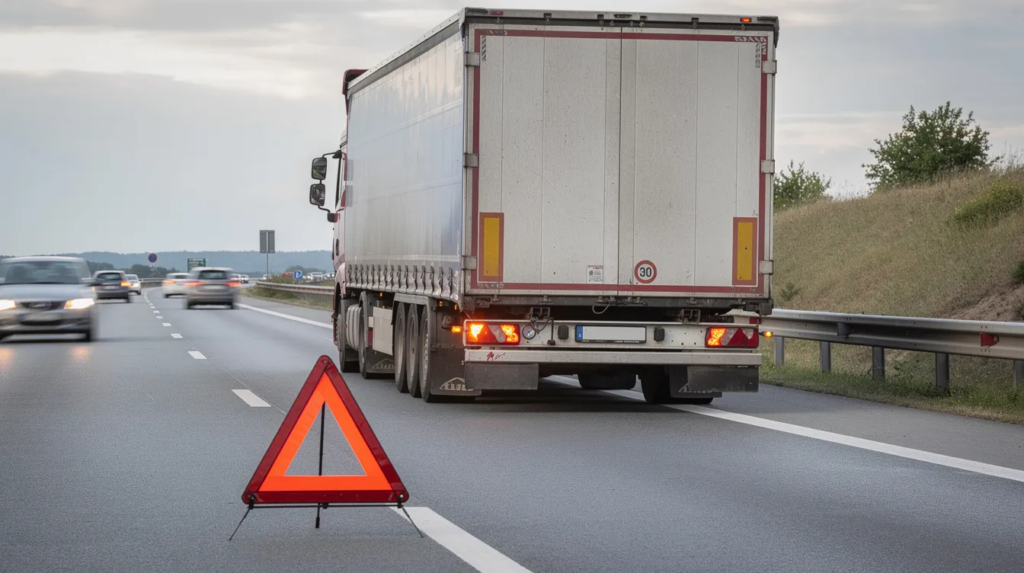
That was exactly the situation on a rest area along the A93 near Weiden, close to the Czech border, on the afternoon of 22 July. The driver of a tractor unit noticed a warning symbol on the dashboard while underway, pulled into the next lay-by as a precaution, and called the breakdown hotline. This article explains what warning light colours actually mean, why fault codes are only a starting point, and how a €555 scanner-based repair kept the stop to under two hours.
What happened on the A93 near Weiden?
A tractor unit was travelling on the A93 between Regensburg and the Czech border when a warning light lit up on the instrument cluster. The driver made the right call: pulled into the next lay-by, switched on the hazard lights, shut the engine down, and avoided the temptation to keep going and “see how it goes”.
The screen showed a text message together with a fault code. Without a scanner, there was no way to tell on the spot whether this was a serious fault with engine-damage risk or a low-priority notice. That uncertainty is exactly what a breakdown dispatch line is for: the driver read out the light’s colour and the on-screen code, dispatch classified the vehicle as unfit to continue until cleared, and sent a technician with a mobile diagnostic tool.
The Upper Palatinate location, close to the Czech border, is not a remote stretch of motorway, but workshop capacity is thinner there than around Munich or Nuremberg. That makes every minute of response time count double: a stranded artic occupies a lay-by that other drivers need for their statutory rest breaks, and idle time adds up fast for the haulier.
What do warning light colours actually mean?
Red means stop immediately, shut the engine down in a controlled manner, and do not continue until the fault has been diagnosed. Amber/yellow signals a fault that usually allows limited driving to the nearest workshop. Green or blue lights are purely informational and require no action.
This three-tier logic follows the international ISO 2575 standard for commercial vehicle warning symbols, not an individual manufacturer’s house style. Red lights indicate a condition that immediately threatens the vehicle or road safety, such as loss of oil pressure or a brake pressure drop. Amber lights flag a fault that limits function without forcing an immediate stop, such as an early-stage AdBlue/SCR fault. Green and blue symbols, like main beam or active cruise control, simply confirm the current driving state.
One practical point matters here: an amber light can escalate to red within a few kilometres if the underlying fault worsens. So the rule for any unfamiliar symbol stays the same — slow down, find a safe place to stop, read the exact on-screen message, then decide.
Which red warning lights demand an immediate stop?
Four red warnings tolerate no delay: oil pressure, engine temperature, brake system pressure, and the charging/alternator light. Ignoring any of these risks a catastrophic engine failure or a full loss of braking capability.
- Oil pressure – When oil pressure drops, engine bearings and pistons lose lubrication within seconds to a few minutes. The result is often an engine rebuild costing five figures, in place of a sensor fault that would have cost 90 euros in labour.
- Engine temperature – Overheating warps cylinder heads and blows gaskets. An engine that has genuinely “cooked” typically needs a full rebuild.
- Brake system pressure – If air pressure in the brake circuit drops below the safe threshold, service braking degrades progressively. On a fully loaded 40-tonne artic, that is a direct accident risk, not a theoretical one.
- Charging/alternator – A failed charging circuit means the vehicle steadily loses electrical power. ABS, engine management, and lighting can fail one after another, often in the middle of the motorway.
For all four, the response is identical: pull onto the hard shoulder, hazard lights on, warning triangle out, and shut the engine down before secondary damage occurs.
Which amber warning lights get underestimated?
Three amber lights look harmless but are not: emissions/SCR, ABS/EBS, and brake pad wear. They typically allow short-term driving, but they get worse without intervention.
An SCR (emissions/AdBlue) fault often starts as a plain warning, moves into a countdown of remaining kilometres, and ends in a power derate. Ignore the light long enough, and the truck ends up limited to around 20 km/h in live traffic.
An ABS/EBS fault does not mean the brakes have failed. Service braking usually keeps working normally, but the anti-lock system no longer intervenes during hard braking. On wet or icy road surfaces, the risk of wheel lock-up and skidding rises sharply.
The brake pad wear warning activates once the pad material drops below a defined minimum thickness. Drivers who ignore this for weeks end up braking metal-on-metal, which extends stopping distance and damages the brake discs as well.
Why does the same warning icon mean something different on different truck brands?
An identical dashboard symbol can point to different fault sources on a MAN, Scania, Volvo, or Mercedes-Benz, because each manufacturer runs its own control-unit logic and diagnostic protocol. Only a brand-capable scanner reads the actual stored fault code, not just the lit-up icon.
The amber engine warning (“check engine”) light can flag an intake sensor fault on one vehicle and an injection system fault on another. Without reading the stored fault code, any guess remains speculation. That is exactly why the technician’s first move on the A93 was plugging the scanner into the vehicle interface, rather than interpreting the symbol from experience alone.
For more background on how these control units communicate, see our article on CAN-bus repair for trucks, since nearly all modern warning systems run over the CAN bus.
What actually is a fault code, and why is it a symptom rather than a diagnosis?
A fault code (DTC) tells you which control unit registered a deviation, not necessarily which component is broken. One code can be triggered by a faulty sensor, damaged wiring, or the monitored component itself.
On the A93 job, the display showed a code for a signal deviation in an engine sensor circuit. Three causes were theoretically possible: the sensor itself, a loose connector, or a broken wire in the feed line. Only live measurement with the scanner at the vehicle, not the code alone, narrowed the cause down to the sensor itself.
Anyone who reflexively orders the most expensive suspected part based on a code alone often wastes money. In mobile diagnostic work, the majority of cases turn out to be sensors or wiring, not the monitored main component.
What can on-site diagnostics actually determine, versus a full workshop?
A mobile scanner reads fault codes, live sensor values, and system status — it cannot replace an engine rebuild or a full workshop test bench. On site, it reliably identifies the faulty component when the issue is a clearly isolated part such as a sensor.
What the mobile scanner can do:
1. Read all stored and active fault codes from the engine control unit.
2. Compare live sensor readings against manufacturer reference values.
3. Visually inspect connectors, wiring harness, and component condition.
4. Replace the identified part on the spot, if it is a standard component such as a sensor.
5. Clear the fault memory only after the fault is genuinely fixed, followed by a test run.
What it cannot do: internal engine measurements, detailed compression testing, or complex software reflashes that require a proper workshop environment with a lift and stable power supply. For those cases, a truck service workshop remains the right address, and the mobile technician arranges transport there if needed.
Why should you never just clear the fault code and drive on?
Clearing the fault memory without fixing the root cause brings the warning back within a short distance, often worse than before. On emissions and brake systems, continuing to drive with a known, unresolved fault can also be a legal violation.
The engine control unit keeps logging the underlying condition even if the light briefly goes out. As soon as the triggering condition recurs, the warning returns, usually somewhere without a nearby workshop. With SCR faults, the control software is also programmed to automatically derate engine power after a set number of kilometres if the fault is not resolved. Simply clearing the code postpones the problem rather than solving it.
What should you tell dispatch on the phone?
The colour of the light and the exact on-screen message speed up technician and parts selection considerably. A call that just says “something’s flashing amber” costs valuable minutes; a call with colour, symbol, and fault text saves them.
In practice, that means drivers should photograph the display or note down the exact text as soon as they are safely stopped, before calling. Dispatch and the technician can then work out during the drive over which diagnostic tool and which likely spare parts are needed, rather than starting from scratch on arrival.
Why do sensors fail more often than the parts they monitor?
Sensors are the most mechanically and electrically vulnerable link in the system, exposed directly to vibration, moisture, and dirt. That is good news for the repair bill, since a sensor swap is far cheaper than replacing the monitored main component.
An engine sensor often sits right on the engine block or in the intake tract, exactly where heat, vibration, and road grime hit hardest. Typical failure causes include:
- Dirt building up on the sensor tip from oil mist or road grime, distorting the measured signal.
- Moisture inside the connector, leading to short circuits or high resistance at contact points.
- Vibration, which fatigues solder joints and wire connections inside the sensor over years of service.
- Chafed wiring, where cables rub against engine components until the insulation wears through.
Exactly this pattern showed up on the A93 job: the sensor itself returned an implausible signal in the live-data test, while the monitored engine area passed visual inspection cleanly. Swapping the part took well under an hour.
The full timeline of the callout
| Time | Phase | Action |
|---|---|---|
| 12:11 | Emergency call | Driver reports warning light, location A93 lay-by near Weiden |
| 12:11–12:26 | Dispatch | Colour/code assessed, technician with diagnostic tool alerted |
| 12:26–13:11 | Response drive | Technician travels to the lay-by (45 minutes) |
| 13:11–14:06 | Diagnostics & repair | Fault code read, sensor tested, part replaced, test run |
| 14:06 | Completion | Vehicle roadworthy again, continues journey |
Total time from call to departure: 1 hour 55 minutes.
Cost breakdown
| Item | Price (EUR, net) |
|---|---|
| Callout fee | 220 |
| Scanner diagnostics | 150 |
| Sensor (part) | 95 |
| On-site labour | 90 |
| Total | 555 |
All amounts are net, plus statutory VAT. For comparison, a stranded artic with missed delivery slots and an idle driver typically costs a haulier €800 to €1,200 per day. A €555 mobile diagnosis with sensor replacement is cheaper than that even if the callout had taken several hours.
Why call a professional instead of guessing yourself?
- Wrong remote diagnosis: guessing from symptoms alone often means replacing the wrong, more expensive part.
- No manufacturer access: modern control units frequently need brand-specific diagnostic software rarely available privately.
- Roadside safety risk: working without proper protection, a hi-vis vest, and a warning triangle on the hard shoulder is genuinely dangerous.
- Legal exposure: continuing to drive with a known brake or emissions fault risks fines and can compromise insurance cover after an accident.
- Lost time: a wrong diagnosis ends up costing more time than going straight to a mobile specialist.
Typical call-outs we handle
Alongside warning-light cases like this one, our day-to-day work across Germany includes engine failures requiring recovery, electrical failures that shut a truck down completely, plus standard tyre blowouts and off-road recoveries. Every job starts with the same question: is this something a scanner and spare part can fix on site, or does it need a workshop with a lift?
Prevention tips for drivers and fleets
Regular service intervals, as specified by MAN, Scania, Volvo, or Mercedes-Benz, noticeably reduce sensor failure risk, since wiring and connectors get checked along the way. Fleet operators should train drivers to report every warning light immediately by colour, rather than “keeping an eye on it”. A quick phone photo of the display saves real diagnostic time when it matters.
Extended background: warning systems in modern trucks
Modern tractor units carry dozens of sensors constantly monitoring oil pressure, exhaust values, tyre pressure, brake pressure, and engine temperature. Manufacturers such as MAN increasingly build in redundant sensors to cut false alarms without missing genuine faults. Component suppliers such as Bosch provide much of the sensor technology fitted across different truck brands’ engine control units. Roadworthiness itself is also checked periodically through official inspections, with UK requirements set out by the Driver and Vehicle Standards Agency.
Why choose LKWHelp24?
We are available 24/7 across Germany, backed by a vetted partner network of mobile diagnostic technicians who can read fault codes across all major truck brands. Our dispatch team is multilingual, so international drivers can describe the problem in their own language. Pricing is communicated transparently before work begins, with no hidden line items on the invoice.
Frequently asked questions
Can I keep driving with an amber warning light?
In most cases yes, but only to the nearest workshop and at reduced speed. With emissions or brake warnings, keep the distance as short as possible, since the condition can worsen while driving.
What does a red warning light mean on a truck?
Red means stop immediately. Oil pressure, temperature, brake pressure, and charging warning lights all indicate a condition that can lead to engine or brake damage if you keep driving.
How much does mobile engine diagnostics on the motorway cost?
In the case described here, total costs including callout, scanner diagnostics, sensor, and labour came to €555 net. The range depends on travel distance and the part involved.
How long does on-site fault code diagnostics take?
Reading the code alone usually takes 10 to 20 minutes. Including part replacement and a test run, as in this case, the total was 55 minutes.
Why does the scanner only show a code and not a clear diagnosis?
A fault code identifies the affected control unit and the type of deviation, not automatically the broken part. Live data and a visual inspection are needed to narrow down the cause.
Can I just clear the fault myself?
Technically yes, but it is not advisable. Without fixing the underlying cause, the fault returns, and on emissions or brake systems, driving with a known unresolved fault can also be unlawful.
Summary
- Vehicle: tractor unit
- Location: lay-by on the A93 near Weiden, Upper Palatinate, close to the Czech border
- Date: 22 July, daytime
- Cause: defective sensor, engine warning light
- Response time: 45-minute drive after 15 minutes of dispatch
- Total duration: 1 hour 55 minutes
- Cost: €555 net
- Consequential damage: none, thanks to stopping in time and an on-site repair
Get help now
If a warning light comes on in your cab and you are not sure whether it is safe to keep driving, call us before taking the risk. We are available around the clock, across Germany, on +49 160 5753826 or via www.lkwhelp24.com. Mobile diagnostics, tyre service, and towing from a single provider — see our 24/7 truck breakdown assistance, mobile truck service, and, if it comes to that, our towing service — or reach our contact page directly.
Keywords: mobile truck engine diagnostics | truck warning light meaning | reading truck fault codes | red warning light HGV | amber warning light HGV | engine sensor failure truck | breakdown assistance A93 Weiden | truck diagnostics motorway
Related articles
- CAN-Bus LKW Reparatur: Ursachen, Diagnose und mobile Hilfe
- Trucks Towing Service on the A14 Near Leipzig – Engine Failure
- IVECO S-Way Electrical Failure in Frankfurt – Emergency Trucks Towing Service
- Truck Tire Service Near Me: How LKWHelp24 Got a Semi-Truck Moving in 90 Minutes on the A43
- Truck Towing Service in Germany – 24/7 Heavy-Duty Assistance